Derbyshire Language Scheme: A Teacher's GuideDerbyshire Language Scheme: A Teacher's Guide: practical strategies for teachers

Updated on  

June 13, 2026

Derbyshire Language Scheme: A Teacher's Guide

|

June 13, 2026

An evidence-informed guide for teachers and SENCOs on using the Derbyshire Language Scheme (DLS) to support learners with language delay. This article explains Information Carrying Words (ICWs), implementation, and the research evidence.

Key Takeaways

  • The Derbyshire Language Scheme is a structured intervention that develops receptive language through play-based activities.
  • Its core principle is the use of 'Information Carrying Words' (ICWs), which are the essential words a learner must understand to follow an instruction.
  • The scheme assesses and teaches language comprehension by systematically increasing the number of ICWs in a command, from one to four.
  • Evidence suggests DLS can improve oral comprehension, but its effectiveness is influenced by a learner's working memory capacity.
  • Teachers must be careful to remove non-verbal cues (pointing, eye-gaze) to ensure they are accurately assessing language processing, not just a learner's ability to follow visual prompts.

What is the Derbyshire Language Scheme?

The Derbyshire Language Scheme (DLS) is a developmental language intervention designed to assess and improve receptive language skills in learners. Developed in the UK, it is widely used by Speech and Language Therapists (SLTs), SENCOs, and teaching assistants to support children with Developmental Language Disorder (DLD) or other Speech, Language, and Communication Needs (SLCN).

Stages of the Derbyshire Language Scheme infographic showing progressive levels of Information Carrying Words (ICWs).
Stages of the Derbyshire Language Scheme

The central concept of the DLS is the 'Information Carrying Word' (ICW). An ICW is any word within an instruction that a learner must understand to respond correctly. By systematically increasing the number of ICWs in a spoken command, the scheme provides a structured way to build a learner's ability to process increasingly complex language.

For example, the instruction "Give me the red car" contains two ICWs. The learner must understand both "red" (not blue, not green) and "car" (not doll, not block) to succeed. The scheme uses simple, play-based activities with carefully selected toys and objects to assess a learner's current ICW level and then teach the next stage.

Who is the Derbyshire Language Scheme for?

The DLS is primarily intended for learners with identified receptive language difficulties. This includes:

  • Learners with a diagnosis of Developmental Language Disorder (DLD).
  • Learners in Early Years settings who show signs of language delay.
  • Learners with SLCN associated with other conditions, such as Autism.
  • Older learners who struggle to follow multi-step instructions in the classroom.

It is particularly useful for establishing a baseline of a learner's receptive language ability and for providing a structured, measurable intervention pathway.

However, the DLS is not a universal solution. It is less suited for learners whose primary difficulty is with expressive language (forming sentences) rather than receptive language (understanding). While it can support expressive skills indirectly, other approaches like Colourful Semantics or usage-based therapies may be more appropriate for targeting sentence construction. Furthermore, as the scheme is heavily dependent on auditory memory, its results must be interpreted with care. A low score may reflect a working memory deficit as much as a language comprehension issue (Frizelle, 2017).

How Does the Derbyshire Language Scheme Work?

The DLS operates on a clear cognitive principle: to improve language comprehension, we must scaffold a learner's ability to hold and process multiple units of information in their auditory working memory. The ICW framework provides the scaffold.

The process typically involves two phases: assessment and teaching.

1. Assessment: The practitioner uses a standardised set of toys and objects to find the learner's current ICW level. They give a series of instructions, starting at the 1-ICW level.
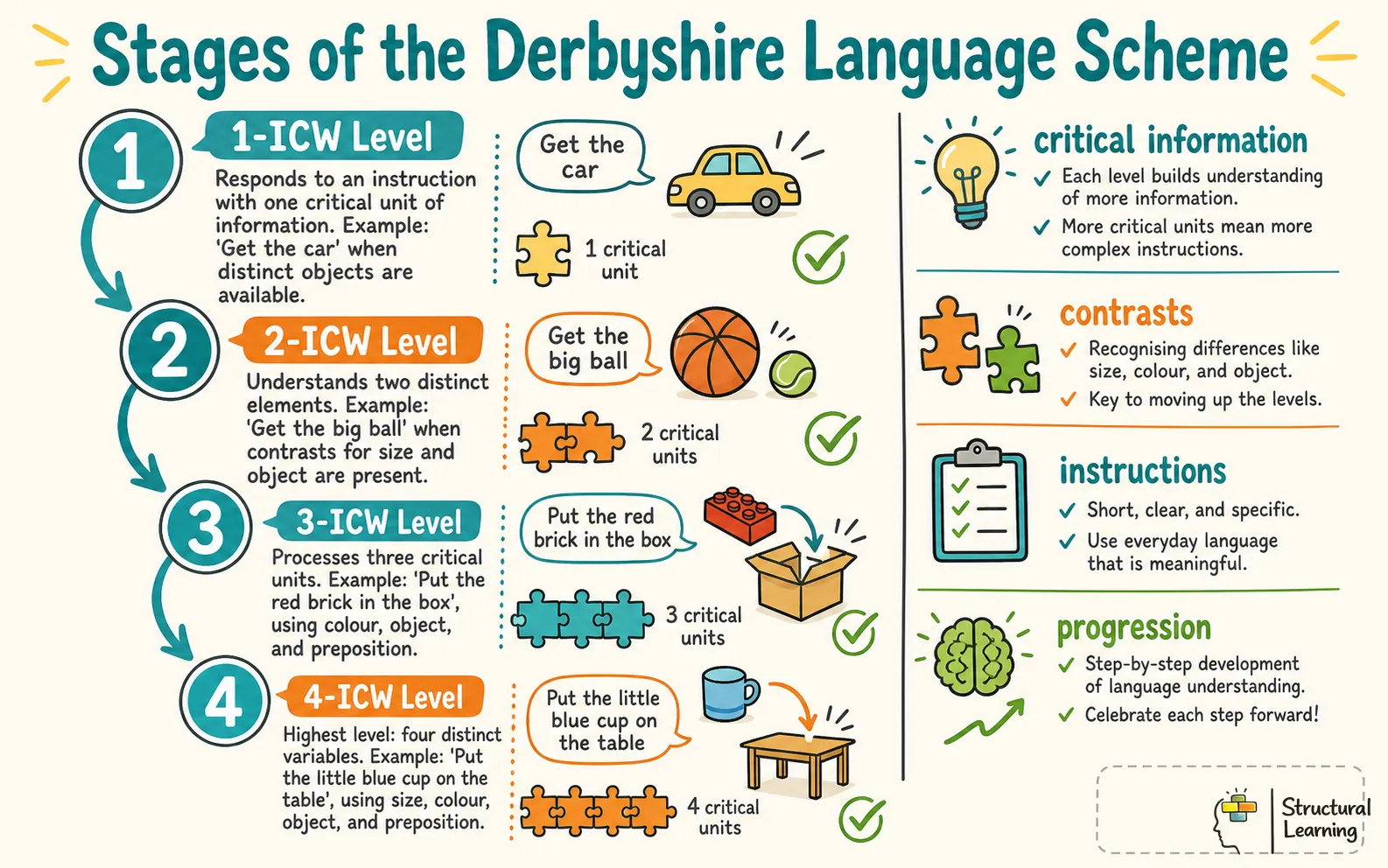
  • 1-ICW: "Get the car." (The choice is between a car, a doll, a block, etc.)
  • 2-ICW: "Get the big ball." (Contrasts for size and object are present.)
  • 3-ICW: "Put the red brick in the box." (Contrasts for colour, object, and preposition.)
  • 4-ICW: "Put the little blue cup on the table." (Contrasts for size, colour, object, and preposition.)

A crucial part of the assessment is "the choice rule". For a word to be an ICW, the learner must have a genuine choice. To test the word "red", there must be an object of another colour available. To test the word "cup", another type of object must be present.

2. Teaching: Once the learner's maximum reliable ICW level is found, teaching begins at that level. The goal is to consolidate understanding before moving to the next level of complexity. The practitioner uses play-based scenarios, giving many examples of instructions at the target ICW level until the learner is consistently successful. Only then do they introduce the next ICW level.

A critical element of DLS delivery, often missed in busy classrooms, is the elimination of non-verbal cues. To truly assess language processing, the teacher must not point, look at the correct object, or use gestures. The instruction must be carried by the words alone.

A Classroom Example: Information Carrying Words in a KS2 History Lesson

The principles of DLS can be adapted for older learners using age-appropriate materials. Consider a Year 4 lesson on the Romans. A teacher is working with a small group of learners with SLCN.

Target: Secure understanding at a 3-ICW level.

Resources: A large map of Roman Britain, a tray of small figures (Roman legionaries, Celtic warriors), and model buildings (a villa, a fort).

Teacher's setup: The teacher ensures there are clear contrasts for each potential ICW. The tray contains both legionaries and warriors. The map has both villas and forts marked in multiple locations.

What the teacher says: The teacher gains the learner's attention and gives the instruction clearly, without pointing or looking at the map.

"Put the legionary beside the fort."

What the learner does: The learner must hold three key pieces of information and act on them in sequence:

  1. Select the correct figure: the legionary (not the Celtic warrior).
  2. Process the spatial concept: beside (not on, or inside).
  3. Locate the correct building: the fort (not the villa).

If the learner makes a mistake, for example, putting the legionary beside the villa, the teacher knows the breakdown occurred on the third ICW. They can then simplify the task to consolidate the concept of 'fort' before re-attempting the 3-ICW instruction.

The Link to Working Memory: A Common Misconception

A significant critique of the DLS framework is that it conflates language comprehension with working memory. Teachers often assume a learner's failure on a DLS task is purely a language problem. However, research highlights that a learner's ability to complete the task is heavily determined by their raw working memory capacity (Frizelle, 2017).

In essence, a 4-ICW instruction requires a learner to hold four separate chunks of information in their mind while they act. A learner with a weak working memory may understand the individual words ("little," "blue," "cup," "on") but be unable to retain the full sequence long enough to execute the command.

This has important implications for the classroom. When a learner struggles with multi-step instructions, it is vital to consider whether the issue is:

  • Vocabulary: Does the learner not know the meaning of a specific word?
  • Comprehension: Does the learner struggle to process the sentence structure?
  • Working Memory: Does the learner understand the words but forget the instruction before they can complete it?

Using DLS principles can help diagnose the issue, but we must be cautious not to label a working memory challenge as a simple language deficit.

How to Implement the Derbyshire Language Scheme: A Sequence for SENCOs

For a SENCO or TA looking to use DLS principles for a targeted intervention, a structured approach is key.

Step Action Considerations
1. Baseline Assessment Use a simple, play-based setup with clear contrasts to find the learner's current ICW level. Start at 1-ICW and move up until they make consistent errors. Ensure the environment is quiet and free from distractions. Do not use any gestural or visual cues. The learner's success must depend only on understanding the words.
2. Target Setting Set the teaching target at the learner's highest consistent ICW level. The aim is to build fluency and confidence before increasing complexity. A learner who gets 3 out of 5 at the 3-ICW level should work at the 2-ICW level until it is fully secure.
3. Structured Teaching Plan short, regular sessions (e.g., 10-15 minutes daily) using a variety of toys and activities. Provide many opportunities for the learner to hear and respond to instructions at their target level. Keep it fun and engaging. The DLS is a 'little and often' approach. Repetition is key.
4. Scaffolding If the learner makes a mistake, simplify the instruction. For example, if they fail at a 3-ICW level, drop back to a 2-ICW level instruction within the same activity. Use praise for listening and trying, not just for correct answers. The goal is to build confidence.
5. Increasing Complexity Once the learner is consistently successful at their target level (e.g., 90% accuracy over several sessions), introduce the next ICW level. Start the next level with very clear, simple contrasts before making the choices more subtle.
6. Monitor and Record Keep a simple record of sessions, including the target ICW level, the activities used, and the learner's success rate. This data is vital for tracking progress and demonstrating the impact of the intervention. It also helps in discussions with SLTs and parents.

Evidence and Limitations: What Does the Research Say?

The evidence base for language interventions is complex. While the ICW construct is very widely used in UK speech and language therapy, direct research into the DLS programme itself is less common than for its underlying principles (Spencer et al., 2025). Systematic reviews of oral language interventions generally find positive effects, but the size of the effect varies greatly depending on the type and intensity of the intervention (Heidlage et al., 2019; Donolato et al., 2023).

The most recent and rigorous evaluation of an adapted form of the scheme (A-DLS) produced mixed results. The study found that while A-DLS led to significant improvements in children's oral comprehension, it was less effective than a usage-based therapy (Building Early Sentences Therapy) at improving children's ability to generate their own sentences (expressive language) and in sustaining progress after the intervention had finished (McKean et al., 2025).

Derbyshire Language Scheme Study Notes preview
◆ Structural Learning
Derbyshire Language Scheme Study Notes
Study notesOne-page revision sheet

Download a one-page study note for Derbyshire Language Scheme, with the key ideas, limitations and classroom links in one place.

Something went wrong - please try again.

Therefore, while the DLS is a valuable tool for developing receptive language, teachers should be aware of its limitations.

  • It is not designed to be a comprehensive expressive language programme.
  • Its impact is closely tied to a learner's working memory.
  • Gains in comprehension during the intervention may not automatically transfer to other contexts or accelerate long-term language growth without additional support.

Derbyshire Language Scheme vs. Other Approaches

Approach Focus Mechanism Best for...
Derbyshire Language Scheme Receptive language (understanding instructions) Systematically increasing the number of Information Carrying Words (ICWs) a learner can process. Assessing and building auditory memory and the ability to follow increasingly complex commands.
Colourful Semantics Expressive language (sentence structure) Using colour-coded visual cues to help learners understand the structure of sentences (Who? What doing? What? Where?). Learners who can understand words but struggle to organise them into grammatically correct sentences.
Usage-Based Therapies (e.g., BEST) Expressive language (generalisation) High-intensity modelling and recasting of target sentence structures in meaningful contexts to build abstract grammatical rules. Developing flexible, independent sentence construction and promoting long-term language growth.

Connecting DLS to Structural Learning: Building Blocks for Sentences

The core principle of the DLS, breaking language down into manageable 'information carrying' units, aligns perfectly with the Structural Learning approach of using building blocks to understand sentence structure. The DLS provides the foundation of comprehension upon which the expressive skills taught with sentence building blocks can be constructed.

A learner who has progressed through the DLS to a 4-ICW level has demonstrated the cognitive capacity to hold four key ideas in mind. This is the prerequisite for constructing a sentence with four distinct elements, such as:

  • Who? (The man)
  • What doing? (is kicking)
  • What? (the ball)
  • Where? (in the park)

You can use the DLS framework to check if a learner has the receptive capacity for the sentence structures you are teaching. If a learner struggles to build a four-part sentence, assess their ICW level. They may need targeted work on holding three or four pieces of information in their working memory before they can successfully manipulate three or four sentence blocks.

Research Evidence Check

Evidence Synthesis

What is the evidence that information-carrying-word and receptive language interventions improve classroom language comprehension?

Mixed evidence: The Consensus search returns a mixed or indirect evidence base, so claims should be framed around the underlying teaching principle rather than the branded programme alone.

25% Yes from 8 studiesstrong evidence
  • Yes25%
  • Possibly25%
  • Mixed38%
  • No13%
Teacher takeaway

Use the approach as a structured support, not a guarantee: identify the target skill, teach it explicitly, and monitor whether it transfers into classroom language, reading or writing.

View the evidence behind this answer8 studies
1The effects of parent-implemented language interventions on child linguistic outcomes: A meta-analysisJodi K. Heidlage et al. (2019) · Early Childhood Research Quarterly
meta analysispossibly2019200 citations

Abstract Intervening early is important to minimize persistent difficulties in language and related domains in young children with or at-risk for language impairment (LI; Rescorla, 2009). Because language is first learned in caregiver–child interactions, parent-implemented interventions are potentially an important early intervention for children with or at-risk for LI. Previous meta-analyses have examined outcomes of parent-implemented interventions for children with primary and secondary LI, but have not included children at-risk for LI due to low SES. A systematic review of the literature identified 25 randomized controlled trials of parent-implemented language interventions examining linguistic outcomes for young children. Studies included 1734 participants (M = 3.7 years) with or at-risk for LI due to low SES. Results of these meta-analyses indicated modest improvements in expressive vocabulary and small improvements in expressive language for children with or at-risk for LI. The effect size for expressive vocabulary outcomes was significant for shared book reading interventions (g = 0.37, 95% CI [0.15–0.59]) and interventions implemented in play and/or routines (g = 0.50, 95% CI [0.05–0.95]). The effect size for expressive language was significant (g = 0.42, 95% CI [0.19–0.65]), but not for receptive language (g = 0.07, ns), and the effect size for receptive vocabulary was not significant (g = 0.18, ns). Sub-group analyses for expressive vocabulary and expressive language indicated moderate to large significant effects for children with or at-risk for primary LI and smaller, non-significant effects for children with Autism Spectrum Disorder. Findings are generally consistent with a previous meta-analysis (Roberts & Kaiser, 2011), indicating parent-implemented language interventions may have positive effects on linguistic outcomes for young children with or at-risk for LI. Limited measures of parent training procedures and varied measures of parent outcomes limited the analysis of how child outcomes were achieved.

Classroom implication: Translate the finding into explicit modelling, guided practice and progress monitoring rather than relying on one-off exposure.

2Oral language interventions can improve language outcomes in children with neurodevelopmental disorders: A systematic review and meta‐analysisEnrica Donolato et al. (2023) · Campbell Systematic Reviews
meta analysismixed202329 citations

Young people who fail to develop language as expected face significant challenges in all aspects of life. Unfortunately, language disorders are common, either as a distinct condition (e.g., Developmental Language Disorder) or as a part of another neurodevelopmental condition (e.g., autism). Finding ways to attenuate language problems through intervention has the potential to yield great benefits not only for the individual but also for society as a whole. This meta-analytic review examined the effect of oral language interventions for children with neurodevelopmental disorders. The last electronic search was conducted in April 2022. Intervention studies had to target language skills for children from 2 to 18 years of age with Developmental Language Disorder, autism, intellectual disability, Down syndrome, Fragile X syndrome, and Williams syndrome in randomised controlled trials or quasi-experimental designs. Control groups had to include business-as-usual, waiting list, passive or active conditions. However, we excluded studies in which the active control group received a different type, delivery, or dosage of another language intervention. Eligible interventions implemented explicit and structured activities (i.e., explicit instruction of vocabulary, narrative structure or grammatical rules) and/or implicit and broad activities (i.e., shared book reading, general language stimulation). The intervention studies had to assess language skills in receptive and/or expressive modalities. The search provided 8195 records after deduplication. Records were screened by title and abstract, leading to full-text examinations of 448 records. We performed Correlated and Hierarchical Effects models and ran a retrospective power analysis via simulation. Publication bias was assessed via-curve and precision-effect estimate. We examined 38 studies, with 46 group comparisons and 108 effects comparing pre-/post-tests and eight studies, with 12 group comparisons and 21 effects at follow-up. The results showed a mean effect size of = 0.27 at the post-test and = 0.18 at follow-up. However, there was evidence of publication bias and overestimation of the mean effects. Effects from the meta-analysis were significantly related to these elements: (1) receptive vocabulary and omnibus receptive measures showed smaller effect sizes relative to expressive vocabulary, grammar, expressive and receptive discourse, and omnibus expressive tests; and (2) the length of the intervention, where longer sessions conducted over a longer period of time were more beneficial than brief sessions and short-term interventions. Neither moderators concerning participants' characteristics (children's diagnosis, diagnostic status, age, sex, and non-verbal cognitive ability and severity of language impairment), nor those regarding of the treatment components and implementation of the language interventions (intervention content, setting, delivery agent, session structure of the intervention or total number of sessions) reached significance. The same occurred to indicators of study quality. The risk of bias assessment showed that reporting quality for the studies examined in the review was poor. In sum, the current evidence base is promising but inconclusive. Pre-registration and replication of more robust and adequately powered trials, which include a wider range of diagnostic conditions, together with more long-term follow-up comparisons, are needed to drive evidence-based practice and policy.

Classroom implication: Use this as a caution: check learner fit, delivery quality and progress data before treating the approach as settled practice.

3Efficacy of the Treatment of Developmental Language Disorder: A Systematic ReviewS. Rinaldi et al. (2021) · Brain Sciences
systematic reviewno202183 citations

Language disorder is the most frequent developmental disorder in childhood and it has a significant negative impact on children's development. The goal of the present review was to systematically analyze the effectiveness of interventions in children with developmental language disorder (DLD) from an evidence-based perspective. We considered systematic reviews, meta-analyses of randomized controlled trials (RCTs), control group cohort studies on any type of intervention aimed at improving children's skills in the phono-articulatory, phonological, semantic-lexical, and morpho-syntactic fields in preschool and primary school children (up to eight years of age) that were diagnosed with DLD. We identified 27 full-length studies, 26 RCT and one review. Early intensive intervention in three- and four-year-old children has a positive effect on phonological expressive and receptive skills and acquisitions are maintained in the medium term. Less evidence is available on the treatment of expressive vocabulary (and no evidence on receptive vocabulary). Intervention on morphological and syntactic skills has effective results on expressive (but not receptive) skills; however, a number of inconsistent results have also been reported. Only one study reports a positive effect of treatment on inferential narrative skills. Limited evidence is also available on the treatment of meta-phonological skills. More studies investigated the effectiveness of interventions on general language skills, which now appears as a promising area of investigation, even though results are not all consistent. The effectiveness of interventions over expressive and receptive phonological skills, morpho-syntactic skills, as well as inferential skills in narrative context underscores the importance that these trainings be implemented in children with DLD.

Classroom implication: Use this as a caution: check learner fit, delivery quality and progress data before treating the approach as settled practice.

4A Systematic Review and Meta-Analysis of Vocabulary Interventions for Deaf/Hard of Hearing Children and Adolescents.Hülya Aldemir et al. (2023) · Journal of Speech, Language, and Hearing Research
meta analysispossibly20237 citations

The development of vocabulary size in deaf/hard of hearing (DHH) children and adolescents can be delayed compared to their peers due to lack of access to early language input. Complementary vocabulary interventions are reported in the literature. Our aim is to evaluate the effectiveness of intervention methods for their vocabulary improvement. Following the Preferred Reporting Items for Systematic Reviews and Meta-Analyses guidelines, we searched five databases for peer-reviewed journal articles in English, published between 2000 and 2022 (inclusive), reporting vocabulary interventions for 2- to 18-year-old DHH children and adolescents without comorbidities. We conducted separate meta-analyses using a random-effects model on receptive oral vocabulary, expressive oral vocabulary, and signed vocabulary. We assessed the methodological quality of each paper. This review is preregistered in PROSPERO (International Prospective Register of Systematic Reviews) with ID CRD42021243479. We included 25 group studies in this review out of 1,724 identified records. The quality assessment of the studies revealed risk of bias ranging from some concerns to high risk. Experimental vocabulary instruction produced improvement in receptive oral vocabulary (Hedges's= 1.08, 95% CI [0.25, 1.90],= 93.46,= .01), expressive oral vocabulary (Hedges's= 1.00, 95% CI [0.18, 1.83],= 96.37,= .02), and signed vocabulary (Hedges's= 1.88, 95% CI [1.09, 2.66],= 96.01,< .001) in the experimental groups. Written vocabulary and general vocabulary skills are also reported as a synthesis of results. Multisensory and multimodal explicit vocabulary instruction for DHH children and adolescents is helpful in improving vocabulary acquisition with respect to baseline levels. However, its effectiveness must be carefully interpreted due to the lack of proper control groups and details onreported in the studies. https://doi.org/10.23641/asha.23646357.

Classroom implication: Translate the finding into explicit modelling, guided practice and progress monitoring rather than relying on one-off exposure.

5Evaluating a Targeted Language Intervention for Children Aged 4–6 Years—Applying an ‘Information Carrying Words’ ApproachSarah Spencer et al. (2025) · International Journal of Language &amp; Communication Disorders
peer reviewed studyyes2025

Very little research has investigated the use of the information carrying words (ICW) construct within language interventions, despite its very widespread use in speech and language therapy in the United Kingdom. The Language Enrichment Activity Programme (LEAP) is an intervention programme that applies the ICW construct to differentiate children's level of need and structure play-based learning activities. LEAP sessions are designed to be child-led, building language skills through application of communication supporting strategies (CSS) such as modelling, recasting and inviting communicative participation via choices and expectant pausing. This study aims to evaluate the impact of trainee speech and language therapists (SLTs) delivering LEAP on the language skills of primary school children (aged 4-6 years). One hundred eighteen children were selected by their teachers. Participating children were semi-randomly allocated to either a control group (n = 48) or to a group that received 12 sessions of LEAP over 6 weeks (n = 70). A smaller sub-cohort was followed up 8 weeks following the end of LEAP (received LEAP n = 41, control group n = 46). LEAP was delivered by trainee SLTs to small groups of children. Assessments were carried out blind to group allocation pre- and post-intervention in order to evaluate the impact of intervention on receptive and expressive language skills. Outcome measures were a bespoke comprehension and expression outcome measure and the Renfrew Action Picture Test (RAPT; Renfrew 2019). Children who received LEAP had improved scores on both the RAPT assessment and the bespoke outcome measure. There was a significant interaction between time (pre- and post-intervention) and group (those who received LEAP vs. the control) for the RAPT grammar score, and the LEAP vocabulary and expressive ICW score. LEAP had less of an impact for a sub-cohort followed up 8 weeks following the intervention, with only the LEAP expressive score showing significant interaction between the three assessment time points and group (those who received LEAP vs. the control). The LEAP was successfully delivered to small groups of children and supported them in developing their expressive language skills. Working with trainee SLTs increased the capacity to deliver LEAP at a low cost to schools. Results are promising and add to an emerging evidence base for the application of the ICW construct within SLT intervention programmes. What is already known on this subject Use of an information carrying words (ICW) construct in speech and language therapy is very common in the United Kingdom, and yet very little research has been done in this area. There is strong evidence for the role of communication supporting strategies (e.g., recasting, giving choices, and use of multisensory input) to accelerate children's language development. However, more translational research is needed to investigate the impact of interventions which include such strategies. New service delivery models are also needed to facilitate increased access to interventions, particularly beyond the preschool years and where schools are unable to staff comprehensive language interventions internally. What this study adds This project evaluates the impact of a targeted language intervention programme for children in the early stages of primary school in the United Kingdom: the Language Enrichment Activities Programme (LEAP). This programme uses ICW to differentiate language intervention activities, while using robust communication supporting strategies during sessions. The study evaluates the impact of LEAP on a cohort of 118 children from 8 schools, with promising results. Children who received LEAP had increased scores on measures of expressive language when compared to children who did not take part in LEAP. What are the clinical implications of this study? Our study adds to an emerging evidence base supporting the application of the ICW construct within language interventions. It also offers a model for collaboration between schools, speech and language therapy services, and trainee speech and language therapists to increase capacity for targeted small group interventions for language skills in early primary school. The paper uses the LEAP intervention as a starting point for discussion about how to best deliver targeted small group interventions and issues in making these types of groups inclusive and accessible.

Classroom implication: Translate the finding into explicit modelling, guided practice and progress monitoring rather than relying on one-off exposure.

6Language intervention in bilingual children with developmental language disorder: A systematic review.Vishnu Kk Nair et al. (2022) · International Journal of Language &amp; Communication Disorders
systematic reviewmixed202227 citations

Although there is a growing body of literature on cognitive and language processing in bilingual children with developmental language disorder (DLD), there is a major gap in the evidence for language intervention. Critically, speech-language therapists are often required to make clinical decisions for language intervention on specific domains, such as phonology, vocabulary, morphosyntax and literacy. To examine evidence for language intervention and cross-language transfer effects in bilingual children with DLD. Specifically, the study aimed to review intervention evidence targeting non-linguistic cognitive skills and six areas of language: phonology, vocabulary, morphosyntax, pragmatics, narrative skills and literacy. We carried out searches in five electronic databases: CINAHL, Scopus, Psychinfo, Proquest and Sciencedirect. Data from selected papers were extracted and organized into the three following categories: study information, participant information and intervention information. Critical appraisal for selected papers was conducted using a quality assessment tool (QAT). We included 14 papers in the review. The majority indicated evidence for vocabulary intervention. There was limited evidence for intervention targeting phonology or morphosyntax. Cross-language generalization effects were evident for vocabulary, but in some instances also reported for morphosyntax and literacy. The present review indicates that there is a significant gap in the literature regarding language intervention for several key language areas such as morphosyntax, narrative skills and literacy. There are only limited data for the effects of cross-language generalization indicating that more research is needed in this area specifically for skills beyond vocabulary. What is already known on the subject Previous studies have examined the effects of bi- and monolingual intervention in bilingual children with DLD. Although the results indicated superior effects for bilingual compared with monolingual intervention, language intervention evidence in specific language domains (e.g., vocabulary, literacy) has not been investigated. What this paper adds to existing knowledge This study will add intervention evidence specific to language domains such as phonology, vocabulary, morphosyntax, pragmatics, narrative skills and literacy. Additionally, we have synthesized intervention evidence on non-linguistic cognition given that these skills are often impaired in bilingual children with DLD. The review has also demonstrated evidence for the effects of cross-language transfer beyond vocabulary skills, especially when the intervention was provided in the home language. What are the potential or actual clinical implications of this work? Although there was a lack of intervention evidence in language domains such as pragmatics, the results indicated some evidence for intervention targeting vocabulary. However, positive effects of cross-language generalization were not constrained to vocabulary but were also reported for intervention targeting mean length of utterance and literacy in the home language. This result indicates an interactive nature of the two languages, as well as provides further evidence for supporting home language(s) in intervention. Finally, intervention targeting non-linguistic cognition may yield additional cross-domain generalization to language skills specifically for bilingual children with DLD.

Classroom implication: Use this as a caution: check learner fit, delivery quality and progress data before treating the approach as settled practice.

7Vocabulary interventions for children with developmental language disorder: a systematic reviewRafiah Ansari et al. (2025) · Frontiers in Psychology
systematic reviewyes20256 citations

Developmental language disorder (DLD) is a neurodevelopmental condition often characterised by vocabulary difficulties that lead to academic and social challenges. The acquisition of vocabulary is a complex, dynamic process of mapping word sound (phonology) to meaning (semantics) supported by contextual cues; a complexity that vocabulary interventions need to address. To understand the key features and impact of such interventions, a systematic review of word-learning studies involving children aged 5-11 with DLD was conducted. A structured search covered seven electronic databases for the period 1990-2023. In addition, the reference lists of identified studies were searched manually. Studies were appraised for quality and data was extracted relating to word-learning effectiveness and intervention characteristics. Findings were reported as written summaries and quantitative data ranges. Sixteen relevant studies were identified with most appraised as medium quality. Interventions tended to be delivered individually in school by speech and language therapists. The most common outcome measure was expressive target-word tests, such as picture naming and word definitions. Interventions explicitly targeting phonological and semantic word features had the most high-quality studies reporting significant vocabulary gain. The inclusion of stories to provide context implicitly during phonological and semantic interventions was beneficial, though stories alone were less effective. Specificity in learning was noted across studies. Gains did not generally transfer to non-targeted words and showed depreciation following therapy. Intervention responses were influenced by children's language profiles. For example, children with more severe language difficulties were less responsive to contextual cues during story reading and were more distracted by extraneous music during multimedia-supported word learning. Whilst the available studies have limitations in range and quality, they do suggest some benefits of combining explicit and implicit vocabulary strategies and considering children's presenting profiles. Implications for practitioners supporting the individual needs of children with DLD are discussed. This includes addressing issues with the generalization and maintenance of vocabulary gains by targeting the most relevant words and encouraging recall and self-management strategies. Further research should explore the influence of home-school carryover. https://www.crd.york.ac.uk/prospero/display_record.php?ID=CRD42022327345, PROSPERO, Reg: CRD42022327345.

Classroom implication: Translate the finding into explicit modelling, guided practice and progress monitoring rather than relying on one-off exposure.

8Intervention for mixed receptive–expressive language impairment: a reviewJ. Boyle et al. (2010) · Developmental Medicine &amp; Child Neurology
systematic reviewmixed201036 citations

Studies indicate that language impairment that cannot be accounted for by factors such as below-average non-verbal ability, hearing impairment, behaviour or emotional problems, or neurological impairments affects some 6% of school-age children. Language impairment with a receptive language component is more resistant to intervention than specific expressive or phonological delays, and carries a greater risk of comorbid behavioural difficulties as well as adverse outcomes for language development and academic progress. This paper considers underlying explanations that may account for receptive-expressive language impairment. It also reviews evidence for the effectiveness of intervention from theory and recent systematic reviews, trials, and speech and language therapy practice.

Classroom implication: Use this as a caution: check learner fit, delivery quality and progress data before treating the approach as settled practice.

Frequently Asked Questions about the Derbyshire Language Scheme

1. Do I need special training to use the Derbyshire Language Scheme? While formal training is offered and is highly beneficial for SLTs, teachers and TAs can effectively use the principles of ICW assessment and teaching by following the structured sequence described above. The key is rigour in removing non-verbal cues and providing clear contrasts.

2. Can I use the DLS with a whole class? The DLS is designed as an individual or very small group intervention. Its strength lies in its ability to target a learner's specific developmental level. It is not practical for whole-class teaching, but its principles, such as being mindful of the number of key instructions you give at once, are excellent universal practice.

3. What's the difference between the Derbyshire Language Scheme and the 'Rapid DLS'? The 'Rapid DLS' is often a school-adapted version designed to be delivered more quickly or to larger groups. These adaptations can be pragmatic, but as research suggests, they may lose the individualised progression of the full scheme and be less effective at generating expressive language gains (McKean et al., 2025).

4. How long should a learner be on the programme? This is highly individual. Progress depends on the learner's starting point, the frequency of sessions, and any co-occurring difficulties. The key is to see steady progress through the ICW levels, which should be documented and reviewed regularly.


Your Next-Lesson Action

Choose one multi-step instruction you regularly give your class. Identify the information-carrying words within it. Next lesson, when you give that instruction to a learner who struggles to follow directions, say it clearly and then consciously pause, making no gestures or pointing. Watch to see where the breakdown occurs. This small act of observation is the first step in diagnosing whether the barrier is vocabulary, comprehension, or working memory.

Research sources

Further reading from peer-reviewed research

These 5 studies give source context for the classroom guidance in this article on Derbyshire Language Scheme: A Teacher's Guide. They are included as starting points for deeper reading, not as a substitute for local professional judgement.

Systematic Review 83 citations mdpi.com

Efficacy of the Treatment of Developmental Language Disorder: A Systematic Review

S. Rinaldi et al. (2021) | Brain Sciences

Use this as a caution: check learner fit, delivery quality and progress data before treating the approach as settled practice.

View study

Systematic Review frontiersin.org

Vocabulary interventions for children with developmental language disorder: a systematic review

Rafiah Ansari et al. (2025) | Frontiers in Psychology

Translate the finding into explicit modelling, guided practice and progress monitoring rather than relying on one-off exposure.

View study

Meta Analysis 200 citations linkinghub.elsevier.com

The effects of parent-implemented language interventions on child linguistic outcomes: A meta-analysis

Jodi K. Heidlage et al. (2019) | Early Childhood Research Quarterly

Translate the finding into explicit modelling, guided practice and progress monitoring rather than relying on one-off exposure.

View study

Meta Analysis 29 citations journals.sagepub.com

Oral language interventions can improve language outcomes in children with neurodevelopmental disorders: A systematic review and meta‐analysis

Enrica Donolato et al. (2023) | Campbell Systematic Reviews

Use this as a caution: check learner fit, delivery quality and progress data before treating the approach as settled practice.

View study

Systematic Review 27 citations onlinelibrary.wiley.com

Language intervention in bilingual children with developmental language disorder: A systematic review.

Vishnu Kk Nair et al. (2022) | International Journal of Language &amp; Communication Disorders

Use this as a caution: check learner fit, delivery quality and progress data before treating the approach as settled practice.

View study

Paul Main, Founder of Structural Learning
About the Author
Paul Main
Founder & Metacognition Researcher

Paul Main is an educator and metacognition researcher who founded Structural Learning in 2002. With a psychology degree from the University of Sunderland and 22+ years helping schools embed thinking skills, he bridges the gap between educational research and classroom practice. Fellow of the RSA and Chartered College of Teaching, with 128+ Google Scholar citations.

More →

SEND

Back to Blog