Updated on
October 7, 2026
Concept Map Examples: Check Linking Words Against a Source
Model concept maps by checking linking phrases against a source. Use plant and display examples, an editable review sheet and four-page practice pack.

Updated on
October 7, 2026
Model concept maps by checking linking phrases against a source. Use plant and display examples, an editable review sheet and four-page practice pack.
What is a concept map?
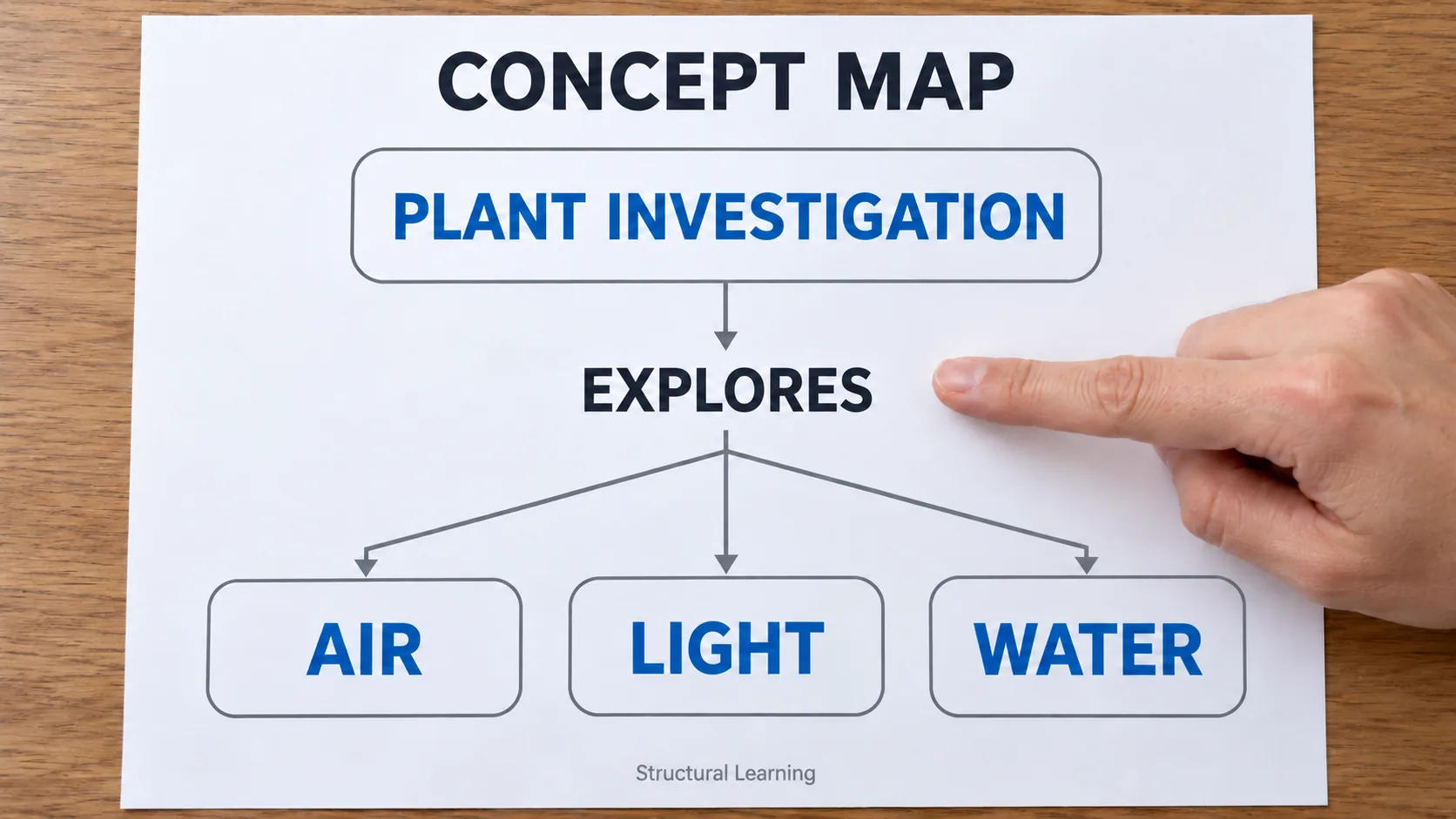
A concept map is a diagram in which named links connect concepts into meaningful statements. For example, plant investigation explores requirements involving water. Check each relationship against a supplied source, revise unsupported wording and keep unanswered claims visible. The examples below model that process for classroom teachers.
Put one draft link beside a short source and ask learners to read it as a complete statement. Keep the concepts in place while checking the relationship between them. Replace an unsupported linking phrase, explain the change and retain any claim the source leaves unresolved.
Try this tomorrow
Year 3 science. Use the supplied plant source below. Compare “proves identical needs for” with “explores requirements involving”. Ask which phrase fits the source, then model the revision with the same two concepts.
Key takeaways
Novak and Cañas explain that linking words specify relationships between concepts. A focus question gives the map its context. Their original IHMC report supplies the construction guidance used here. Our visual organisers guide introduces the wider range of formats.
Read the whole statement
Captions → name → Sources
A radial map can collect related ideas around a central topic. The mind maps guide covers those designs. Here, the teaching task is to inspect named relationships. Select a different shape when the task requires a sequence, comparison or another structure, using the subject organiser toolkit.
Start with the question and a small set of concepts. Read each connection aloud before adding more branches. For broader theory about connecting new ideas with existing knowledge, see the meaningful learning guide.
Source and setup first. This is a planning map based on the DfE Year 3 Plants programme. The focus question is: “Which requirements will our plant investigation explore?” The supplied source is adapted from that curriculum clause.
Supplied plant source
Year 3 science asks learners to explore requirements for plant life and growth: air, light, water, nutrients from soil and room to grow. It also asks how requirements vary between plants. This is a curriculum planning source, not an experimental result.
Build three initial statements about air, light and water. Each uses “Plant investigation” as the first concept and “explores requirements involving” as its linking phrase. Extend the full planning map with nutrients from soil and room to grow. Keep the variation qualifier beside it.
Draft link: revise
Plant investigation → proves identical needs for → water
The phrase claims proof of identical needs. The source asks for exploration and variation.
Revised link: supported
Plant investigation → explores requirements involving → water
The concepts stay fixed. The new link describes the topic of the planned investigation.
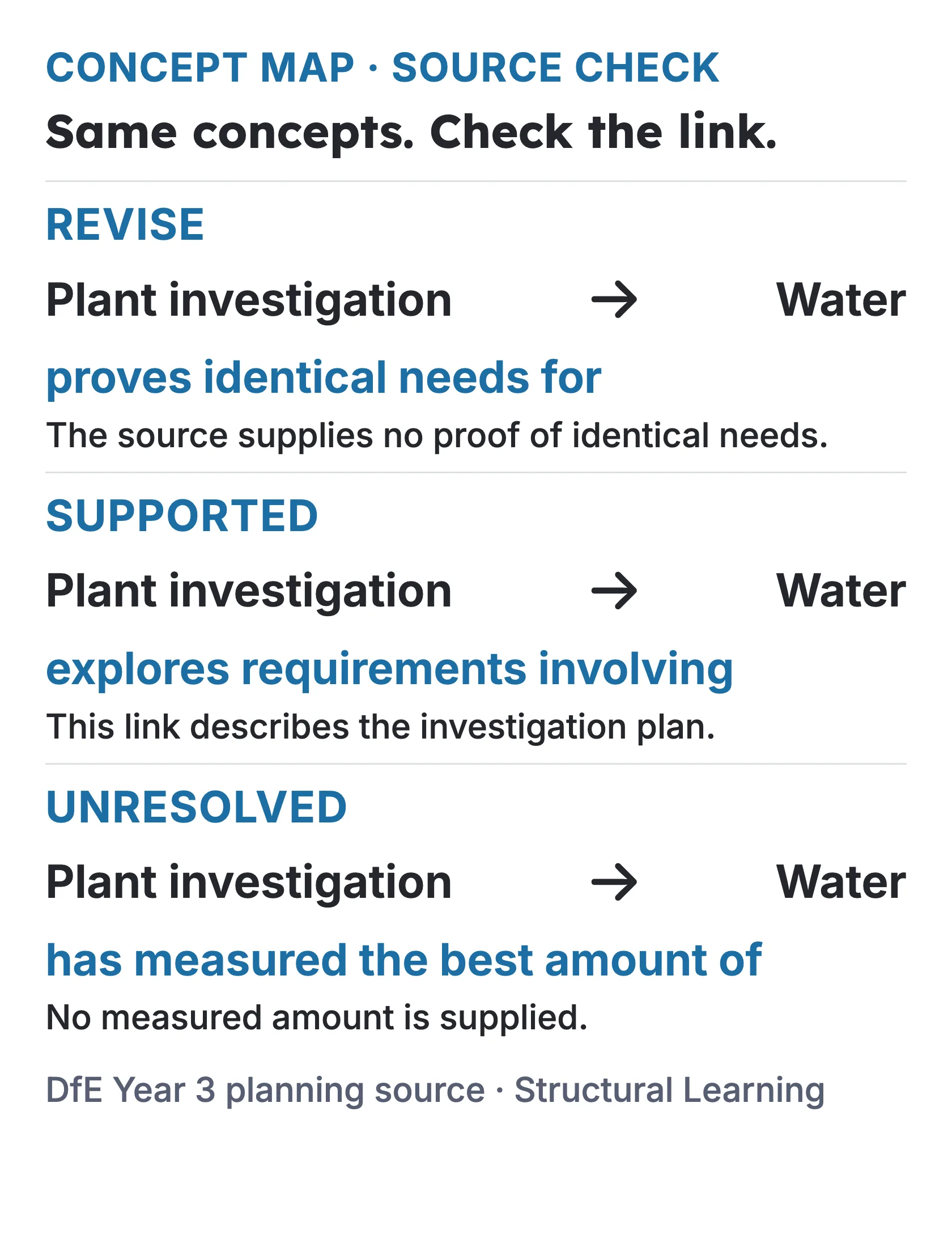
Model explanation: “I replaced proves identical needs for with explores requirements involving. The source sets an investigation topic and retains variation between plants.” Ask learners to identify the two source ideas used in that explanation.
A second draft says, “Plant investigation has measured the best amount of water.” Mark this unresolved because the supplied source contains no measurements. Keep it separate from the supported planning statements. Ask what investigation or further source would supply evidence for the chosen plant and conditions.
For a complete follow-up, give the room-to-grow factor and ask for a fresh statement. The model answer is: “Plant investigation explores requirements involving room to grow.” The factor appears in the source, while a best size remains unspecified.
Compare the draft statement with the source before choosing a response. A vague relationship needs precision. A conflicting relationship needs revision. An absent detail needs more evidence.
| Draft relationship | Source check | Teacher decision |
|---|---|---|
| Captions are related to sources. | The display passage states what captions do. | Replace are related to with name. |
| Checking captions happens after opening. | The passage places checking before opening. | Change after to before. |
| The investigation has measured the best amount of water. | The plant source gives no measurements. | Keep unresolved and identify the missing evidence. |
Keep a record of the original link and the reason for changing it. The schema-building guide discusses revisiting earlier ideas. For an unresolved statement, use the inquiry cycle to plan the next question and an appropriate source.
Source and setup first. This original fictional passage provides all the information for the exercise. The focus question is: “What does the supplied display plan tell us about order and captions?” It describes a made-up plan, rather than an observed school project.
Supplied display passage
The group chooses examples before drafting captions. Captions are checked before the display opens. Every caption names its source.
Complete map statements
Choosing examples → happens before → Drafting captions
Checking captions → happens before → Opening the display
Captions → name → Sources
One link to repair
Before: Checking captions → happens after → Opening the display.
After: Checking captions → happens before → Opening the display.
Evidence: The second sentence places checking before opening.
Model explanation: “I changed happens after to happens before and kept both concepts. That restores the order stated in the second sentence.” This explanation names the change and locates its evidence.
Keep “Opening the display happens on Monday” unresolved. The passage gives an order but no opening day. A sequence cannot supply an unstated date. Ask for the additional planning information that would settle it.
Then check a fresh relationship. Ask what every caption names and where the passage says so. The complete answer is: “Captions name sources. The third sentence supports this relationship.” For the wider purpose of a classroom display, use our working walls and classroom displays guide.
Ask the learner to read one revised statement and explain the replaced phrase. Follow up with a fresh link using the same source. This gives you a specific response to inspect alongside the finished map.
If the learner reads the statement accurately but cannot locate evidence, return to the passage. If they find evidence but reverse the relationship, compare the two linking phrases. If the detail is absent, ask them to name what is missing.
The responsive teaching guide provides wider context for choosing the next teaching move. For science planning, the science metacognition guide offers context for explaining a choice. In this routine, ask what was checked, what changed and what still needs evidence.
The mini app has eleven text fields: Focus, Source and three From, Link and To rows. Its initial statements are the three supported plant-planning propositions. Read each assembled statement against the source, then select Supported, Revise or Unresolved.
Map It · Concept Map
Edit the focus, source and three From, Link and To propositions. Choose a manual status for each statement, then mark the set reviewed against the source. Any text edit clears all three statuses and your review. Statuses are your judgements, not automatic verification.
Your statements
Manual source status: Unreviewed
Manual source status: Unreviewed
Manual source status: Unreviewed
Statements not marked as reviewed
Unreviewed is the starting status. Changing any text field clears all three statuses and the review mark. Changing a status clears the mark only. Keep the old phrase in your notebook before editing because the sheet keeps no version history.
Use the manual checkbox after reviewing all three complete statements against a non-empty source. Reviewed can include Revise and Unresolved. The output says, “Statements marked as reviewed by you.” It records your decision, not a declaration that every claim is true.
Print the current focus, source, statements, manual statuses and review state. Incomplete rows are labelled without being presented as reviewed statements. Reset restores the exact starting text with all statuses Unreviewed and the mark unchecked. Save your wording elsewhere before resetting.
The IHMC report provides theory and construction guidance, not a trial of these lessons. DfE supplies the plant curriculum content. Both worked cases and their follow-ups are authored teaching proposals. The display passage is fiction. These sources establish neither an attainment gain nor superiority over other organisers.
The plant map describes requirements to investigate, not experimental findings or a full photosynthesis model. The mini app records manual judgements without verifying facts. Social posts provide viewpoints about mapping, revision and assessment. They do not establish outcomes for these examples or identify who created a map.
These verified posts offer perspectives on using maps. Use the questions to inspect the teaching task rather than treating a finished diagram as sufficient evidence.
@SoLInTheWild, 13 May 2026, describes a “dynamic and fluid revision process”. This is a view about mapping with peer feedback. Here, retain the old and revised link so the explanation identifies an actual change.
@IanKinchin, 16 June 2024, asks, “Is this the answer to the 'problem' of AI in assessment?” That question invites scrutiny. Require a source match and explanation; authorship requires separate evidence.
@teachtomorrowuk, 28 March 2024, promotes maps to “show their understanding”. Our proposed follow-up asks for a complete statement and supporting words. The post itself is promotional, not a classroom trial.
The four-page static PDF contains a filled plant example with all five requirements, an original blank template, four notebook tasks and full teacher answers. Both source passages are supplied. Write on the printed sheet or in your notebook, keeping each old link beside its revision.
Practise repairing the identical-needs claim, retaining the missing measurement, correcting before and after, and separating a supported caption link from an unstated date. Other shapes are available in our graphic organiser templates guide.
Classroom resource
Download concept map examples, a blank link-check template, practice and teacher answers (PDF)
No email is required for this download.
For this task, the key feature is a named relationship that reads as a statement. A radial collection of keywords serves a different purpose. Choose the structure that matches the question.
Cross-links connect different parts of a map. Add one when you can explain and support its relationship. This introductory task starts with three readable statements rather than a required number of crossings.
No. A source may leave the claim unsettled. Mark it unresolved, identify the missing evidence and decide what further source would answer it.
No. It records your manual review of all three complete statements. A reviewed statement can still need revision or remain unresolved. Text edits clear the statuses and mark.
Novak, J. D., and Cañas, A. J. (2008). The Theory Underlying Concept Maps and How to Construct and Use Them. IHMC CmapTools 2006-01 Rev 01-2008.
Department for Education (2015 edition). National curriculum in England: science programmes of study. Year 3 Plants.