Updated on
October 7, 2026
Number Talks Examples: Compare Methods and Check Answers
Teach number talks with three checked examples, two methods, discussion prompts and fresh-problem checks, plus an editable plan and four-page pack.

Updated on
October 7, 2026
Teach number talks with three checked examples, two methods, discussion prompts and fresh-problem checks, plus an editable plan and four-page pack.
What are Number Talks?
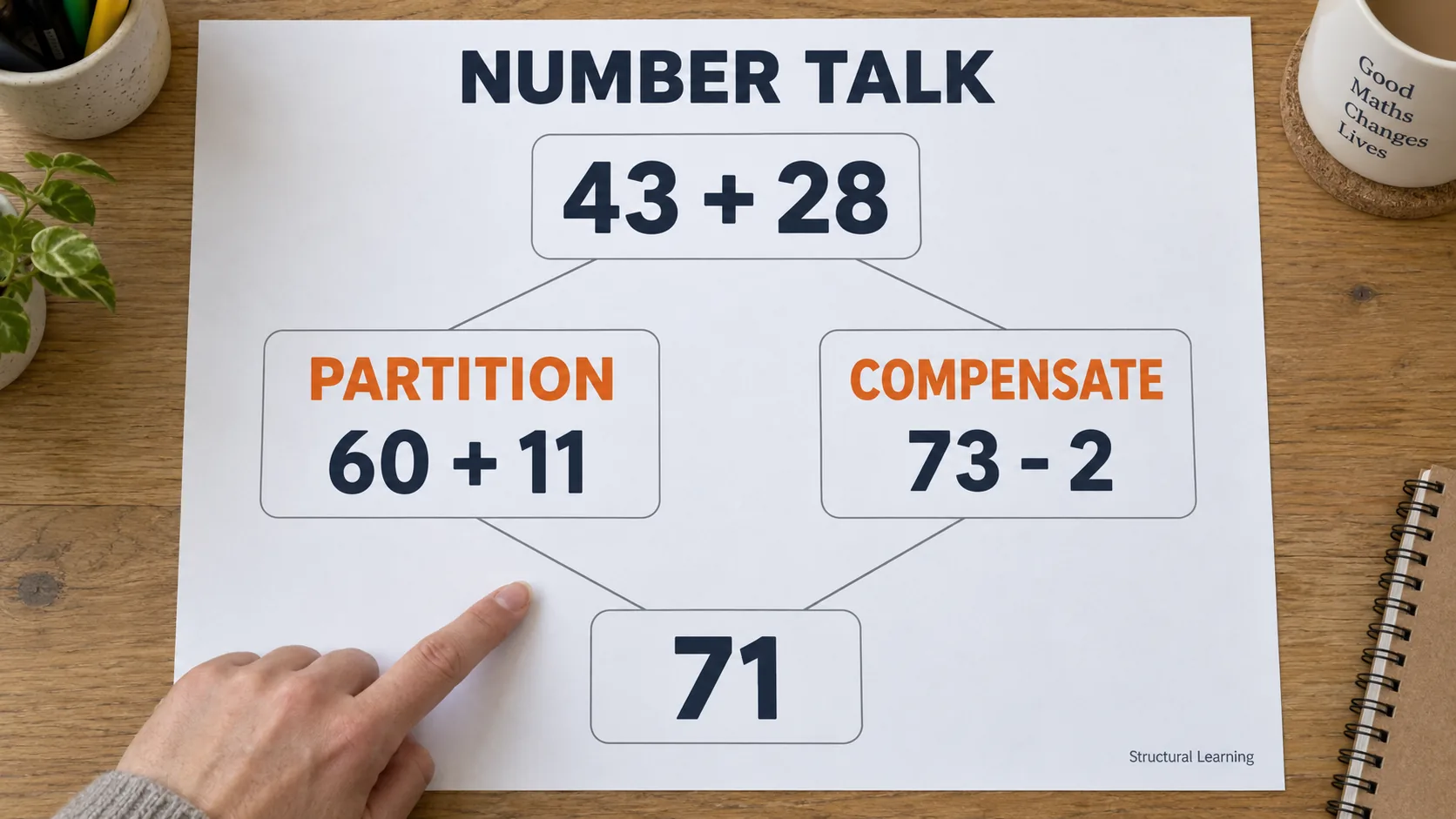
Number talks are short classroom discussions in which learners solve a mental calculation and compare how valid methods work. For 43 + 28, partitioning gives 60 + 11 and compensation gives 73 - 2; both make 71. Ask for a reason, correct any change in value and then check a fresh problem.
Put 43 + 28 on the board and give learners time to work it out mentally. Invite two methods and record the steps clearly. Ask what each method changes and how it keeps the original value. Finish with a fresh calculation completed independently.
Try this tomorrow
Year 4 maths. Compare 60 + 11 with 73 - 2 as routes to 71. Ask why the compensation method removes two. Then give 46 + 27 and check whether learners adjust the correction to three.
Key takeaways
Select a familiar calculation with two routes worth discussing. Decide which relationship you want learners to explain before inviting answers. For the examples here, it is an extra amount, an extra group or an equivalent fraction.
Heinemann’s Number Talks guidance describes mental solving followed by discussion and justification. Inside Mathematics provides an original collection of classroom examples. These sources establish the routine’s format; the calculations and responses below are authored teaching proposals.
The England mathematics programme includes fluency and mathematical reasoning with justification. Keep the discussion within your existing sequence of teaching. Our KS2 maths guide supplies the wider curriculum context.
Write the starting calculation separately from its methods. When a learner changes a number, ask what must happen next to preserve the sum or product. For general prompts that reveal reasoning, see the questioning techniques guide.
Setup. The task is 43 + 28. Learners have met tens and ones and can add to make a nearby multiple of ten. The teacher’s proposed opening question is: “How can you work this out mentally? Be ready to explain your method.”
Partition tens and ones
40 + 20 = 60
3 + 8 = 11
60 + 11 = 71
Both numbers are split into tens and ones. Recombining those parts keeps the original sum.
Make 30, then compensate
43 + 30 = 73
30 - 28 = 2
73 - 2 = 71
Adding 30 adds two extra ones. Removing those two returns to adding 28.
Compare prompt: “What changed when 28 became 30, and why does subtracting two restore the original sum?” The complete model response is: “We added two more than we needed. Subtracting those two makes the total equal to 43 + 28.”
Authored draft misstep: 43 + 28 = 43 + 30 = 73. Point to the change from 28 to 30. The corrected chain is 43 + 28 = 43 + 30 - 2 = 71.
Now give 46 + 27. Partitioning gives 60 + 13 = 73. Compensation gives 46 + 30 = 76, followed by 76 - 3 = 73. Ask why the correction changed. Copying “subtract two” would answer a different calculation.
Keep the number relationships visible during the explanation. Use separate primary retrieval practice when you want to revisit familiar facts before a discussion. This comparison task asks learners to explain how those facts are being used.
Setup. The task is 19 × 5, using known facts about groups of five. Ask: “How can you use a number you know to work this out mentally?” Record both routes so learners can compare the group counts.
Use 20 groups
20 × 5 = 100
20 - 19 = 1
1 × 5 = 5
100 - 5 = 95
Twenty groups include one extra group of five. Remove that group.
Split 19 groups
10 × 5 = 50
9 × 5 = 45
50 + 45 = 95
Ten groups and nine groups together make nineteen groups. Their totals combine to 95.
Compare prompt: “Why does one extra group mean subtracting five rather than subtracting one?” The model response is: “The group count increased by one, and each group contains five. We must remove all five objects in that group.”
Authored draft misstep: 19 × 5 = 20 × 5 - 1 = 99. Label it as an error before discussing it. Correct the chain to 19 × 5 = 20 × 5 - 5 = 95.
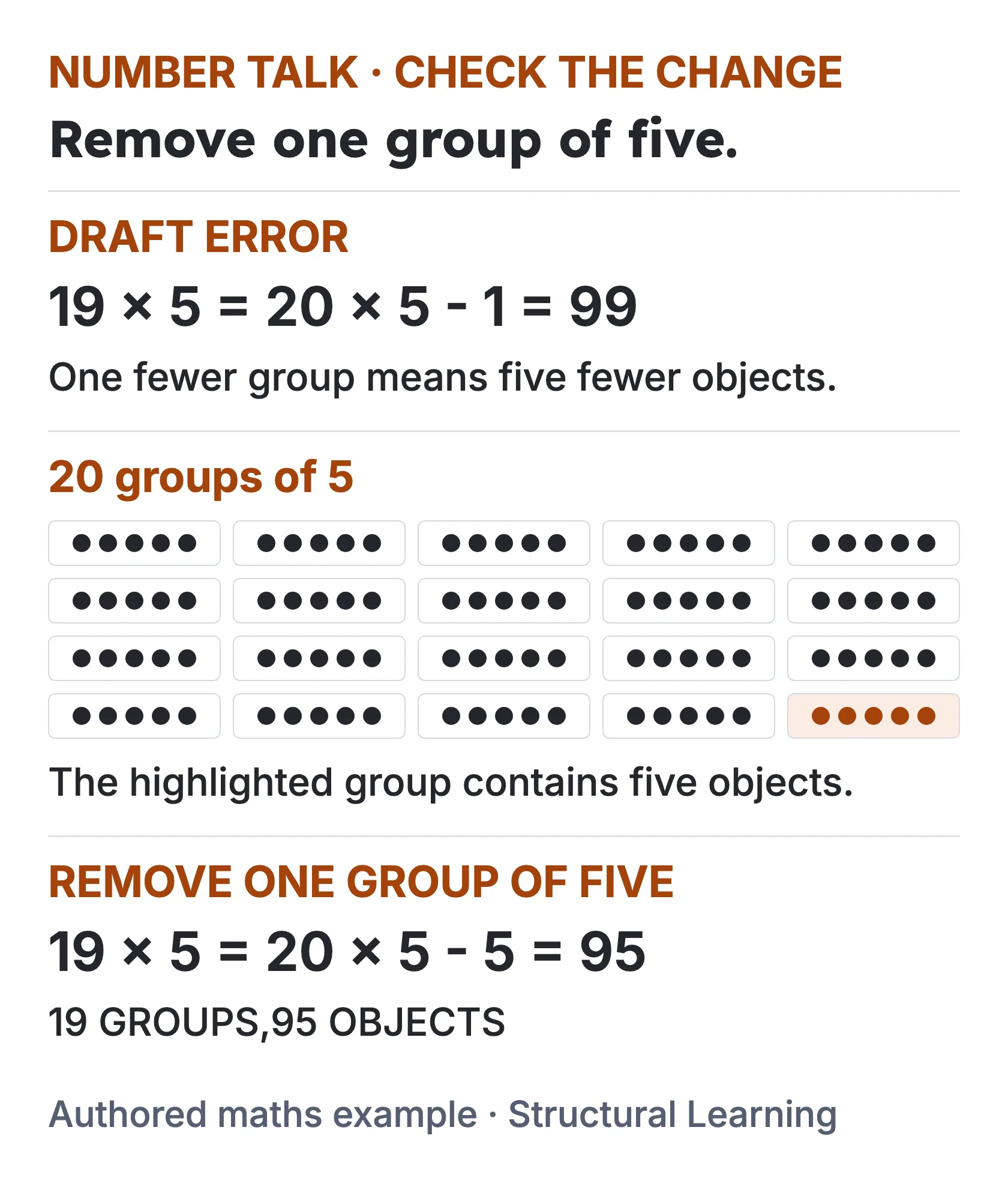
For the fresh check, ask for 21 × 5. Twenty groups give 100, and one more group contributes five. The correct answer is 105. Ask the learner to explain why adding one object would fail to account for the extra group.
A grouped representation can accompany the explanation. Our Singapore maths guide gives wider context for using representations. Here, the specific teaching decision is to show what the extra group contains.
Setup. The task is 1/2 + 3/4. Learners have met equivalent fractions and can recognise two halves as one whole. Ask: “How can you add these fractions using equal units or a whole?”
Use common quarters
1/2 = 2/4
2/4 + 3/4 = 5/4
5/4 = 1 + 1/4 = 1 1/4
The common unit is a quarter. Five quarters make one whole and one quarter.
Regroup to make a whole
3/4 = 1/2 + 1/4
1/2 + 3/4 = 1/2 + 1/2 + 1/4
1/2 + 1/2 = 1
1 + 1/4 = 1 1/4 = 5/4
Two halves form the whole, leaving one quarter.
Compare prompt: “How do these methods explain the same total without adding denominators?” The model response is: “One method counts five quarters. The other makes a whole from two halves and keeps the remaining quarter. Both represent 5/4.”
Authored draft misstep: 1/2 + 3/4 = 4/6. Ask what units the two fractions describe. Correct the sum using 1/2 = 2/4, then add the five quarters. Adding denominators has changed the units and the value.
For the fresh check, use 3/5 + 1/2. Rename the fractions as 6/10 and 5/10. Their sum is 11/10, or 1 1/10. Ask why tenths provide a common unit and how the extra tenth remains after making a whole.
Use a precise comparison question after the methods have been recorded. “Which is better?” can invite a preference without an explanation. Ask which step changed an amount, group count or representation, and why the correction keeps the calculation equivalent.
| Case | Change to inspect | Explanation to seek |
|---|---|---|
| 43 + 28 | 28 becomes 30. | Two extra ones were added, so remove two. |
| 19 × 5 | 19 groups become 20. | The extra group contains five, so remove five. |
| 1/2 + 3/4 | A half is renamed as two quarters. | The value stays equal while the unit becomes a quarter. |
More than one method can fit a calculation. The conditional knowledge guide discusses choosing a strategy for a task. In these cases, compare mathematical validity and the number relationships each method makes visible.
Preparing the explanation is part of the teacher’s subject knowledge. The pedagogical content knowledge guide gives that wider context. Here, anticipate the difference between one extra object and one extra group.
After the comparison, give a fresh problem and ask for a brief explanation in the notebook. Use it to inspect whether the learner can adjust the method to the new numbers. Keep the first model available when further teaching is needed.
Our mathematical metacognition guide covers planning and checking more broadly. This bank supplies the exact arithmetic for one particular comparison and its follow-up. The responsive teaching guide offers context for choosing what to revisit from the response.
For these checks, look for subtracting three in 46 + 27, adding a group of five in 21 × 5, and common tenths in 3/5 + 1/2. Ask the learner to locate the change in their working. A correct answer to one fresh problem supplies local evidence for that response.
The verified X views here concern the balance between discussion and independent work. They provide viewpoints and self-reports, rather than evidence that these authored lessons improved learning.
In a reply on 17 August 2025, @tetheredtoed1 objects to repeated Number Talks and explain-your-thinking expectations when work then remains unfinished. The practical question is how to keep the comparison focused. Choose one relationship to discuss, then leave time for the new calculation.
On 10 June 2026, @Maths_Devon reports an independent-work period and a short whiteboard check before discussing answers. The post does not mention Number Talks. Its relevance here is the separation of independent work from the discussion. Our oracy guide provides broader context for purposeful classroom talk.
Choose Addition, Multiplication or Fractions. Each case contains its fixed problem, correct answer and two full methods. Edit Context, Opening question, Compare prompt and Follow-up to prepare your discussion.
Say It · Teacher planning
Choose one of the three checked examples. Edit the prompts for your class, then review the complete plan before printing. The example maths and methods are provided as written.
Switching the case replaces your four planning fields. Copy wording you want to keep before switching.
Your talk plan
Teacher planning text can be edited here. It is not checked for accuracy.
The printed plan includes the answer and both methods, so use it as a teacher sheet. Changing the case loads that case’s maths and its four starting prompts. Reset restores the four prompts for the currently selected case.
Print the current case and your planning text when ready. Save a copy of wording you need before changing cases or resetting. The fixed calculations remain unchanged when you edit a teacher prompt.
Minaz and Taş (2026) studied 219 fourth-grade learners aged 10–11 across three public schools. Their ten-week quasi-experimental programme used five Number Talks activities weekly. It reported a number-sense difference favouring the intervention. May (2020) studied two fifth-grade classes of 22 each. Sessions lasted 20–30 minutes, twice weekly for six weeks. The speed result was significant; flexibility and accuracy tests were not.
Those designs, samples and schedules bound the findings. They do not establish a gain from these short authored cases or their planner. The worked responses and likely errors are teaching proposals. The planner neither generates new maths nor grades learner answers. Its editable text needs teacher review. Retain the school’s other practice and curriculum sequence, including any White Rose maths planning already in use.
The four-page static resource contains a filled addition case, an original blank discussion plan, four notebook tasks and full teacher answers. All calculations are supplied. Write your answers on paper or in a notebook, showing the step and its reason.
The tasks compare two addition methods, adjust the compensation for a new sum, repair the extra-group mistake and add fractions using equal units. The answers include 71, 73, 95, 105, 5/4 and the fresh fraction total 11/10.
Classroom resource
Download Number Talks examples, a blank discussion plan, practice and teacher answers (PDF)
No email is required for this download.
Invite valid alternatives that learners can explain. Keep the starting calculation fixed and inspect how each route preserves its value. A preference alone does not explain the mathematics.
Record and label the draft clearly. Locate the step that changes the value or unit, then model its correction. Use the fresh problem to check the explanation.
Keep a focused discussion and a separate check. The fresh calculation asks learners to apply the relationship to different numbers. Continue the other practice in your teaching sequence.
The maths is fixed to three checked cases. You can edit the teacher planning fields, but the sheet does not solve new calculations or assess typed answers.
Heinemann (2022). Create Confident Problem Solvers with Number Talks. Publisher procedure guidance, 11 May.
Inside Mathematics, Charles A. Dana Center, University of Texas at Austin (n.d.). Number Talks.
Department for Education (2021 edition). National curriculum in England: mathematics programmes of study.
Minaz, M. B., and Taş, H. (2026). The impact of number talks on the number sense of fourth-grade primary school students. BMC Psychology, 14, 244.
May, P. L. (2020). Number Talks Benefit Fifth Graders’ Numeracy. International Journal of Instruction, 13(4), 361–374.