Updated on
October 7, 2026
Brain Breaks for Classrooms: Activities and Return Cues
Plan ordinary brain breaks with three complete classroom examples, clear return cues and next tasks, an editable plan and four-page printable practice.

Updated on
October 7, 2026
Plan ordinary brain breaks with three complete classroom examples, clear return cues and next tasks, an editable plan and four-page printable practice.
What are ordinary classroom brain breaks?
Brain breaks are short planned pauses or changes of activity during a lesson. For classroom use, specify the pause cue, a familiar activity, the planning time, a clear return cue and the first next task. The examples here are ordinary teacher plans. Physical-activity research does not establish a benefit for every break or an optimal duration.
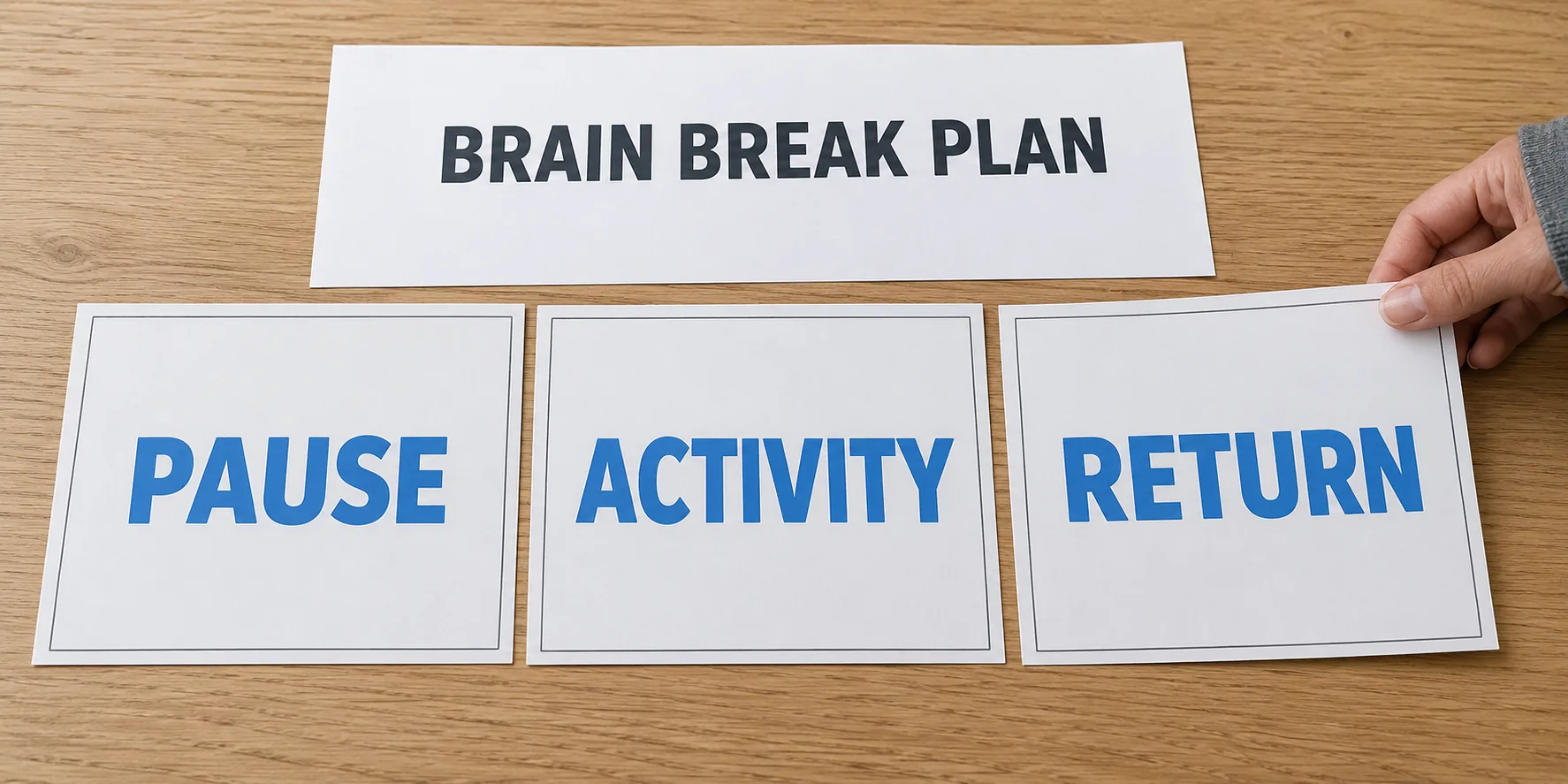
Before pausing a lesson, write the first task learners will begin afterwards. Then choose a familiar activity for the available space and time. Give one cue to pause and another to stop the activity. Keep the next instruction ready so the class knows what happens on returning.
Try this tomorrow
Prepare a three-part plan: pause, activity and return. Replace “Back to work” with a stopping action and a named task, such as “Stop the pattern. Read the first question.” Choose the planning time before the lesson.
Key takeaways
Use the lesson’s next instruction to organise the pause. If learners will return to a paragraph, keep their place marked. If they will begin a question, have that question ready. The activity then sits within a planned sequence.
The CDC classroom physical activity guidance describes brief activity periods, either integrated into teaching or provided as breaks. This article supplies original ordinary planning examples. Its focus is the teacher’s directions around the activity.
Our lesson planning guide provides the wider context for sequencing tasks. Here, write five fields: Context, Pause cue, Activity directions, Return cue and Next task. The last field tells you where the lesson is going.
Choose a pause at a point you can describe, such as between two writing sections or before starting questions. Avoid leaving the restart as an unspecified instruction. Decide which book, sentence or question learners will look at first.
The three examples use the usual classroom place and a familiar movement pattern. Choose the pattern that fits the arrangement you already have. Keep the directions short enough to read aloud and the stopping cue easy to distinguish.
| Planning choice | Logistical fit | Return point |
|---|---|---|
| Desk-side reach | Uses the usual desk space and a familiar seated or standing pattern. | The next sentence of a writing task. |
| Alternating taps | Keeps books and the marked reading place available. | The first question and its instruction. |
| Stand and return | Uses a familiar change of posture in the current place. | The table entry needed for an answer. |
The planner offers 45 and 60 seconds as author planning choices. These values make the examples concrete; they are not tested or optimal durations. The teacher gives the return cue. The mini app does not run a countdown.
A plan also needs clear instructions. The teacher lesson-design guide provides context for preparing those instructions. Use that context to organise the next step, rather than to predict an effect of the break.
Setup. This authored plan pauses between two short writing sections. The class stays in its usual place. The teacher chooses 60 seconds and has the opening words for the next section ready.
Pause and activity
Pause cue: “Finish your current word, put the pencil down and pause.”
Activity: Raise both hands, lower them, then reach forward and bring them back. Repeat the familiar pattern until the return cue. Use the class’s usual seated or standing version.
Return and next task
Return cue: “Stop the pattern, lower your hands and look at the next sentence.”
Next task: “Write the first sentence of your next section. Start with the opening words you planned.”
The plan ends with a specific writing action. The teacher can see whether learners stopped the pattern and began the named sentence. That observation concerns the return you planned.
If the class has stopped but several learners are unsure where to begin, repeat the opening words and identify the sentence. The responsive teaching guide gives wider context for choosing a follow-up from the response you actually see.
Setup. This authored plan sits between reading a short passage and beginning questions. It requires no historical claim to use. Learners mark their place before a 60-second alternating-taps activity.
Pause and activity
Pause cue: “Mark your place in the passage, put the pen down and pause.”
Activity: Tap the left hand and then the right hand lightly on the desk or lap. Repeat the alternating pattern in the usual place until the return cue.
Return and next task
Return cue: “Stop the taps, place your hands still and return to the marked passage.”
Next task: “Read the first question and underline its command word. Then locate the sentence the question asks you to use.”
The marked place preserves a practical reference point. The next instruction identifies the question and the action to begin. Use our questioning techniques guide when planning what that question asks learners to do.
For a local check, ask one learner to state the first instruction. A model response is: “Read question one and underline its command word.” Check the teacher’s cue against that response before adding further directions.
Setup. This authored plan pauses after a table entry and before a question. The teacher chooses 45 seconds. It uses the class’s familiar stand-and-sit pattern or its usual seated movement version.
Pause and activity
Pause cue: “Finish the current table entry, put your pen down and pause.”
Activity: Stand and sit back down in the usual place, repeating the familiar pattern until the return cue. For the usual seated version, raise and lower the left hand, then the right hand, and repeat.
Return and next task
Return cue: “Stop the movement and look at the first question.”
Next task: “Read the first question. Point to the table entry you will use, then begin your answer.”
The plan specifies a starting reference in the table. Use the table and question already prepared for the lesson. The teacher’s observation is whether learners found the requested entry and began an answer.
If the next task asks for familiar knowledge instead, name the item to recall in the plan. Our primary retrieval practice guide provides context for that different task. The pause itself is not evidence that recall improved.
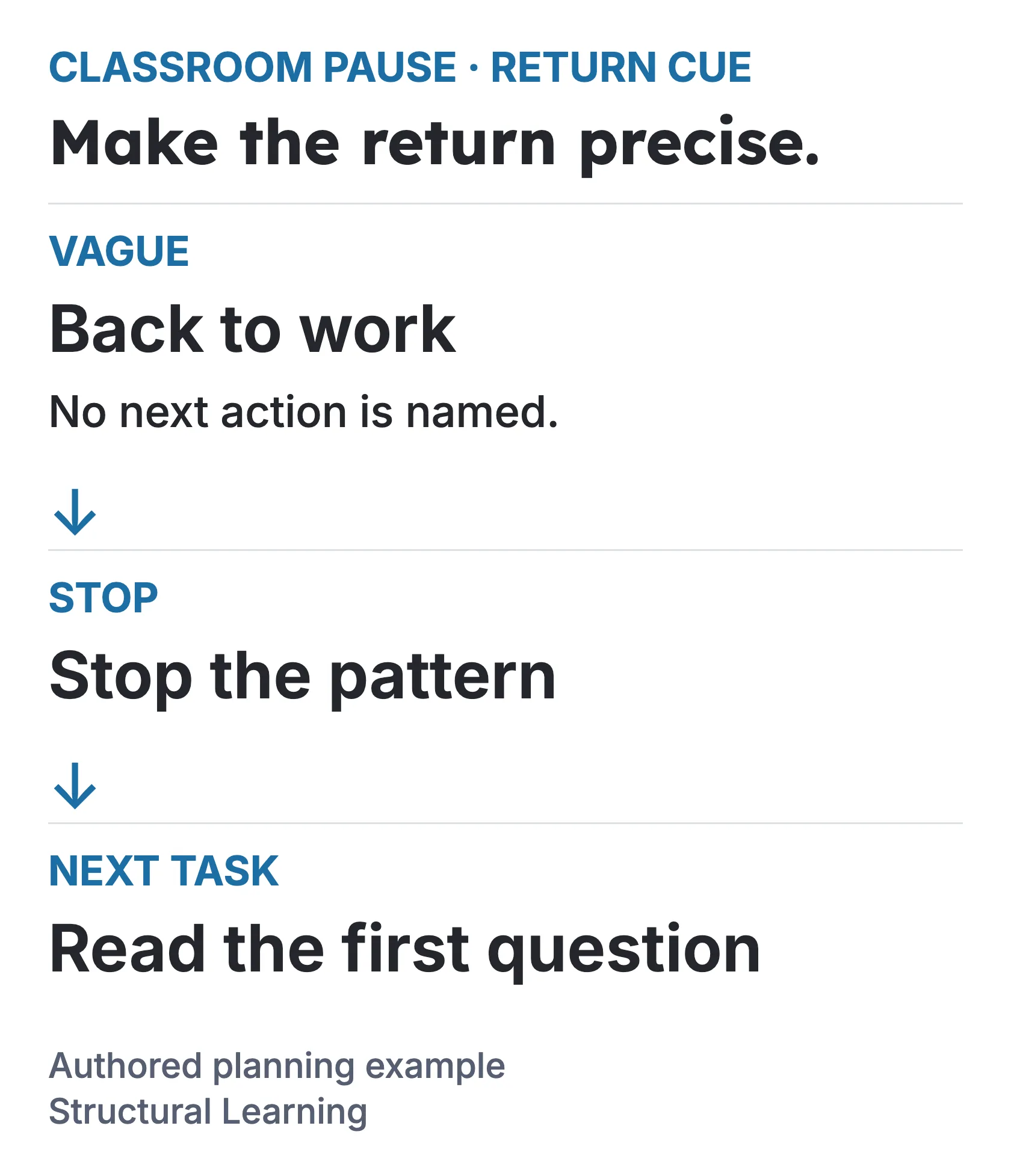
“Back to work” leaves the action to stop and the next task unstated. In the example below, the teacher names both. The change makes the plan explicit without promising an improvement in learning.
Authored cue revision
Vague: “Back to work.”
Stopping action: “Stop the pattern.”
First next task: “Read the first question.”
Keep the words consistent with the activity learners are doing. For taps, say “Stop the taps”. For the reach pattern, name the pattern and the position of the hands. Then give the first instruction.
A visible next-step instruction can be part of the plan. Our classroom displays guide gives broader context for presenting classroom information. Use the display to name the first task clearly.
Decide what you will notice before the lesson. Did the activity stop on the cue? Did learners locate the next question? Did they begin the named task? These questions keep the note tied to visible actions.
A model note could read: “Most learners stopped tapping and began question one. Three still needed the first instruction repeated.” This is an authored example of a note, not a classroom report.
The note supplies no memory test, attainment comparison or measure of the activity’s effect. Use it to refine the directions you gave. For wider discussion of purposeful spoken instructions, see our oracy guide.
Choose Reach, Taps or Stand and return, then select a planning time of 45 or 60 seconds. Edit Context, Pause cue, Activity directions, Return cue and Next task. Read the whole sequence before using it.
Map It · Teacher planning
Choose an ordinary activity and planning time, then edit the five teacher fields. The plan specifies what stops, what happens during the pause and what begins next.
45 and 60 seconds are planning options, not recommended doses. No timer is included.
Changing the activity replaces your edited plan and selected time. Copy what you need first.
Your break plan
Incomplete plan
Changing the activity replaces your edited fields and selected time with that case’s starting plan. Copy any wording you need first. Reset restores all five starting fields and the default time for the currently selected case.
Print the current activity, time and five fields as a teacher sheet. Blank fields are labelled Incomplete. Complete those directions before use. The planner organises your text; it does not assess benefits or generate a new routine.
Watson and colleagues (2017) reviewed physical classroom activity among children aged 5–12. Their 39-article review included 16 articles in meta-analyses and found substantial variation in interventions and outcomes. Its pooled classroom-behaviour result favoured physical activity. The cognitive-function estimate was statistically inconclusive. Ruhland and Lange (2021) also stress differences in participants, duration and activity type. Masini and colleagues’ published-study account (2020) includes 22 studies; its pooled time-on-task analysis of two studies was statistically inconclusive.
These sources concern physical-activity programmes. They do not validate every quiet change of task, the exact activities here, the chosen 45/60-second times or the new secondary plans. All three examples are teacher planning proposals. The observations described are local checks of stopping and restarting, without a comparison that establishes a learning effect.
The four-page static PDF contains the three completed plans, an original blank template, four scenario tasks and full model answers. Write your planning responses in a notebook or on paper. Each scenario supplies its time, arrangement and next task.
The tasks ask you to choose by logistical fit, improve a return cue, name the first next step and distinguish an observation from a claim about memory. Alternative wording can be suitable when it preserves the supplied facts.
Download the four-page planning pack (PDF)
They are author planning choices for these examples. The sources do not establish them as optimal durations or test the exact plans here.
The popular label covers different pauses and activity changes. The physical-activity evidence cited here does not establish the same effects for every quiet change of task.
Name the activity to stop and the first task to begin. In the taps example, stop the taps, return to the marked passage and read question one.
A completed plan records your directions. Observe the return to the task and refine those directions from what you notice. It does not establish a causal learning or memory benefit.
Centers for Disease Control and Prevention (2024). Classroom Physical Activity. Guidance dated 26 June.
Watson, A., Timperio, A., Brown, H., Best, K., and Hesketh, K. D. (2017). Effect of classroom-based physical activity interventions on academic and physical activity outcomes: a systematic review and meta-analysis.
Ruhland, S., and Lange, K. W. (2021). Effect of classroom-based physical activity interventions on attention and on-task behavior in schoolchildren: A systematic review. Sports Medicine and Health Science, 3(3), 125–133.
Masini, A., Marini, S., Gori, D., Leoni, E., Rochira, A., and Dallolio, L. (2020). Evaluation of school-based interventions of active breaks in primary schools: A systematic review and meta-analysis. Original author’s Study 1 account of the published review, Journal of Science and Medicine in Sport, 23(4), 377–384.