Updated on
October 7, 2026
KWL Charts: Examples, Templates and Teaching Routine
Teach a KWL chart before, during and after reading, with checked sound and library examples, an editable source sheet and four-page printable practice.

Updated on
October 7, 2026
Teach a KWL chart before, during and after reading, with checked sound and library examples, an editable source sheet and four-page printable practice.
What is a KWL chart?
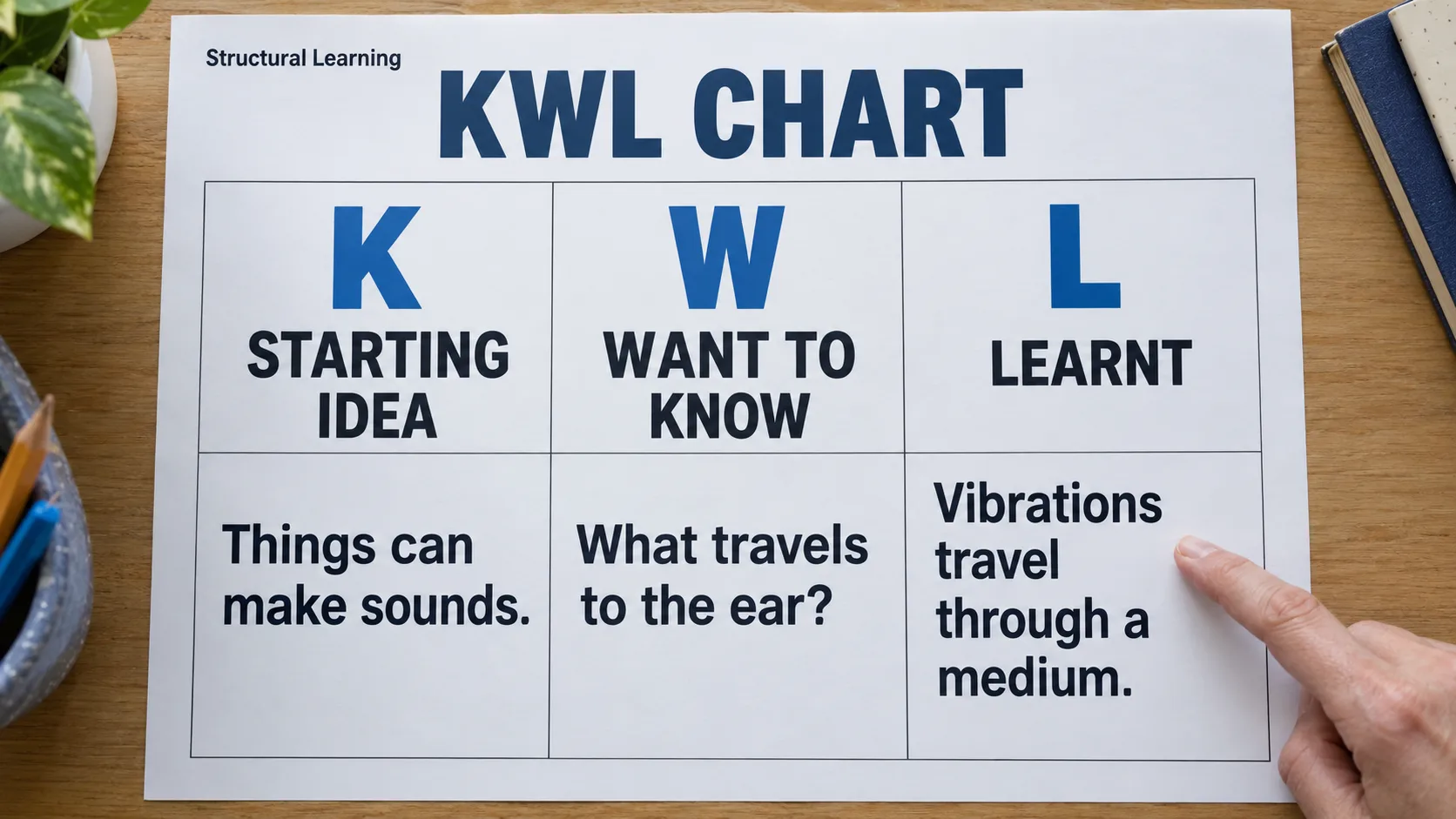
A KWL chart is a three-column organiser for Know, Want to know and Learned. Record starting ideas as claims to check, use questions to guide reading, and link learned entries to evidence. Revisit ideas that need changing and leave questions open when the source does not answer them.
Before reading, ask learners for an idea they want to check and a question they want answered. Mark the idea as a starting claim. After reading, return to it with the source visible. Show whether the evidence confirms it, changes it or leaves it unresolved.
Try this tomorrow
Year 4 science. Use the two-sentence sound source below. Record one idea to check and two questions. After reading, answer the supported question, revise the initial idea and leave the speed question open.
Key takeaways
KWL stands for Know, Want to know and Learned. The classic chart has these three columns. The ReadWriteThink guide uses the chart before, during and after research. Here, label K entries as starting ideas and check them against the source.
Keep the first entry short enough to revisit. Ask, “What makes you think that?” Record the response as a starting idea to check. Add a question that the lesson’s source might answer.
Our visual organisers guide already offers a KWL option in a type-and-subject selector. This article focuses on the teaching sequence around the chart: checking a source, matching answers and showing a revision.
Source and setup first. The Department for Education Year 4 Sound programme links sounds with something vibrating and states that vibrations from sounds travel through a medium to the ear. The starting ideas and questions below are authored teaching cases.
Supplied source
Something vibrating can make a sound. Vibrations from sounds travel through a medium to the ear.
Before: K and W
K1, idea to check: Sound can reach the ear without travelling through a medium.
K2, idea to check: Something vibrating can make a sound.
W1: What travels from a sound source to the ear?
W2: How fast do these vibrations travel?
During: inspect the source
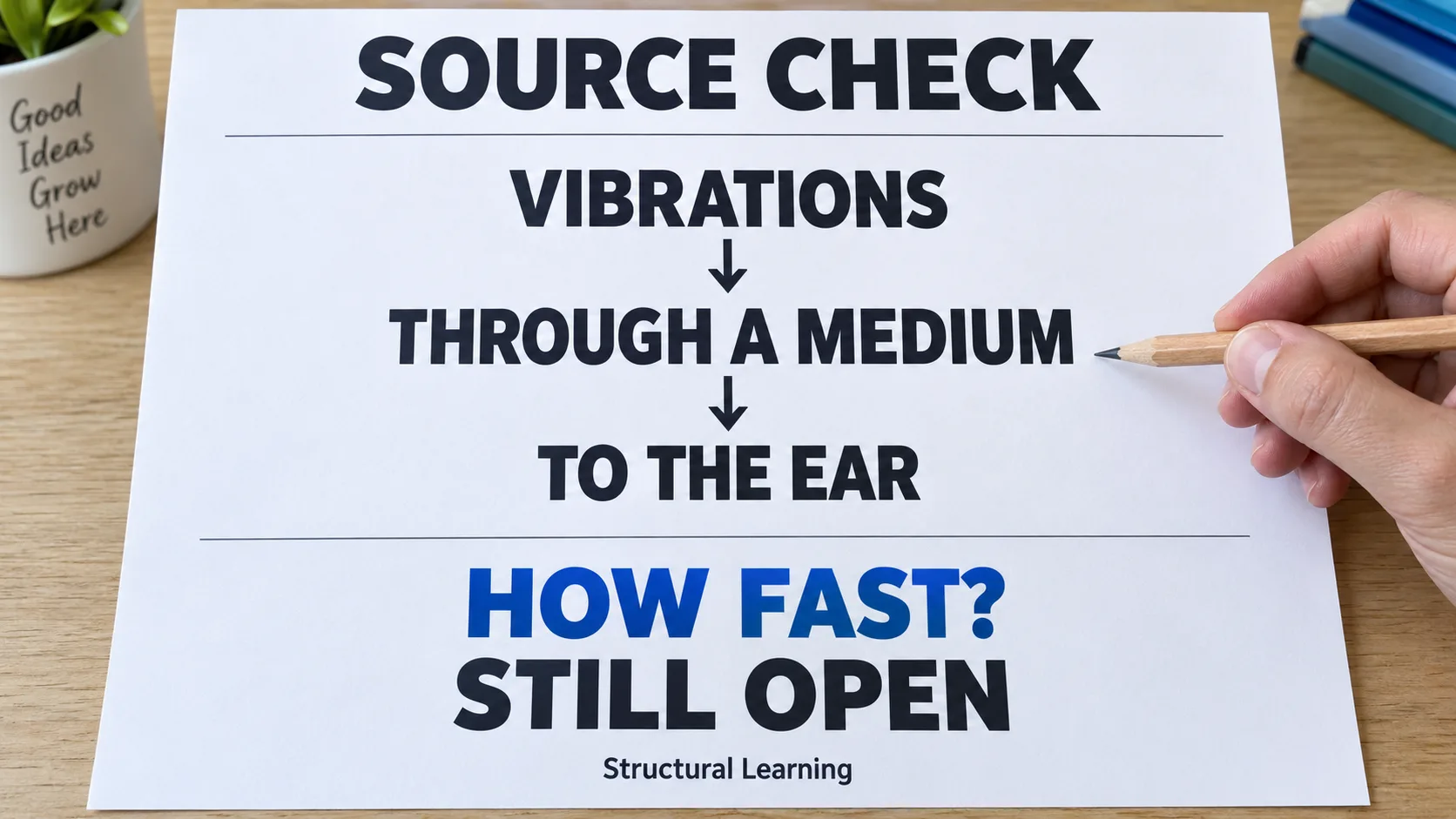
Read the two statements. Locate “vibrations”, “through a medium” and “to the ear”. Ask which question these words answer.
The source supplies a route. Keep the speed question open.
After: L and source checks
L1: Vibrations from sounds travel through a medium to the ear. This answers W1.
L2: Something vibrating can make a sound. This confirms K2 within the supplied source.
Revise K1: Replace “without travelling through a medium” with the supported statement “through a medium”.
Keep W2 open: The source gives no speed.
The revision is the teaching move. Put K1 beside the source statement and ask which words disagree. Then ask for a corrected sentence. The complete model is: “Vibrations from sounds travel through a medium to the ear.”
A learned entry can answer a W question or check an earlier K idea. Keep those relationships explicit. L2 checks K2. W2 stays open until a further source supplies the requested speed information.
Read the source for the chosen question. Underline or identify the phrase that supports the answer. Then write an L entry that retains its meaning. A copied sentence is a starting point for discussion; ask learners to explain what it says.
| Question | What the source supplies | Decision |
|---|---|---|
| What travels to the ear? | Vibrations from sounds, through a medium. | Write the supported answer in L. |
| How fast do these vibrations travel? | No speed or number. | Keep the question open. |
For the open question, name what another source would need to supply. In this example it would need speed information for an appropriate context. Leave the answer blank until that information is available.
The broader inquiry cycle gives context for carrying a question into further work. An unanswered question records the limit of the current source.
Source and setup first. This original fictional planning passage supplies all the information for the exercise. Use it as an authored practice case.
Supplied library passage
The school library will close on Friday afternoon for a stock check. New loans can be made again on Monday morning. Already borrowed books keep their stated due dates.
Before
K1, idea to check: New loans resume on Monday afternoon.
K2, idea to check: Already borrowed books keep their due dates.
W1: When can new loans be made again?
W2: How many books will staff check?
After
L1: New loans resume on Monday morning. This answers W1 and revises K1.
L2: Already borrowed books keep their stated due dates. This confirms K2 within the passage.
W2 stays open: No book count is given.
Contrast morning with afternoon and point to the second sentence. The corrected entry preserves the source’s wording. For W2, the question asks for a number. This source gives a reason for closing. Keep the book-count question open. Use our inference and deduction guide to plan questions about stated information and interpretation.
Keep the original idea and its revision visible in the notebook or discussion record. That shows what changed. The editable sheet displays the current version. Keep earlier versions in your separate record.
Use the source check to choose a specific follow-up. A supported answer, a changed starting idea and an open question need different responses.
| Entry | Teacher response |
|---|---|
| Supported L answer | Ask the learner to explain it and identify the supporting phrase. |
| K conflicts with the source | Compare the two statements and write a supported revision. |
| Open W question | Identify the missing information and plan a suitable further source. |
The schema-building guide warns that a chart can retain a wrong idea when it is recorded and left alone. The revision step here gives the teacher a concrete response.
Our responsive teaching guide provides wider planning context. Judge the content of an answer, then choose what to revisit. Pair the completed grid with its source check to show which claim was reviewed.
Keep the classic three-column structure. The separate source reference and Learned check are added teaching supports. They record where an answer came from and that you have reviewed the L entries against it.
The manual mark applies to Learned entries only. Review K ideas and W questions separately. In the sound model, W2 remains open even after the two L statements have been checked.
ReadWriteThink also describes an optional K-W-L-S extension. S records what older learners still want to learn. That is different from the source-reference addition used here. Label an adaptation clearly rather than changing what the classic letters mean.
Edit Topic, What We Know, What We Want to Know, What We Learned and Source used. The initial example is the authored sound case. Choose Before to hide Learned in both its editor and preview. Choose After to show it.
Map It · K/W/L
A starting idea in K can still need checking. Add learning only after reading the source. Leave unanswered questions in W. Make each match against the source yourself. The check applies to Learned entries only. Before view hides the Learned editor and sheet column.
Example
Source used:
Learned entries not checked
When you have checked the Learned entries, use the manual checkbox. Its output says, “Learned entries marked as checked by you.” Any edit clears that mark. Add both a Learned entry and its source reference before marking the entries as checked.
The app preserves the questions you enter and displays your current text. Use the supplied source to judge each answer, match W questions with L entries and check subject claims.
Print the current view when ready. Reset restores the exact five starting fields in Before view with the mark unchecked. Copy any edits you need before resetting. Keep the source line as a reference beside the three classic columns.
What the sources establish
ReadWriteThink provides the classic chart structure and guidance for using it before, during and after research. The Department for Education provides the Year 4 sound content. The sound example uses that curriculum content. Both worked examples use the chart to check ideas, match questions and revise entries.
The sources do not establish that this adaptation improves attainment or works best across ages and subjects. The two classroom models and teacher responses are proposals. The library passage is fictional.
The science source is deliberately short. It answers a route question, not a speed question. The Learned mark records your manual check, not automatic verification. Official guidance supplies the procedural view. It is not a report of these authored lessons running in a classroom.
The four-page pack contains a filled sound model, an original blank template, practice tasks and full teacher answers. The separate source/check space is an adaptation. The PDF is static; write on it or in your notebook.
Use the sound task to revise K1 and distinguish W1 from W2. Use the library task to correct afternoon to morning and preserve the missing book-count question. All required source content is supplied.
Classroom resource
Download the KWL examples, blank template, practice and teacher answers (PDF)
No email is required for this download.
Plan the question, source and follow-up together.
Record what learners think they know, then check it. In this adaptation, K is explicitly labelled starting ideas. Retain a revision when the source changes an entry.
Keep the question open until a source supports an answer. State what information a further source would need to provide.
The classic chart has K, W and L. Keep the source reference and manual Learned check as separate additions.
The checkbox records your manual review of Learned entries. Review K ideas, answer W questions and judge each subject claim against the source yourself.
ReadWriteThink (n.d.). K-W-L Chart. Teaching with this printout and More ideas to try.
International Reading Association and National Council of Teachers of English (2004). K-W-L Chart. Original three-column chart. This pack uses an original layout.
Department for Education (2015 edition). National curriculum in England: science programmes of study. Year 4 Sound.