Updated on
September 24, 2026
Wait Time in Education: 3 Seconds That Change the Answer
Wait time strategies for the classroom: how long to pause after a question, the two pauses Rowe found, a classroom timer and what changes when you hold it.


Updated on
September 24, 2026
Wait time strategies for the classroom: how long to pause after a question, the two pauses Rowe found, a classroom timer and what changes when you hold it.
What is wait time in teaching?
Wait time is the pause a teacher leaves after asking a question before expecting an answer, and the pause after a learner finishes speaking before the teacher responds. Mary Budd Rowe named these wait time 1 and wait time 2, and found teachers typically leave under a second for each. Tobin’s 1987 review found classroom talk and achievement changed once average wait time crossed roughly three seconds.
Ask a question, then count. Most teachers, measured properly, get to about one before they fill the silence themselves. Rowe (1986) found teachers typically wait less than a second after asking a question, and less than a second again after a learner stops speaking.
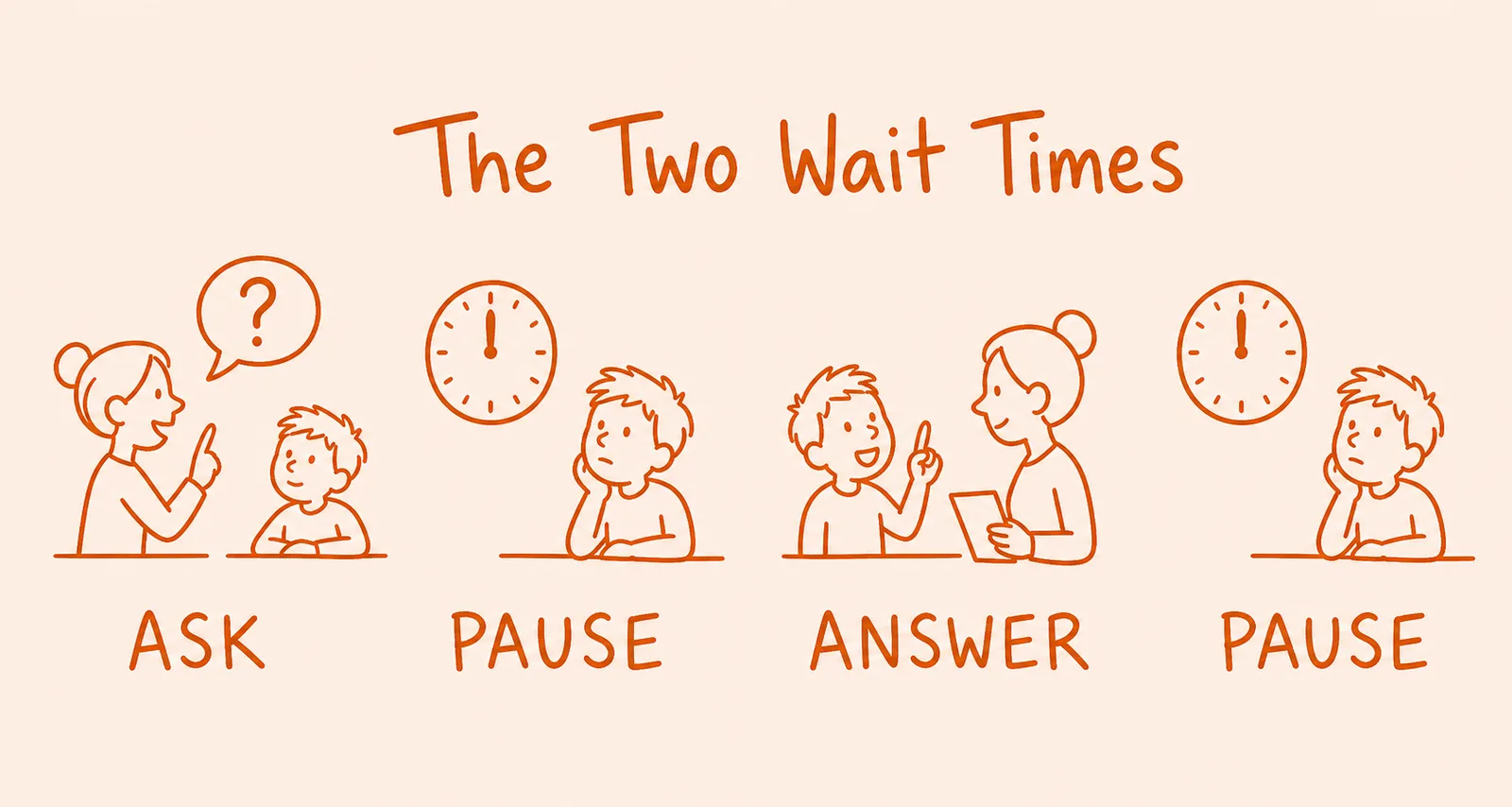
Wait time is the pause a teacher leaves after asking a question, before anyone is expected to answer. It has a second, less famous half: the pause after a learner finishes speaking, before the teacher responds. Rowe named these wait time 1 and wait time 2, and the second one is the one almost everybody drops.
The threshold everyone quotes is three seconds, and the real number is more interesting. Rowe's own 1986 paper puts the threshold at 2.7 seconds: "there is a threshold value below which changes in wait time produce little effect and above which (2.7 seconds) there are marked consequences for both teachers and learners". The three seconds teachers are trained on is her rounded practical target, not her measured threshold. Tobin's (1987) review then found the same shape across the wider literature: above roughly three seconds, teacher and learner talk changed and higher cognitive level achievement was obtained in elementary, middle and high school science, with gains also reported in middle school mathematics.
Here is what it looks like when it fails. A teacher asks a Year 8 class why the reaction slowed down. Nobody moves.
After a second and a half the silence is unbearable, so the teacher answers it themselves, or rephrases the question into a much easier one. The class has just learned that if they say nothing for two seconds, the question gets easier.
Wait time is the duration of the pause between utterances in classroom questioning. Tobin defines it exactly that way: the duration of pauses separating utterances during verbal interaction. In practice it means two distinct pauses, and treating them as one thing is the commonest reason teachers get little out of extending it.
Wait time 1 is the pause after you ask the question and before anyone answers. This is the one every training session covers. It gives learners time to retrieve, to construct a sentence, and to decide whether to risk it.
Wait time 2 is the pause after a learner stops talking and before you say anything. Rowe measured this too and found it equally short. It is the more powerful of the two and almost nobody does it, because the moment a learner stops, the natural teacher move is to evaluate: "good", "yes", "nearly". That evaluation closes the thought down.
Leave wait time 2 and three things happen. The learner who was speaking often keeps going and says the more interesting half. Other learners join in without being asked. And you stop being the hinge that every single utterance passes through, which is the shift that oracy work is trying to produce in the first place.
The evidence is old, consistent in direction, and thinner in method than its status suggests. It rests on a small body of classroom observation from the 1970s and 1980s, reviewed once in 1987, and it has not been meta-analysed. What it supports is a threshold effect rather than a dose response.
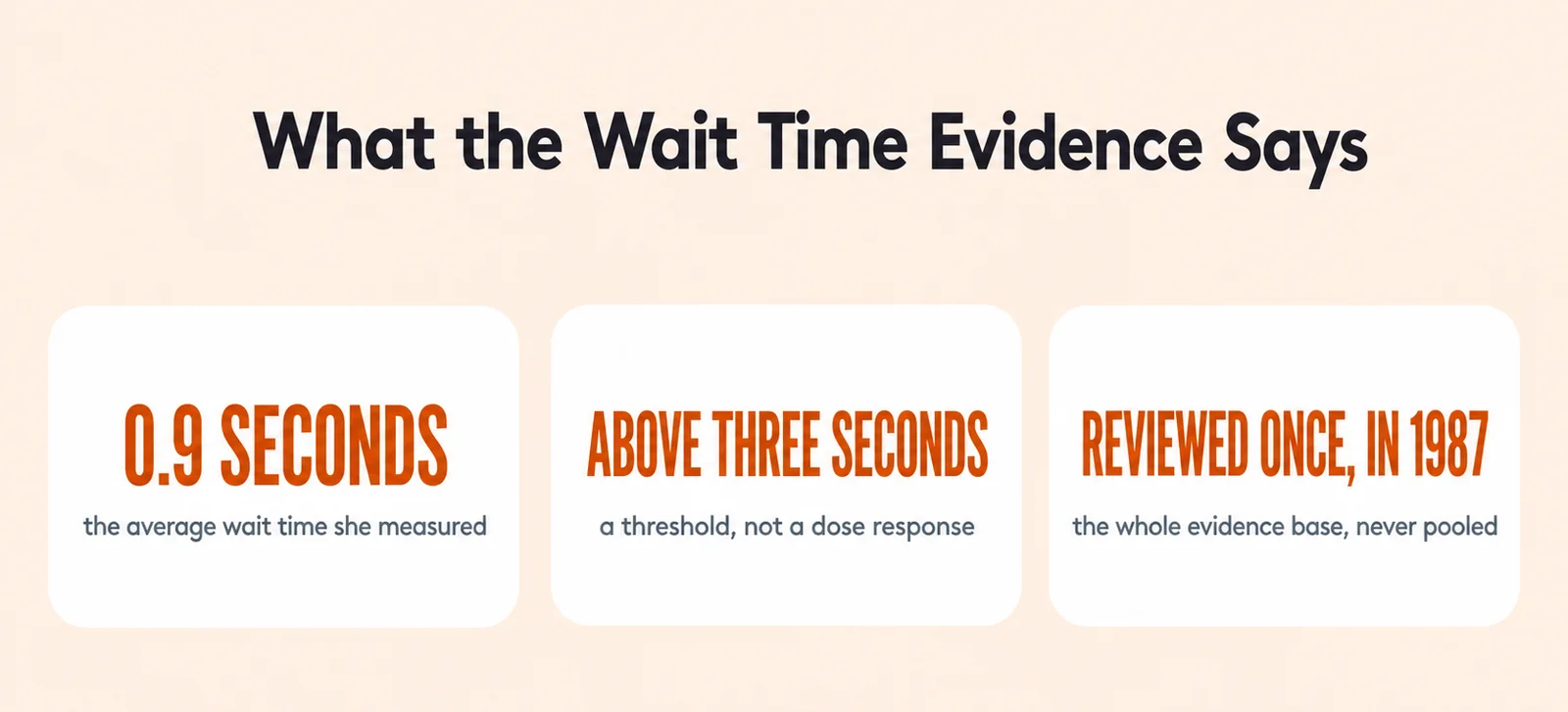
Rowe's 1974 study is the origin of the whole idea, and her 1986 summary in the Journal of Teacher Education is the readable version. The core observation is the one quoted at the top: teachers typically wait one second or less after asking, and less than a second after a learner answers. Her tape analysis put the average wait time 2 at 0.9 seconds. On the handful of anomalous recordings that started the whole line of research, wait time 1 ran to three to five seconds and wait time 2 exceeded three.
What extending it changed, in her account, was not simply that answers got better. It was that the shape of classroom talk changed: responses got longer, more learners volunteered without being called on, failures to respond fell, and learners started offering speculative reasoning rather than only recall.
Rowe was careful about her own work in a way her citers are not. She measured pauses with a servo-chart plotter and states plainly that measuring wait time with a stopwatch is unsatisfactory for research, because the pauses are too brief and too frequent to give reliable data. She also published a companion paper the same year, "Reflections on wait-time: some methodological questions", raising the measurement problems in her own study. A researcher publishing her own methodological doubts is a good sign about the researcher and a warning about anyone who quotes the headline without them.
Tobin (1987) reviewed the wait time studies across subjects and age groups. The finding is specific: above roughly three seconds of average wait time, discourse changed and higher cognitive level achievement was obtained in science across elementary, middle and high school, with increases also reported in middle school mathematics. His explanation is that the pause gives both teacher and learners additional time to think.
Two things follow that teachers rarely hear. It is a threshold, so going from one second to two probably buys you very little, and the gain arrives when you cross three. And the achievement evidence is concentrated in science and mathematics, which is where the studies were done, not a statement about every subject.
There is no meta-analysis of wait time. The evidence base is a set of classroom observation studies conducted largely in one period, reviewed once. Nobody has run a large modern randomised trial of extending wait time, and the effect sizes teachers see quoted are generally not from any single measurement.
Longer is also not indefinitely better. Nothing in the literature supports waiting ten seconds, and a pause long enough to become an event stops being thinking time and becomes social pressure.
Extending wait time is famously hard because the silence feels much longer to the person responsible for it. Four moves make it survivable. Tell the class what the pause is for, count it deliberately rather than by feel, refuse to fill it with an easier rephrase, and then leave the second pause after the answer. The first of those matters most, because an unexplained silence gets read as a hunt for a volunteer.
Give the pause a job and say what it is. Silence with no instruction is ambiguous, and learners read it as a hunt for a volunteer. "Ten seconds to think, nobody's hand up yet" converts the same silence into a task. This is also what stops the fastest three learners from owning every question.
Count deliberately. Three seconds is longer than it feels. Count it in your head, or watch the second hand. Most teachers who believe they wait three seconds are waiting one and a half, and the only way to find out is to be timed or recorded.
Do not fill the silence with a rephrase. Rephrasing is the commonest way wait time collapses, because it feels helpful. Almost always it makes the question easier, and the class learns to wait you out. If the question needs rebuilding, rebuild it before the lesson using the stems in our guide to higher-order questioning, not in the silence. If you want everyone rehearsing rather than one learner answering, turn and talk does that job better than a longer silence.
Then leave the second pause. When the learner stops, say nothing. Look at them. Count two.
This is the hardest one and it is where the reasoning arrives. If you must do something, make it a neutral prompt rather than an evaluation: "and then?", or "say more".
Wait time pairs naturally with the techniques that decide who answers. It is technique 33 in Teach Like a Champion 3.0, one of the 63 set out in our complete guide to Teach Like a Champion, and it sits in the same chapter as cold calling. The two work together: the pause creates the thinking, and the cold call means everyone has to do it. Our guide to questioning covers how the question itself is built.
Mini app · Build It · Routines
Put it on the board and the clock does the chivvying, so you do not have to.
Do Now
04:00
ReadyFour minutes, on your own, in silence.
Routines
It ends in silence on purpose. A timer that shouts across a room of learners working is a second interruption, not a signal.
The same three seconds do different work depending on the question, so here are five classrooms and what the pause buys in each.
| Classroom | The question | What the pause does |
|---|---|---|
| Year 2 phonics | Which sound do you hear at the end of "jump"? | A three-count lets the whole carpet segment the word before hands go up, so the answer comes from thirty mouths rather than the fastest one. |
| Year 6 maths | Why does 0.5 x 8 give a smaller number than 8? | The pause after the first answer, wait time 2, is where "because half of 8 is 4" turns into a rule about multiplying by less than one. |
| Year 8 science | Why did the reaction slow down? | The teacher counts three, refuses the rephrase, and the second answer names the concentration falling. |
| Year 10 English | What does the second stanza change? | "Ten seconds, no hands" turns the silence into a task and stops the same three learners answering. |
| Year 12 history | How far was the reform a response to pressure from below? | Wait time 2 after the first answer lets the speaker add the counter-argument themselves, before anyone else supplies it. |
Wait time is one of the few techniques where the inclusion story mostly runs in its favour, with two real exceptions. Rowe herself discussed its use with learners with additional needs in her 1986 paper, which is more than most techniques can say.
For learners with slower processing or a language disorder, the pause is the accommodation. A learner who needs longer to retrieve a word is excluded by a one-second wait and included by a four-second one, without anything else changing and without anyone noticing. Developmental language disorder is common enough that this is not an edge case: Norbury and colleagues (2016), screening a population sample of over 7,000 children, found roughly two in every thirty at school entry met criteria for language disorder. In a class of thirty, the extra two seconds is for them.
For an anxious learner, a long public silence can be the problem rather than the solution. If the silence is understood as the class waiting for a named individual, extending it extends the exposure. The fix is to make the pause collective and explicitly not a hunt for a volunteer, which is the same move that makes wait time work anyway.
For a learner with selective mutism, extended waiting for speech increases the demand rather than reducing it. The pause is not neutral if what is being waited for is a spoken answer from someone for whom speech is the difficulty. Agree a non-verbal route in advance.
Say the pause out loud where it helps. "I'm going to give everyone ten seconds" removes ambiguity for learners who find unstructured silence hard to read, including many autistic learners, and it costs the rest of the class nothing.
This is the finding that should matter most to anyone teaching in an international school, and it is buried in Rowe's own 1986 review rather than in anything written since.
Rowe reports Shrum (1985), who measured wait time in second-language classes and found wait time 2 running at 0.73 seconds, shorter than the 0.90 seconds Rowe recorded in ordinary classrooms. Rowe's own verdict on that figure is that it is "much too short for thoughtful cognitive processing". Shrum also found that average wait times are longer following questions asked in the learner's first language than in their second.
Read that twice. A learner working in an additional language needs more time to construct a response, and the measured reality is that they are given less of it. The mechanism is presumably ordinary and unconscious: a hesitant answer in a second language reads as not knowing, so the teacher steps in sooner.
Rowe reports the same pattern for learners with additional needs from the other direction, citing two 1985 studies by Korinek and by Lee in which learners did better at a five-second interval than at the usual one second. Her explanation is plain: "in these cases, fundamental processing just takes more time."
One caution about a figure you will meet. Various teacher-facing sites recommend twenty to thirty seconds of wait time specifically for learners with English as an additional language. That figure could not be traced to any study. What is established is the direction, not a number: these learners currently receive less time than their classmates, and the fix is to give them at least as much rather than to hit a target nobody has tested.
It is awkward for you, not for them. Learners experience the pause as thinking time once they know what it is for. Say what the pause is for ("nobody answers for three seconds, everyone gets a first idea"), then count it rather than feel it. Counting turns a social discomfort into a procedure, and procedures are easy to keep.
They sit there when the pause has no task. Give it one. "Everyone writes one idea on the whiteboard" or "rehearse your answer with your partner" turns the wait into visible thinking, and you can see who is stuck. A Year 5 class that has to hold up a board cannot opt out of the silence.
Three seconds on ten questions is thirty seconds a lesson. The real cost sits on the other side: a teacher who fills the gap answers their own questions, which covers the content without anyone learning it. If coverage is the worry, cut a question rather than the pause; the ones that survive will do more work.
True, and that is the point. A pause after "what is the capital of France?" changes nothing, because there is nothing to think about. Wait time is an argument for asking fewer, better questions: ones that need a because, a comparison or a prediction. Plan two of those per lesson and give each its three seconds.
The technique is well supported in direction and weakly supported in modern method. The evidence is old and has never been meta-analysed, the achievement findings come from science and mathematics classrooms specifically, and the whole thing is easy to reduce to a number on an observation form. Three qualifications are worth holding before it becomes a lesson observation criterion.
Li (2026) is useful here because explores how modern digital tutors and educational AI systems are programmed with 'artificial wait time' to prevent immediate answers and develop learner cognitive engagement. McGill (2021) is useful here because reframes wait time from a purely interactional tool into a cognitive necessity, exploring its role in managing working memory during high-stakes classroom questioning.
The evidence is old and has never been meta-analysed. The foundational work is from 1974, the review from 1987, and there is no modern trial. That does not make it wrong. It does mean anyone quoting a precise effect size should be asked where it came from.
The achievement findings are subject-specific. Tobin's higher-attainment results are in science and mathematics, because that is where the studies were run. Extending that to all subjects is reasonable inference, not evidence.
It becomes a tick-box in lesson observation. Counting a teacher's pause is easy to observe, which makes it attractive to put on a form. A three-second pause after a question with one obvious answer changes nothing. The pause is only worth anything if the question was worth thinking about, and the observation form cannot see that.
Wait time is the pause a teacher leaves after asking a question before expecting an answer, and the pause after a learner finishes speaking before the teacher responds. Rowe named these wait time 1 and wait time 2.
At least three seconds. Rowe's own measured threshold is 2.7 seconds, and she rounds it to three as a practical target. Tobin's 1987 review found the same pattern across the wider literature: below the threshold very little changes, above it both classroom talk and higher cognitive level achievement shift.
They are usually used to mean the same pause. Some writers prefer think time because it names what the silence is for rather than what the teacher is doing, which is a fair point: a pause with no stated purpose tends to be read as waiting for a volunteer.
Because silence feels far longer to the person responsible for it. Most teachers who believe they wait three seconds wait about one and a half. The only reliable way to find out is to be recorded or timed by a colleague.
Usually yes, and it is one of the cheapest adjustments available. For a learner with slower processing or a language disorder the pause is the accommodation. The exceptions are anxious learners, for whom a long public silence can increase exposure, and learners with selective mutism, for whom waiting increases the demand to speak.
Every reference below was checked twice: once to confirm it exists, and again to confirm the record it resolves to is the paper being cited. Links go to the original publisher rather than to an aggregator.