Updated on
October 1, 2026
Class Discussion Techniques: Habits, Picker and PDF
Choose a class discussion technique for your lesson. Try the structure picker, teach habits that connect ideas, and download the practical PDF card.

Updated on
October 1, 2026
Choose a class discussion technique for your lesson. Try the structure picker, teach habits that connect ideas, and download the practical PDF card.
What are habits of discussion?
Habits of Discussion teaches learners to connect contributions by adding reasons, asking questions and clarifying ideas. Doug Lemov’s technique combines learner conventions with teacher planning. Choose a structure for the task and provide accessible ways to participate.
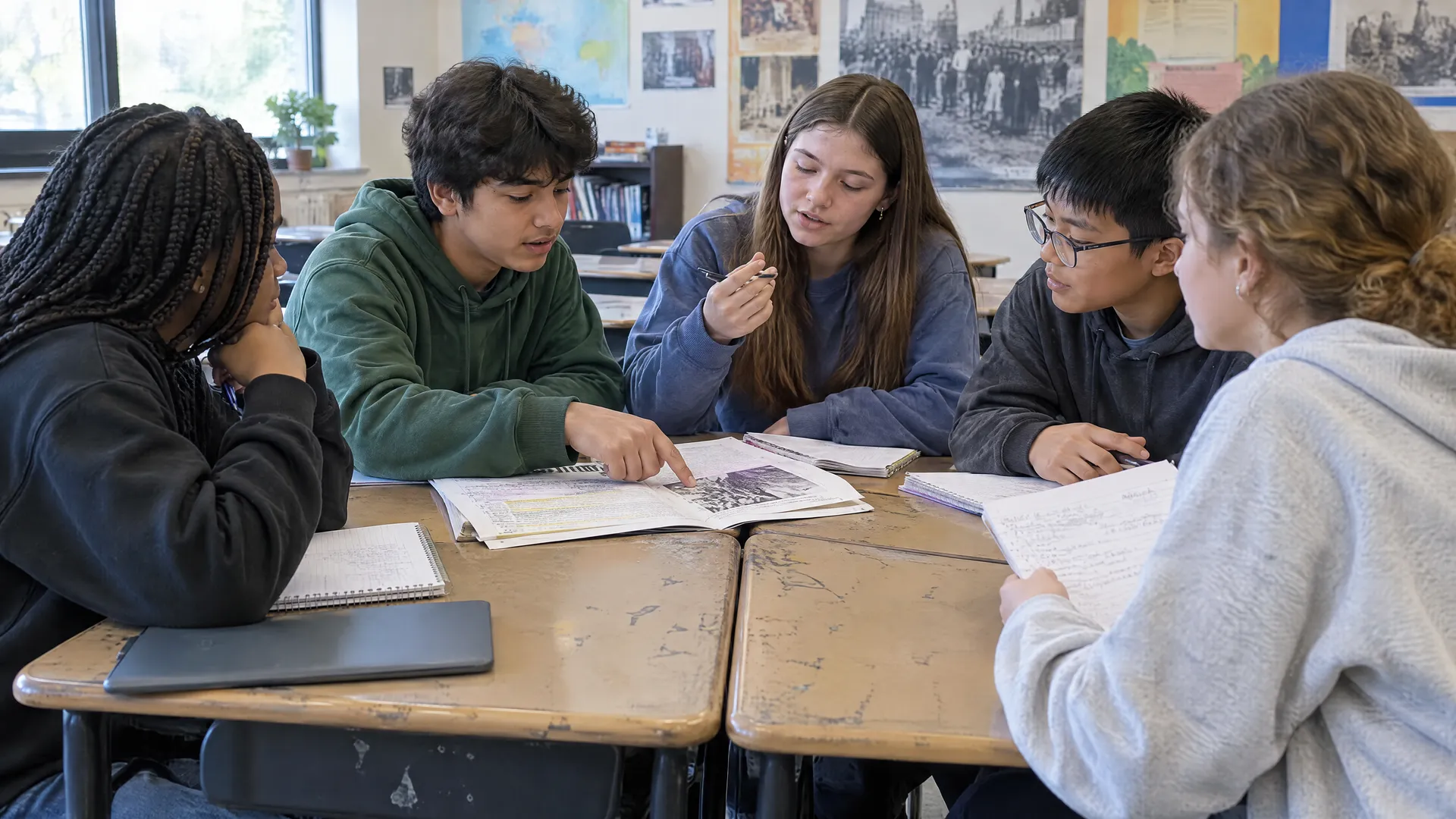
A class discussion technique is a way to organise how learners exchange ideas. Habits of Discussion adds a useful focus: connect a response to what someone has already said. For example, in Year 8 / Grade 7 history, one learner argues that the Luddites opposed machinery. Another asks whether the evidence points instead to worries about wages. The second contribution gives the class something to examine.
A structure shapes the exchange, but it cannot supply the question, knowledge or reasons. The menu includes think, pair, share, snowball, envoys, fishbowl, silent talk, philosophical chairs, Socratic seminar and Harkness. Choose according to what learners need to do: rehearse an explanation, compare reasons, test a text or develop an idea together.

Surface participation
“I respectfully agree.” A discussion stem replaces the explanation.
Reasoning to explore
“You said the source shows agreement. I read this phrase differently because…”
Follow-up check. Ask the learner to paraphrase the earlier idea before explaining the difference.
Show the class both versions. Ask which reply builds on the earlier idea and which only sounds polite.
For a short pause within a lesson, try a partner exchange. A prepared-text seminar needs time for reading as well as talk. A written thread can make several ideas available at once, although writing also needs accessible alternatives. The picker offers starting arrangements and approximate timings. Adapt them to your task rather than treating a result as a prescription.
A discussion is a structure before it is a conversation: who speaks first, who tracks, what ends it. Say how long you have, what you want the talk to do and how many are in the room, and you get the structure that fits, the words to say, the roles, the rule that makes it work, and the thing it cannot give you.
Say how long you have, what the talk is for and how many are in the room, then show the structure.
Before you run it
Adapt the discussion conventions to your class: make an idea available through an agreed route, connect to an earlier contribution, explain agreement or disagreement, and add a useful reason or question. Model one move at a time and retain support while it helps.
Doug Lemov’s Teach Like a Champion 3.0 places Habits of Discussion at technique 44. Its training materials distinguish two parts: teaching talk fundamentals and planning or guiding the talk. The first helps learners respond to one another. The second helps the teacher connect those responses to a worthwhile learning goal.
Earlier editions use different technique numbers, so name the edition when citing the book. Habits of Discussion also differs from Habits of Attention. A visible listening posture does not establish that someone understood an idea. Look for evidence in a response, explanation or subsequent task.
Try one clear focus: a response should connect to an earlier idea. A learner might add an example, ask for evidence or explain a disagreement. Naming the earlier speaker can help make that link clear, but pointing to a written idea or checking a partner’s meaning can do the same job.
In the history example above, the teacher could ask: “Which evidence supports each explanation?” This returns attention to the claim. Asking everyone to use a particular phrase would tell you less about their understanding. The purpose is to develop an idea, not to reward a polished performance.
Lemov’s materials describe Strategic Restate, Knowledge Feeding and Stamping. These offer ways to return to an important idea, supply missing knowledge and make the emerging understanding clear. They need judgement: a talk may need clarification before it needs another question.
A teacher’s summary is not evidence that every learner understood. A check of each learner’s grasp can show what still needs teaching. A short explanation, choice with a reason or annotated example may be more useful than counting ideas.
The studies checked for this guide did not isolate Habits of Discussion as a named technique. They examined dialogue features or supported teaching programmes. Use them to inform your choices, while keeping that distinction clear. The dialogic teaching guide explains the broader pedagogy.
Look at how one response connects to an earlier idea. Ask which reason or example helps the group make its explanation more precise.
Teacher voices · Say It
Understanding cannot be inferred from silence, compliance or one correct answer.
@dnleslie
A calm room or an active discussion can both hide gaps. After the exchange, ask for a short explanation or worked example that shows each learner’s thinking.
A classroom routine gives talk a shape. The next question is what the reasoning shows and which knowledge or response would help it develop.
Classroom practice · Say It
| Give the second partner a thinking job | ||
|---|---|---|
| Starting point | Try in your lesson | Check the boundary |
| Ask the first partner for an explanation. Invite the second to add a reason, ask a question or test an example. Reverse the roles when it serves the task. | Notice what the second contribution adds. A sentence stem can cue a response, but it cannot establish the quality of the reasoning. |
The Education Endowment Foundation’s Dialogic Teaching trial tested a whole supported programme, with training, mentoring and video review. It did not test Habits of Discussion, so the trial’s results cannot be claimed for a set of discussion habits on their own. The dialogic teaching guide covers what the trial found and what its follow-up showed.
Howe and colleagues (2019) analysed 144 lessons in 72 English primary classrooms. Elaborating and questioning earlier ideas were associated with curriculum mastery when participation was extensive. Elaboration was also associated with attitudes. This was an observational study of existing lessons, so the findings do not establish that those talk moves caused the outcomes.
Extensive participation does not mean requiring every learner to speak publicly. It encourages attention to who has opportunities to engage with ideas. A learner may need preparation, a written response or an agreed communication aid. An observation of speech alone cannot show everything they understood.
Mercer, Wegerif and Dawes (1999) taught ground rules for reasoning together in a small matched-control study. The programme reported better group reasoning and improved scores on a test of reasoning. Mercer and Sams (2006) examined guided small-group maths work and reported benefits for reasoning and understanding. Both involved explicit teaching, rather than simply putting learners together.
Choose one useful move and show why it helps. Use familiar content at first, so learners can attend to the exchange as well as the subject. Then apply the move to a more demanding question. There is no fixed timetable for making a habit fluent.
123Model one of the numbered moves, such as paraphrasing an earlier idea, before the discussion begins.
Offer two versions of an exchange. In the first, the second speaker replaces the earlier idea with an unrelated answer. In the second, they add evidence or ask a question about it. Ask learners what the second version made possible. This gives the convention a purpose they can recognise.
For example, one learner says a character is brave because she returns to help. Another adds that she also says she is frightened. The class can now explore whether bravery requires feeling no fear. An answer can become better justified without anyone changing their view.
“I would add…” and “What evidence supports…?” can offer a starting point. Invite learners to finish in their own words. Keep a stem available for those who need it, and reduce prompts when learners can make the connection independently. Remove a scaffold according to its usefulness, not a date on the calendar.
Give thinking time after the question and after a demanding idea. A few seconds can be a starting point, but some tasks and learners need longer. A quick written note through Everybody Writes can help prepare an idea, where writing is an appropriate route.
Listen for the claim and its supporting reason. Is evidence being used accurately? Did a response clarify, challenge or extend the idea? Choose one example to revisit with the class, then check what each learner has understood. Do not assume that the most frequent contributor has the strongest grasp.
Turn and Talk provides a short rehearsal route. Exploratory Talk focuses on testing reasons together. Accountable Talk offers further ways to connect ideas and evidence. These approaches can serve different purposes within the same lesson.
Agree how learners can access the question and contribute to the thinking. Options may include preparation time, a visual prompt, writing, drawing, pointing, an AAC device or a partner-mediated response. Use established communication arrangements. An alternative route should involve the same subject idea, rather than an unrelated task.
An idea can contain a useful reason without following a prescribed sentence pattern. Teach subject vocabulary and formal registers when they serve the learning goal. During talk, attend first to meaning and evidence. Accent and home dialect are not measures of reasoning.
A learner may refer to an earlier idea without remembering the speaker’s name. Let them point to a note or describe the idea instead. If you offer advance notice of an idea, agree the route as well as the time. Notice alone does not remove communication or anxiety needs.
The NHS explains selective mutism as an anxiety condition in which a person may be unable to speak in particular situations. It recommends reducing speaking pressure. Quietness in a lesson is not enough to identify the condition.
Follow an existing support plan and work with the learner, family and relevant specialists. Agree a comfortable contribution route without drawing public attention to it. Do not use surprise questioning or a compulsory speaking turn as treatment. Our oracy guide places communication access alongside speaking and listening.
A protocol can become a performance of the rules. Learners may use the stems fluently while overlooking the evidence. Ask what became clearer, what is better supported and what remains unresolved. A count of changed minds is not a diagnostic test of learning.
Discussion also depends on subject knowledge. If the class lacks the information needed to weigh a claim, supply or revisit it. Use Socratic questioning to examine a reason, rather than to keep questioning a learner who needs an explanation. Sometimes a direct explanation followed by practice is the useful next step.
Before the next discussion, decide which earlier idea you want learners to build on, and write the question that brings it back.
They are taught routines for responding to earlier ideas, alongside teacher planning and guidance. In Lemov’s third edition they form technique 44. The aim is connected reasoning, rather than a series of unrelated answers.
The named technique comes from Doug Lemov’s practice framework. The author’s training materials distinguish learner fundamentals from leading the talk. Broader dialogue research can inform its use, but it does not establish the effect of the named technique alone.
Start with the thinking you need learners to do. A partner exchange can prepare an explanation. A seminar can examine a text in depth. Consider preparation, room arrangement and communication access before choosing a structure or timing.
Plan opportunities for each learner to engage with the idea. Do not make public speech the only acceptable route. Check understanding through a suitable response from each learner, and follow communication support plans where they are in place.
Choose one talk move for an upcoming lesson. Model it, listen to one exchange and use a response from each learner to decide what to teach next.
The PDF card puts the discussion moves on one page, with a worked maths example. It is a planning aid to adapt to your class, not a validated intervention.
Pick one habit, teach it with its sentence stem and listen for it in the next discussion. It has become a habit when learners use it without the prompt.