Updated on
September 23, 2026
Joy Factor: Fun Inside the Work, Never Fun as Payment for It
Rewards for engaging with a task reduced intrinsic motivation at d = -0.40 across 128 studies. Positive feedback moved it the other way at +0.33.


Updated on
September 23, 2026
Rewards for engaging with a task reduced intrinsic motivation at d = -0.40 across 128 studies. Positive feedback moved it the other way at +0.33.
What is Joy Factor?
Joy Factor is technique 63 in Teach Like a Champion 3.0, the last in the book. It means deliberately building moments of pleasure into lessons through competition, theatre, humour or games, so that the joy serves the learning rather than interrupting it. The evidence draws a sharp line between joy that is part of the work and joy offered as payment for it.
A teacher promises the class a game if they finish the exercise. They finish it. The next time there is no game, and the exercise is harder to get started than it was before the game existed.
Joy Factor means deliberately building moments of pleasure into a lesson: a chant, a competition, a bit of theatre, a game. It is technique 63 in Teach Like a Champion 3.0 (Lemov, 2021), the last in the book, in the chapter on building motivation and trust.
The relevant evidence is the most robust and most misunderstood finding in motivation research. Deci, Koestner and Ryan (1999) meta-analysed 128 studies of extrinsic rewards and intrinsic motivation. Rewards contingent on engaging with a task produced d = -0.40 on free-choice intrinsic motivation. Completion-contingent rewards, -0.36. Performance-contingent, -0.28. Positive feedback, by contrast, produced +0.33.
That set of numbers is the whole design brief for this technique. Joy that is part of the work is a different thing from joy that is payment for the work, and the second one has a measured cost.
Joy Factor is the deliberate use of fun as an instructional tool rather than as a break from instruction. It includes competition, theatre, humour, chants and games, and the criterion Lemov applies is that the joy should serve the learning rather than interrupt it. It is the last technique in the book, which is a reasonable place for it.
The distinction that matters, and that the technique's name obscures, is between joy that lives inside the work and joy that is exchanged for the work.
The overjustification literature is unusually settled, and it draws a sharp line straight through the middle of this technique. Rewards offered for doing a task reduce the desire to do it. Feedback about doing it well does not.
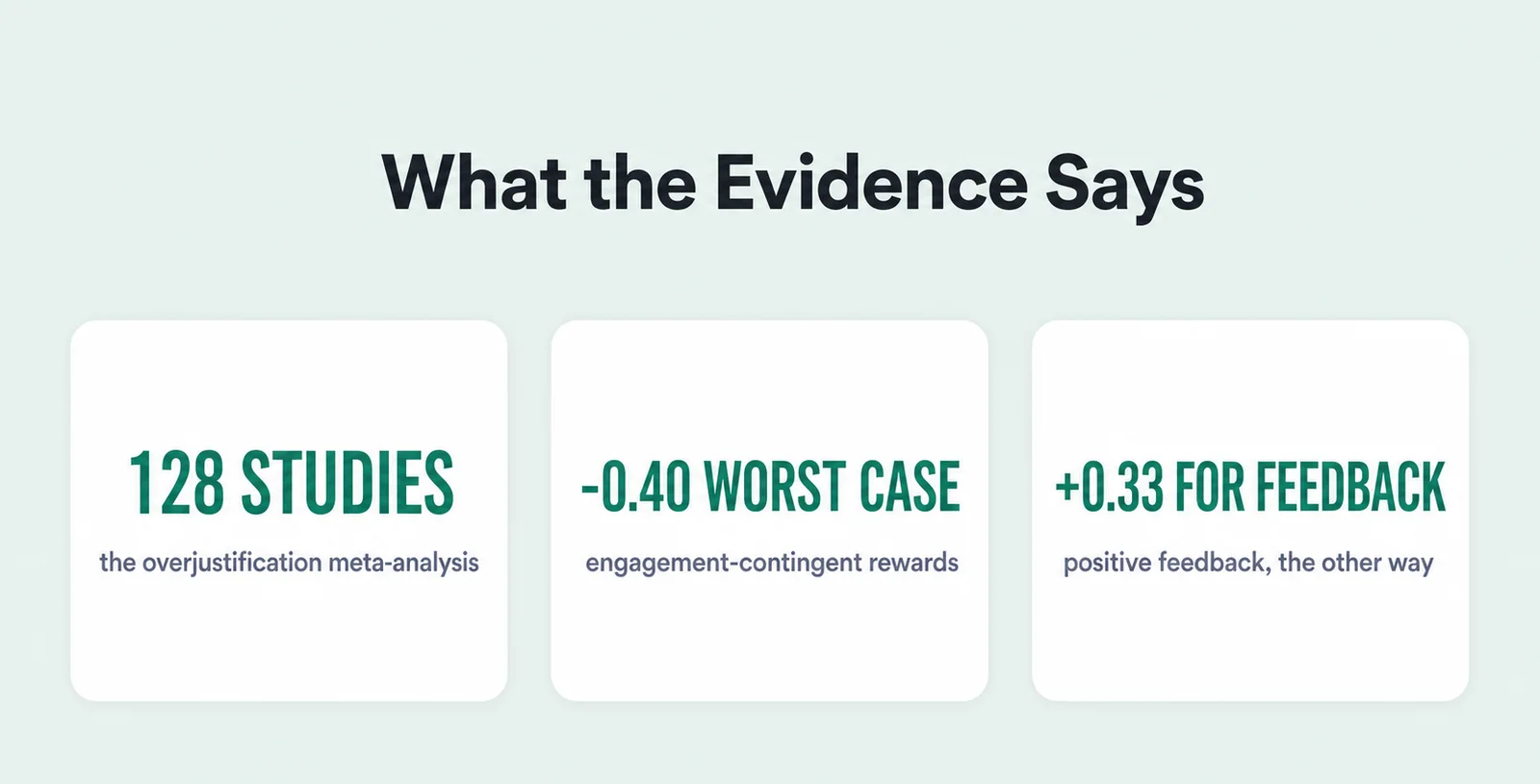
Deci, Koestner and Ryan's meta-analysis covers 128 studies and separates reward types cleanly. Every kind of tangible contingent reward reduced free-choice intrinsic motivation, with engagement-contingent rewards worst at -0.40. Positive feedback moved it the other way at +0.33, and self-reported interest at +0.31.
Applied to a classroom, that separates two things teachers routinely bundle. A game used as the practice, where the fun and the learning are the same activity, is not a reward and is not covered by the negative findings. A game promised for completing the practice is engagement-contingent, and it is the condition with the largest negative effect.
There is a qualification that runs against a school audience and should be said rather than buried. Verbal rewards were less enhancing for children than for college students. The positive half of this finding is weaker in exactly the population teachers work with.
It does not say competition is bad, or that classrooms should be joyless, or that fun undermines learning. It says that making an enjoyable thing conditional on completing an unenjoyable one teaches learners that the second thing needs paying for.
There is also no study of Joy Factor as a technique. Nothing tests whether adding designed moments of pleasure to lessons improves anything, and the honest position is that this is a plausible practice supported by an adjacent literature that mostly tells you how to get it wrong.
Four rules, and the first one carries almost all of the evidence. Put the joy inside the task rather than after it, keep it short, never make it conditional, and make sure it is not a reward for speed.
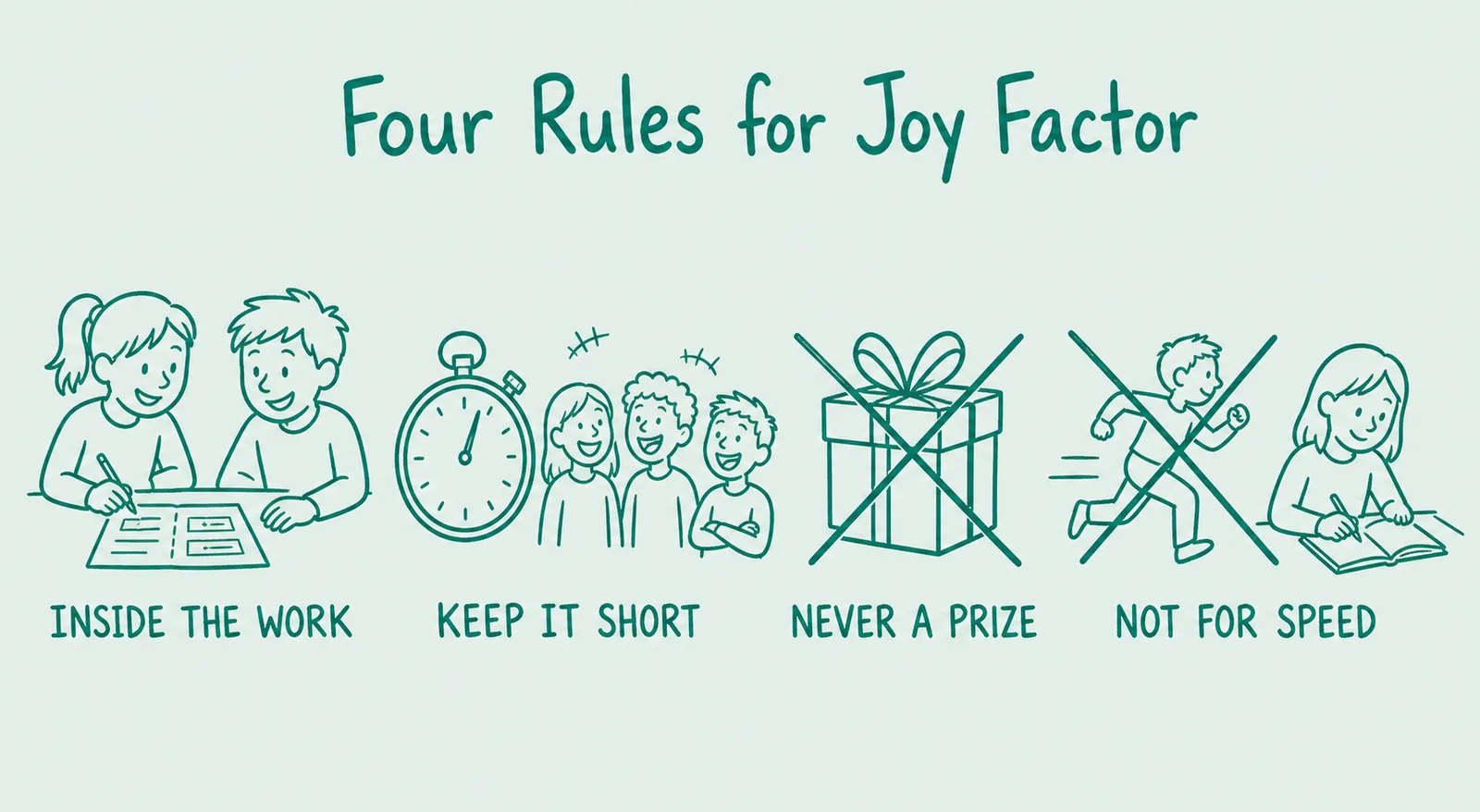
The fun should be the work. A competitive retrieval round is joy and practice at once. A quiz as a prize for finishing the worksheet is a contingent reward, and it is the shape the evidence warns about.
Keep it brief and end it cleanly. Ninety seconds of theatre inside a lesson costs nothing. Ten minutes of it becomes the lesson, and then the actual work is what happens after the good bit.
Never announce it in advance as an incentive. "If we get through this, we'll play the game" converts joy into payment in one sentence.
Do not attach it to finishing first. A reward for speed excludes exactly the learners who need the time, and it makes the fun a property of being quick.
The designed moments of pleasure that make a classroom lively are also the least predictable and the loudest parts of a lesson, which puts them exactly where several groups of learners struggle.
For autistic learners, spontaneity is not automatically pleasant. An unannounced chant or a sudden change of register removes the predictability that makes a lesson navigable. Signalling it in advance, "in a minute we are going to do the fast round", costs nothing and changes the experience.
Competition is not fun for everyone. For an anxious learner, a public race is a public risk. Competing against a previous score rather than against classmates keeps the energy and removes the exposure.
Volume is a real barrier. Chants and cheers are loud, and the noise degrades listening conditions for learners with hearing impairment or auditory processing difficulty just as the lesson gets most animated.
An opt-out should exist and should not be visible. A learner who does not want to join a chant should be able to not join it without that becoming a thing the class notices.
Joy Factor has no direct evidence base whatsoever. The literature that bears on it is about rewards and motivation, and its main contribution is a warning rather than an endorsement. The strongest positive finding in that literature, that positive feedback enhances intrinsic motivation, is weaker for children than for adults. And the technique's success criterion, that the class enjoyed it, is the least reliable measure in teaching, because a lesson can be enjoyable and empty.
It is technique 63 in Teach Like a Champion 3.0, the last in the book. It means deliberately building moments of pleasure into lessons, through competition, theatre, humour or games, so that the joy serves the learning rather than interrupting it.
Tangible contingent rewards do. Across 128 studies, rewards for engaging with a task reduced free-choice intrinsic motivation at d = -0.40. Positive feedback went the other way at +0.33, so feedback and rewards are not the same instrument.
That is the shape with the largest measured cost. A game made conditional on finishing the work is an engagement-contingent reward. Running the same game as the practice itself carries none of that problem.
Joy Factor is one of the 63 moves in our complete guide to Teach Like a Champion, and it sits beside precise praise in the same chapter on motivation and trust.
Two techniques sit closest to this one: positive framing, which shapes how the energy is described; and turn and talk, a routine that is enjoyable because of the work, not despite it.