Updated on
September 24, 2026
SLANT: Where It Came From, and Why Its Schools Dropped It
SLANT is not Lemov's. It is a 1991 Kansas strategy resting on one study of three learners, and Uncommon Schools retired it in 2020. What to keep.


Updated on
September 24, 2026
SLANT is not Lemov's. It is a 1991 Kansas strategy resting on one study of three learners, and Uncommon Schools retired it in 2020. What to keep.
What does SLANT stand for?
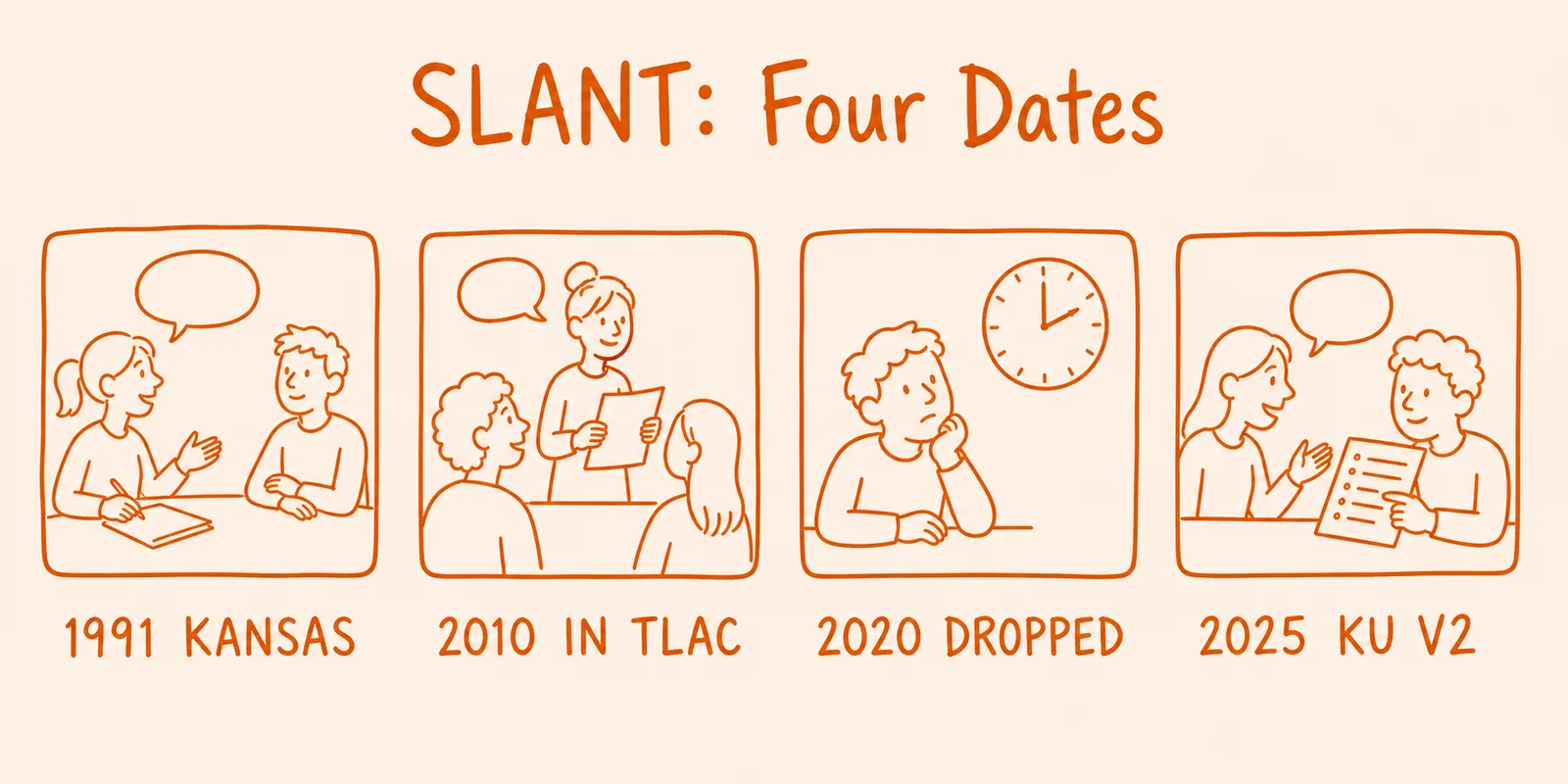
SLANT is a classroom participation acronym: Sit up, Lean forward (some versions say Listen), Ask and answer questions, Nod your head, Track the speaker. It was published by the University of Kansas Center for Research on Learning in 1991 as a strategy for learners with disabilities, adopted by Doug Lemov as technique 32 in the 2010 first edition of Teach Like a Champion, and publicly retired by Uncommon Schools in August 2020. It does not appear among the 63 techniques in Teach Like a Champion 3.0.
A Year 7 learner is sitting up, facing the teacher, nodding. Her eyes have not left the front of the room for four minutes. She is also, by every measure the research offers, less likely to be thinking hard than the learner beside her who is staring at the ceiling.
That is the difficulty with SLANT, and it is not the difficulty most people expect. SLANT asks learners to Sit up, Lean forward or Listen depending on whose version you have, Ask and answer questions, Nod your head, and Track the speaker. Two of those five are demands about the body, and one of them runs directly against what we know about how children manage a hard thought. In a Year 7 lesson, for example, the learner staring at the ceiling is very often the one doing the work.
Three facts change how this technique should be read, and none of them appears on the pages currently explaining it. SLANT is not Doug Lemov's; it was published by the University of Kansas in 1991. Its entire evidence base is one study of three learners (Ellis, 1989). And in August 2020 Uncommon Schools, the network Lemov helped found, publicly retired it.
SLANT is a mnemonic for five participation behaviours. Four letters are stable across every version: Sit up, Ask and answer questions, Nod your head, Track the speaker. The L is not stable. The University of Kansas original and most American sources give Lean forward. Much of the British coverage gives Listen. If you are writing it into a school policy, pick one and say which.
SLANT is published by the University of Kansas Center for Research on Learning as part of its Strategic Instruction Model, under the title "SLANT: A Starter Strategy for Class Participation". The first edition is dated 1991 and a second edition was issued in 2025, so this is not a retired artefact at its source. It is a live, maintained learning strategy.
That origin matters for two reasons. It predates Teach Like a Champion by nineteen years, so describing SLANT as a Lemov technique is simply wrong. And Kansas frames it as a strategy for learners to use, with the acronym as the surface of something deeper about becoming a strategic learner. The version that spread through schools kept the surface.
Lemov included SLANT as technique 32 in the 2010 first edition of Teach Like a Champion, which carried 49 techniques. That book, and the charter schools associated with it, are how the acronym crossed the Atlantic and arrived in English behaviour policies. Our guide to all 63 techniques in the current edition sets out the wider list and what changed between editions.
Kansas publishes its own research brief for SLANT, and it cites a single study: Ellis (1989), a multiple-baseline single-subject design with three learners with mild disabilities. The results were striking within that design, and the design is three learners. Both halves of that sentence should travel with any claim that SLANT is evidence-based.
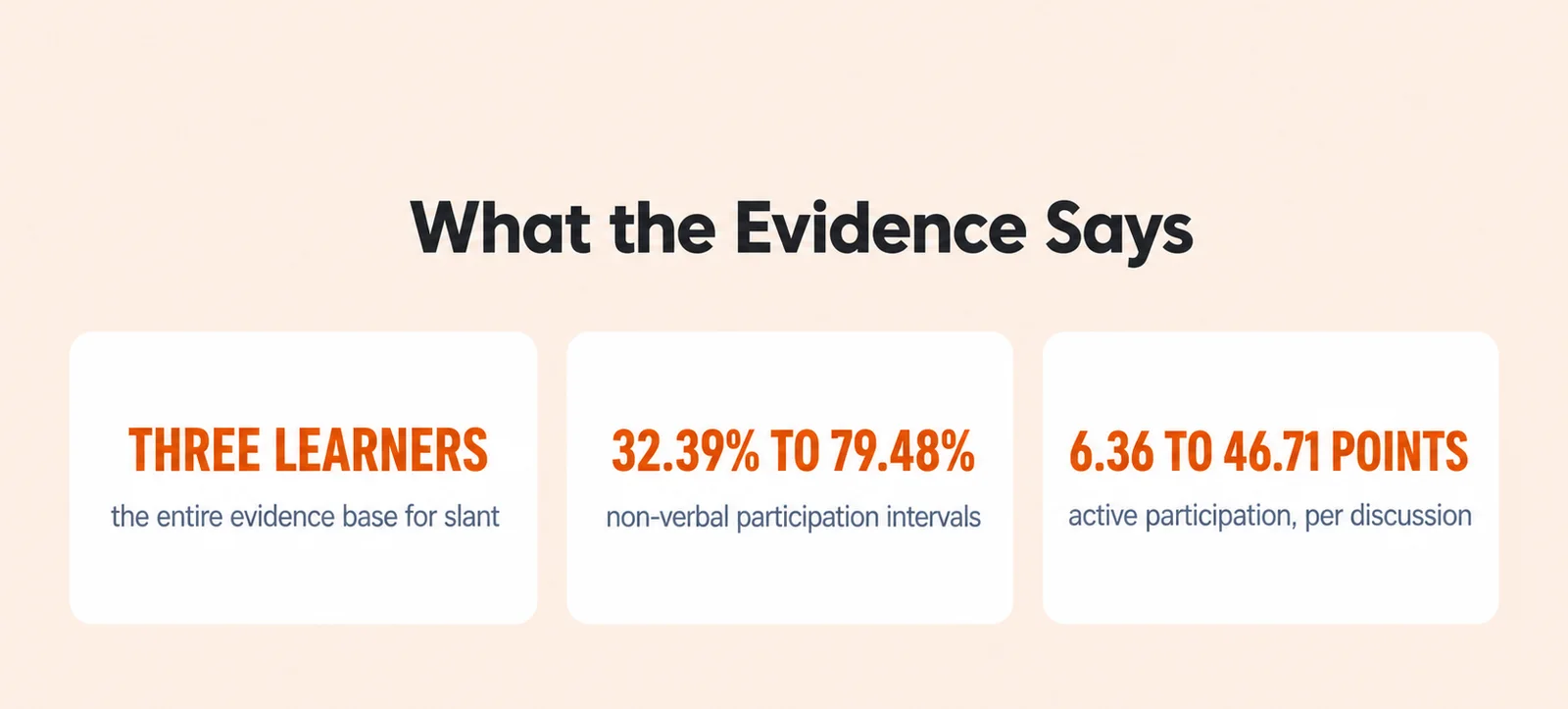
Before instruction, the three learners used non-verbal participation behaviours in an average of 32.39% of observed intervals. After instruction in SLANT, that rose to 79.48%. On active participation, scored in points for volunteering and answering, they moved from an average of 6.36 points per discussion to 46.71. Learners without disabilities who had no SLANT instruction averaged 36.53 in the same discussions.
Read plainly, three learners with disabilities went from participating far less than their peers to participating more, and the change began at the point instruction started. That is a real finding and it is a good one. It is also the reason the technique existed: SLANT was built to help learners who were being left out of discussion to get into it.
A multiple-baseline design with three participants is built to show that a change followed an intervention in those individuals. It is not built to estimate an effect across a population, and it cannot tell you what happens when the same acronym is applied to a whole class as a compliance standard rather than taught to a learner as a strategy they choose to use.
That is the gap the last thirty years fell into. A participation strategy for learners who wanted to join in became a posture requirement for learners who had no say in it, and no study was ever run on the second thing. Anyone citing "the research on SLANT" at you is citing three learners in 1989.
In August 2020 Uncommon Schools published an open letter, signed by chief executive Brett Peiser, ending SLANT along with silent corridors and detentions for minor infractions. The letter framed the change as part of a commitment to becoming an increasingly anti-racist organisation, in the period following the killing of George Floyd. This is the single most useful fact about SLANT and it is almost never mentioned alongside it.
Reported in Forbes, the letter described dropping SLANT as part of "removing undue focus on things like eye contact and seat posture, and putting greater focus on increasing intellectual student engagement to build confidence within our students". That is worth reading twice, because it is not a rejection of high expectations. It is a judgement that the network had been measuring the wrong thing.
Tes reported the same announcement in Britain, noting that it landed badly with some school leaders here who had built behaviour policies on the approach. Uncommon also relaxed uniform rules and committed to alternatives to exclusion. Separately, the KIPP network dropped its "Work hard. Be nice." motto in the same period.
The 2021 third edition carries 63 techniques and SLANT is not among them. The nearest thing in its place is Habits of Attention, technique 48, which is about teaching visible attention behaviours so that listening can be seen. That is a narrower and more defensible claim than SLANT made, and it is a meaningful revision rather than a rename.
So the position in 2026 is unusual. The originating university still publishes and updates SLANT as a learning strategy. The charter network that made it famous has retired it. The book that carried it to Britain has dropped it. Many British schools still have it on a wall.
The objection to SLANT is usually stated as a general discomfort with controlling children's bodies. There is a sharper and more useful version, and it applies to only two of the five letters. Requiring sustained eye contact and requiring visible agreement both ask learners to do something that interferes with thinking, and the evidence for that is not a matter of opinion.
When a question is hard, children look away. This is not avoidance or rudeness. It is a way of cutting the flow of visual and social information so that working memory can be spent on the problem instead. Phelps, Doherty-Sneddon and Warnock (2006) tested this directly in a teaching context and found that helping children use gaze aversion improved the answers they gave.
"Track the speaker", enforced as a rule, removes that option at exactly the moment a learner most needs it. A class that has been trained never to look away will look attentive, and will be spending part of its attention on looking attentive. This is the same reason wait time works: thinking needs space, and some of that space is visual.
For autistic learners the cost is larger and better documented. Doherty-Sneddon, Riby and Whittle (2011) found gaze aversion functioning as a cognitive load management strategy in autism and in Williams syndrome, which means an autistic learner looking away during a hard question is doing something useful, not something to be corrected.
Hadjikhani et al. (2017) went further and looked at what happens when gaze is constrained to the eye region: it provoked abnormally high subcortical activation in autistic participants. And Trevisan, Roberts, Lin and Birmingham (2017) collected first-hand accounts from autistic adults and teenagers describing what eye contact is actually like for them. Taken together these say that a rule requiring eye contact is not asking an autistic learner to try harder. It is asking them to accept a real cost in order to look like everybody else.
"Nod your head" carries a smaller but related problem. It asks for a visible signal of agreement and comprehension, which means a learner who has not understood is being asked to perform understanding. That is bad for the learner and it is bad for the teacher, who has just lost the signal they most needed.
The wider criticism is set out most carefully in Joanne Golann's Scripting the Moves (2020), an ethnography of a no-excuses school. Her argument is not that structure harms learners. It is that heavily scripted physical compliance can produce deference rather than the confident self-advocacy the schools intend, and that this lands hardest on the learners the approach was designed to serve.
Uncommon's own letter reached a version of the same conclusion from the inside, which is a stronger form of the argument than any critic could make from outside.
Our position is to keep the participation and drop the two body demands. Sit up, listen, and ask and answer questions are ordinary, reasonable expectations that make a lesson work. Nod your head and track the speaker are not, and the reason for dropping them is evidence about thinking rather than a preference about classroom culture. Uncommon reached the same place in 2020 and named the same two things.
Sitting up is a fair ask and costs nothing to a learner who can do it. Listening is the actual objective. Asking and answering questions is the participation the strategy was built for in the first place, and it is the only one of the five that Ellis (1989) measured as an outcome rather than as a behaviour.
Notice that this leaves you with a participation expectation and no posture code, which is roughly what Kansas was describing in 1991 before the acronym travelled.
You still need to know whether the class is listening, and "they are all facing me" was never good evidence of that. The replacements are checks rather than postures.
| Instead of | Do this | Why it is better |
|---|---|---|
| Track the speaker | Ask a learner to add to or restate what the last speaker said | Tests listening rather than looking, and leaves gaze free for thinking |
| Nod your head | Take a written or whiteboard answer from everybody at once | A nod is a performance of understanding. A written answer is evidence of it |
| A general attention rule | Name the means of participation for this task: aloud, in writing, or by signal | Tells a learner what to do rather than how to sit |
Each of those has its own guide: habits of discussion for building on a named speaker, everybody writes for the written check, and means of participation for naming the route in. Cold calling does the job that "track the speaker" was pretending to do, which is making it likely that any learner will be asked.
Changing a whole-school acronym is a bigger job than changing a lesson. The smallest honest change is to stop enforcing the two body letters while leaving the poster alone until the policy is next reviewed, and to tell staff explicitly that no learner is to be corrected for looking away while thinking. That single instruction removes most of the harm.
The fuller change is to write the expectation as participation rather than posture, which is a conversation with a SENCO rather than a poster reprint. If you do it, the Uncommon letter is a useful thing to put in front of a governing body, because it is the network that invented the practice saying it was measuring the wrong thing.
Four qualifications belong with everything above, and a thoughtful colleague could raise any of them. They concern the strength of the gaze evidence, the risk of over-reading a corporate decision, the fact that SLANT's original purpose was inclusion rather than control, and the honest observation that no trial has compared the adapted version with the full one.
Phelps and colleagues studied gaze aversion during question answering, not classroom attention policies. Extending it to "therefore do not require eye contact all lesson" is a reasonable inference and it is an inference. What the studies establish firmly is narrower: looking away helps children answer hard questions, and interfering with that has a cost.
Uncommon Schools retiring SLANT is an institutional decision made in a particular political moment, and it should not be read as a study. Its value is different and still considerable: it is the strongest possible source conceding a weakness, which is the kind of evidence that is very hard to dismiss as motivated.
It would be neat to say SLANT was always a compliance device, and it would be false. Ellis (1989) was working with learners with disabilities who were not getting into discussions, and the strategy helped them. Any account that treats SLANT purely as body-policing has skipped its first two decades. What went wrong was the change from a strategy a learner is taught to use to a standard a class is measured against.
There is no study comparing three-letter SLANT with five-letter SLANT, and there will probably never be one. The recommendation here rests on removing two elements with a documented cost and keeping three with none, which is a defensible design decision rather than a tested result. It should be described that way in a staff meeting.
Every source below was checked twice: once to confirm the record exists, and again against Crossref to confirm it is the work being cited. Two candidate references were discarded during this check because the digital object identifiers resolved to different papers. Links go to the publisher, never to an aggregator.