504 Plan for Anxiety: Evidence-Based Accommodations and Scaffolded Support

Updated on  

February 26, 2026

504 Plan for Anxiety: Evidence-Based Accommodations and Scaffolded Support

|

February 26, 2026

Evidence-based accommodations for 504 plans addressing anxiety: scaffolded exposure frameworks, condition-specific strategies, CBT-informed accommodations, and how to build resilience rather than avoidance.

Anxiety is now the fastest-growing reason that American students receive a Section 504 Plan. The Centers for Disease Control and Prevention (CDC, 2022) documented anxiety diagnoses in children aged 3-17 rising from 7.1% to over 9.4% between 2016 and 2022, with rates climbing further in the post-2020 period. For general education teachers, school counsellors, and 504 coordinators, that trajectory means more students arriving in the classroom with anxiety-related accommodations than ever before, often without a clear explanation of why those accommodations were chosen or what they are supposed to achieve.

A 504 Plan is a civil rights document, not a special education document. It derives its authority from Section 504 of the Rehabilitation Act of 1973, which prohibits disability-based discrimination in any programme or activity receiving federal funding. The plan requires schools to provide reasonable accommodations that give a student with a qualifying disability equal access to education. A 504 Plan does not change the curriculum a student is expected to master, does not provide specially designed instruction, and does not involve the team procedures or funding mechanisms of the Individuals with Disabilities Education Act (IDEA). If you have ever wondered why a student with significant anxiety has a 504 Plan rather than an IEP, the short answer is that anxiety alone qualifies as a disability under Section 504 without requiring a separate educational need for specially designed instruction. For a fuller comparison of these two frameworks, see our guide on 504 plans versus IEPs.

Key Takeaways

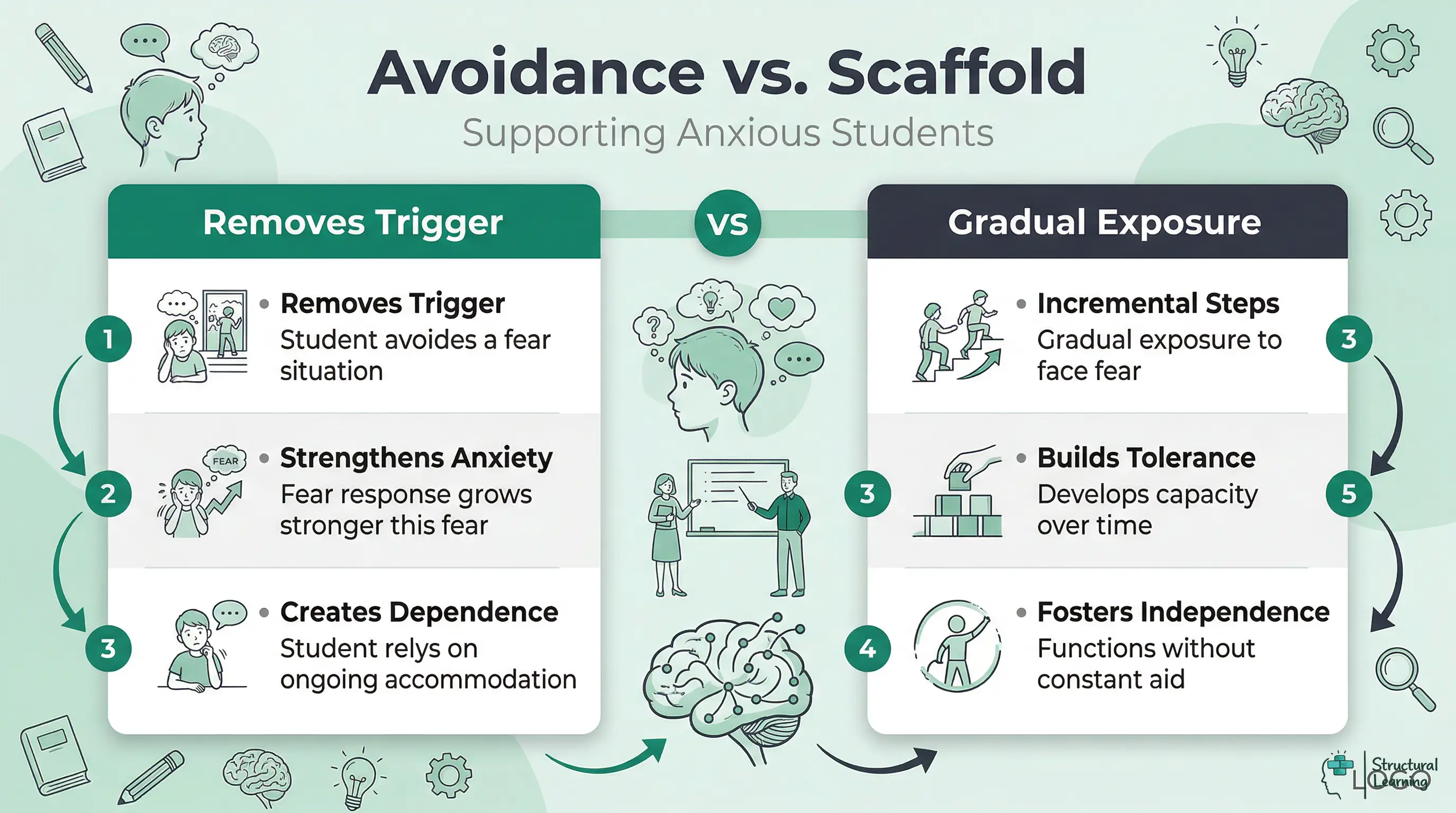
  1. Avoidance accommodations maintain anxiety rather than reducing it: CBT research by Kendall and Hedtke (2006) and Rapee, Schniering, and Hudson (2009) consistently shows that accommodations designed to remove an anxious student from a trigger situation strengthen the anxiety response over time. The student never builds the tolerance needed to function without the accommodation.
  2. Scaffolded exposure is the evidence-based alternative: Rather than writing "student does not have to present to the class," a 504 team should write a graduated sequence: teacher only, then one peer, then a pre-recorded video, then a small group, then the full class with notes. The scaffold builds capacity while maintaining immediate access to the curriculum.
  3. Section 504 eligibility requires substantial limitation, not diagnosis: A clinical anxiety diagnosis is useful supporting evidence, but it does not automatically trigger 504 eligibility. The team must document how anxiety substantially limits a major life activity, specifically learning, concentrating, thinking, or communicating, in the school environment.
  4. The classroom teacher is the primary implementer, not the plan author: 504 Plans are designed by a team but lived out daily by the general education teacher. Your consistent implementation, your tracking of whether accommodations are actually being used, and your observation of avoidance versus engagement are what determine whether a student makes progress or becomes more dependent.

When Anxiety Qualifies for a Section 504 Plan

Section 504 uses a broad definition of disability. A student qualifies when they have a physical or mental impairment that substantially limits one or more major life activities. The Office for Civil Rights (OCR), which enforces Section 504, has confirmed that major life activities include learning, concentrating, thinking, communicating, and caring for oneself. Anxiety can impair any or all of these.

The critical word is 'substantially.' A student who feels nervous before a test does not qualify. A student whose anxiety causes them to freeze during assessments, miss significant instructional time due to avoidance, or be unable to complete assignments under typical classroom conditions may well qualify. The team's job is to gather evidence of how anxiety functions in the school environment, not simply to confirm that a diagnosis exists.

Documentation typically comes from multiple sources: a clinical diagnosis from a licensed psychologist or psychiatrist, teacher observation reports, attendance records, academic performance data, and parent reports. OCR guidance is clear that schools cannot require a clinical diagnosis as a precondition for a 504 evaluation, but a diagnosis is helpful evidence. The team considers all available data and makes an eligibility determination based on educational impact.

One practical point for teachers: if a student in your class is frequently absent, regularly requests to leave the room, consistently underperforms relative to apparent ability, or shows marked distress in specific situations such as oral presentations or group tasks, that pattern is worth documenting and sharing with the school counsellor or 504 coordinator. You are often the person with the most detailed evidence of functional impairment.

Types of Anxiety That Appear in the Classroom

Anxiety is not a single condition. The presentations you encounter in the classroom vary significantly, and effective accommodations need to match the specific anxiety profile rather than applying a generic list.

Generalised Anxiety Disorder

Students with generalised anxiety disorder (GAD) experience persistent, wide-ranging worry that is difficult to control and spans multiple domains. In the classroom, this often appears as excessive reassurance-seeking, difficulty starting tasks because of fear of making mistakes, frequent questions about deadlines or expectations, and physical symptoms including headaches or stomach aches on school days. These students typically struggle with open-ended tasks that have no single correct answer, because uncertainty amplifies their worry.

Social Anxiety Disorder

Social anxiety disorder involves marked fear of one or more social situations in which the student might be scrutinised by others. In school, the triggers are pervasive: answering questions in class, reading aloud, working in groups, eating in the cafeteria, walking into the classroom after arriving late. Rapee and colleagues (2009) note that socially anxious students often interpret neutral social cues as negative evaluations, meaning a teacher's ordinary expression during a presentation registers as disapproval. Avoidance of social triggers can appear as refusal, illness complaints, or selective mutism.

Separation Anxiety

Separation anxiety manifests as excessive distress when separated from attachment figures, typically parents. In older students it can present as school avoidance, repeated visits to the nurse's office, or persistent requests to contact home. Transitions that increase physical distance from caregivers, including field trips, overnight activities, and changing classrooms between periods, are particularly difficult.

Selective Mutism

Selective mutism is a condition in which a student who speaks freely in some settings, typically at home, is consistently unable to speak in others, most often school. It is not defiance or shyness. It is a functional anxiety response in which the expectation of speaking triggers a freeze response. Students with selective mutism often have adequate academic knowledge but cannot demonstrate it through oral means. Accommodations need to provide alternative channels for demonstrating understanding without forcing speech before the student is ready.

Test and Performance Anxiety

Test anxiety involves significant worry and physiological arousal specifically in evaluation contexts. It impairs working memory during assessments, which is a well-documented mechanism: Eysenck and colleagues (2007) showed that anxiety occupies the same cognitive resources required for complex problem-solving. The result is a student who knows the material in low-stakes contexts but cannot retrieve it under test conditions. Performance anxiety follows the same pattern but applies to presentations, demonstrations, and public performances. Understanding working memory and how anxiety taxes it helps teachers appreciate why a bright, prepared student can go blank at exactly the wrong moment.

The Problem With Avoidance-Based Accommodations

The most common 504 accommodations for anxiety follow an avoidance logic. The student finds presentations distressing, so the plan states they are not required to present. The student becomes overwhelmed during timed tests, so the plan removes time limits entirely. The student avoids group work, so the plan permits individual completion of all group tasks. These accommodations feel compassionate, and in the short term they work: the student's distress decreases when the trigger is removed.

The problem is what happens over months and years. Kendall and Hedtke (2006), whose Coping Cat Cognitive Behavioural Therapy programme for anxiety has the strongest evidence base in the field, describe avoidance as the engine that keeps anxiety running. When a student avoids a situation, they do not learn that the feared outcome either does not happen or is manageable if it does. The absence of the dreaded event is attributed not to safety but to the avoidance itself. "I survived because I didn't have to do it" is the internal conclusion, and the anxiety remains intact, often stronger.

Rapee, Schniering, and Hudson (2009) reviewed the evidence base for childhood anxiety interventions and found consistent support for exposure-based approaches as the most effective treatment. Exposure involves confronting feared situations at a level that generates manageable distress, remaining in the situation long enough for anxiety to reduce naturally, and repeating this process across contexts. The research is not ambiguous. Mychailyszyn and colleagues (2012) conducted a meta-analysis of school-based anxiety interventions and found effect sizes for CBT-aligned treatments significantly exceeding those for non-exposure-based support.

The implication for 504 planning is uncomfortable but important. A plan written around permanent avoidance is not a support document. It is a maintenance document for the student's disability. The student's access to education is protected, but their capacity to function is not improved. Langley and colleagues (2015) put it plainly: schools that remove every trigger from an anxious student's day are protecting their present functioning at the cost of their future independence.

This does not mean exposing students to situations that cause severe distress without support. It means designing accommodations that scaffold the student toward the trigger, providing support at each stage, tracking progress, and raising expectations as tolerance builds. The comparison with scaffolding in education is exact: you do not remove the challenge, you provide temporary support that fades as competence develops.

The Scaffolded Exposure Framework for 504 Plans

The 'Anxiety-to-Access Bridge' reframes every avoidance accommodation as a graduated sequence. Instead of writing what a student does not have to do, the 504 team writes what the student will do at each stage, with explicit criteria for moving to the next stage. This approach keeps the student in the curriculum while building tolerance systematically.

The framework works by identifying the anxiety trigger, establishing the long-term target behaviour (what the student should be able to do without accommodation), and writing a step sequence that connects where the student is now to where the team wants them to be. Each step includes a support that fades at the next step.

Presentations and Oral Communication

Long-term target: Student presents independently to the full class.

Step 1: Student presents to the teacher only, after school or during a free period, with notes permitted.

Step 2: Student presents to the teacher and one trusted peer, with notes permitted.

Step 3: Student submits a pre-recorded video presentation, reviewed only by the teacher.

Step 4: Student presents live to a small group of three to four students, with notes permitted.

Step 5: Student presents to the full class with notes permitted.

Step 6: Student presents to the full class without notes.

Movement between steps is triggered by the student demonstrating the current step without significant distress on three separate occasions, not by the calendar. The 504 team reviews progress at the six-week review, adjusts the timeline, and documents which step the student is currently working on.

Timed Assessments

Long-term target: Student completes assessments under standard time conditions.

Step 1: Extended time (double time) with a separate, quiet room.

Step 2: Extended time (1.5x) with a separate, quiet room.

Step 3: Standard time with a separate, quiet room.

Step 4: Standard time in the regular classroom.

Mychailyszyn and colleagues (2012) found that permanent extended time without any plan for reduction creates a secondary problem: students become unable to monitor their own pacing and develop an expectation of additional time as their permanent operating mode. Building the reduction plan into the 504 document sets an explicit expectation from the outset.

Group Work

Long-term target: Student participates in self-selected groups, then randomly assigned groups.

Step 1: Student completes the task individually, with the teacher noting which group task elements they demonstrate solo.

Step 2: Student works in a pair with a teacher-selected partner.

Step 3: Student works in a group of three, with a pre-assigned role that provides structure.

Step 4: Student works in a group of four with a rotating role.

Step 5: Student participates in randomly assigned groups.

Transitions and New Environments

Long-term target: Student transitions between environments and activities independently.
Step 1: Student receives a written schedule at the start of each day and a verbal one-minute warning before transitions.

Step 2: Student receives only a written schedule, without verbal warnings.

Step 3: Student uses the classroom schedule posted on the board, without personal copies.

Written Assignments

Long-term target: Student completes written assignments under standard conditions.

Step 1: Student submits bullet-point outline, assessed for comprehension; no prose required.

Step 2: Student submits a partial draft, with teacher feedback before final submission.

Step 3: Student submits a complete first draft for feedback, with revision opportunity.

Step 4: Student submits a final draft only, under standard conditions.

The key principle across all triggers is that every step is a real step toward independence, not a holding position. If a student has been at Step 2 for a semester with no movement, the 504 team needs to examine whether the scaffold is moving, whether the student is receiving CBT support outside school, or whether a more intensive support level is required.

Avoidance Versus Scaffolded Exposure: A Comparison

Anxiety Trigger Avoidance Accommodation (Common) Scaffolded Exposure Accommodation (Evidence-Based)
Oral presentations Student is exempt from all presentations Student follows a 6-step sequence from teacher-only audience to full class; movement criteria defined
Timed assessments Student receives unlimited time, indefinitely Student begins at double time; plan includes a graduated reduction schedule reviewed at each 6-week meeting
Group work Student completes all group tasks individually Student begins in paired work with a teacher-selected partner; steps toward randomly assigned groups of four
Transitions between classes Student given a pass to leave class early to avoid crowded hallways at all times Student uses early pass for three weeks, then transitions two minutes early, then one minute early, then at standard time
New activities or tasks Teacher previews all new tasks privately before the class session indefinitely Teacher provides 48-hour preview for first three weeks, then 24-hour preview, then end-of-lesson preview for next day only
Written assignments under pressure Student exempt from in-class writing; submits all work as take-home Student begins with bullet outlines in class; builds to partial drafts; reaches full in-class drafting by agreed date
Speaking on the phone or to unfamiliar adults Student communicates only through email or written notes; phone calls and verbal adult communication not required Student practises scripted exchanges with familiar adults; advances to unscripted exchanges; then to brief contact with unfamiliar adults
Lunchtime and unstructured social periods Student permitted to eat lunch in a separate room alone every day Student begins lunch in small group (two others) with a counsellor present; advances to lunch in cafeteria with a pre-arranged peer; then to standard cafeteria lunch

Evidence-Based Accommodations by Anxiety Type

The following accommodations are organised by anxiety presentation. Each is connected to the cognitive or physiological mechanism it addresses. Accommodations work when they target the specific driver of impairment rather than offering a generic buffer.

Accommodations for Generalised Anxiety Disorder

Students with GAD are exhausted by uncertainty. The cognitive mechanism is excessive threat appraisal: they scan continuously for signs that something might go wrong. Accommodations that reduce uncertainty directly target this mechanism.

Written schedule and advance notice of changes. Provide a written schedule at the start of each day, and give at least 24 hours' notice when the schedule will change. This does not mean protecting the student from all changes; it means giving them time to process change before it arrives. The goal is reducing surprise, not preventing flexibility.

Clarification without penalty. Students with GAD need to know that seeking clarification is permitted and will not mark them out as incompetent. A brief classroom norm, "you can ask me to rephrase anything", removes the social cost of seeking reassurance. Do not, however, allow unlimited reassurance-seeking, as this is its own form of avoidance. One clarification per task is a reasonable limit.

Reduced assignment length in the short term. When GAD is causing significant impairment to task initiation, reducing the length of written tasks for a defined period while the student works with a therapist allows them to maintain curriculum access. This should be documented with a clear review date, not written as a permanent modification.

Flexible seating. Access to seating near an exit or away from high-traffic areas reduces the low-level arousal that GAD students carry into every lesson. This is a minimal intervention with no instructional cost.

Accommodations for Social Anxiety Disorder

Social anxiety is fundamentally about evaluation. The feared outcome is being judged negatively by peers or adults. Accommodations should reduce the public visibility of the student's performance while the scaffolded exposure sequence gradually builds tolerance.

Pre-teach content before class discussions. Give the student the discussion question or text the day before. A student who arrives knowing their contribution reduces the evaluative threat from unpredictability. This is also good instructional practice for any student who benefits from processing time.

Opt-in rather than cold-call participation. Cold-calling amplifies social anxiety significantly. Instead, use a hand-signal system where students indicate they have an answer ready, or use written response tools such as exit tickets, mini-whiteboards, or anonymous digital response platforms. The student's participation is not removed; the involuntary public exposure is reduced. This connects directly to the research on self-regulation in the classroom and how environmental design shapes student behaviour.

Partner work before group work. Never assign a socially anxious student directly to a group of four or five. The scaffolded exposure framework applies: begin with a known partner, then a triad, then a larger group.

Private feedback on assessed work. Return graded work face-down or electronically. For students with social anxiety, seeing their grade before peers can react creates unnecessary evaluative exposure.

Accommodations for Test Anxiety

Test anxiety is primarily a working memory problem during assessment. The worry itself consumes working memory capacity, leaving less available for retrieval and problem-solving. Jaycox and colleagues (2009) found that cognitive strategies taught before assessments, alongside environmental adjustments, produced significantly better outcomes than environmental adjustments alone.

Extended time in a separate room. The combination addresses two problems: extended time compensates for the processing slowdown caused by anxiety, and a separate room reduces the social comparison pressure that sustains worry during a test. Neither accommodation is permanent in a scaffolded plan.

Teach a pre-assessment routine. Work with the counsellor to establish a short routine the student uses before every test: three slow breaths, two minutes of reviewing notes they know well, a single self-instruction cue such as "start with what I know." This addresses the cognitive mechanism directly and is something the student carries forward without the accommodation.

Read instructions aloud. For students whose test anxiety peaks at the point of reading instructions, having instructions read aloud or provided in written advance reduces the moment of confusion that can cascade into panic.

Access to a familiar adult during the assessment. For students with high test anxiety, knowing that a familiar adult is in the room or accessible reduces physiological arousal. Over time, this access is faded: the adult is visible but not in the room, then available on request only, then not present at all.

Accommodations for Separation Anxiety

Separation anxiety accommodations should focus on building the student's tolerance for separation, not on maintaining constant contact with home.

One brief check-in call per day, at a fixed time. Not on demand. A student permitted to call home whenever distressed learns that distress produces contact, which maintains the separation anxiety. One call, timed, gives the student something to anticipate and reduces the unpredictability of separation. The frequency fades across the year.

A trusted adult the student can visit briefly. A specific adult, not "any available adult," reduces the student's anxiety about who to find in a moment of distress. The visit is brief (two to three minutes) and purposeful: the student checks in, uses a grounding strategy, and returns to class. This is not a sanctuary to wait in.

Visual structure for the school day. A printed schedule showing how the day breaks into segments, with an end time circled, gives separation-anxious students a concrete end point. "School ends at 3:15" is less anxiety-provoking than a formless day of unknown length.

Accommodations for Selective Mutism

Selective mutism requires a gradual speech exposure plan developed with the school speech-language pathologist and, where available, a therapist specialising in selective mutism. The core principle is the same as all scaffolded exposure: the expectation of speech increases in small increments, in the student's most comfortable environment first.

Alternative response formats. The student demonstrates knowledge through writing, drawing, pointing, nodding, or using a communication device. This maintains curriculum access while the speech exposure plan runs in parallel. Crucially, these alternatives are documented as temporary, not permanent.

No pressure to speak in front of the class. Cold-calling a student with selective mutism does not help them overcome their anxiety; it typically increases it and can set back progress significantly. This is one accommodation that begins as avoidance but is justified because premature forced exposure without a graduated plan is counterproductive.

Slide talk before voice talk. Begin with the student communicating only with the teacher, in private. As comfort increases, the teacher introduces a second adult, then a peer. The first vocal communication the student produces is often a whisper in a one-to-one setting. That moment, however small, is a clinical and educational milestone.

Writing the 504 Plan for Anxiety

A well-written 504 Plan for anxiety has six components. Vague language in any component creates implementation problems at the classroom level.

Identified disability. State the diagnosis and its category under Section 504: "Student has been diagnosed with generalised anxiety disorder (DSM-5), a mental impairment that substantially limits learning, concentrating, and thinking."

Functional impact statement. Describe specifically how the impairment manifests in school: "Student's anxiety causes significant impairment in timed assessment conditions, resulting in performance substantially below demonstrated knowledge levels. Student requires extended time to access the curriculum equitably." Avoid vague language such as "student experiences anxiety that affects school performance."

Specific accommodations with duration or review criteria. Write what the accommodation is, when it applies, and what the criterion for review is. "Student will receive 100% extended time for all assessments in a separate, quiet room for the first 12 weeks of the school year. At the 12-week review, the team will assess whether time can be reduced to 50% extended, based on assessment performance data and teacher observation."

Responsible staff. Name who implements each accommodation. "All classroom teachers implement extended time and separate room. The school counsellor monitors the progress of the graduated presentation sequence and conducts bi-weekly check-ins."

Review schedule. Anxiety 504 Plans should be reviewed more frequently than the standard annual review, particularly in the first year. Six-week reviews allow the team to track whether the scaffolded exposure plan is moving and to adjust if progress has stalled.

Shared understanding of the plan's goal. Every plan should include a statement of intent: "The goal of this plan is to build the student's capacity to access learning with reduced support over time. Accommodations will be reviewed and faded as tolerance increases." This sentence protects the team from a legal perspective and sets the right expectation with the student and family.

Teachers implementing 504 accommodations for ADHD will recognise a similar framework. The same principles of specificity, review, and capacity-building apply across disability categories.

The General Education Teacher's Role

You did not write the 504 Plan. You implement it, every day, in every lesson, and your implementation quality determines whether it works.

The most important thing you do is distinguish between a student using an accommodation and a student avoiding work. These look different. A student using extended time who is working steadily through the assessment is using their accommodation. A student using extended time who is sitting with their head down and producing nothing is avoiding. Both situations require different responses, and the 504 team needs your observations to make good decisions at reviews.

Consistency matters enormously. A student with GAD whose teacher sometimes provides advance notice and sometimes does not learns that the accommodation is unreliable, which adds the uncertainty of the accommodation itself to the list of things to worry about. If you cannot implement an accommodation consistently in a particular context, raise that at the next team meeting.

Communicate with the school counsellor or 504 coordinator when you observe patterns that suggest a student's anxiety is increasing rather than decreasing. Signs include: escalating reassurance-seeking, new avoidance behaviours not previously seen, physical complaints that seem tied to specific lesson types, or a student who is using their accommodation but showing no progress toward reduced need. These observations are the data the team needs for their reviews.

Be careful about over-accommodating informally. Teachers with high empathy for anxious students sometimes provide accommodations beyond the plan without documenting them. This feels kind, and it may relieve distress in the moment, but it disrupts the graduated plan and gives the counsellor inaccurate data. If you think an accommodation is insufficient, bring it to the team. Do not quietly expand it on your own.

Understanding how cognitive load theory operates in your classroom will help you design lessons that do not inadvertently amplify anxiety. Tasks with high intrinsic and extraneous cognitive load simultaneously, such as dense new content delivered in a noisy room with ambiguous instructions, are more difficult for anxious students to manage not because of their anxiety specifically but because their worry occupies additional working memory. Reducing extraneous load through clear instructions, structured tasks, and visual supports helps all students and is particularly significant for students with anxiety.

The teacher's role also includes understanding the executive function demands of the tasks you set. Planning, task initiation, and cognitive flexibility are all aspects of executive function that anxiety impairs. Students who appear disorganised or who repeatedly fail to start tasks may be experiencing anxiety-driven executive function disruption rather than laziness or lack of interest.

Differentiation strategies that you already use for other students, chunking tasks, providing worked examples, building in choice, and offering processing time, are often the same strategies that support anxious students without requiring any additional accommodation at the classroom level.

What to Do When a 504 Plan Is Not Enough

A 504 Plan provides accommodations but not instruction. If a student's anxiety is so pervasive that they need someone to teach them anxiety management skills directly, to engage in therapeutic exposure under clinical supervision, or to follow a crisis intervention protocol during the school day, a 504 Plan is not the right framework.

Consider requesting an IEP evaluation when you observe the following: the student's attendance is dropping significantly despite the accommodations in place; the student is not progressing through the graduated exposure sequence despite consistent implementation over a full semester; the student is experiencing anxiety-related crises at school that require clinical intervention during the school day; or the student's academic performance is declining significantly across subjects despite accommodations addressing access.

An IEP can include specially designed instruction in social-emotional skills, a therapeutic component delivered by a licensed school counsellor within the school day, a crisis plan with defined staff roles, and specialist consultation from a school psychologist. These are not things a 504 Plan can mandate.

The relationship between 504 plans and the MTSS tiered support framework is worth understanding. Most students with anxiety 504 Plans have received some Tier 2 support before reaching the 504 stage: small-group social-emotional learning, check-in check-out, or counsellor support. A student who has not responded to Tier 2 interventions after a full semester may need Tier 3 support, which could be an IEP with a therapeutic component, intensive school-based CBT, or a referral to an outside provider with a formal coordination agreement between the school and the clinical provider.

If a student has an existing 504 Plan and their anxiety is worsening rather than improving, the team needs to meet, not wait for the annual review. Request a meeting, bring your observational data, and make the case that the current plan is not producing the intended outcome. If progress has stalled completely, see our guide on what to do when IEP progress stalls, which addresses the same fundamental question of what to do when a support plan is not working.

A Cross-Atlantic Perspective

In England, anxiety in students does not produce a document equivalent to a 504 Plan. The Equality Act 2010 requires schools to make 'reasonable adjustments' for students with disabilities, including mental health conditions such as anxiety disorder. These adjustments are typically embedded within the school's graduated approach: class teacher differentiation at Tier 1, targeted small-group support at Tier 2, and specialist involvement at Tier 3.

The UK system has two practical advantages worth noting. First, because reasonable adjustments do not produce a separate formalised document for most students, teachers are less likely to treat accommodations as external requirements divorced from their instructional decisions. The adjustments are teaching decisions, chosen because they work, not because a form requires them. Second, the UK approach is built around a cycle of assess, plan, do, and review, which has the same spirit as the scaffolded exposure framework described in this article: adjustments are provisional and reviewed regularly, not permanent grants.

The lesson for US teachers and 504 coordinators is not that the formal 504 document is unnecessary. It is not. Students with anxiety need legal protection, clear documentation, and consistent implementation. But the 504 document should read like a teaching plan, not a liability checklist. The best 504 plans for anxiety feel like what a reflective teacher would naturally do for that student, written down with specificity and a review date. A growth mindset approach to the 504 Plan itself, viewing it as a working document that evolves as the student grows, rather than a fixed entitlement, brings it closer to the spirit of effective differentiation in both systems.

Writing the 504 Plan: A Practical Template

Every accommodation in a 504 Plan for anxiety should follow this structure: what, when, by whom, and what the review criterion is. The following template shows how to write accommodations that are specific enough to implement and honest enough to improve.

Extended time template: "[Student] will receive [X]% additional time for all assessments in [Grade X]. Assessments will be completed in [Room/Location] to reduce distraction. At the [date] review, the team will consider reducing extended time to [Y]% based on [assessment performance data and teacher observation notes from the previous grading period]."

Presentation scaffold template: "[Student] is currently at Step [X] of the oral presentation scaffold (see attached progression). The responsible adult for tracking progress through the scaffold is [Name and Role]. Progress to the next step requires [criterion]. The team will review progress at [date]."

Transition support template: "[Student] will receive a written schedule at the start of each school day and 24 hours' advance notice of changes. This accommodation will be reviewed at [date] with the goal of reducing to [end-of-day notice of the following day's schedule] by [date]."

Participation template: "[Student] will not be cold-called for oral participation in class. The teacher will use [hand-signal system/mini-whiteboard responses/exit tickets] to provide equitable participation opportunities. [Student] will be expected to contribute using these alternatives at the same frequency as peers. The team will revisit oral participation expectations at [date] in line with the graduated exposure plan."

Further Reading

Key Research Papers on Anxiety, 504 Plans, and School-Based Interventions

The following studies form the evidence base for the scaffolded exposure approach described in this article. Each represents peer-reviewed research with direct implications for how schools design accommodations for anxious students.

Child Anxiety Disorders: Development, Treatment, and Psychopathology View study
Rapee, R. M., Schniering, C. A., and Hudson, J. L. (2009)

This review synthesises the developmental and clinical literature on childhood anxiety, with particular attention to the mechanisms of maintenance including avoidance and parental accommodation. Rapee and colleagues make an explicit argument that school-based interventions must be designed to reduce avoidance rather than manage it, a principle that translates directly into how 504 accommodation lists should be constructed. The paper provides the theoretical backbone for the scaffolded exposure framework.

Coping Cat Workbook (CBT for Anxious Youth) View study
Kendall, P. C. and Hedtke, K. A. (2006)

The Coping Cat programme is the most extensively validated CBT intervention for childhood anxiety in the literature, with over 30 randomised controlled trials demonstrating its efficacy. Kendall and Hedtke's treatment manual establishes the graduated exposure hierarchy as the central active ingredient: it is not the coping strategies alone that reduce anxiety, but the systematic confrontation of feared situations within a supported framework. Teachers who understand the Coping Cat model can align their classroom implementation with concurrent clinical work a student may be receiving.

School-Based Interventions for Internalising Disorders: A Meta-Analysis View study
Mychailyszyn, M. P., Brodman, D. M., Read, K. L., and Kendall, P. C. (2012)

This meta-analysis examined 32 school-based randomised controlled trials targeting anxiety and depression in children and adolescents. Mychailyszyn and colleagues found that CBT-based interventions produced substantially larger effect sizes than non-exposure-based programmes, and that the school setting was a viable and sometimes superior alternative to clinic-based delivery. The review is significant for 504 coordinators because it establishes that the school itself, not just the clinic, is a legitimate site for the active ingredient of anxiety treatment.

School-Based Cognitive Behavioural Therapy for Anxiety: A Systematic Review View study
Langley, A. K., Nadeem, E., Kataoka, S. H., Stein, B. D., and Jaycox, L. H. (2015)

Langley and colleagues reviewed implementation science for school-based CBT, examining not just whether it works but under what conditions it is most successfully delivered in typical school settings. Their findings on the importance of teacher involvement in reinforcing exposure exercises outside formal intervention sessions are directly relevant to how 504 plans should be structured: accommodations work better when they are aligned with a therapeutic framework rather than designed independently of it. The paper is a compelling argument for closer coordination between 504 coordinators and any outside clinical providers a student is working with.

The Efficacy of School-Based CBT Interventions for Anxiety Disorders in Children and Adolescents View study
Jaycox, L. H., Langley, A. K., and Dean, K. L. (2009)

This study examined outcomes from school-based anxiety treatment delivered by trained school counsellors rather than clinical psychologists, finding that counsellors could effectively implement exposure-based CBT with adequate training and supervision. For school teams without access to clinical psychologists, the study provides evidence that school counsellors, when trained in exposure principles, can deliver meaningful anxiety intervention. The paper also examines teacher-level variables that predict student outcomes, reinforcing the case that the classroom teacher's role in the intervention is active, not peripheral.

References

CDC (2022). Data and Statistics on Children's Mental Health. Centers for Disease Control and Prevention.

Eysenck, M. W., Derakshan, N., Santos, R., and Calvo, M. G. (2007). Anxiety and cognitive performance: Attentional control theory. Emotion, 7(2), 336-353.

Jaycox, L. H., Langley, A. K., and Dean, K. L. (2009). The efficacy of school-based CBT interventions for anxiety disorders. Behavior Modification, 33(3), 317-341.

Kendall, P. C. and Hedtke, K. A. (2006). Coping Cat Workbook (2nd ed.). Workbook Publishing.

Langley, A. K., Nadeem, E., Kataoka, S. H., Stein, B. D., and Jaycox, L. H. (2015). Evidence-based mental health programs in schools: Barriers and facilitators of successful implementation. School Mental Health, 2(3), 105-113.

Mychailyszyn, M. P., Brodman, D. M., Read, K. L., and Kendall, P. C. (2012). Cognitive-behavioral school-based interventions for anxious and depressed youth. Clinical Psychology: Science and Practice, 19(2), 132-153.

Rapee, R. M., Schniering, C. A., and Hudson, J. L. (2009). Anxiety disorders during childhood and adolescence: Origins and treatment. Annual Review of Clinical Psychology, 5, 311-341.

Silverman, W. K. and Hinshaw, S. P. (2008). The second special issue on evidence-based psychosocial treatments for children and adolescents. Journal of Clinical Child and Adolescent Psychology, 37(1), 1-7.

---

The single most useful thing you can do this week: review the 504 plans currently active on your caseload and identify any accommodation written as a permanent exemption. For each one, draft a graduated sequence that moves toward the same outcome the student would achieve without the accommodation. Bring those drafts to the next 504 meeting. That conversation is the start of a plan that genuinely helps.

Loading audit...

Anxiety is now the fastest-growing reason that American students receive a Section 504 Plan. The Centers for Disease Control and Prevention (CDC, 2022) documented anxiety diagnoses in children aged 3-17 rising from 7.1% to over 9.4% between 2016 and 2022, with rates climbing further in the post-2020 period. For general education teachers, school counsellors, and 504 coordinators, that trajectory means more students arriving in the classroom with anxiety-related accommodations than ever before, often without a clear explanation of why those accommodations were chosen or what they are supposed to achieve.

A 504 Plan is a civil rights document, not a special education document. It derives its authority from Section 504 of the Rehabilitation Act of 1973, which prohibits disability-based discrimination in any programme or activity receiving federal funding. The plan requires schools to provide reasonable accommodations that give a student with a qualifying disability equal access to education. A 504 Plan does not change the curriculum a student is expected to master, does not provide specially designed instruction, and does not involve the team procedures or funding mechanisms of the Individuals with Disabilities Education Act (IDEA). If you have ever wondered why a student with significant anxiety has a 504 Plan rather than an IEP, the short answer is that anxiety alone qualifies as a disability under Section 504 without requiring a separate educational need for specially designed instruction. For a fuller comparison of these two frameworks, see our guide on 504 plans versus IEPs.

Key Takeaways

  1. Avoidance accommodations maintain anxiety rather than reducing it: CBT research by Kendall and Hedtke (2006) and Rapee, Schniering, and Hudson (2009) consistently shows that accommodations designed to remove an anxious student from a trigger situation strengthen the anxiety response over time. The student never builds the tolerance needed to function without the accommodation.
  2. Scaffolded exposure is the evidence-based alternative: Rather than writing "student does not have to present to the class," a 504 team should write a graduated sequence: teacher only, then one peer, then a pre-recorded video, then a small group, then the full class with notes. The scaffold builds capacity while maintaining immediate access to the curriculum.
  3. Section 504 eligibility requires substantial limitation, not diagnosis: A clinical anxiety diagnosis is useful supporting evidence, but it does not automatically trigger 504 eligibility. The team must document how anxiety substantially limits a major life activity, specifically learning, concentrating, thinking, or communicating, in the school environment.
  4. The classroom teacher is the primary implementer, not the plan author: 504 Plans are designed by a team but lived out daily by the general education teacher. Your consistent implementation, your tracking of whether accommodations are actually being used, and your observation of avoidance versus engagement are what determine whether a student makes progress or becomes more dependent.

When Anxiety Qualifies for a Section 504 Plan

Section 504 uses a broad definition of disability. A student qualifies when they have a physical or mental impairment that substantially limits one or more major life activities. The Office for Civil Rights (OCR), which enforces Section 504, has confirmed that major life activities include learning, concentrating, thinking, communicating, and caring for oneself. Anxiety can impair any or all of these.

The critical word is 'substantially.' A student who feels nervous before a test does not qualify. A student whose anxiety causes them to freeze during assessments, miss significant instructional time due to avoidance, or be unable to complete assignments under typical classroom conditions may well qualify. The team's job is to gather evidence of how anxiety functions in the school environment, not simply to confirm that a diagnosis exists.

Documentation typically comes from multiple sources: a clinical diagnosis from a licensed psychologist or psychiatrist, teacher observation reports, attendance records, academic performance data, and parent reports. OCR guidance is clear that schools cannot require a clinical diagnosis as a precondition for a 504 evaluation, but a diagnosis is helpful evidence. The team considers all available data and makes an eligibility determination based on educational impact.

One practical point for teachers: if a student in your class is frequently absent, regularly requests to leave the room, consistently underperforms relative to apparent ability, or shows marked distress in specific situations such as oral presentations or group tasks, that pattern is worth documenting and sharing with the school counsellor or 504 coordinator. You are often the person with the most detailed evidence of functional impairment.

Types of Anxiety That Appear in the Classroom

Anxiety is not a single condition. The presentations you encounter in the classroom vary significantly, and effective accommodations need to match the specific anxiety profile rather than applying a generic list.

Generalised Anxiety Disorder

Students with generalised anxiety disorder (GAD) experience persistent, wide-ranging worry that is difficult to control and spans multiple domains. In the classroom, this often appears as excessive reassurance-seeking, difficulty starting tasks because of fear of making mistakes, frequent questions about deadlines or expectations, and physical symptoms including headaches or stomach aches on school days. These students typically struggle with open-ended tasks that have no single correct answer, because uncertainty amplifies their worry.

Social Anxiety Disorder

Social anxiety disorder involves marked fear of one or more social situations in which the student might be scrutinised by others. In school, the triggers are pervasive: answering questions in class, reading aloud, working in groups, eating in the cafeteria, walking into the classroom after arriving late. Rapee and colleagues (2009) note that socially anxious students often interpret neutral social cues as negative evaluations, meaning a teacher's ordinary expression during a presentation registers as disapproval. Avoidance of social triggers can appear as refusal, illness complaints, or selective mutism.

Separation Anxiety

Separation anxiety manifests as excessive distress when separated from attachment figures, typically parents. In older students it can present as school avoidance, repeated visits to the nurse's office, or persistent requests to contact home. Transitions that increase physical distance from caregivers, including field trips, overnight activities, and changing classrooms between periods, are particularly difficult.

Selective Mutism

Selective mutism is a condition in which a student who speaks freely in some settings, typically at home, is consistently unable to speak in others, most often school. It is not defiance or shyness. It is a functional anxiety response in which the expectation of speaking triggers a freeze response. Students with selective mutism often have adequate academic knowledge but cannot demonstrate it through oral means. Accommodations need to provide alternative channels for demonstrating understanding without forcing speech before the student is ready.

Test and Performance Anxiety

Test anxiety involves significant worry and physiological arousal specifically in evaluation contexts. It impairs working memory during assessments, which is a well-documented mechanism: Eysenck and colleagues (2007) showed that anxiety occupies the same cognitive resources required for complex problem-solving. The result is a student who knows the material in low-stakes contexts but cannot retrieve it under test conditions. Performance anxiety follows the same pattern but applies to presentations, demonstrations, and public performances. Understanding working memory and how anxiety taxes it helps teachers appreciate why a bright, prepared student can go blank at exactly the wrong moment.

The Problem With Avoidance-Based Accommodations

The most common 504 accommodations for anxiety follow an avoidance logic. The student finds presentations distressing, so the plan states they are not required to present. The student becomes overwhelmed during timed tests, so the plan removes time limits entirely. The student avoids group work, so the plan permits individual completion of all group tasks. These accommodations feel compassionate, and in the short term they work: the student's distress decreases when the trigger is removed.

The problem is what happens over months and years. Kendall and Hedtke (2006), whose Coping Cat Cognitive Behavioural Therapy programme for anxiety has the strongest evidence base in the field, describe avoidance as the engine that keeps anxiety running. When a student avoids a situation, they do not learn that the feared outcome either does not happen or is manageable if it does. The absence of the dreaded event is attributed not to safety but to the avoidance itself. "I survived because I didn't have to do it" is the internal conclusion, and the anxiety remains intact, often stronger.

Rapee, Schniering, and Hudson (2009) reviewed the evidence base for childhood anxiety interventions and found consistent support for exposure-based approaches as the most effective treatment. Exposure involves confronting feared situations at a level that generates manageable distress, remaining in the situation long enough for anxiety to reduce naturally, and repeating this process across contexts. The research is not ambiguous. Mychailyszyn and colleagues (2012) conducted a meta-analysis of school-based anxiety interventions and found effect sizes for CBT-aligned treatments significantly exceeding those for non-exposure-based support.

The implication for 504 planning is uncomfortable but important. A plan written around permanent avoidance is not a support document. It is a maintenance document for the student's disability. The student's access to education is protected, but their capacity to function is not improved. Langley and colleagues (2015) put it plainly: schools that remove every trigger from an anxious student's day are protecting their present functioning at the cost of their future independence.

This does not mean exposing students to situations that cause severe distress without support. It means designing accommodations that scaffold the student toward the trigger, providing support at each stage, tracking progress, and raising expectations as tolerance builds. The comparison with scaffolding in education is exact: you do not remove the challenge, you provide temporary support that fades as competence develops.

The Scaffolded Exposure Framework for 504 Plans

The 'Anxiety-to-Access Bridge' reframes every avoidance accommodation as a graduated sequence. Instead of writing what a student does not have to do, the 504 team writes what the student will do at each stage, with explicit criteria for moving to the next stage. This approach keeps the student in the curriculum while building tolerance systematically.

The framework works by identifying the anxiety trigger, establishing the long-term target behaviour (what the student should be able to do without accommodation), and writing a step sequence that connects where the student is now to where the team wants them to be. Each step includes a support that fades at the next step.

Presentations and Oral Communication

Long-term target: Student presents independently to the full class.

Step 1: Student presents to the teacher only, after school or during a free period, with notes permitted.

Step 2: Student presents to the teacher and one trusted peer, with notes permitted.

Step 3: Student submits a pre-recorded video presentation, reviewed only by the teacher.

Step 4: Student presents live to a small group of three to four students, with notes permitted.

Step 5: Student presents to the full class with notes permitted.

Step 6: Student presents to the full class without notes.

Movement between steps is triggered by the student demonstrating the current step without significant distress on three separate occasions, not by the calendar. The 504 team reviews progress at the six-week review, adjusts the timeline, and documents which step the student is currently working on.

Timed Assessments

Long-term target: Student completes assessments under standard time conditions.

Step 1: Extended time (double time) with a separate, quiet room.

Step 2: Extended time (1.5x) with a separate, quiet room.

Step 3: Standard time with a separate, quiet room.

Step 4: Standard time in the regular classroom.

Mychailyszyn and colleagues (2012) found that permanent extended time without any plan for reduction creates a secondary problem: students become unable to monitor their own pacing and develop an expectation of additional time as their permanent operating mode. Building the reduction plan into the 504 document sets an explicit expectation from the outset.

Group Work

Long-term target: Student participates in self-selected groups, then randomly assigned groups.

Step 1: Student completes the task individually, with the teacher noting which group task elements they demonstrate solo.

Step 2: Student works in a pair with a teacher-selected partner.

Step 3: Student works in a group of three, with a pre-assigned role that provides structure.

Step 4: Student works in a group of four with a rotating role.

Step 5: Student participates in randomly assigned groups.

Transitions and New Environments

Long-term target: Student transitions between environments and activities independently.

Step 1: Student receives a written schedule at the start of each day and a verbal one-minute warning before transitions.

Step 2: Student receives only a written schedule, without verbal warnings.

Step 3: Student uses the classroom schedule posted on the board, without personal copies.

Written Assignments

Long-term target: Student completes written assignments under standard conditions.

Step 1: Student submits bullet-point outline, assessed for comprehension; no prose required.

Step 2: Student submits a partial draft, with teacher feedback before final submission.

Step 3: Student submits a complete first draft for feedback, with revision opportunity.

Step 4: Student submits a final draft only, under standard conditions.

The key principle across all triggers is that every step is a real step toward independence, not a holding position. If a student has been at Step 2 for a semester with no movement, the 504 team needs to examine whether the scaffold is moving, whether the student is receiving CBT support outside school, or whether a more intensive support level is required.

Avoidance Versus Scaffolded Exposure: A Comparison

Anxiety Trigger Avoidance Accommodation (Common) Scaffolded Exposure Accommodation (Evidence-Based)
Oral presentations Student is exempt from all presentations Student follows a 6-step sequence from teacher-only audience to full class; movement criteria defined
Timed assessments Student receives unlimited time, indefinitely Student begins at double time; plan includes a graduated reduction schedule reviewed at each 6-week meeting
Group work Student completes all group tasks individually Student begins in paired work with a teacher-selected partner; steps toward randomly assigned groups of four
Transitions between classes Student given a pass to leave class early to avoid crowded hallways at all times Student uses early pass for three weeks, then transitions two minutes early, then one minute early, then at standard time
New activities or tasks Teacher previews all new tasks privately before the class session indefinitely Teacher provides 48-hour preview for first three weeks, then 24-hour preview, then end-of-lesson preview for next day only
Written assignments under pressure Student exempt from in-class writing; submits all work as take-home Student begins with bullet outlines in class; builds to partial drafts; reaches full in-class drafting by agreed date
Speaking on the phone or to unfamiliar adults Student communicates only through email or written notes; phone calls and verbal adult communication not required Student practises scripted exchanges with familiar adults; advances to unscripted exchanges; then to brief contact with unfamiliar adults
Lunchtime and unstructured social periods Student permitted to eat lunch in a separate room alone every day Student begins lunch in small group (two others) with a counsellor present; advances to lunch in cafeteria with a pre-arranged peer; then to standard cafeteria lunch

Evidence-Based Accommodations by Anxiety Type

The following accommodations are organised by anxiety presentation. Each is connected to the cognitive or physiological mechanism it addresses. Accommodations work when they target the specific driver of impairment rather than offering a generic buffer.

Accommodations for Generalised Anxiety Disorder

Students with GAD are exhausted by uncertainty. The cognitive mechanism is excessive threat appraisal: they scan continuously for signs that something might go wrong. Accommodations that reduce uncertainty directly target this mechanism.

Written schedule and advance notice of changes. Provide a written schedule at the start of each day, and give at least 24 hours' notice when the schedule will change. This does not mean protecting the student from all changes; it means giving them time to process change before it arrives. The goal is reducing surprise, not preventing flexibility.

Clarification without penalty. Students with GAD need to know that seeking clarification is permitted and will not mark them out as incompetent. A brief classroom norm, "you can ask me to rephrase anything", removes the social cost of seeking reassurance. Do not, however, allow unlimited reassurance-seeking, as this is its own form of avoidance. One clarification per task is a reasonable limit.

Reduced assignment length in the short term. When GAD is causing significant impairment to task initiation, reducing the length of written tasks for a defined period while the student works with a therapist allows them to maintain curriculum access. This should be documented with a clear review date, not written as a permanent modification.

Flexible seating. Access to seating near an exit or away from high-traffic areas reduces the low-level arousal that GAD students carry into every lesson. This is a minimal intervention with no instructional cost.

Accommodations for Social Anxiety Disorder

Social anxiety is fundamentally about evaluation. The feared outcome is being judged negatively by peers or adults. Accommodations should reduce the public visibility of the student's performance while the scaffolded exposure sequence gradually builds tolerance.

Pre-teach content before class discussions. Give the student the discussion question or text the day before. A student who arrives knowing their contribution reduces the evaluative threat from unpredictability. This is also good instructional practice for any student who benefits from processing time.

Opt-in rather than cold-call participation. Cold-calling amplifies social anxiety significantly. Instead, use a hand-signal system where students indicate they have an answer ready, or use written response tools such as exit tickets, mini-whiteboards, or anonymous digital response platforms. The student's participation is not removed; the involuntary public exposure is reduced. This connects directly to the research on self-regulation in the classroom and how environmental design shapes student behaviour.

Partner work before group work. Never assign a socially anxious student directly to a group of four or five. The scaffolded exposure framework applies: begin with a known partner, then a triad, then a larger group.

Private feedback on assessed work. Return graded work face-down or electronically. For students with social anxiety, seeing their grade before peers can react creates unnecessary evaluative exposure.

Accommodations for Test Anxiety

Test anxiety is primarily a working memory problem during assessment. The worry itself consumes working memory capacity, leaving less available for retrieval and problem-solving. Jaycox and colleagues (2009) found that cognitive strategies taught before assessments, alongside environmental adjustments, produced significantly better outcomes than environmental adjustments alone.

Extended time in a separate room. The combination addresses two problems: extended time compensates for the processing slowdown caused by anxiety, and a separate room reduces the social comparison pressure that sustains worry during a test. Neither accommodation is permanent in a scaffolded plan.

Teach a pre-assessment routine. Work with the counsellor to establish a short routine the student uses before every test: three slow breaths, two minutes of reviewing notes they know well, a single self-instruction cue such as "start with what I know." This addresses the cognitive mechanism directly and is something the student carries forward without the accommodation.

Read instructions aloud. For students whose test anxiety peaks at the point of reading instructions, having instructions read aloud or provided in written advance reduces the moment of confusion that can cascade into panic.

Access to a familiar adult during the assessment. For students with high test anxiety, knowing that a familiar adult is in the room or accessible reduces physiological arousal. Over time, this access is faded: the adult is visible but not in the room, then available on request only, then not present at all.

Accommodations for Separation Anxiety

Separation anxiety accommodations should focus on building the student's tolerance for separation, not on maintaining constant contact with home.

One brief check-in call per day, at a fixed time. Not on demand. A student permitted to call home whenever distressed learns that distress produces contact, which maintains the separation anxiety. One call, timed, gives the student something to anticipate and reduces the unpredictability of separation. The frequency fades across the year.

A trusted adult the student can visit briefly. A specific adult, not "any available adult," reduces the student's anxiety about who to find in a moment of distress. The visit is brief (two to three minutes) and purposeful: the student checks in, uses a grounding strategy, and returns to class. This is not a sanctuary to wait in.

Visual structure for the school day. A printed schedule showing how the day breaks into segments, with an end time circled, gives separation-anxious students a concrete end point. "School ends at 3:15" is less anxiety-provoking than a formless day of unknown length.

Accommodations for Selective Mutism

Selective mutism requires a gradual speech exposure plan developed with the school speech-language pathologist and, where available, a therapist specialising in selective mutism. The core principle is the same as all scaffolded exposure: the expectation of speech increases in small increments, in the student's most comfortable environment first.

Alternative response formats. The student demonstrates knowledge through writing, drawing, pointing, nodding, or using a communication device. This maintains curriculum access while the speech exposure plan runs in parallel. Crucially, these alternatives are documented as temporary, not permanent.

No pressure to speak in front of the class. Cold-calling a student with selective mutism does not help them overcome their anxiety; it typically increases it and can set back progress significantly. This is one accommodation that begins as avoidance but is justified because premature forced exposure without a graduated plan is counterproductive.

Slide talk before voice talk. Begin with the student communicating only with the teacher, in private. As comfort increases, the teacher introduces a second adult, then a peer. The first vocal communication the student produces is often a whisper in a one-to-one setting. That moment, however small, is a clinical and educational milestone.

Writing the 504 Plan for Anxiety

A well-written 504 Plan for anxiety has six components. Vague language in any component creates implementation problems at the classroom level.

Identified disability. State the diagnosis and its category under Section 504: "Student has been diagnosed with generalised anxiety disorder (DSM-5), a mental impairment that substantially limits learning, concentrating, and thinking."

Functional impact statement. Describe specifically how the impairment manifests in school: "Student's anxiety causes significant impairment in timed assessment conditions, resulting in performance substantially below demonstrated knowledge levels. Student requires extended time to access the curriculum equitably." Avoid vague language such as "student experiences anxiety that affects school performance."

Specific accommodations with duration or review criteria. Write what the accommodation is, when it applies, and what the criterion for review is. "Student will receive 100% extended time for all assessments in a separate, quiet room for the first 12 weeks of the school year. At the 12-week review, the team will assess whether time can be reduced to 50% extended, based on assessment performance data and teacher observation."

Responsible staff. Name who implements each accommodation. "All classroom teachers implement extended time and separate room. The school counsellor monitors the progress of the graduated presentation sequence and conducts bi-weekly check-ins."

Review schedule. Anxiety 504 Plans should be reviewed more frequently than the standard annual review, particularly in the first year. Six-week reviews allow the team to track whether the scaffolded exposure plan is moving and to adjust if progress has stalled.

Shared understanding of the plan's goal. Every plan should include a statement of intent: "The goal of this plan is to build the student's capacity to access learning with reduced support over time. Accommodations will be reviewed and faded as tolerance increases." This sentence protects the team from a legal perspective and sets the right expectation with the student and family.

Teachers implementing 504 accommodations for ADHD will recognise a similar framework. The same principles of specificity, review, and capacity-building apply across disability categories.

The General Education Teacher's Role

You did not write the 504 Plan. You implement it, every day, in every lesson, and your implementation quality determines whether it works.

The most important thing you do is distinguish between a student using an accommodation and a student avoiding work. These look different. A student using extended time who is working steadily through the assessment is using their accommodation. A student using extended time who is sitting with their head down and producing nothing is avoiding. Both situations require different responses, and the 504 team needs your observations to make good decisions at reviews.

Consistency matters enormously. A student with GAD whose teacher sometimes provides advance notice and sometimes does not learns that the accommodation is unreliable, which adds the uncertainty of the accommodation itself to the list of things to worry about. If you cannot implement an accommodation consistently in a particular context, raise that at the next team meeting.

Communicate with the school counsellor or 504 coordinator when you observe patterns that suggest a student's anxiety is increasing rather than decreasing. Signs include: escalating reassurance-seeking, new avoidance behaviours not previously seen, physical complaints that seem tied to specific lesson types, or a student who is using their accommodation but showing no progress toward reduced need. These observations are the data the team needs for their reviews.

Be careful about over-accommodating informally. Teachers with high empathy for anxious students sometimes provide accommodations beyond the plan without documenting them. This feels kind, and it may relieve distress in the moment, but it disrupts the graduated plan and gives the counsellor inaccurate data. If you think an accommodation is insufficient, bring it to the team. Do not quietly expand it on your own.

Understanding how cognitive load theory operates in your classroom will help you design lessons that do not inadvertently amplify anxiety. Tasks with high intrinsic and extraneous cognitive load simultaneously, such as dense new content delivered in a noisy room with ambiguous instructions, are more difficult for anxious students to manage not because of their anxiety specifically but because their worry occupies additional working memory. Reducing extraneous load through clear instructions, structured tasks, and visual supports helps all students and is particularly significant for students with anxiety.

The teacher's role also includes understanding the executive function demands of the tasks you set. Planning, task initiation, and cognitive flexibility are all aspects of executive function that anxiety impairs. Students who appear disorganised or who repeatedly fail to start tasks may be experiencing anxiety-driven executive function disruption rather than laziness or lack of interest.

Differentiation strategies that you already use for other students, chunking tasks, providing worked examples, building in choice, and offering processing time, are often the same strategies that support anxious students without requiring any additional accommodation at the classroom level.

What to Do When a 504 Plan Is Not Enough

A 504 Plan provides accommodations but not instruction. If a student's anxiety is so pervasive that they need someone to teach them anxiety management skills directly, to engage in therapeutic exposure under clinical supervision, or to follow a crisis intervention protocol during the school day, a 504 Plan is not the right framework.

Consider requesting an IEP evaluation when you observe the following: the student's attendance is dropping significantly despite the accommodations in place; the student is not progressing through the graduated exposure sequence despite consistent implementation over a full semester; the student is experiencing anxiety-related crises at school that require clinical intervention during the school day; or the student's academic performance is declining significantly across subjects despite accommodations addressing access.

An IEP can include specially designed instruction in social-emotional skills, a therapeutic component delivered by a licensed school counsellor within the school day, a crisis plan with defined staff roles, and specialist consultation from a school psychologist. These are not things a 504 Plan can mandate.

The relationship between 504 plans and the MTSS tiered support framework is worth understanding. Most students with anxiety 504 Plans have received some Tier 2 support before reaching the 504 stage: small-group social-emotional learning, check-in check-out, or counsellor support. A student who has not responded to Tier 2 interventions after a full semester may need Tier 3 support, which could be an IEP with a therapeutic component, intensive school-based CBT, or a referral to an outside provider with a formal coordination agreement between the school and the clinical provider.

If a student has an existing 504 Plan and their anxiety is worsening rather than improving, the team needs to meet, not wait for the annual review. Request a meeting, bring your observational data, and make the case that the current plan is not producing the intended outcome. If progress has stalled completely, see our guide on what to do when IEP progress stalls, which addresses the same fundamental question of what to do when a support plan is not working.

A Cross-Atlantic Perspective

In England, anxiety in students does not produce a document equivalent to a 504 Plan. The Equality Act 2010 requires schools to make 'reasonable adjustments' for students with disabilities, including mental health conditions such as anxiety disorder. These adjustments are typically embedded within the school's graduated approach: class teacher differentiation at Tier 1, targeted small-group support at Tier 2, and specialist involvement at Tier 3.

The UK system has two practical advantages worth noting. First, because reasonable adjustments do not produce a separate formalised document for most students, teachers are less likely to treat accommodations as external requirements divorced from their instructional decisions. The adjustments are teaching decisions, chosen because they work, not because a form requires them. Second, the UK approach is built around a cycle of assess, plan, do, and review, which has the same spirit as the scaffolded exposure framework described in this article: adjustments are provisional and reviewed regularly, not permanent grants.

The lesson for US teachers and 504 coordinators is not that the formal 504 document is unnecessary. It is not. Students with anxiety need legal protection, clear documentation, and consistent implementation. But the 504 document should read like a teaching plan, not a liability checklist. The best 504 plans for anxiety feel like what a reflective teacher would naturally do for that student, written down with specificity and a review date. A growth mindset approach to the 504 Plan itself, viewing it as a working document that evolves as the student grows, rather than a fixed entitlement, brings it closer to the spirit of effective differentiation in both systems.

Writing the 504 Plan: A Practical Template

Every accommodation in a 504 Plan for anxiety should follow this structure: what, when, by whom, and what the review criterion is. The following template shows how to write accommodations that are specific enough to implement and honest enough to improve.

Extended time template: "[Student] will receive [X]% additional time for all assessments in [Grade X]. Assessments will be completed in [Room/Location] to reduce distraction. At the [date] review, the team will consider reducing extended time to [Y]% based on [assessment performance data and teacher observation notes from the previous grading period]."

Presentation scaffold template: "[Student] is currently at Step [X] of the oral presentation scaffold (see attached progression). The responsible adult for tracking progress through the scaffold is [Name and Role]. Progress to the next step requires [criterion]. The team will review progress at [date]."

Transition support template: "[Student] will receive a written schedule at the start of each school day and 24 hours' advance notice of changes. This accommodation will be reviewed at [date] with the goal of reducing to [end-of-day notice of the following day's schedule] by [date]."

Participation template: "[Student] will not be cold-called for oral participation in class. The teacher will use [hand-signal system/mini-whiteboard responses/exit tickets] to provide equitable participation opportunities. [Student] will be expected to contribute using these alternatives at the same frequency as peers. The team will revisit oral participation expectations at [date] in line with the graduated exposure plan."

Further Reading

Key Research Papers on Anxiety, 504 Plans, and School-Based Interventions

The following studies form the evidence base for the scaffolded exposure approach described in this article. Each represents peer-reviewed research with direct implications for how schools design accommodations for anxious students.

Child Anxiety Disorders: Development, Treatment, and Psychopathology View study
Rapee, R. M., Schniering, C. A., and Hudson, J. L. (2009)

This review synthesises the developmental and clinical literature on childhood anxiety, with particular attention to the mechanisms of maintenance including avoidance and parental accommodation. Rapee and colleagues make an explicit argument that school-based interventions must be designed to reduce avoidance rather than manage it, a principle that translates directly into how 504 accommodation lists should be constructed. The paper provides the theoretical backbone for the scaffolded exposure framework.

Coping Cat Workbook (CBT for Anxious Youth) View study
Kendall, P. C. and Hedtke, K. A. (2006)

The Coping Cat programme is the most extensively validated CBT intervention for childhood anxiety in the literature, with over 30 randomised controlled trials demonstrating its efficacy. Kendall and Hedtke's treatment manual establishes the graduated exposure hierarchy as the central active ingredient: it is not the coping strategies alone that reduce anxiety, but the systematic confrontation of feared situations within a supported framework. Teachers who understand the Coping Cat model can align their classroom implementation with concurrent clinical work a student may be receiving.

School-Based Interventions for Internalising Disorders: A Meta-Analysis View study
Mychailyszyn, M. P., Brodman, D. M., Read, K. L., and Kendall, P. C. (2012)

This meta-analysis examined 32 school-based randomised controlled trials targeting anxiety and depression in children and adolescents. Mychailyszyn and colleagues found that CBT-based interventions produced substantially larger effect sizes than non-exposure-based programmes, and that the school setting was a viable and sometimes superior alternative to clinic-based delivery. The review is significant for 504 coordinators because it establishes that the school itself, not just the clinic, is a legitimate site for the active ingredient of anxiety treatment.

School-Based Cognitive Behavioural Therapy for Anxiety: A Systematic Review View study
Langley, A. K., Nadeem, E., Kataoka, S. H., Stein, B. D., and Jaycox, L. H. (2015)

Langley and colleagues reviewed implementation science for school-based CBT, examining not just whether it works but under what conditions it is most successfully delivered in typical school settings. Their findings on the importance of teacher involvement in reinforcing exposure exercises outside formal intervention sessions are directly relevant to how 504 plans should be structured: accommodations work better when they are aligned with a therapeutic framework rather than designed independently of it. The paper is a compelling argument for closer coordination between 504 coordinators and any outside clinical providers a student is working with.

The Efficacy of School-Based CBT Interventions for Anxiety Disorders in Children and Adolescents View study
Jaycox, L. H., Langley, A. K., and Dean, K. L. (2009)

This study examined outcomes from school-based anxiety treatment delivered by trained school counsellors rather than clinical psychologists, finding that counsellors could effectively implement exposure-based CBT with adequate training and supervision. For school teams without access to clinical psychologists, the study provides evidence that school counsellors, when trained in exposure principles, can deliver meaningful anxiety intervention. The paper also examines teacher-level variables that predict student outcomes, reinforcing the case that the classroom teacher's role in the intervention is active, not peripheral.

References

CDC (2022). Data and Statistics on Children's Mental Health. Centers for Disease Control and Prevention.

Eysenck, M. W., Derakshan, N., Santos, R., and Calvo, M. G. (2007). Anxiety and cognitive performance: Attentional control theory. Emotion, 7(2), 336-353.

Jaycox, L. H., Langley, A. K., and Dean, K. L. (2009). The efficacy of school-based CBT interventions for anxiety disorders. Behavior Modification, 33(3), 317-341.

Kendall, P. C. and Hedtke, K. A. (2006). Coping Cat Workbook (2nd ed.). Workbook Publishing.

Langley, A. K., Nadeem, E., Kataoka, S. H., Stein, B. D., and Jaycox, L. H. (2015). Evidence-based mental health programs in schools: Barriers and facilitators of successful implementation. School Mental Health, 2(3), 105-113.

Mychailyszyn, M. P., Brodman, D. M., Read, K. L., and Kendall, P. C. (2012). Cognitive-behavioral school-based interventions for anxious and depressed youth. Clinical Psychology: Science and Practice, 19(2), 132-153.

Rapee, R. M., Schniering, C. A., and Hudson, J. L. (2009). Anxiety disorders during childhood and adolescence: Origins and treatment. Annual Review of Clinical Psychology, 5, 311-341.

Silverman, W. K. and Hinshaw, S. P. (2008). The second special issue on evidence-based psychosocial treatments for children and adolescents. Journal of Clinical Child and Adolescent Psychology, 37(1), 1-7.

---

The single most useful thing you can do this week: review the 504 plans currently active on your caseload and identify any accommodation written as a permanent exemption. For each one, draft a graduated sequence that moves toward the same outcome the student would achieve without the accommodation. Bring those drafts to the next 504 meeting. That conversation is the start of a plan that genuinely helps.

SEND

Back to Blog

{"@context":"https://schema.org","@graph":[{"@type":"Article","@id":"https://www.structural-learning.com/post/504-plan-anxiety-accommodations-teachers-guide#article","headline":"504 Plan for Anxiety: Evidence-Based Accommodations and Scaffolded Support","description":"Evidence-based accommodations for 504 plans addressing anxiety: scaffolded exposure frameworks, condition-specific strategies, CBT-informed accommodations,...","datePublished":"2026-02-26T19:45:46.983Z","dateModified":"2026-02-26T19:45:48.303Z","author":{"@type":"Person","name":"Paul Main","url":"https://www.structural-learning.com/team/paulmain","jobTitle":"Founder & Educational Consultant"},"publisher":{"@type":"Organization","name":"Structural Learning","url":"https://www.structural-learning.com","logo":{"@type":"ImageObject","url":"https://cdn.prod.website-files.com/5b69a01ba2e409e5d5e055c6/6040bf0426cb415ba2fc7882_newlogoblue.svg"}},"mainEntityOfPage":{"@type":"WebPage","@id":"https://www.structural-learning.com/post/504-plan-anxiety-accommodations-teachers-guide"},"wordCount":6084},{"@type":"BreadcrumbList","@id":"https://www.structural-learning.com/post/504-plan-anxiety-accommodations-teachers-guide#breadcrumb","itemListElement":[{"@type":"ListItem","position":1,"name":"Home","item":"https://www.structural-learning.com/"},{"@type":"ListItem","position":2,"name":"Blog","item":"https://www.structural-learning.com/blog"},{"@type":"ListItem","position":3,"name":"504 Plan for Anxiety: Evidence-Based Accommodations and Scaffolded Support","item":"https://www.structural-learning.com/post/504-plan-anxiety-accommodations-teachers-guide"}]}]}