504 Plan: A Teacher's Guide504 Plan: A Teacher's Guide: practical strategies for teachers

Updated on  

June 20, 2026

504 Plan: A Teacher's Guide

|

June 19, 2026

A 504 plan is a legally binding blueprint designed to ensure that learners with physical or mental impairments receive necessary accommodations to access

A 504 plan is a legally binding document. It ensures learners with physical or mental impairments receive accommodations to access the general curriculum equally. For classroom teachers, these plans are not administrative paperwork but practical, evidence-based tools that guide how we reduce cognitive barriers and support diverse learning needs. By integrating these accommodations within a Multi-Tiered System of Supports (MTSS) framework, educators can establish a highly inclusive learning environment that supports progress for every child (Fuchs & Fuchs, 2006). Understanding how to apply these strategies effectively allows teachers to manage cognitive load and design lessons that support the entire classroom.

Key Takeaways

  • Section 504 Foundation: Derived from the US Rehabilitation Act of 1973, it is a civil rights law protecting individuals from discrimination based on disability.
  • Accommodations vs Modifications: A 504 plan removes environmental and pedagogical barriers without changing the academic curriculum or lowering standards.
  • Broad Eligibility: Focuses on physical or mental impairments that substantially limit major life activities, including concentrating, thinking, and learning.
  • Cognitive Science Alignment: Using chunking, visual aids, and clear routines directly reduces extraneous cognitive load, freeing working memory for academic tasks.
  • Universal Design for Learning (UDL): Designing classrooms for the margins ensures that 504 accommodations often support and benefit all learners.
  • Collaboration and Monitoring: Clear communication with the Special Educational Needs Coordinator (SENCO), parents, and the learner ensures consistent, measurable implementation.

Key Takeaways Concrete Example

  • What the teacher does: The teacher provides a visual daily timetable on the whiteboard and hands out a small printed checklist to a learner with executive functioning needs before independent writing tasks.
  • What learners produce: The learner ticks off each completed step on their checklist and produces a structured paragraph using the visual guides.

What Is a 504 Plan?

A 504 plan originates from Section 504 of the Rehabilitation Act of 1973. This is a civil rights law designed to eliminate discrimination against individuals with disabilities in programmes receiving federal financial assistance. The US Department of Education and its Office for Civil Rights enforce these protections in public schools across the country. This law aims to create a level playing field. It ensures students with disabilities have equal access to educational opportunities alongside their peers (US Department of Education, 2020).

To qualify for a 504 plan, a learner must have a physical or mental impairment that substantially limits one or more major life activities. These major life activities include fundamental tasks such as learning, reading, concentrating, thinking, and communicating. The definition of a disability under Section 504 and the Americans with Disabilities Act (ADA) is intentionally broad (Fletcher et al., 2018). This broad definition means that many conditions, including medical issues, mental health challenges, and various learning disabilities, can qualify a learner for support even if they do not require specialised instruction.

It is important to distinguish this from an Individualised Education Program (IEP). An IEP falls under the Individuals with Disabilities Education Act (IDEA), which is a specific special education law. An IEP requires that a student's disability adversely affects their educational performance to the degree that they require specially designed instruction. A 504 plan for students does not require a change to what is being taught. Instead, a 504 plan dictates how the environment or the delivery of instruction must be adapted so the learner can access the standard curriculum.

Comparing a 504 Plan and an IEP

Aspect 504 Plan Individualised Education Program (IEP)
Governing Law Section 504 of the Rehabilitation Act of 1973 (Civil Rights Law) Individuals with Disabilities Education Act (IDEA) (Special Education Law)
Core Purpose To remove barriers and provide equitable access to the standard curriculum To provide specialised instruction and related services to meet unique needs
Eligibility Criteria A physical or mental impairment that substantially limits a major life activity One of 13 specified disabilities that adversely affects educational performance
Curriculum Changes No modification to what is taught; only changes how it is accessed Can modify the curriculum, learning goals, and grade-level expectations
Funding No direct federal funding; public schools must comply using general funds Receives federal funding specifically allocated for special education

What Is a 504 Plan Concrete Example

  • What the teacher does: The teacher makes sure that all digital reading lists are compatible with text-to-speech software and provides a pre-printed list of key vocabulary terms in a large, clean sans-serif font for a learner with a tracking impairment.
  • What learners produce: The learner uses a screen reader to listen to the digital text, refers to the vocabulary sheet to clarify terms, and dictates a summary paragraph using the school's voice-input tool.

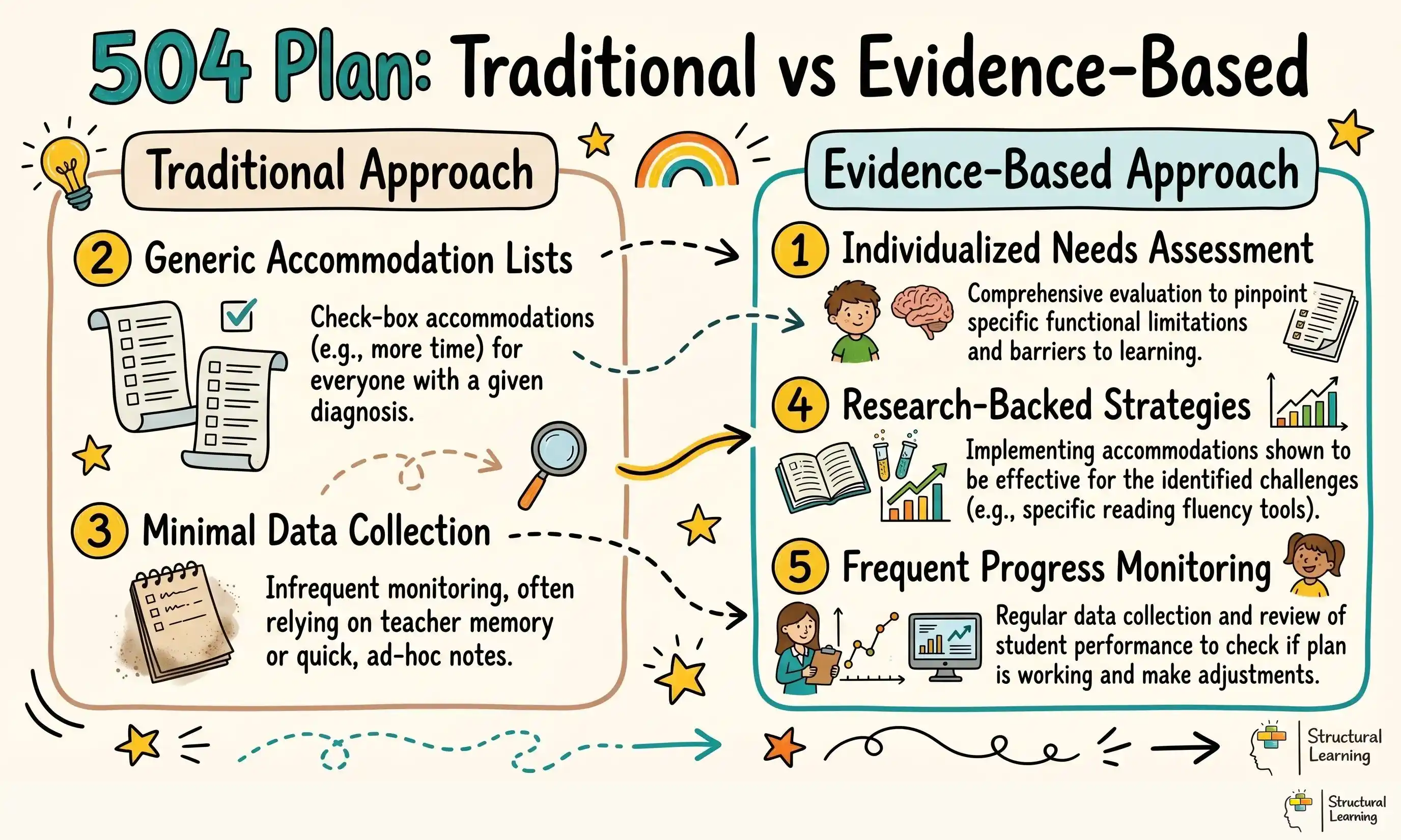
504 Plan: Traditional vs Evidence-Based infographic for teachers
504 Plan: Traditional vs Evidence-Based

Why 504 Plans Matter for Teachers

A 504 plan is far more than a legal compliance document. It is a highly effective pedagogical tool that helps teachers manage cognitive load and design better lessons. Sweller (1988) demonstrated that working memory has strict limits. When learners face unnecessary barriers in the classroom, their working memory becomes overloaded, which severely limits their capacity to process and retain new academic content. Learners with attention deficits or learning disabilities struggle with noisy classrooms or complex instructions. This drains the mental energy they need to learn the actual curriculum.

Accommodations directly reduce this extraneous cognitive load (Kirschner, Sweller & Clark, 2006). Barkley (2012) highlights how deficits in executive functioning impact learners, particularly those navigating ADHD alongside other learning disabilities. A well-constructed 504 plan scaffolds these executive functions. By providing graphic organisers, chunked assignments, or visual timers, teachers externalise the organisational processes that the learner's brain struggles to manage independently. This allows the learner to focus their cognitive resources on the learning objective rather than struggling with the format of the task.

Furthermore, applying these accommodations aligns closely with the principles of Universal Design for Learning. Rose & Meyer (2002) argue that designing instruction for the margins inherently benefits the entire classroom. When teachers use clear, structured routines designed to support learners with learning disabilities, the whole class experiences a more predictable and supportive learning environment (CAST, 2018). Strategies mandated by a 504 plan for one student, such as providing lesson notes in advance or allowing verbal responses, often become effective methods that improve engagement and comprehension for all learners.

Why 504 Plans Matter Concrete Example

  • What the teacher does: To reduce extraneous cognitive load during a complex science inquiry, the teacher provides a laminated guide with a single, clear step-by-step instruction and a corresponding diagram on each page, rather than a dense paragraph of text.
  • What learners produce: The learner follows the simplified sequential guides, performs the experiment independently, and records their measurements in a pre-formatted results table without experiencing cognitive overload.

504 Plans in the Classroom

Translating the legal requirements of Section 504 into daily classroom practice requires intentional planning. The goal is to integrate accommodations smoothly into core instruction so that learners feel supported without feeling singled out (DuPaul et al., 2011).

Strategy 1: Managing ADHD and Executive Function

ADHD frequently co-occurs with various learning disabilities, making executive function support critical. These learners often struggle with working memory, task initiation, and sustained attention (Pfiffner et al., 2007).

  • What the teacher does: The teacher chunks multi-step projects into smaller, manageable phases with distinct deadlines. The teacher provides graphic organisers that explicitly map out how to structure an essay or a science report. Visual timers are displayed on the board to help learners visualise the passage of time during independent work.
  • What learners produce: The learner uses a simplified checklist to mark off completed phases of their project before moving to the next step. They fill out the graphic organiser before attempting to write their draft, ensuring their ideas are structured before they manage the cognitive demands of sentence formation.

Strategy 2: Supporting Anxiety Needs

Anxiety can severely impact a learner's ability to process information and demonstrate their knowledge, often masquerading as behavioural issues or learning disabilities (Huberty, 2012).

  • What the teacher does: The teacher provides a highly predictable daily schedule and clearly signals any upcoming changes to routines in advance. The teacher issues a discrete 'cool down' pass that allows the learner to leave the room for a designated safe space without having to ask permission publicly (Wood, 2006).
  • What learners produce: The learner references a visual schedule taped to their desk to anticipate the flow of the lesson. When feeling overwhelmed, they place their cool-down pass on the teacher's desk and silently walk to the designated quiet area for five minutes to use self-regulation strategies.

Strategy 3: Navigating Autism and Sensory Needs

Learners on the autism spectrum may experience sensory overload and require highly explicit instructional routines to work through the social and academic demands of the classroom (Mesibov, Shea & Schopler, 2005).

  • What the teacher does: The teacher minimises sensory distractions by adjusting lighting, allowing noise-cancelling headphones during independent work, and seating the learner away from high-traffic areas like the classroom door. The teacher uses explicit instructional routines and literal language, avoiding sarcasm or idioms that might cause confusion.
  • What learners produce: The learner wears noise-cancelling headphones while completing their independent reading tasks. They rely on consistent, colour-coded folders to organise their materials and follow structured transition cues, such as a specific classroom chime, to prepare for the next activity.

Strategy 4: Addressing Dyslexia and Reading Challenges

Specific learning disabilities in reading require accommodations that bypass decoding challenges so the learner can demonstrate their actual comprehension and analytical skills (Snowling, 2013).

  • What the teacher does: The teacher ensures all digital reading materials are compatible with text-to-speech software. The teacher provides guided reading notes or partial outlines in advance of a lecture. When assessing knowledge, the teacher allows verbal responses or extended time to reduce the pressure on reading fluency (Shaywitz, 2003).
  • What learners produce: The learner listens to their history textbook using an audio app while following along with the text. During a lecture, they use the guided notes to fill in targeted vocabulary words rather than attempting to copy entire sentences from the board.

504 Plans in the Classroom Concrete Example

  • What the teacher does: The teacher provides a structured writing frame with sentence starters and transition words for a history lesson, and allows a learner with written expression challenges to use a speech-to-text app.
  • What learners produce: The learner drafts a cohesive three-paragraph historical argument, using the sentence starters to organize their thoughts and speech-to-text to write their draft without being blocked by spelling difficulties.

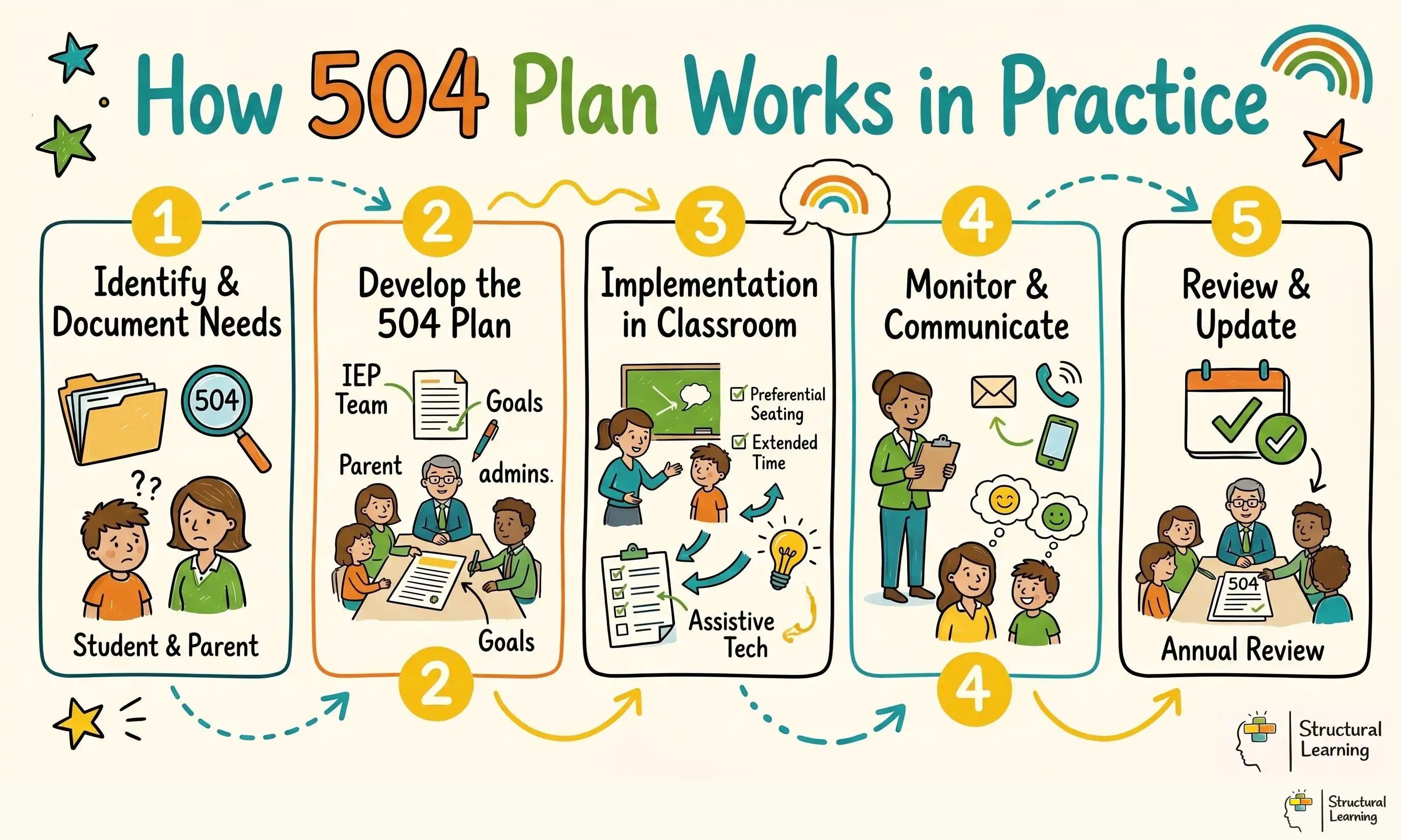
How 504 Plan Works in Practice infographic for teachers
How 504 Plan Works in Practice

Common Misconceptions

Misunderstanding the purpose and legal boundaries of these accommodations can lead to frustration for both teachers and families. Correcting these misconceptions is vital for effective implementation.

  • Misconception 1: A 504 plan is just a stepping stone to an IEP.
    • Correction: These are distinct paths. A learner might have severe learning disabilities that require the specialised, modified instruction of an IEP. Another learner might have profound physical disabilities but excel academically, requiring only the accessibility accommodations of a 504 plan. One does not automatically lead to the other (Fletcher et al., 2018).
  • Misconception 2: Accommodations provide an unfair advantage.
    • Correction: Accommodations do not lower the state standards or change the learning expectations. They simply remove the barrier caused by the disability. Using text-to-speech for reading-based learning disabilities is akin to wearing glasses; it provides access to the text, but the learner must still do the cognitive work of analysing the content (Hattie, 2009).
  • Misconception 3: These plans only cover learning disabilities.
    • Correction: While they frequently support learners with learning disabilities, they also cover medical conditions like diabetes, severe allergies, or asthma. If a physical or mental impairment limits major life activities, Section 504 applies.
  • Misconception 4: A formal medical diagnosis is legally required.
    • A medical diagnosis is helpful, but it is not always required. A school can evaluate a learner using its own data and classroom observations. They can use this evidence to determine if an impairment limits major life activities.

Common Misconceptions Concrete Example

  • What the teacher does: The teacher permits a learner with dysgraphia to complete a geography assessment by labelling a map and recording verbal explanations on an iPad, using the same academic grading rubric as the rest of the class.
  • What learners produce: The learner demonstrates thorough knowledge of geographical landforms through an accurate, labelled map and high-quality audio recordings that are assessed for geographical accuracy.

Practical Implementation Guide

Navigating the 504 process requires coordination between the classroom teacher, the school district, and the family. Here is a step-by-step guide from referral to report cards.
Step 1: Referral and Data Collection The process usually begins when a teacher or parent notices a learner struggling despite high-quality core instruction. The teacher should gather empirical data from their Multi-Tiered System of Supports (MTSS) or Response to Intervention (RTI) processes. Document what Tier 1 and Tier 2 interventions have been attempted, noting what impact they had on the learner's progress, behaviour, and engagement. This data is important for identifying underlying learning disabilities or attention issues (Jimerson et al., 2015).

Step 2: The Eligibility Meeting A committee, which must include people knowledgeable about the child, the evaluation data, and the placement options, convenes to review the evidence. They determine if the learner meets the criteria under Section 504 and the ADA. The classroom teacher's role here is to provide a clear, objective picture of how the suspected impairment limits the learner's major life activities within the typical classroom environment.

Step 3: Drafting the Plan If eligible, the team drafts the 504 plan for students. Accommodations must be specific, measurable, and directly linked to the barrier caused by the disability. Vague accommodations like "extra help when needed" are ineffective. Instead, the team should write targeted supports like "extended time (1.5x) on assessments requiring written expression" to specifically address writing-based learning disabilities.

Step 4: Classroom Execution and Monitoring Once signed, the plan is legally binding. The teacher must use the accommodations consistently. teachers need to to track whether the accommodations are actually working. A learner may use graphic organisers but still struggle to complete writing assignments. If so, the teacher must collect data and request a review meeting to adjust the plan.

Actionable vs. Ineffective Accommodations

Ineffective/Vague Accommodation ✗ Actionable/Measurable 504 Accommodation ✓
"Provide extra help with writing when needed." "Provide a graphic organiser and three specific sentence frames for all essays exceeding 200 words."
"Give the learner extra time for tests." "Allow 1.5x extended time on all summative assessments, administered in a quiet space with visual timers."
"Help the learner stay organised." "Allocate five minutes at the end of each day for the teacher to check the learner's homework planner and confirm materials are packed."
"Reduce distraction in the classroom." "Seat the learner in the front row, away from windows, doors, and noisy ventilation units, and allow noise-cancelling headphones during independent work."

Practical Implementation Guide Concrete Example

  • What the teacher does: The teacher logs the learner's weekly assignment completion rate on a simple spreadsheet, noting whether the provided visual checklists were used and if they resulted in completed work.
  • What learners produce: The learner uses their personalized checklist during class time to complete and hand in their maths assignments, which are tracked and logged in the teacher's records.

504 Plans Across Subjects

Accommodations look different depending on the cognitive demands of the specific subject area. Here is how to adapt strategies across core disciplines.

Maths

In Maths, learners often struggle with procedural memory and spatial organisation, which are common challenges in learning disabilities related to numeracy. The cognitive load of remembering a formula while simultaneously executing a multi-step calculation can cause frequent errors (Sweller, 1988).

Teachers can provide formula reference sheets or multiplication charts during classwork and exams. This removes the barrier of working memory retrieval, allowing the learner to demonstrate their understanding of the mathematical concept. Teachers can also provide graph paper with large squares to help learners align numbers correctly during long division or complex algebra, reducing spatial confusion.

English and Literacy

English classes demand heavy reading and writing, presenting significant barriers for learners with language-based learning disabilities like dyslexia or dysgraphia (Snowling, 2013).

Teachers can allow the use of speech-to-text software for drafting essays, enabling learners to express their complex ideas without being hindered by spelling and physical writing barriers. When assigning class novels, teachers can provide access to audiobooks. During vocabulary instruction, teachers can limit the number of words tested at one time, chunking a list of twenty words into two lists of ten, reducing the immediate memory burden.

Science

Science involves complex vocabulary, multi-step laboratory experiments, and conceptual reasoning. This environment can overwhelm learners with executive function deficits or specific learning disabilities.

Before a lab experiment, teachers can provide a visual, step-by-step checklist of the procedure. Teachers can pair the learner with a supportive peer model during group work to assist with task initiation and pacing. Teachers can provide partially completed diagrams for complex topics like cell structure. Learners label key parts instead of drawing the whole system from scratch.

504 Plans Across Subjects Concrete Example

  • What the teacher does: The teacher shares a digital template containing pre-formatted headers and sentence frames across English, science, and history classes to support a learner with organizing written work.
  • What learners produce: The learner produces structured, coherent paragraphs in each subject area, using the consistent templates to reduce the cognitive effort of layout and organization.

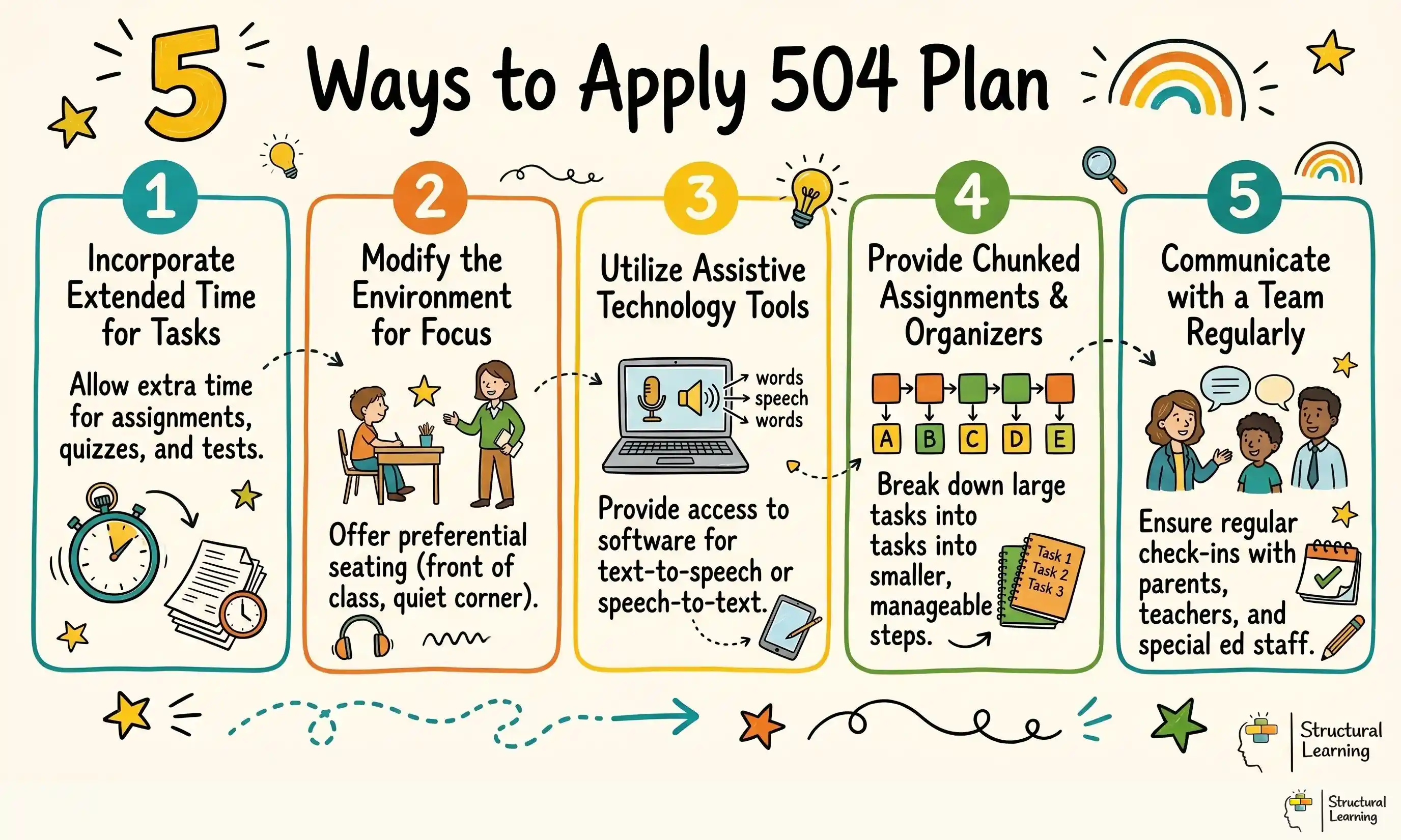
5 Ways to Apply 504 Plan infographic for teachers
5 Ways to Apply 504 Plan

Common Questions About 504 Plans

What is the difference between an IEP and a 504 plan?

An IEP is created under special education law (IDEA) and provides specialised instruction and related services for students with disabilities who require a modified curriculum. A 504 plan falls under civil rights law and provides accommodations to ensure equitable access to the standard general education curriculum without changing the academic expectations.

Who oversees the 504 process in a school district?

Every school district receiving federal funds must designate at least one person to coordinate its compliance with Section 504. This person is often the school counsellor, a building administrator, or a dedicated 504 coordinator, though classroom teachers are responsible for the daily implementation of the accommodations (US Department of Education, 2020).

Can a student with learning disabilities have both plans?

No, a learner does not need both. If a student qualifies for an IEP under special education, all necessary accommodations that would typically be in a 504 plan are legally required to be written directly into their IEP document. The IEP provides a more thorough umbrella of support.

Are these plans only for students with learning disabilities?

No. Learning disabilities and ADHD are common reasons for 504 Plans. However, these plans also cover medical issues like diabetes, epilepsy, and severe food allergies. They can even include mental health conditions like depression and severe anxiety. The condition simply needs to limit major life activities to be covered.

How often should a 504 plan be reviewed?

While Section 504 regulations require periodic re-evaluations, best practice dictates that school districts review a 504 plan for students at least once a year. This annual review ensures the accommodations are still relevant, effective, and appropriate for the learner's current grade level and changing needs (US Department of Education, 2020).

What happens if a teacher fails to use the accommodations?

Because Section 504 of the Rehabilitation Act is a federal civil rights law, failing to provide the documented accommodations is a violation of the learner's civil rights. Parents can file a grievance with the school district or submit a formal complaint directly to the US Department of Education's Office for Civil Rights.

Research sources

Further reading from peer-reviewed research

These 5 studies give source context for the classroom guidance in this article on 504 Plan: A Teacher's Guide. They are included as starting points for deeper reading, not as a substitute for local professional judgement.

14 citations onlinelibrary.wiley.com

Two critical thinking models-probing questions and conceptualization-adding 4 skillsets to the teacher's armamentarium.

Johnsen et al. (2020) | Journal of Dental Education

This research provides useful context for classroom decisions, especially when teachers match the intervention to learner need and check progress over time.

View study

19 citations online-journals.org

Transforming English Language Education in Saudi Arabia: Why Does Technology Matter?

Al-Shehri (2020) | International Journal of Emerging Technologies in Learning (iJET)

This research provides useful context for classroom decisions, especially when teachers match the intervention to learner need and check progress over time.

View study

16 citations ejmste.com

The development of an online STEM teacher professional development package with the DECODE model: An new teacher’s quality maintenance

Wahono et al. (2022) | Eurasia Journal of Mathematics, Science and Technology Education

This research provides useful context for classroom decisions, especially when teachers match the intervention to learner need and check progress over time.

View study

12 citations brill.com

A Teacher’s Practical Knowledge in an SSI-STEAM Program Dealing with Climate Change

Won et al. (2021) | Asia-Pacific Science Education

This research provides useful context for classroom decisions, especially when teachers match the intervention to learner need and check progress over time.

View study

mdpi.com

Why Inclusive Resources Matter - The Importance of Inclusive Internal Resources for Strain and Intended Inclusive Practices of Pre-Service Teachers

Oetjen (2023) | Education sciences

This research provides useful context for classroom decisions, especially when teachers match the intervention to learner need and check progress over time.

View study

Common Questions Concrete Example

  • What the teacher does: The teacher reads the accommodation list before a major assessment, arranges a quiet space in the classroom with a privacy screen, and provides a clear checklist of instructions.
  • What learners produce: The learner completes the assessment in the quiet area and submits their answered paper, demonstrating their actual knowledge without being distracted by classroom noise.
Free Resource Pack

504 Plan: A Teacher's Guide

4 essential resources to help teachers understand and effectively use 504 Plans in the classroom.

504 Plan: A Teacher's Guide, 4 resources
504 Plan Teacher Guide Special Education Needs Accommodations Inclusive Education Legal Framework CPD Visual Checklist Quick Reference IEP Differences

Download your free bundle

Fill in your details below and we'll send the resource pack straight to your inbox.

Quick survey (helps us create better resources)

How confident are you in understanding and effectively implementing 504 Plans in your classroom?

Not at all confident
Slightly confident
Moderately confident
Very confident
Extremely confident

How effectively does your school community (admin, colleagues) support teachers in implementing 504 Plans?

Not effective at all
Slightly effective
Moderately effective
Very effective
Extremely effective

To what extent do you feel you consistently provide all required accommodations for students with 504 Plans?

Rarely/Never
Sometimes
About Half the Time
Most of the Time
Always/Consistently

Your resource pack is ready

We've also sent a copy to your email. Check your inbox.

504 Plan: A Teacher's Guide: Study Notes preview
◆ Structural Learning
504 Plan: A Teacher's Guide: Study Notes
Study notesOne-page revision sheet

A one-page revision sheet covering the key ideas, classroom links, limitations and exam-ready comparisons.

Something went wrong - please try again.
Paul Main, Founder of Structural Learning
About the Author
Paul Main
Founder & Metacognition Researcher

Paul Main is an educator and metacognition researcher who founded Structural Learning in 2002. With a psychology degree from the University of Sunderland and 22+ years helping schools embed thinking skills, he bridges the gap between educational research and classroom practice. Fellow of the RSA and Chartered College of Teaching, with 128+ Google Scholar citations.

More →

Educational Technology

Back to Blog