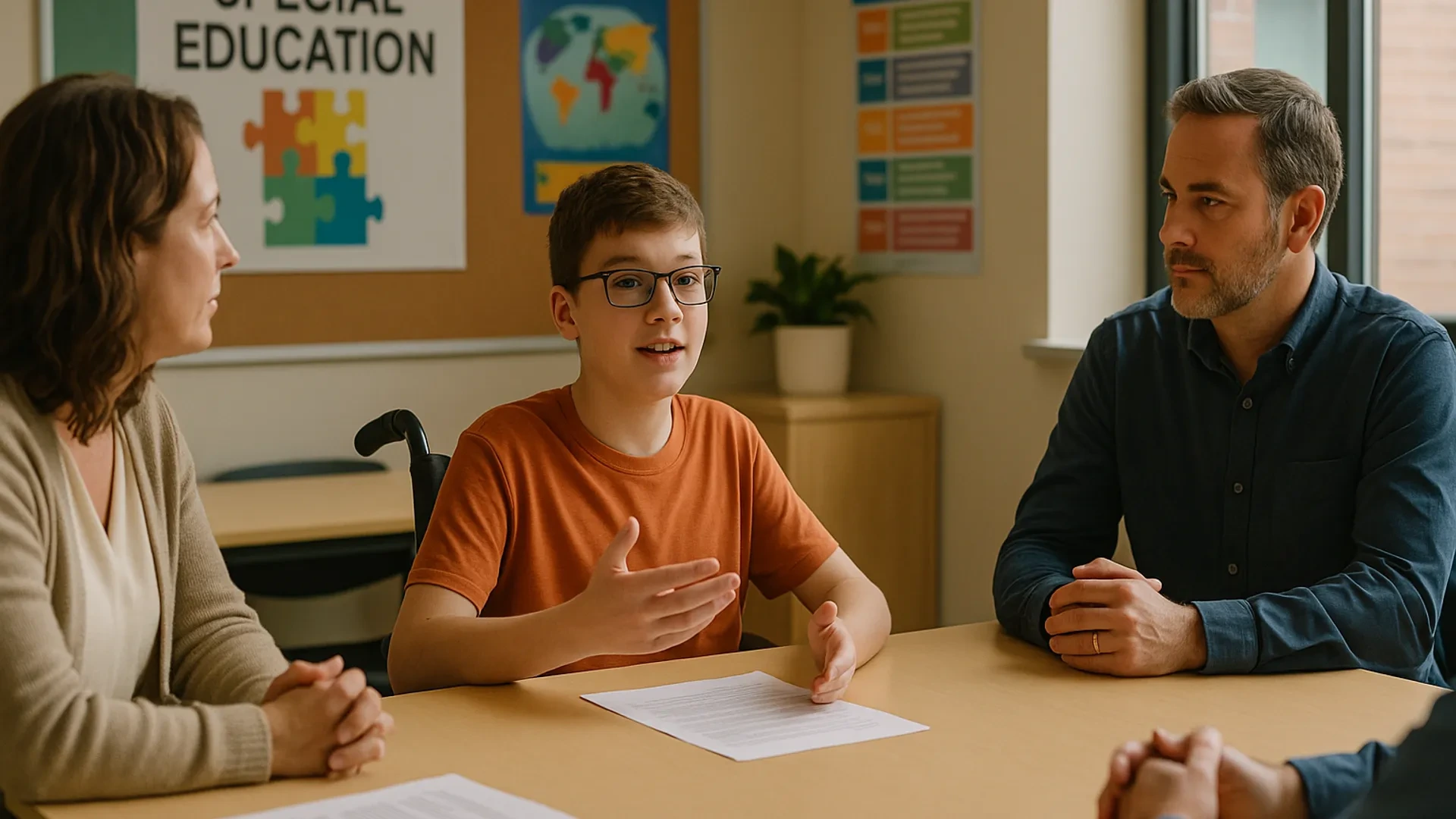
Self-Advocacy IEP Goals: Examples and Writing GuideStudent self-advocating at an IEP meeting with teachers

Updated on  

March 6, 2026

Self-Advocacy IEP Goals: Examples and Writing Guide

|

March 6, 2026

Ready-to-use self-advocacy IEP goal examples by grade level. Includes 20 SMART goals, teaching strategies, disability-specific examples, and measurement tools for IEP teams.

Self-Advocacy IEP Goals: Examples and Writing Guide

Most IEPs focus on reading, maths, or behaviour. Few include self-advocacy. That's a problem, because students who can articulate their own needs achieve better outcomes in secondary school, higher education, and employment. Self-advocacy isn't optional; it's a survival skill that separates students who thrive from those who fall through cracks.

Key Takeaways

  1. Self-advocacy predicts success: Research consistently shows students who can articulate their needs achieve better academic, employment, and post-school outcomes.
  2. Start early, build gradually: Self-advocacy skills should begin in elementary school with simple tasks like asking for help and progress to leading IEP meetings by high school.
  3. Every IEP needs self-advocacy: IDEA transition requirements make self-advocacy goals essential from age 16, but the groundwork should start years earlier.
  4. Measure what matters: Track self-advocacy through frequency counts, rubrics, and student-led demonstrations rather than subjective teacher judgement.

What Is Self-Advocacy in Special Education?

Self-advocacy is knowing what you need and saying it. It means a student understands their disability, recognises how it affects learning, and can communicate those needs to teachers, family, and peers. A Year 4 child asking for a quiet space to concentrate is self-advocating. A Year 10 student explaining to a supply teacher that she needs extra processing time is self-advocating. A Year 12 pupil requesting a reduced course load at college is self-advocating.

Self-advocacy combines three elements: self-knowledge (understanding your strengths and gaps), disability awareness (knowing how your disability shows up), and communication (asking for what you need clearly and respectfully). Without it, students rely entirely on adults to identify problems and arrange solutions. Once adults leave (secondary school teachers don't know about primary accommodations; college staff don't coordinate with secondary; employers don't ask), support disappears.

Research shows self-advocacy skills predict post-school success better than academic achievement alone (Test, Fowler, Wood, Brewer, & Eddy, 2005; Wehmeyer, Palmer, Agran, Mithaug, & Martin, 2000). Students with disabilities who self-advocate have higher employment rates (Wehmeyer & Palmer, 2003), earn more in their first jobs, and report better quality of life in adulthood (Nota, Ferrari, Soresi, & Wehmeyer, 2007).

Yet most IEPs skip this entirely. Schools write goals for decoding, number sense, and behaviour management but leave self-advocacy to chance. This article provides 20 ready-to-use goals, grade-by-grade examples, and a framework for teaching students to own their support.

UK Educator? While IEP goals are a US framework, self-advocacy skills are equally important in UK SEND provision. In the UK, self-advocacy connects to Preparing for Adulthood outcomes in EHCPs.

See our guide: Special Educational Needs: A Teacher's Guide.

Why Self-Advocacy Goals Belong in Every IEP

First, the legal requirement. The Individuals with Disabilities Education Act (IDEA) mandates that IEPs include transition planning beginning at age 16 (or younger in some states). That plan must address post-secondary goals: employment, higher education, and independent living. You cannot achieve those without self-advocacy. The IEP transition team must help students develop skills to pursue their goals. Self-advocacy is that foundation.

Second, the evidence gap. Many schools assume self-advocacy happens naturally or happens in other settings. Research contradicts this. Students with disabilities often don't understand their disability labels (Shaw, 2005), don't know what accommodations help them, and don't ask for support even when struggling (Getzel & Wehman, 2005). Self-advocacy is a taught skill, not innate. Schools must intentionally build it.

Third, college readiness. Secondary school staff know students' needs and provide accommodations automatically. College disability services require students to register, provide documentation, attend meetings, and advocate for their accommodations. Students who have never requested accommodation fail to register and miss out entirely (Newman, Wagner, Cameto, & Knokey, 2009). A student who spent five years with automatic support but never asked for it will not survive the first semester of college.

Finally, employment outcomes. Employers don't read IEPs. They don't know your processing speed, anxiety triggers, or sensory needs unless you tell them. Workers who communicate their needs and propose solutions are promoted; workers who stay silent fall behind. Self-advocacy measured in secondary school predicts wages and job satisfaction 15 years later (Lindstrom, Doren, & Miesch, 2000).

Self-Advocacy IEP Goals by Grade Level

Elementary School (K-5 Years)

Young children's self-advocacy starts with identification and asking. Goals focus on recognising their own needs and using simple language to request help. Success looks like: "I need a break," "Can you repeat that?" or "This is hard for me."

Year 2 Example: Given a task he finds difficult (e.g., reading aloud), [student] will raise his hand and say "I need help" or "That's too hard" in at least 4 out of 5 opportunities, as recorded by his teacher during independent work time.

Year 4 Example: When asked by a teacher or peer "What do you find hard in maths?" [student] will name one specific area (e.g., "I don't understand word problems" or "Fractions confuse me") with 80% accuracy across three separate conversations, recorded by staff.

Year 5 Example: During group work, [student] will identify when she needs a break and request it appropriately ("Can I take a quiet break?" or "I need to move") in at least 3 out of 4 group sessions, as measured by teacher observation notes.

Middle School (Years 6-8)

By middle school, self-advocacy expands to explaining needs to multiple adults (different teachers for each subject) and requesting accommodations. Students learn disability language and why their accommodations matter. Success looks like: "I have dyslexia, which makes reading slow. I need extra time on tests" or "I have ADHD, so I focus better if I sit near the front."

Year 6 Example: [Student] will explain to at least two different teachers what his ADHD is and how it affects his learning (e.g., "I get distracted by noise, so I need to sit away from the door"), using prepared sentences or notes, in at least 3 separate conversations, recorded by staff.

Year 7 Example: When a new teacher assigns homework, [student] will identify one accommodation she needs and request it in writing (email, note, or form) with 75% accuracy, as tracked through a log kept by the special education coordinator.

Year 8 Example: [Student] will attend and contribute to his transition planning meeting by stating one goal (e.g., "I want to study maths at secondary school") and one accommodation he needs (e.g., "I need extra time"), recorded by IEP team in meeting minutes.

High School (Years 9-12)

High school self-advocacy moves into leadership. Students lead their own IEP meetings, self-monitor progress, make decisions about disclosure, and represent themselves to new adults (secondary school staff, college advisers, employers). Success looks like: running your IEP meeting, deciding when to tell a teacher about your disability, or negotiating accommodations with a supervisor.

Year 9 Example: [Student] will prepare for his annual IEP meeting by completing a one-page "About Me" sheet (strengths, areas of difficulty, goals, accommodation preferences) and will answer at least three questions from the IEP team during the meeting, recorded in meeting notes.

Year 10 Example: [Student] will initiate a conversation with at least one teacher each term to request an accommodation or explain how a current accommodation is working, documented through email, a completed form, or teacher notes; target: 75% compliance across three terms.

Year 11 Example: [Student] will develop a transition portfolio including his disability label, accommodation needs, documentation (e.g., diagnosis letters), and post-secondary goals; he will present this to the college disability services office and participate in the accommodation planning meeting.

Year 12 Example: [Student] will lead her final IEP meeting by presenting her post-secondary goals, her accommodation needs for the first year of college/work, and a 12-month action plan for transitioning to independent living, with facilitation from staff if needed.

20 Ready-to-Use Self-Advocacy IEP Goal Examples

Use these examples as templates. Adjust the specific context (subject, setting, frequency) to match your student and student's age. All follow the formula: Given [context], [student] will [behaviour] with [success criteria], as measured by [data method].

Goal ID Goal Statement Grade Category
1 Given a task he finds difficult, [student] will raise his hand and communicate his need (verbally or with a prepared card) in 4 out of 5 opportunities. 2-3 Communication
2 When asked about her strengths, [student] will name two things she is good at with 100% accuracy across five separate conversations. 4-5 Self-Knowledge
3 When asked about her disability, [student] will explain one way it affects her learning (e.g., "Dyslexia makes reading slow") using three to five words, with 80% accuracy. 5-6 Self-Knowledge
4 During group work, [student] will request a break using an agreed phrase ("I need a break" or quiet break signal) in 3 out of 4 group sessions, as recorded by staff. 3-5 Communication
5 Given a new teacher or setting, [student] will communicate his accommodation needs (verbally or in writing) within the first week with staff facilitation, recorded in a log. 6-8 Communication
6 When asked about her learning style, [student] will identify one strategy that helps her learn best and explain why (e.g., "I learn better with pictures because I'm a visual learner") with 90% accuracy. 7-8 Self-Knowledge
7 Given feedback that he's off-task, [student] will use a self-monitoring strategy (checklist, timer, or prompt card) to refocus and report back within 5 minutes, in 4 out of 5 instances. 6-9 Rights & Responsibilities
8 During an IEP meeting, [student] will contribute by answering at least three questions about her goals, needs, or preferences, recorded in meeting notes. 8-10 Communication
9 When assigned a task without accommodation guidance, [student] will identify which accommodation he needs and request it (verbally or by email) with 85% accuracy within 24 hours. 7-9 Problem-Solving
10 Given a conflict with a peer or teacher, [student] will identify the problem, propose two possible solutions, and communicate his preferred solution calmly in 80% of documented incidents. 8-11 Problem-Solving
11 [Student] will complete a strengths and needs self-assessment questionnaire and discuss the results with her IEP team, identifying two post-secondary goals and three accommodation needs. 9-10 Self-Knowledge
12 Given an unsupported task in a new class, [student] will initiate contact with the teacher within three days to discuss accommodations, using a prepared accommodation request form or verbal script. 9-11 Communication
13 [Student] will attend at least 80% of check-in meetings with his special education coordinator and will track his own progress on self-advocacy goals using a provided self-monitoring form. 7-12 Rights & Responsibilities
14 When given a choice about disclosing her disability to new people, [student] will make a decision, explain her reasoning, and communicate the disclosure (or choice not to disclose) appropriately in 90% of documented situations. 9-12 Rights & Responsibilities
15 Given written or verbal feedback on his progress, [student] will identify one area to improve and ask for one specific way his teacher can help him in 4 out of 5 feedback conversations. 8-10 Problem-Solving
16 During the transition planning process, [student] will identify three potential employers or higher education providers, research their accessibility features, and articulate how her accommodations will support her success. 10-12 Problem-Solving
17 Before each IEP meeting, [student] will prepare a list of topics to discuss, goals he wants to set, and accommodations he wants to request; he will lead the first part of the meeting using his notes. 10-12 Communication
18 [Student] will create and maintain a digital or paper portfolio containing her accommodation letters, a one-page "About Me" summary, documented proof of accommodations used, and post-secondary planning documents. 9-12 Self-Knowledge
19 Given a mock interview or workplace scenario, [student] will explain his disability, requested accommodations, and strengths as an employee, using clear language and confident body language, rated 8/10 or higher on a rubric. 11-12 Communication
20 At the college disability services office or employer orientation, [student] will independently register, present her documentation, request needed accommodations, and follow up on status within one week. 12 Rights & Responsibilities

How to Write Effective Self-Advocacy IEP Goals

Start with Present Levels

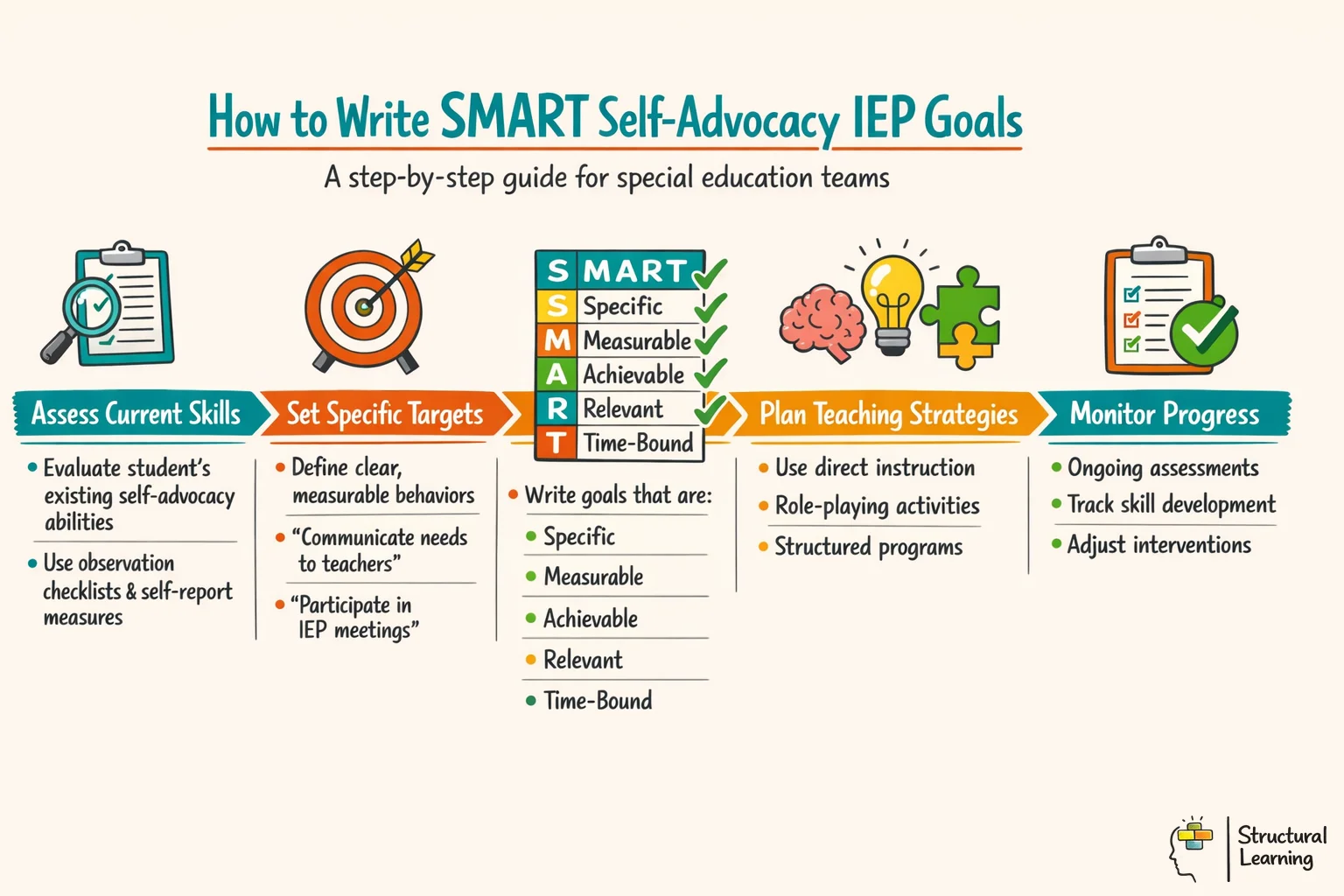
Before writing any goal, document where your student is now. Can he name one thing he's good at? Can she ask for help at all? Does he understand what his disability is? Present levels answer these questions and prevent you from setting unrealistic goals. A student who doesn't recognise her own needs cannot lead an IEP meeting yet. Start with awareness; work toward leadership.

Use the SMART Framework

SMART goals are Specific, Measurable, Achievable, Relevant, and Time-bound. "Self-advocacy skills will improve" is not SMART. "By June 30th, [student] will request accommodation from at least two different teachers each term, documented through email or staff notes, with 80% accuracy" is SMART. The goal names the exact behaviour, the measurement method, the success threshold, and the timeframe.

Include Measurable Criteria

Avoid vague language like "will understand" or "will demonstrate awareness." These cannot be measured. Instead, use observable verbs: will name, will ask, will explain, will initiate, will complete, will attend, will lead. Pair each verb with a frequency target (4 out of 5 times, 80% accuracy, at least twice per term, within 24 hours). Vagueness leads to arguments at review meetings; specificity prevents them.

Specify the Data Collection Method

How will you know if the goal is met? Write it into the goal. "Recorded by teacher observation notes," "documented in accommodation request log," "measured through self-assessment rubric," "tracked by special education coordinator check-ins." Without a clear method, staff will forget to collect data and you will have no evidence at review time.

Common Mistakes to Avoid

Mistake 1: Making the goal dependent on the student's mood or maturity. "When [student] is ready, he will lead his IEP meeting." This is not a goal; it's wishful thinking. Maturity doesn't happen without teaching. Make the goal about teaching the skill, not waiting for readiness.
Mistake 2: Confusing self-advocacy with compliance. "Student will follow teacher directions without questioning" is obedience, not self-advocacy. Self-advocacy includes respectfully questioning when you don't understand or when an accommodation isn't working. Teach both compliance and advocacy; they are not opposites.

Mistake 3: Setting goals that are too big. "Student will self-advocate independently across all settings by June" is unrealistic for most students. Break it into smaller steps: understanding disability, naming one strength, asking for help, explaining needs to one teacher, then multiple teachers, then leading meetings. Build over years, not months.

Mistake 4: Forgetting to teach. Writing a goal does not teach the skill. The goal documents what you will teach and how you will measure it. You still must provide explicit instruction, model, role-play, and practice. Without teaching, the goal will not be met.

Teaching Self-Advocacy Skills in the Classroom

Direct Instruction: Scripts, Modelling, and Role-Play

Self-advocacy is a taught skill, not something students discover. Start with direct instruction. Teach students to name their strengths: "I'm good at...", "I can...", "I'm better at...". Teach them to name their challenges: "I find it hard to...", "I need help with...", "This is confusing because...". Use visuals (posters, worksheets, sentence frames) so students don't have to memorise language.

Model asking for help yourself. Narrate what you're thinking: "I don't understand this, so I'm going to ask someone. I'll say, 'Can you explain that again?' because I want to learn it." Show students what it looks like, sounds like, and feels like to ask. Model it repeatedly. Then invite students to practice with you before they do it alone.

Use role-play and video modelling. Pair students to practice asking for a break, explaining a disability, or requesting accommodation. Record videos of students role-playing successfully so others can watch and learn. Peer models are powerful. A Year 7 student watching a Year 7 peer explain why he needs quiet time learns more than listening to a teacher talk about it.

The I'M DETERMINED Framework

Virginia Department of Education developed the I'M DETERMINED curriculum, a research-backed framework for teaching self-advocacy. It teaches students to know themselves (identity and strengths), make decisions (expressing preferences, solving problems), take action (communicating needs, setting goals), and learn and reflect (checking progress). The framework is hierarchical: students learn to know themselves before they can make decisions; they make decisions before they can take action.

I'M DETERMINED materials include lesson plans, activities, and assessments. Lessons start in Year 4 and progress through to Year 12. The curriculum explicitly teaches students to discuss disability, set goals, and participate in IEP meetings. If your school doesn't use it, you can access free resources at the Virginia Department of Education website.

Student-Led IEP Meetings: Step-by-Step

Begin with a simple version in elementary school: the student says his name, shares one thing he's good at, and names one thing he wants to learn. Gradually expand. By Year 8, the student should present his current level of performance and one goal. By Year 10, the student leads most of the meeting with staff facilitation.

To prepare, work with the student one-to-one before the meeting. Teach him to read the agenda. Help him fill in a one-page form: "What am I good at? What's hard for me? What do I want to work on? What help do I need?" Practice his presentation two or three times. Rehearsal reduces anxiety and increases confidence. During the meeting, sit next to the student so he can see you if he gets stuck, but let him do the talking.

The Self-Advocacy Skill Progression

Teach self-advocacy in four stages, building over years not months. Stage 1: Awareness. Students recognise their strengths and needs. "I'm good at drawing. I find maths hard." No communication yet, just thinking. Stage 2: Communication. Students express their needs to one trusted adult. "I need extra time on tests." Communication is direct but limited in scope. Stage 3: Negotiation. Students ask for specific accommodations, understand why they need them, and explain to multiple people. "I have dyslexia, which makes reading slow. I need a reader or text-to-speech." Stage 4: Leadership. Students make decisions about their support, problem-solve when accommodations don't work, and prepare for transitions. They lead their IEP meeting, choose their accommodations, and represent themselves at college or work.

Do not skip stages. A student in Stage 1 cannot yet negotiate. Teaching him to negotiate will fail because he hasn't built self-awareness yet. Build the foundation first.

Self-Advocacy Goals for Students with Specific Disabilities

ADHD

Students with ADHD often struggle to notice their own executive function breakdowns. They get distracted and don't realise it. Self-advocacy goals should focus on self-monitoring: noticing when attention is drifting, recognising when they need movement, and requesting breaks before they dysregulate.

Example Goal 1: During seatwork, [student] will use a self-monitoring checklist (Am I sitting? Am I looking at my work? What should I be doing right now?) every 10 minutes and will request a movement break if he marks "no" on any item, in 4 out of 5 independent work sessions.

Example Goal 2: [Student] will identify one classroom accommodation that helps him focus (fidget tool, movement break, seat location, background noise reduction) and will advocate for that accommodation with each new teacher, requesting it verbally or in writing within the first week of class, for 80% of his classes.

Autism

Autistic students may struggle to initiate social communication or may not recognise that their needs differ from peers. Goals should focus on understanding sensory and social needs, scripted disclosure, and requesting accommodation without anxiety.

Example Goal 1: [Student] will identify one sensory accommodation she needs in each environment (quiet space, reduced lighting, headphones, fidget item) and will use a prepared disclosure script ("I have autism and need a quiet space to focus") to communicate this to at least one staff member in each new setting, measured across three transitions with 90% accuracy.

Example Goal 2: When overwhelmed or anxious, [student] will use an agreed signal or say a prepared phrase ("I need a break" or show a break card) to request time alone or sensory support, in 4 out of 5 documented instances, before dysregulation occurs.

Learning Disabilities (Dyslexia, Dyscalculia, Dysgraphia)

Students with learning disabilities need to understand that their disability is neurological, not a reflection of effort or intelligence. Self-advocacy goals focus on explaining the disability to teachers, requesting reading or writing supports, and monitoring whether accommodations are working.

Example Goal 1: [Student] will explain to new teachers that he has dyslexia and that he needs extra time to read and a reader or text-to-speech tool, using a prepared letter or verbal script, within the first week of each new class or term, documented for 100% of his teachers.

Example Goal 2: Given a written assignment, [student] will identify which accommodation she needs (extended time, speech-to-text, template, graphic organiser) and will request it from her teacher within 24 hours with 85% accuracy, tracked through accommodation request logs.

Emotional and Behavioural Difficulties

Students with emotional and behavioural difficulties need to learn to recognise their own emotional state, identify triggers, and request support or space before behaviour escalates. Goals focus on self-regulation advocacy and problem-solving.

Example Goal 1: [Student] will use a feelings thermometer (1-10 scale) to identify his current emotional state and will request a support strategy (talk to counsellor, take a break, change activity, talk to a peer) when his rating reaches 6 or higher, in 3 out of 4 check-in times.

Example Goal 2: When she has a conflict with a peer or adult, [student] will describe what happened, her feelings, and one possible solution, either verbally or in writing, in 75% of conflict situations, with staff support if needed.

Measuring Progress on Self-Advocacy Goals

Data Collection Methods

Self-advocacy goals are qualitative and sometimes hard to measure, but they must be measured. Use one of these methods for each goal.

Frequency counts: Tally how many times the student asks for help, requests accommodation, or participates in a check-in. Record a date and note (e.g., "9 Feb: asked for a break during independent work; 11 Feb: emailed teacher about accommodation request"). Review every two weeks to track trends.

Rubrics: Create a simple rubric to rate the quality of self-advocacy. Example: 1 = student does not initiate; 2 = student initiates but needs heavy prompting; 3 = student initiates with light prompting; 4 = student initiates independently. Assess once per month.

Self-assessment scales: Ask students to rate themselves. "How well did I explain my needs today?" (1-5 scale). Students' perception of progress is important data. It also builds metacognition. Collect once per week.

Portfolio evidence: Collect samples: emails where the student requested accommodation, notes from student-led IEP meeting contributions, self-monitoring forms, accommodation logs, recordings or notes of student explanations of their disability. Portfolios show growth over time in a powerful way.

The Self-Advocacy Questionnaire

Sievert, Curcio, and Ewoldt (2014) developed the Self-Advocacy Questionnaire, a research-backed tool that measures self-advocacy knowledge and skills across four areas: knowing yourself, knowing your rights, making decisions, and communicating with others. The tool has student, staff, and parent versions. It's a formative assessment, not a summative one; use it to identify skill gaps and set goals, then re-administer it every six months to measure growth (Sievert, Curcio, & Ewoldt, 2014).

Progress Monitoring Schedule

Build data collection into your routine so it doesn't feel like extra work. Check progress every two weeks minimum. If a student is making progress, maintain current teaching. If no progress after four weeks, adjust your teaching strategy. Ask: Is the skill too hard? Does the student need more practice? Is the goal unclear?

Conduct a full review every eight weeks. Bring together all the data (frequency counts, rubric scores, portfolio samples) and ask: Is the student moving toward independence? Is the current teaching working? What's the next step? Use this data to inform your IEP annual review.

Self-Advocacy Beyond the Classroom

Workplace Self-Advocacy

An employer doesn't know about accommodations unless the employee says something. A worker who has never self-advocated in school will not suddenly do it at work. In school, staff know and notice; at work, they don't. Self-advocacy transitions into workplace skills: knowing when to disclose disability, how to request reasonable adjustment without sounding demanding, and how to problem-solve when accommodations break down.

Teach transition-age students to draft a workplace self-advocacy statement: "I have ADHD, which affects my attention to detail. In previous roles, I've found that checking work against a checklist helps me catch errors. Can we build that into the role?" This statement is factual, not emotional. It proposes a solution. It teaches an employer how to help you succeed.

College Disability Services Navigation

College disability services require self-advocacy that secondary schools don't. Students must register with disability services, provide documentation, attend meetings, and advocate for accommodations. Students who have never done this often don't register at all. By Year 11, begin teaching students to contact disability services, understand what documentation they'll need, and prepare their self-advocacy statement for college.

Practise the college transition before it happens. Invite a local college disability services coordinator to speak to your students. Role-play the college intake meeting. Have students complete practice paperwork. The more familiar the process becomes, the more likely they are to complete it.

Community Self-Advocacy

Self-advocacy extends to any setting where a student needs support: transport, healthcare, recreation. A teenager using public transport can self-advocate by asking for help if she's confused about the route. A student at the GP can self-advocate by explaining their sensory needs so the appointment doesn't trigger anxiety. These are all self-advocacy moments. Frame them as such. Notice when your student self-advocates in community settings and reinforce it.

Lifelong Self-Advocacy Skills

Self-advocacy doesn't stop after secondary school. Adults with disabilities self-advocate at work, at university, with healthcare providers, and in relationships. The self-advocacy skills you teach in school become lifelong skills. A student who learns to ask for what he needs at Year 8 is building skills he will use at 28, 38, and beyond. Research shows strong self-advocacy in secondary school predicts employment, earnings, and life satisfaction 15 years later (Lindstrom, Doren, & Miesch, 2000). This matters.

Frequently Asked Questions

At what age should self-advocacy goals start?

As early as possible. Elementary school is not too early to begin. A Year 2 student can learn to ask for help. A Year 4 student can identify one strength. A Year 6 student can explain her disability to a new teacher. Don't wait until Year 10 to introduce self-advocacy. The earlier you start, the more time students have to practise and refine the skill before they transition to secondary school or college, where self-advocacy becomes critical.

Can self-advocacy goals replace other IEP goals?

No. Self-advocacy goals are in addition to academic or behavioural goals. A student still needs goals in reading, maths, or social skills. Self-advocacy supports those goals; it does not replace them. A student working on reading fluency and self-advocacy simultaneously will probably progress better in reading because he is also learning to request support when reading becomes hard.

What if a student is not ready or willing to self-advocate?

Start with Stage 1 awareness. A student does not have to be ready; readiness comes through teaching. Begin small: help the student notice one thing he is good at. Build confidence with success. A student who thinks self-advocacy means being rude or demanding needs reassurance that asking for help is brave, not bad. A student who is anxious about drawing attention to himself needs practice in safe environments before public self-advocacy. Readiness is built, not waited for.

How do I convince parents that self-advocacy goals matter?

Share the research. Show parents the Wehmeyer studies showing that students who self-advocate have better employment outcomes. Explain the secondary school transition: teachers change every lesson and may not know about accommodations unless the student says. Explain higher education: colleges require students to register for disability services. Explain employment: employers don't read IEPs. Self-advocacy is the bridge between secondary school support and independent adult life. Parents who understand this will support the goal. A one-page fact sheet with evidence and examples is powerful.

How do self-advocacy goals align with transition planning?

They are inseparable. Transition planning (required by IDEA from age 16) focuses on post-secondary goals: employment, higher education, community participation. A student cannot achieve any of these without self-advocacy. At the transition planning meeting, ask: "What post-secondary goal does this student have?" Then ask: "What self-advocacy skills will he need to achieve that goal?" If the goal is secondary school leading to university, the student needs to advocate for accommodations with each new teacher and with the university disability services office. If the goal is employment, the student needs to disclose his disability and request reasonable adjustments with his employer. Build self-advocacy goals from the transition goal backwards.

Key Points to Remember

Self-advocacy is a taught skill that predicts post-school success better than academic achievement alone. Students don't develop it by accident; they develop it through systematic instruction, practice, and feedback from adults who believe they can do it.

Start early. A Year 2 student can ask for help. Build gradually through four stages: awareness, communication, negotiation, leadership. By secondary school, your student should be leading his own IEP meeting and asking for accommodations from new teachers. By the end of Year 12, he should be ready to navigate college disability services or disclose his needs to an employer independently.

Use the 20 goal examples in this article as starting points. Adjust them for your student's age, disability, and current level. Build data collection into your routine. Measure progress every two weeks. Adjust teaching if progress stalls.

Remember: self-advocacy is not about being rude or difficult. It is about knowing yourself, understanding your needs, and communicating clearly and respectfully so others can help you succeed. That skill will serve your student for life.

Further Reading: Key Research on Self-Advocacy

These peer-reviewed studies explore how self-determination and self-advocacy skills improve post-school outcomes for students with disabilities.

Self-Determination and Transition: A National Study of Teachers of Students with Disabilities View study ↗
187 citations

Shogren et al. (2015)

This large-scale study found that self-determination instruction, including self-advocacy skills, significantly predicted post-school employment and independent living outcomes for students with disabilities.

The Impact of the Self-Determined Learning Model of Instruction on Student Self-Determination View study ↗
312 citations

Wehmeyer et al. (2012)

Wehmeyer's research demonstrated that teaching students to set goals, self-monitor, and self-advocate using the SDLMI framework produced measurable gains in self-determination across disability categories.

Self-Advocacy Among Students with Disabilities: A Systematic Review View study ↗
94 citations

Test et al. (2005)

This systematic review identified four core components of self-advocacy: knowledge of self, knowledge of rights, communication, and leadership. These components form the basis for writing measurable IEP goals.

Student Involvement in Individualised Education Programs: A Review and Analysis View study ↗
156 citations

Martin et al. (2006)

Martin found that when students actively participated in their IEP meetings, they showed stronger self-advocacy skills, better goal attainment, and higher satisfaction with their education plans.

Promoting Self-Determination in Students with Developmental Disabilities View study ↗
420 citations

Wehmeyer & Shogren (2017)

The definitive text on self-determination instruction. Provides the theoretical framework and practical strategies for teaching self-advocacy across all age groups and disability categories.

Next Steps for Your Classroom

This week, identify one student with a disability who does not have a self-advocacy goal on his IEP. Use the present level assessment: Can he name one strength? Can he ask for help? Can he explain his disability? Write one age-appropriate goal from the examples in this article. Begin teaching the skill tomorrow using modelling, role-play, or direct instruction. Collect data on a simple tally sheet. Review progress in two weeks. That's the foundation. Build from there.

Loading audit...

Self-Advocacy IEP Goals: Examples and Writing Guide

Most IEPs focus on reading, maths, or behaviour. Few include self-advocacy. That's a problem, because students who can articulate their own needs achieve better outcomes in secondary school, higher education, and employment. Self-advocacy isn't optional; it's a survival skill that separates students who thrive from those who fall through cracks.

Key Takeaways

  1. Self-advocacy predicts success: Research consistently shows students who can articulate their needs achieve better academic, employment, and post-school outcomes.
  2. Start early, build gradually: Self-advocacy skills should begin in elementary school with simple tasks like asking for help and progress to leading IEP meetings by high school.
  3. Every IEP needs self-advocacy: IDEA transition requirements make self-advocacy goals essential from age 16, but the groundwork should start years earlier.
  4. Measure what matters: Track self-advocacy through frequency counts, rubrics, and student-led demonstrations rather than subjective teacher judgement.

What Is Self-Advocacy in Special Education?

Self-advocacy is knowing what you need and saying it. It means a student understands their disability, recognises how it affects learning, and can communicate those needs to teachers, family, and peers. A Year 4 child asking for a quiet space to concentrate is self-advocating. A Year 10 student explaining to a supply teacher that she needs extra processing time is self-advocating. A Year 12 pupil requesting a reduced course load at college is self-advocating.

Self-advocacy combines three elements: self-knowledge (understanding your strengths and gaps), disability awareness (knowing how your disability shows up), and communication (asking for what you need clearly and respectfully). Without it, students rely entirely on adults to identify problems and arrange solutions. Once adults leave (secondary school teachers don't know about primary accommodations; college staff don't coordinate with secondary; employers don't ask), support disappears.

Research shows self-advocacy skills predict post-school success better than academic achievement alone (Test, Fowler, Wood, Brewer, & Eddy, 2005; Wehmeyer, Palmer, Agran, Mithaug, & Martin, 2000). Students with disabilities who self-advocate have higher employment rates (Wehmeyer & Palmer, 2003), earn more in their first jobs, and report better quality of life in adulthood (Nota, Ferrari, Soresi, & Wehmeyer, 2007).

Yet most IEPs skip this entirely. Schools write goals for decoding, number sense, and behaviour management but leave self-advocacy to chance. This article provides 20 ready-to-use goals, grade-by-grade examples, and a framework for teaching students to own their support.

UK Educator? While IEP goals are a US framework, self-advocacy skills are equally important in UK SEND provision. In the UK, self-advocacy connects to Preparing for Adulthood outcomes in EHCPs.

See our guide: Special Educational Needs: A Teacher's Guide.

Why Self-Advocacy Goals Belong in Every IEP

First, the legal requirement. The Individuals with Disabilities Education Act (IDEA) mandates that IEPs include transition planning beginning at age 16 (or younger in some states). That plan must address post-secondary goals: employment, higher education, and independent living. You cannot achieve those without self-advocacy. The IEP transition team must help students develop skills to pursue their goals. Self-advocacy is that foundation.

Second, the evidence gap. Many schools assume self-advocacy happens naturally or happens in other settings. Research contradicts this. Students with disabilities often don't understand their disability labels (Shaw, 2005), don't know what accommodations help them, and don't ask for support even when struggling (Getzel & Wehman, 2005). Self-advocacy is a taught skill, not innate. Schools must intentionally build it.

Third, college readiness. Secondary school staff know students' needs and provide accommodations automatically. College disability services require students to register, provide documentation, attend meetings, and advocate for their accommodations. Students who have never requested accommodation fail to register and miss out entirely (Newman, Wagner, Cameto, & Knokey, 2009). A student who spent five years with automatic support but never asked for it will not survive the first semester of college.

Finally, employment outcomes. Employers don't read IEPs. They don't know your processing speed, anxiety triggers, or sensory needs unless you tell them. Workers who communicate their needs and propose solutions are promoted; workers who stay silent fall behind. Self-advocacy measured in secondary school predicts wages and job satisfaction 15 years later (Lindstrom, Doren, & Miesch, 2000).

Self-Advocacy IEP Goals by Grade Level

Elementary School (K-5 Years)

Young children's self-advocacy starts with identification and asking. Goals focus on recognising their own needs and using simple language to request help. Success looks like: "I need a break," "Can you repeat that?" or "This is hard for me."

Year 2 Example: Given a task he finds difficult (e.g., reading aloud), [student] will raise his hand and say "I need help" or "That's too hard" in at least 4 out of 5 opportunities, as recorded by his teacher during independent work time.

Year 4 Example: When asked by a teacher or peer "What do you find hard in maths?" [student] will name one specific area (e.g., "I don't understand word problems" or "Fractions confuse me") with 80% accuracy across three separate conversations, recorded by staff.

Year 5 Example: During group work, [student] will identify when she needs a break and request it appropriately ("Can I take a quiet break?" or "I need to move") in at least 3 out of 4 group sessions, as measured by teacher observation notes.

Middle School (Years 6-8)

By middle school, self-advocacy expands to explaining needs to multiple adults (different teachers for each subject) and requesting accommodations. Students learn disability language and why their accommodations matter. Success looks like: "I have dyslexia, which makes reading slow. I need extra time on tests" or "I have ADHD, so I focus better if I sit near the front."

Year 6 Example: [Student] will explain to at least two different teachers what his ADHD is and how it affects his learning (e.g., "I get distracted by noise, so I need to sit away from the door"), using prepared sentences or notes, in at least 3 separate conversations, recorded by staff.

Year 7 Example: When a new teacher assigns homework, [student] will identify one accommodation she needs and request it in writing (email, note, or form) with 75% accuracy, as tracked through a log kept by the special education coordinator.

Year 8 Example: [Student] will attend and contribute to his transition planning meeting by stating one goal (e.g., "I want to study maths at secondary school") and one accommodation he needs (e.g., "I need extra time"), recorded by IEP team in meeting minutes.

High School (Years 9-12)

High school self-advocacy moves into leadership. Students lead their own IEP meetings, self-monitor progress, make decisions about disclosure, and represent themselves to new adults (secondary school staff, college advisers, employers). Success looks like: running your IEP meeting, deciding when to tell a teacher about your disability, or negotiating accommodations with a supervisor.

Year 9 Example: [Student] will prepare for his annual IEP meeting by completing a one-page "About Me" sheet (strengths, areas of difficulty, goals, accommodation preferences) and will answer at least three questions from the IEP team during the meeting, recorded in meeting notes.

Year 10 Example: [Student] will initiate a conversation with at least one teacher each term to request an accommodation or explain how a current accommodation is working, documented through email, a completed form, or teacher notes; target: 75% compliance across three terms.

Year 11 Example: [Student] will develop a transition portfolio including his disability label, accommodation needs, documentation (e.g., diagnosis letters), and post-secondary goals; he will present this to the college disability services office and participate in the accommodation planning meeting.

Year 12 Example: [Student] will lead her final IEP meeting by presenting her post-secondary goals, her accommodation needs for the first year of college/work, and a 12-month action plan for transitioning to independent living, with facilitation from staff if needed.

20 Ready-to-Use Self-Advocacy IEP Goal Examples

Use these examples as templates. Adjust the specific context (subject, setting, frequency) to match your student and student's age. All follow the formula: Given [context], [student] will [behaviour] with [success criteria], as measured by [data method].

Goal ID Goal Statement Grade Category
1 Given a task he finds difficult, [student] will raise his hand and communicate his need (verbally or with a prepared card) in 4 out of 5 opportunities. 2-3 Communication
2 When asked about her strengths, [student] will name two things she is good at with 100% accuracy across five separate conversations. 4-5 Self-Knowledge
3 When asked about her disability, [student] will explain one way it affects her learning (e.g., "Dyslexia makes reading slow") using three to five words, with 80% accuracy. 5-6 Self-Knowledge
4 During group work, [student] will request a break using an agreed phrase ("I need a break" or quiet break signal) in 3 out of 4 group sessions, as recorded by staff. 3-5 Communication
5 Given a new teacher or setting, [student] will communicate his accommodation needs (verbally or in writing) within the first week with staff facilitation, recorded in a log. 6-8 Communication
6 When asked about her learning style, [student] will identify one strategy that helps her learn best and explain why (e.g., "I learn better with pictures because I'm a visual learner") with 90% accuracy. 7-8 Self-Knowledge
7 Given feedback that he's off-task, [student] will use a self-monitoring strategy (checklist, timer, or prompt card) to refocus and report back within 5 minutes, in 4 out of 5 instances. 6-9 Rights & Responsibilities
8 During an IEP meeting, [student] will contribute by answering at least three questions about her goals, needs, or preferences, recorded in meeting notes. 8-10 Communication
9 When assigned a task without accommodation guidance, [student] will identify which accommodation he needs and request it (verbally or by email) with 85% accuracy within 24 hours. 7-9 Problem-Solving
10 Given a conflict with a peer or teacher, [student] will identify the problem, propose two possible solutions, and communicate his preferred solution calmly in 80% of documented incidents. 8-11 Problem-Solving
11 [Student] will complete a strengths and needs self-assessment questionnaire and discuss the results with her IEP team, identifying two post-secondary goals and three accommodation needs. 9-10 Self-Knowledge
12 Given an unsupported task in a new class, [student] will initiate contact with the teacher within three days to discuss accommodations, using a prepared accommodation request form or verbal script. 9-11 Communication
13 [Student] will attend at least 80% of check-in meetings with his special education coordinator and will track his own progress on self-advocacy goals using a provided self-monitoring form. 7-12 Rights & Responsibilities
14 When given a choice about disclosing her disability to new people, [student] will make a decision, explain her reasoning, and communicate the disclosure (or choice not to disclose) appropriately in 90% of documented situations. 9-12 Rights & Responsibilities
15 Given written or verbal feedback on his progress, [student] will identify one area to improve and ask for one specific way his teacher can help him in 4 out of 5 feedback conversations. 8-10 Problem-Solving
16 During the transition planning process, [student] will identify three potential employers or higher education providers, research their accessibility features, and articulate how her accommodations will support her success. 10-12 Problem-Solving
17 Before each IEP meeting, [student] will prepare a list of topics to discuss, goals he wants to set, and accommodations he wants to request; he will lead the first part of the meeting using his notes. 10-12 Communication
18 [Student] will create and maintain a digital or paper portfolio containing her accommodation letters, a one-page "About Me" summary, documented proof of accommodations used, and post-secondary planning documents. 9-12 Self-Knowledge
19 Given a mock interview or workplace scenario, [student] will explain his disability, requested accommodations, and strengths as an employee, using clear language and confident body language, rated 8/10 or higher on a rubric. 11-12 Communication
20 At the college disability services office or employer orientation, [student] will independently register, present her documentation, request needed accommodations, and follow up on status within one week. 12 Rights & Responsibilities

How to Write Effective Self-Advocacy IEP Goals

Start with Present Levels

Before writing any goal, document where your student is now. Can he name one thing he's good at? Can she ask for help at all? Does he understand what his disability is? Present levels answer these questions and prevent you from setting unrealistic goals. A student who doesn't recognise her own needs cannot lead an IEP meeting yet. Start with awareness; work toward leadership.

Use the SMART Framework

SMART goals are Specific, Measurable, Achievable, Relevant, and Time-bound. "Self-advocacy skills will improve" is not SMART. "By June 30th, [student] will request accommodation from at least two different teachers each term, documented through email or staff notes, with 80% accuracy" is SMART. The goal names the exact behaviour, the measurement method, the success threshold, and the timeframe.

Include Measurable Criteria

Avoid vague language like "will understand" or "will demonstrate awareness." These cannot be measured. Instead, use observable verbs: will name, will ask, will explain, will initiate, will complete, will attend, will lead. Pair each verb with a frequency target (4 out of 5 times, 80% accuracy, at least twice per term, within 24 hours). Vagueness leads to arguments at review meetings; specificity prevents them.

Specify the Data Collection Method

How will you know if the goal is met? Write it into the goal. "Recorded by teacher observation notes," "documented in accommodation request log," "measured through self-assessment rubric," "tracked by special education coordinator check-ins." Without a clear method, staff will forget to collect data and you will have no evidence at review time.

Common Mistakes to Avoid

Mistake 1: Making the goal dependent on the student's mood or maturity. "When [student] is ready, he will lead his IEP meeting." This is not a goal; it's wishful thinking. Maturity doesn't happen without teaching. Make the goal about teaching the skill, not waiting for readiness.

Mistake 2: Confusing self-advocacy with compliance. "Student will follow teacher directions without questioning" is obedience, not self-advocacy. Self-advocacy includes respectfully questioning when you don't understand or when an accommodation isn't working. Teach both compliance and advocacy; they are not opposites.

Mistake 3: Setting goals that are too big. "Student will self-advocate independently across all settings by June" is unrealistic for most students. Break it into smaller steps: understanding disability, naming one strength, asking for help, explaining needs to one teacher, then multiple teachers, then leading meetings. Build over years, not months.

Mistake 4: Forgetting to teach. Writing a goal does not teach the skill. The goal documents what you will teach and how you will measure it. You still must provide explicit instruction, model, role-play, and practice. Without teaching, the goal will not be met.

Teaching Self-Advocacy Skills in the Classroom

Direct Instruction: Scripts, Modelling, and Role-Play

Self-advocacy is a taught skill, not something students discover. Start with direct instruction. Teach students to name their strengths: "I'm good at...", "I can...", "I'm better at...". Teach them to name their challenges: "I find it hard to...", "I need help with...", "This is confusing because...". Use visuals (posters, worksheets, sentence frames) so students don't have to memorise language.

Model asking for help yourself. Narrate what you're thinking: "I don't understand this, so I'm going to ask someone. I'll say, 'Can you explain that again?' because I want to learn it." Show students what it looks like, sounds like, and feels like to ask. Model it repeatedly. Then invite students to practice with you before they do it alone.

Use role-play and video modelling. Pair students to practice asking for a break, explaining a disability, or requesting accommodation. Record videos of students role-playing successfully so others can watch and learn. Peer models are powerful. A Year 7 student watching a Year 7 peer explain why he needs quiet time learns more than listening to a teacher talk about it.

The I'M DETERMINED Framework

Virginia Department of Education developed the I'M DETERMINED curriculum, a research-backed framework for teaching self-advocacy. It teaches students to know themselves (identity and strengths), make decisions (expressing preferences, solving problems), take action (communicating needs, setting goals), and learn and reflect (checking progress). The framework is hierarchical: students learn to know themselves before they can make decisions; they make decisions before they can take action.

I'M DETERMINED materials include lesson plans, activities, and assessments. Lessons start in Year 4 and progress through to Year 12. The curriculum explicitly teaches students to discuss disability, set goals, and participate in IEP meetings. If your school doesn't use it, you can access free resources at the Virginia Department of Education website.

Student-Led IEP Meetings: Step-by-Step

Begin with a simple version in elementary school: the student says his name, shares one thing he's good at, and names one thing he wants to learn. Gradually expand. By Year 8, the student should present his current level of performance and one goal. By Year 10, the student leads most of the meeting with staff facilitation.

To prepare, work with the student one-to-one before the meeting. Teach him to read the agenda. Help him fill in a one-page form: "What am I good at? What's hard for me? What do I want to work on? What help do I need?" Practice his presentation two or three times. Rehearsal reduces anxiety and increases confidence. During the meeting, sit next to the student so he can see you if he gets stuck, but let him do the talking.

The Self-Advocacy Skill Progression

Teach self-advocacy in four stages, building over years not months. Stage 1: Awareness. Students recognise their strengths and needs. "I'm good at drawing. I find maths hard." No communication yet, just thinking. Stage 2: Communication. Students express their needs to one trusted adult. "I need extra time on tests." Communication is direct but limited in scope. Stage 3: Negotiation. Students ask for specific accommodations, understand why they need them, and explain to multiple people. "I have dyslexia, which makes reading slow. I need a reader or text-to-speech." Stage 4: Leadership. Students make decisions about their support, problem-solve when accommodations don't work, and prepare for transitions. They lead their IEP meeting, choose their accommodations, and represent themselves at college or work.

Do not skip stages. A student in Stage 1 cannot yet negotiate. Teaching him to negotiate will fail because he hasn't built self-awareness yet. Build the foundation first.

Self-Advocacy Goals for Students with Specific Disabilities

ADHD

Students with ADHD often struggle to notice their own executive function breakdowns. They get distracted and don't realise it. Self-advocacy goals should focus on self-monitoring: noticing when attention is drifting, recognising when they need movement, and requesting breaks before they dysregulate.

Example Goal 1: During seatwork, [student] will use a self-monitoring checklist (Am I sitting? Am I looking at my work? What should I be doing right now?) every 10 minutes and will request a movement break if he marks "no" on any item, in 4 out of 5 independent work sessions.

Example Goal 2: [Student] will identify one classroom accommodation that helps him focus (fidget tool, movement break, seat location, background noise reduction) and will advocate for that accommodation with each new teacher, requesting it verbally or in writing within the first week of class, for 80% of his classes.

Autism

Autistic students may struggle to initiate social communication or may not recognise that their needs differ from peers. Goals should focus on understanding sensory and social needs, scripted disclosure, and requesting accommodation without anxiety.

Example Goal 1: [Student] will identify one sensory accommodation she needs in each environment (quiet space, reduced lighting, headphones, fidget item) and will use a prepared disclosure script ("I have autism and need a quiet space to focus") to communicate this to at least one staff member in each new setting, measured across three transitions with 90% accuracy.

Example Goal 2: When overwhelmed or anxious, [student] will use an agreed signal or say a prepared phrase ("I need a break" or show a break card) to request time alone or sensory support, in 4 out of 5 documented instances, before dysregulation occurs.

Learning Disabilities (Dyslexia, Dyscalculia, Dysgraphia)

Students with learning disabilities need to understand that their disability is neurological, not a reflection of effort or intelligence. Self-advocacy goals focus on explaining the disability to teachers, requesting reading or writing supports, and monitoring whether accommodations are working.

Example Goal 1: [Student] will explain to new teachers that he has dyslexia and that he needs extra time to read and a reader or text-to-speech tool, using a prepared letter or verbal script, within the first week of each new class or term, documented for 100% of his teachers.

Example Goal 2: Given a written assignment, [student] will identify which accommodation she needs (extended time, speech-to-text, template, graphic organiser) and will request it from her teacher within 24 hours with 85% accuracy, tracked through accommodation request logs.

Emotional and Behavioural Difficulties

Students with emotional and behavioural difficulties need to learn to recognise their own emotional state, identify triggers, and request support or space before behaviour escalates. Goals focus on self-regulation advocacy and problem-solving.

Example Goal 1: [Student] will use a feelings thermometer (1-10 scale) to identify his current emotional state and will request a support strategy (talk to counsellor, take a break, change activity, talk to a peer) when his rating reaches 6 or higher, in 3 out of 4 check-in times.

Example Goal 2: When she has a conflict with a peer or adult, [student] will describe what happened, her feelings, and one possible solution, either verbally or in writing, in 75% of conflict situations, with staff support if needed.

Measuring Progress on Self-Advocacy Goals

Data Collection Methods

Self-advocacy goals are qualitative and sometimes hard to measure, but they must be measured. Use one of these methods for each goal.

Frequency counts: Tally how many times the student asks for help, requests accommodation, or participates in a check-in. Record a date and note (e.g., "9 Feb: asked for a break during independent work; 11 Feb: emailed teacher about accommodation request"). Review every two weeks to track trends.

Rubrics: Create a simple rubric to rate the quality of self-advocacy. Example: 1 = student does not initiate; 2 = student initiates but needs heavy prompting; 3 = student initiates with light prompting; 4 = student initiates independently. Assess once per month.

Self-assessment scales: Ask students to rate themselves. "How well did I explain my needs today?" (1-5 scale). Students' perception of progress is important data. It also builds metacognition. Collect once per week.

Portfolio evidence: Collect samples: emails where the student requested accommodation, notes from student-led IEP meeting contributions, self-monitoring forms, accommodation logs, recordings or notes of student explanations of their disability. Portfolios show growth over time in a powerful way.

The Self-Advocacy Questionnaire

Sievert, Curcio, and Ewoldt (2014) developed the Self-Advocacy Questionnaire, a research-backed tool that measures self-advocacy knowledge and skills across four areas: knowing yourself, knowing your rights, making decisions, and communicating with others. The tool has student, staff, and parent versions. It's a formative assessment, not a summative one; use it to identify skill gaps and set goals, then re-administer it every six months to measure growth (Sievert, Curcio, & Ewoldt, 2014).

Progress Monitoring Schedule

Build data collection into your routine so it doesn't feel like extra work. Check progress every two weeks minimum. If a student is making progress, maintain current teaching. If no progress after four weeks, adjust your teaching strategy. Ask: Is the skill too hard? Does the student need more practice? Is the goal unclear?

Conduct a full review every eight weeks. Bring together all the data (frequency counts, rubric scores, portfolio samples) and ask: Is the student moving toward independence? Is the current teaching working? What's the next step? Use this data to inform your IEP annual review.

Self-Advocacy Beyond the Classroom

Workplace Self-Advocacy

An employer doesn't know about accommodations unless the employee says something. A worker who has never self-advocated in school will not suddenly do it at work. In school, staff know and notice; at work, they don't. Self-advocacy transitions into workplace skills: knowing when to disclose disability, how to request reasonable adjustment without sounding demanding, and how to problem-solve when accommodations break down.

Teach transition-age students to draft a workplace self-advocacy statement: "I have ADHD, which affects my attention to detail. In previous roles, I've found that checking work against a checklist helps me catch errors. Can we build that into the role?" This statement is factual, not emotional. It proposes a solution. It teaches an employer how to help you succeed.

College Disability Services Navigation

College disability services require self-advocacy that secondary schools don't. Students must register with disability services, provide documentation, attend meetings, and advocate for accommodations. Students who have never done this often don't register at all. By Year 11, begin teaching students to contact disability services, understand what documentation they'll need, and prepare their self-advocacy statement for college.

Practise the college transition before it happens. Invite a local college disability services coordinator to speak to your students. Role-play the college intake meeting. Have students complete practice paperwork. The more familiar the process becomes, the more likely they are to complete it.

Community Self-Advocacy

Self-advocacy extends to any setting where a student needs support: transport, healthcare, recreation. A teenager using public transport can self-advocate by asking for help if she's confused about the route. A student at the GP can self-advocate by explaining their sensory needs so the appointment doesn't trigger anxiety. These are all self-advocacy moments. Frame them as such. Notice when your student self-advocates in community settings and reinforce it.

Lifelong Self-Advocacy Skills

Self-advocacy doesn't stop after secondary school. Adults with disabilities self-advocate at work, at university, with healthcare providers, and in relationships. The self-advocacy skills you teach in school become lifelong skills. A student who learns to ask for what he needs at Year 8 is building skills he will use at 28, 38, and beyond. Research shows strong self-advocacy in secondary school predicts employment, earnings, and life satisfaction 15 years later (Lindstrom, Doren, & Miesch, 2000). This matters.

Frequently Asked Questions

At what age should self-advocacy goals start?

As early as possible. Elementary school is not too early to begin. A Year 2 student can learn to ask for help. A Year 4 student can identify one strength. A Year 6 student can explain her disability to a new teacher. Don't wait until Year 10 to introduce self-advocacy. The earlier you start, the more time students have to practise and refine the skill before they transition to secondary school or college, where self-advocacy becomes critical.

Can self-advocacy goals replace other IEP goals?

No. Self-advocacy goals are in addition to academic or behavioural goals. A student still needs goals in reading, maths, or social skills. Self-advocacy supports those goals; it does not replace them. A student working on reading fluency and self-advocacy simultaneously will probably progress better in reading because he is also learning to request support when reading becomes hard.

What if a student is not ready or willing to self-advocate?

Start with Stage 1 awareness. A student does not have to be ready; readiness comes through teaching. Begin small: help the student notice one thing he is good at. Build confidence with success. A student who thinks self-advocacy means being rude or demanding needs reassurance that asking for help is brave, not bad. A student who is anxious about drawing attention to himself needs practice in safe environments before public self-advocacy. Readiness is built, not waited for.

How do I convince parents that self-advocacy goals matter?

Share the research. Show parents the Wehmeyer studies showing that students who self-advocate have better employment outcomes. Explain the secondary school transition: teachers change every lesson and may not know about accommodations unless the student says. Explain higher education: colleges require students to register for disability services. Explain employment: employers don't read IEPs. Self-advocacy is the bridge between secondary school support and independent adult life. Parents who understand this will support the goal. A one-page fact sheet with evidence and examples is powerful.

How do self-advocacy goals align with transition planning?

They are inseparable. Transition planning (required by IDEA from age 16) focuses on post-secondary goals: employment, higher education, community participation. A student cannot achieve any of these without self-advocacy. At the transition planning meeting, ask: "What post-secondary goal does this student have?" Then ask: "What self-advocacy skills will he need to achieve that goal?" If the goal is secondary school leading to university, the student needs to advocate for accommodations with each new teacher and with the university disability services office. If the goal is employment, the student needs to disclose his disability and request reasonable adjustments with his employer. Build self-advocacy goals from the transition goal backwards.

Key Points to Remember

Self-advocacy is a taught skill that predicts post-school success better than academic achievement alone. Students don't develop it by accident; they develop it through systematic instruction, practice, and feedback from adults who believe they can do it.

Start early. A Year 2 student can ask for help. Build gradually through four stages: awareness, communication, negotiation, leadership. By secondary school, your student should be leading his own IEP meeting and asking for accommodations from new teachers. By the end of Year 12, he should be ready to navigate college disability services or disclose his needs to an employer independently.

Use the 20 goal examples in this article as starting points. Adjust them for your student's age, disability, and current level. Build data collection into your routine. Measure progress every two weeks. Adjust teaching if progress stalls.

Remember: self-advocacy is not about being rude or difficult. It is about knowing yourself, understanding your needs, and communicating clearly and respectfully so others can help you succeed. That skill will serve your student for life.

Further Reading: Key Research on Self-Advocacy

These peer-reviewed studies explore how self-determination and self-advocacy skills improve post-school outcomes for students with disabilities.

Self-Determination and Transition: A National Study of Teachers of Students with Disabilities View study ↗
187 citations

Shogren et al. (2015)

This large-scale study found that self-determination instruction, including self-advocacy skills, significantly predicted post-school employment and independent living outcomes for students with disabilities.

The Impact of the Self-Determined Learning Model of Instruction on Student Self-Determination View study ↗
312 citations

Wehmeyer et al. (2012)

Wehmeyer's research demonstrated that teaching students to set goals, self-monitor, and self-advocate using the SDLMI framework produced measurable gains in self-determination across disability categories.

Self-Advocacy Among Students with Disabilities: A Systematic Review View study ↗
94 citations

Test et al. (2005)

This systematic review identified four core components of self-advocacy: knowledge of self, knowledge of rights, communication, and leadership. These components form the basis for writing measurable IEP goals.

Student Involvement in Individualised Education Programs: A Review and Analysis View study ↗
156 citations

Martin et al. (2006)

Martin found that when students actively participated in their IEP meetings, they showed stronger self-advocacy skills, better goal attainment, and higher satisfaction with their education plans.

Promoting Self-Determination in Students with Developmental Disabilities View study ↗
420 citations

Wehmeyer & Shogren (2017)

The definitive text on self-determination instruction. Provides the theoretical framework and practical strategies for teaching self-advocacy across all age groups and disability categories.

Next Steps for Your Classroom

This week, identify one student with a disability who does not have a self-advocacy goal on his IEP. Use the present level assessment: Can he name one strength? Can he ask for help? Can he explain his disability? Write one age-appropriate goal from the examples in this article. Begin teaching the skill tomorrow using modelling, role-play, or direct instruction. Collect data on a simple tally sheet. Review progress in two weeks. That's the foundation. Build from there.

No Posts found.
Back to Blog