Cued Articulation: The Complete Teacher's Guide to Visual Sound Teaching
|
January 16, 2026
Master Cued Articulation with this complete guide to Jane Passy's visual sound system. Learn the 49 hand cues, colour coding, and how to support phonics and speech development.
Main, P. (2026, January 20). Cued Articulation: The Complete Teacher's Guide to Visual Sound Teaching. Retrieved from https://www.structural-learning.com/post/cued-articulation-complete-teachers-guide
As a teacher, you can transform how your pupils learn to read and pronounce sounds by implementing Cued Articulation in your classroom. This powerful visual system uses simple hand movements to represent each speech sound, making phonics lessons more engaging and accessible for all learners. Developed by speech therapist Jane Passy, the 49 hand cues help children physically see and feel where sounds are made in their mouths, supporting everything from basic phonics instruction to helping pupils with learning difficulties. Whether you're teaching reception or supporting struggling readers, this complete guide will show you exactly how to bring sounds to life through movement.
Key Takeaways
Cued Articulation at a Glance: 49 Sounds, 49 Signs
Key Takeaways
One Sound, One Sign: Each of the 49 phonemes in English has its own unique hand cue. The cues are logical, showing both the place of articulation (where in the mouth) and the manner of articulation (how the sound is made)
Visual Support for Auditory Processing: Children who struggle to hear the differences between sounds can see the differences instead. This is particularly powerful for children with hearing impairments, phonological delays, or auditory processing difficulties
Bridges Speech and Literacy: Cued Articulation supports both speech production and phonics learning. Teachers report improved phonological awareness across whole classes when cues are used consistently during phonics instruction
Not Sign Language: Cued Articulation represents sounds, not words. It can be used alongside sign language systems like BSL or Makaton, but serves a completely different purpose
What is Cued Articulation?
Cued Articulation is a visual phonics system that uses 49 distinct hand movements to represent every English speech sound. Developed by Jane Passy in the late 1970s, each hand cue shows children where sounds are made in the mouth and how they are produced.Cued Articulation is a visual phonics system that uses 49 distinct hand movements to represent every English speech sound. Developed by Jane Passy in the late 1970s, each hand cue shows children where sounds are made in the mouth and how they are produced.Cued Articulation is a visual phonics system that uses 49 distinct hand movements to represent every English speech sound. Developed by Jane Passy in the late 1970s, each hand cue shows children where sounds are made in the mouth and how they are produced.Cued Articulation is a visual phonics system that uses 49 distinct hand movements to represent every English speech sound. Developed by Jane Passy in the late 1970s, each hand cue shows children where sounds are made in the mouth and how they are produced.
Cued Articulation is a signing system for the 49 sounds (phonemes) used in spoken English. Each sound has its own hand movement that gives visual information about:
Jane Passy developed the system while working with children who had severe speech and language difficulties. She observed that many children struggled with auditory recall and needed visual support to learn and remember speech sounds. The cues she developed are logical and based on linguistic theory, making them easier to learn and remember than arbitrary signs.
The system covers:
Consonant cues are colour coded by type, providing an additional visual support when sounds are represented in written form.
How Cued Articulation Works
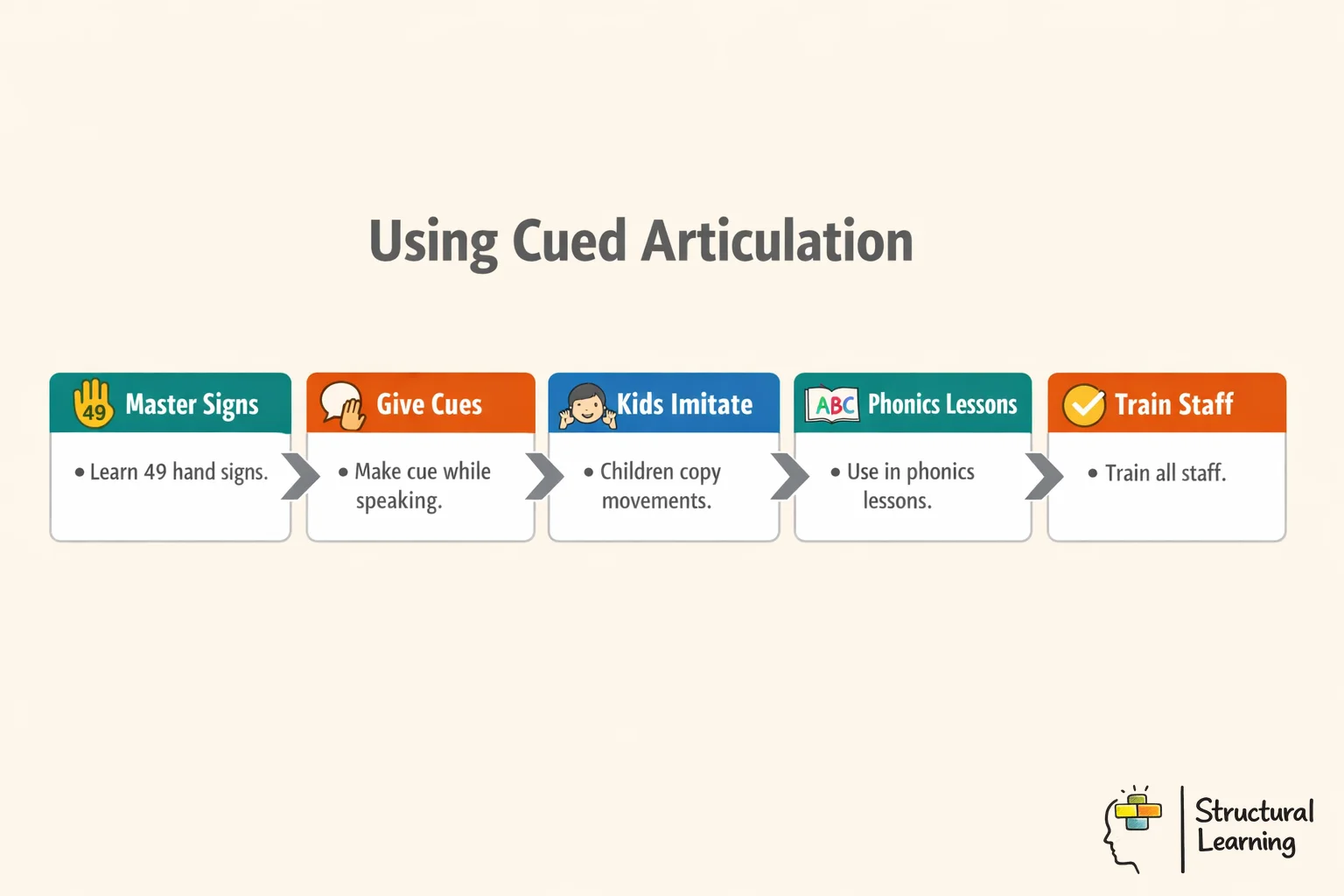
Cued Articulation works by providing visual hand cues that demonstrate the place, manner, and voicing of each speech sound. Teachers make the hand movement whilst saying the sound, allowing children to simultaneously see, hear, and understand how phonemes are physically produced in the mouth.
The Logic Behind the Cues
Each cue provides information about how the sound is produced. For example:
The /p/ sound:
This cue shows that /p/ is:
The /m/ sound:
This cue shows that /m/ is:
Consonant Colour Coding
Consonant sounds are organised into colour-coded groups based on how they are produced:
| Colour | Sound Type | Examples |
|--------|------------|----------|
| Red | Plosives | p, b, t, d, k, g |
| Orange | Nasals | m, n, ng |
| Yellow | Fricatives | f, v, s, z, sh, th |
| Green | Affricates | ch, j |
| Blue | Approximants | w, r, l, y |
This colour coding provides an additional visual memory aid, particularly useful when children are learning to read and write.
Vowel Cues
Vowel cues work differently from consonants because all vowels are voiced and continuous. The vowel cues indicate:
Vowel cues are made in different positions relative to the face, showing the tongue position within the mouth.
Using Cued Articulation
Supporting ESOL and EAL Learners
Cued Articulation provides crucial visual phonics support for ESOL and EAL learners by offering hand gestures that bridge language barriers and help students distinguish English sounds they cannot hear clearly. The system supports mainstream classroom learning whilst providing essential visual support for children who struggle to distinguish between similar-sounding phonemes through hearing alone.Cued Articulation benefits all children learning phonics, particularly those with auditory processing difficulties, hearing impairments, or speech delays. The system supports mainstream classroom learning whilst providing essential visual support for children who struggle to distinguish between similar-sounding phonemes through hearing alone.
Pronunciation Difficulties and Speech Disorders
Children who have difficulty producing certain sounds can use the cues to:
Hearing Impaired Students Benefits
For children who cannot hear all the differences between sounds, Cued Articulation provides visual access to phonemic information. The cues show what the ears cannot detect.
Phonological Disorder Teaching Support
Children with phonological awareness difficulties often struggle to:
Cued Articulation makes these abstract concepts visible and concrete.
English Language Learner Benefits
Children learning English may need to produce sounds that do not exist in their first language. The cues help learners:
Interactive Classroom Activities
Many schools have adopted Cued Articulation for whole-class phonics teaching. Benefits include:
Whole Class Teaching Strategies
Teachers implement whole class teaching strategies for Cued Articulation by leading group phonics sessions where all children simultaneously make hand cues whilst saying sounds together. The cues integrate into daily blending, segmenting, and spelling practise, providing visual support that reinforces auditory learning and helps children remember sound-symbol relationships more effectively.Teachers use Cued Articulation by making the hand cue whilst saying each sound during phonics activities. The cues integrate into daily blending, segmenting, and spelling practise, providing visual support that reinforces auditory learning and helps children remember sound-symbol relationships more effectively.
Integrating Cues into Phonics Lessons
Incorporate cues into daily phonics teaching:
One-to-One Cued Articulation Support
For children receiving speech and language therapy:
Creating School-Wide Consistency
For maximum impact:
Classroom Implementation Best Practices
Do:
Avoid:
From Sound to Sign: How Cued Articulation Works
Cued Articulation vs Other Phonics Systems
Cued Articulation vs Cued Speech
Cued Articulation differs from other phonics systems by using hand gestures to represent speech sounds visually, whilst traditional phonics methods rely primarily on letters and written symbols.
| Basis | How/where sound is made | Stories and actions |
| Logic | Based on articulation | Based on memorable associations |
| Coverage | All 49 phonemes | 42 sounds |
| Transfer | Supports speech production | Primarily supports letter-sound links |
Some schools prefer Cued Articulation because the cues carry information about sound production, while others prefer Jolly Phonics actions for their memorable, story-based approach. Some schools use both.
Cued Articulation vs Sign Language (BSL/Makaton)
Cued Articulation is not sign language:
They serve different purposes and can be used together. A child might use Makaton signs for communication while also using Cued Articulation for phonics and speech work.
Training and Professional Development
School-wide implementation requires training all staff to use consistent hand cues across phonics lessons, speech therapy sessions, and support activities. Leadership establishes a unified visual language by ensuring teachers, teaching assistants, and specialists use identical cues throughout the school day.
Getting Started: Teacher Certification
Collaborating with Speech Therapists
If your school has children receiving speech and language therapy:
Digital Apps and Technology Resources
Tracking Student Progress Effectively
Track the impact of Cued Articulation by monitoring:
Essential Cued Articulation Hand Signals
Plosive Sounds (Red)
The essential cued articulation hand signals comprise specific hand movements and positions that represent different speech sounds, enabling teachers to provide visual cues for phoneme production and pronunciation instruction.
|-------|-----------------|
| /p/ | Index finger and thumb together at mouth corner, pull apart |
| /b/ | Same as /p/ but add voice |
| /t/ | Tap finger behind teeth |
| /d/ | Same as /t/ but add voice |
| /k/ | Finger touches back of throat area |
| /g/ | Same as /k/ but add voice |
Nasal Sounds (Orange)
| Sound | Cue Description |
|-------|-----------------|
| /m/ | Fingers on closed lips, slide down |
| /n/ | Finger on nose bridge, slide down |
Flow diagram: How Cued Articulation Works: From Visual Cue to Speech Production
| /ng/ | Finger touches throat, slides down |
Fricative Sounds (Yellow)
| Sound | Cue Description |
|-------|-----------------|
| /f/ | Top teeth on bottom lip, hand waves away |
| /v/ | Same as /f/ but add voice |
| /s/ | Finger traces "snake" from mouth |
| /z/ | Same as /s/ but add voice |
| /sh/ | Finger to lips, hand pushes away |
Common Cued Articulation Questions Answered
What Age Should Children Start?
Teachers and parents commonly ask about the appropriate starting age for cued articulation, how to implement the system effectively, and whether it works for children with different learning needs. However, cues can be introduced at any age when speech or phonics support is needed.Children can begin learning cues from around age 3-4, when phonological awareness typically starts developing. However, cues can be introduced at any age when speech or phonics support is needed.
Must I Learn All 49 Cues?
No. Start with the sounds you are currently teaching in phonics, then gradually add more cues as you introduce new sounds. Most teachers become confident with the system over a few months.
Can Cued Articulation help with dyslexia?
Children with dyslexia often have underlying phonological processing difficulties. The visual support provided by Cued Articulation can help make phoneme-grapheme relationships more concrete and memorable.
Is Cued Articulation evidence-based?
While large-scale controlled trials are limited, Cued Articulation is widely used by speech and language therapists and is recommended in many therapy protocols. Research on multi-sensory phonics approaches supports the value of visual cueing for sound learning.
How Does It Differ from Phonics?
Cued Articulation cues are based on how sounds are physically produced, while phonics actions (like Jolly Phonics) are based on memorable stories or associations. Both support learning, but Cued Articulation carries additional information about articulation.
Why Teachers Love Cued Articulation: 6 Key Benefits
Delete, redundant with H2 #2
Cued Articulation is a systematic teaching method that uses specific hand gestures and movements to visually represent how speech sounds are produced in the mouth. Created by speech and language therapist Jane Passy in the 1980s, this method transforms abstract phonemes into concrete, visible actions that children can see, copy and understand.Cued Articulation is a systematic teaching method that uses specific hand gestures and movements to visually represent how speech sounds are produced in the mouth. Created by speech and language therapist Jane Passy in the 1980s, this method transforms abstract phonemes into concrete, visible actions that children can see, copy and understand.
At its core, Cued Articulation consists of 49 distinct hand signals, one for each phoneme in Standard English. Each cue shows pupils exactly where to place their tongue, how to position their lips, and whether to use their voice. For instance, when teaching the /p/ sound, you'll tap your lips with two fingers to show it's made by pressing the lips together and releasing a small burst of air. For the /s/ sound, you'll draw your finger down from your teeth whilst making a hissing motion, demonstrating the continuous airflow.
The system goes beyond simple hand gestures by incorporating colour coding that groups sounds by their manner of production. Plosive sounds like /p/, /b/, /t/, /d/, /k/, and /g/ are associated with red, whilst fricatives such as /f/, /v/, /s/, and /z/ use yellow. This colour-coding helps children recognise sound patterns and understand the relationships between different phonemes.
In the classroom, Cued Articulation serves multiple purposes. It provides crucial visual support for children with hearing difficulties or auditory processing challenges, offers a multisensory approach that engages visual, auditory and kinaesthetic learners simultaneously, and creates a consistent method for teaching pronunciation across the entire school. Teachers report that pupils often spontaneously use the cues when attempting to spell unfamiliar words, demonstrating how the system bridges the gap between spoken and written language.
Professional Training Programmes and Certification Pathways
A comprehensive Cued Articulation teacher training curriculum includes foundational theory, systematic hand cue instruction, phonological awareness integration, classroom implementation strategies, and ongoing assessment methods delivered through structured course modules. Whether you're learning independently or participating in whole-school training, following a clear progression ensures you master both the technical skills and classroom application of this powerful teaching tool.
Begin your training process by learning the consonant sounds first, grouped by their colour categories. Start with the red plosive sounds (/p/, /b/, /t/, /d/, /k/, /g/), practising each cue until the hand movements feel natural. Once confident with these, progress to the yellow fricatives (/f/, /v/, /s/, /z/) and continue through each colour group. This systematic approach mirrors how children learn sounds, making it easier to anticipate their learning needs.
After mastering individual cues, focus on smooth transitions between sounds during blending practise. For example, when teaching the word "cat", practise moving fluidly from the /k/ cue (back of hand to throat) to the /a/ cue (open hand at mouth) to the /t/ cue (finger to tongue tip). These transitions are crucial; research by Snowling and Hulme (2011) shows that children's blending abilities directly correlate with reading success.
Structure your professional development across six weekly sessions: Week 1 covers plosives and basic implementation, Week 2 introduces fricatives with classroom practise, Week 3 adds nasals and liquids, Week 4 focuses on vowel sounds, Week 5 combines all sounds in word-level work, and Week 6 addresses differentiation strategies for pupils with additional needs. Between sessions, practise with colleagues during planning time, observe each other's lessons, and gradually integrate cues into your daily phonics teaching. This measured approach ensures sustainable implementation that genuinely enhances your pupils' phonological awareness and reading development.
How to Implement Cued Articulation in Your Classroom
Starting with Cued Articulation requires minimal preparation but thoughtful planning. Begin by mastering five to ten essential cues yourself; practise in front of a mirror until the movements feel natural. Focus first on sounds your pupils find challenging, such as /th/ or /r/, rather than attempting all 49 cues at once.
Introduce cues gradually during your existing phonics lessons. When teaching the /p/ sound, for example, show children the popping motion at your lips whilst making the sound. Have pupils mirror your hand movement as they practise the phoneme. This multisensory approach, combining visual, auditory and kinaesthetic elements, supports diverse learning styles and strengthens sound-letter connections.
Create a classroom display featuring photographs of each cue alongside its corresponding grapheme. Position this at child height near your phonics area, allowing pupils to reference the signs independently during reading and writing activities. Many teachers laminate individual cue cards for table-top use during guided reading sessions.
Consistency across year groups maximises impact. Schedule a brief staff meeting to teach colleagues the cues for commonly confused sounds. When teaching assistants, SENCOs and class teachers all use identical hand movements, children receive reinforcement throughout their school day. This unified approach particularly benefits pupils with speech and language difficulties who may work with multiple adults.
Track progress by noting which sounds improve most rapidly with cue support. Research by Passy (2010) indicates that visual cues significantly enhance phoneme discrimination, particularly for voiced and voiceless pairs like /p/ and /b/. Use this data to inform your phonics planning and identify pupils who might benefit from additional visual support in their learning process.
Summary
Cued Articulation is a visual teaching system that uses hand gestures to show children how and where speech sounds are produced in the mouth. By providing hand cues that show how and where sounds are made, Jane Passy's system gives children visual access to the abstract world of phonemes.Cued Articulation is a powerful visual tool for teaching speech sounds. By providing hand cues that show how and where sounds are made, Jane Passy's system gives children visual access to the abstract world of phonemes.Cued Articulation combines hand gestures with speech sounds to help teachers provide visual cues that show children how and where phonemes are produced in the mouth. By providing hand cues that show how and where sounds are made, Jane Passy's system gives children visual access to the abstract world of phonemes.Cued Articulation is a powerful visual tool for teaching speech sounds. By providing hand cues that show how and where sounds are made, Jane Passy's system gives children visual access to the abstract world of phonemes.
Whether used to support children with speech difficulties, enhance whole-class phonics teaching, or help children learning English as an additional language, Cued Articulation provides a consistent, logical, and effective approach to sound learning.
The key to success is consistency. When all staff use the cues correctly and regularly, and when children are encouraged to use them too, Cued Articulation can transform phonological awareness and speech production across your school.
What is Cued Articulation? A Complete Overview
Cued Articulation is a visual signing system that represents the 49 phonemes of English through specific hand movements and positions. Created by speech and language therapist Jane Passy in the 1980s, this approach helps children understand exactly how sounds are formed by showing the position of the tongue, lips and vocal cords during speech production.
Each hand cue acts as a visual map of the mouth, demonstrating where air flows and how speech organs move to create specific sounds. For instance, when teaching the /p/ sound, you'll place your hand flat against your lips then move it forwards in a quick motion, showing pupils how the sound 'pops' from closed lips. Similarly, the /s/ sound uses a wiggling finger motion that mirrors the snake-like flow of air between the teeth.
What makes Cued Articulation particularly effective in the classroom is its systematic organisation. Consonants are grouped by colour according to how they're produced: red for plosive sounds like /b/ and /p/, yellow for fricatives such as /f/ and /v/, and green for nasal sounds including /m/ and /n/. This colour-coding helps pupils recognise patterns in sound production, supporting both phonics instruction and spelling development.
The system works alongside any phonics programme, whether you're using Letters and Sounds, Read Write Inc., or another scheme. Teachers typically introduce cues gradually, starting with initial sounds in Reception, then building to include vowel sounds and consonant blends as pupils progress. Research by Spooner (2002) found that pupils using Cued Articulation showed significant improvements in phonological awareness compared to traditional phonics instruction alone, particularly benefiting those with speech and language difficulties or dyslexia.
Professional Development and Training Options
Whilst you can begin using basic Cued Articulation cues immediately, formal training significantly enhances your effectiveness and ensures you're teaching the system correctly. The official Cued Articulation courses, developed by Jane Passy herself, provide comprehensive instruction in all 49 hand cues alongside practical classroom implementation strategies.
The standard two-day foundation course covers essential components: accurate cue production, colour-coding systems, and integration with synthetic phonics programmes. Participants practise each cue extensively, receive feedback on their technique, and explore how to adapt the system for pupils with specific learning difficulties. Many local authorities offer these courses termly; alternatively, schools can arrange in-house training for whole-staff consistency.
For teachers seeking deeper expertise, advanced practitioner courses focus on using Cued Articulation for speech and language support. These sessions explore how to identify articulation errors through cue analysis and develop targeted intervention programmes. Upon completion, you'll receive certification recognised by speech and language therapy services, enabling closer collaboration with SaLT professionals.
Between formal courses, several practical resources support ongoing professional development. The official Cued Articulation DVD demonstrates each cue in detail, perfect for staff meetings or self-study. Many schools establish peer observation systems where confident practitioners model cue use during phonics lessons, helping colleagues refine their technique. Additionally, creating video recordings of yourself teaching with cues allows self-assessment and improvement.
Investment in proper training pays dividends; research by Spooner (2019) found that teachers who completed certified training showed 40% greater accuracy in cue production and reported increased confidence supporting pupils with speech sound difficulties. Consider budgeting for at least foundation-level training for all staff teaching phonics, ensuring consistent, high-quality implementation across your school.
Who Should Use Cued Articulation Teaching Methods
Cued Articulation benefits a wide range of learners across primary settings, making it an essential tool for any teacher's phonics toolkit. The system particularly supports children who struggle with traditional phonics approaches, including those with speech and language difficulties, dyslexia, or auditory processing challenges. Research by Stackhouse and Wells (1997) highlights how visual cues help children develop clearer phonological representations, especially when auditory discrimination proves difficult.
In mainstream classrooms, the approach works brilliantly for pupils learning English as an additional language (EAL), as the hand movements provide a concrete reference point for unfamiliar sounds. Reception and Year 1 teachers report that using cues during whole-class phonics lessons helps all children, not just those with identified needs, grasp sound-letter relationships more quickly. The visual element particularly supports kinaesthetic learners who benefit from movement and physical representation of abstract concepts.
Teaching assistants and learning support staff find the system invaluable during intervention sessions. For instance, when working with a Year 2 pupil struggling to distinguish between 'p' and 'b' sounds, the distinct hand cues (plosive movement at lips versus throat) provide immediate clarity. Similarly, SENCOs recommend training all support staff in the basic cues to ensure consistency across different learning contexts.
The approach also proves effective with older primary pupils who missed early phonics instruction or need remedial support. Year 3 and 4 teachers successfully use cues to teach spelling patterns and support reading fluency without making older children feel they're repeating 'babyish' activities. The hand movements simply become another tool in their learning repertoire, supporting metacognition about how sounds work.
Frequently Asked Questions
How long does it take children to learn all 49 Cued Articulation hand movements?
Teachers frequently ask how long children need to learn cued articulation hand cues, with most mastering basic sounds within 4-6 weeks of daily practise. However, mastery and automatic recall typically develops over a full term of consistent use. Start with the most common sounds first and gradually introduce more complex phonemes as children become confident with the system.
Can Cued Articulation be used with synthetic phonics programmes like Letters and Sounds?
Yes, Cued Articulation works excellently alongside any systematic synthetic phonics programme. Simply add the appropriate hand cue when introducing each new sound during your phonics lessons. The visual support enhances rather than replaces your existing phonics teaching, making it particularly effective during blending and segmenting activities.
What age groups benefit most from Cued Articulation in schools?
Cued Articulation is most commonly used with children aged 3-8 years, from nursery through to Year 3. It's particularly beneficial for reception and Year 1 pupils learning their initial sounds, as well as older children who are struggling readers or have speech and language difficulties. Even secondary pupils with literacy challenges can benefit from this visual support.
Do teaching assistants need special training to use Cued Articulation effectively?
Yes, all staff should receive proper training to ensure consistency across the school. Many local authorities offer Cued Articulation courses, or you can arrange whole-school training with certified trainers. Teaching assistants particularly benefit from training as they often work with children who need the most support with phonics and speech development.
How does Cued Articulation help children with English as an additional language?
Cued Articulation is particularly powerful for EAL learners as it provides visual clues for English sounds that may not exist in their home language. The hand movements help children distinguish between similar sounds like 'th' and 'f', which can be challenging for non-native speakers. This visual support accelerates their phonological awareness and pronunciation skills.
Further Reading: Key Research Papers
These peer-reviewed studies provide the research foundation for the strategies discussed in this article:
Using Multimodal Information for Web Front-End Development Instruction: Analysing Effects on Cognitive Behaviour, Interaction, and Persistent LearningView study ↗ 2 citations
Ming Lu & Zhongyi Hu (2025)
This research demonstrates that combining visual, auditory, and hands-on learning approaches significantly boosts student engagement and helps knowledge stick better over time. While focused on web development, the findings reveal how multi-sensory teaching methods can transform any classroom by making learning more interactive and memorable. Teachers can apply these principles to create richer learning experiences that accommodate different learning styles and improve long-term retention.
Flashcard-based physical education: Enhancing students' physical fitness through visual-motor learning cuesView study ↗
Sumbara Hambali et al. (2025)
Elementary students showed remarkable improvements in physical fitness when teachers used visual flashcards to demonstrate proper movement techniques during PE classes. This study proves that visual cues can make physical education more effective and engaging, especially for students who struggle with traditional instruction methods. PE teachers and classroom educators can use this approach to help students better understand and remember proper techniques for any physical activity or movement-based learning.
Using Multimodal Learning in Arabic Vocabulary Instruction at Islamic Elementary SchoolView study ↗
Nurul Fahmi et al. (2025)
Sixth-grade students mastered Arabic vocabulary much more effectively when teachers combined visual, auditory, and interactive elements rather than relying on traditional teaching methods alone. The research shows how integrating multiple senses creates deeper understanding and better retention of new words and concepts. Language teachers and educators working with any subject can use these multi-sensory strategies to help students connect with challenging material and improve their learning outcomes.
A Phonemic-Based Methodology for Overcoming Dyslexia in Primary School Children through Sound Analysis InstructionView study ↗ 1 citations
Pulatova Dilfuza Azamkhulovna et al. (2025)
Students with dyslexia made significant reading and writing progress when teachers used a structured approach combining sound analysis with visual aids, games, and hands-on activities. This research provides concrete evidence that multi-sensory phonemic instruction can break through traditional barriers that prevent dyslexic students from developing literacy skills. Teachers working with struggling readers can implement these practical techniques to help all students better understand the connection between sounds and letters.
A Gesture-based Mobile Platform for Accessible EducationView study ↗
K. Saravanan et al. (2025)
Researchers developed a step-by-step mobile learning platform that uses gestures and visual cues to teach sign language, making education more accessible for deaf and mute students. The study highlights how technology can bridge communication gaps and create inclusive learning environments where all students can participate fully. Teachers can draw inspiration from this gesture-based approach to incorporate more visual and kinesthetic elements into their instruction, benefiting not only students with hearing impairments but all learners who thrive with movement and visual cues.
As a teacher, you can transform how your pupils learn to read and pronounce sounds by implementing Cued Articulation in your classroom. This powerful visual system uses simple hand movements to represent each speech sound, making phonics lessons more engaging and accessible for all learners. Developed by speech therapist Jane Passy, the 49 hand cues help children physically see and feel where sounds are made in their mouths, supporting everything from basic phonics instruction to helping pupils with learning difficulties. Whether you're teaching reception or supporting struggling readers, this complete guide will show you exactly how to bring sounds to life through movement.
Key Takeaways
Cued Articulation at a Glance: 49 Sounds, 49 Signs
Key Takeaways
One Sound, One Sign: Each of the 49 phonemes in English has its own unique hand cue. The cues are logical, showing both the place of articulation (where in the mouth) and the manner of articulation (how the sound is made)
Visual Support for Auditory Processing: Children who struggle to hear the differences between sounds can see the differences instead. This is particularly powerful for children with hearing impairments, phonological delays, or auditory processing difficulties
Bridges Speech and Literacy: Cued Articulation supports both speech production and phonics learning. Teachers report improved phonological awareness across whole classes when cues are used consistently during phonics instruction
Not Sign Language: Cued Articulation represents sounds, not words. It can be used alongside sign language systems like BSL or Makaton, but serves a completely different purpose
What is Cued Articulation?
Cued Articulation is a visual phonics system that uses 49 distinct hand movements to represent every English speech sound. Developed by Jane Passy in the late 1970s, each hand cue shows children where sounds are made in the mouth and how they are produced.Cued Articulation is a visual phonics system that uses 49 distinct hand movements to represent every English speech sound. Developed by Jane Passy in the late 1970s, each hand cue shows children where sounds are made in the mouth and how they are produced.Cued Articulation is a visual phonics system that uses 49 distinct hand movements to represent every English speech sound. Developed by Jane Passy in the late 1970s, each hand cue shows children where sounds are made in the mouth and how they are produced.Cued Articulation is a visual phonics system that uses 49 distinct hand movements to represent every English speech sound. Developed by Jane Passy in the late 1970s, each hand cue shows children where sounds are made in the mouth and how they are produced.
Cued Articulation is a signing system for the 49 sounds (phonemes) used in spoken English. Each sound has its own hand movement that gives visual information about:
Jane Passy developed the system while working with children who had severe speech and language difficulties. She observed that many children struggled with auditory recall and needed visual support to learn and remember speech sounds. The cues she developed are logical and based on linguistic theory, making them easier to learn and remember than arbitrary signs.
The system covers:
Consonant cues are colour coded by type, providing an additional visual support when sounds are represented in written form.
How Cued Articulation Works
Cued Articulation works by providing visual hand cues that demonstrate the place, manner, and voicing of each speech sound. Teachers make the hand movement whilst saying the sound, allowing children to simultaneously see, hear, and understand how phonemes are physically produced in the mouth.
The Logic Behind the Cues
Each cue provides information about how the sound is produced. For example:
The /p/ sound:
This cue shows that /p/ is:
The /m/ sound:
This cue shows that /m/ is:
Consonant Colour Coding
Consonant sounds are organised into colour-coded groups based on how they are produced:
| Colour | Sound Type | Examples |
|--------|------------|----------|
| Red | Plosives | p, b, t, d, k, g |
| Orange | Nasals | m, n, ng |
| Yellow | Fricatives | f, v, s, z, sh, th |
| Green | Affricates | ch, j |
| Blue | Approximants | w, r, l, y |
This colour coding provides an additional visual memory aid, particularly useful when children are learning to read and write.
Vowel Cues
Vowel cues work differently from consonants because all vowels are voiced and continuous. The vowel cues indicate:
Vowel cues are made in different positions relative to the face, showing the tongue position within the mouth.
Using Cued Articulation
Supporting ESOL and EAL Learners
Cued Articulation provides crucial visual phonics support for ESOL and EAL learners by offering hand gestures that bridge language barriers and help students distinguish English sounds they cannot hear clearly. The system supports mainstream classroom learning whilst providing essential visual support for children who struggle to distinguish between similar-sounding phonemes through hearing alone.Cued Articulation benefits all children learning phonics, particularly those with auditory processing difficulties, hearing impairments, or speech delays. The system supports mainstream classroom learning whilst providing essential visual support for children who struggle to distinguish between similar-sounding phonemes through hearing alone.
Pronunciation Difficulties and Speech Disorders
Children who have difficulty producing certain sounds can use the cues to:
Hearing Impaired Students Benefits
For children who cannot hear all the differences between sounds, Cued Articulation provides visual access to phonemic information. The cues show what the ears cannot detect.
Phonological Disorder Teaching Support
Children with phonological awareness difficulties often struggle to:
Cued Articulation makes these abstract concepts visible and concrete.
English Language Learner Benefits
Children learning English may need to produce sounds that do not exist in their first language. The cues help learners:
Interactive Classroom Activities
Many schools have adopted Cued Articulation for whole-class phonics teaching. Benefits include:
Whole Class Teaching Strategies
Teachers implement whole class teaching strategies for Cued Articulation by leading group phonics sessions where all children simultaneously make hand cues whilst saying sounds together. The cues integrate into daily blending, segmenting, and spelling practise, providing visual support that reinforces auditory learning and helps children remember sound-symbol relationships more effectively.Teachers use Cued Articulation by making the hand cue whilst saying each sound during phonics activities. The cues integrate into daily blending, segmenting, and spelling practise, providing visual support that reinforces auditory learning and helps children remember sound-symbol relationships more effectively.
Integrating Cues into Phonics Lessons
Incorporate cues into daily phonics teaching:
One-to-One Cued Articulation Support
For children receiving speech and language therapy:
Creating School-Wide Consistency
For maximum impact:
Classroom Implementation Best Practices
Do:
Avoid:
From Sound to Sign: How Cued Articulation Works
Cued Articulation vs Other Phonics Systems
Cued Articulation vs Cued Speech
Cued Articulation differs from other phonics systems by using hand gestures to represent speech sounds visually, whilst traditional phonics methods rely primarily on letters and written symbols.
| Basis | How/where sound is made | Stories and actions |
| Logic | Based on articulation | Based on memorable associations |
| Coverage | All 49 phonemes | 42 sounds |
| Transfer | Supports speech production | Primarily supports letter-sound links |
Some schools prefer Cued Articulation because the cues carry information about sound production, while others prefer Jolly Phonics actions for their memorable, story-based approach. Some schools use both.
Cued Articulation vs Sign Language (BSL/Makaton)
Cued Articulation is not sign language:
They serve different purposes and can be used together. A child might use Makaton signs for communication while also using Cued Articulation for phonics and speech work.
Training and Professional Development
School-wide implementation requires training all staff to use consistent hand cues across phonics lessons, speech therapy sessions, and support activities. Leadership establishes a unified visual language by ensuring teachers, teaching assistants, and specialists use identical cues throughout the school day.
Getting Started: Teacher Certification
Collaborating with Speech Therapists
If your school has children receiving speech and language therapy:
Digital Apps and Technology Resources
Tracking Student Progress Effectively
Track the impact of Cued Articulation by monitoring:
Essential Cued Articulation Hand Signals
Plosive Sounds (Red)
The essential cued articulation hand signals comprise specific hand movements and positions that represent different speech sounds, enabling teachers to provide visual cues for phoneme production and pronunciation instruction.
|-------|-----------------|
| /p/ | Index finger and thumb together at mouth corner, pull apart |
| /b/ | Same as /p/ but add voice |
| /t/ | Tap finger behind teeth |
| /d/ | Same as /t/ but add voice |
| /k/ | Finger touches back of throat area |
| /g/ | Same as /k/ but add voice |
Nasal Sounds (Orange)
| Sound | Cue Description |
|-------|-----------------|
| /m/ | Fingers on closed lips, slide down |
| /n/ | Finger on nose bridge, slide down |
Flow diagram: How Cued Articulation Works: From Visual Cue to Speech Production
| /ng/ | Finger touches throat, slides down |
Fricative Sounds (Yellow)
| Sound | Cue Description |
|-------|-----------------|
| /f/ | Top teeth on bottom lip, hand waves away |
| /v/ | Same as /f/ but add voice |
| /s/ | Finger traces "snake" from mouth |
| /z/ | Same as /s/ but add voice |
| /sh/ | Finger to lips, hand pushes away |
Common Cued Articulation Questions Answered
What Age Should Children Start?
Teachers and parents commonly ask about the appropriate starting age for cued articulation, how to implement the system effectively, and whether it works for children with different learning needs. However, cues can be introduced at any age when speech or phonics support is needed.Children can begin learning cues from around age 3-4, when phonological awareness typically starts developing. However, cues can be introduced at any age when speech or phonics support is needed.
Must I Learn All 49 Cues?
No. Start with the sounds you are currently teaching in phonics, then gradually add more cues as you introduce new sounds. Most teachers become confident with the system over a few months.
Can Cued Articulation help with dyslexia?
Children with dyslexia often have underlying phonological processing difficulties. The visual support provided by Cued Articulation can help make phoneme-grapheme relationships more concrete and memorable.
Is Cued Articulation evidence-based?
While large-scale controlled trials are limited, Cued Articulation is widely used by speech and language therapists and is recommended in many therapy protocols. Research on multi-sensory phonics approaches supports the value of visual cueing for sound learning.
How Does It Differ from Phonics?
Cued Articulation cues are based on how sounds are physically produced, while phonics actions (like Jolly Phonics) are based on memorable stories or associations. Both support learning, but Cued Articulation carries additional information about articulation.
Why Teachers Love Cued Articulation: 6 Key Benefits
Delete, redundant with H2 #2
Cued Articulation is a systematic teaching method that uses specific hand gestures and movements to visually represent how speech sounds are produced in the mouth. Created by speech and language therapist Jane Passy in the 1980s, this method transforms abstract phonemes into concrete, visible actions that children can see, copy and understand.Cued Articulation is a systematic teaching method that uses specific hand gestures and movements to visually represent how speech sounds are produced in the mouth. Created by speech and language therapist Jane Passy in the 1980s, this method transforms abstract phonemes into concrete, visible actions that children can see, copy and understand.
At its core, Cued Articulation consists of 49 distinct hand signals, one for each phoneme in Standard English. Each cue shows pupils exactly where to place their tongue, how to position their lips, and whether to use their voice. For instance, when teaching the /p/ sound, you'll tap your lips with two fingers to show it's made by pressing the lips together and releasing a small burst of air. For the /s/ sound, you'll draw your finger down from your teeth whilst making a hissing motion, demonstrating the continuous airflow.
The system goes beyond simple hand gestures by incorporating colour coding that groups sounds by their manner of production. Plosive sounds like /p/, /b/, /t/, /d/, /k/, and /g/ are associated with red, whilst fricatives such as /f/, /v/, /s/, and /z/ use yellow. This colour-coding helps children recognise sound patterns and understand the relationships between different phonemes.
In the classroom, Cued Articulation serves multiple purposes. It provides crucial visual support for children with hearing difficulties or auditory processing challenges, offers a multisensory approach that engages visual, auditory and kinaesthetic learners simultaneously, and creates a consistent method for teaching pronunciation across the entire school. Teachers report that pupils often spontaneously use the cues when attempting to spell unfamiliar words, demonstrating how the system bridges the gap between spoken and written language.
Professional Training Programmes and Certification Pathways
A comprehensive Cued Articulation teacher training curriculum includes foundational theory, systematic hand cue instruction, phonological awareness integration, classroom implementation strategies, and ongoing assessment methods delivered through structured course modules. Whether you're learning independently or participating in whole-school training, following a clear progression ensures you master both the technical skills and classroom application of this powerful teaching tool.
Begin your training process by learning the consonant sounds first, grouped by their colour categories. Start with the red plosive sounds (/p/, /b/, /t/, /d/, /k/, /g/), practising each cue until the hand movements feel natural. Once confident with these, progress to the yellow fricatives (/f/, /v/, /s/, /z/) and continue through each colour group. This systematic approach mirrors how children learn sounds, making it easier to anticipate their learning needs.
After mastering individual cues, focus on smooth transitions between sounds during blending practise. For example, when teaching the word "cat", practise moving fluidly from the /k/ cue (back of hand to throat) to the /a/ cue (open hand at mouth) to the /t/ cue (finger to tongue tip). These transitions are crucial; research by Snowling and Hulme (2011) shows that children's blending abilities directly correlate with reading success.
Structure your professional development across six weekly sessions: Week 1 covers plosives and basic implementation, Week 2 introduces fricatives with classroom practise, Week 3 adds nasals and liquids, Week 4 focuses on vowel sounds, Week 5 combines all sounds in word-level work, and Week 6 addresses differentiation strategies for pupils with additional needs. Between sessions, practise with colleagues during planning time, observe each other's lessons, and gradually integrate cues into your daily phonics teaching. This measured approach ensures sustainable implementation that genuinely enhances your pupils' phonological awareness and reading development.
How to Implement Cued Articulation in Your Classroom
Starting with Cued Articulation requires minimal preparation but thoughtful planning. Begin by mastering five to ten essential cues yourself; practise in front of a mirror until the movements feel natural. Focus first on sounds your pupils find challenging, such as /th/ or /r/, rather than attempting all 49 cues at once.
Introduce cues gradually during your existing phonics lessons. When teaching the /p/ sound, for example, show children the popping motion at your lips whilst making the sound. Have pupils mirror your hand movement as they practise the phoneme. This multisensory approach, combining visual, auditory and kinaesthetic elements, supports diverse learning styles and strengthens sound-letter connections.
Create a classroom display featuring photographs of each cue alongside its corresponding grapheme. Position this at child height near your phonics area, allowing pupils to reference the signs independently during reading and writing activities. Many teachers laminate individual cue cards for table-top use during guided reading sessions.
Consistency across year groups maximises impact. Schedule a brief staff meeting to teach colleagues the cues for commonly confused sounds. When teaching assistants, SENCOs and class teachers all use identical hand movements, children receive reinforcement throughout their school day. This unified approach particularly benefits pupils with speech and language difficulties who may work with multiple adults.
Track progress by noting which sounds improve most rapidly with cue support. Research by Passy (2010) indicates that visual cues significantly enhance phoneme discrimination, particularly for voiced and voiceless pairs like /p/ and /b/. Use this data to inform your phonics planning and identify pupils who might benefit from additional visual support in their learning process.
Summary
Cued Articulation is a visual teaching system that uses hand gestures to show children how and where speech sounds are produced in the mouth. By providing hand cues that show how and where sounds are made, Jane Passy's system gives children visual access to the abstract world of phonemes.Cued Articulation is a powerful visual tool for teaching speech sounds. By providing hand cues that show how and where sounds are made, Jane Passy's system gives children visual access to the abstract world of phonemes.Cued Articulation combines hand gestures with speech sounds to help teachers provide visual cues that show children how and where phonemes are produced in the mouth. By providing hand cues that show how and where sounds are made, Jane Passy's system gives children visual access to the abstract world of phonemes.Cued Articulation is a powerful visual tool for teaching speech sounds. By providing hand cues that show how and where sounds are made, Jane Passy's system gives children visual access to the abstract world of phonemes.
Whether used to support children with speech difficulties, enhance whole-class phonics teaching, or help children learning English as an additional language, Cued Articulation provides a consistent, logical, and effective approach to sound learning.
The key to success is consistency. When all staff use the cues correctly and regularly, and when children are encouraged to use them too, Cued Articulation can transform phonological awareness and speech production across your school.
What is Cued Articulation? A Complete Overview
Cued Articulation is a visual signing system that represents the 49 phonemes of English through specific hand movements and positions. Created by speech and language therapist Jane Passy in the 1980s, this approach helps children understand exactly how sounds are formed by showing the position of the tongue, lips and vocal cords during speech production.
Each hand cue acts as a visual map of the mouth, demonstrating where air flows and how speech organs move to create specific sounds. For instance, when teaching the /p/ sound, you'll place your hand flat against your lips then move it forwards in a quick motion, showing pupils how the sound 'pops' from closed lips. Similarly, the /s/ sound uses a wiggling finger motion that mirrors the snake-like flow of air between the teeth.
What makes Cued Articulation particularly effective in the classroom is its systematic organisation. Consonants are grouped by colour according to how they're produced: red for plosive sounds like /b/ and /p/, yellow for fricatives such as /f/ and /v/, and green for nasal sounds including /m/ and /n/. This colour-coding helps pupils recognise patterns in sound production, supporting both phonics instruction and spelling development.
The system works alongside any phonics programme, whether you're using Letters and Sounds, Read Write Inc., or another scheme. Teachers typically introduce cues gradually, starting with initial sounds in Reception, then building to include vowel sounds and consonant blends as pupils progress. Research by Spooner (2002) found that pupils using Cued Articulation showed significant improvements in phonological awareness compared to traditional phonics instruction alone, particularly benefiting those with speech and language difficulties or dyslexia.
Professional Development and Training Options
Whilst you can begin using basic Cued Articulation cues immediately, formal training significantly enhances your effectiveness and ensures you're teaching the system correctly. The official Cued Articulation courses, developed by Jane Passy herself, provide comprehensive instruction in all 49 hand cues alongside practical classroom implementation strategies.
The standard two-day foundation course covers essential components: accurate cue production, colour-coding systems, and integration with synthetic phonics programmes. Participants practise each cue extensively, receive feedback on their technique, and explore how to adapt the system for pupils with specific learning difficulties. Many local authorities offer these courses termly; alternatively, schools can arrange in-house training for whole-staff consistency.
For teachers seeking deeper expertise, advanced practitioner courses focus on using Cued Articulation for speech and language support. These sessions explore how to identify articulation errors through cue analysis and develop targeted intervention programmes. Upon completion, you'll receive certification recognised by speech and language therapy services, enabling closer collaboration with SaLT professionals.
Between formal courses, several practical resources support ongoing professional development. The official Cued Articulation DVD demonstrates each cue in detail, perfect for staff meetings or self-study. Many schools establish peer observation systems where confident practitioners model cue use during phonics lessons, helping colleagues refine their technique. Additionally, creating video recordings of yourself teaching with cues allows self-assessment and improvement.
Investment in proper training pays dividends; research by Spooner (2019) found that teachers who completed certified training showed 40% greater accuracy in cue production and reported increased confidence supporting pupils with speech sound difficulties. Consider budgeting for at least foundation-level training for all staff teaching phonics, ensuring consistent, high-quality implementation across your school.
Who Should Use Cued Articulation Teaching Methods
Cued Articulation benefits a wide range of learners across primary settings, making it an essential tool for any teacher's phonics toolkit. The system particularly supports children who struggle with traditional phonics approaches, including those with speech and language difficulties, dyslexia, or auditory processing challenges. Research by Stackhouse and Wells (1997) highlights how visual cues help children develop clearer phonological representations, especially when auditory discrimination proves difficult.
In mainstream classrooms, the approach works brilliantly for pupils learning English as an additional language (EAL), as the hand movements provide a concrete reference point for unfamiliar sounds. Reception and Year 1 teachers report that using cues during whole-class phonics lessons helps all children, not just those with identified needs, grasp sound-letter relationships more quickly. The visual element particularly supports kinaesthetic learners who benefit from movement and physical representation of abstract concepts.
Teaching assistants and learning support staff find the system invaluable during intervention sessions. For instance, when working with a Year 2 pupil struggling to distinguish between 'p' and 'b' sounds, the distinct hand cues (plosive movement at lips versus throat) provide immediate clarity. Similarly, SENCOs recommend training all support staff in the basic cues to ensure consistency across different learning contexts.
The approach also proves effective with older primary pupils who missed early phonics instruction or need remedial support. Year 3 and 4 teachers successfully use cues to teach spelling patterns and support reading fluency without making older children feel they're repeating 'babyish' activities. The hand movements simply become another tool in their learning repertoire, supporting metacognition about how sounds work.
Frequently Asked Questions
How long does it take children to learn all 49 Cued Articulation hand movements?
Teachers frequently ask how long children need to learn cued articulation hand cues, with most mastering basic sounds within 4-6 weeks of daily practise. However, mastery and automatic recall typically develops over a full term of consistent use. Start with the most common sounds first and gradually introduce more complex phonemes as children become confident with the system.
Can Cued Articulation be used with synthetic phonics programmes like Letters and Sounds?
Yes, Cued Articulation works excellently alongside any systematic synthetic phonics programme. Simply add the appropriate hand cue when introducing each new sound during your phonics lessons. The visual support enhances rather than replaces your existing phonics teaching, making it particularly effective during blending and segmenting activities.
What age groups benefit most from Cued Articulation in schools?
Cued Articulation is most commonly used with children aged 3-8 years, from nursery through to Year 3. It's particularly beneficial for reception and Year 1 pupils learning their initial sounds, as well as older children who are struggling readers or have speech and language difficulties. Even secondary pupils with literacy challenges can benefit from this visual support.
Do teaching assistants need special training to use Cued Articulation effectively?
Yes, all staff should receive proper training to ensure consistency across the school. Many local authorities offer Cued Articulation courses, or you can arrange whole-school training with certified trainers. Teaching assistants particularly benefit from training as they often work with children who need the most support with phonics and speech development.
How does Cued Articulation help children with English as an additional language?
Cued Articulation is particularly powerful for EAL learners as it provides visual clues for English sounds that may not exist in their home language. The hand movements help children distinguish between similar sounds like 'th' and 'f', which can be challenging for non-native speakers. This visual support accelerates their phonological awareness and pronunciation skills.
Further Reading: Key Research Papers
These peer-reviewed studies provide the research foundation for the strategies discussed in this article:
Using Multimodal Information for Web Front-End Development Instruction: Analysing Effects on Cognitive Behaviour, Interaction, and Persistent LearningView study ↗ 2 citations
Ming Lu & Zhongyi Hu (2025)
This research demonstrates that combining visual, auditory, and hands-on learning approaches significantly boosts student engagement and helps knowledge stick better over time. While focused on web development, the findings reveal how multi-sensory teaching methods can transform any classroom by making learning more interactive and memorable. Teachers can apply these principles to create richer learning experiences that accommodate different learning styles and improve long-term retention.
Flashcard-based physical education: Enhancing students' physical fitness through visual-motor learning cuesView study ↗
Sumbara Hambali et al. (2025)
Elementary students showed remarkable improvements in physical fitness when teachers used visual flashcards to demonstrate proper movement techniques during PE classes. This study proves that visual cues can make physical education more effective and engaging, especially for students who struggle with traditional instruction methods. PE teachers and classroom educators can use this approach to help students better understand and remember proper techniques for any physical activity or movement-based learning.
Using Multimodal Learning in Arabic Vocabulary Instruction at Islamic Elementary SchoolView study ↗
Nurul Fahmi et al. (2025)
Sixth-grade students mastered Arabic vocabulary much more effectively when teachers combined visual, auditory, and interactive elements rather than relying on traditional teaching methods alone. The research shows how integrating multiple senses creates deeper understanding and better retention of new words and concepts. Language teachers and educators working with any subject can use these multi-sensory strategies to help students connect with challenging material and improve their learning outcomes.
A Phonemic-Based Methodology for Overcoming Dyslexia in Primary School Children through Sound Analysis InstructionView study ↗ 1 citations
Pulatova Dilfuza Azamkhulovna et al. (2025)
Students with dyslexia made significant reading and writing progress when teachers used a structured approach combining sound analysis with visual aids, games, and hands-on activities. This research provides concrete evidence that multi-sensory phonemic instruction can break through traditional barriers that prevent dyslexic students from developing literacy skills. Teachers working with struggling readers can implement these practical techniques to help all students better understand the connection between sounds and letters.
A Gesture-based Mobile Platform for Accessible EducationView study ↗
K. Saravanan et al. (2025)
Researchers developed a step-by-step mobile learning platform that uses gestures and visual cues to teach sign language, making education more accessible for deaf and mute students. The study highlights how technology can bridge communication gaps and create inclusive learning environments where all students can participate fully. Teachers can draw inspiration from this gesture-based approach to incorporate more visual and kinesthetic elements into their instruction, benefiting not only students with hearing impairments but all learners who thrive with movement and visual cues.