A comprehensive guide to JCQ access arrangements for UK teachers and SENCOs. Covers 2025/26 changes, Form 8 evidence, delegated arrangements, SENCO calendar, and the research evidence.
JCQ access arrangements give students with identified needs the conditions they require to demonstrate what they know in examinations. In the 2024/25 academic year, Ofqual data showed that between 16.6% and 25.5% of students received 25% extra time, and between 4.8% and 7.7% received a computer reader or reader, meaning that access arrangements now affect millions of students across England, Wales, and Northern Ireland. Despite this scale, research by Antalek et al. (2025) found that practitioners consistently identify a lack of consistency, under-resourcing, and inadequate training as the dominant challenges in implementing arrangements fairly. This guide sets out the full picture for classroom teachers and SENCOs: what the arrangements are, what changed for 2025/26, how to gather the evidence, how to train students to use their arrangements, and how to avoid the most common mistakes.
Key Takeaways
Normal way of working is the central test: An arrangement must reflect how a student already works in lessons, not just what they need in an exam. Teachers are now required to contribute evidence of this in Form 8 Part 1 before any assessment takes place.
2025/26 introduces a rest breaks trial requirement: For students with physical or sensory impairments (but not learning difficulties), SENCOs must trial supervised rest breaks before applying for extra time. This is a significant workload and philosophical shift away from extra time as the default.
21 arrangements are delegated: SENCOs can approve these without an online application through the Access Arrangements Online (AAO) system, but they must still maintain full evidence. Only arrangements requiring formal qualification-level assessment need an AAO application.
Training students to use their arrangements is the gap most schools miss: UCL and Nuffield Foundation research (2025) found that around 30% of students with literacy difficulties do not improve with extra time or word processors, often because they have never been taught how to use their arrangements strategically in exam conditions.
What JCQ Access Arrangements Are
Access arrangements are pre-examination adjustments that allow students with identified physical, sensory, or learning difficulties to access assessments on the same basis as their peers. They are not concessions or advantages. The Joint Council for Qualifications (JCQ) administers them through its annual publication, Access Arrangements and Reasonable Adjustments (AARA), which is updated each August for the coming academic year.
The legal foundation is the Equality Act 2010, which requires examination bodies to make reasonable adjustments for disabled candidates. JCQ operates as the shared service through which all major UK awarding organisations (AQA, OCR, Pearson Edexcel, WJEC, CCEA) apply this requirement consistently. What JCQ publishes is the agreed standard, and all centres are inspected against it.
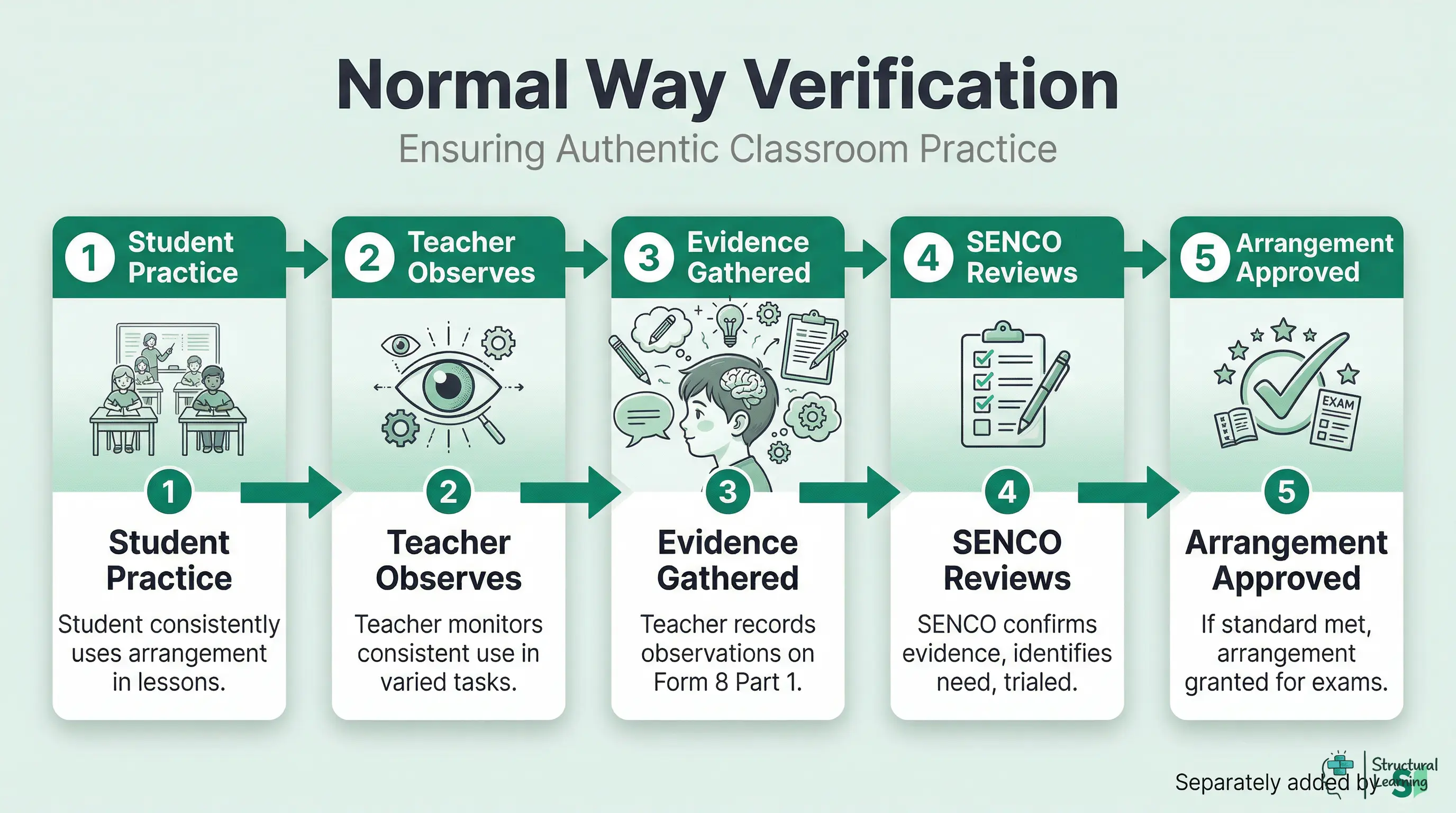
The single most important principle underpinning every arrangement is the "normal way of working" standard. An arrangement must reflect the way a student already functions in the classroom, not simply the way they struggle in a high-pressure exam. If a student does not use a word processor in lessons, they cannot receive word processor access in exams purely because they find handwriting stressful. The arrangement must be embedded in regular classroom practice before it is valid for examination use. Subject teachers play a central role in confirming this, which is why the 2025/26 changes to Form 8 place teacher feedback at the front of the process.
It is also worth being clear about what access arrangements are not. They are not a reward for effort or persistence, not a substitute for effective classroom support under the graduated approach, and not evidence in themselves that a student has a special educational need. Students can qualify for arrangements even without an EHCP or an entry on the SEN Support register, provided they meet the qualifying criteria set out in AARA.
What Changed for 2025/26
The 2025/26 cycle introduced several changes of varying significance. Some are administrative simplifications; others represent a genuine shift in philosophy. The table below summarises the most important changes.
Change
Before (2024/25)
After (2025/26)
Practical impact
Rest breaks trial
Not required before applying for extra time
Must trial supervised rest breaks before applying for extra time (for non-learning difficulty impairments)
Significant new workload for SENCOs; may reduce extra time applications
Form 8 Part 1
Could be submitted as a skeleton form
Must include teacher feedback and evidence of normal way of working before assessment begins
Teachers are now formally part of the process before the specialist assessor is involved
Mock exam evidence
Not explicitly required
Samples of mock papers across relevant subjects required for extra time applications
Evidence gathering must now include annotated mock scripts showing how time is used
Teacher feedback
Recommended
Mandatory in Form 8 Part 1
Subject HoDs must ensure they respond promptly to SENCO requests
Data consent forms
Signed candidate consent and data protection confirmation required
No longer required
Reduced administrative burden
Terminology
"Communication Professional"
"Sign Language Professional"
Update documentation, job descriptions, and invigilator briefings
Technology emphasis
SENCOs "may wish to consider" technology
Explicit expectation to use arrangements that prepare candidates for the workplace
Human readers and scribes are positioned as last resorts rather than defaults
The shift toward workplace preparation is philosophically significant. JCQ is signalling that wherever a student can use technology (a word processor, text-to-speech software, speech recognition) in place of a human reader or scribe, that is the preferred route. Schools that have been routinely granting human scribes and readers need to review whether those students are genuinely unable to use technology, and if technology is viable, to train students to use it. This aligns with the research finding that access to assistive technology in examinations better reflects the tools candidates will use in employment and further education (Sumner et al., 2026).
The Full Range of Access Arrangements
JCQ distinguishes between delegated arrangements and non-delegated arrangements. Delegated arrangements are those the SENCO can approve without submitting an online application through AAO. Non-delegated arrangements require a formal application, and most require a qualified assessor to complete the assessment section of Form 8. The table below lists the delegated arrangements; anything not listed here requires an AAO application.
Delegated arrangement
Who typically needs it
Evidence required
Extra time up to 25%
Students with SpLD, processing difficulties, physical or sensory impairment
Form 8 with qualified assessor evidence; mock exam evidence; teacher feedback
Rest breaks
Students with physical impairment, chronic fatigue, anxiety, or concentration difficulties
Medical evidence or Form 8; evidence of need in lessons
Word processor
Students for whom handwriting is a persistent barrier due to SpLD or physical difficulty
Evidence word processor is normal way of working; Form 8 if SpLD
Coloured overlays
Students with visual stress or Irlen syndrome
Evidence of use in lessons
Coloured question paper
Students with visual stress
Evidence of use; must be ordered before deadlines
Amplification device
Students with hearing impairment
Audiological evidence
Low vision aid / magnification
Students with visual impairment
Ophthalmological evidence
Tinted glasses
Students with light sensitivity
Evidence of use in lessons
Separate invigilation
Students with medical conditions, significant anxiety, or behavioural needs
Medical or professional evidence; SENCO assessment
Prompter
Students with significant attention difficulties (e.g. ADHD) or autism
Evidence of need; documented in EHCP or professional report
Supervised rest breaks in a separate room
Students with physical impairment or medical need
Medical evidence; SENCO assessment
Transcript
Students with handwriting that is illegible
Evidence that handwriting is normally illegible; samples
Bilingual translation dictionary
Students for whom English is not their first language (where permitted by specification)
SENCO decision; subject to specification rules
Non-delegated arrangements include a reader (human), a scribe (human), British Sign Language interpretation, oral language modifier, practical assistant, and extra time beyond 25%. Each of these requires a formal AAO application, and most require a Form 8 completed by a qualified assessor holding a current Patoss practising certificate or equivalent SASC-approved qualification. The SENCO must not complete the assessment section of Form 8 unless they hold the appropriate qualification. For students on the autism spectrum or with ADHD, it is common to need a combination of delegated arrangements (extra time, separate room, prompter) alongside careful documentation of how those needs present in classroom settings.
The Evidence Base: Does Extra Time Actually Help?
Before examining the evidence, it is worth noting that extra time remains the most widely used arrangement. Ofqual's 2025 regulatory report confirmed that 16.6% to 25.5% of students in GCSE and A level examinations received 25% extra time in 2024/25, a figure that has risen steadily over the past decade. The question of whether it helps is not merely academic: it shapes how SENCOs justify applications and how schools design their support for students who use it.
The most thorough review of the research, published by Duncan and Purcell (2020) in the Journal of Further and Higher Education, examined 32 studies conducted between 1984 and 2017. Their central finding was that there is no consensus on whether extra time improves outcomes for students with specific learning difficulties. The studies that showed the largest improvements were those where the time limits in standard conditions were found to be artificially tight, meaning that the improvement reflected the inadequacy of the original time allocation, not the effectiveness of the arrangement itself.
UCL Institute of Education and Nuffield Foundation research published in 2025 found more nuanced results. Students using word processors showed an average improvement of 13.9% in their assessment scores, while those using extra time showed an average improvement of 8.18%. However, approximately 30% of students with literacy difficulties showed no measurable improvement from either arrangement. The researchers concluded that this group had likely never been taught how to use their arrangements strategically, and that the arrangement itself, without training, is insufficient. This connects directly to the working memory demands of examination conditions: a student who is cognitively overloaded by the pressure of the exam environment cannot use additional time effectively if they have not practised doing so. The relationship between cognitive load and exam performance under access arrangements is an underexplored area in UK practice.
Ofqual's 2025 review of research literature on extra time concluded that most students with relevant needs benefit from the arrangement, but that effects are strongly dependent on whether the examination is "speeded" (i.e., whether time pressure is a genuine construct being measured) and whether the student has received adequate preparation. The Ofqual regulatory report also called on awarding organisations to improve monitoring systems and provide clearer guidance to reduce inconsistency in application rates between schools. A survey by Vidal Rodeiro and Macinska (2023) across 258 centres in eight countries found that while levels of awareness of access arrangements were generally reassuring, considerable variation existed in how confidently practitioners interpreted and applied the regulations.
Gathering the Evidence: Form 8 and Teacher Responsibilities
Form 8 is the primary evidence document for access arrangements. For 2025/26, it has a restructured Part 1 that must be completed before any assessment takes place. This section requires the SENCO or designated teacher to record the student's history of need, current classroom provision, and the evidence gathered from subject teachers. Skeleton forms, which were sometimes submitted with minimal detail, are now explicitly prohibited. JCQ's overview of evidence requirements for 2025/26 states that Part 1 must demonstrate a clear picture of the student's functioning in everyday learning.
Subject teachers are now formally part of this process. When a SENCO requests teacher feedback for a student being considered for access arrangements, this is not a formality. The feedback needs to describe specific, observed behaviours: how long it takes the student to complete written tasks compared to peers, whether they lose track of their place when reading, whether they frequently re-read instructions, how they perform under timed conditions. Vague statements such as "struggles with exams" or "finds writing difficult" are insufficient. What JCQ inspectors are looking for is evidence that the arrangement reflects a genuine and persistent pattern of need that is visible across the school day.
For students applying for extra time, mock examination evidence is now required. This means that schools need to use at least some internal assessments under timed conditions where the student's access arrangements are in place, and the resulting scripts need to show how the student used the time. If a student consistently finishes well within their extra time, that is relevant evidence. If a student uses every additional minute, that is equally relevant. The evidence should be collected across multiple subjects where the arrangement applies, which means the exams officer, SENCO, and subject teachers all need to coordinate earlier in the year than has historically been the norm.
For students whose need relates to learning difficulties specifically, the assessment section of Form 8 must be completed by a qualified assessor. The assessor must hold a current practising certificate from Patoss or an equivalent SASC-recognised qualification. The assessment tools used must be current norm-referenced tests (typically within five years). Schools that rely on an independent educational psychologist's report must check whether the report is current and whether it includes the specific test scores that Form 8 requires. A diagnostic report that says "dyslexia confirmed" without including standardised scores does not meet the Form 8 requirements. This is a distinction that matters significantly for students with special educational needs who receive private assessments outside the school setting.
Where a student holds an Education, Health and Care Plan, that document can serve as evidence, but it does not eliminate the need to confirm that the arrangements remain appropriate and reflect current need. Students' needs evolve between the time an EHCP is written and the time they sit examinations, particularly at KS4 and post-16. The SENCO must confirm, in writing, that the proposed arrangements are consistent with what is described in the EHCP and that they remain the student's normal way of working.
A SENCO Calendar for Access Arrangements
Managing access arrangements across a school's exam cohort requires systematic planning from the start of the academic year. The calendar below maps the key tasks to the school year for the June 2026 examination series. Deadlines for modified papers are particularly important because they are fixed and non-negotiable.
Month
Task
Notes
September
Download and read new JCQ AARA document; identify Year 10/11 and Sixth Form exam cohort; check AAO system access
JCQ publishes new regulations in August each year. Never apply last year's rules to this year's cohort.
October
Begin screening Year 11 and Year 13 students; request teacher feedback for identified students; begin Form 8 Part 1 evidence gathering
Use a standardised referral form so teacher feedback is consistent and detailed enough for Form 8.
November
Assess students requiring Form 8 assessment section (or commission external assessments); begin trialling rest breaks for relevant students
Rest break trials must be documented with dates, duration, and student response. Build this into mock exam schedules.
December
Run mock exams with access arrangements in place; collect annotated mock scripts as evidence; complete delegated arrangements
Ensure invigilators are briefed and that access arrangements are recorded on seating plans for JCQ inspection readiness.
January
Submit modified paper orders by 31 January deadline; complete AAO applications for non-delegated arrangements where possible
Modified papers (Braille, enlarged print) have a hard 31 January deadline. Missing this cannot be remedied.
February
Continue AAO applications; review any students transferring from other centres; check for students newly identified through AS results or teacher referrals
Students who transfer from another centre do not automatically bring their arrangements with them. Check JCQ guidance on centre transfers.
March
Complete all AAO applications by the 21 March deadline for the summer series; confirm all Form 8s are fully completed and stored
Post-deadline applications require awarding organisation approval and are not guaranteed.
April
Brief all invigilators on individual student arrangements; set up specialist accommodation; finalise seating plans
Invigilators must be told exactly what each student's arrangements are and how to use them. Generic briefings are not sufficient for JCQ inspection.
May-June
Run examinations with arrangements in place; keep attendance and incident records; prepare for potential JCQ inspection
JCQ can inspect any centre at any time during the exam series. Have Form 8s, AAO confirmations, and seating plans immediately accessible.
July
Archive all access arrangements documentation for the required retention period; begin identifying Year 10 students for the next cycle; review what went wrong and what needs improving
JCQ requires retention of Form 8s and supporting evidence for at least six months after results day.
This calendar assumes a school running a single June examination series. Schools with November or January examination entries will need to adjust timelines accordingly, with modified paper deadlines typically falling in September for November series. The SENCO annual calendar provides broader context for how access arrangement deadlines fit alongside other SENCO responsibilities across the school year.
Training Students to Use Their Arrangements
The most consistent finding in the research literature is that schools identify access arrangements, apply for them, and then fail to teach students how to use them. Antalek et al. (2025) found this as a recurring theme across the 35 practitioners they interviewed, noting that the administrative burden of the application process leaves little capacity for the implementation phase. Sumner et al. (2026) surveyed 134 SEN practitioners and identified training as the most significant unmet need in access arrangements practice.
This matters because an arrangement that a student has never practised using is effectively no arrangement at all. A student given 25% extra time who has never sat a timed practice paper with that extra time available will not know how to distribute it. They may rush the paper as normal, finish early, and sit without using the additional minutes, because the experience of having more time than they expect is unfamiliar. Research from the UCL and Nuffield Foundation (2025) makes clear that the 30% of students who show no improvement with extra time or word processors are very likely in this situation.
Practical training for students using extra time should include at least three to four timed practice sessions before the examination series begins, with explicit coaching on how to use the additional time. Strategies worth teaching directly include: reading all questions before beginning, returning to incomplete answers in the final minutes, and checking for incomplete sentences or missing steps in worked answers. These are not naturally obvious strategies for many students, particularly those with working memory difficulties, who may struggle to hold the overall structure of an exam in mind while writing individual answers.
For students using a word processor, the practical requirements are different but equally specific. The word processor must be in exam mode, meaning no internet access, no spell-check that offers alternative spellings (unless the specification permits), and no access to stored content. Students need to practise typing at speed under pressure, and they need to understand exactly which features they are and are not allowed to use. A student who discovers during the actual examination that the word processor behaves differently from their practice sessions is at a significant disadvantage. The same applies to students using computer readers: the voice, speed, and format of the audio output should be the same in practice sessions as in the real examination.
Destigmatisation is a separate challenge. UCL research identified stigma as a factor leading some students to opt out of arrangements they had been granted. Students, particularly in secondary settings, may refuse to sit in a separate room, decline a scribe, or choose not to request rest breaks because they do not want to be identified as different from their peers. SENCOs and form tutors can address this by normalising the use of arrangements early, involving students in conversations about why the arrangements exist, and, where possible, giving students agency in how they are implemented. The framing matters: an arrangement is a tool for accuracy, not an admission of inability. For students with special educational needs, this sense of agency connects to broader themes of self-advocacy that are worth developing across Key Stage 3 and 4, well before examinations begin.
Common Mistakes Schools Make
JCQ inspection findings and the practitioner research both point to a consistent set of errors. Identifying these in advance allows schools to put systems in place rather than discovering problems during an inspection.
Skeleton Form 8s. This is the most common and now most clearly prohibited error. A Form 8 that records a student's name, date of birth, and proposed arrangements without substantive evidence of need will not withstand JCQ scrutiny. Each section of the form must be completed in full, with specific reference to the student's profile and history. The prohibition on skeleton forms in 2025/26 regulations makes this a compliance issue, not merely a quality concern.
Failing to demonstrate normal way of working. Approving an arrangement and documenting that it reflects normal way of working are not the same thing. The evidence must show that the student regularly uses the arrangement in classroom settings. If a word processor was granted but the student never uses one in lessons, the evidence trail will not support the arrangement. SENCOs should check that subject teachers are actively providing the documented accommodation.
Arrangements not updated after centre transfer. Students who move from one school to another, or who transfer to a sixth form college, do not automatically carry their arrangements with them. The new centre must establish its own evidence base and submit new applications where required. JCQ's guidance on arrangements when a candidate changes centre sets out the process. Schools that assume arrangements transfer automatically are at risk of running examinations without valid authorisation.
Over-reliance on extra time when rest breaks are more appropriate. The 2025/26 change requiring a rest break trial before applying for extra time (for non-learning difficulty impairments) was introduced partly because evidence suggested that some students benefit more from structured breaks than from additional time. A student with chronic fatigue, for example, may perform better with supervised rest breaks that allow them to recover between sections of a paper, rather than with extra time that simply extends the duration of fatigue. This is not a binary choice: students can have both, where evidence supports it.
Missing the modified paper deadline. The 31 January deadline for modified papers (Braille, enlarged print, modified language versions) is not flexible. A student with visual impairment who has not been identified and whose paper has not been ordered will sit an examination without appropriate materials. Identification of students requiring modified papers must happen in September, not February.
Not involving students in the process. JCQ requires that students are aware of and consent to their access arrangements. Student voice is also referenced in the 2025/26 regulations in the context of ensuring that arrangements reflect the student's own experience of their need. A SENCO who completes the entire process without any conversation with the student about their experience risks producing documentation that does not accurately reflect how the student functions.
Using outdated assessment tools. Norm-referenced assessments must be based on current norms. An assessment tool that was last re-normed over five years ago may not meet JCQ requirements. Assessors are responsible for checking this, but SENCOs who commission external assessments should confirm that the tools being used are current. Assessments completed when a student was in Year 7 will not reflect their Year 11 profile and will not meet the requirements for current need.
Treating EHCP as a substitute for Form 8. An EHCP is evidence of an identified need at the time it was written. It does not automatically entitle a student to any particular access arrangement, and it does not substitute for Form 8 where Form 8 is required. The SENCO must still confirm that the proposed arrangements reflect current need and are the student's normal way of working, even where an EHCP exists. This is particularly relevant where the EHCP was written at primary school and the student is now in Year 11. The connection between the annual review process and access arrangements evidence should be actively managed.
Not training invigilators on individual arrangements. An invigilator who does not know that a student is entitled to a prompter, or who does not know what a prompter is permitted to say, is likely to either over-support or under-support the student. Invigilator briefings must be specific to individual students, not generic. This includes ensuring that invigilators know how rest breaks work (the clock stops; the student must not discuss the examination), and how word processors should be set up in exam mode.
Delegated vs Non-Delegated Arrangements: The Practical Distinction
Understanding the difference between delegated and non-delegated arrangements matters for workload planning and for ensuring that the right level of evidence is collected before a student enters an examination room. The practical question is: does this arrangement require an online application through AAO, or can the SENCO approve it internally?
The 21 delegated arrangements can be approved by the SENCO (or a teacher they have designated) without an online application. However, delegated does not mean undocumented. Every delegated arrangement must still be supported by Form 8 Part 1 evidence (for those arrangements requiring it), be entered into the school's access arrangements records, and be the student's genuine normal way of working. The SENCO takes full professional responsibility for the accuracy of all delegated arrangements. In a JCQ inspection, the inspector will ask to see the evidence for every arrangement in use, delegated or not.
Non-delegated arrangements are those where JCQ has determined that the risk of inappropriate use is high enough to require external oversight. Human readers and scribes fall into this category because they can significantly affect the assessment construct: a reader who paraphrases or emphasises, or a scribe who expands on a student's dictation, could give a false impression of the student's knowledge. AAO applications for non-delegated arrangements are reviewed by the awarding organisation before approval, and approval is not guaranteed. Schools that assume approval is automatic are taking a risk, particularly where applications are submitted close to the deadline.
The most common non-delegated arrangements teachers need to understand are the reader (human), the scribe (human), and extra time beyond 25%. For a student who cannot use a word processor or speech recognition software due to the nature of their impairment, a scribe may be necessary. The scribe must be trained, must not be a subject teacher for that paper, and must follow JCQ's scribing rules precisely. The scaffolding provided by a scribe in examination conditions is tightly regulated to ensure it does not become assistance. Schools training new scribes should use JCQ's own training materials, which are available on the JCQ website.
For students with significant learning needs who are not entered for GCSE or A level, separate arrangements apply under access arrangements for qualifications below Level 2, but these are outside the scope of JCQ's AARA framework and are governed by the awarding organisation directly. The interface between access arrangements and the broader assessment framework for students with complex needs is an area where SENCOs frequently need to take specialist advice.
The Equity Challenge and Practical Responses
The research is consistent on one uncomfortable point: access arrangements are not equally available to all students who need them, regardless of official policy. Antalek et al. (2025) found that independent schools reported significantly greater capacity to fund specialist assessors, maintain up-to-date assessment tools, and provide adequate training for staff, compared to state-funded schools. Sumner et al. (2026) identified lack of time and lack of resources as the top two barriers faced by SEN practitioners in state schools.
This does not mean state schools are helpless. JCQ provides free CPD webinars, including sessions with Nick Lait, JCQ's Head of Exam Services, which are available through partners including SENsible SENCO and Communicate-ed. Real Training also offers a free access arrangements update course for 2025/26. These resources do not replace the Patoss qualification required for completing assessment sections of Form 8, but they do provide accessible updates on regulatory changes that are available to all practitioners.
Multi-academy trusts with multiple schools can pool specialist assessor capacity, sharing a qualified practitioner across several sites rather than each school bearing the full cost of maintaining that expertise internally. Schools that cannot access a qualified assessor through their trust may be able to commission assessments through local authority SEN advisory services, though availability varies considerably by area. The differentiation required to ensure equitable access to arrangements does not only happen in classrooms; it requires deliberate resourcing decisions at leadership level.
The JCQ workplace preparation agenda creates one genuinely useful opportunity for under-resourced schools. If technology (text-to-speech software, speech recognition, word processors) can replace human readers and scribes for a given student, that reduces the per-student cost of delivering the arrangement significantly. Schools that invest in assistive technology infrastructure and train students to use it are likely to find that fewer non-delegated arrangement applications (with their associated assessment costs) are needed. The transition requires upfront investment in technology and training, but the long-term position is more sustainable.
Further Reading
Further Reading: Key Research on Access Arrangements
The following research papers form the evidence base for this guide. Each addresses a distinct aspect of access arrangements practice.
Understanding exam access arrangements in practice: Challenges and opportunitiesView study
Antalek, C., Sumner, E., & Esposito, R. (2025) | British Educational Research Journal
Interviews with 35 practitioners across primary and secondary settings. Identifies equity in identification, resource inequality between school types, and lack of consistency as the three dominant challenges. Essential reading for SENCOs designing fair identification systems.
A survey of SEN practitioners' experiences of identifying and supporting exam access arrangements View study
Sumner, E., Antalek, C., & Esposito, R. (2026) | Journal of Research in Special Educational Needs
Survey of 134 SEN practitioners. Finds that lack of time and lack of resources are the top two barriers, and that training students to use their arrangements is the area of practice most frequently neglected. Provides a clear research base for arguing for SENCO time allocation.
Consensus or contradiction? A review of research into extra time for students with specific learning difficulties View study
Duncan, H. & Purcell, C. (2020) | Journal of Further and Higher Education, 44(4)
Reviews 32 studies conducted between 1984 and 2017. Concludes there is no consensus on whether extra time improves outcomes, and that apparent improvements in some studies reflect inadequate standard time limits rather than the arrangement's effectiveness. Useful for schools reviewing whether extra time is the most appropriate arrangement for individual students.
Teachers' and students' views of access arrangements in high-stakes examinationsView study
Vidal Rodeiro, C. & Macinska, S. (2023) | Research Matters (Cambridge Assessment), Issue 35
Survey of 258 examination centres across eight countries. Finds variation in how confidently practitioners interpret access arrangement regulations, and identifies awareness gaps that affect equitable implementation. Provides international comparative context for UK practice.
Access arrangements for GCSE, AS and A level: 2024 to 2025 academic yearView study
Ofqual (2025) | Regulatory statistics report
Sets out the revised methodology and 2024/25 data showing 16.6% to 25.5% of students receiving 25% extra time. Includes Ofqual's analysis of the rise in access arrangements usage and its implications for assessment validity. Essential context for school leaders making policy decisions about access arrangements.
The next concrete step for most schools is to audit which students in the current Year 11 and Year 13 cohort have arrangements in place and to check whether there is documented evidence of the arrangements being used in lessons. If there is not, that evidence needs to be gathered now, before the application deadline in March. Run a mock examination with access arrangements fully in place, collect the scripts, and note how students use the time or tools they have been given. That evidence is both a JCQ requirement and the foundation for training students to use their arrangements more effectively in the examinations that count.
JCQ access arrangements give students with identified needs the conditions they require to demonstrate what they know in examinations. In the 2024/25 academic year, Ofqual data showed that between 16.6% and 25.5% of students received 25% extra time, and between 4.8% and 7.7% received a computer reader or reader, meaning that access arrangements now affect millions of students across England, Wales, and Northern Ireland. Despite this scale, research by Antalek et al. (2025) found that practitioners consistently identify a lack of consistency, under-resourcing, and inadequate training as the dominant challenges in implementing arrangements fairly. This guide sets out the full picture for classroom teachers and SENCOs: what the arrangements are, what changed for 2025/26, how to gather the evidence, how to train students to use their arrangements, and how to avoid the most common mistakes.
Key Takeaways
Normal way of working is the central test: An arrangement must reflect how a student already works in lessons, not just what they need in an exam. Teachers are now required to contribute evidence of this in Form 8 Part 1 before any assessment takes place.
2025/26 introduces a rest breaks trial requirement: For students with physical or sensory impairments (but not learning difficulties), SENCOs must trial supervised rest breaks before applying for extra time. This is a significant workload and philosophical shift away from extra time as the default.
21 arrangements are delegated: SENCOs can approve these without an online application through the Access Arrangements Online (AAO) system, but they must still maintain full evidence. Only arrangements requiring formal qualification-level assessment need an AAO application.
Training students to use their arrangements is the gap most schools miss: UCL and Nuffield Foundation research (2025) found that around 30% of students with literacy difficulties do not improve with extra time or word processors, often because they have never been taught how to use their arrangements strategically in exam conditions.
What JCQ Access Arrangements Are
Access arrangements are pre-examination adjustments that allow students with identified physical, sensory, or learning difficulties to access assessments on the same basis as their peers. They are not concessions or advantages. The Joint Council for Qualifications (JCQ) administers them through its annual publication, Access Arrangements and Reasonable Adjustments (AARA), which is updated each August for the coming academic year.
The legal foundation is the Equality Act 2010, which requires examination bodies to make reasonable adjustments for disabled candidates. JCQ operates as the shared service through which all major UK awarding organisations (AQA, OCR, Pearson Edexcel, WJEC, CCEA) apply this requirement consistently. What JCQ publishes is the agreed standard, and all centres are inspected against it.
The single most important principle underpinning every arrangement is the "normal way of working" standard. An arrangement must reflect the way a student already functions in the classroom, not simply the way they struggle in a high-pressure exam. If a student does not use a word processor in lessons, they cannot receive word processor access in exams purely because they find handwriting stressful. The arrangement must be embedded in regular classroom practice before it is valid for examination use. Subject teachers play a central role in confirming this, which is why the 2025/26 changes to Form 8 place teacher feedback at the front of the process.
It is also worth being clear about what access arrangements are not. They are not a reward for effort or persistence, not a substitute for effective classroom support under the graduated approach, and not evidence in themselves that a student has a special educational need. Students can qualify for arrangements even without an EHCP or an entry on the SEN Support register, provided they meet the qualifying criteria set out in AARA.
What Changed for 2025/26
The 2025/26 cycle introduced several changes of varying significance. Some are administrative simplifications; others represent a genuine shift in philosophy. The table below summarises the most important changes.
Change
Before (2024/25)
After (2025/26)
Practical impact
Rest breaks trial
Not required before applying for extra time
Must trial supervised rest breaks before applying for extra time (for non-learning difficulty impairments)
Significant new workload for SENCOs; may reduce extra time applications
Form 8 Part 1
Could be submitted as a skeleton form
Must include teacher feedback and evidence of normal way of working before assessment begins
Teachers are now formally part of the process before the specialist assessor is involved
Mock exam evidence
Not explicitly required
Samples of mock papers across relevant subjects required for extra time applications
Evidence gathering must now include annotated mock scripts showing how time is used
Teacher feedback
Recommended
Mandatory in Form 8 Part 1
Subject HoDs must ensure they respond promptly to SENCO requests
Data consent forms
Signed candidate consent and data protection confirmation required
No longer required
Reduced administrative burden
Terminology
"Communication Professional"
"Sign Language Professional"
Update documentation, job descriptions, and invigilator briefings
Technology emphasis
SENCOs "may wish to consider" technology
Explicit expectation to use arrangements that prepare candidates for the workplace
Human readers and scribes are positioned as last resorts rather than defaults
The shift toward workplace preparation is philosophically significant. JCQ is signalling that wherever a student can use technology (a word processor, text-to-speech software, speech recognition) in place of a human reader or scribe, that is the preferred route. Schools that have been routinely granting human scribes and readers need to review whether those students are genuinely unable to use technology, and if technology is viable, to train students to use it. This aligns with the research finding that access to assistive technology in examinations better reflects the tools candidates will use in employment and further education (Sumner et al., 2026).
The Full Range of Access Arrangements
JCQ distinguishes between delegated arrangements and non-delegated arrangements. Delegated arrangements are those the SENCO can approve without submitting an online application through AAO. Non-delegated arrangements require a formal application, and most require a qualified assessor to complete the assessment section of Form 8. The table below lists the delegated arrangements; anything not listed here requires an AAO application.
Delegated arrangement
Who typically needs it
Evidence required
Extra time up to 25%
Students with SpLD, processing difficulties, physical or sensory impairment
Form 8 with qualified assessor evidence; mock exam evidence; teacher feedback
Rest breaks
Students with physical impairment, chronic fatigue, anxiety, or concentration difficulties
Medical evidence or Form 8; evidence of need in lessons
Word processor
Students for whom handwriting is a persistent barrier due to SpLD or physical difficulty
Evidence word processor is normal way of working; Form 8 if SpLD
Coloured overlays
Students with visual stress or Irlen syndrome
Evidence of use in lessons
Coloured question paper
Students with visual stress
Evidence of use; must be ordered before deadlines
Amplification device
Students with hearing impairment
Audiological evidence
Low vision aid / magnification
Students with visual impairment
Ophthalmological evidence
Tinted glasses
Students with light sensitivity
Evidence of use in lessons
Separate invigilation
Students with medical conditions, significant anxiety, or behavioural needs
Medical or professional evidence; SENCO assessment
Prompter
Students with significant attention difficulties (e.g. ADHD) or autism
Evidence of need; documented in EHCP or professional report
Supervised rest breaks in a separate room
Students with physical impairment or medical need
Medical evidence; SENCO assessment
Transcript
Students with handwriting that is illegible
Evidence that handwriting is normally illegible; samples
Bilingual translation dictionary
Students for whom English is not their first language (where permitted by specification)
SENCO decision; subject to specification rules
Non-delegated arrangements include a reader (human), a scribe (human), British Sign Language interpretation, oral language modifier, practical assistant, and extra time beyond 25%. Each of these requires a formal AAO application, and most require a Form 8 completed by a qualified assessor holding a current Patoss practising certificate or equivalent SASC-approved qualification. The SENCO must not complete the assessment section of Form 8 unless they hold the appropriate qualification. For students on the autism spectrum or with ADHD, it is common to need a combination of delegated arrangements (extra time, separate room, prompter) alongside careful documentation of how those needs present in classroom settings.
The Evidence Base: Does Extra Time Actually Help?
Before examining the evidence, it is worth noting that extra time remains the most widely used arrangement. Ofqual's 2025 regulatory report confirmed that 16.6% to 25.5% of students in GCSE and A level examinations received 25% extra time in 2024/25, a figure that has risen steadily over the past decade. The question of whether it helps is not merely academic: it shapes how SENCOs justify applications and how schools design their support for students who use it.
The most thorough review of the research, published by Duncan and Purcell (2020) in the Journal of Further and Higher Education, examined 32 studies conducted between 1984 and 2017. Their central finding was that there is no consensus on whether extra time improves outcomes for students with specific learning difficulties. The studies that showed the largest improvements were those where the time limits in standard conditions were found to be artificially tight, meaning that the improvement reflected the inadequacy of the original time allocation, not the effectiveness of the arrangement itself.
UCL Institute of Education and Nuffield Foundation research published in 2025 found more nuanced results. Students using word processors showed an average improvement of 13.9% in their assessment scores, while those using extra time showed an average improvement of 8.18%. However, approximately 30% of students with literacy difficulties showed no measurable improvement from either arrangement. The researchers concluded that this group had likely never been taught how to use their arrangements strategically, and that the arrangement itself, without training, is insufficient. This connects directly to the working memory demands of examination conditions: a student who is cognitively overloaded by the pressure of the exam environment cannot use additional time effectively if they have not practised doing so. The relationship between cognitive load and exam performance under access arrangements is an underexplored area in UK practice.
Ofqual's 2025 review of research literature on extra time concluded that most students with relevant needs benefit from the arrangement, but that effects are strongly dependent on whether the examination is "speeded" (i.e., whether time pressure is a genuine construct being measured) and whether the student has received adequate preparation. The Ofqual regulatory report also called on awarding organisations to improve monitoring systems and provide clearer guidance to reduce inconsistency in application rates between schools. A survey by Vidal Rodeiro and Macinska (2023) across 258 centres in eight countries found that while levels of awareness of access arrangements were generally reassuring, considerable variation existed in how confidently practitioners interpreted and applied the regulations.
Gathering the Evidence: Form 8 and Teacher Responsibilities
Form 8 is the primary evidence document for access arrangements. For 2025/26, it has a restructured Part 1 that must be completed before any assessment takes place. This section requires the SENCO or designated teacher to record the student's history of need, current classroom provision, and the evidence gathered from subject teachers. Skeleton forms, which were sometimes submitted with minimal detail, are now explicitly prohibited. JCQ's overview of evidence requirements for 2025/26 states that Part 1 must demonstrate a clear picture of the student's functioning in everyday learning.
Subject teachers are now formally part of this process. When a SENCO requests teacher feedback for a student being considered for access arrangements, this is not a formality. The feedback needs to describe specific, observed behaviours: how long it takes the student to complete written tasks compared to peers, whether they lose track of their place when reading, whether they frequently re-read instructions, how they perform under timed conditions. Vague statements such as "struggles with exams" or "finds writing difficult" are insufficient. What JCQ inspectors are looking for is evidence that the arrangement reflects a genuine and persistent pattern of need that is visible across the school day.
For students applying for extra time, mock examination evidence is now required. This means that schools need to use at least some internal assessments under timed conditions where the student's access arrangements are in place, and the resulting scripts need to show how the student used the time. If a student consistently finishes well within their extra time, that is relevant evidence. If a student uses every additional minute, that is equally relevant. The evidence should be collected across multiple subjects where the arrangement applies, which means the exams officer, SENCO, and subject teachers all need to coordinate earlier in the year than has historically been the norm.
For students whose need relates to learning difficulties specifically, the assessment section of Form 8 must be completed by a qualified assessor. The assessor must hold a current practising certificate from Patoss or an equivalent SASC-recognised qualification. The assessment tools used must be current norm-referenced tests (typically within five years). Schools that rely on an independent educational psychologist's report must check whether the report is current and whether it includes the specific test scores that Form 8 requires. A diagnostic report that says "dyslexia confirmed" without including standardised scores does not meet the Form 8 requirements. This is a distinction that matters significantly for students with special educational needs who receive private assessments outside the school setting.
Where a student holds an Education, Health and Care Plan, that document can serve as evidence, but it does not eliminate the need to confirm that the arrangements remain appropriate and reflect current need. Students' needs evolve between the time an EHCP is written and the time they sit examinations, particularly at KS4 and post-16. The SENCO must confirm, in writing, that the proposed arrangements are consistent with what is described in the EHCP and that they remain the student's normal way of working.
A SENCO Calendar for Access Arrangements
Managing access arrangements across a school's exam cohort requires systematic planning from the start of the academic year. The calendar below maps the key tasks to the school year for the June 2026 examination series. Deadlines for modified papers are particularly important because they are fixed and non-negotiable.
Month
Task
Notes
September
Download and read new JCQ AARA document; identify Year 10/11 and Sixth Form exam cohort; check AAO system access
JCQ publishes new regulations in August each year. Never apply last year's rules to this year's cohort.
October
Begin screening Year 11 and Year 13 students; request teacher feedback for identified students; begin Form 8 Part 1 evidence gathering
Use a standardised referral form so teacher feedback is consistent and detailed enough for Form 8.
November
Assess students requiring Form 8 assessment section (or commission external assessments); begin trialling rest breaks for relevant students
Rest break trials must be documented with dates, duration, and student response. Build this into mock exam schedules.
December
Run mock exams with access arrangements in place; collect annotated mock scripts as evidence; complete delegated arrangements
Ensure invigilators are briefed and that access arrangements are recorded on seating plans for JCQ inspection readiness.
January
Submit modified paper orders by 31 January deadline; complete AAO applications for non-delegated arrangements where possible
Modified papers (Braille, enlarged print) have a hard 31 January deadline. Missing this cannot be remedied.
February
Continue AAO applications; review any students transferring from other centres; check for students newly identified through AS results or teacher referrals
Students who transfer from another centre do not automatically bring their arrangements with them. Check JCQ guidance on centre transfers.
March
Complete all AAO applications by the 21 March deadline for the summer series; confirm all Form 8s are fully completed and stored
Post-deadline applications require awarding organisation approval and are not guaranteed.
April
Brief all invigilators on individual student arrangements; set up specialist accommodation; finalise seating plans
Invigilators must be told exactly what each student's arrangements are and how to use them. Generic briefings are not sufficient for JCQ inspection.
May-June
Run examinations with arrangements in place; keep attendance and incident records; prepare for potential JCQ inspection
JCQ can inspect any centre at any time during the exam series. Have Form 8s, AAO confirmations, and seating plans immediately accessible.
July
Archive all access arrangements documentation for the required retention period; begin identifying Year 10 students for the next cycle; review what went wrong and what needs improving
JCQ requires retention of Form 8s and supporting evidence for at least six months after results day.
This calendar assumes a school running a single June examination series. Schools with November or January examination entries will need to adjust timelines accordingly, with modified paper deadlines typically falling in September for November series. The SENCO annual calendar provides broader context for how access arrangement deadlines fit alongside other SENCO responsibilities across the school year.
Training Students to Use Their Arrangements
The most consistent finding in the research literature is that schools identify access arrangements, apply for them, and then fail to teach students how to use them. Antalek et al. (2025) found this as a recurring theme across the 35 practitioners they interviewed, noting that the administrative burden of the application process leaves little capacity for the implementation phase. Sumner et al. (2026) surveyed 134 SEN practitioners and identified training as the most significant unmet need in access arrangements practice.
This matters because an arrangement that a student has never practised using is effectively no arrangement at all. A student given 25% extra time who has never sat a timed practice paper with that extra time available will not know how to distribute it. They may rush the paper as normal, finish early, and sit without using the additional minutes, because the experience of having more time than they expect is unfamiliar. Research from the UCL and Nuffield Foundation (2025) makes clear that the 30% of students who show no improvement with extra time or word processors are very likely in this situation.
Practical training for students using extra time should include at least three to four timed practice sessions before the examination series begins, with explicit coaching on how to use the additional time. Strategies worth teaching directly include: reading all questions before beginning, returning to incomplete answers in the final minutes, and checking for incomplete sentences or missing steps in worked answers. These are not naturally obvious strategies for many students, particularly those with working memory difficulties, who may struggle to hold the overall structure of an exam in mind while writing individual answers.
For students using a word processor, the practical requirements are different but equally specific. The word processor must be in exam mode, meaning no internet access, no spell-check that offers alternative spellings (unless the specification permits), and no access to stored content. Students need to practise typing at speed under pressure, and they need to understand exactly which features they are and are not allowed to use. A student who discovers during the actual examination that the word processor behaves differently from their practice sessions is at a significant disadvantage. The same applies to students using computer readers: the voice, speed, and format of the audio output should be the same in practice sessions as in the real examination.
Destigmatisation is a separate challenge. UCL research identified stigma as a factor leading some students to opt out of arrangements they had been granted. Students, particularly in secondary settings, may refuse to sit in a separate room, decline a scribe, or choose not to request rest breaks because they do not want to be identified as different from their peers. SENCOs and form tutors can address this by normalising the use of arrangements early, involving students in conversations about why the arrangements exist, and, where possible, giving students agency in how they are implemented. The framing matters: an arrangement is a tool for accuracy, not an admission of inability. For students with special educational needs, this sense of agency connects to broader themes of self-advocacy that are worth developing across Key Stage 3 and 4, well before examinations begin.
Common Mistakes Schools Make
JCQ inspection findings and the practitioner research both point to a consistent set of errors. Identifying these in advance allows schools to put systems in place rather than discovering problems during an inspection.
Skeleton Form 8s. This is the most common and now most clearly prohibited error. A Form 8 that records a student's name, date of birth, and proposed arrangements without substantive evidence of need will not withstand JCQ scrutiny. Each section of the form must be completed in full, with specific reference to the student's profile and history. The prohibition on skeleton forms in 2025/26 regulations makes this a compliance issue, not merely a quality concern.
Failing to demonstrate normal way of working. Approving an arrangement and documenting that it reflects normal way of working are not the same thing. The evidence must show that the student regularly uses the arrangement in classroom settings. If a word processor was granted but the student never uses one in lessons, the evidence trail will not support the arrangement. SENCOs should check that subject teachers are actively providing the documented accommodation.
Arrangements not updated after centre transfer. Students who move from one school to another, or who transfer to a sixth form college, do not automatically carry their arrangements with them. The new centre must establish its own evidence base and submit new applications where required. JCQ's guidance on arrangements when a candidate changes centre sets out the process. Schools that assume arrangements transfer automatically are at risk of running examinations without valid authorisation.
Over-reliance on extra time when rest breaks are more appropriate. The 2025/26 change requiring a rest break trial before applying for extra time (for non-learning difficulty impairments) was introduced partly because evidence suggested that some students benefit more from structured breaks than from additional time. A student with chronic fatigue, for example, may perform better with supervised rest breaks that allow them to recover between sections of a paper, rather than with extra time that simply extends the duration of fatigue. This is not a binary choice: students can have both, where evidence supports it.
Missing the modified paper deadline. The 31 January deadline for modified papers (Braille, enlarged print, modified language versions) is not flexible. A student with visual impairment who has not been identified and whose paper has not been ordered will sit an examination without appropriate materials. Identification of students requiring modified papers must happen in September, not February.
Not involving students in the process. JCQ requires that students are aware of and consent to their access arrangements. Student voice is also referenced in the 2025/26 regulations in the context of ensuring that arrangements reflect the student's own experience of their need. A SENCO who completes the entire process without any conversation with the student about their experience risks producing documentation that does not accurately reflect how the student functions.
Using outdated assessment tools. Norm-referenced assessments must be based on current norms. An assessment tool that was last re-normed over five years ago may not meet JCQ requirements. Assessors are responsible for checking this, but SENCOs who commission external assessments should confirm that the tools being used are current. Assessments completed when a student was in Year 7 will not reflect their Year 11 profile and will not meet the requirements for current need.
Treating EHCP as a substitute for Form 8. An EHCP is evidence of an identified need at the time it was written. It does not automatically entitle a student to any particular access arrangement, and it does not substitute for Form 8 where Form 8 is required. The SENCO must still confirm that the proposed arrangements reflect current need and are the student's normal way of working, even where an EHCP exists. This is particularly relevant where the EHCP was written at primary school and the student is now in Year 11. The connection between the annual review process and access arrangements evidence should be actively managed.
Not training invigilators on individual arrangements. An invigilator who does not know that a student is entitled to a prompter, or who does not know what a prompter is permitted to say, is likely to either over-support or under-support the student. Invigilator briefings must be specific to individual students, not generic. This includes ensuring that invigilators know how rest breaks work (the clock stops; the student must not discuss the examination), and how word processors should be set up in exam mode.
Delegated vs Non-Delegated Arrangements: The Practical Distinction
Understanding the difference between delegated and non-delegated arrangements matters for workload planning and for ensuring that the right level of evidence is collected before a student enters an examination room. The practical question is: does this arrangement require an online application through AAO, or can the SENCO approve it internally?
The 21 delegated arrangements can be approved by the SENCO (or a teacher they have designated) without an online application. However, delegated does not mean undocumented. Every delegated arrangement must still be supported by Form 8 Part 1 evidence (for those arrangements requiring it), be entered into the school's access arrangements records, and be the student's genuine normal way of working. The SENCO takes full professional responsibility for the accuracy of all delegated arrangements. In a JCQ inspection, the inspector will ask to see the evidence for every arrangement in use, delegated or not.
Non-delegated arrangements are those where JCQ has determined that the risk of inappropriate use is high enough to require external oversight. Human readers and scribes fall into this category because they can significantly affect the assessment construct: a reader who paraphrases or emphasises, or a scribe who expands on a student's dictation, could give a false impression of the student's knowledge. AAO applications for non-delegated arrangements are reviewed by the awarding organisation before approval, and approval is not guaranteed. Schools that assume approval is automatic are taking a risk, particularly where applications are submitted close to the deadline.
The most common non-delegated arrangements teachers need to understand are the reader (human), the scribe (human), and extra time beyond 25%. For a student who cannot use a word processor or speech recognition software due to the nature of their impairment, a scribe may be necessary. The scribe must be trained, must not be a subject teacher for that paper, and must follow JCQ's scribing rules precisely. The scaffolding provided by a scribe in examination conditions is tightly regulated to ensure it does not become assistance. Schools training new scribes should use JCQ's own training materials, which are available on the JCQ website.
For students with significant learning needs who are not entered for GCSE or A level, separate arrangements apply under access arrangements for qualifications below Level 2, but these are outside the scope of JCQ's AARA framework and are governed by the awarding organisation directly. The interface between access arrangements and the broader assessment framework for students with complex needs is an area where SENCOs frequently need to take specialist advice.
The Equity Challenge and Practical Responses
The research is consistent on one uncomfortable point: access arrangements are not equally available to all students who need them, regardless of official policy. Antalek et al. (2025) found that independent schools reported significantly greater capacity to fund specialist assessors, maintain up-to-date assessment tools, and provide adequate training for staff, compared to state-funded schools. Sumner et al. (2026) identified lack of time and lack of resources as the top two barriers faced by SEN practitioners in state schools.
This does not mean state schools are helpless. JCQ provides free CPD webinars, including sessions with Nick Lait, JCQ's Head of Exam Services, which are available through partners including SENsible SENCO and Communicate-ed. Real Training also offers a free access arrangements update course for 2025/26. These resources do not replace the Patoss qualification required for completing assessment sections of Form 8, but they do provide accessible updates on regulatory changes that are available to all practitioners.
Multi-academy trusts with multiple schools can pool specialist assessor capacity, sharing a qualified practitioner across several sites rather than each school bearing the full cost of maintaining that expertise internally. Schools that cannot access a qualified assessor through their trust may be able to commission assessments through local authority SEN advisory services, though availability varies considerably by area. The differentiation required to ensure equitable access to arrangements does not only happen in classrooms; it requires deliberate resourcing decisions at leadership level.
The JCQ workplace preparation agenda creates one genuinely useful opportunity for under-resourced schools. If technology (text-to-speech software, speech recognition, word processors) can replace human readers and scribes for a given student, that reduces the per-student cost of delivering the arrangement significantly. Schools that invest in assistive technology infrastructure and train students to use it are likely to find that fewer non-delegated arrangement applications (with their associated assessment costs) are needed. The transition requires upfront investment in technology and training, but the long-term position is more sustainable.
Further Reading
Further Reading: Key Research on Access Arrangements
The following research papers form the evidence base for this guide. Each addresses a distinct aspect of access arrangements practice.
Understanding exam access arrangements in practice: Challenges and opportunitiesView study
Antalek, C., Sumner, E., & Esposito, R. (2025) | British Educational Research Journal
Interviews with 35 practitioners across primary and secondary settings. Identifies equity in identification, resource inequality between school types, and lack of consistency as the three dominant challenges. Essential reading for SENCOs designing fair identification systems.
A survey of SEN practitioners' experiences of identifying and supporting exam access arrangements View study
Sumner, E., Antalek, C., & Esposito, R. (2026) | Journal of Research in Special Educational Needs
Survey of 134 SEN practitioners. Finds that lack of time and lack of resources are the top two barriers, and that training students to use their arrangements is the area of practice most frequently neglected. Provides a clear research base for arguing for SENCO time allocation.
Consensus or contradiction? A review of research into extra time for students with specific learning difficulties View study
Duncan, H. & Purcell, C. (2020) | Journal of Further and Higher Education, 44(4)
Reviews 32 studies conducted between 1984 and 2017. Concludes there is no consensus on whether extra time improves outcomes, and that apparent improvements in some studies reflect inadequate standard time limits rather than the arrangement's effectiveness. Useful for schools reviewing whether extra time is the most appropriate arrangement for individual students.
Teachers' and students' views of access arrangements in high-stakes examinationsView study
Vidal Rodeiro, C. & Macinska, S. (2023) | Research Matters (Cambridge Assessment), Issue 35
Survey of 258 examination centres across eight countries. Finds variation in how confidently practitioners interpret access arrangement regulations, and identifies awareness gaps that affect equitable implementation. Provides international comparative context for UK practice.
Access arrangements for GCSE, AS and A level: 2024 to 2025 academic yearView study
Ofqual (2025) | Regulatory statistics report
Sets out the revised methodology and 2024/25 data showing 16.6% to 25.5% of students receiving 25% extra time. Includes Ofqual's analysis of the rise in access arrangements usage and its implications for assessment validity. Essential context for school leaders making policy decisions about access arrangements.
The next concrete step for most schools is to audit which students in the current Year 11 and Year 13 cohort have arrangements in place and to check whether there is documented evidence of the arrangements being used in lessons. If there is not, that evidence needs to be gathered now, before the application deadline in March. Run a mock examination with access arrangements fully in place, collect the scripts, and note how students use the time or tools they have been given. That evidence is both a JCQ requirement and the foundation for training students to use their arrangements more effectively in the examinations that count.