Updated on
October 7, 2026
Cornell Notes: Examples, Template and Teaching Routine
Model Cornell notes with a filled science example, cue questions, a summary, an editable teaching sheet and printable practice for secondary classrooms.

Updated on
October 7, 2026
Model Cornell notes with a filled science example, cue questions, a summary, an editable teaching sheet and printable practice for secondary classrooms.
What are Cornell notes?
Cornell notes are a note-taking format with a main notes column, a smaller cue column and a summary area. Record the key ideas, turn them into questions or cues, and summarise without adding new facts. Cover the notes to answer from memory, then reveal them and check the answer against the source.
Show a short source and model one note before asking learners to fill a page. Turn that note into a question. Cover the note, answer the question aloud, then reveal it and check the answer. Add the summary after the key ideas are secure.
Try this tomorrow
Year 8 science. Use the thermal energy example below. Model the direction of transfer, write its cue question, then cover the notes. Ask learners to answer and explain which words in the source support their response.
Key takeaways
Give each space a clear job. The main column records the ideas. The smaller cue column holds questions or prompts for revisiting them. The summary brings the key ideas together below. Keep the source beside the first model so learners can see where each idea came from.
| Section | Teacher model | Check |
|---|---|---|
| Notes | Record a concise idea from the source. | Does it retain the meaning? |
| Cues | Ask a question answered by the notes. | Can the notes answer it? |
| Summary | Join the main ideas in a short account. | Has it added a new claim? |
Cornell’s Learning Strategies Center credits the method to education professor Walter Pauk. This article follows the centre’s official worksheet and adapts the classroom examples. It builds on the broader learning-to-learn guide through a complete model and a teaching follow-up.
Source and setup first. The DfE science programme describes heating from hotter to cooler objects, contact/conduction and a reduced temperature difference. The Department of Energy insulation guide supports the physical idea of reducing heat flow. The warm-cup classroom context is author-created.
Supplied teaching text
Heating transfers energy from a hotter object to a cooler one. Energy transfer through contact is called conduction. Such transfers tend to reduce the temperature difference. Insulation reduces energy transfer.
Imagine a warm cup in a cooler classroom as the lesson context. Read the supplied statements before recording the notes. No temperatures or measured cooling results are needed for this writing example.
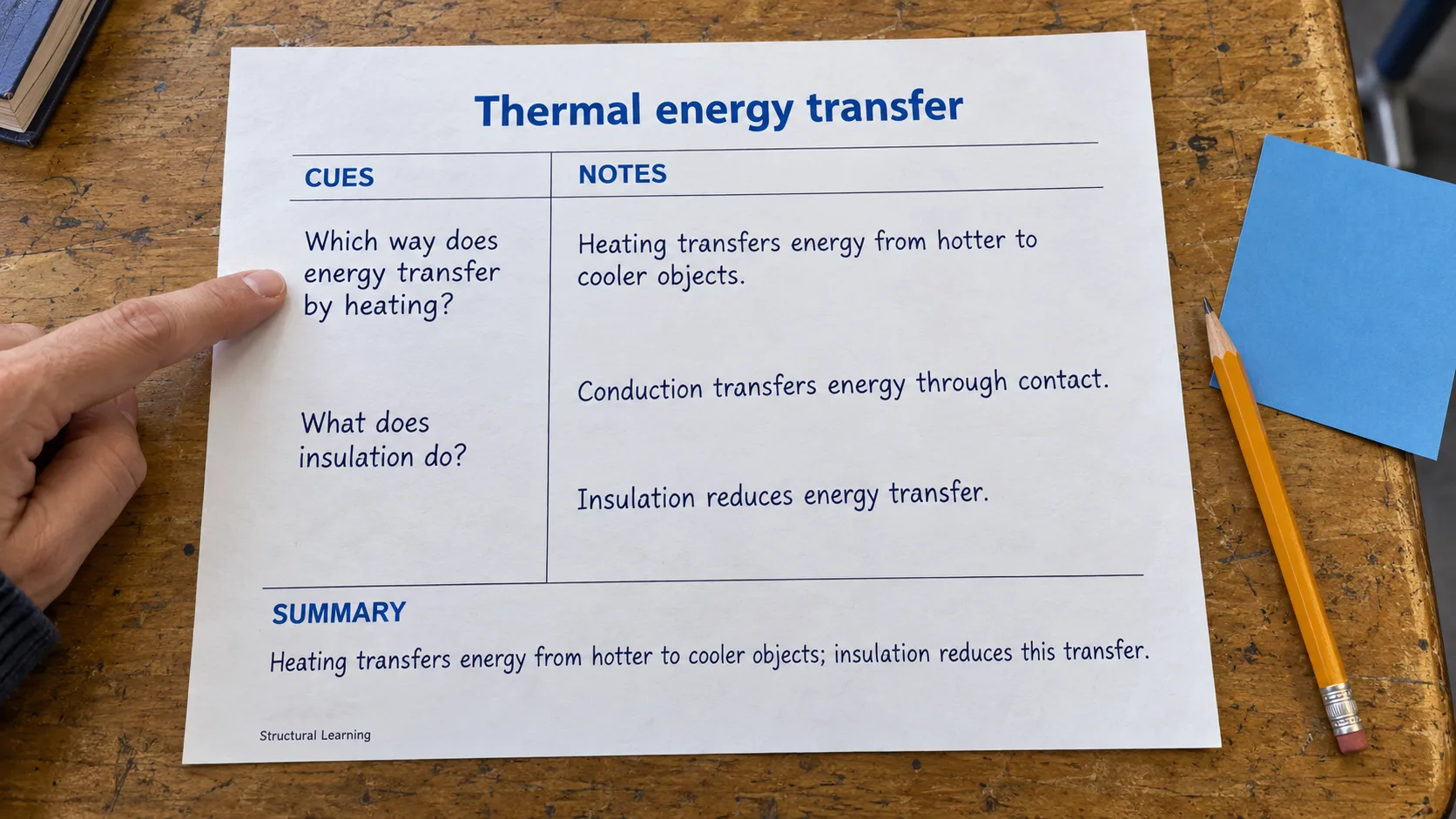
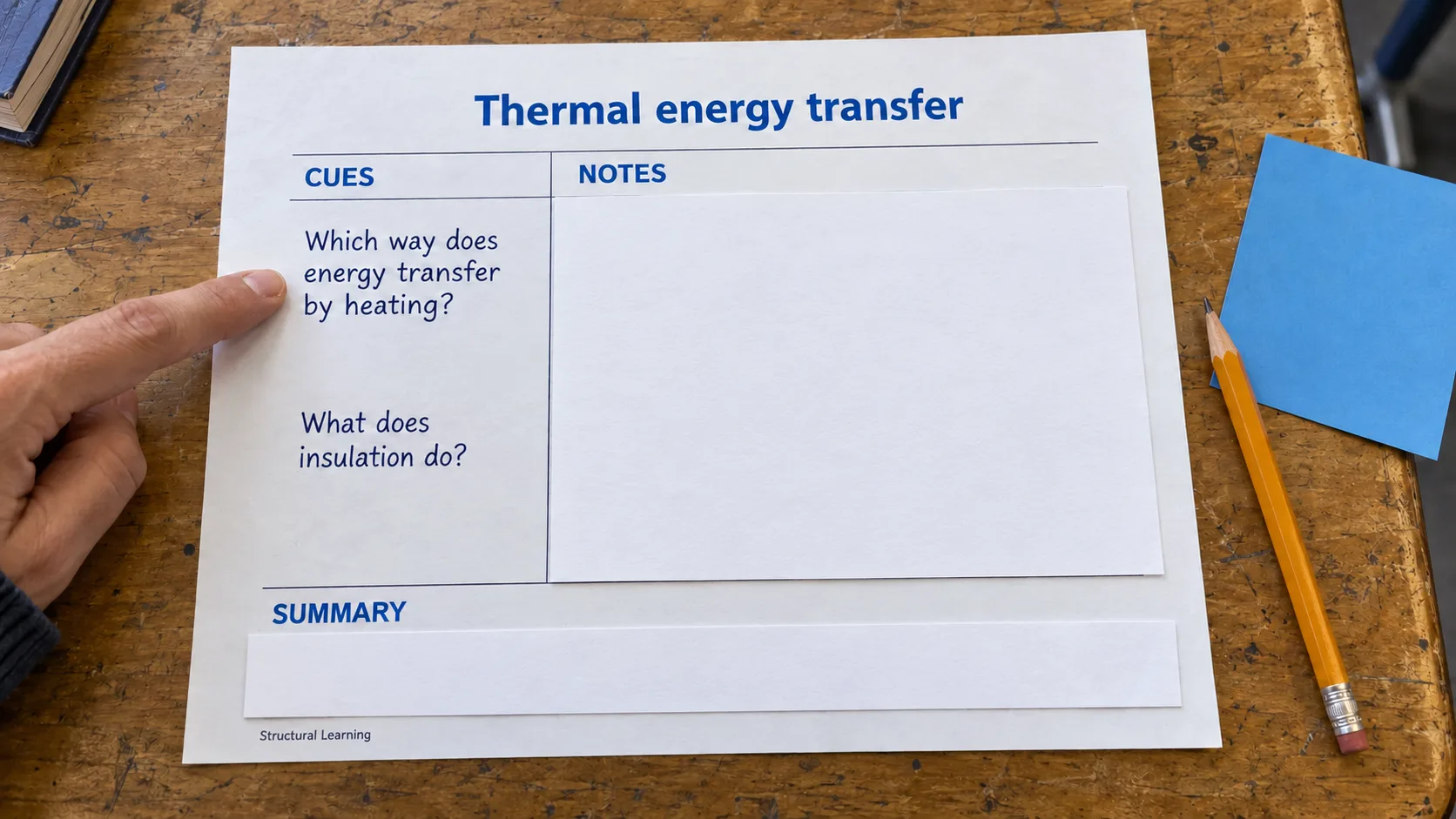
Topic: Thermal energy transfer and insulation
| Cue question | Notes |
|---|---|
| Which way does energy transfer by heating? | Heating transfers energy from hotter to cooler objects. |
| What is conduction? | Conduction is energy transfer through contact. |
| What happens to the temperature difference? | These transfers tend to reduce the temperature difference. |
| What does insulation do? | Insulation reduces energy transfer. |
Summary: Heating transfers energy from hotter to cooler objects. Conduction involves contact; insulation reduces transfer.
Model the first row: select the direction of heating, shorten it without changing the meaning, then ask a question that brings that idea back. The summary joins ideas already present. It introduces neither a temperature nor a claim about the best insulating material.
Completed retrieval check: Cover the notes and answer “What does insulation do?” The model answer is “It reduces energy transfer.” Reveal the fourth note and compare the wording.
If a practice answer says that insulation stops all transfer, revisit reduces in the source. Ask for the corrected answer, then try the cue with the notes covered again. This gives the teacher a specific follow-up. The response is an authored practice case, not a reported classroom result.
| Source only | Added claim |
|---|---|
| Insulation reduces energy transfer. | Insulation stops all transfer. |
Compare the wording with the supplied source. Keep reduces; do not change it to stops.
Source and setup first. Use this original fictional planning passage. The group and schedule are supplied for the exercise.
Supplied planning passage
A Year 6 group is preparing a classroom display. They will choose three examples on Monday, draft captions on Tuesday and check the captions against their sources on Wednesday. They will display the work on Thursday. Every caption must name its source.
Notes
Monday: choose three examples. Tuesday: draft captions. Wednesday: check captions against sources. Thursday: display the work. Each caption must name its source.
Cues and answers
What happens on Monday? The group chooses three examples.
When are captions checked? On Wednesday.
What must every caption name? Its source.
Summary: The group chooses examples, drafts and checks captions, then displays the work. Every caption names its source.
Model one cue together, then cover the notes. For “When are captions checked?”, Wednesday is the complete answer. If a practice response gives Tuesday, reopen the notes and distinguish drafting from checking. Ask the cue again after the distinction is clear.
This is a modest introduction using a short supplied passage. Keep the note sheet small and model each step. The example provides a supported extension for Year 6 alongside the article’s main secondary focus.
The official Cornell worksheet names five actions. Its second action is Questions. Use those labels accurately when explaining the routine.
Teach the first cycle with a source already understood. Show how to shorten an idea while retaining its meaning. Model a question, a covered answer and a source check. Use the modelled-to-independent writing sequence to plan those steps.
The filled science sheet can serve as a worked exemplar. Ask learners to identify a cue that retrieves a particular note. For deliberate practice, focus the next attempt on an unclear question or an inaccurate summary.
Listen for the idea, then compare it with the source. A complete answer can use different wording. A partial answer needs the missing detail. An incorrect answer needs a clear contrast with the relevant note.
| Practice answer | What to revisit | Follow-up |
|---|---|---|
| “From hotter to cooler.” | The intended direction is present. | Ask for a sentence using the topic. |
| “Conduction is transfer.” | Contact is missing. | Revisit the second note, then answer again. |
| “Insulation stops transfer.” | The note says reduces. | Compare the words and restate the answer. |
Keep the focus on the answer, rather than how full the page looks. Our secondary metacognition guide provides wider planning context. Use a later Do Now starter to revisit a selected cue.
Roediger and Karpicke (2006) studied free recall and restudy of prose with university undergraduates. Initial testing produced better delayed recall under the tested conditions. Immediate results favoured restudy. The paper supports a retrieval rationale, rather than validating a Cornell layout.
Use our retrieval practice guide for broader classroom planning. In this proposed routine, covering notes creates an answer attempt before the source is shown again. Record what needs teaching next.
One post says, “Cornell notes and lecture summaries are your friend.” @Fabius1453 It expresses a positive view, not an independently verified classroom outcome.
A former learner writes, “Cornell notes hasn’t even scratched my brain in college”. @yurbaconmyheart This is one learner’s account, not a teacher report.
Give the page a visible purpose. Ask a cue, hear the answer and check it. A useful teacher response follows the content of that answer. Read the classroom metacognition guide for related reflection planning.
Change the topic, notes, cues and summary to fit your source. The starting sheet uses the supplied Year 8 science example. Hide the notes, answer from the cues, then reveal the notes to compare.
Map It · Cornell notes
Edit the example, then Recall view hides the notes and summary in the editor and sheet, while keeping your topic and cues in view.
Worked example: Year 8 science. Topic: Thermal energy transfer and insulation. Check your edits against your source before teaching.
Example
Your edits stay in this page until you leave it. Reset restores all four example fields and Full view.
Print the sheet when its content is ready. Reset restores the starting example. Check edited subject facts and cue answers yourself. The notes, questions and summary remain teacher-authored content.
The official Cornell material is university study guidance. The retrieval paper tested undergraduate prose recall, with 120 participants in its first experiment and 180 in its second. Neither establishes that this layout is best for all ages, that these school examples improve attainment, or that a weekly ten-minute review is an optimal dose.
The examples and teacher follow-ups are proposals. The science sheet selects a few supported ideas, not a complete energy lesson. The Year 6 passage is fictional. The X posts establish what their authors said, not classroom outcomes. The mini app organises teacher-entered text; it does not generate or mark answers.
The download contains a filled Cornell example, a blank printable template and four notebook tasks with teacher answers. Write on the printed sheet or in your notebook. The PDF is static; editing controls belong to the mini app.
Practise a cue question, a covered conduction answer, an accurate science summary and questions from the fictional planning passage. All required source content is supplied. Accept equivalent answers that preserve its meaning.
Classroom resource
Download the Cornell example, blank template, practice and answers (PDF)
No email is required for this download.
Compare this layout with the options in our visual organisers guide. Choose a format for the task and teach learners how to use it.
Plan the source, model and retrieval check together.
No. The official worksheet allows questions or cue words. The worked questions here make the intended retrieval target explicit.
Keep this summary within the supplied notes. If you want a new application example, label and check it separately.
The editable sheet accepts typed content. The printable sheet supports writing by hand. Teach the same cue, notes and source-check routine in either medium.
No. It is a static printable template. Use the mini app to edit the four content areas before printing.
Cornell University Learning Strategies Center (n.d.). The Cornell Note Taking System. Origin attribution.
Cornell University Learning Strategies Center (n.d.). The Cornell Note-taking System. Official worksheet, page 1.
Department for Education (2015 edition). National curriculum in England: science programmes of study. Key Stage 3, energy changes and transfers.
U.S. Department of Energy (2010). Guide to Home Insulation. R-Value, page 1.
Roediger, H. L., III and Karpicke, J. D. (2006). Test-Enhanced Learning: Taking Memory Tests Improves Long-Term Retention. Psychological Science, 17(3), 249–255.