Updated on
September 23, 2026
Do Now Examples: A Bank of Lesson Starters by Subject
Do now examples by subject and phase, what it looks like from Reception to KS4, teachers' objections answered, a generator and a printable table.


Updated on
September 23, 2026
Do now examples by subject and phase, what it looks like from Reception to KS4, teachers' objections answered, a generator and a printable table.
What is a Do Now?
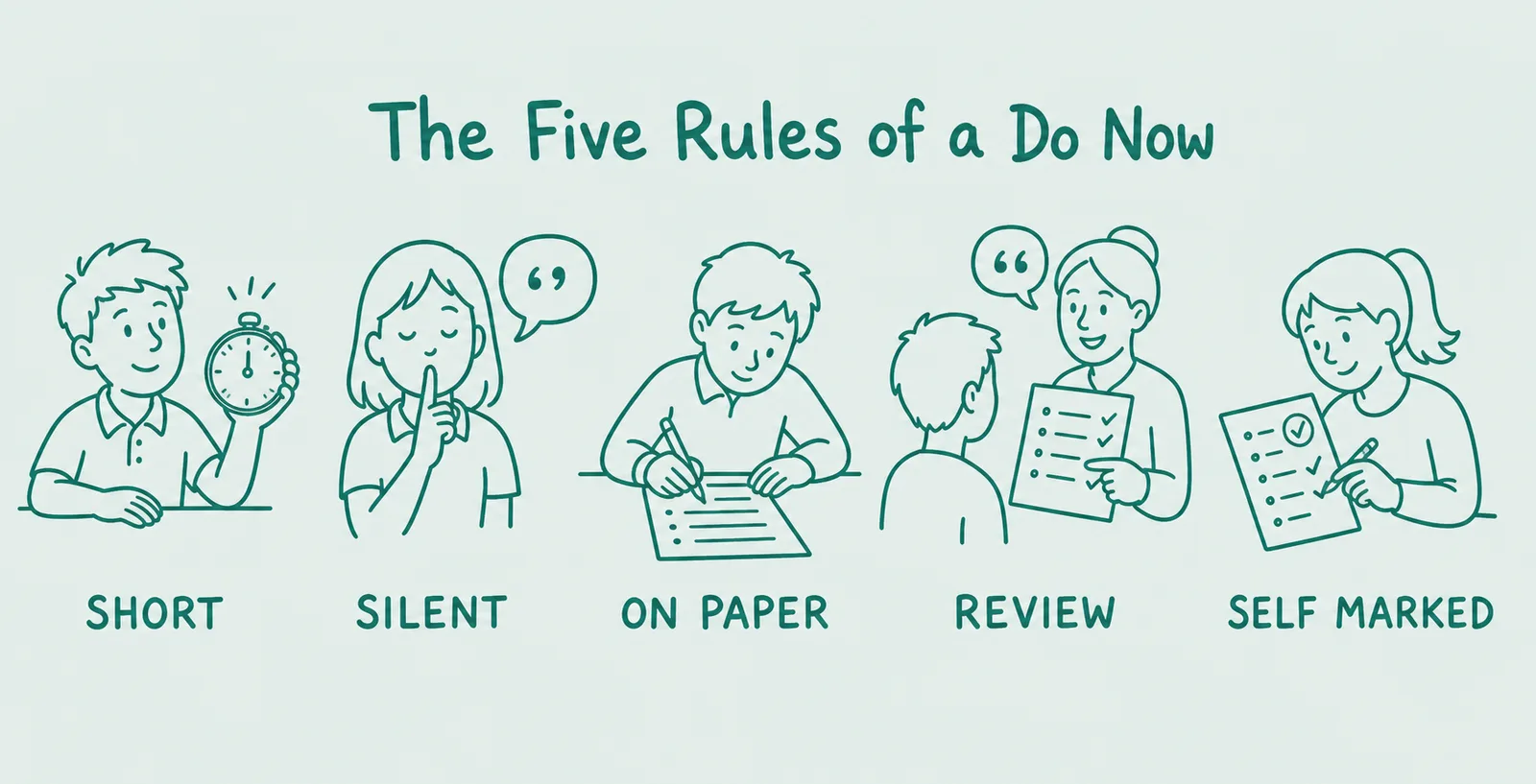
A Do Now is a short task learners begin the moment they enter, before the lesson formally starts. It runs for three to five minutes, is silent and independent, needs nothing beyond pen and paper, reviews prior learning rather than introducing new content, and can be self-checked so learners know straight away whether they were right.
Walk into a secondary classroom at the start of period one and count the minutes before the first learner does any thinking. Four is common, and five is not unusual. Ofsted's own description of low-level disruption includes "being slow to start work or follow instructions", listed alongside chatting and calling out (Ofsted, 2014).
A Do Now is the standard answer to that problem. It is a short written task waiting on the desk or the board before the teacher says anything, which learners begin the moment they walk in, unprompted and without help. Doug Lemov named the technique in Teach Like a Champion, where it appears as technique 20 of 63, in the chapter on lesson structures. British schools frequently call the same slot a starter, or a Do Now task.
Where most guidance thins out is on the evidence. Ofsted's much-quoted figure came from a YouGov survey of 1,048 teachers and 1,024 parents, and it concerns lost learning time rather than starters. No study has ever tested the Do Now as a named practice, so everything defensible that anyone says about it is inference from three separate literatures: retrieval practice, distributed practice and cognitive load.
That inference is sound, and it remains inference. The practical consequence is that the design of the questions does all the work. In a Year 8 history class, three questions revisiting last week's material on the English Civil War are doing something the evidence supports; the same three minutes spent on a word search are not.
In a hurry? Go straight to the 24 named Do Now strategies, or to the worked examples by subject and year group. The research behind them is below that.
A Do Now is a short written task that learners begin unprompted as they arrive, work at independently and in silence for three to five minutes, and complete with nothing but a pen. What separates it from an ordinary starter is not the content but the independence. A task you have to launch cannot begin until the room is already settled, which is precisely the window a Do Now exists to occupy.
Teach Like a Champion specifies four criteria, not five, and they are better read as a set than as a list of desirable features. Each removes a particular way in which the opening minutes leak away.
Criterion two is the one schools quietly drop, criterion three is the one they overrun, and criterion four is the one this guide deliberately narrows.
Five versions circulate in staffrooms that the technique does not support. Each quietly removes the feature that made the routine effective.
| What teachers pass round | What the technique specifies |
|---|---|
| "Any starter counts as a Do Now" | A task requiring explanation fails the independence criterion, and that is the entire distinction between them. |
| "It should be fun or engaging" | Neither word appears among the criteria. A written product does, because that is what makes the task checkable. |
| "It can be a paired discussion" | The criteria explicitly rule out discussion with classmates. Paired talk is valuable, and it belongs later in the lesson. |
| "Five to ten minutes is fine" | Three to five. Beyond that it becomes the lesson rather than the entry to it, and the review has nowhere to go. |
| "Going through the answers is the starter" | The review should be shorter than the task. A lengthy post-mortem costs more time than the disruption it replaced. |
Four of these five criteria come directly from Lemov. The fifth is ours, and we treat it as non-negotiable, because a task nobody checks is a task nobody learns from. Three to five minutes is brief enough for the slowest writer to produce something and to leave room for the review; the silence is what makes the written page diagnostic, since a learner who has conferred is no longer telling you what they personally know.
| Criterion | What it looks like in the room | Where it comes from |
|---|---|---|
| 1. Three to five minutes | Four short questions, timed, visible before the bell | Lemov's third criterion |
| 2. Silent and independent | No teacher explanation, no conferring with a neighbour | Lemov's second criterion |
| 3. Pen and paper, nothing else | No logins, no textbook hunt, no equipment to fetch | Lemov's second criterion, which excludes materials you have not already handed over |
| 4. Reviews prior learning | Questions drawn from last lesson, last week, last term | A narrowing of Lemov's fourth criterion, which also permits previewing today |
| 5. Self-checkable | Answers displayed and marked in under two minutes | Ours, not Lemov's. Rowland (2014) found testing with feedback outperformed testing without it |
Lemov's first criterion, that the task lives in the same place every lesson, concerns routine rather than design, so it is handled further down.
A Do Now that introduces new content asks learners to think hard about something unfamiliar at the one moment when no teacher is free to help. Sweller (1988) showed that a demanding task can use up most of working memory while producing very little learning. Reviewing material that is partly secure keeps the load manageable and the retrieval effortful. That combination is the one that pays.
Our guide to cognitive load theory covers the architecture, and our working memory guide sets out the practical limits.
Design the task so answers can go up on the board and be marked in under two minutes. Rowland (2014) found in a meta-analytic review that effortful recall outperformed recognition, and that testing accompanied by feedback outperformed testing without it. A Do Now whose answers are never revealed is therefore the weakest available version, and also the most common, because it is the version that survives a rushed morning.
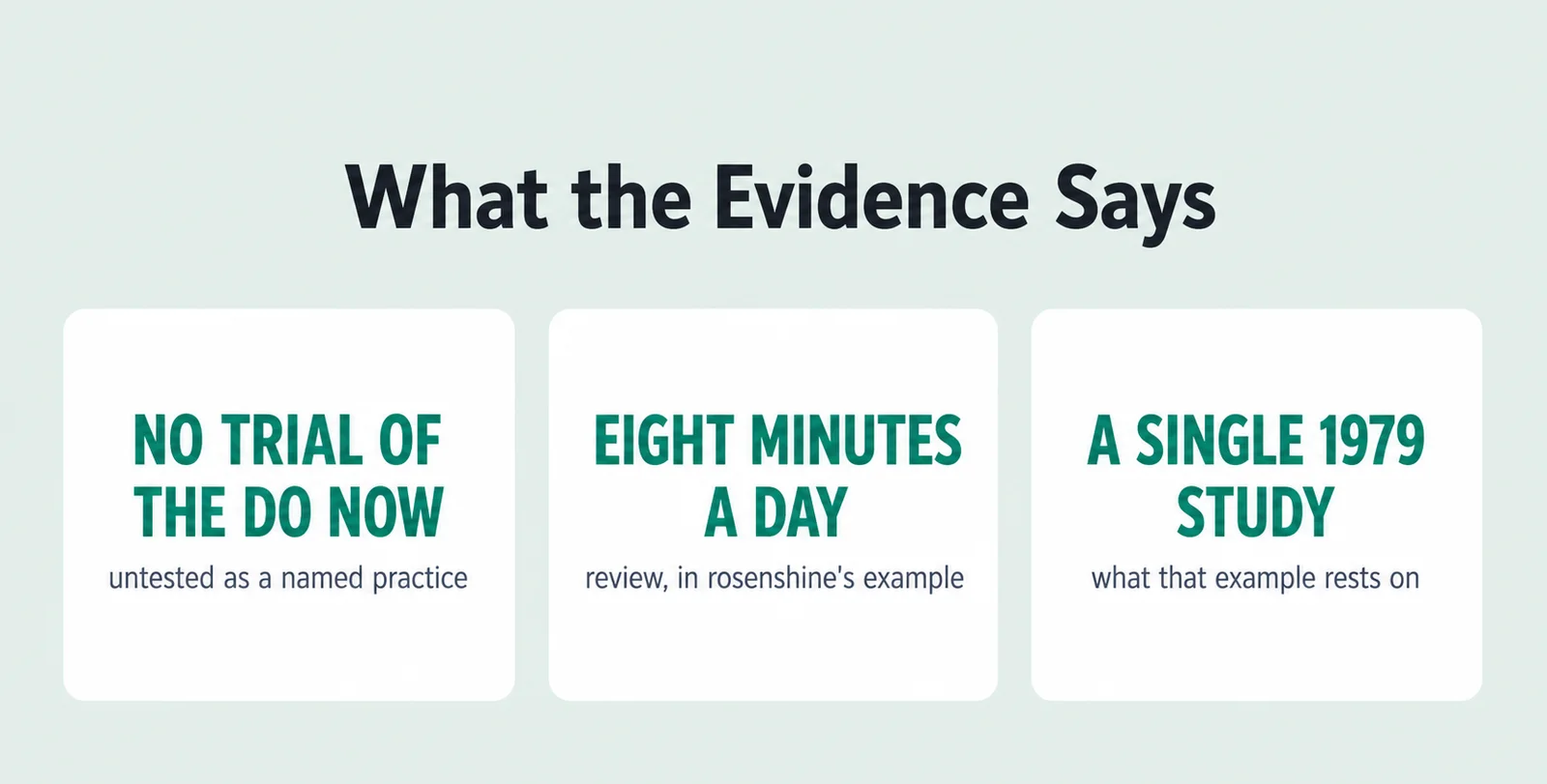
No study has tested the Do Now as a named practice. There is no trial of it, no meta-analysis and no effect size, and anyone claiming otherwise is repeating something they have not checked. What exists instead is three well-evidenced literatures that a properly designed Do Now sits squarely inside, and reading them is what tells you which four questions to write.
Roediger and Karpicke (2006) gave learners identical material, then had some re-read it while others were tested on it. After five minutes the re-readers looked better; after a week the tested group was substantially ahead. That reversal explains why the routine feels less productive than it is. Karpicke and Roediger (2008) extended the point: once something can be recalled, further restudying adds almost nothing while further retrieval continues to pay.
Both were laboratory studies with university participants, so the school-facing citation is Agarwal, Nunes and Blunt (2021), a systematic review of retrieval practice in real classrooms across a range of ages and subjects. The benefit holds up in schools, though the size of it varies considerably. Our guide to retrieval practice works through the classroom detail.
Cepeda and colleagues (2006) synthesised a substantial body of work and established two findings that matter here. Spacing outperforms massing, and the optimal gap widens as the retention interval lengthens. If learners must hold something until a summer examination, revisiting it a week later is insufficient. See spaced practice for planning the gaps across a scheme of work, and for why they have to widen as material ages.
The first of Rosenshine's ten principles is to begin a lesson with a short review of previous learning, because daily review strengthens earlier learning and leads to fluent recall (Rosenshine, 2012). His illustration is an experiment in elementary school mathematics where teachers spent eight minutes a day on review, checking homework, working through errors and rehearsing skills that needed to become automatic. The study he points to is Good and Grouws (1979).
Two qualifications matter. That eight minutes included marking homework, so it was not a Do Now. And the illustration rests on a single experiment, in one American state, in fourth-grade mathematics, published in 1979. Our guide to Rosenshine's principles of instruction covers the complete set.
The quickest way to get a Do Now wrong is to write four questions about yesterday and stop there. The quickest way to get it right is to decide where each question comes from before deciding what it asks. Below is the structure we would recommend, followed by worked examples spanning primary, secondary and sixth form that you can lift and adapt directly.
Allocate each question a job before writing it. This is the entire design decision, and it takes about a minute once the habit is established.
| Question | Drawn from | What it is doing |
|---|---|---|
| 1 | Last lesson | Almost everyone succeeds, so nobody begins the day failing. |
| 2 | Last week | Distant enough to require effort, recent enough to remain fair. |
| 3 | Last half term | The spacing question, and the one that keeps older material alive. |
| 4 | Last year, or the prerequisite for today | Reaches furthest back, and connects to the lesson about to begin. |
Worked through for that Year 8 history lesson: a cause of the English Civil War from last lesson, the year Charles I was executed from last week, what the Domesday Book recorded from the autumn term, and a power Parliament held beforehand. A retrieval grid does the same job in a format learners mark themselves.
Every set below follows the identical four-slot structure. None requires a device, a worksheet or an explanation, and each can be marked from the board in under two minutes.
| Class | The four questions |
|---|---|
| Year 2, mixed | Write the number 34 in words. What is ten more than 46? Circle the verb in "The dog ran quickly." Write the plural of "box". |
| Year 4, maths | What is 7 times 6? Write three quarters as a decimal. What is the perimeter of a rectangle 5cm by 3cm? Round 4,382 to the nearest hundred. |
| Year 6, English | Punctuate: "After lunch we went outside." What is a fronted adverbial? Write the past tense of "to bring". Name one feature of a formal letter. |
| Year 8, history | Name one cause of the English Civil War. In which year was Charles I executed? What did the Domesday Book record? Name one power Parliament held before the war. |
| Year 9, science | Write the word equation for photosynthesis. What does a catalyst do? What is the unit of force? What charge does an electron carry? |
| Year 10, English literature | Who says "Out, damned spot"? Define dramatic irony in one sentence. What is iambic pentameter? Give one quotation showing Macbeth's ambition. |
| Year 11, French | Give the past participle of "aller". Translate "I have lived here for three years." What gender is "problème"? Write a sentence using "depuis". |
| Year 12, psychology | Define standard deviation. What is an independent measures design? Name one ethical issue raised by Zimbardo's prison study. What are demand characteristics? |
Notice what is absent. No question asks for an opinion, because opinions cannot be marked from the board, and none requires a text in front of the learner, because that counts as equipment.
Four short-answer questions remains difficult to improve on. A retrieval grid weighted by how far back the content reaches works well once the routine is established, a recall column from a knowledge organiser works where the organiser is embedded, and labelling a blank diagram suits science and geography. The format to avoid is multiple choice whose answers are never revealed, because it surrenders both of the ingredients Rowland (2014) identified while still consuming five minutes. Twenty-four named formats, with their sources and their real running times, are catalogued below.
Mini app · Build It · Starters
Pick a subject, a phase and today's topic. You get four review questions, sized for the first five minutes.
Pick a subject and a phase, then build the task. Nothing is saved, so change the topic and build it again.
Why it reviews rather than previews
A starter that introduces new material needs you at the front, so the room waits. A starter that pulls back old material runs itself, and the pulling back is the bit that strengthens the memory. That is retrieval practice, and it is the same reasoning behind Rosenshine's daily review.
Built to these five rules
The app builds the frame and holds the constraints. You still check that the questions match what this class was actually taught.
There is no shortage of Do Now formats. There is a shortage of formats with a name, an author, and an honest account of how long they really take. Below are 24, grouped by what they ask a learner to do. Each row says where it came from, how many minutes it needs, whether it reviews old material or previews new, and whether learners can mark it themselves.
Eighteen of the 24 review old material only. Four work either way. Two preview new content, and they are flagged, because the placement evidence runs against them. McDaniel et al. (2011) ran quizzes before and after instruction in a real middle school science classroom across a full year: the quizzes placed after instruction produced large gains on the end-of-term exam, and the pre-lesson quizzes did not.
Where a format has no traceable originator, this guide says so rather than inventing one. That is the honest answer for seven of the 24, and it is worth knowing before you credit a colleague with something nobody can source.
These four give a learner nothing to recognise. No stem, no options, no word bank. That is the point: retrieving from nothing is harder and it sticks better. Karpicke and Blunt (2011) found free recall beat elaborative study with concept mapping on a delayed test, which is the strongest single result behind the brain dump.
| Strategy | Where it comes from | Minutes | Reviews or previews | Learners can mark it |
|---|---|---|---|---|
| Brain dump, also free recall or blurting | Named by Pooja Agarwal and Patrice Bain in Powerful Teaching (2019). "Blurting" is UK revision slang with no traceable originator | Up to 5 | Reviews | Nothing to mark, which is its weakness |
| Two Things | Pooja Agarwal, retrievalpractice.org | 2 to 3 | Either | Ungraded by design |
| Cops and Robbers | Described by Kate Jones in Retrieval Practice (2019). She may be popularising it rather than inventing it, so credit her with the description | 5 to 8 | Reviews | No, learners steal from each other instead |
| Knowledge organiser self-quiz, look, cover, write, check | Joe Kirby at Michaela Community School (2015). The look, cover, write, check routine itself is decades-old UK primary practice with no known inventor | 5 to 10 | Reviews | Yes |
A brain dump needs a specific prompt or learners will not know how much to write, and it needs a check afterwards. On its own it cannot tell a learner what they failed to recall. Cops and Robbers solves that socially: learners write alone against a timer in a Cop column, then circulate and steal anything new into a Robber column.
Six formats that deliberately reach further back than last lesson. This is the spacing effect doing the work, and Cepeda et al. (2006) is the synthesis behind it: the longer material has to last, the wider the gap between practices should be. A starter that only ever asks about yesterday keeps nothing alive.
| Strategy | Where it comes from | Minutes | Reviews or previews | Learners can mark it |
|---|---|---|---|---|
| Retrieval grid | Kate Jones, UK history teacher, Retrieval Practice (John Catt, 2019) | 5 to 10 | Reviews | Partly, then teacher feedback |
| Last lesson, last week, last term | No traceable originator. It is the retrieval grid logic without the grid. Rosenshine’s daily review is the research ancestor | 4 to 6 | Reviews | Yes |
| The Review, 15 questions in three fives | Ben Newmark, "Nothing new; it’s a review", 13 November 2017 | About 5 | Reviews | Yes, read aloud then self-marked |
| Flashback 4 | White Rose Education, premium tier. Revisits previous steps, blocks, terms and years | About 5 | Reviews | Not stated on the source |
| Retrieval Roulette | Adam Boxer, "A Chemical Orthodoxy", 4 May 2017. A spreadsheet draws five questions from the whole course and five from the current topic | 10 to 30 | Reviews | Peer-marked on a folded slip |
| Flashcards and the Leitner box | Sebastian Leitner, So lernt man lernen (1972). Compartments of 1, 2, 5, 8 and 14cm; a correct card moves to a wider compartment, a wrong one goes back to the front | 5 to 10 | Reviews | Yes |
Two honest notes. Kate Jones’s grids are recency-banded and colour-coded, but the exact colour scheme varies. Some versions award escalating points for older material and others award none, so describe the mechanic rather than copying one scheme.
Boxer says the ten-question Retrieval Roulette "can take 25/30 minutes which can eat away at your lesson time". He later added six and eight question versions. The canonical form is not a five-minute starter.
Newmark’s Review is the clearest practitioner statement of the position McDaniel et al. support, and he arrived at it from the classroom rather than the literature. Five questions on last lesson, five on the current topic, five on anything covered since starting the subject. He reads them aloud rather than projecting them, which forces the pace and stops learners reading ahead. He calls it "a doddle to plan".
The Leitner box is the only format here where the spacing lives in the object rather than in your planning. That is why it survives a busy term when a teacher-scheduled rota does not.
Self-marking is the difference between a starter that runs every day and one that dies in week three. These five all hand the marking to the learner. The cost is that you see the class picture rather than each individual, which is the right trade for a five-minute task.
| Strategy | Where it comes from | Minutes | Reviews or previews | Learners can mark it |
|---|---|---|---|---|
| Carousel Learning quiz | UK company co-founded by Adam Boxer with Josh Perry and Jose Diaz, built 2020. The commercial descendant of Retrieval Roulette, and what it added was self-marking | 5 to 15 | Reviews | Yes, against a model answer |
| Low-Stakes Quiz | Craig Barton, Tips for Teachers. Ten mixed-topic questions, easiest to hardest, aiming at roughly an 80 per cent class average | 15, plus 12 for review cards | Reviews | Yes, with a confidence rating per question |
| 5-a-day | Corbettmaths. Five mixed questions from a dated page, no login. Primary, GCSE 9-1, Further Maths and legacy tiers | 10 to 15 | Reviews | Yes, though the source page does not state this explicitly |
| Numeracy Ninjas | William Emeny, launched 2015. Foundations for Years 1 to 6, Essentials for Year 7, Plus for Years 8 to 10 | 5 | Reviews | Yes, against a projected answer deck |
| Cloze or gap-fill, no word bank | No traceable originator. The evidence is the specific part: Slamecka and Graf (1978) on the generation effect | 3 to 5 | Reviews | Yes |
The cloze design rule follows straight from the generation effect. Generating a word yourself retains better than reading it, so a word bank turns generation back into recognition and gives most of the benefit away. If you want retrieval, remove the bank.
Two caveats worth printing. Barton’s full Low-Stakes Quiz routine runs closer to 30 minutes once the review cards are made; the quiz portion alone is what works as a starter. And Numeracy Ninjas was free at launch and is now a free trial then paid membership, which teachers who remember it from 2015 will not expect.
The problem with four questions in a book is that you find out who understood after the lesson. These three give you the class picture in the first five minutes, while you can still change what you teach. Do not conflate them: they are genuinely different techniques with different inventors.
| Strategy | Where it comes from | Minutes | Reviews or previews | Learners can mark it |
|---|---|---|---|---|
| Mini whiteboard "show me" | Tom Sherrington, teacherhead, 28 August 2012. The ancestor is Dylan Wiliam’s all-learner response systems in Embedded Formative Assessment | 2 to 5 | Either | No, you scan every board at once |
| Multiple-choice diagnostic question | Craig Barton, tipsforteachers.co.uk and the diagnosticquestions.com bank | 2 to 5 | Either | Yes, on the reveal |
| Show Call | Doug Lemov, Teach Like a Champion. "A type of Cold Call that involves taking learners’ written work and displaying it to the class" | 3 to 5 | Reviews | No, the class works on it together |
Barton’s design rules for a diagnostic question are the useful part. Every distractor must be plausible and each one should reveal a specific misconception, there must be no ambiguity in the stem or the options, and the question must not need several steps, because then you cannot tell which step went wrong.
Three things look alike and are not. Sherrington’s mini whiteboards show you everyone’s board at once. Lemov’s Show Call displays one learner’s exercise book to everyone.
Wiliam’s hinge question is a mid-lesson checkpoint by design, though it is often repurposed as a starter. Boxer adds a fourth variant, the tick trick. Learners keep their board visible during feedback and tick each correct part against it.
Three formats that put a wrong answer at the centre rather than a right one. The evidence here is specific rather than general. Booth et al. (2013) found that studying incorrect worked examples alongside correct ones improved algebra learning, and Große and Renkl (2007) found the same effect depends on learners being told where to look.
| Strategy | Where it comes from | Minutes | Reviews or previews | Learners can mark it |
|---|---|---|---|---|
| My Favorite No | Leah Alcala, via a Teaching Channel video. Keep the US spelling, it is a proper name | 5 to 8 | Reviews | Class-corrected, not self-marked |
| Find the error, or erroneous examples | No traceable originator as a named format, but the evidence base is real: Große and Renkl (2007), Booth et al. (2013) | 5 | Reviews | Partly |
| Exit ticket into the next Do Now | Exit tickets are Doug Lemov. The loop into the next lesson’s starter is not established to anyone, and it is often wrongly credited to Dylan Wiliam | 5 | Reviews | No, you read the slips |
Alcala’s routine is worth the detail. Learners answer one warm-up question on an index card and hand it in. You sort the cards quickly into a yes pile and a no pile.
Pick the most instructive wrong answer and rewrite it on the board anonymously. The class first says what the answer got right, then finds and corrects the error. Learners correct the mistake, not you.
The exit ticket loop is the only format in this catalogue that closes the assessment loop, which makes it the strongest answer to the question teachers actually ask: how do I know what to put in tomorrow’s Do Now. Read the slips after the lesson, find the common gap, write tomorrow’s four questions to target it.
One format, and it is the odd one out in this catalogue because it cannot be marked. Structured comparison has a real evidence base: Alfieri, Nokes-Malach and Schunn (2013) meta-analysed learning through case comparisons and found reliable benefits. The cost is that it needs talk, so it needs longer than four questions in a book.
| Strategy | Where it comes from | Minutes | Reviews or previews | Learners can mark it |
|---|---|---|---|---|
| Odd One Out, and Which One Doesn’t Belong | Which One Doesn’t Belong is Christopher Danielson’s book; the classroom site was built by teacher Mary Bourassa. Odd One Out generally has no single originator | 5 to 8 | Either | No, it is discussion-marked |
The design intent of Which One Doesn’t Belong is that a case can be made for every one of the four items, so there is no answer to reveal. That is a feature for oracy and a problem for a five-minute self-marking starter. Use it when you want justification, not when you want coverage. One practical note: the wodb.ca site now redirects to a domain sale page, so do not send learners there.
Both of these introduce new material rather than strengthening old, which is the placement McDaniel et al. (2011) found did not produce a gain. They are still defensible, for reasons worth stating plainly rather than dodging, and Lemov’s own fourth criterion for a Do Now explicitly permits preview.
| Strategy | Where it comes from | Minutes | Reviews or previews | Learners can mark it |
|---|---|---|---|---|
| Vocabulary and etymology starter | Alex Quigley, Closing the Vocabulary Gap, for the root, prefix and suffix routine. Vocabulary Ninja publishes the word-of-the-day format in two tiers | 3 to 5 | Previews | No |
| Thunks and Big Questions | Ian Gilbert, The Little Book of Thunks. Gilbert credits Matthew Lipman and Philosophy for Children as the lineage | 5 to 10 | Previews | No right answer to mark |
The vocabulary starter earns its place because vocabulary is cumulative: the routine reviews known word families while introducing one new word, so it is doing more review than it looks. It is still not doing what a review quiz does, and this guide will not pretend otherwise.
Thunks are the weakest fit on this guide’s own argument, and the Association for Science Education is right about why: a Thunk is a settling activity to run before the actual starter. It gets a class through the door. It does not strengthen memory. That is a real job, but it is a different job.
The honest reconciliation on placement comes from Pan and Sana (2021), who compared pretesting against posttesting directly. Pretesting reliably helps the specific material the prequestion asked about, and does little or nothing for the material it did not ask about, while review quizzing strengthens everything it covers. So the usable rule is this: if you preview, you are buying attention on one point and paying for it elsewhere.
These four appear on every list of starters and none of them is really a five-minute task. They are listed separately rather than dropped, because they are genuinely useful in the right slot, and because a teacher who tries to run one as a Do Now will lose the first quarter of the lesson.
Two more formats are widely used and could not be traced to anyone: the retrieval clock and the retrieval mat. Both are real and both are sold by resource sites, but no originator could be established, so this guide names neither an inventor nor a canonical version.
Compare eight classroom routines for varying the task, checking every learner and keeping the review brief.
| Routine, as teachers describe it | What you would notice | What the evidence says |
|---|---|---|
| Four-quadrant history slide Split the slide into four. Three multiple-choice questions plus one sentence. Answers on mini-whiteboards. It is the Do Now, not a later task.
|
A history board already up as the class sits. Three ticks and one written line, not a paragraph. | Lemov, The Do Now: A Primer: a written product, three to five minutes, no direction from the teacher. Durrington Research School, 28 Apr 2021: the five-minute cap is the criterion schools miss. The four-quadrant routine is one teacher's account, not trial evidence. |
| Year 7 English sentence Put a labelled Do Now on the IWB: one sentence, list the adjectives, upgrade two, continue the description. A support line defines adjective. Learners write as they sit. |
Year 7 English, pens down on a sentence, not a ten-item quiz. The slide is already there. | The article already argues an English Do Now can be a sentence. This row is the photographed board, 4 Sep 2026. EEF, Cattrall, 4 Jun 2024: retrieval is not only a factual quiz; probing questions can follow a first recall. Not a trial of this slide. |
| Books, not boards Science Do Now in exercise books. Skip mini-whiteboards: not enough space, hard to read, faff at the door. If you need the misses, ask for hands.
|
Books open on the first task. No board distribution. Hands for the items that failed, not a wall of boards. | A science-teacher claim, not a trial. On the same thread @hannahtuffnell keeps boards so the class can show the wrongs. @Miss_GJohnston, 13 Sep 2026: if they are writing more than ten words, paper while you circulate. EEF Cattrall still names mini-whiteboards as one way to capture every attempt. The disagreement is the finding. |
| Rub out the rights, hold up the wrongs Go through the Do Now. Learners rub out what they got right. Boards up only on the misses, so the teacher sees the misconception, not the score.
|
A room of boards that show errors. Correct work already gone. The scan is of what failed. | EEF Cattrall: retrieval of incorrect information can embed a misconception, so feedback has to land. Rowland (2014), already on this article: testing with feedback beat testing without it. This row is how one science teacher makes the miss visible. Not a trial of rubbing out. |
| English refuses the default board objection Do not make mini-whiteboard retrieval the starter in every subject. Geography HoD in Northern Ireland: apply the principle, keep the subject. |
English writing a sentence in books while science holds boards. Same school, two tools. | EEF Cattrall: retrieval should not be a single, separate activity prescribed the same way in every room. @Miss_GJohnston on the same thread: boards exist to be held up and scanned; more than ten words belongs on paper. No trial of a whole-school MWB ban. The Year 9 observation that started the thread is @hkateaching, whose bio now says teaching in Qatar, so it is not a UK Year 9 cell. |
| Register, then the answers Meet them at the door with one script: hello, come in, here is today's Do Now. Call the register. When the register is done, go through the answers together. |
Computing class already writing while names are called. Review starts only when the list is finished. | Durrington: teachers often interrupt a class already doing the Do Now by explaining it. Lemov primer: keep the review to five minutes max, and choose what not to review. The script solves the door. It does not cap the review. Not a trial of computing starters. |
| Eight questions, three-minute clock Eight to ten retrieval items on mini-whiteboards. A visible 03:00 timer. Reveal, learners tally, boards up, scan, reteach the misses. Silent from the threshold, even with three seconds to the bell. |
A dated slide, numbered items, a clock. Nobody waiting in the doorway. Answers hidden until the reveal. | The photographed timer is three minutes. Lemov primer: three to five minutes, then a review that must not become the lesson. EEF Cattrall, citing Agarwal, Nunes and Blunt (2021): the active attempt to retrieve is the mechanism, so notes and visible answers during recall are not retrieval. @XpatEducator, 14 Sep 2026, DistillED: answers visible during recall is copying. |
| Seven periods of the same style objection Keep a silent start, but vary the cue so the same learner does not meet one identical Do Now seven times a day, for years. |
The ritual holds. The task shape changes: quiz, map, talk prompt, error hunt. | @laurapatranella, 19 Jun 2026, on the same thread: a CLT-aligned bank can vary the task so it is not the same thing every day. EEF Cattrall: retrieval should not be a single, separate activity, and policies that fix the number and form of questions miss the flex subjects need. No trial of seven identical starters. The live US complaint is sameness of style, not the same quiz item. |
The task is the straightforward half. Most Do Nows fail after the pens go down, because the review is either skipped or allowed to swell until it has consumed the first quarter of the lesson. Set a rule and hold it: a three-minute task earns a two-minute review, which means marking all four questions while discussing only the one or two the room actually got wrong.
The quickest review is answers on the board and a green pen. It takes ninety seconds, every learner marks their own work, and you circulate reading margins rather than collecting books. Where you need the whole class simultaneously, mini whiteboards give a show-me on the single question you most need answered, and cold calling keeps the sample honest when volunteers would distort it.
Rosenshine puts the optimal success rate during instruction at approximately 80 per cent. A serviceable rule is that if roughly four in five answered correctly, review the question and move on. If substantially fewer did, you have identified a reteaching problem rather than a review problem, and it belongs inside the lesson. This is the moment a Do Now becomes genuine formative assessment rather than a settling routine.
Use the questions and evidence below to decide when a Do Now supports retrieval and when it becomes a routine without purpose.
Question
“Do now/starter. One of the most damaging policy enforcements ever.”
What the replies and the evidence say. The same account did not give a mechanism when asked, which @Mr_Raichura, 3 Sep 2026, tells teachers not to run a Do Now when seating a new class. @teacherhead, 1 Feb 2026, defends a rigid regime as a desire for deeper knowledge. The disagreement is the finding: switch it off on day one, or keep it as culture. Neither post is a trial of a whole-school mandate.
Question
“Fundamentally, most Do Nows don't work because the students don't know enough stuff to be able to answer the questions.”
What the replies and the evidence say. The same post: they leave answers blank, you reteach, participation craters, and six starter questions cannot cover a curriculum. @DavidDidau, 19 Jun 2026, on the same argument: Do Nows should activate knowledge for today's lesson, not space the entire curriculum. They disagree on what the four minutes are for. EEF Cattrall, 4 Jun 2024: balance challenge with a chance of success, and do not write a policy that fixes the number of questions.
Question
“English should not be subjected to a one-size-fits-all appraoch to lesson planning. MWB retrieval should not be the default starter.”
What the replies and the evidence say. @Miss_GJohnston, same thread: if they write more than ten words, paper while you circulate; boards exist to be held up and scanned. @hannahtuffnell, 8 Jan 2026, keeps boards so the class can show the wrongs. The replies do not agree on the tool. EEF Cattrall names mini-whiteboards as one way to capture every attempt, and also says retrieval must flex by subject. No trial of a whole-school board ban.
Question
“Some are simply doing too much for Do Now, and then it spoils further learning.”
What the replies and the evidence say. The same post: set them work, to do in silence, assess, that is it. @joel120193, 3 Jan 2026, listing live faults: time taken to complete Do Nows is too long. Lemov, The Do Now: A Primer: review five minutes max, or the Do Now becomes the lesson. @adamboxer1, 28 Jun 2026: five to ten max. The published rule is shorter than the science-teacher cap. That gap is the finding.
Question
“If I'm a student, and I have to go into 7 classes every day, all with the same style Do Now, for years, I'm going to lose my mind.”
What the replies and the evidence say. @laurapatranella, @laurapatranella: a CLT-aligned bank can vary the task so it is not the same thing every day. Teachers split on whether a consistent format supports retrieval or makes seven lessons feel repetitive. EEF Cattrall: retrieval should not be a single, separate activity. This is a teacher's account, not trial evidence about seven identical starters.
Question
“Do Nows are an issue because it becomes really easy for 5 minutes to stretch to 10 then 20 then half the class time is gone.”
What the replies and the evidence say. The same post starts class with a 30-second attendance check and then the lesson, so the alternative on offer is no Do Now. Durrington, 28 Apr 2021: the five-minute cap is the criterion schools miss, and the review then eats practice time. Edutopia, Sep 2026, quoting Barry Forbes: a bell ringer should support the lesson, not be busy work. Nobody in the posts we read posted cutting it to four minutes.
A Do Now is a habit before it is a task. Habits are established in the opening weeks or not at all. Teach the routine as explicitly as you would teach content.
In week one, narrate it: this is where it lives, this is when you start, this is what silence looks like. In week two, prompt rather than narrate. By week three, say nothing and let the room run it.
This is Lemov's first criterion, and it is the one teachers break most often. They usually do it with good intentions. The slide deck changes, so the task moves to a handout, then the board, then a shared document.
Every move brings back the question the routine exists to answer. Choose one place and stick to it for a term. A consistent lesson format is easier to keep up than a clever one. Our guide to classroom routines covers the wider pattern.
Cook and colleagues (2018) evaluated greeting learners at the classroom door in American middle schools, using a randomised design, and reported increased academic engaged time alongside reduced off-task behaviour. It is a small single-country study, so read it as encouraging rather than settled. The greeting and the Do Now are the same routine viewed from two sides, since you can stand at the door precisely because the task does not need you at the front. Decide in advance that a late arrival joins the review, and keep a two-question version for the learner who cannot begin.
Three posts carried a board, a retrieval slide or a pro forma a teacher could pin. The useful words are lifted into a strip you can print.
Year 7 focusing straight away in English with a focused do now to start the lesson!
@KC1school
The useful bit is the Do Now Task on the IWB: one sentence, three questions, a support line for adjective.
Pin this under the board
Read the sentence below and answer the following questions:
Support: Adjective- modifies (describes) a noun. Swap the sentence for today's text.
Students answer 8–10 retrieval questions on their mini-whiteboards at the start of class. I reveal the correct answers, students check and tally their score, then show their boards.
@SoLInTheWild
The useful bit is the eight-item retrieval list with a 03:00 timer in the corner.
Pin this under the board
Then: reveal, tally, boards up, reteach the misses. Their words, their order. Swap the items for your unit.
My 4th grade classroom's morning "Do Now": Retrieval practice concept map over our week long technology unit followed by spaced morphology practice utilizing "because, but, so" sentence expansion.
@VinceBoley
The useful bit is the Daily Retrieval pro forma: opening-routine ticks, vocabulary for brain dump, then a spaced-retrieval concept map.
Pin this under the board
Opening routine
Vocabulary for brain dump
Drones · Robots · Driverless Cars
Spaced retrieval (concept map)
Centre: Technology. Branches from last week's unit. Then because, but, so.
One identical task for an entire class is a design decision carrying a cost, not a neutral default. Kalyuga and colleagues (2003) established the expertise reversal effect, whereby instructional support that helps a learner who knows little can actively hinder a learner who knows more. A Do Now pitched at the middle is therefore slightly wrong at both ends of the room, which is manageable provided the adjustments are cheap enough to make every lesson.
The instinct is to allow more time. Reduce the number of questions instead. Two questions completed and marked are worth considerably more than four abandoned, and the timing of the routine stays intact for everyone else. Prepare the reduced set in advance so no negotiation happens at the door, because the aim is that this learner finishes something inside the same window as the class.
If the question is about photosynthesis, the sentence itself should not be the hard part. Strip the wording back until the only difficulty left is recalling the answer. For learners with English as an additional language, this is the most valuable adjustment you can make, and it costs nothing. Use shorter stems, one clause and no embedded conditionals, but keep the subject vocabulary, because that is exactly what you want them to retrieve.
The written product criterion exists so the task can be checked. Handwriting is not the objective. For a learner with significant writing difficulty, circling, annotating, matching or answering to a scribe all serve the same purpose.
Agarwal and colleagues (2017) found that retrieval practice helped participants with lower working memory capacity at least as much as it helped others. Those participants were at university, not at school. So read it as a reason to include these learners, not as evidence about SEND.
What a Do Now looks like when a post names the year, grade or phase. A band with no named post is not drawn empty.
| Phase | What the teacher does | What you would notice | The trap at that age |
|---|---|---|---|
| Reception and KS1 ages 4 to 7 US: K to 2 |
Make morning-work binders for kindergarten, not eight retrieval items on a timer.
|
A folder of independent work while the teacher does the door. Not a labelled Do Now on the IWB. | Putting a secondary retrieval quiz on a kindergarten page. The posts we read showed binders and TPT morning-work packets, not a board Do Now. |
| KS2 ages 7 to 11 US: Grades 3 to 5 |
Print a Daily Retrieval sheet: opening-routine ticks, a vocabulary brain dump, then a concept map of last week's technology unit. | A paper pro forma on the desk, not a three-minute clock on the wall. Drones, robots, driverless cars mapped from last week's technology unit. | Calling a concept map a five-minute Do Now and then letting the map become the lesson. The post asks how to improve the sheet. It does not time it. |
| KS3 ages 11 to 14 US: Grades 6 to 8 |
UK Year 7 English: a labelled Do Now on the IWB, one sentence, list adjectives, upgrade two, continue the description. Learners write as they sit. | Year 7, blazers, pens on a sentence about a forest, not a ten-item science quiz. The slide is already there. | Copying a secondary science retrieval list into Year 7 English. The photographed task is a sentence, which is the point. |
KS4 and Post-16: not found in the posts we read.
Two things differ in an international setting, and both press on the fourth criterion. Intakes arrive mid-year from entirely different curricula. That means reviewing previously covered content can be meaningless for a third of the room. Staffrooms also mix teaching traditions: a British-trained colleague says starter, an American-trained colleague says bell work, and each assumes the other means the same thing.
The remedy is to draw questions from the current course rather than an assumed prior curriculum, and to keep a knowledge organiser for the unit so a learner who joined in March has somewhere to recover content from. Where a class spans a wide range of English proficiency, the reading-demand adjustment above matters more than any other.
"It eats my first five minutes." It does not; it replaces them. Ofsted (2014) put the time lost to settling and low-level disruption at close to four minutes a lesson before any Do Now existed. A three-minute task on the board as learners walk in spends that time on retrieval instead of on waiting. In a Year 8 history lesson the teacher has two dates and a source on the screen before the first learner arrives; by the time the register is done, every learner has written two sentences and the lesson starts from work, not from silence.
"My class cannot work in silence." Not yet, and not without being taught how. The routine section above sets out the three-week teaching sequence: model it, narrate it, praise the first learners who start unprompted, and hold the standard on day fourteen as firmly as on day one. A Year 4 class that talks through the first week is a class still learning the routine, not proof that the routine cannot work. Silence is the product of the teaching, not a precondition for it.
"It is just another compliance ritual." It can be, and the limitations section below gives that critique its due (Cushing, 2021). The difference that matters is between two things. One is a three-minute retrieval task a teacher chooses for a reason. The other is a whole-school regime policed on learning walks.
The first serves the lesson. The second serves the walk. Heads of department sometimes mandate the format without asking what each subject needs to retrieve. When they do, they get the ritual and lose the learning.
The Do Now has no evidence base of its own, borrows one from laboratory studies conducted largely with university participants in the United States, and belongs to a school of practice that has attracted serious academic criticism. None of that makes it a poor routine. All of it should temper how confidently anyone recommends it, and four limits are worth knowing before building a department policy around it.
Hinze and Rapp (2014) compared high-stakes and low-stakes quizzing directly. Performance on the quizzes themselves was equivalent, so on the day everything appeared healthy. Final test performance, however, was better after the low-stakes version, and only the low-stakes version outperformed re-reading. Grading a Do Now, or allowing it to feel graded, can remove the benefit entirely while leaving every visible sign of it intact.
Pan and Rickard (2018) reviewed whether the benefit of testing carries beyond the exact material tested. It does transfer, but less reliably than the direct benefit on the tested content. For a Do Now that means the four questions you ask are the four things you have strengthened, and the rest of the topic is not covered by proxy. It is an argument for planning questions across a term rather than selecting them the night before.
This is a live dispute rather than a settled question, and the two decisive papers were published back to back in the same journal issue. Van Gog and Sweller (2015) argued that the testing effect diminishes or even disappears as material becomes more complex. Karpicke and Aue (2015) replied that it is alive and well with complex materials. For a Do Now the reading is reassuring, since short factual questions are the territory where the effect is least contested.
Cushing (2021) examined Teach Like a Champion techniques in an English secondary school and argued that they operate as a form of language and behaviour policing, falling hardest on learners whose speech is furthest from the school norm. Golann (2015) studied a high-performing no-excuses school and argued that its scripted regime produced deference rather than the independence it aimed at. These are serious arguments from serious researchers and they deserve stating at full strength.
Where we land is this. The objection targets a whole-school regime of scripted compliance. A three-minute silent retrieval task is not that.
The objection gains teeth in three situations. The Do Now might be one of forty compliance moments in a day. It might be the only silent activity in an otherwise talkative classroom. Or enforcement might fall unevenly across learners.
The technique itself does not police speech, but the culture built around it can. The simple answer is to balance a silent start with a routine that gives talk back, such as turn and talk.
Every reference below was checked twice: once to confirm the record exists, and again against Crossref to confirm it is the paper being cited. A deliberately malformed control was run through the same check and correctly failed, so the check is known to fail when it should. Links go to the publisher or the DOI, never an aggregator.
These peer-reviewed studies provide the evidence base for the strategies discussed above.
PSYCHOLOGICAL CHARACTERISTICS OF SPEECH CULTIVATION BY WORKING ON THE TEXT IN PRIMARY SCHOOL READING LESSONS View study ↗
11 citations
Asadovna (2021)
This research provides valuable insights for classroom practice.
WHAT DOES A STUDENT OF A TEACHING DEGREE LEARN APART FROM SUBJECTS? View study ↗
Linares (2021)
This research provides valuable insights for classroom practice.
Development and evaluation of a retrieval-augmented large language model framework for enhancing endodontic education View study ↗
26 citations
Xu et al. (2025)
This research provides valuable insights for classroom practice.
Enhancing Partially Relevant Video Retrieval with Hyperbolic Learning View study ↗
23 citations
Li et al. (2025)
This research provides valuable insights for classroom practice.
Judgments of Learning Following Retrieval Practice Produce Minimal Reactivity Effect on Learning of Education-Related Materials View study ↗
Zhao et al. (2023)
This research provides valuable insights for classroom practice.