Jungian Archetypes: 12 Characters Every Teacher Should Know
Master Jung's 12 archetypes to improve character analysis and storytelling. Timeless patterns students see in literature, myths, and film.


Master Jung's 12 archetypes to improve character analysis and storytelling. Timeless patterns students see in literature, myths, and film.
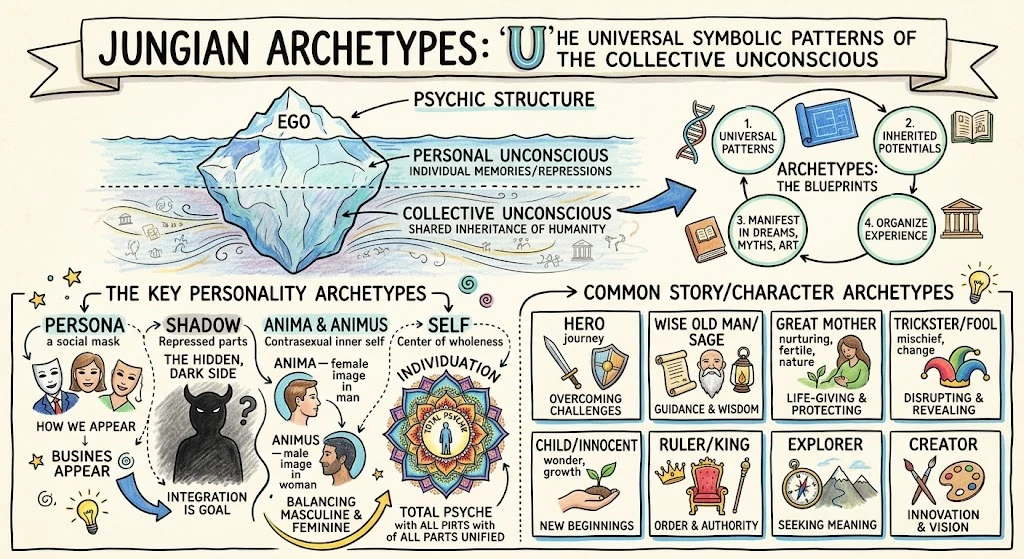
Carl Jung's 12 archetypes are shared patterns of personality and behaviour. He believed they come from a collective unconscious, a shared layer of mind found in all people. Two of the most influential are the Persona and the Shadow. The Persona is the social mask we show the world.
This sits within the wider fundamental theories of learning that shape modern classroom practice.
The Shadow is the hidden part of the self. It holds traits we often reject or hide. These ideas help explain why certain symbols and character types appear across myths, stories and everyday life. Once you spot these archetypes, patterns become clear.
Hattie (2009) says understanding the learner is key for good teaching. Link this understanding to learning theories in your practise. For more on this topic, see Sigmund freuds theories. Jung's archetypes can help you understand learner behaviour (Carl Jung).
Jung described introversion and extroversion. In UK classrooms, teachers often value extroverted learners more.
Teachers sometimes favour talk and see quietness as a negative trait. This can disadvantage introverted learners, and Coplan et al. (2011) found that teachers often underrate quiet learners' skills.
Jung (1921) described introversion as a valid way to direct attention. Yet schools often value spoken skills more than quiet thought. Teachers can help quieter learners succeed by noticing their strengths. Classrooms should respect introversion and avoid forced extraversion (Jung, 1921).
A 20-minute deep-dive episode on Jungian Archetypes: 12 Characters Every Teacher Should Know, voiced by Structural Learning. Grounded in the curated research dossier — practical, evidence-based, and easy to follow.
Jung saw introversion and extraversion as neutral ways of paying attention, not as levels of ability (Jung, 1921). Even so, classrooms can put quieter learners at a disadvantage when participation means speaking fast and often. Coplan et al. (2011) found that teachers had less positive expectations for shy or quiet children in classroom vignettes. Sedova and Sedlacek (2023) distinguish vocal and silent participation, so it is safer to count written preparation, listening, questioning and small-group talk as evidence of participation.
Remove this claim or correctly attribute it to the modern researcher (e.g., Insung Jung) rather than Carl Jung.
Carl Jung's archetypal theory is a useful model. It explores universal symbols and patterns within our shared unconscious. Use it as a starting point for professional discussion: identify the learner's current need, record evidence from more than one lesson, and agree the next classroom adjustment with the SENCO or family.
Archetypes are central to this idea. They act as universal symbols in our shared mind, and Jung (1969) said that these patterns shape our behaviour and imagery.
Jung (1969) saw archetypes as predispositions, not fixed forms. They guide how learners perceive and behave, as Samuels (1986) explained. Neumann (1954) believed these universal experience patterns are inherited.
Use universal stories in class. Talk about common themes in global fairy tales, myths, and legends. Explore recurring character types like heroes (Campbell, 1949), villains (Propp, 1968) or mentors (Jung, 1968).
The collective unconscious is a shared part of the mind. It holds universal human experiences, memories, and symbolic ideas. Use it as a starting point for professional discussion: identify the learner's current need, record evidence from more than one lesson, and agree the next classroom adjustment with the SENCO or family.
Learners can tap into these shared human experiences. Jung (1968) believed it holds memories and ideas from all cultures.
Jung (1921) distinguished this from the personal unconscious; it holds repressed memories. Jung (1921) placed archetypes in the collective unconscious. These archetypes subtly influence how learners think, feel, and act.
Brainstorming with learners uncovers feelings on key topics like "home". Mind maps on the board reveal shared ideas and universal experiences. This may highlight the collective unconscious (Jung, 1969; Neumann, 1954).
The familiar 12 archetypes are a later framework for teaching, branding and storytelling. They are not a list Jung set out as a classroom taxonomy. Jung's own map is often taught through four primary structures: Persona, Shadow, Anima/Animus and Self (Jung, 1921; Pearson, 1991). Because readers will see different lists on Wikipedia, Verywell Mind, PositivePsychology.com, Conor Neill, Psychologist World, The Oak Tree Practice, YouTube, Reddit and The Novel Factory, this article separates Jung's core concepts from later 12-archetype lists.
Pearson (1991) found twelve learner types, like the Innocent and Hero. The list features the Rebel, Lover, and Sage types. Each type shows strengths, weaknesses, and behaviours typical of learners.
Jung's (1969) archetypes fascinate learners; use film and literature to teach them. Pearson (1991) says learners can find archetypes in characters.
Archetypal patterns are repeated models of motivation. They shape personality and behaviour. Learners also see these roles in stories. Use it as a starting point for professional discussion: identify the learner's current need, record evidence from more than one lesson, and agree the next classroom adjustment with the SENCO or family.
Pearson (1991) found that caregivers support others. They often put other people first. These patterns help learners grasp why characters act.
Pearson (1991) found story heroes act bravely. Pearson (1991) noted caregivers help others with compassion. Pearson (1991) said explorers seek freedom. Rebels challenge rules for liberation (Pearson, 1991).
The Lover values relationships (Pearson, 1997), while the Creator focuses on making things (Jung, 1921). The Jester enjoys life (Pearson, 1991), and the Sage wants knowledge and truth (Pearson, 1991).
The Magician transforms through influence (Campbell, 1949; Pearson, 1991). The Ruler desires order and control (Pearson, 1991).
Learners analyse characters looking for patterns. They write and use text as proof (Jung, 1969; Frye, 1957). This work develops critical thought; it helps learners understand literature better.
The Shadow archetype is the repressed part of personality that contains rejected instincts, impulses and unwanted desires. It holds the darker elements we often reject. These include instincts and unwanted desires.
Jung (1959) described the Shadow as the part of personality that holds rejected or unacceptable self-aspects. Learners must integrate this to grow. Noticing it prevents projection, where you blame others for your own flaws.
Jung (1938) saw value in knowing our flaws. Help learners discuss and accept their imperfections. Gilbert (2009) and Neff (2011) link this to better self understanding.
How well do you understand the key concepts from this article? This interactive quiz covers the main ideas with detailed explanations for each answer.
Jungian archetypes are patterns that help teachers recognise what motivates learners. They can then adapt classroom tasks and support. Use it as a starting point for professional discussion: identify the learner's current need, record evidence from more than one lesson, and agree the next classroom adjustment with the SENCO or family.
For more on this topic, see Jungian psychology. Recognising archetypes in learners lets you tailor teaching.
The "Hero" archetype (Jung, 1919) likes challenges. A "Caregiver" learner (Jung, 1919) excels in group work.
Archetype theory supports inclusion and helps teachers connect with learners. Jung (1969) said teachers use them to improve topic understanding. Pearson (1991) showed archetypes build learner self-knowledge and understanding of others. Marzano (2003), cited by the EEF, stresses knowing learners.
For group tasks, assign roles based on archetypes. "Creators" brainstorm ideas, "Sages" research, and "Caregivers" support the group. This approach, according to lets each learner use their strengths, improving teamwork.
Teachers can use Jungian themes to design the curriculum. Archetypal ideas can also structure literary study, interpretation, and discussion. Use it as a starting point for professional discussion: identify the learner's current need, record evidence from more than one lesson, and agree the next classroom adjustment with the SENCO or family.
Teachers can explore archetypes with learners to analyse texts. Campbell (1949) found that this approach improves learning because it helps a learner understand deeper meanings and connections.
Archetypes, like the "Hero", help learners understand figures such as Nelson Mandela. Bloom (1998) found they give insights into Shakespeare too. Think "Lover" or "Rebel".
Jung (1969) suggested archetypes in literature can help learners. Learners can spot archetypes in characters. Campbell (1949) and Frye (1957) showed archetypes shape actions and relationships. This builds thinking skills and learner comprehension.
Critics question the evidence for Jungian archetypal theory and its claim to be universal. The collective unconscious is hard to test directly, so teachers should present it as psychoanalytic theory, not settled cognitive science. A stronger classroom link is schema theory: learners build organised knowledge patterns that guide attention, memory and interpretation. Retrieval practice has clearer direct evidence for long-term recall (Sweller, 1988; Karpicke, 2008).
Modern critics also warn teachers not to use archetypes to diagnose learners. Personality typing can create stereotypes and false certainty, especially when it is linked to MBTI-style labels (Pittenger, 1993; Grant, 2021). Use archetypes for texts, artefacts and narratives. Do not use them to predict ability, behaviour or pastoral need.
Discuss archetypal theory's critiques with learners. Ask them to assess this framework from different views. This builds critical thinking skills, so learners form informed opinions (Jung, 1969; Neumann, 1954).
Jung's ideas still matter most in English, Media and History. They help learners spot repeated story patterns in myths, novels, films, political speeches and AI-generated text. In 2026, this is a media literacy issue. Generative AI often repeats familiar Hero, Rebel, Sage and Caregiver plots because it has been trained on large stores of human writing, not because it understands identity or culture (Bender et al., 2021).
The classroom task is not to ask which archetype a learner is. It is to ask which patterns a text or model keeps repeating, whose experiences are missing, and how a writer could make the narrative less predictable. This links archetypes to cultural variation, narrative identity and critical literacy rather than to fixed learner profiles.
This slide deck summarises the key ideas from this article. Use it for CPD sessions, staff training, or as a quick revision aid.
References form the source list for this text. They document the works cited by the author. This supports the article's academic credibility. Riverhead Books.
Hattie (2009) looked at how well learners do. He studied many different research papers. His work is called Visible Learning. It gives teachers useful classroom ideas. These methods can boost results for every child. This improves their overall outcomes.
Jung (1968) explored archetypes and the collective unconscious. He argued that shared human experiences shape learner understanding. His book looks at these common experiences (Jung, 1968).
Jung, C. G. (1969). *Psychology and religion: West and East* (2nd ed.). Princeton University Press.
Pearson, C. S. (1991). *Awakening the heroes within: Twelve archetypes to help us find ourselves and transform our world*. HarperOne.
Samuels, A. (1993). *The political psyche*. Routledge.
Sigmund Freud (1923) and Carl Jung, though initially collaborators, developed distinct theories of the human psyche. Jung built upon Freud's foundational work on the unconscious mind but diverged significantly in his understanding of its nature and contents. Their differing perspectives offer unique lenses for interpreting human behaviour and motivation.
Freud posited a personal unconscious, a reservoir of repressed memories, desires, and conflicts, primarily driven by sexual and aggressive instincts (Freud, 1923). He believed early childhood experiences and psychosexual development shaped an individual's personality. In contrast, Jung expanded this concept to include a collective unconscious, a universal, inherited repository of archetypes and shared human experiences.
Jung's collective unconscious contains universal patterns of thought and behaviour, such as the Hero or the Mother, which manifest across cultures. He saw personality development, or individuation, as a lifelong process of integrating conscious and unconscious aspects of the self. Freud's structural model of personality, the Id, Ego, and Superego, focused on the conflict between primal urges, reality, and moral standards.
Consider a learner who consistently seeks attention through unconventional behaviour. A Freudian perspective might suggest unresolved conflicts or unmet needs from their home environment manifesting as a defence mechanism. A Jungian perspective might interpret this as the learner's Shadow aspects emerging, perhaps due to a rigid Persona they feel compelled to maintain, or an unconscious drive to express a "Trickster" archetype. The teacher could provide opportunities for controlled expression or self-reflection.
| Aspect | Sigmund Freud | Carl Jung |
|---|---|---|
| Unconscious Mind | Personal unconscious, repressed memories, sexual/aggressive drives. | Personal unconscious and collective unconscious (archetypes). |
| Personality Structure | Id, Ego, Superego. | Ego, Persona, Shadow, Anima/Animus, Self, archetypes. |
| Development Focus | Psychosexual stages, early childhood experiences. | Individuation, lifelong integration of self. |
The Persona archetype represents the social mask individuals wear, adapting their behaviour to meet societal expectations and group norms (Jung, 1921). It functions as a mediator between the individual's inner world and the external environment, allowing for social interaction and acceptance. This public self is not necessarily false, but it is a curated presentation of identity.
In a school setting, learners frequently adopt different personas to navigate various social and academic demands. A learner might present as highly motivated and compliant in a subject they enjoy, actively participating and seeking approval. Conversely, the same learner might adopt a disengaged or rebellious persona in a class where they feel less confident or understood.
Teachers can observe these shifting personas when a learner, for instance, is boisterous and outgoing during break time but becomes quiet and reserved when asked to present their work to the class. Recognising these behavioural shifts helps teachers understand the social pressures learners experience. Teachers can support learners by creating an inclusive environment where learners feel safe to express a broader range of their authentic selves, reducing the need for rigid self-presentation (Wiliam, 2011).
Carl Jung's theory of psychological types influenced the Myers-Briggs Type Indicator (MBTI), but that does not make MBTI a sound basis for grouping learners or planning staff CPD. Reviews and public critiques of the instrument warn about reliability, validity and labelling risks (Pittenger, 1993; Grant, 2021). Treat Jung's typology as historical background, not as a school assessment tool.
It is important to distinguish between Jung's archetypes and MBTI personality types. Archetypes are universal, inherited patterns of thought and behaviour, residing in the collective unconscious (Jung, 1921). MBTI types, conversely, describe conscious preferences for how individuals direct energy, gather information, make decisions, and orient themselves to the outer world.
| Concept | Nature | Focus |
|---|---|---|
| Jungian Archetypes | Universal, unconscious patterns | Shared human experience, myths |
| MBTI Types | Conscious individual preferences | Personal interaction with the world |
For school leaders, the distinction matters in CPD. An INSET day built around MBTI-style colours or matrices may be engaging, but it should not replace professional development focused on evidence-informed mechanisms such as goal setting, rehearsal, feedback and sustained follow-up (Education Endowment Foundation, 2021). In class, teachers can still offer quiet reflection before discussion without claiming that a learner belongs to a fixed type.
Jung identified four psychological functions that describe how individuals perceive and evaluate information. These functions operate in two pairs: Thinking and Feeling, which are rational functions, and Sensation and Intuition, which are irrational functions (Jung, 1921). Each person typically develops a dominant function, influencing their preferred way of engaging with the world.
The Thinking function involves logical, objective analysis, evaluating information based on truth or falsehood. Individuals preferring this function seek to understand the world through reason and principles. Conversely, the Feeling function assesses information based on personal values, relationships, and subjective judgments of good or bad.
Sensation is a perceptive function that focuses on concrete facts and immediate sensory experiences. It deals with what is real and present, gathering data directly from the environment. Intuition, however, perceives possibilities, underlying meanings, and future implications, often unconsciously. It looks beyond the obvious to grasp patterns and potentials.
Teachers can observe these functions in how learners approach tasks. For instance, when analysing a historical event, a learner with a dominant Thinking function might meticulously list causes and effects, focusing on logical consistency. Another learner, strong in Feeling, might discuss the moral implications of decisions made by historical figures, considering their impact on human relationships.
| Function | Primary Focus | Classroom Manifestation |
|---|---|---|
| Thinking | Logic, objective analysis | Analysing data, problem-solving with principles |
| Feeling | Values, relationships | Discussing moral dilemmas, evaluating character motives |
| Sensation | Concrete facts, present reality | Observing details, practical application of skills |
| Intuition | Possibilities, hidden meanings | Brainstorming ideas, seeing patterns in complex texts |
Individuation describes the lifelong psychological process of integrating conscious and unconscious aspects of the psyche to form a unique, unified self (Jung, 1968). It represents the innate drive towards psychological wholeness and self-realisation, moving beyond a fragmented sense of self.
A important step in individuation involves confronting and integrating the Shadow. Recognising and accepting traits often deemed undesirable, rather than repressing them, allows for greater self-awareness and authenticity. This process diminishes internal psychological conflict, building a more complete identity.
Consider a learner who consistently blames classmates for group project failures, avoiding personal responsibility. A teacher might guide a reflective journal activity where the learner explores their own contributions and feelings of inadequacy. This helps the learner acknowledge and integrate their "shadow" traits, such as fear of failure, leading to a more balanced self-perception and improved collaborative behaviour.
Teachers can support learners' individuation by cultivating classroom environments that encourage self-reflection and the acceptance of diverse personal traits. This approach helps learners develop a coherent sense of self, equipping them to navigate academic and social challenges with greater self-possession and purpose.
Carl Jung proposed the Anima and Animus as archetypal representations of the feminine and masculine principles within the individual psyche. These internal figures exist regardless of a person's biological sex. They influence behaviour, emotions, and perceptions, often unconsciously (Jung, 1968).
The Anima represents the unconscious feminine aspect in men. It influences a man's emotional life, capacity for relationships, and creative expression. For example, a male learner who typically avoids emotional topics might show unexpected empathy or artistic flair in a drama lesson, indicating an active Anima.
Conversely, the Animus embodies the unconscious masculine aspect in women. It shapes a woman's capacity for reasoning, assertiveness, and forming opinions. A female learner, usually quiet, might articulate a surprisingly strong and logical argument during a class debate, demonstrating the influence of her Animus.
Syzygy refers to the archetypal pairing of the Anima and Animus, symbolising psychological wholeness and integration. Achieving a balance between these internal principles leads to a more complete and harmonious personality. Teachers can observe learners expressing these integrated qualities through balanced self-expression and interaction.
| Archetype | Description | Influence |
|---|---|---|
| Anima | Unconscious feminine aspect in men | Emotions, relationships, creativity |
| Animus | Unconscious masculine aspect in women | Reasoning, assertiveness, opinions |
| Syzygy | Archetypal pairing of Anima and Animus | Psychological wholeness, integration |
Carl Jung described the Persona as the social mask an individual presents to the world. This outward-facing aspect of personality helps individuals navigate social interactions and fulfil societal expectations (Jung, 1968). It represents a compromise between one's true self and the demands of the external environment.
For many neurodivergent learners, this concept of a "Persona" takes on a more complex and often exhausting form known as masking or camouflaging. Neurodiversity is a spectrum of differences in attention, communication, sensory processing and self-regulation, not a Jungian personality type. Masking involves consciously or unconsciously suppressing natural behaviours and adopting neurotypical ones to fit in and avoid negative judgment (Livingstone & Russell, 2023).
The act of masking requires significant cognitive effort, diverting mental resources away from learning and processing academic content. Learners might appear attentive and compliant, yet internally they are expending immense energy maintaining their "mask" (Bottema-Beutel et al., 2021). This can lead to increased anxiety, burnout, and a sense of inauthenticity.
Teachers must develop a keen awareness of the subtle signs of masking, which can vary greatly among learners. A primary school child with autism might meticulously copy the play patterns of peers, even if they do not genuinely enjoy the activity, to avoid standing out during break time. This child might then experience emotional meltdowns at home due to the sustained effort of masking at school.
In a secondary classroom, an ADHD learner might suppress their urge to fidget or interrupt, appearing calm and focused. However, this suppression can lead to internal restlessness, reduced comprehension, and an inability to recall information later, as their cognitive load was directed towards self-regulation rather than learning (Barkley, 2015). Observing sudden shifts in energy or behaviour outside of structured tasks can offer clues.
Reducing the need for masking starts with an inclusive classroom culture. Teachers should model acceptance of different ways of thinking, communicating and behaving. Give learners ways to show understanding without public performance, while using evidence of learning rather than compliance as the guide (Hattie, 2009).
This involves offering flexible learning environments and varied participation methods. For instance, allowing learners to respond in writing, through drawing, or by using a graphic organiser instead of always requiring verbal contributions can support those who mask during spoken interactions. Regularly checking in with learners individually and creating safe spaces for them to share concerns can also help.
Teachers can also normalise neurodivergent traits by discussing different learning styles and communication preferences openly. When a teacher acknowledges that some learners might need to move to focus or prefer quiet work, it validates these needs and reduces the pressure to mask. This approach helps learners feel seen and understood, building an environment where their authentic selves can thrive.
Teachers frequently encounter learner behaviours that elicit strong emotional responses, sometimes feeling disproportionate to the actual incident. Carl Jung's concept of the "Shadow" provides a valuable framework for understanding these intense, often unconscious, reactions. This perspective shifts the focus from solely "fixing" the learner to encouraging deeper self-reflection in the teacher.
The Shadow encompasses the repressed or unacknowledged aspects of a teacher's personality, including undesirable traits, impulses, and past experiences. When a learner's actions inadvertently mirror one of these hidden facets, it can trigger a powerful, unconscious reaction. Recognising this dynamic allows teachers to develop more considered and less reactive responses in their behaviour management.
The Shadow can manifest when a teacher's personal insecurities are activated by learner behaviour. For instance, a teacher who struggles with their own feelings of inadequacy might react with excessive anger towards a Year 7 learner who appears to deliberately challenge their instructions. This disproportionate response often stems less from the learner's defiance and more from the teacher's internal struggle with authority or control.
Consider a secondary school teacher who values meticulous organisation and feels intense frustration with a Year 10 learner's consistently messy desk and lost homework. This reaction could be rooted in the teacher's own repressed desire for less rigidity in their life, or perhaps a past experience where disorganisation led to significant personal negative consequences. Wiliam (2011) highlights the critical importance of teachers understanding their own impact on learning, which inherently includes their emotional responses and biases in the classroom.
Integrating the Shadow involves acknowledging and understanding these hidden parts of oneself, rather than acting on every impulse. Teachers can cultivate self-awareness through regular reflective practices, such as journaling about challenging classroom interactions. Asking "Why did that specific behaviour trigger such a strong reaction in me?" helps to uncover underlying personal triggers and patterns.
Seeking constructive, confidential feedback from trusted colleagues or mentors can also illuminate a teacher's blind spots. An external observer might notice a consistent overreaction to particular learner behaviours, offering a valuable alternative perspective. This process enables teachers to develop greater emotional regulation, building more thoughtful and measured responses to learner challenges, rather than impulsive ones.
This Jungian perspective reframes behaviour management from a purely external, punitive model to one that integrates profound internal self-awareness. When teachers understand their own Shadow, they can respond to learner behaviour with increased empathy, objectivity, and consistency. This leads to more equitable and effective classroom management strategies.
Instead of simply labelling a learner as "unconventional" or "difficult," a teacher can reflect on what aspect of the learner's behaviour is activating their own internal conflict or unresolved issues. This deeper understanding builds a more supportive and growth-oriented learning environment for all. Hattie (2009) consistently demonstrates the significant positive impact of strong teacher-learner relationships on learning outcomes, relationships that are undoubtedly strengthened by a teacher's self-awareness and emotional intelligence.
Jung's archetypes, such as the Persona and the Shadow, are abstract psychological constructs. Explaining these concepts to Key Stage 2 and 3 learners presents a significant pedagogical challenge. Kinesthetic learning provides a powerful approach to bridge this gap, allowing learners to physically engage with complex ideas (Bruner, 1966).
By transforming abstract archetypal roles into tangible, manipulable elements, teachers can guide deeper understanding. This approach moves beyond passive listening, requiring learners to actively construct meaning through physical interaction. Such active engagement supports memory retention and conceptual grasp, while retrieval practice has stronger direct evidence for durable recall (Karpicke, 2008; Dunlosky et al., 2013).
For KS2 English learners, teachers can introduce the Persona and Shadow using physical representations. Provide learners with two distinct coloured cards or small blocks, one representing the 'Persona' (the face shown to the world) and the other the 'Shadow' (hidden traits). Learners then select character traits written on smaller slips of paper, deciding which block each trait belongs to for a given story character.
For example, when analysing a character like the Big Bad Wolf, learners might place "cunning" and "charming" with the Persona block, and "greedy" and "fearful" with the Shadow block. This physical sorting activity helps learners visualise the duality within a character and understand how different traits form these archetypal aspects. Teachers can prompt discussions by asking, "Why did you put 'charming' with the Persona for the wolf?" or "What does the wolf hide in its Shadow?"
In KS3 English, teachers can extend this kinesthetic approach to narrative construction and character development. Provide learners with a set of generic character archetypes (e.g., Hero, Mentor, Trickster, Shadow Figure) represented by small figurines or labelled cards. Learners physically arrange these archetypes on a story map or a large sheet of paper to plan a narrative arc.
Learners might place the 'Hero' at the start, then introduce the 'Mentor' figure, followed by an encounter with the 'Shadow Figure'. As they move the pieces, they articulate how each archetype influences the plot and the protagonist's internal journey. This physical manipulation helps learners grasp the structural roles archetypes play in storytelling, making the abstract concept of a 'collective unconscious' manifest in their creative work (Vygotsky, 1978).
Understanding Carl Jung's archetypes offers insights into fundamental human motivations and cognitive predispositions. This understanding can inform the design of learning experiences, moving beyond simplistic categorisation of learners. Archetypes represent deep-seated patterns that influence how individuals perceive information and approach tasks.
Teachers can use this knowledge to anticipate varied responses to learning activities and to design instruction that broadens learners' cognitive repertoires. The aim is to support all learners in engaging with essential thinking processes, regardless of their dominant archetypal leanings.
A common misconception is to profile learners by perceived archetypes, such as assigning "Creators" to brainstorming tasks or "Rulers" to leadership roles. This has the same practical risk as personality typing: it can narrow expectations and reduce access to unfamiliar challenges (Pittenger, 1993). Effective teaching expands learners' capabilities rather than reinforcing existing preferences (Wiliam, 2011).
Instead, teachers should design flexible learning environments and employ a range of thinking routines and graphic organisers. These tools can encourage learners to engage with different modes of thought, helping them develop a more versatile intellectual toolkit. This approach acknowledges individual differences while promoting growth across all cognitive domains.
Teachers can select or adapt generic thinking routines and graphic organisers by considering how archetypal motivations might influence engagement. For instance, a learner with a strong "Explorer" predisposition might thrive with inquiry-based concept maps, while a "Sage" might prefer structured analytical frameworks. The goal is to provide scaffolding that supports all learners in accessing complex thinking.
By offering varied entry points and processing methods, teachers can help learners develop metacognitive awareness of their own learning styles. This allows learners to consciously choose strategies that best suit a given task, rather than defaulting to habitual approaches (Dunlosky et al., 2013).
In a Year 5 English lesson, learners are analysing characters in a novel. The teacher introduces a character analysis graphic organiser, structured to explore motivations, actions, and consequences. This tool helps learners systematically break down complex characters.
A learner with a strong "Innocent" archetype might initially focus on surface-level goodness, while a "Rebel" might be drawn to challenging character flaws. The graphic organiser prompts all learners to consider deeper psychological aspects, such as a character's hidden fears or aspirations, encouraging a more careful understanding of narrative roles.
For a Year 10 Physics lesson on forces, learners are tasked with designing an experiment to measure friction. The teacher provides a structured problem-solving frame, guiding them through hypothesis formation, experimental design, data collection, and analysis. This frame ensures a systematic approach to scientific inquiry.
A learner with a "Magician" archetype might intuitively seek creative solutions, while a "Caregiver" might prioritise safety and precision in their design. The problem-solving frame ensures all learners address critical scientific steps, such as identifying variables and controlling for bias, building rigorous experimental thinking.
Individuation and personal growth involve mixing different parts of the self. This creates a fuller identity. The person stops hiding behind a Persona. They stop pushing difficult feelings into the Shadow. Instead, they learn to recognise these parts. They bring them into better balance. This idea matters greatly for teachers. School is not only about academic results. It is also a place where learners shape their identity, confidence and behaviour.
In the classroom, individuation can be understood as growth in self-awareness. A learner who always appears confident may be masking anxiety, while a quiet learner may have a rich inner life that is easy to miss. Jung's theory reminds us not to reduce children to one visible trait. It also fits well with research on metacognition and self-regulation, which shows that learners make better decisions when they can notice and reflect on their thinking, emotions and habits.
One practical strategy is structured reflection. After a group task, ask learners to write briefly about the version of themselves they showed to others, and what they were thinking but did not say. A second approach is to use literature and drama to explore character motives, asking questions such as, Which part of this character is public, and which part is hidden? This gives learners a safer way to discuss inner conflict before applying the idea to their own learning.
Teachers can also support individuation by normalising complexity. When giving feedback, avoid fixed labels like lazy, unconventional, or shy. Focus instead on patterns that can change. These patterns change with support and practice. Showing your own reflective language helps too. For example, say you felt frustrated in a lesson. Then say you paused and reset. Used carefully, individuation offers a helpful frame for personal growth. It helps learners build insight and emotional honesty. It also builds a stronger sense of self.
The core four are Jung's main mental patterns. They explain identity, inner conflict and psychological wholeness. In Jungian theory, these help explain how people manage growth. For teachers, this has practical value. Learners often show one version of themselves in public. Underneath, they may carry very different feelings.
The Persona is the social face a learner shows. It helps them meet classroom expectations. They might act as the hard-working learner, the joker or the quiet observer. The Shadow holds traits a learner rejects or hides. These include anger, envy or insecurity. It can even hold confidence they do not yet trust. A useful strategy is to separate behaviour from identity. Say "that choice was unhelpful" instead of "you are difficult". This matters because teacher expectations shape participation and self-concept. Hattie's work echoes this point.
Jung used the words Anima and Animus to describe inner qualities that balance conscious identity. The terms reflect older gender assumptions, so teachers should use them with care and avoid presenting masculinity or femininity as fixed traits.
In the classroom, the useful point is broader: do not reward only talk, speed or toughness. Make room for empathy, reflection, imagination and sensitivity through paired talk, reflective journals and more than one way to show understanding.
For Jung, the Self is the organising centre. It holds these tensions together. It moves a person towards greater integration. In school, this means helping learners connect their traits. They connect strengths, weaknesses, feelings, and goals. This is better than performing a single label all day. Teachers can use brief check-ins or literature discussions. They can discuss character motives with the class. Low-stakes self-reflection tasks also help learners. Learners notice their public mask and their hidden responses. Used carefully, the Core Four gives teachers a useful language.
Shadow work is the disciplined practice of recognising disowned traits and understanding how they shape thoughts, relationships and behaviour. In schools, shadow work is not therapy in the classroom, it is a form of disciplined reflection that helps teachers and learners notice what gets pushed out of awareness. Jung argued that these rejected traits often return through projection, when we spot in others what we struggle to accept in ourselves.
For teachers, this matters most in moments of strong reaction. If a learner seems lazy, rude or attention-seeking, it is worth pausing to ask, what exactly is being triggered here, and why? Schön's idea of the reflective practitioner is useful, because it turns difficult classroom moments into professional learning. A short routine can help: note the trigger, name the feeling, then choose a response based on evidence rather than impulse.
One useful idea is a private reflection log. Use this after a hard lesson. Teachers can note down a learner's behaviour. Record your first thought. Then, write a calmer second view. This often uncovers our own hidden beliefs. We might hold assumptions about compliance, confidence or ability. Another approach uses books, myths or history. These help to discuss shadow traits safely. Ask learners where characters hide fear, pride or resentment. This keeps the chat thoughtful and right for their age.
Integration does not mean removing the Shadow. It means recognising it so it causes less harm. In practice, this might involve restorative questions after conflict. It might mean teaching learners to separate feeling from action. You could also create quiet ways to take part. This stops introverted learners being seen as switched off. Teachers can become more aware of their own blind spots. When they do, classroom relationships become fairer, calmer, and more humane.
Persona and neurodivergent masking are different concepts. A persona is a social role. Masking means hiding differences to meet expectations. A persona helps a person fit into a group. A neurodiversity lens helps us see this difference. Classrooms often rely on neurotypical rules. Here, some neurodivergent learners mask or camouflage themselves. They hide confusion, sensory overload, or stimming. They also hide impulsive acts or social doubts. This makes them look fine to adults.
This matters because outward behaviour can mislead teachers. A learner might make eye contact and sit still. They might also copy peer responses. Teachers may praise them for maturity. However, this learner might carry a heavy cognitive load. This leaves little capacity for listening, planning, or writing. In a Year 8 English lesson, a teacher might praise a learner. The teacher says they are joining in well. But the learner’s page contains only two thin notes. Most of their effort went into performance, not thinking.
The cost is not minor. A study looked at autistic learners in mainstream secondary schools. These schools were in the UK and Ireland. Camouflaging is associated with the link between lower school belonging and higher anxiety. Over time, that strain can feed neurodivergent burnout. Autistic burnout research shows this clearly. It appears as exhaustion and reduced functioning. It also lowers tolerance for everyday demands (Raymaker et al., 2020).
For teachers, the practical point is simple: good SEND provision should reduce the need to mask, not reward it. The SEND Code of Practice asks schools to identify need and remove barriers through suitable support, not train learners into better compliance (Department for Education and Department of Health and Social Care, 2015).
Inclusive pedagogy means offering response choices, predictable routines, sensory adjustments and private check-ins. Try: "You can answer aloud, show me your notes, or type it." Next lesson, watch for learners who appear compliant but produce little, and treat that gap as information rather than defiance.
Free for teachers. The platform builds a classroom-ready lesson plan from your topic in under two minutes.
Create Free Account →
Downloadable Structural Learning presentation on Jungian Archetypes: 12 Characters Every Teacher Should Know. Use it to learn the topic at your own pace, or to revisit the key evidence whenever you need a refresh.
Download Slides (.pptx)PowerPoint format. Compatible with Google Slides and LibreOffice.
Teachers can use archetypes as starting points for character design, motivation and conflict. Ask learners to build a character who shows one dominant pattern, then add contradictions so the writing feels realistic rather than stereotyped. This works well for story openings, drama tasks and descriptive writing.
Keep the focus on fiction, myths or historical figures before asking learners to reflect on themselves. Present the Shadow as the parts of people they may hide, ignore or find difficult, rather than something bad or dangerous. Use clear boundaries, avoid forced personal disclosure and offer reflective writing instead of public sharing.
Yes, archetypes can give learners a simple lens for comparing characters, leaders and viewpoints across texts and topics. A teacher might ask who acts as a mentor, rebel or caregiver and what that role adds to the group. This often leads to more focused discussion because learners have a shared vocabulary for analysing behaviour and motivation.
No, archetypes work best as a reflective tool, not a fixed label. If teachers treat them too literally, learners can feel boxed in and expectations may narrow. It is better to use archetypes to explore patterns in stories, choices and classroom behaviour while reminding learners that people change across situations.
Persona helps teachers discuss a key difference. It separates how someone looks in class from how they feel. This is useful in tutor time and pastoral work. It also helps build relationships. It prompts curiosity rather than quick judgement. Teachers can show this by checking in privately. They can speak with learners whose confident or good behaviour hides stress.
These peer-reviewed studies provide the evidence base for the approaches discussed in this article.
How Jung's concept of the wounded healer can guide learning and teaching in social work and human services 29 citations
M. Newcomb et al. (2015)
Newcomb et al. (2015) explored how Jung's wounded-healer idea can guide learning and teaching: when teachers draw thoughtfully on their own experience of difficulty, they may better empathise with learners facing similar challenges.
Jung's Psychology and Deleuze's Philosophy. This study looks at the unconscious in learning. View the study online. It has 23 citations.
Inna Semetsky & joshua delpech-ramey (2012)
Jung's work impacts learning. Teachers understand how unconscious processes affect learners. This knowledge helps teaching, addressing hidden barriers.
Theory grounded. Classroom workable. Free for teachers.