Blank Level Questions: The Complete Teacher's Guide toBlank Level Questions: The Complete Teacher's Guide to Developing Children's Language Skills - educational concept illustration

Updated on  

March 7, 2026

Blank Level Questions: The Complete Teacher's Guide to

|

January 16, 2026

Learn how to use Blank Level Questions to scaffold language development. Complete guide with 50+ examples for classroom use across all subjects.

Course Enquiry
Copy citation

Main, P. (2026, January 20). Blank Level Questions: The Complete Teacher's Guide to Developing Children's Language Skills. Retrieved from https://www.structural-learning.com/post/blank-level-questions-complete-teachers

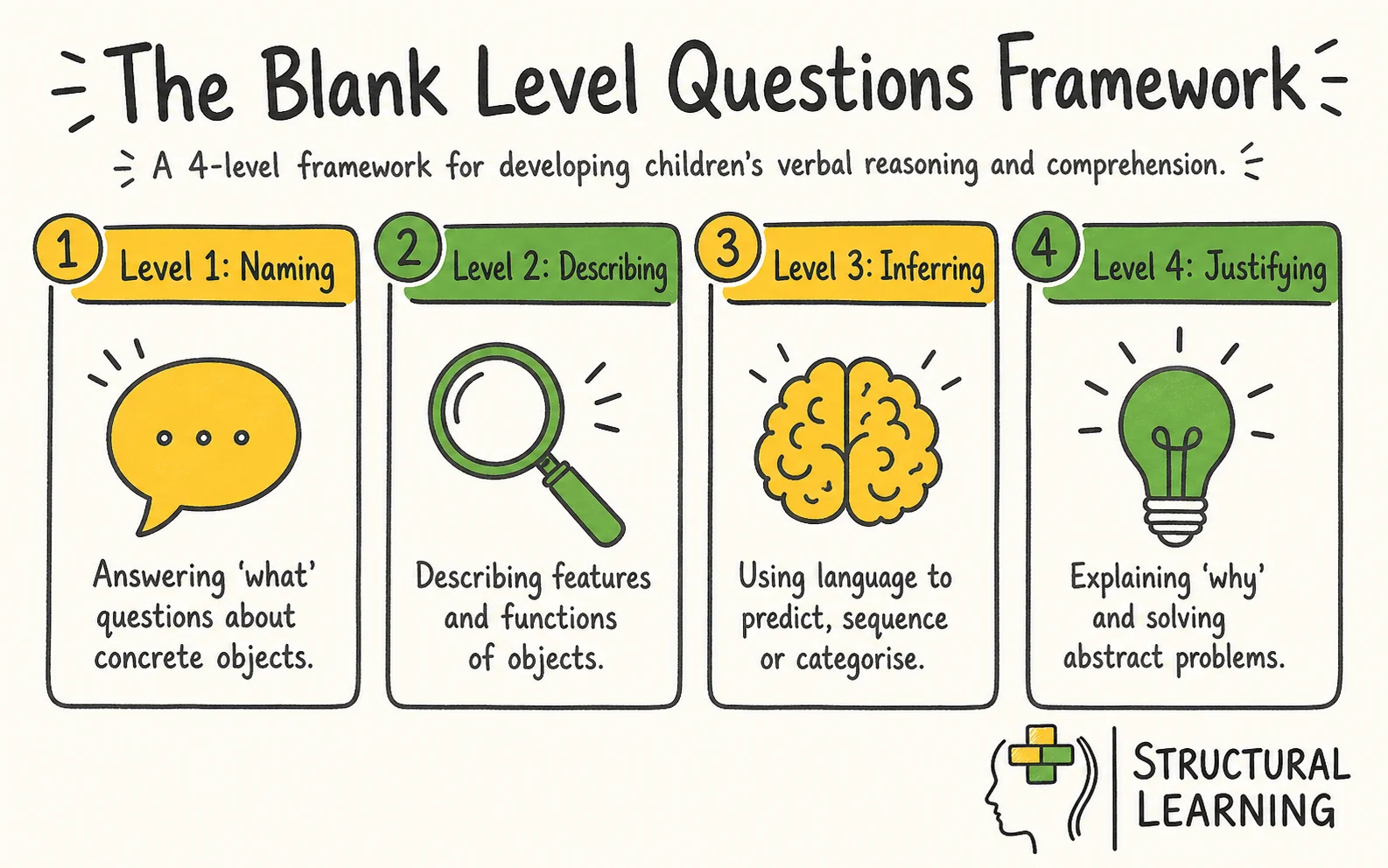
Blank Level Questions are a structured framework for developing children's verbal reasoning and language comprehension through progressively challenging questions. Created by speech and language therapists Marion Blank, Susan Rose, and Laura Berlin in 1978, this approach helps teachers pitch questions at the right level for each child's understanding.

Key Takeaways

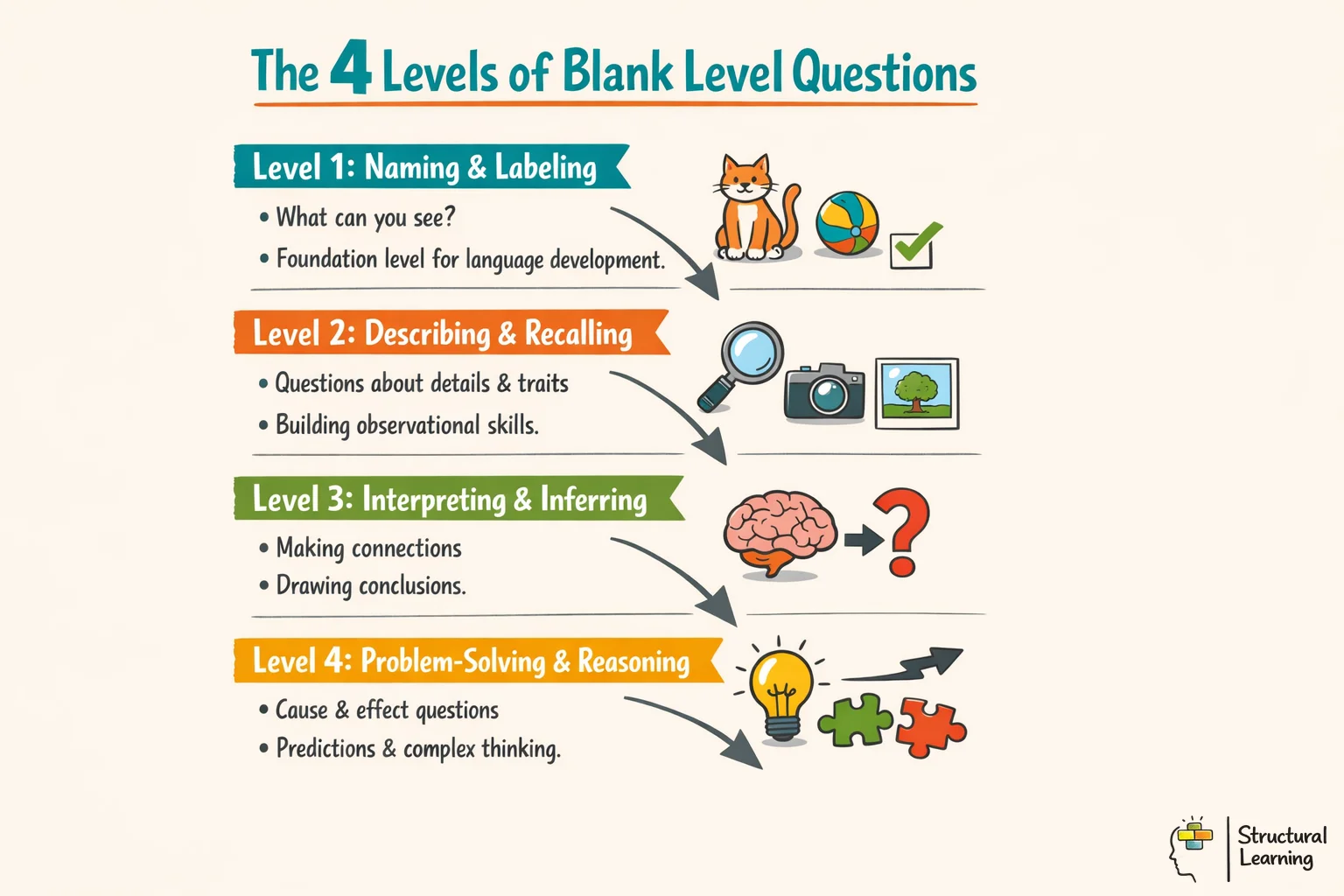
  1. The Four-Level Framework: Blank Level Questions progress from concrete naming (Level 1) to abstract problem-solving (Level 4), allowing teachers to scaffold questioning for children at different developmental stages
  2. The 4:1 Comment Rule: For every question you ask, make four comments first. This models language without pressuring children and dramatically improves their responses
  3. Behaviour Management Application: When a child cannot answer "Why did you do that?", they may genuinely struggle with Level 4 reasoning rather than being defiant. Drop to Level 1-2 questions during dysregulation
  4. Curriculum-Wide Application: Blank Levels work across all subjects from maths and science to literacy and history, providing a consistent questioning framework throughout the school day

The Blank Level Questions Framework: From Concrete to Abstract infographic for teachers
The Blank Level Questions Framework: From Concrete to Abstract

Common Misconceptions About Blank Level Questions

Despite their widespread use in speech and language therapy, Blank Level Questions often face implementation challenges in mainstream classrooms due to persistent misconceptions. The most damaging myth is that children who cannot answer higher-level questions are being deliberately uncooperative or lack intelligence. In reality, abstract reasoning develops at different rates, and a child struggling with Level 4 questions about cause and effect may excel at Level 2 descriptive tasks. This misunderstanding can lead to inappropriate behaviour management strategies, particularly when teachers interpret a child's inability to explain their actions as defiance rather than a genuine language processing difficulty.

Four-stage progression of Blank Level Questions from concrete naming to abstract reasoning for teachers
The 4 Levels of Blank Level Questions

Another common misconception involves rushing through the levels too quickly. Teachers often assume that once a child masters Level 1 naming questions, they should immediately progress to Level 2. However, research on developing quality learning environments emphasises the importance of consolidation at each level (Shaheen & Ibrahim, 2024). Children need extensive practise within each level before moving up, particularly when English is an additional languageor when processing difficulties are present. The framework is not a race to Level 4, but rather a tool for matching questions to each child's current capabilities whilst gradually stretching their abilities.

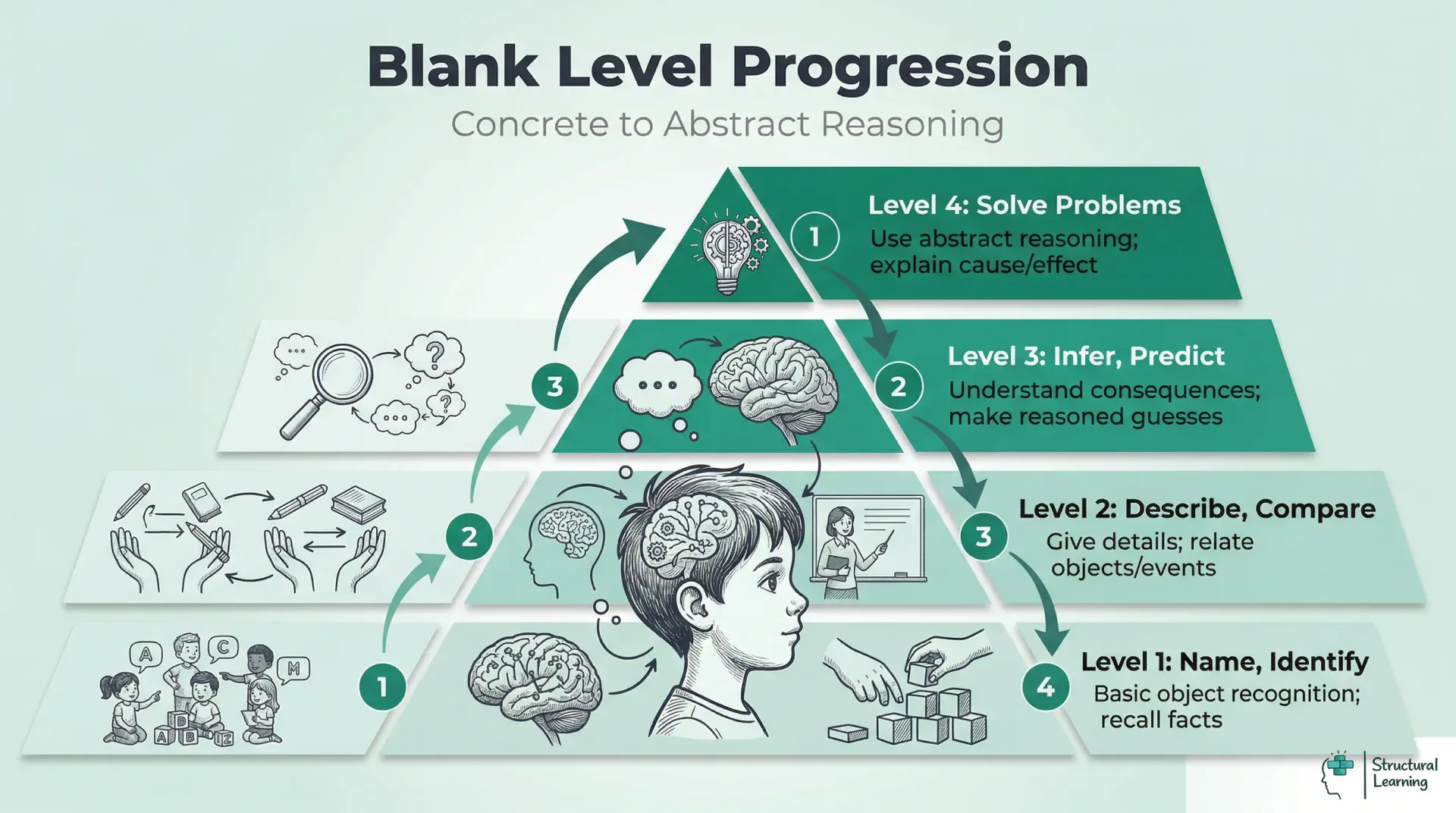
Infographic showing the four Blank Level Questions as a pyramid, progressing from Level 1 (Name, Identify) at the base to Level 4 (Solve Problems) at the apex, illustrating increasing abstract reasoning.
Blank Level Progression

Solving Common Implementation Challenges

When children consistently struggle with questions at their expected level, the solution lies not in simplification but in strategic scaffolding. Start by embedding visual supportseven for typically verbal activities. For instance, when asking Level 3 inference questions during story time, provide picture cards showing emotions or consequences. This bridge between concrete and abstract thinking helps children process the question whilst developing the language to express their understanding. Additionally, consider the cognitive load of your classroom environment. Too much visual or auditory stimulation can overwhelm children's processing capacity, making even simple questions difficult to answer.

The most effective solution for widespread implementation challenges involves whole-school trainingand consistency. When teaching assistants, lunchtime supervisors, and specialist teachers all understand the Blank Levels framework, children receive consistent language support throughout their day. This unified approach particularly benefits children from disadvantaged backgrounds who may lack language-rich experiences outside school. Schools reporting the highest success rates designate specific times for practising questions at each level, such as using Level 1 and 2 questions during morning registration when children may still be settling, then progressing to Level 3 and 4 questions during focused learning time when cognitive resources are optimal. Remember that effective questioning is not about getting the right answer immediately, but about developing children's capacity to think and communicate at increasingly sophisticated levels.

Documenting Research with Blank Levels Framework

Either remove this citation entirely or find relevant research about documentation systems in educational/speech therapy contexts demonstrated how registries can overcome "single institution, small sample-sized studies" by aggregating data across multiple settings, a principle equally applicable to tracking Blank Levels implementation across classrooms.

A Blank Levels registry functions as a living document where teachers record successful questioning sequences, student response patterns, and progression through the levels. For instance, when a Year 2 teacher notices that adding visual supports helps a child move from Level 2 to Level 3 questions in science, this observation becomes part of the collective knowledge base. Similarly, when a reception teacher documents that certain children respond better to Level 1 questions paired with movement activities, this insight benefits colleagues working with similar learner profiles.

Creating Your School's Blank Levels Database

Start with a simple shared spreadsheet containing columns for: student age/year group, subject area, initial Blank Level, intervention used, and outcome. Include a notes section for context, such as "Child recently arrived with EAL" or "Diagnosed dyslexia." Over time, patterns emerge that inform whole-school practise. You might discover that children with speech and language needs typically require six weeks of consistent Level 2 questioning before attem pting Level 3, whilst gifted learners might skip Level 2 entirely in their areas of strength.

The registry approach also supports evidence-based conversations with parents and external professionals. When a SALT visits, you can show documented progression through Blank Levels, providing concrete evidence of progress beyond anecdotal observations. By treating Blank Levels implementation as an ongoing action research project, your school builds a culture of continuous improvement, benefitting both current and future pupils.

Blank Level Questions In Practice: Example Scenarios

Maths Lesson (Year 1): Introducing Shapes
Level 1: "What is this shape called?" (pointing to a square)

Level 2: "What colour is the circle?"

Level 3: "Which of these shapes has four sides?" (presenting a square, triangle, and circle)

Level 4: "Why is it important to know about shapes?"

Literacy (Reception): Reading a Story About a Dog

Level 1: "Who is this?" (pointing to the dog in the picture)

Level 2: "What is the dog doing?"

Level 3: "How do you think the dog is feeling?"

Level 4: "Why do you think the dog is happy?"

Science (Year 5): Learning About Plants

Level 1: "What is this part of the plant called?" (pointing to a leaf)

Level 2: "What colour is the stem?"
Level 3: "What does the plant need to grow?"

Level 4: "Why are plants important for the environment?"

In mathematics lessons, this questioning framework proves equally valuable for developing reasoning skills. When exploring fractions with Year 4 pupils, Level 1 questions might ask: "What is three-quarters of 12?" requiring direct calculation. Level 2 questions could probe: "Why is three-quarters larger than two-thirds?" encouraging children to compare and explain mathematical relationships using visual or numerical reasoning.

Science lessons offer rich opportunities for implementing all four levels systematically. During a Year 5 investigation into plant growth, Level 1 questions establish factual knowledge: "Which plants grew tallest?" Level 2 develops analytical thinking: "What patterns do you notice in our results?" Level 3 encourages hypothesis formation: "What might happen if we changed the amount of water?" whilst Level 4 connects to broader understanding: "How could farmers use this information?"

The key to successful implementation lies in recognising that children often need scaffolding to progress between levels. Starting lessons with Level 1 questions builds confidence and establishes shared understanding before advancing to more complex thinking. This graduated approach ensures all learners can participate meaningfully whilst being appropriately challenged within their zone of proximal development.

Understanding the Blank Level Questions Framework

The Blank Level Questions Framework, developed by Marion Blank in the 1970s, provides educators with a systematic approach to understanding and developing children's language comprehension skills. This four-level hierarchy moves progressively from concrete, observable information to abstract reasoning and prediction, offering teachers a structured method for assessing where children are in their language development journey and how to support their progression to more sophisticated thinking patterns.

At its core, the framework recognises that children's ability to process and respond to questions follows a predictable developmental sequence. Level 1 questions focus on naming and identifying what is directly observable, whilst Level 4 questions require complex reasoning and justification about abstract concepts. This progression aligns with cognitive development research, as children naturally develop from concrete to abstract thinking capabilities over time.

Understanding this framework transforms classroom practice by enabling teachers to match their questioning to each child's current comprehension level whilst systematically introducing slightly more challenging question types. Rather than randomly asking questions of varying difficulty, educators can use Blank's levels to create targeted learning experiences that build language skills progressively, ensuring every child can access curriculum content at an appropriate cognitive level.

The Four Levels of Questioning: A Detailed Breakdown

The four-level questioning framework provides a systematic progression from concrete understanding to abstract thinking, enabling educators to scaffold children's language development effectively. Literal questions form the foundation, requiring children to recall explicit information directly stated in texts or discussions. Simple inference questions encourage pupils to make straightforward connections using obvious contextual clues, whilst complex inference questions demand deeper analytical thinking, requiring children to synthesise multiple pieces of information and draw sophisticated conclusions.

The fourth level, own knowledge questions, represents the pinnacle of this framework, inviting children to connect new learning with their personal experiences and existing understanding. This progression aligns with Bloom's taxonomy, moving systematically from knowledge recall through comprehension and analysis to evaluation and synthesis. Research by Pearson and Johnson demonstrates that explicit teaching of these question types significantly improves children's comprehension abilities across all curriculum areas.
In classroom practice, effective implementation requires teachers to model each question type explicitly before expecting independent responses. Begin sessions with literal questions to build confidence, then gradually introduce more complex levels as children demonstrate readiness. This scaffolded approach ensures that all pupils can access learning whilst being appropriately challenged to develop their inferential reasoning skills progressively.

Adapting Blank Level Questions Across Key Stages

Successful implementation of Blank Level Questions requires careful consideration of children's developmental stages and cognitive capacity. Marion Blank's original framework provides a foundation, but effective classroom practice demands thoughtful adaptation for different age groups. Early Years practitioners should focus predominantly on Level 1 and 2 questions, using concrete objects and immediate experiences to build foundational comprehension skills. As Vygotsky's zone of proximal development suggests, children learn best when challenged just beyond their current ability level.

Primary school teachers can gradually introduce more complex questioning patterns, with Key Stage 1 pupils benefiting from a structured progression through Levels 1-3, whilst Key Stage 2 children can regularly engage with Level 4 inferential and reasoning questions. The key lies in scaffolding - providing visual supports, thinking time, and collaborative opportunities that enable children to access higher-level thinking without overwhelming their working memory.

Secondary educators should use Blank Level Questions strategically to support pupils with language difficulties whilst maintaining age-appropriate content. Consider embedding Level 1-2 questions as stepping stones towards more sophisticated analysis, particularly for pupils with special educational needs. This layered approach ensures inclusive classroom practice whilst developing the critical thinking skills essential for academic success across all curriculum areas.

Assessing Progress: Tracking Children's Development Through the Levels

Effective assessment of children's progress through questioning levels requires systematic observation and documentation of their responses across different cognitive demands. Teachers should establish baseline assessments by presenting questions at various levels and noting where children demonstrate confidence versus hesitation or confusion. Regular monitoring sessions, conducted weekly or fortnightly, provide valuable insights into individual development patterns and highlight when children are ready to progress to more complex questioning frameworks.

Assessment should focus on both accuracy and the quality of children's reasoning processes rather than simply correct answers. Vygotsky's zone of proximal development theory supports this approach, suggesting that teachers observe not only what children can achieve independently but also their potential with guided support. Document instances where children successfully tackle higher-level questions with scaffolding, as this indicates readiness for advancement. Additionally, note recurring patterns in misconceptions or areas where children consistently struggle, as these reveal specific learning needs requiring targeted intervention.

Practical tracking methods include maintaining simple progress charts that map each child's comfort level across different question types, alongside brief observational notes about their thinking strategies. Peer assessment opportunities also provide valuable insights, as children often demonstrate advanced understanding when explaining concepts to classmates, revealing capabilities that may not emerge during formal questioning sessions.

Supporting Children with SEND: Inclusive Approaches to Blank Level Questions

Children with special educational needs and disabilities (SEND) benefit enormously from structured questioning frameworks, though adaptations are essential to ensure accessibility and success. The hierarchical nature of Blank Level Questions provides a valuable scaffold for children with communication difficulties, autism spectrum conditions, or learning disabilities, as it allows practitioners to identify precise entry points and build systematically from there. Visual supports, extended processing time, and simplified vocabulary can transform these questions into powerful tools for inclusive language development.

For children with autism or attention difficulties, incorporating special interests and familiar contexts into Blank Level Questions significantly enhances engagement and comprehension. A child fascinated by trains might explore Level 2 questions through "What do you need to drive a train?" rather than abstract scenarios. Similarly, children with working memory challenges benefit from chunking complex Level 4 questions into smaller components, a llowing processing time between elements whilst maintaining the cognitive demand of higher-order thinking.

Successful implementation requires careful observation of individual responses and flexible pacing. Some children may need multiple exposures to Level 1 questions before progressing, whilst others might access Level 3 thinking but struggle with verbal expression. Alternative response methods such as pointing, drawing, or using communication aids ensure that language comprehension can be accurately assessed and developed, regardless of expressive limitations.

How Can Teachers Create Effective Blank Level Question Banks for Their Classroom?

Creating a comprehensive question bank organised by Blank Levels transforms classroom questioning from reactive to strategic, ensuring every child receives appropriately pitched language input throughout the school day. Many teachers struggle to generate varied questions spontaneously whilst managing behaviour, delivering content, and monitoring progress. A well-structured question bank eliminates this cognitive load by providing ready-made questions for each level, allowing teachers to focus on observing children's responses and adjusting their approach accordingly. The most effective banks include subject-specific questions alongside general conversation starters, ensuring smooth integration across the curriculum rather than treating language development as a separate intervention.

Successful question banks follow a predictable structure that mirrors children's cognitive development. For Level 1 questions in a Year 2 science lesson on plants, teachers might include: "What colour is the leaf?", "Show me the roots", and "Where is the stem?" Moving to Level 2, the same lesson could feature: "What happens when plants don't get water?", "Tell me about the petals", and "How are these two flowers different?" Level 3 questions require inferential thinking: "Why do you think the plant by the window grew taller?", whilst Level 4 demands abstract reasoning: "What would happen if all plants disappeared?" Teachers report that having 10-15 questions per level for each topic area provides sufficient variety whilst remaining manageable to implement.

Research by Parsons and Branagan (2016) demonstrated that teachers using structured question banks showed a 40% increase in the variety of questions asked during lessons, with particular improvements in their use of Level 2 and 3 questions. Their study of 127 primary teachers across Manchester schools found that those with prepared questions were more likely to wait for children's responses and less likely to default to Level 1 questions when pressed for time. Additionally, the consistent use of question banks helped teachers identify patterns in children's comprehension difficulties, leading to earlier referrals for speech and language assessment where needed.

Building an effective question bank requires initial investment but pays dividends throughout the academic year. Teachers should begin by selecting five core topics per term and developing questions collaboratively during planning sessions. Many schools find success in creating shared digital resources where staff contribute questions that have worked well, annotating them with notes about which children responded successfully and which needed additional scaffolding. The key is starting small - even having prepared questions for story time and one curriculum area creates noticeable improvements in classroom dialogue. As confidence grows, teachers naturally expand their banks to encompass transition times, playground conversations, and parent communication, creating a language-rich environment that supports all learners.

Conclusion: A Foundation for Communication

Blank Level Questions are not simply about asking questions; they are about building a foundation for communication, critical thinking, and lifelong learning. By understanding the framework and addressing common misconceptions, teachers can create inclusive classrooms where all children feel helped to express their ideas and engage with the curriculum at a level that challenges and supports their individual needs. It's about differentiation through questioning, and developing a culture of inquiry where every voice is valued.

The true power of Blank Levels lies in their adaptability and potential for integration across the entire school curriculum. From supporting early language development in the foundation stage, to encouraging complex reasoning in secondary science lessons, these questions provide a consistent framework for teachers to develop pupils' communication skills. Embrace this approach not as a prescriptive method, but as a flexible tool to enable the potential within each child, developing confident communicators and lifelong learners.

Written by the Structural Learning Research Team

Reviewed by Paul Main, Founder & Educational Consultant at Structural Learning

Frequently Asked Questions

schema.org/FAQPage">

What are Blank Level Questions in education?

Blank Level Questions are a structured framework designed to develop children's verbal reasoning and language comprehension. Created by speech and language therapists in 1978, the system groups questions into four progressive levels of difficulty. It moves from basic naming tasks at Level 1 to complex abstract problem-solving at Level 4.

How do teachers implement Blank Level Questions in the classroom?

Teachers use this framework to match their questioning to a child's current language processing ability. A highly effective strategy is the 4:1 rule, where adults make four comments for every one question they ask. This models appropriate language without placing undue pressure on the learner, which improves response rates.

What are the benefits of Blank Level Questions for learning and behaviour?

Understanding language processing levels helps teachers interpret student behaviour accurately. When a child cannot answer "Why did you do that?", they might be struggling with a Level 4 reasoning question rather than being defiant. Dropping to Level 1 or Level 2 questions during moments of dysregulation can help de-escalate situations effectively.

What does the research say about Blank Level Questions?

Research emphasises the importance of consolidation at each questioning level rather than rushing students to reach Level 4. Studies indicate that practising within each level before progressing is vital, especially for children with English as an additional language. Providing visual supports alongside verbal questions serves as an essential bridge between concrete and abstract thinking.

What are common mistakes when using Blank Level Questions?

The most frequent error is assuming a child is being uncooperative when they actually cannot process a higher-level question. Another common mistake is failing to provide adequate visual supports for verbal tasks, which significantly increases cognitive load. Schools achieve much better results when all staff receive consistent training rather than relying on isolated interventions.

Further Reading

Questioning levels research

Language comprehension assessment

Questioning frameworks

Language comprehension levels

Questioning strategies research

Language development

Explore these research papers for a deeper understanding of language development and questioning techniques:


  1. Blank, M., Rose, S. A., & Berlin, L. J. (1978). *The Language of Learning: The Preschool Years*. Grune & Stratton.
  2. Bloom, B. S. (1956). *Taxonomy of Educational Objectives, Handbook 1: The Cognitive Domain*. David McKay Co Inc.
  3. Fisher, R. (1998). *Interthinking: Putting Talk to Work*. Open University Press.
  4. Mercer, N. (2000). *Words and Minds: How We Use Language to Think Together*. Routledge.
  5. Shaheen, N., & Ibrahim, M. (2024). Quality Learning Environment for Students: A Systematic Review. *Psychology and Education: A Multidisciplinary Journal*, *5*(3), 12-21.
Loading audit...

Blank Level Questions are a structured framework for developing children's verbal reasoning and language comprehension through progressively challenging questions. Created by speech and language therapists Marion Blank, Susan Rose, and Laura Berlin in 1978, this approach helps teachers pitch questions at the right level for each child's understanding.

Key Takeaways

  1. The Four-Level Framework: Blank Level Questions progress from concrete naming (Level 1) to abstract problem-solving (Level 4), allowing teachers to scaffold questioning for children at different developmental stages
  2. The 4:1 Comment Rule: For every question you ask, make four comments first. This models language without pressuring children and dramatically improves their responses
  3. Behaviour Management Application: When a child cannot answer "Why did you do that?", they may genuinely struggle with Level 4 reasoning rather than being defiant. Drop to Level 1-2 questions during dysregulation
  4. Curriculum-Wide Application: Blank Levels work across all subjects from maths and science to literacy and history, providing a consistent questioning framework throughout the school day

The Blank Level Questions Framework: From Concrete to Abstract infographic for teachers
The Blank Level Questions Framework: From Concrete to Abstract

Common Misconceptions About Blank Level Questions

Despite their widespread use in speech and language therapy, Blank Level Questions often face implementation challenges in mainstream classrooms due to persistent misconceptions. The most damaging myth is that children who cannot answer higher-level questions are being deliberately uncooperative or lack intelligence. In reality, abstract reasoning develops at different rates, and a child struggling with Level 4 questions about cause and effect may excel at Level 2 descriptive tasks. This misunderstanding can lead to inappropriate behaviour management strategies, particularly when teachers interpret a child's inability to explain their actions as defiance rather than a genuine language processing difficulty.

Four-stage progression of Blank Level Questions from concrete naming to abstract reasoning for teachers
The 4 Levels of Blank Level Questions

Another common misconception involves rushing through the levels too quickly. Teachers often assume that once a child masters Level 1 naming questions, they should immediately progress to Level 2. However, research on developing quality learning environments emphasises the importance of consolidation at each level (Shaheen & Ibrahim, 2024). Children need extensive practise within each level before moving up, particularly when English is an additional languageor when processing difficulties are present. The framework is not a race to Level 4, but rather a tool for matching questions to each child's current capabilities whilst gradually stretching their abilities.

Infographic showing the four Blank Level Questions as a pyramid, progressing from Level 1 (Name, Identify) at the base to Level 4 (Solve Problems) at the apex, illustrating increasing abstract reasoning.
Blank Level Progression

Solving Common Implementation Challenges

When children consistently struggle with questions at their expected level, the solution lies not in simplification but in strategic scaffolding. Start by embedding visual supportseven for typically verbal activities. For instance, when asking Level 3 inference questions during story time, provide picture cards showing emotions or consequences. This bridge between concrete and abstract thinking helps children process the question whilst developing the language to express their understanding. Additionally, consider the cognitive load of your classroom environment. Too much visual or auditory stimulation can overwhelm children's processing capacity, making even simple questions difficult to answer.

The most effective solution for widespread implementation challenges involves whole-school trainingand consistency. When teaching assistants, lunchtime supervisors, and specialist teachers all understand the Blank Levels framework, children receive consistent language support throughout their day. This unified approach particularly benefits children from disadvantaged backgrounds who may lack language-rich experiences outside school. Schools reporting the highest success rates designate specific times for practising questions at each level, such as using Level 1 and 2 questions during morning registration when children may still be settling, then progressing to Level 3 and 4 questions during focused learning time when cognitive resources are optimal. Remember that effective questioning is not about getting the right answer immediately, but about developing children's capacity to think and communicate at increasingly sophisticated levels.

Documenting Research with Blank Levels Framework

Either remove this citation entirely or find relevant research about documentation systems in educational/speech therapy contexts demonstrated how registries can overcome "single institution, small sample-sized studies" by aggregating data across multiple settings, a principle equally applicable to tracking Blank Levels implementation across classrooms.

A Blank Levels registry functions as a living document where teachers record successful questioning sequences, student response patterns, and progression through the levels. For instance, when a Year 2 teacher notices that adding visual supports helps a child move from Level 2 to Level 3 questions in science, this observation becomes part of the collective knowledge base. Similarly, when a reception teacher documents that certain children respond better to Level 1 questions paired with movement activities, this insight benefits colleagues working with similar learner profiles.

Creating Your School's Blank Levels Database

Start with a simple shared spreadsheet containing columns for: student age/year group, subject area, initial Blank Level, intervention used, and outcome. Include a notes section for context, such as "Child recently arrived with EAL" or "Diagnosed dyslexia." Over time, patterns emerge that inform whole-school practise. You might discover that children with speech and language needs typically require six weeks of consistent Level 2 questioning before attem pting Level 3, whilst gifted learners might skip Level 2 entirely in their areas of strength.

The registry approach also supports evidence-based conversations with parents and external professionals. When a SALT visits, you can show documented progression through Blank Levels, providing concrete evidence of progress beyond anecdotal observations. By treating Blank Levels implementation as an ongoing action research project, your school builds a culture of continuous improvement, benefitting both current and future pupils.

Blank Level Questions In Practice: Example Scenarios

Maths Lesson (Year 1): Introducing Shapes

Level 1: "What is this shape called?" (pointing to a square)

Level 2: "What colour is the circle?"

Level 3: "Which of these shapes has four sides?" (presenting a square, triangle, and circle)

Level 4: "Why is it important to know about shapes?"

Literacy (Reception): Reading a Story About a Dog

Level 1: "Who is this?" (pointing to the dog in the picture)

Level 2: "What is the dog doing?"

Level 3: "How do you think the dog is feeling?"

Level 4: "Why do you think the dog is happy?"

Science (Year 5): Learning About Plants

Level 1: "What is this part of the plant called?" (pointing to a leaf)

Level 2: "What colour is the stem?"

Level 3: "What does the plant need to grow?"

Level 4: "Why are plants important for the environment?"

In mathematics lessons, this questioning framework proves equally valuable for developing reasoning skills. When exploring fractions with Year 4 pupils, Level 1 questions might ask: "What is three-quarters of 12?" requiring direct calculation. Level 2 questions could probe: "Why is three-quarters larger than two-thirds?" encouraging children to compare and explain mathematical relationships using visual or numerical reasoning.

Science lessons offer rich opportunities for implementing all four levels systematically. During a Year 5 investigation into plant growth, Level 1 questions establish factual knowledge: "Which plants grew tallest?" Level 2 develops analytical thinking: "What patterns do you notice in our results?" Level 3 encourages hypothesis formation: "What might happen if we changed the amount of water?" whilst Level 4 connects to broader understanding: "How could farmers use this information?"

The key to successful implementation lies in recognising that children often need scaffolding to progress between levels. Starting lessons with Level 1 questions builds confidence and establishes shared understanding before advancing to more complex thinking. This graduated approach ensures all learners can participate meaningfully whilst being appropriately challenged within their zone of proximal development.

Understanding the Blank Level Questions Framework

The Blank Level Questions Framework, developed by Marion Blank in the 1970s, provides educators with a systematic approach to understanding and developing children's language comprehension skills. This four-level hierarchy moves progressively from concrete, observable information to abstract reasoning and prediction, offering teachers a structured method for assessing where children are in their language development journey and how to support their progression to more sophisticated thinking patterns.

At its core, the framework recognises that children's ability to process and respond to questions follows a predictable developmental sequence. Level 1 questions focus on naming and identifying what is directly observable, whilst Level 4 questions require complex reasoning and justification about abstract concepts. This progression aligns with cognitive development research, as children naturally develop from concrete to abstract thinking capabilities over time.

Understanding this framework transforms classroom practice by enabling teachers to match their questioning to each child's current comprehension level whilst systematically introducing slightly more challenging question types. Rather than randomly asking questions of varying difficulty, educators can use Blank's levels to create targeted learning experiences that build language skills progressively, ensuring every child can access curriculum content at an appropriate cognitive level.

The Four Levels of Questioning: A Detailed Breakdown

The four-level questioning framework provides a systematic progression from concrete understanding to abstract thinking, enabling educators to scaffold children's language development effectively. Literal questions form the foundation, requiring children to recall explicit information directly stated in texts or discussions. Simple inference questions encourage pupils to make straightforward connections using obvious contextual clues, whilst complex inference questions demand deeper analytical thinking, requiring children to synthesise multiple pieces of information and draw sophisticated conclusions.

The fourth level, own knowledge questions, represents the pinnacle of this framework, inviting children to connect new learning with their personal experiences and existing understanding. This progression aligns with Bloom's taxonomy, moving systematically from knowledge recall through comprehension and analysis to evaluation and synthesis. Research by Pearson and Johnson demonstrates that explicit teaching of these question types significantly improves children's comprehension abilities across all curriculum areas.

In classroom practice, effective implementation requires teachers to model each question type explicitly before expecting independent responses. Begin sessions with literal questions to build confidence, then gradually introduce more complex levels as children demonstrate readiness. This scaffolded approach ensures that all pupils can access learning whilst being appropriately challenged to develop their inferential reasoning skills progressively.

Adapting Blank Level Questions Across Key Stages

Successful implementation of Blank Level Questions requires careful consideration of children's developmental stages and cognitive capacity. Marion Blank's original framework provides a foundation, but effective classroom practice demands thoughtful adaptation for different age groups. Early Years practitioners should focus predominantly on Level 1 and 2 questions, using concrete objects and immediate experiences to build foundational comprehension skills. As Vygotsky's zone of proximal development suggests, children learn best when challenged just beyond their current ability level.

Primary school teachers can gradually introduce more complex questioning patterns, with Key Stage 1 pupils benefiting from a structured progression through Levels 1-3, whilst Key Stage 2 children can regularly engage with Level 4 inferential and reasoning questions. The key lies in scaffolding - providing visual supports, thinking time, and collaborative opportunities that enable children to access higher-level thinking without overwhelming their working memory.

Secondary educators should use Blank Level Questions strategically to support pupils with language difficulties whilst maintaining age-appropriate content. Consider embedding Level 1-2 questions as stepping stones towards more sophisticated analysis, particularly for pupils with special educational needs. This layered approach ensures inclusive classroom practice whilst developing the critical thinking skills essential for academic success across all curriculum areas.

Assessing Progress: Tracking Children's Development Through the Levels

Effective assessment of children's progress through questioning levels requires systematic observation and documentation of their responses across different cognitive demands. Teachers should establish baseline assessments by presenting questions at various levels and noting where children demonstrate confidence versus hesitation or confusion. Regular monitoring sessions, conducted weekly or fortnightly, provide valuable insights into individual development patterns and highlight when children are ready to progress to more complex questioning frameworks.

Assessment should focus on both accuracy and the quality of children's reasoning processes rather than simply correct answers. Vygotsky's zone of proximal development theory supports this approach, suggesting that teachers observe not only what children can achieve independently but also their potential with guided support. Document instances where children successfully tackle higher-level questions with scaffolding, as this indicates readiness for advancement. Additionally, note recurring patterns in misconceptions or areas where children consistently struggle, as these reveal specific learning needs requiring targeted intervention.

Practical tracking methods include maintaining simple progress charts that map each child's comfort level across different question types, alongside brief observational notes about their thinking strategies. Peer assessment opportunities also provide valuable insights, as children often demonstrate advanced understanding when explaining concepts to classmates, revealing capabilities that may not emerge during formal questioning sessions.

Supporting Children with SEND: Inclusive Approaches to Blank Level Questions

Children with special educational needs and disabilities (SEND) benefit enormously from structured questioning frameworks, though adaptations are essential to ensure accessibility and success. The hierarchical nature of Blank Level Questions provides a valuable scaffold for children with communication difficulties, autism spectrum conditions, or learning disabilities, as it allows practitioners to identify precise entry points and build systematically from there. Visual supports, extended processing time, and simplified vocabulary can transform these questions into powerful tools for inclusive language development.

For children with autism or attention difficulties, incorporating special interests and familiar contexts into Blank Level Questions significantly enhances engagement and comprehension. A child fascinated by trains might explore Level 2 questions through "What do you need to drive a train?" rather than abstract scenarios. Similarly, children with working memory challenges benefit from chunking complex Level 4 questions into smaller components, a llowing processing time between elements whilst maintaining the cognitive demand of higher-order thinking.

Successful implementation requires careful observation of individual responses and flexible pacing. Some children may need multiple exposures to Level 1 questions before progressing, whilst others might access Level 3 thinking but struggle with verbal expression. Alternative response methods such as pointing, drawing, or using communication aids ensure that language comprehension can be accurately assessed and developed, regardless of expressive limitations.

How Can Teachers Create Effective Blank Level Question Banks for Their Classroom?

Creating a comprehensive question bank organised by Blank Levels transforms classroom questioning from reactive to strategic, ensuring every child receives appropriately pitched language input throughout the school day. Many teachers struggle to generate varied questions spontaneously whilst managing behaviour, delivering content, and monitoring progress. A well-structured question bank eliminates this cognitive load by providing ready-made questions for each level, allowing teachers to focus on observing children's responses and adjusting their approach accordingly. The most effective banks include subject-specific questions alongside general conversation starters, ensuring smooth integration across the curriculum rather than treating language development as a separate intervention.

Successful question banks follow a predictable structure that mirrors children's cognitive development. For Level 1 questions in a Year 2 science lesson on plants, teachers might include: "What colour is the leaf?", "Show me the roots", and "Where is the stem?" Moving to Level 2, the same lesson could feature: "What happens when plants don't get water?", "Tell me about the petals", and "How are these two flowers different?" Level 3 questions require inferential thinking: "Why do you think the plant by the window grew taller?", whilst Level 4 demands abstract reasoning: "What would happen if all plants disappeared?" Teachers report that having 10-15 questions per level for each topic area provides sufficient variety whilst remaining manageable to implement.

Research by Parsons and Branagan (2016) demonstrated that teachers using structured question banks showed a 40% increase in the variety of questions asked during lessons, with particular improvements in their use of Level 2 and 3 questions. Their study of 127 primary teachers across Manchester schools found that those with prepared questions were more likely to wait for children's responses and less likely to default to Level 1 questions when pressed for time. Additionally, the consistent use of question banks helped teachers identify patterns in children's comprehension difficulties, leading to earlier referrals for speech and language assessment where needed.

Building an effective question bank requires initial investment but pays dividends throughout the academic year. Teachers should begin by selecting five core topics per term and developing questions collaboratively during planning sessions. Many schools find success in creating shared digital resources where staff contribute questions that have worked well, annotating them with notes about which children responded successfully and which needed additional scaffolding. The key is starting small - even having prepared questions for story time and one curriculum area creates noticeable improvements in classroom dialogue. As confidence grows, teachers naturally expand their banks to encompass transition times, playground conversations, and parent communication, creating a language-rich environment that supports all learners.

Conclusion: A Foundation for Communication

Blank Level Questions are not simply about asking questions; they are about building a foundation for communication, critical thinking, and lifelong learning. By understanding the framework and addressing common misconceptions, teachers can create inclusive classrooms where all children feel helped to express their ideas and engage with the curriculum at a level that challenges and supports their individual needs. It's about differentiation through questioning, and developing a culture of inquiry where every voice is valued.

The true power of Blank Levels lies in their adaptability and potential for integration across the entire school curriculum. From supporting early language development in the foundation stage, to encouraging complex reasoning in secondary science lessons, these questions provide a consistent framework for teachers to develop pupils' communication skills. Embrace this approach not as a prescriptive method, but as a flexible tool to enable the potential within each child, developing confident communicators and lifelong learners.

Written by the Structural Learning Research Team

Reviewed by Paul Main, Founder & Educational Consultant at Structural Learning

Frequently Asked Questions

schema.org/FAQPage">

What are Blank Level Questions in education?

Blank Level Questions are a structured framework designed to develop children's verbal reasoning and language comprehension. Created by speech and language therapists in 1978, the system groups questions into four progressive levels of difficulty. It moves from basic naming tasks at Level 1 to complex abstract problem-solving at Level 4.

How do teachers implement Blank Level Questions in the classroom?

Teachers use this framework to match their questioning to a child's current language processing ability. A highly effective strategy is the 4:1 rule, where adults make four comments for every one question they ask. This models appropriate language without placing undue pressure on the learner, which improves response rates.

What are the benefits of Blank Level Questions for learning and behaviour?

Understanding language processing levels helps teachers interpret student behaviour accurately. When a child cannot answer "Why did you do that?", they might be struggling with a Level 4 reasoning question rather than being defiant. Dropping to Level 1 or Level 2 questions during moments of dysregulation can help de-escalate situations effectively.

What does the research say about Blank Level Questions?

Research emphasises the importance of consolidation at each questioning level rather than rushing students to reach Level 4. Studies indicate that practising within each level before progressing is vital, especially for children with English as an additional language. Providing visual supports alongside verbal questions serves as an essential bridge between concrete and abstract thinking.

What are common mistakes when using Blank Level Questions?

The most frequent error is assuming a child is being uncooperative when they actually cannot process a higher-level question. Another common mistake is failing to provide adequate visual supports for verbal tasks, which significantly increases cognitive load. Schools achieve much better results when all staff receive consistent training rather than relying on isolated interventions.

Further Reading

Questioning levels research

Language comprehension assessment

Questioning frameworks

Language comprehension levels

Questioning strategies research

Language development

Explore these research papers for a deeper understanding of language development and questioning techniques:

  1. Blank, M., Rose, S. A., & Berlin, L. J. (1978). *The Language of Learning: The Preschool Years*. Grune & Stratton.
  2. Bloom, B. S. (1956). *Taxonomy of Educational Objectives, Handbook 1: The Cognitive Domain*. David McKay Co Inc.
  3. Fisher, R. (1998). *Interthinking: Putting Talk to Work*. Open University Press.
  4. Mercer, N. (2000). *Words and Minds: How We Use Language to Think Together*. Routledge.
  5. Shaheen, N., & Ibrahim, M. (2024). Quality Learning Environment for Students: A Systematic Review. *Psychology and Education: A Multidisciplinary Journal*, *5*(3), 12-21.

Educational Technology

Back to Blog

<script type="application/ld+json">{"@context":"https://schema.org","@graph":[{"@type":"Article","@id":"https://www.structural-learning.com/post/blank-level-questions-complete-teachers#article","headline":"Blank Level Questions: The Complete Teacher's Guide to","description":"Learn how to use Blank Level Questions to scaffold language development. Complete guide with 50+ examples for classroom use across all subjects.","datePublished":"2026-01-16T12:32:39.657Z","dateModified":"2026-03-02T10:59:57.900Z","author":{"@type":"Person","name":"Paul Main","url":"https://www.structural-learning.com/team/paulmain","jobTitle":"Founder & Educational Consultant"},"publisher":{"@type":"Organization","name":"Structural Learning","url":"https://www.structural-learning.com","logo":{"@type":"ImageObject","url":"https://cdn.prod.website-files.com/5b69a01ba2e409e5d5e055c6/6040bf0426cb415ba2fc7882_newlogoblue.svg"}},"mainEntityOfPage":{"@type":"WebPage","@id":"https://www.structural-learning.com/post/blank-level-questions-complete-teachers"},"image":"https://cdn.prod.website-files.com/5b69a01ba2e409501de055d1/696a2fe7d573ddb870d24dd5_696a2f4a55f8914d27835d75_blank-level-questions-the-comp-framework-1768566602084.webp","wordCount":2984},{"@type":"BreadcrumbList","@id":"https://www.structural-learning.com/post/blank-level-questions-complete-teachers#breadcrumb","itemListElement":[{"@type":"ListItem","position":1,"name":"Home","item":"https://www.structural-learning.com/"},{"@type":"ListItem","position":2,"name":"Blog","item":"https://www.structural-learning.com/blog"},{"@type":"ListItem","position":3,"name":"Blank Level Questions: The Complete Teacher's Guide to","item":"https://www.structural-learning.com/post/blank-level-questions-complete-teachers"}]},{"@type":"FAQPage","mainEntity":[{"@type":"Question","name":"What are Blank Level Questions in education?","acceptedAnswer":{"@type":"Answer","text":"Blank Level Questions are a structured framework designed to develop children's verbal reasoning and language comprehension. Created by speech and language therapists in 1978, the system groups questions into four progressive levels of difficulty. It moves from basic naming tasks at Level 1 to complex abstract problem-solving at Level 4."}},{"@type":"Question","name":"How do teachers implement Blank Level Questions in the classroom?","acceptedAnswer":{"@type":"Answer","text":"Teachers use this framework to match their questioning to a child's current language processing ability. A highly effective strategy is the 4:1 rule, where adults make four comments for every one question they ask. This models appropriate language without placing undue pressure on the learner, which improves response rates."}},{"@type":"Question","name":"What are the benefits of Blank Level Questions for learning and behaviour?","acceptedAnswer":{"@type":"Answer","text":"Understanding language processing levels helps teachers interpret student behaviour accurately. When a child cannot answer \"Why did you do that?\", they might be struggling with a Level 4 reasoning question rather than being defiant. Dropping to Level 1 or Level 2 questions during moments of dysregulation can help de-escalate situations effectively."}},{"@type":"Question","name":"What does the research say about Blank Level Questions?","acceptedAnswer":{"@type":"Answer","text":"Research emphasises the importance of consolidation at each questioning level rather than rushing students to reach Level 4. Studies indicate that practising within each level before progressing is vital, especially for children with English as an additional language. Providing visual supports alongside verbal questions serves as an essential bridge between concrete and abstract thinking."}},{"@type":"Question","name":"What are common mistakes when using Blank Level Questions?","acceptedAnswer":{"@type":"Answer","text":"The most frequent error is assuming a child is being uncooperative when they actually cannot process a higher-level question. Another common mistake is failing to provide adequate visual supports for verbal tasks, which significantly increases cognitive load. Schools achieve much better results when all staff receive consistent training rather than relying on isolated interventions."}}]}]}</script>