Updated on
September 24, 2026
SEND Acronyms Decoded: Every Abbreviation Teachers Need
Complete glossary of 100+ SEND acronyms for UK teachers. Covers EHCP, CAMHS, EP, SALT, SENCO, and all assessment and provision abbreviations.


Updated on
September 24, 2026
Complete glossary of 100+ SEND acronyms for UK teachers. Covers EHCP, CAMHS, EP, SALT, SENCO, and all assessment and provision abbreviations.
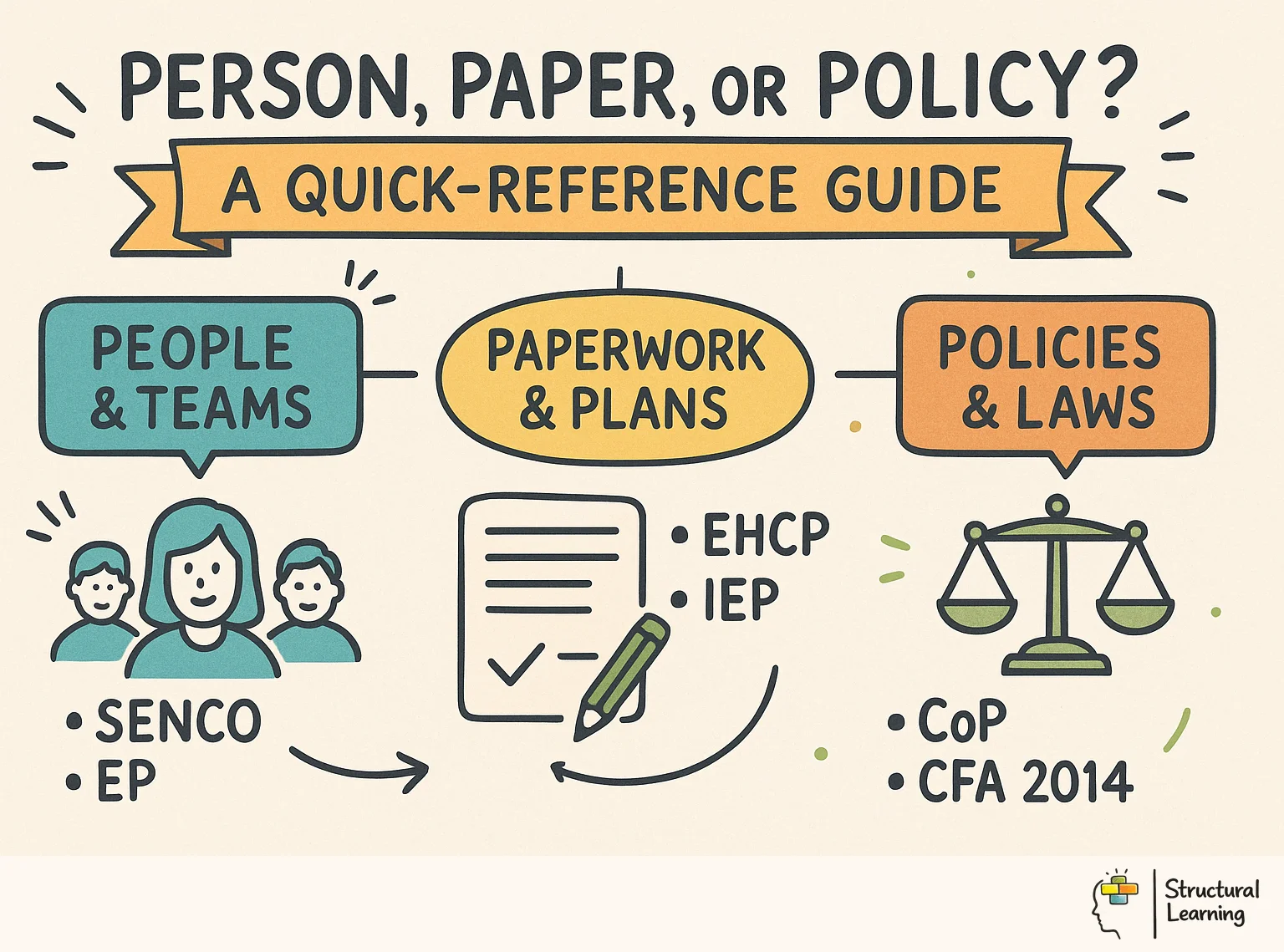
SEND documentation is saturated with acronyms. A newly qualified teacher reading their first EHCP will encounter SALT, OT, EP, CAMHS, SEMH, and dozens more, often with no glossary attached. Annual review paperwork assumes you already know what APDR means.
Referral forms reference TAC, TAF, and MASH without explanation. This guide explains every abbreviation you will meet in UK special educational needs provision. They are grouped by category and explained in plain English with classroom context. The term describes a structured process for turning evidence into a classroom decision, not a label on its own.
SEND acronyms are short terms used in England's special educational needs and disabilities system. They name legal documents, professional roles, assessment cycles, services and categories of need. For example, EHCP means Education, Health and Care Plan, and APDR means Assess, Plan, Do, Review (Department for Education, 2015; Department for Education, 2023).
These twenty acronyms appear in virtually every SEND document, meeting, and conversation in UK schools. If you learn nothing else from this guide, learn these.
A Year 3 class teacher receiving their first EHCP transfer file will see most of these within the first two pages. Knowing them before your first annual review meeting means you can focus on the child rather than decoding the paperwork.
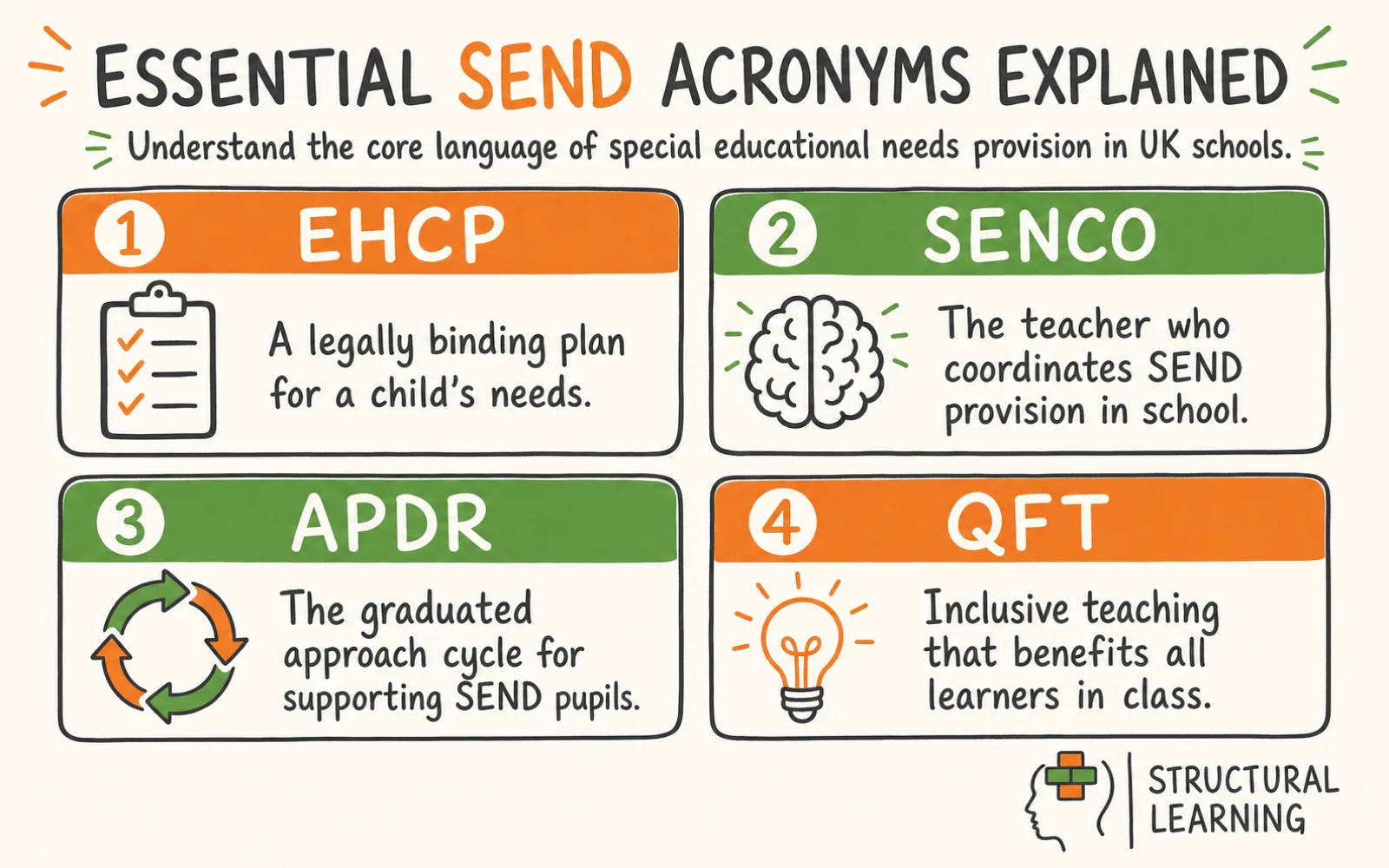
For example, a typical sentence in an EHCP might read: "Following APDR, the SENCO consulted with the EP and SALT, who recommended QFT adjustments alongside a targeted SEMH intervention delivered by the LSA." That single sentence contains seven acronyms. With the table above, you can now read it fluently.
These acronyms describe specific conditions, diagnoses, or categories of need. You will see them on SEN registers, in EP reports, on CAMHS referral forms, and throughout EHCPs.
When a parent tells you their child has a diagnosis of DCD, or an EP report arrives referencing SpLD, knowing what these mean (and what they look like in your classroom) is essential for planning effective differentiation.
For example, a Year 5 learner's SEN register entry might list "ASC, SpLD (dyslexia), SEMH." This tells you the child is autistic, has a specific literacy difficulty, and experiences social or emotional challenges. Each acronym points you towards a different set of classroom strategies.
These acronyms relate to how schools identify needs, plan support, and track progress. You will encounter them during provision mapping, SENCO meetings, and when writing or reviewing support plans.
It can vary across settings and contexts, so it is often misunderstood and needs clear explaining. When teachers use a strengths-based view and focus on what learners can do, they can design better instruction. A deficit-based model can lower expectations by mistake. By contrast, inclusive pedagogy emphasises what learners can do and pushes teachers to extend rather than restrict opportunities.
Furthermore, studies by Florian and Black-Hawkins (2011) advocate for inclusive practices. They promote pedagogies that respond to individual learning differences. Rose and Meyer's (2002) work on Universal Design for Learning (UDL) offers a framework for creating accessible learning experiences. These approaches support learners with SEND to achieve their full potential.
Quality First Teaching (QFT) is the foundation of fairness in the classroom (Florian & Black-Hawkins, 2011). High-quality, inclusive core teaching helps every learner. It also reduces the need for later targeted interventions. Effective QFT responds to individual differences while keeping a shared learning experience open to all.
Child and Adolescent Mental Health Services (CAMHS) are under specific pressure. At the same time, schools are increasingly expected to support learners with mental health needs. Teachers report feeling under-resourced to meet this demand, and Weare (2015) highlights the importance of whole-school approaches to promoting mental wellbeing. Humphrey (2013) critically examines social and emotional learning programmes and argues that consistent, school-wide implementation matters more than the choice of any specific programme.
| Acronym | Full Term | What It Means | When You Encounter It |
|---|---|---|---|
| SEND | Special Educational Needs and Disabilities | The umbrella term for children who need additional support to access education | Every policy, meeting, and training session |
| SEN | Special Educational Needs | SEN registers, legacy paperwork, casual staff conversation | |
| SENCO | Special Educational Needs Coordinator | The teacher responsible for coordinating SEND provision across the school | Your first point of contact for any SEND concern |
| EHCP | Education, Health and Care Plan | A legally binding document setting out a child's needs and the provision required across education, health, and care | Annual reviews, transition planning, funding requests |
| APDR | Assess, Plan, Do, Review | The graduated approach cycle used to identify and respond to SEND; the backbone of school-based SEND provision | Provision mapping, IEP reviews, Ofsted inspections |
| IEP | Individual Education Plan | A document listing specific targets, strategies, and success criteria for a learner with SEND | Termly reviews, parent meetings, handover between year groups |
| SMART | Specific, Measurable, Achievable, Relevant, Time-bound | The criteria every IEP target should meet | Writing IEP targets, provision planning |
| QFT | Quality First Teaching | Ofsted reports, lesson observations, SEND reviews | |
| EP | Educational Psychologist | A specialist who assesses learning, behaviour, and emotional needs, then recommends strategies | EHCP assessments, complex case consultations |
| SALT | Speech and Language Therapist | A therapist who assesses and treats communication difficulties including speech, language, and social communication | EHCP reports, colourful semantics programmes, communication passports |
| OT | Occupational Therapist | A therapist who supports fine motor skills, sensory processing, and daily living activities in school | Handwriting assessments, sensory diet recommendations, seating reviews |
| CAMHS | Child and Adolescent Mental Health Services | Referrals for anxiety, self-harm, eating disorders, ADHD diagnosis | |
| SEMH | Social, Emotional and Mental Health | One of the four broad areas of need in the SEND Code of Practice; replaced the older term BESD, although Norwich and Eaton (2014) caution that changing the label does not by itself change assessment, teaching or exclusion practice | SEN registers, EHCP needs categories, provision mapping |
| LA | Local Authority | The council responsible for SEND services, EHCP decisions, and school place commissioning in your area | EHCP applications, funding discussions, tribunal correspondence |
| NASEN | National Association for Special Educational Needs | The leading professional membership body for SEND, providing training, resources, and policy guidance | CPD courses, published resources, national standards |
| DfE | Department for Education | The government department responsible for education policy in England | Statutory guidance, Teachers' Standards, SEND Code of Practice |
| Ofsted | Office for Standards in Education | The inspectorate that evaluates schools, including their SEND provision | Inspection frameworks, area SEND inspections, school reports |
| COP | Code of Practice (SEND) | The statutory guidance (2015) that sets out how schools, LAs, and health bodies must identify and support children with SEND | Every SEND policy, training session, and Ofsted inspection |
| TA | Teaching Assistant | Support staff who work alongside teachers, often deployed to support learners with SEND | Timetables, EHCP provision, intervention groups |
| LSA | Learning Support Assistant | Another title for a TA, sometimes used when the role is specifically SEND-focussed | Job descriptions, EHCP provision maps, staffing structures |
Your SENCO wants you to update the IEP's APDR cycle with SMART targets before the TAC meeting. This means reviewing the assess, plan, do, review cycle. Update the learner's individual education plan using specific, measurable targets. Have it ready for the multi agency team meeting.
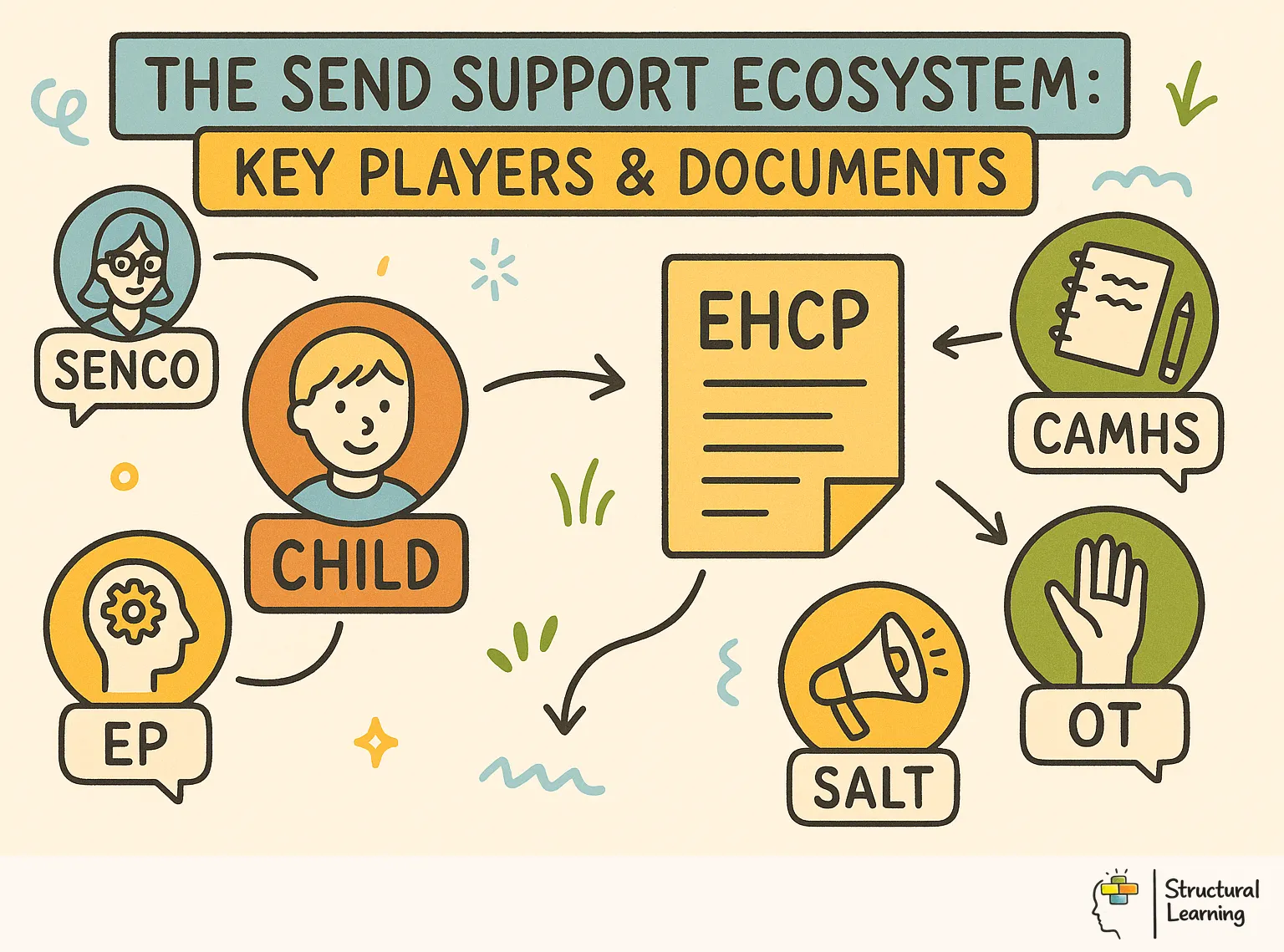
When a multi-agency meeting is called, the invite list reads like an alphabet soup. Knowing who each professional is and when they typically get involved helps you prepare the right evidence and ask the right questions.
Autism spectrum condition (ASC) impacts social skills, interaction, and thought flexibility. ASC is preferred now; it avoids using the term "disorder".
Baron-Cohen (1995) researched ASC traits. Frith (2003) studied ASC and theory of mind. Happé (1999) explored central coherence in learners with ASC.
Neurodevelopmental conditions can show as inattention, hyperactivity and impulsivity. CAMHS or a paediatrician makes the diagnosis.
The older label "Attention Deficit Disorder" was used for children who mainly show inattention. Barkley (2014) reviewed this presentation. He argued that it is better described as Sluggish Cognitive Tempo (SCT) or Concentration Deficit Disorder (CDD). This is a distinct profile that includes daydreaming, appearing confused and slow information processing, and it overlaps with but is separable from the inattentive presentation of ADHD.
Profound and Multiple Learning Difficulties (PMLD) can strongly affect a learner's experience in school. They also create specific teaching challenges. Effective strategies need careful thought about each learner's sensory, communication and physical needs. This draws on the inclusive-pedagogy framework of Florian and Black-Hawkins (2011) and the Universal Design for Learning principles of Rose and Meyer (2002).
Pathological Demand Avoidance (PDA) can disrupt classroom engagement. Learners with a PDA profile often find everyday demands hard to follow. They may also struggle to process social information and manage transitions. Effective practice draws on autism research (Baron-Cohen, 1995; Happé, 1999) and on the executive function profile work of Ozonoff and Jensen (1999), using strategies that reduce direct demand, offer choice, and lower social pressure.
Trauma affects learners and can change concentration, emotional control, and behaviour (APA, 2013). It can be triggered by experiences or by witnessing events (van der Kolk, 2014). Perry (2009) shows that trauma changes brain function. When teachers understand this, they can support learners more effectively.
| Acronym | Full Term | Explanation | In Your Classroom |
|---|---|---|---|
| ASD/ASC | Autism Spectrum Disorder / Autism Spectrum Condition | Visual timetables, clear instructions, reduced sensory input, predictable routines | |
| ADHD | Attention Deficit Hyperactivity Disorder | Movement breaks, chunked tasks, fidget tools, seating near the teacher | |
| ADD | Attention Deficit Disorder | These learners often appear daydreamy rather than challenging; check understanding frequently | |
| DCD | Developmental Coordination Disorder | Affects motor coordination and planning. Previously called dyspraxia (still commonly used) | Handwriting support, extra time for recording, alternatives to writing (voice recording, typing) |
| SpLD | Specific Learning Difficulty | An umbrella term covering dyslexia, dyscalculia, dysgraphia, and DCD | Multi-sensory teaching, scaffolded tasks, coloured overlays, structured literacy programmes |
| MLD | Moderate Learning Difficulty | Attainment well below age-related expectations across most areas of the curriculum | Simplified language, concrete resources, overlearning, smaller step targets |
| SLD | Severe Learning Difficulty | specific intellectual disability requiring a highly adapted curriculum, often in a specialist setting | Sensory approaches, PECS, intensive interaction, life skills focus |
| PMLD | Profound and Multiple Learning Difficulties | Specialist equipment, sensory rooms, switch-access technology, 1:1 or 2:1 support | |
| PDA | Pathological Demand Avoidance | Indirect language, choices, flexible approaches, reduced direct demands | |
| ODD | Oppositional Defiant Disorder | A pattern of angry, defiant behaviour towards authority figures lasting at least six months | Positive reinforcement, clear boundaries, avoid power struggles, de-escalation strategies |
| OCD | Obsessive Compulsive Disorder | A mental health condition involving intrusive thoughts (obsessions) and repetitive behaviours (compulsions) | Flexible deadlines, discrete check-ins, awareness that rituals are anxiety-driven not defiance |
| PTSD | Post-Traumatic Stress Disorder | Trauma-informed practice, predictable routines, safe spaces, avoid triggers where known | |
| FASD | Foetal Alcohol Spectrum Disorder | A range of effects caused by prenatal alcohol exposure, affecting learning, memory, and behaviour | Short instructions, visual prompts, repetition, concrete language, minimal abstract concepts |
| VI | Visual Impairment | Partial sight or blindness affecting access to visual learning materials | Large print, high contrast, seating position, assistive technology, VI teacher involvement |
| HI | Hearing Impairment | Partial or total hearing loss affecting access to spoken language | Radio aids, face the learner when speaking, visual instructions, HI teacher involvement |
| MSI | Multi-Sensory Impairment | Combined visual and hearing impairment requiring specialist support | Tactile resources, intervenor support, adapted communication systems |
| EAL | English as an Additional Language | Not a SEND category, but often appears in SEND discussions when language needs and learning needs overlap | Pre-teaching vocabulary, visual supports, home language use, careful assessment to distinguish EAL from SpLD |
| CiC/LAC | Children in Care / Looked After Children | Children in local authority care. Not a SEND category but frequently co-occurs with SEND; has its own statutory protections | PEP meetings, designated teacher involvement, pupil premium Plus funding, attachment-aware practice |
| EBSA | Emotionally Based School Avoidance | Persistent difficulty attending school driven by anxiety or emotional distress rather than truancy | Phased return plans, reduced timetable, safe person in school, home learning support |
For example, if a Year 2 learner struggles with pencil grip and letter formation, the right professional is an OT, not a SALT. If a Year 6 learner won't speak in class but speaks freely at home, refer them to a SALT with selective mutism expertise, not an EP.
These acronyms reference the legal framework underpinning SEND provision. When a parent quotes "the COP" or a solicitor references "the CFA 2014," they are pointing to specific legal duties. Understanding the shorthand helps you respond with confidence.
| Acronym | Full Term | Explanation and Context |
|---|---|---|
| APDR | Assess, Plan, Do, Review | The graduated approach required by the COP. You assess the learner's needs, plan the intervention, deliver it, then review its impact. The cycle repeats termly or more frequently. |
| IEP | Individual Education Plan | A short document with 3 or 4 SMART targets. Some schools now use "SEN Support Plans" or "Learner Profiles" instead, but IEP remains widely understood. |
| IBP | Individual Behaviour Plan | Similar to an IEP but focussed specifically on behaviour targets and strategies. Common for learners with SEMH needs. |
| PSP | Pastoral Support Programme | A structured 16-week programme for learners at risk of permanent exclusion. Involves multi-agency review meetings. |
| PEP | Personal Education Plan | A statutory plan for looked after children (CiC/LAC), reviewed termly. Covers educational targets and how pupil premium Plus funding is used. |
| CAF/EHA | Common Assessment Framework / Early Help Assessment | A multi-agency assessment for families needing support from more than one service. EHA has replaced CAF in most areas, but both terms are still used. |
| TAC/TAF | Team Around the Child / Team Around the Family | A multi-agency meeting bringing together all professionals involved with a child or family. You may be asked to attend and provide classroom evidence. |
| EHCA | Education, Health and Care Needs Assessment | The formal assessment process that may lead to an EHCP. The LA must decide whether to carry out an EHC needs assessment within 6 weeks; if it issues an EHC plan, the whole process from request to final plan must normally take no more than 20 weeks. Source: DfE SEND Code of Practice, paras 9.40-9.41. |
| SEN Support | SEN Support (K code) | The category for learners with identified SEND who receive support through the graduated approach but do not have an EHCP. Recorded as "K" on the school census. |
| SA / SA+ | School Action / School Action Plus | Legacy terms (pre-2014) for levels of SEN support. SA meant school-led intervention; SA+ meant external specialists were involved. Now replaced by "SEN Support." |
| P Levels/P Scales | Performance Levels | Assessment criteria (P1 to P8) used for learners working below the level of the national curriculum. Largely replaced by the Pre-Key Stage Standards but still referenced in some settings. |
For example, if a parent mentions their child's rights under the Equality Act, they mean schools must make reasonable adjustments under EA 2010. Knowing this means you can immediately check whether your school has documented the adjustments in place and evidenced the decision-making process.
These are the acronyms you will use daily in lesson planning, assessment, and classroom communication. Many are not SEND-specific, but they appear frequently in SEND contexts.
Educational psychologists assess learning abilities and needs. They also identify barriers to learning and emotional challenges. Psychologists get involved in EHCA processes and complex cases. They help when support in school has led to limited progress (DfE, 2015).
NHS services diagnose and treat mental health. They help learners with anxiety and depression. Services also address self-harm and eating disorders. They assess for ADHD and autism (APA, 2013; NICE, 2023).
Qualified teachers give expert advice for visually impaired learners (VI). They suggest resources and adapt spaces for access. Learners with VI on the SEN register must have their support.
A qualified teacher of the deaf advises on hearing tech. They suggest acoustic changes and communication tips. They must be involved for learners with hearing impairment (HI).
| Acronym | Full Term | Role and When They Get Involved |
|---|---|---|
| EP | Educational Psychologist | |
| SALT/SLT | Speech and Language Therapist | Assesses and treats speech, language, and communication needs. Involved when a child has delayed language, unclear speech, or social communication difficulties. |
| OT | Occupational Therapist | Supports fine and gross motor skills, sensory processing, and daily living skills. Involved for handwriting difficulties, sensory needs, and physical access to the curriculum. |
| CAMHS | Child and Adolescent Mental Health Services | |
| CYPMHS | Children and Young People's Mental Health Services | The updated name for CAMHS in many areas. Same service, different branding. Check your local area's terminology. |
| Portage | Portage Home Visiting Service | An early intervention service for pre-school children with SEND. Portage workers visit families at home to teach developmental skills through play. Involved from birth to school entry. |
| SENDIASS | SEND Information, Advice and Support Service | A free, impartial service for parents and young people navigating the SEND system. Formerly called Parent Partnership. Every LA must provide one. |
| LADO | Local Authority Designated Officer | Manages allegations of abuse against adults who work with children. Involved when a safeguarding allegation is made against staff. |
| DSL | Designated Safeguarding Lead | The senior staff member responsible for safeguarding in your school. Your first point of contact for any child protection concern. Often overlaps with the SENCO role in smaller schools. |
| MASH | Multi-Agency Safeguarding Hub | A single point of contact where police, social care, health, and education share information on safeguarding referrals. You contact MASH when making a safeguarding referral. |
| AIO | Attendance Improvement Officer | Works with families to improve school attendance. Involved when persistent absence is a concern, particularly relevant for learners with EBSA. |
| VI Teacher | Visual Impairment Teacher | |
| HI Teacher | Hearing Impairment Teacher |
IEP targets require knowledge. GLD means Good Level of Development (EYFS). PECS, a picture system, helps learners lacking speech. AAC includes all alternative communication, like sign language or eye gaze.
This alphabetical table covers every acronym in this guide. Print it, pin it near your desk, and use it to decode any SEND document you receive.

Print the quick reference wall chart above and pin it next to your desk this week. The next time you receive an EHCP, an EP report, or an invite to a TAC meeting, you will have every acronym at your fingertips. Start with the essential 20, then use the categorised tables to build your knowledge as each acronym appears in your work. The fastest way to learn them is not memorisation; it is encountering them in real documents with this guide open beside you.
The UN agreement protects learners' rights to education, health and safety. Article 23 focuses specifically on learners with disabilities.
The Warnock Report (1978) shaped SEND policy. It introduced the term "special educational needs." The report recommended integrating learners with disabilities in mainstream schools (Warnock, 1978). This integration happened in mainstream schools (Warnock, 1978).
| Acronym | Full Term | Significance |
|---|---|---|
| COP 2015 | SEND Code of Practice (2015) | The statutory guidance all schools must follow. Covers identification, the graduated approach, EHCPs, and the roles of everyone involved in SEND. This is the document your SENCO references most. |
| CFA 2014 | Children and Families Act 2014 | The primary legislation that introduced EHCPs, replaced Statements, and extended SEND provision to age 25. This is the law that gives the COP its legal force. |
| EA 2010 | Equality Act 2010 | Requires schools to make reasonable adjustments for disabled learners and prevents discrimination. Applies to all schools, including academies and independent schools. |
| UNCRC | United Nations Convention on the Rights of the Child | |
| DDA | Disability Discrimination Act (1995) | Legacy legislation now replaced by the Equality Act 2010. You may still see it referenced in older policies and case law. |
| Warnock Report | Warnock Report (1978) | |
| Lamb Inquiry | Lamb Inquiry (2009) | Investigated parental confidence in the SEN system. Its recommendations influenced the move towards the CFA 2014 and the emphasis on parental involvement. |
| Green Paper 2022 | SEND Review: Right Support, Right Place, Right Time | The government's 2022 proposals for SEND reform, leading to the 2026 reforms now being implemented. Introduced concepts like tailored lists of interventions and national standards. |
A SEND acronym glossary is useful, but it cannot make unclear provision lawful or fair. The Lamb Inquiry showed that families lose trust when the SEN system feels opaque, defensive or hard to challenge (Lamb, 2009). Acronyms may speed professional discussion, but they can also exclude parents from decisions about assessment, funding and placement.
There are also limits to the learning theory often used around SEND teaching. Vygotsky (1978) gives teachers a strong rationale for scaffolding, but the zone of proximal development is difficult to measure consistently. It came from cultural historical theory, not large classroom trials, so teachers need local evidence from APDR cycles as well as theory.
Karpicke (2008) shows that retrieval strengthens later recall, yet much retrieval research uses controlled tasks that do not match complex SEND classrooms. Learners with language needs, anxiety, trauma or working memory difficulties may need extra cueing, reduced threat and alternative response modes before retrieval practice is fair.
Finally, SEND categories carry cultural and methodological risks. Strand and Lindsay (2009) found ethnic disproportionality in SEN identification in England, and Norwich and Eaton (2014) warned that moving from BESD to SEMH does not by itself change practice. Despite these limits, SEND acronyms still have enduring value when teachers use them as precise routes into evidence, provision and family dialogue.
APDR stands for Assess, Plan, Do, Review. It is the graduated approach cycle used in UK schools to identify and support learners with special educational needs. Teachers use this framework to set specific targets, use strategies, and measure the impact of those interventions over time.
Quality First Teaching means high quality, inclusive teaching for all learners before extra interventions are added. Teachers do this with clear visual aids, scaffolded tasks, frequent checks for understanding, and adapted resources. This removes many barriers to learning during regular lessons.
SEN refers to educational needs. SEND includes both educational needs and any linked disabilities. Older policy documents use "SEN". The current statutory framework, the SEND Code of Practice: 0 to 25 years (DfE, 2015), uses "SEND" to recognise both elements together.
Teachers often focus on funding over specialist advice. They may miss nuances in professional recommendations. Ignoring specific strategies behind acronyms leads to poor support and unmet duties. Learners then don't get what they need.
Teachers need to read SEND reports quickly and put support in place promptly. Clear comprehension helps teachers communicate with families and other agencies. It also supports precise, effective classroom adjustments. This draws on the inclusive-education framework set out in the SEND Code of Practice (DfE, 2015) and the inclusive-pedagogy principles of Florian and Black-Hawkins (2011).
Research shows that clear communication improves learner outcomes (Epstein, 2001). When teachers use report strategies well, they can improve interventions. Accurate records also meet obligations and help focus resources for learners.
Karpicke, J. (2008). The critical importance of retrieval for learning.
Vygotsky, L. (1978). Mind in society: The development of higher psychological processes.
These five resources provide the official definitions and frameworks behind the acronyms in this guide.
SEND Code of Practice: 0 to 25 Years (DfE, 2015)
The statutory guidance underpinning all SEND provision in England. Every acronym in the assessment and legislation sections traces back to this document. Essential reading for any teacher working with learners on the SEN register.
Nasen SEND Glossary
A searchable glossary maintained by the National Association for Special Educational Needs. Useful as a quick-check companion to this guide when you encounter an unfamiliar term in a meeting or document.
Council for Disabled Children: Resources for Practitioners
Practical guides on EHCPs, the graduated approach, and working with families. Particularly strong on translating legislation into classroom action.
The Communication Trust: Resources for Schools
focussed on speech, language, and communication needs. Covers SALT referral pathways, AAC systems, and classroom strategies for learners with communication difficulties.
DfE Teachers' Standards (2011, updated 2021)
Standard 5 requires teachers to 'adapt teaching to respond to the strengths and needs of all pupils' and to understand the needs of pupils including those with special educational needs and disabilities. Source: DfE Teachers' Standards, 2021, Standard 5. Understanding the acronyms in this guide is a prerequisite for meeting that standard in practice.
External References: EEF: SEND in Mainstream Schools | SEND Code of Practice: 0 to 25 Years (DfE)
Free School Meal (FSM) eligibility can signal economic hardship. It prompts pupil premium funding, and schools track it when they look at attainment gaps. Free School Meals eligibility is also a common proxy for socio-economic disadvantage. It is linked to persistent attainment gaps in national assessment data published by the Department for Education.
| Acronym | Full Term | Classroom Context |
|---|---|---|
| QFT | Quality First Teaching | The baseline expectation: inclusive teaching that meets most needs before additional interventions are considered. Your differentiated lesson plans are QFT in action. |
| AfL | Assessment for Learning | Ongoing formative assessment during lessons (mini whiteboards, thumbs up, exit tickets). Critical for SEND learners because it shows you immediately if they have understood. |
| WAGOLL | What A Good One Looks Like | A model example shown to learners before they attempt a task. Particularly helpful for SEND learners who need concrete models rather than abstract instructions. |
| WALT/WILF | We Are Learning To / What I'm Looking For | Lesson objective and success criteria displayed for learners. Helps SEND learners understand both the purpose and the expected outcome of each task. |
| KS1-4 | Key Stages 1 to 4 | The phases of the national curriculum: KS1 (Years 1-2), KS2 (Years 3-6), KS3 (Years 7-9), KS4 (Years 10-11). SEND provision is planned around these transition points. |
| EYFS | Early Years Foundation Stage | The framework for children from birth to age 5. Early identification of SEND often happens during EYFS through the two-year-old progress check. |
| NC | National Curriculum | The statutory curriculum for maintained schools. Some learners with SEND may be disapplied from parts of the NC if documented in their EHCP. |
| PP | pupil premium | Additional funding for disadvantaged learners (FSM eligible, CiC, service children). Not SEND-specific, but many SEND learners also qualify. Your school must publish how PP is spent. |
| FSM | Free School Meals | |
| ARE | Age Related Expectations | The standard a learner is expected to reach for their age. SEND learners may be working below ARE; this is documented on the SEN register and in IEPs. |
| GLD | Good Level of Development | The EYFS expected standard at the end of Reception. Children not meeting GLD in communication, literacy, or maths often begin the SEND identification process. |
| PECS | Picture Exchange Communication System | A structured communication programme where children exchange picture cards to make requests. Common for non-verbal or minimally verbal children with autism. |
| AAC | Augmentative and Alternative Communication | Any communication method used alongside or instead of speech: symbol boards, eye-gaze devices, speech-generating apps, sign language. You may need training on a learner's specific AAC system. |
| BSL | British Sign Language | A full language used by deaf learners and adults. If a learner uses BSL, your school may need a communication support worker or interpreter in lessons. |
| Widgit | Widgit Symbols | A commercially available symbol set used to create visual timetables, social stories, and adapted worksheets. Common in primary schools and special schools. |
The Common Assessment Framework / Early Help Assessment (CAF/EHA) is a shared assessment for families who need help from more than one service. Agencies use it together to spot needs early. They can then plan the right support for learners and their families, in line with the multi-agency expectations of the SEND Code of Practice (DfE, 2015) and the Working Together to Safeguard Children statutory framework.
The Children and Families Act 2014 is key SEND law. It brought in Education, Health and Care Plans (EHCPs). This law extended support for learners up to age 25.
TAC/TAF meetings bring together professionals who work with a learner. These multi-agency assessments help them coordinate support. Multi-agency working improves how support is planned around the learner. It is also a core expectation of the SEND Code of Practice (DfE, 2015).
| Acronym | Full Term | Category | One-Line Explanation |
|---|---|---|---|
| AAC | Augmentative and Alternative Communication | Classroom | Any communication method used alongside or instead of speech |
| ADD | Attention Deficit Disorder | Condition | Older term for inattentive-type ADHD (without hyperactivity) |
| ADHD | Attention Deficit Hyperactivity Disorder | Condition | Neurodevelopmental condition: inattention, hyperactivity, impulsivity |
| AfL | Assessment for Learning | Classroom | Ongoing formative assessment during lessons |
| AIO | Attendance Improvement Officer | Professional | Works with families to improve school attendance |
| APDR | Assess, Plan, Do, Review | Assessment | The graduated approach cycle for SEND provision |
| ARE | Age Related Expectations | Classroom | The standard a learner should reach for their age |
| ASD/ASC | Autism Spectrum Disorder/Condition | Condition | Neurodevelopmental condition affecting social communication and interaction |
| BSL | British Sign Language | Classroom | Full language used by deaf learners and adults in the UK |
| CAMHS | Child and Adolescent Mental Health Services | Professional | NHS mental health services for children and young people |
| CiC/LAC | Children in Care / Looked After Children | Condition | Children in local authority care with statutory protections |
| COP | SEND Code of Practice (2015) | Legislation | Statutory guidance for SEND identification and support |
| CYPMHS | Children and Young People's Mental Health Services | Professional | Updated name for CAMHS used in many areas |
| DCD | Developmental Coordination Disorder | Condition | Motor coordination difficulty, previously called dyspraxia |
| DDA | Disability Discrimination Act (1995) | Legislation | Legacy law now replaced by the Equality Act 2010 |
| DfE | Department for Education | Essential | Government department responsible for education policy in England |
| DSL | Designated Safeguarding Lead | Professional | Senior staff member responsible for child protection in your school |
| EA 2010 | Equality Act 2010 | Legislation | Requires reasonable adjustments and prevents disability discrimination |
| EAL | English as an Additional Language | Classroom | Learners whose first language is not English |
| EBSA | Emotionally Based School Avoidance | Condition | Persistent difficulty attending school driven by anxiety |
| EHCA | Education, Health and Care Needs Assessment | Assessment | Formal assessment process that may lead to an EHCP |
| EHCP | Education, Health and Care Plan | Essential | Legally binding plan setting out needs and provision |
| EP | Educational Psychologist | Professional | Specialist assessing learning, behaviour, and emotional needs |
| EYFS | Early Years Foundation Stage | Classroom | Framework for children from birth to age 5 |
| FASD | Foetal Alcohol Spectrum Disorder | Condition | Range of effects from prenatal alcohol exposure |
| FSM | Free School Meals | Classroom | Indicator of economic disadvantage, triggers pupil premium |
| GLD | Good Level of Development | Classroom | EYFS expected standard at end of Reception |
| HI | Hearing Impairment | Condition | Partial or total hearing loss |
| IBP | Individual Behaviour Plan | Assessment | Behaviour-focussed plan with specific targets and strategies |
| IEP | Individual Education Plan | Assessment | Document with SMART targets for a learner with SEND |
| KS1-4 | Key Stages 1 to 4 | Classroom | Phases of the national curriculum (Years 1-11) |
| LA | Local Authority | Essential | Council responsible for SEND services and EHCP decisions |
| LADO | Local Authority Designated Officer | Professional | Manages allegations against adults who work with children |
| LSA | Learning Support Assistant | Essential | Support staff role, often SEND-focussed (same as TA in many schools) |
| MASH | Multi-Agency Safeguarding Hub | Professional | Single point of contact for safeguarding referrals |
| MLD | Moderate Learning Difficulty | Condition | Attainment well below age-related expectations across the curriculum |
| MSI | Multi-Sensory Impairment | Condition | Combined visual and hearing impairment |
| NASEN | National Association for Special Educational Needs | Essential | Leading professional membership body for SEND |
| NC | National Curriculum | Classroom | Statutory curriculum for maintained schools in England |
| OCD | Obsessive Compulsive Disorder | Condition | Intrusive thoughts (obsessions) and repetitive behaviours (compulsions) |
| ODD | Oppositional Defiant Disorder | Condition | Pattern of angry, defiant behaviour towards authority figures |
| Ofsted | Office for Standards in Education | Essential | Inspectorate that evaluates schools including SEND provision |
| OT | Occupational Therapist | Professional | Supports motor skills, sensory processing, and daily living in school |
| P Levels | Performance Levels | Assessment | Assessment criteria for learners working below the national curriculum |
| PDA | Pathological Demand Avoidance | Condition | Autism profile with extreme anxiety around everyday demands |
| PECS | Picture Exchange Communication System | Classroom | Picture card communication programme for non-verbal children |
| PEP | Personal Education Plan | Assessment | Statutory education plan for looked after children |
| PMLD | Profound and Multiple Learning Difficulties | Condition | Complex needs across multiple areas requiring specialist support |
| Portage | Portage Home Visiting Service | Professional | Early intervention home visiting for pre-school children with SEND |
| PP | pupil premium | Classroom | Additional funding for disadvantaged learners |
| PSP | Pastoral Support Programme | Assessment | 16-week programme for learners at risk of permanent exclusion |
| PTSD | Post-Traumatic Stress Disorder | Condition | Condition triggered by experiencing or witnessing trauma |
| QFT | Quality First Teaching | Classroom | Inclusive classroom teaching that meets needs before interventions |
| SA/SA+ | School Action / School Action Plus | Assessment | Legacy SEN support levels, now replaced by "SEN Support" |
| SALT/SLT | Speech and Language Therapist | Professional | Assesses and treats speech, language, and communication needs |
| SEMH | Social, Emotional and Mental Health | Essential | One of the four broad areas of SEND need in the Code of Practice |
| SEN | Special Educational Needs | Essential | Educational component of SEND (without the disability element) |
| SENCO | Special Educational Needs Coordinator | Essential | Teacher responsible for coordinating SEND provision in school |
| SEND | Special Educational Needs and Disabilities | Essential | Umbrella term for children needing additional educational support |
| SENDIASS | SEND Information, Advice and Support Service | Professional | Free, impartial support service for parents navigating SEND |
| SLD | Severe Learning Difficulty | Condition | specific intellectual disability requiring a highly adapted curriculum |
| SMART | Specific, Measurable, Achievable, Relevant, Time-bound | Essential | Target-setting criteria for IEPs and provision plans |
| SpLD | Specific Learning Difficulty | Condition | Umbrella term for dyslexia, dyscalculia, dysgraphia, and DCD |
| TA | Teaching Assistant | Essential | Support staff working alongside teachers, often supporting SEND learners |
| UNCRC | UN Convention on the Rights of the Child | Legislation | International agreement guaranteeing children's rights to education |
| VI | Visual Impairment | Condition | Partial sight or blindness affecting access to learning |
| WAGOLL | What A Good One Looks Like | Classroom | Model example shown to learners before they attempt a task |
| WALT/WILF | We Are Learning To / What I'm Looking For | Classroom | Lesson objectives and success criteria for learners |
| Widgit | Widgit Symbols | Classroom | Symbol set for visual timetables, social stories, and adapted resources |