ODD in the Classroom: Supporting Pupils with Oppositional Defiant Disorder
|
February 24, 2026
A practical guide for UK teachers on recognising and supporting pupils with Oppositional Defiant Disorder using evidence-based strategies and the APDR cycle.
Every school in the UK has pupils who push back against rules, argue with adults and seem to resist authority at every turn. For most children, this is a passing phase. But for the estimated 5% of school-age children in the UK who meet the criteria for Oppositional Defiant Disorder (ODD), the pattern runs deeper, lasts longer and disrupts learning for the child and their classmates alike. If you are a teacher, teaching assistant or SENCo, understanding ODD is not optional. It is a core part of your professional toolkit for special educational needs provision.
ODD is one of the most common behavioural disorders in childhood, yet it remains widely misunderstood in staffrooms. Teachers often describe these pupils as "deliberately difficult" or "choosing to misbehave." The reality is more nuanced. ODD is a recognised clinical condition with specific diagnostic criteria, and the children who live with it need structured, consistent and relationship-driven support rather than punishment alone.
Key Takeaways
ODD is a clinical condition, not a character flaw. It affects approximately 5% of UK children and requires a planned, evidence-based response from schools.
Proactive strategies outperform reactive ones. Consistent routines, clear expectations and positive reinforcement reduce confrontation far more effectively than sanctions.
ODD is frequently confused with PDA, ADHD and Conduct Disorder. Accurate identification matters because the wrong approach can make behaviour worse.
A graduated approach (Assess, Plan, Do, Review) gives schools a framework for tracking progress and adjusting provision without relying on gut instinct alone.
What Is Oppositional Defiant Disorder?
The Diagnostic and Statistical Manual of Mental Disorders (DSM-5) defines ODD as a recurrent pattern of angry or irritable mood, argumentative or defiant behaviour, and vindictiveness lasting at least six months. The behaviours must be directed at someone other than a sibling and must occur more frequently than is typical for the child's age and developmental stage. This distinction matters. All children argue, refuse and push boundaries at times. ODD is diagnosed only when these behaviours are persistent, pervasive and cause meaningful impairment in social, educational or family functioning.
ODD typically emerges before the age of eight, though it can appear later. Research published in the Journal of Child Psychology and Psychiatry suggests that early onset is associated with more persistent difficulties. Boys are diagnosed more frequently than girls in childhood, though this gap narrows in adolescence, which suggests possible referral bias rather than true prevalence differences.
The DSM-5 groups ODD symptoms into three clusters: angry or irritable mood (frequent temper outbursts, touchiness, resentfulness), argumentative or defiant behaviour (arguing with adults, actively defying requests, deliberately annoying others, blaming others for mistakes) and vindictiveness (spiteful or retaliatory behaviour at least twice within six months). A child does not need to show all symptoms. The threshold is four or more from any cluster.
It is worth noting that ODD is not a label that explains why a child behaves this way. It is a description of a pattern. The causes are typically a combination of temperamental factors (low frustration tolerance, high emotional reactivity), family environment, and neurological differences in areas of the brain responsible for executive function and emotional regulation.
How ODD Differs from PDA, ADHD and Conduct Disorder
One of the most common mistakes in schools is treating all oppositional behaviour as if it has the same cause. A pupil with Pathological Demand Avoidance (PDA), a profile of autism, may look similar to a pupil with ODD on the surface. Both refuse adult requests and resist rules. But the underlying drivers are entirely different, and strategies that work for one group can backfire badly with the other.
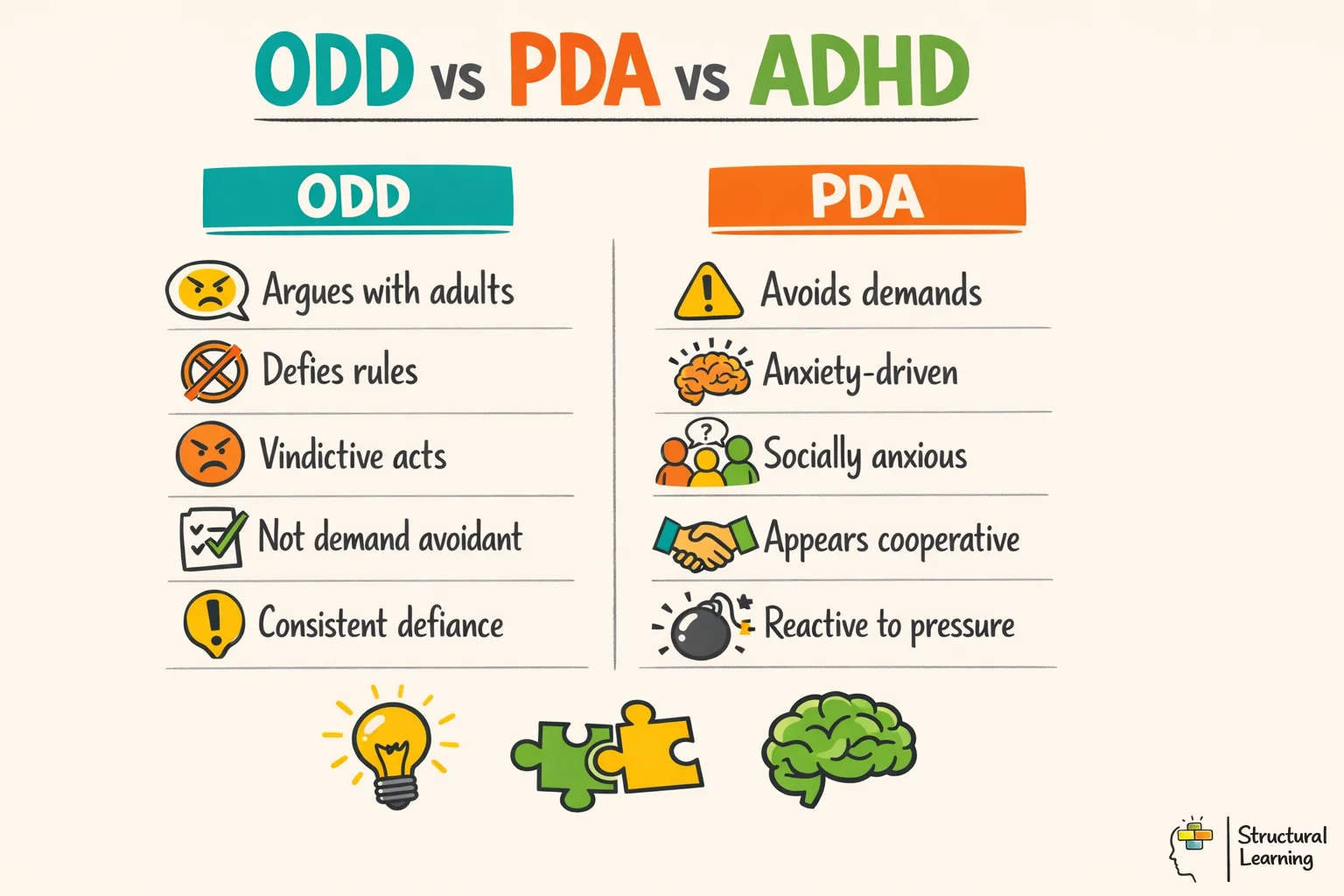
Similarly, ADHD and ODD frequently co-occur. Studies suggest that up to 40-60% of children with ADHD also meet the criteria for ODD. When a pupil with undiagnosed ADHD is treated purely as defiant, schools miss the executive function difficulties driving the behaviour. Conduct Disorder (CD), meanwhile, involves more serious antisocial behaviour such as aggression towards people or animals, destruction of property and deceitfulness. ODD is sometimes a precursor to CD, but the two are clinically distinct.
Feature
ODD
PDA (Autism Profile)
ADHD
Conduct Disorder
Primary driver
Anger, defiance towards authority
Anxiety-driven demand avoidance
Impulsivity, inattention
Aggression, rule violation
Response to direct demands
Argues, refuses, escalates
Panics, withdraws, uses distraction or social strategies to avoid
Forgets, gets distracted, loses focus
Ignores or intimidates
Empathy and remorse
Usually present after calming
Usually present but masked by anxiety
Usually present
Often reduced or absent
Typical onset
Before age 8
Early childhood
Before age 12
Childhood or adolescence
Social relationships
Conflict with authority; peers may be fine
Difficulties reading social cues; may mask
Often wants friendships but struggles with impulse control
May use relationships instrumentally
Effective approach
Consistent boundaries + positive relationship
Reduced demands, flexibility, indirect language
Structure, prompts, movement breaks, medication review
Multi-agency, specialist intervention
Why does this matter for classroom practice? Because a PDA pupil who is given a firm, direct instruction ("You need to sit down now") is likely to experience a surge of anxiety that makes compliance harder. The same instruction may be exactly the right approach for a pupil with ODD, provided it is delivered calmly and paired with a known consequence. Getting the identification right is the first step towards getting the strategy right. If you are unsure, consult your SENCo and consider a referral for a multi-disciplinary assessment.
Recognising ODD in Your Classroom
What does ODD actually look like in a primary or secondary classroom? It is rarely the dramatic, table-flipping image that comes to mind. More often, it is a persistent, low-level pattern that wears teachers down over weeks and months. The pupil who argues with every instruction. The child who refuses to start work unless conditions are exactly right. The young person who blames everyone else when things go wrong. These patterns, taken individually, look like ordinary misbehaviour. Taken together, over time, they form a recognisable clinical picture.
The following table, drawn from DSM-5 criteria and adapted with classroom-specific indicators, can help you identify whether a pupil's behaviour may warrant further investigation.
DSM-5 Symptom Cluster
What You Might See in School
Frequency Threshold
Angry/Irritable Mood
Frequent temper outbursts over minor issues; easily annoyed by peers; persistent resentful or angry mood across the school day
Most days, for at least 6 months
Argumentative/Defiant Behaviour
Argues with teachers over routine instructions; actively refuses to follow classroom rules; deliberately provokes other pupils; blames others for own mistakes or behaviour
At least weekly, for at least 6 months
Vindictiveness
Spiteful comments or actions aimed at peers or staff; holds grudges; retaliatory behaviour after perceived slights
At least twice in the past 6 months
A few important caveats. First, you are not diagnosing ODD. That is a clinical decision made by a paediatrician, psychiatrist or clinical psychologist. Your role is to recognise the pattern, document it carefully and refer appropriately. Second, always consider whether the behaviour might be explained by something else entirely: a bereavement, an attachment difficulty, an undiagnosed learning need, or difficulties with self-regulation. Context matters enormously.
When should you escalate? If you have documented a pattern of oppositional behaviour lasting more than six months that is significantly affecting the pupil's learning or relationships, speak to your SENCo. Bring your records. Include frequency data, specific examples, triggers you have identified and any strategies you have already tried. Good documentation is the bridge between classroom observation and clinical assessment.
Evidence-Based Strategies for ODD
The research is clear on one point: punitive, confrontational approaches make ODD worse, not better. What works is a combination of proactive classroom management, planned de-escalation, consistent boundaries and genuine relationship-building. This is not about being "soft." It is about being strategic. The goal is to reduce the frequency and intensity of oppositional episodes while teaching the child alternative ways to manage their emotions and behaviour.
The strategies below are organised by situation. Many of them overlap with general behaviour management strategies, but the key difference with ODD is the degree of consistency and intentionality required. What works occasionally for other pupils must be applied systematically and without exception for a pupil with ODD.
Situation
Strategy
Why It Works for ODD
Lesson transitions
Give a 2-minute warning before any change of activity. Use a visual timer. State exactly what will happen next.
Reduces the surprise and loss of control that triggers defiance. Predictability lowers arousal.
Giving instructions
Offer limited choices: "Would you like to start with the diagram or the written questions?" Avoid open-ended demands.
Gives the pupil a sense of autonomy within your boundaries. Reduces power struggles.
Refusal to work
Acknowledge the feeling ("I can see this is frustrating"), restate the expectation calmly, offer a reduced first step. Walk away briefly to allow processing time.
Validates emotion without endorsing the refusal. The walk-away prevents escalation and removes the audience.
Arguing with you
State the rule once. State the consequence once. Do not repeat or engage in debate. Use the phrase "I've told you what I need. I'll check back in two minutes."
Removes the argument loop. Pupils with ODD are skilled at drawing adults into extended verbal battles.
Escalating anger
Lower your voice. Reduce your physical proximity. Offer a planned exit: "You can take five minutes in the reading corner." Have a pre-agreed calm-down routine.
Matching intensity fuels the cycle. A calm, low-energy response interrupts the escalation pattern.
After an incident
Wait until the pupil is fully calm (20-30 minutes minimum). Use a restorative conversation: "What happened? What were you feeling? What could we do differently next time?"
Pupils with ODD cannot process consequences or reflect while still in a heightened state. Timing is everything.
Daily relationship-building
Greet the pupil by name at the door. Find one genuine positive comment per lesson. Refer to their interests. Invest in the 2:1 ratio (two positive interactions for every corrective one).
ODD pupils often expect conflict from adults. A consistent positive relationship disrupts this expectation and builds trust over time.
Reinforcing positive behaviour
Catch them being good. Use specific praise: "You started that task within 30 seconds. Well done." Avoid generic praise ("Good boy"). Consider a private reward system rather than public charts.
Specific, immediate reinforcement builds the neural pathways for compliant behaviour. Private systems avoid the public humiliation that can trigger defiance.
Consistent boundaries
Apply the same rules and consequences every time, without exception. Share your approach with all adults who work with the child. Write it into a one-page profile.
Inconsistency is the enemy. If a pupil with ODD discovers that defiance sometimes works, they will increase it. Consistency removes the incentive to test.
Notice the common thread running through every strategy: you stay calm, you stay consistent and you avoid getting drawn into the power struggle. This is emotion coaching in practice. You acknowledge the child's feelings while holding firm on expectations. It is harder than it sounds, especially on a Friday afternoon in a class of 30. But it works.
These strategies align closely with the principles of quality first teaching. Clear instructions, structured routines, differentiated expectations and positive relationships are good for every pupil. For a child with ODD, they are essential. Scaffolding the learning environment in this way reduces the triggers that lead to confrontation in the first place.
What Doesn't Work: Approaches to Avoid
Understanding what not to do is just as important as knowing what to do. Some of the most instinctive responses to oppositional behaviour are precisely the ones that make it worse. If you have ever found yourself in a ten-minute standoff with a pupil while the rest of the class watches, you already know how this feels.
Power struggles. This is the number one trap. A pupil with ODD will argue with you for as long as you are willing to argue back. Every exchange raises the emotional temperature and deepens the confrontation. The moment you engage in a back-and-forth debate about whether a rule is fair, you have already lost the battle. State the expectation. State the consequence. Walk away. Return in two minutes.
Public confrontation. Correcting a pupil with ODD in front of their peers is almost guaranteed to escalate the situation. The child experiences public correction as humiliation, and humiliation triggers defiance. Wherever possible, move conversations to the corridor, speak quietly at the pupil's desk, or use a private signal system that only you and the child understand.
Inconsistency. If the consequence for refusal is different on Monday than it is on Thursday, the pupil learns that defiance is a rational strategy. Why comply when there is a reasonable chance the rule will not be enforced? Every adult working with the child must apply the same approach. This includes supply teachers, lunchtime supervisors and teaching assistants. One-page profiles and behaviour plans exist precisely for this reason.
Zero-tolerance policies. Rigid, whole-school zero-tolerance systems often fail pupils with ODD because they leave no room for the graduated, relationship-based approach these children need. A blanket "three strikes and you're in isolation" rule may work for the majority of pupils. For a child with ODD, it can create a cycle of exclusion that damages the school-pupil relationship beyond repair. Differentiation applies to behaviour management, not just academic work.
Taking it personally. This is perhaps the hardest point. When a pupil says hurtful things, refuses your help or undermines your authority in front of colleagues, it is natural to feel angry, frustrated or defeated. But the child is not doing this to you. They are doing it because their brain is wired for conflict with authority, and they lack the self-regulation skills to respond differently. Separating the behaviour from the child is not just a therapeutic principle. It is a survival strategy for your own wellbeing.
The Graduated Approach for ODD
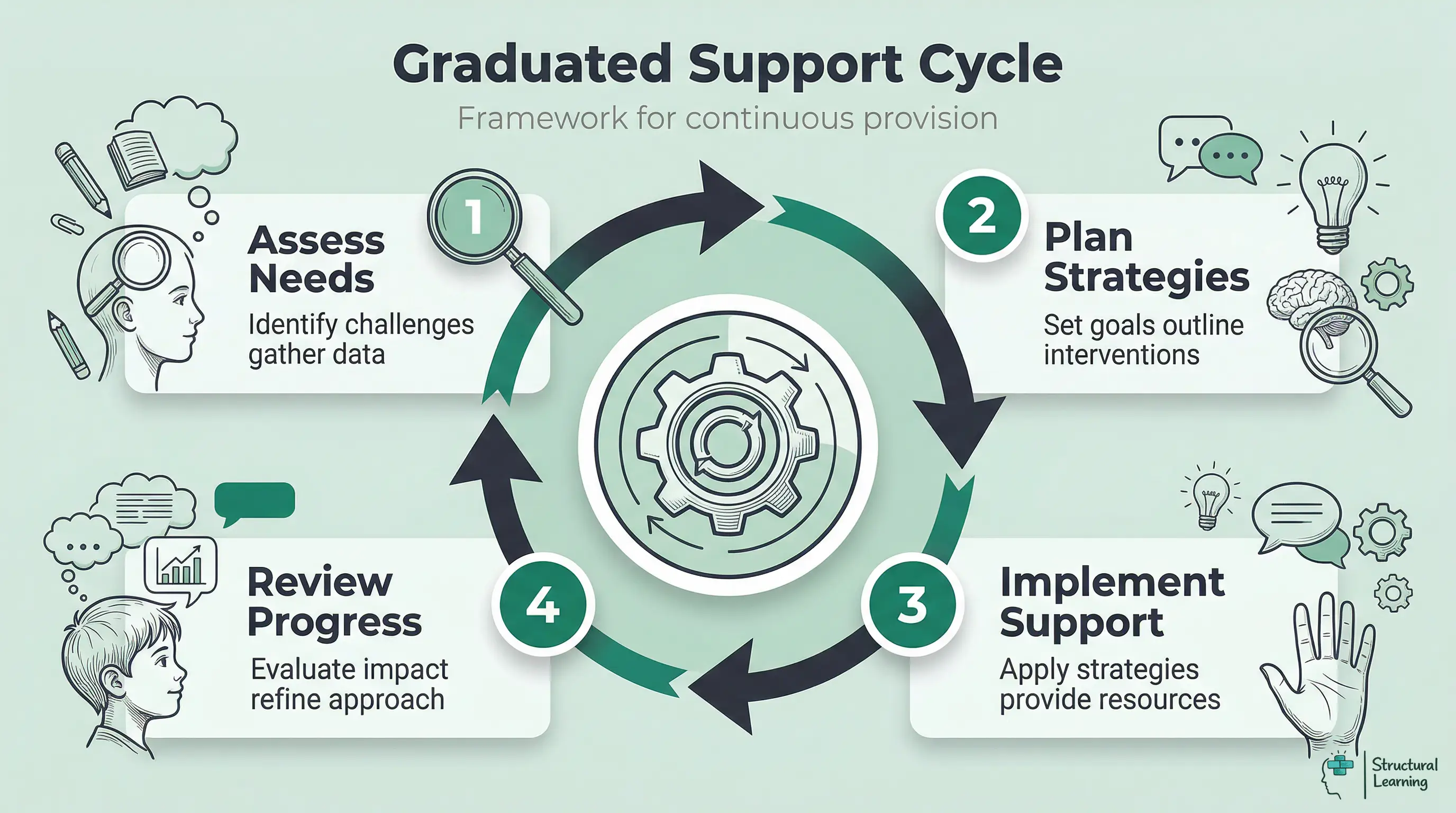
The SEND Code of Practice (2015) sets out a graduated approach to meeting the needs of pupils with special educational needs. This applies to ODD just as it applies to dyslexia, speech and language difficulties or any other area of need. The framework is known as the Assess, Plan, Do, Review (APDR) cycle, and it gives schools a structured way to move beyond reactive behaviour management towards planned, evidence-informed provision.
Assess. Gather baseline data. How often do oppositional behaviours occur? In which lessons? With which adults? Are there specific triggers (transitions, unstructured time, particular subjects)? Use an ABC chart (Antecedent, Behaviour, Consequence) to map patterns. Involve the pupil where possible. Ask them what makes school hard. You may be surprised by the insight they offer. This assessment phase connects directly to your SEMH provision and should involve your SENCo from the outset.
Plan. Based on your assessment, create a targeted behaviour plan. This should specify: the key behaviours you are addressing (no more than two or three at a time), the strategies you will use (drawn from the evidence-based table above), the adults responsible, the review date and the success criteria. Be specific. "Improve behaviour" is not a target. "Reduce the number of lesson refusals from five per day to two per day within four weeks" is. Record this in your provision map.
Do. Implement the plan consistently. Every adult who works with the pupil must know the plan and follow it. This is where one-page profiles are invaluable. They summarise the child's triggers, preferred strategies and de-escalation approaches on a single sheet that can be shared with cover teachers and support staff. Monitor as you go. Keep brief daily notes on incidents and successes.
Review. At the agreed review date (typically every six to eight weeks), assess progress against your success criteria. Has the frequency of oppositional behaviour decreased? Have new patterns emerged? Is the child engaging more in learning? If progress is sufficient, continue the current plan. If not, adjust. If you have been through two or three APDR cycles with limited improvement, this is the point at which to consider requesting an external assessment from an educational psychologist or referral to CAMHS.
The APDR cycle is not bureaucracy for its own sake. It is the mechanism that allows you to demonstrate what you have tried, what has worked and what has not. If a pupil eventually needs an Education, Health and Care Plan (EHCP), your APDR records are the evidence base that supports the application.
Working with Families
ODD does not exist only in school. Parents and carers are dealing with the same behaviours at home, often without the training or support systems that schools have. Building a genuine partnership with the family is one of the most powerful things you can do for a pupil with ODD. It is also one of the most difficult.
Start by recognising that many parents of children with ODD have had negative experiences with schools. They may have been called in repeatedly for meetings that feel like blame sessions. They may have been told their child is "naughty" or that they need to "be firmer at home." By the time they reach your classroom, their defences may be as high as their child's. Lead with empathy. Start every conversation with something positive about their child. Ask about what works at home before offering advice.
Consistency between home and school is the gold standard for ODD management. If you are using a reward system in class, share it with the family and ask if they can mirror it at home. If you have identified specific triggers, compare notes. Some families find that the same strategies that work in the classroom, such as limited choices, advance warnings and consistent consequences, are effective at home too.
When should you recommend a CAMHS referral? If the pupil's behaviour is significantly impacting their learning and wellbeing despite a documented graduated approach in school, a referral to Child and Adolescent Mental Health Services is appropriate. In many areas, the GP is the referral route, but schools can also refer directly in some Clinical Commissioning Group areas. Be honest with parents about what the referral involves and what it does not. CAMHS waiting lists in the UK are long, often exceeding 12 months, so early referral is advisable. In the meantime, school-based counselling, mentoring programmes and structured oracy activities can provide valuable support.
Some schools have found success with parent training programmes such as the Incredible Years or Triple P (Positive Parenting Programme). These evidence-based programmes teach parents specific techniques for managing oppositional behaviour and are recommended by NICE guidelines. If your school does not run these, your local authority may offer them through Early Help services.
ODD Strategies by Symptom
Oppositional Defiant Disorder (ODD) is characterised by a persistent pattern of uncooperative, defiant and hostile behaviour towards authority figures. The following table details how each symptom typically presents in the classroom and provides practical strategies for teachers and SENCOs. Consistency, positive reinforcement and avoiding power struggles are central to effective support.
Symptom
How It Presents
Recommended Strategy
Angry or Irritable Mood
Frequent temper tantrums, easily annoyed, often angry and resentful
Remain calm, use positive reinforcement, avoid power struggles
Argumentative or Defiant Behaviour
Often argues with authority figures, actively defies or refuses to comply with rules, deliberately annoys others
Set clear and consistent rules, provide choices to reduce power struggles, use time-outs when necessary
Vindictiveness
Spiteful or vindictive behaviour, holds grudges
Address behaviours calmly, avoid retaliation, encourage empathy and understanding
Blaming Others
Often blames others for their own mistakes or misbehaviour
Help them understand consequences, teach responsibility, use problem-solving techniques
Easily Annoyed
Easily irritated by peers and adults, low tolerance for frustration
Teach coping skills, use relaxation techniques, create a low-stress environment
Frequent Anger Outbursts
Loses temper frequently, difficulty managing anger in the classroom
Teach anger management strategies, use calming techniques, provide a safe space for cooling down
Refusal to Follow Rules
Consistently disobeys rules and requests from adults
Implement consistent discipline, use a reward system for compliance, provide clear expectations
Frequent Blaming
Regularly blames others for their own behaviour or mistakes
Encourage taking responsibility, discuss the impact of actions on others, use role-playing to teach empathy
Frequent Resentment
Holds onto grudges, often resentful or spiteful towards peers and staff
Teach forgiveness and letting go, encourage positive social interactions, reinforce positive behaviour
Dealing with Authority
Defiance towards authority figures, frequent arguments with teachers and parents
Build a positive relationship, avoid confrontations, use problem-solving approaches
Understanding and Acceptance
ODD is a behavioural disorder, not a choice; pupils need empathy and understanding
Educate yourself about ODD, validate feelings, maintain a supportive attitude
Adapted Communication
Emotional reactions from adults can escalate situations; language and tone matter
Use clear and concise language, avoid emotional reactions, remain calm and neutral, provide specific feedback
Consistent Discipline
Inconsistent consequences lead to confusion and increased defiance
Use consistent and fair discipline, establish a routine, provide immediate consequences
Positive Reinforcement
Pupils with ODD respond better to recognition of positive behaviour than to punishment
Implement a reward system, praise specific positive behaviours, provide tangible incentives
Professional Support
ODD often co-occurs with ADHD, anxiety or conduct disorder and requires specialist input
Seek professional guidance, involve school support services, consider family therapy
Parent Training
Consistency between home and school is essential for managing ODD behaviours
Attend parenting classes, learn behaviour management strategies, seek support groups
Source: Structural Learning ODD Strategies Guide. ODD is a recognised behavioural disorder and strategies should be implemented consistently across home and school. Professional support from CAMHS or educational psychologists is recommended for persistent cases.
Further Reading
Understanding ODD well enough to support pupils effectively requires ongoing professional learning. The following sources provide the strongest evidence base for classroom practitioners working with oppositional behaviour.
NICE Guideline [CG158]: Antisocial Behaviour and Conduct Disorders in Children and Young People. This is the UK's primary clinical guideline covering ODD and Conduct Disorder. It includes recommendations for parent training programmes, school-based interventions and referral pathways. Available at nice.org.uk/guidance/cg158.
American Academy of Child and Adolescent Psychiatry (AACAP): Practice Parameter for the Assessment and Treatment of Children and Adolescents with Oppositional Defiant Disorder. A comprehensive clinical resource covering diagnosis, co-morbidity and evidence-based treatment. Particularly useful for understanding the DSM-5 criteria in depth. Published in the Journal of the American Academy of Child and Adolescent Psychiatry.
The SEND Code of Practice: 0 to 25 Years (DfE, 2015). The statutory framework for SEND provision in England. Chapter 6 covers the graduated approach (APDR cycle) in schools and is essential reading for any teacher working with ODD within the SEND framework.
Nock, M.K., Kazdin, A.E., Hiripi, E. and Kessler, R.C. (2007). Lifetime Prevalence, Correlates and Persistence of Oppositional Defiant Disorder. Journal of Child Psychology and Psychiatry, 48(7), 703-713. A landmark epidemiological study providing prevalence data and analysis of co-morbid conditions. Useful for understanding the scale of ODD and its relationship to other disorders.
The Incredible Years Programme (Webster-Stratton, C.). An evidence-based parent and teacher training programme recommended by NICE for managing conduct problems and ODD. The teacher classroom management component is particularly relevant for UK schools. Details at incredibleyears.com.
ODD is not a label to fear. It is a condition to understand. With the right knowledge, consistent strategies and a commitment to seeing the child behind the behaviour, you can make a genuine difference to their school experience and long-term outcomes. The pupils who push back the hardest are often the ones who need your patience the most.

Every school in the UK has pupils who push back against rules, argue with adults and seem to resist authority at every turn. For most children, this is a passing phase. But for the estimated 5% of school-age children in the UK who meet the criteria for Oppositional Defiant Disorder (ODD), the pattern runs deeper, lasts longer and disrupts learning for the child and their classmates alike. If you are a teacher, teaching assistant or SENCo, understanding ODD is not optional. It is a core part of your professional toolkit for special educational needs provision.
ODD is one of the most common behavioural disorders in childhood, yet it remains widely misunderstood in staffrooms. Teachers often describe these pupils as "deliberately difficult" or "choosing to misbehave." The reality is more nuanced. ODD is a recognised clinical condition with specific diagnostic criteria, and the children who live with it need structured, consistent and relationship-driven support rather than punishment alone.
Key Takeaways
ODD is a clinical condition, not a character flaw. It affects approximately 5% of UK children and requires a planned, evidence-based response from schools.
Proactive strategies outperform reactive ones. Consistent routines, clear expectations and positive reinforcement reduce confrontation far more effectively than sanctions.
ODD is frequently confused with PDA, ADHD and Conduct Disorder. Accurate identification matters because the wrong approach can make behaviour worse.
A graduated approach (Assess, Plan, Do, Review) gives schools a framework for tracking progress and adjusting provision without relying on gut instinct alone.
What Is Oppositional Defiant Disorder?
The Diagnostic and Statistical Manual of Mental Disorders (DSM-5) defines ODD as a recurrent pattern of angry or irritable mood, argumentative or defiant behaviour, and vindictiveness lasting at least six months. The behaviours must be directed at someone other than a sibling and must occur more frequently than is typical for the child's age and developmental stage. This distinction matters. All children argue, refuse and push boundaries at times. ODD is diagnosed only when these behaviours are persistent, pervasive and cause meaningful impairment in social, educational or family functioning.
ODD typically emerges before the age of eight, though it can appear later. Research published in the Journal of Child Psychology and Psychiatry suggests that early onset is associated with more persistent difficulties. Boys are diagnosed more frequently than girls in childhood, though this gap narrows in adolescence, which suggests possible referral bias rather than true prevalence differences.
The DSM-5 groups ODD symptoms into three clusters: angry or irritable mood (frequent temper outbursts, touchiness, resentfulness), argumentative or defiant behaviour (arguing with adults, actively defying requests, deliberately annoying others, blaming others for mistakes) and vindictiveness (spiteful or retaliatory behaviour at least twice within six months). A child does not need to show all symptoms. The threshold is four or more from any cluster.
It is worth noting that ODD is not a label that explains why a child behaves this way. It is a description of a pattern. The causes are typically a combination of temperamental factors (low frustration tolerance, high emotional reactivity), family environment, and neurological differences in areas of the brain responsible for executive function and emotional regulation.
How ODD Differs from PDA, ADHD and Conduct Disorder
One of the most common mistakes in schools is treating all oppositional behaviour as if it has the same cause. A pupil with Pathological Demand Avoidance (PDA), a profile of autism, may look similar to a pupil with ODD on the surface. Both refuse adult requests and resist rules. But the underlying drivers are entirely different, and strategies that work for one group can backfire badly with the other.
Similarly, ADHD and ODD frequently co-occur. Studies suggest that up to 40-60% of children with ADHD also meet the criteria for ODD. When a pupil with undiagnosed ADHD is treated purely as defiant, schools miss the executive function difficulties driving the behaviour. Conduct Disorder (CD), meanwhile, involves more serious antisocial behaviour such as aggression towards people or animals, destruction of property and deceitfulness. ODD is sometimes a precursor to CD, but the two are clinically distinct.
Feature
ODD
PDA (Autism Profile)
ADHD
Conduct Disorder
Primary driver
Anger, defiance towards authority
Anxiety-driven demand avoidance
Impulsivity, inattention
Aggression, rule violation
Response to direct demands
Argues, refuses, escalates
Panics, withdraws, uses distraction or social strategies to avoid
Forgets, gets distracted, loses focus
Ignores or intimidates
Empathy and remorse
Usually present after calming
Usually present but masked by anxiety
Usually present
Often reduced or absent
Typical onset
Before age 8
Early childhood
Before age 12
Childhood or adolescence
Social relationships
Conflict with authority; peers may be fine
Difficulties reading social cues; may mask
Often wants friendships but struggles with impulse control
May use relationships instrumentally
Effective approach
Consistent boundaries + positive relationship
Reduced demands, flexibility, indirect language
Structure, prompts, movement breaks, medication review
Multi-agency, specialist intervention
Why does this matter for classroom practice? Because a PDA pupil who is given a firm, direct instruction ("You need to sit down now") is likely to experience a surge of anxiety that makes compliance harder. The same instruction may be exactly the right approach for a pupil with ODD, provided it is delivered calmly and paired with a known consequence. Getting the identification right is the first step towards getting the strategy right. If you are unsure, consult your SENCo and consider a referral for a multi-disciplinary assessment.
Recognising ODD in Your Classroom
What does ODD actually look like in a primary or secondary classroom? It is rarely the dramatic, table-flipping image that comes to mind. More often, it is a persistent, low-level pattern that wears teachers down over weeks and months. The pupil who argues with every instruction. The child who refuses to start work unless conditions are exactly right. The young person who blames everyone else when things go wrong. These patterns, taken individually, look like ordinary misbehaviour. Taken together, over time, they form a recognisable clinical picture.
The following table, drawn from DSM-5 criteria and adapted with classroom-specific indicators, can help you identify whether a pupil's behaviour may warrant further investigation.
DSM-5 Symptom Cluster
What You Might See in School
Frequency Threshold
Angry/Irritable Mood
Frequent temper outbursts over minor issues; easily annoyed by peers; persistent resentful or angry mood across the school day
Most days, for at least 6 months
Argumentative/Defiant Behaviour
Argues with teachers over routine instructions; actively refuses to follow classroom rules; deliberately provokes other pupils; blames others for own mistakes or behaviour
At least weekly, for at least 6 months
Vindictiveness
Spiteful comments or actions aimed at peers or staff; holds grudges; retaliatory behaviour after perceived slights
At least twice in the past 6 months
A few important caveats. First, you are not diagnosing ODD. That is a clinical decision made by a paediatrician, psychiatrist or clinical psychologist. Your role is to recognise the pattern, document it carefully and refer appropriately. Second, always consider whether the behaviour might be explained by something else entirely: a bereavement, an attachment difficulty, an undiagnosed learning need, or difficulties with self-regulation. Context matters enormously.
When should you escalate? If you have documented a pattern of oppositional behaviour lasting more than six months that is significantly affecting the pupil's learning or relationships, speak to your SENCo. Bring your records. Include frequency data, specific examples, triggers you have identified and any strategies you have already tried. Good documentation is the bridge between classroom observation and clinical assessment.
Evidence-Based Strategies for ODD
The research is clear on one point: punitive, confrontational approaches make ODD worse, not better. What works is a combination of proactive classroom management, planned de-escalation, consistent boundaries and genuine relationship-building. This is not about being "soft." It is about being strategic. The goal is to reduce the frequency and intensity of oppositional episodes while teaching the child alternative ways to manage their emotions and behaviour.
The strategies below are organised by situation. Many of them overlap with general behaviour management strategies, but the key difference with ODD is the degree of consistency and intentionality required. What works occasionally for other pupils must be applied systematically and without exception for a pupil with ODD.
Situation
Strategy
Why It Works for ODD
Lesson transitions
Give a 2-minute warning before any change of activity. Use a visual timer. State exactly what will happen next.
Reduces the surprise and loss of control that triggers defiance. Predictability lowers arousal.
Giving instructions
Offer limited choices: "Would you like to start with the diagram or the written questions?" Avoid open-ended demands.
Gives the pupil a sense of autonomy within your boundaries. Reduces power struggles.
Refusal to work
Acknowledge the feeling ("I can see this is frustrating"), restate the expectation calmly, offer a reduced first step. Walk away briefly to allow processing time.
Validates emotion without endorsing the refusal. The walk-away prevents escalation and removes the audience.
Arguing with you
State the rule once. State the consequence once. Do not repeat or engage in debate. Use the phrase "I've told you what I need. I'll check back in two minutes."
Removes the argument loop. Pupils with ODD are skilled at drawing adults into extended verbal battles.
Escalating anger
Lower your voice. Reduce your physical proximity. Offer a planned exit: "You can take five minutes in the reading corner." Have a pre-agreed calm-down routine.
Matching intensity fuels the cycle. A calm, low-energy response interrupts the escalation pattern.
After an incident
Wait until the pupil is fully calm (20-30 minutes minimum). Use a restorative conversation: "What happened? What were you feeling? What could we do differently next time?"
Pupils with ODD cannot process consequences or reflect while still in a heightened state. Timing is everything.
Daily relationship-building
Greet the pupil by name at the door. Find one genuine positive comment per lesson. Refer to their interests. Invest in the 2:1 ratio (two positive interactions for every corrective one).
ODD pupils often expect conflict from adults. A consistent positive relationship disrupts this expectation and builds trust over time.
Reinforcing positive behaviour
Catch them being good. Use specific praise: "You started that task within 30 seconds. Well done." Avoid generic praise ("Good boy"). Consider a private reward system rather than public charts.
Specific, immediate reinforcement builds the neural pathways for compliant behaviour. Private systems avoid the public humiliation that can trigger defiance.
Consistent boundaries
Apply the same rules and consequences every time, without exception. Share your approach with all adults who work with the child. Write it into a one-page profile.
Inconsistency is the enemy. If a pupil with ODD discovers that defiance sometimes works, they will increase it. Consistency removes the incentive to test.
Notice the common thread running through every strategy: you stay calm, you stay consistent and you avoid getting drawn into the power struggle. This is emotion coaching in practice. You acknowledge the child's feelings while holding firm on expectations. It is harder than it sounds, especially on a Friday afternoon in a class of 30. But it works.
These strategies align closely with the principles of quality first teaching. Clear instructions, structured routines, differentiated expectations and positive relationships are good for every pupil. For a child with ODD, they are essential. Scaffolding the learning environment in this way reduces the triggers that lead to confrontation in the first place.
What Doesn't Work: Approaches to Avoid
Understanding what not to do is just as important as knowing what to do. Some of the most instinctive responses to oppositional behaviour are precisely the ones that make it worse. If you have ever found yourself in a ten-minute standoff with a pupil while the rest of the class watches, you already know how this feels.
Power struggles. This is the number one trap. A pupil with ODD will argue with you for as long as you are willing to argue back. Every exchange raises the emotional temperature and deepens the confrontation. The moment you engage in a back-and-forth debate about whether a rule is fair, you have already lost the battle. State the expectation. State the consequence. Walk away. Return in two minutes.
Public confrontation. Correcting a pupil with ODD in front of their peers is almost guaranteed to escalate the situation. The child experiences public correction as humiliation, and humiliation triggers defiance. Wherever possible, move conversations to the corridor, speak quietly at the pupil's desk, or use a private signal system that only you and the child understand.
Inconsistency. If the consequence for refusal is different on Monday than it is on Thursday, the pupil learns that defiance is a rational strategy. Why comply when there is a reasonable chance the rule will not be enforced? Every adult working with the child must apply the same approach. This includes supply teachers, lunchtime supervisors and teaching assistants. One-page profiles and behaviour plans exist precisely for this reason.
Zero-tolerance policies. Rigid, whole-school zero-tolerance systems often fail pupils with ODD because they leave no room for the graduated, relationship-based approach these children need. A blanket "three strikes and you're in isolation" rule may work for the majority of pupils. For a child with ODD, it can create a cycle of exclusion that damages the school-pupil relationship beyond repair. Differentiation applies to behaviour management, not just academic work.
Taking it personally. This is perhaps the hardest point. When a pupil says hurtful things, refuses your help or undermines your authority in front of colleagues, it is natural to feel angry, frustrated or defeated. But the child is not doing this to you. They are doing it because their brain is wired for conflict with authority, and they lack the self-regulation skills to respond differently. Separating the behaviour from the child is not just a therapeutic principle. It is a survival strategy for your own wellbeing.
The Graduated Approach for ODD
The SEND Code of Practice (2015) sets out a graduated approach to meeting the needs of pupils with special educational needs. This applies to ODD just as it applies to dyslexia, speech and language difficulties or any other area of need. The framework is known as the Assess, Plan, Do, Review (APDR) cycle, and it gives schools a structured way to move beyond reactive behaviour management towards planned, evidence-informed provision.
Assess. Gather baseline data. How often do oppositional behaviours occur? In which lessons? With which adults? Are there specific triggers (transitions, unstructured time, particular subjects)? Use an ABC chart (Antecedent, Behaviour, Consequence) to map patterns. Involve the pupil where possible. Ask them what makes school hard. You may be surprised by the insight they offer. This assessment phase connects directly to your SEMH provision and should involve your SENCo from the outset.
Plan. Based on your assessment, create a targeted behaviour plan. This should specify: the key behaviours you are addressing (no more than two or three at a time), the strategies you will use (drawn from the evidence-based table above), the adults responsible, the review date and the success criteria. Be specific. "Improve behaviour" is not a target. "Reduce the number of lesson refusals from five per day to two per day within four weeks" is. Record this in your provision map.
Do. Implement the plan consistently. Every adult who works with the pupil must know the plan and follow it. This is where one-page profiles are invaluable. They summarise the child's triggers, preferred strategies and de-escalation approaches on a single sheet that can be shared with cover teachers and support staff. Monitor as you go. Keep brief daily notes on incidents and successes.
Review. At the agreed review date (typically every six to eight weeks), assess progress against your success criteria. Has the frequency of oppositional behaviour decreased? Have new patterns emerged? Is the child engaging more in learning? If progress is sufficient, continue the current plan. If not, adjust. If you have been through two or three APDR cycles with limited improvement, this is the point at which to consider requesting an external assessment from an educational psychologist or referral to CAMHS.
The APDR cycle is not bureaucracy for its own sake. It is the mechanism that allows you to demonstrate what you have tried, what has worked and what has not. If a pupil eventually needs an Education, Health and Care Plan (EHCP), your APDR records are the evidence base that supports the application.
Working with Families
ODD does not exist only in school. Parents and carers are dealing with the same behaviours at home, often without the training or support systems that schools have. Building a genuine partnership with the family is one of the most powerful things you can do for a pupil with ODD. It is also one of the most difficult.
Start by recognising that many parents of children with ODD have had negative experiences with schools. They may have been called in repeatedly for meetings that feel like blame sessions. They may have been told their child is "naughty" or that they need to "be firmer at home." By the time they reach your classroom, their defences may be as high as their child's. Lead with empathy. Start every conversation with something positive about their child. Ask about what works at home before offering advice.
Consistency between home and school is the gold standard for ODD management. If you are using a reward system in class, share it with the family and ask if they can mirror it at home. If you have identified specific triggers, compare notes. Some families find that the same strategies that work in the classroom, such as limited choices, advance warnings and consistent consequences, are effective at home too.
When should you recommend a CAMHS referral? If the pupil's behaviour is significantly impacting their learning and wellbeing despite a documented graduated approach in school, a referral to Child and Adolescent Mental Health Services is appropriate. In many areas, the GP is the referral route, but schools can also refer directly in some Clinical Commissioning Group areas. Be honest with parents about what the referral involves and what it does not. CAMHS waiting lists in the UK are long, often exceeding 12 months, so early referral is advisable. In the meantime, school-based counselling, mentoring programmes and structured oracy activities can provide valuable support.
Some schools have found success with parent training programmes such as the Incredible Years or Triple P (Positive Parenting Programme). These evidence-based programmes teach parents specific techniques for managing oppositional behaviour and are recommended by NICE guidelines. If your school does not run these, your local authority may offer them through Early Help services.
ODD Strategies by Symptom
Oppositional Defiant Disorder (ODD) is characterised by a persistent pattern of uncooperative, defiant and hostile behaviour towards authority figures. The following table details how each symptom typically presents in the classroom and provides practical strategies for teachers and SENCOs. Consistency, positive reinforcement and avoiding power struggles are central to effective support.
Symptom
How It Presents
Recommended Strategy
Angry or Irritable Mood
Frequent temper tantrums, easily annoyed, often angry and resentful
Remain calm, use positive reinforcement, avoid power struggles
Argumentative or Defiant Behaviour
Often argues with authority figures, actively defies or refuses to comply with rules, deliberately annoys others
Set clear and consistent rules, provide choices to reduce power struggles, use time-outs when necessary
Vindictiveness
Spiteful or vindictive behaviour, holds grudges
Address behaviours calmly, avoid retaliation, encourage empathy and understanding
Blaming Others
Often blames others for their own mistakes or misbehaviour
Help them understand consequences, teach responsibility, use problem-solving techniques
Easily Annoyed
Easily irritated by peers and adults, low tolerance for frustration
Teach coping skills, use relaxation techniques, create a low-stress environment
Frequent Anger Outbursts
Loses temper frequently, difficulty managing anger in the classroom
Teach anger management strategies, use calming techniques, provide a safe space for cooling down
Refusal to Follow Rules
Consistently disobeys rules and requests from adults
Implement consistent discipline, use a reward system for compliance, provide clear expectations
Frequent Blaming
Regularly blames others for their own behaviour or mistakes
Encourage taking responsibility, discuss the impact of actions on others, use role-playing to teach empathy
Frequent Resentment
Holds onto grudges, often resentful or spiteful towards peers and staff
Teach forgiveness and letting go, encourage positive social interactions, reinforce positive behaviour
Dealing with Authority
Defiance towards authority figures, frequent arguments with teachers and parents
Build a positive relationship, avoid confrontations, use problem-solving approaches
Understanding and Acceptance
ODD is a behavioural disorder, not a choice; pupils need empathy and understanding
Educate yourself about ODD, validate feelings, maintain a supportive attitude
Adapted Communication
Emotional reactions from adults can escalate situations; language and tone matter
Use clear and concise language, avoid emotional reactions, remain calm and neutral, provide specific feedback
Consistent Discipline
Inconsistent consequences lead to confusion and increased defiance
Use consistent and fair discipline, establish a routine, provide immediate consequences
Positive Reinforcement
Pupils with ODD respond better to recognition of positive behaviour than to punishment
Implement a reward system, praise specific positive behaviours, provide tangible incentives
Professional Support
ODD often co-occurs with ADHD, anxiety or conduct disorder and requires specialist input
Seek professional guidance, involve school support services, consider family therapy
Parent Training
Consistency between home and school is essential for managing ODD behaviours
Attend parenting classes, learn behaviour management strategies, seek support groups
Source: Structural Learning ODD Strategies Guide. ODD is a recognised behavioural disorder and strategies should be implemented consistently across home and school. Professional support from CAMHS or educational psychologists is recommended for persistent cases.
Further Reading
Understanding ODD well enough to support pupils effectively requires ongoing professional learning. The following sources provide the strongest evidence base for classroom practitioners working with oppositional behaviour.
NICE Guideline [CG158]: Antisocial Behaviour and Conduct Disorders in Children and Young People. This is the UK's primary clinical guideline covering ODD and Conduct Disorder. It includes recommendations for parent training programmes, school-based interventions and referral pathways. Available at nice.org.uk/guidance/cg158.
American Academy of Child and Adolescent Psychiatry (AACAP): Practice Parameter for the Assessment and Treatment of Children and Adolescents with Oppositional Defiant Disorder. A comprehensive clinical resource covering diagnosis, co-morbidity and evidence-based treatment. Particularly useful for understanding the DSM-5 criteria in depth. Published in the Journal of the American Academy of Child and Adolescent Psychiatry.
The SEND Code of Practice: 0 to 25 Years (DfE, 2015). The statutory framework for SEND provision in England. Chapter 6 covers the graduated approach (APDR cycle) in schools and is essential reading for any teacher working with ODD within the SEND framework.
Nock, M.K., Kazdin, A.E., Hiripi, E. and Kessler, R.C. (2007). Lifetime Prevalence, Correlates and Persistence of Oppositional Defiant Disorder. Journal of Child Psychology and Psychiatry, 48(7), 703-713. A landmark epidemiological study providing prevalence data and analysis of co-morbid conditions. Useful for understanding the scale of ODD and its relationship to other disorders.
The Incredible Years Programme (Webster-Stratton, C.). An evidence-based parent and teacher training programme recommended by NICE for managing conduct problems and ODD. The teacher classroom management component is particularly relevant for UK schools. Details at incredibleyears.com.
ODD is not a label to fear. It is a condition to understand. With the right knowledge, consistent strategies and a commitment to seeing the child behind the behaviour, you can make a genuine difference to their school experience and long-term outcomes. The pupils who push back the hardest are often the ones who need your patience the most.