Updated on
September 23, 2026
Everybody Writes: Two Minutes That Change the Discussion
Writing before discussion means all thirty learners have rehearsed a thought. The meta-analyses say short beats long, and disagree about the prompt.


Updated on
September 23, 2026
Writing before discussion means all thirty learners have rehearsed a thought. The meta-analyses say short beats long, and disagree about the prompt.
What is Everybody Writes?
Everybody Writes is technique 38 in Teach Like a Champion 3.0. Every learner writes a response to a question before any discussion begins, so that all of them have rehearsed a thought rather than a few having volunteered one. It usually runs for one to two minutes, and the writing-to-learn meta-analyses support the short version: longer writing assignments produced smaller effects on learning.
Two meta-analyses of writing to learn disagree about whether the design of the writing task matters. That disagreement is more useful to a teacher than either finding on its own, because it tells you which part of the advice to hold loosely.
Everybody Writes means having every learner write a response before anyone discusses it, so that all thirty have rehearsed a thought rather than three having volunteered one. It is technique 38 in Teach Like a Champion 3.0, in the chapter on building ratio through writing, next to Silent Solo at 39.
The evidence for writing to learn is real and modest. Graham, Kiuhara and MacKay (2020) pooled 56 experiments on writing about content in science, social studies and mathematics and found writing reliably improved learning, at an effect size of 0.30. It worked equally well across those subjects and across primary, middle and high school.
Then the awkward part, and it is worth knowing before you redesign your prompts. In that meta-analysis, the effect was not moderated by the features of the writing activity. Bangert-Drowns, Hurley and Wilkinson (2004), pooling 48 school-based writing-to-learn programmes, found the opposite: metacognitive prompts raised the effect. Two credible syntheses, one saying prompt design matters and one saying it does not.
Everybody Writes is the instruction to write a response before any discussion begins. The teacher poses a question, every learner writes for one or two minutes, and only then does the class talk. Its purpose is ratio: the proportion of the class doing cognitive work at any moment. In a hands-up discussion that proportion is small and it is always the same learners.
Three things, and only the first is obvious. Everybody has an answer, so a cold call cannot land on someone with nothing. The teacher can read the room by circulating, which converts a discussion into a check. And the first contribution to the discussion is a second draft rather than a first thought, which raises the floor of what gets said.
The third is the one that changes lessons. A discussion that opens with a rehearsed contribution starts at a different level from one that opens with whoever thought fastest.
Writing to learn has two good meta-analyses, a modest and consistent effect, and one direct finding that supports the short-and-frequent shape of this technique. It also has a genuine disagreement between the two syntheses about whether prompt design does anything.
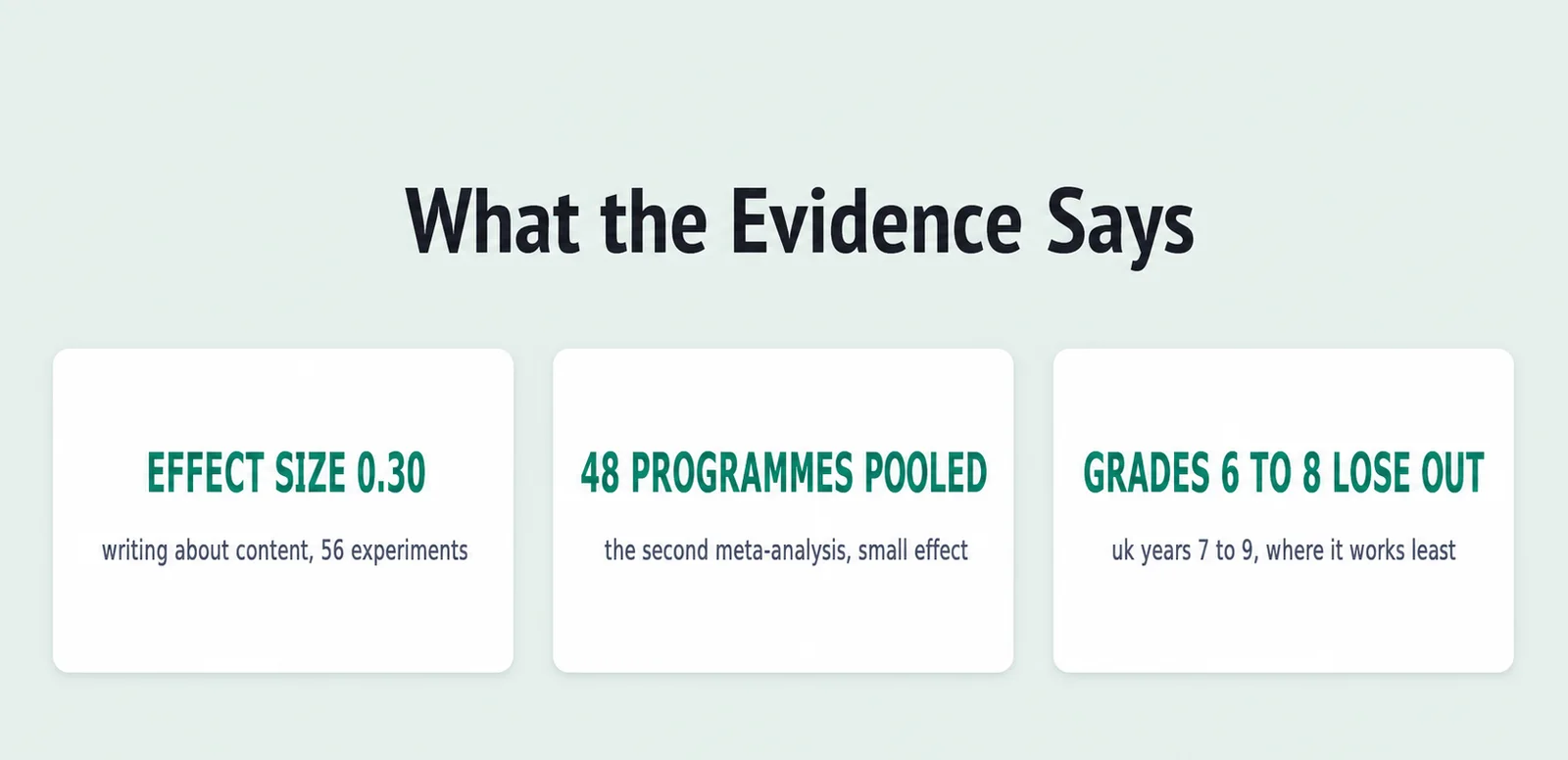
Graham, Kiuhara and MacKay (2020) is the more recent and the more directly relevant: 56 experiments on learners writing about content in science, social studies and mathematics. Writing reliably enhanced learning at an effect size of 0.30. It was equally effective across the three subjects and across elementary, middle and high school learners, and the effect was not moderated by study quality.
Bangert-Drowns, Hurley and Wilkinson (2004) pooled 48 school-based writing-to-learn programmes and reported a small positive impact on conventional achievement measures. Their moderator findings are the useful part, and there are four.
Longer writing assignments reduced the effect. This is the most directly useful finding available for this technique, and it comes from a source that has never heard of Lemov. Short, frequent writing beat extended essays for learning content. A two-minute written response is not a compromised version of an essay; on this evidence it is the better instrument for the job.
Longer treatments raised the effect. One-off writing did little. The gain came from doing it consistently over time, which means Everybody Writes is a routine rather than an intervention you deploy on hard topics.
Metacognitive prompts raised the effect. Asking learners to write about how they decided, rather than only what they concluded, did better. This is the finding Graham and colleagues did not replicate.
Grades 6 to 8 reduced the effect. That is UK Years 7 to 9 almost exactly. The meta-analysis reports it without explaining it. It is the age band where most secondary teachers are trying hardest to establish this routine, and the evidence says it works less well there than either side of it.
Bangert-Drowns and colleagues found the writing task's design mattered. Graham and colleagues found that features of the writing activity, the instruction and the assessment moderated nothing.
Both are peer-reviewed meta-analyses in the same journal. Neither is obviously the weaker. The honest reading is that the act of writing about content is well supported and the optimal design of the prompt is not settled, so a department arguing about prompt wording is arguing about something the evidence does not resolve. Write, write often, and stop tuning.
No study of "write before you discuss" in school classrooms exists. The nearest evidence is from undergraduate science and it is a good analogy rather than a finding about your Year 9 class.
Smith and colleagues (2009), in Science, used exactly this structure: learners answer individually, then discuss, then answer a second comparable question individually. Performance improved, and the striking part is why. The gain was not copying. As the authors put it, peer discussion enhances understanding even when none of the learners in a discussion group originally knows the correct answer. Crouch and Mazur (2001) report ten years of the same commit-then-discuss structure in undergraduate physics.
Individual commitment before group talk has good support. Whether the commitment has to be written, rather than clicked or held in the head, has not been tested.
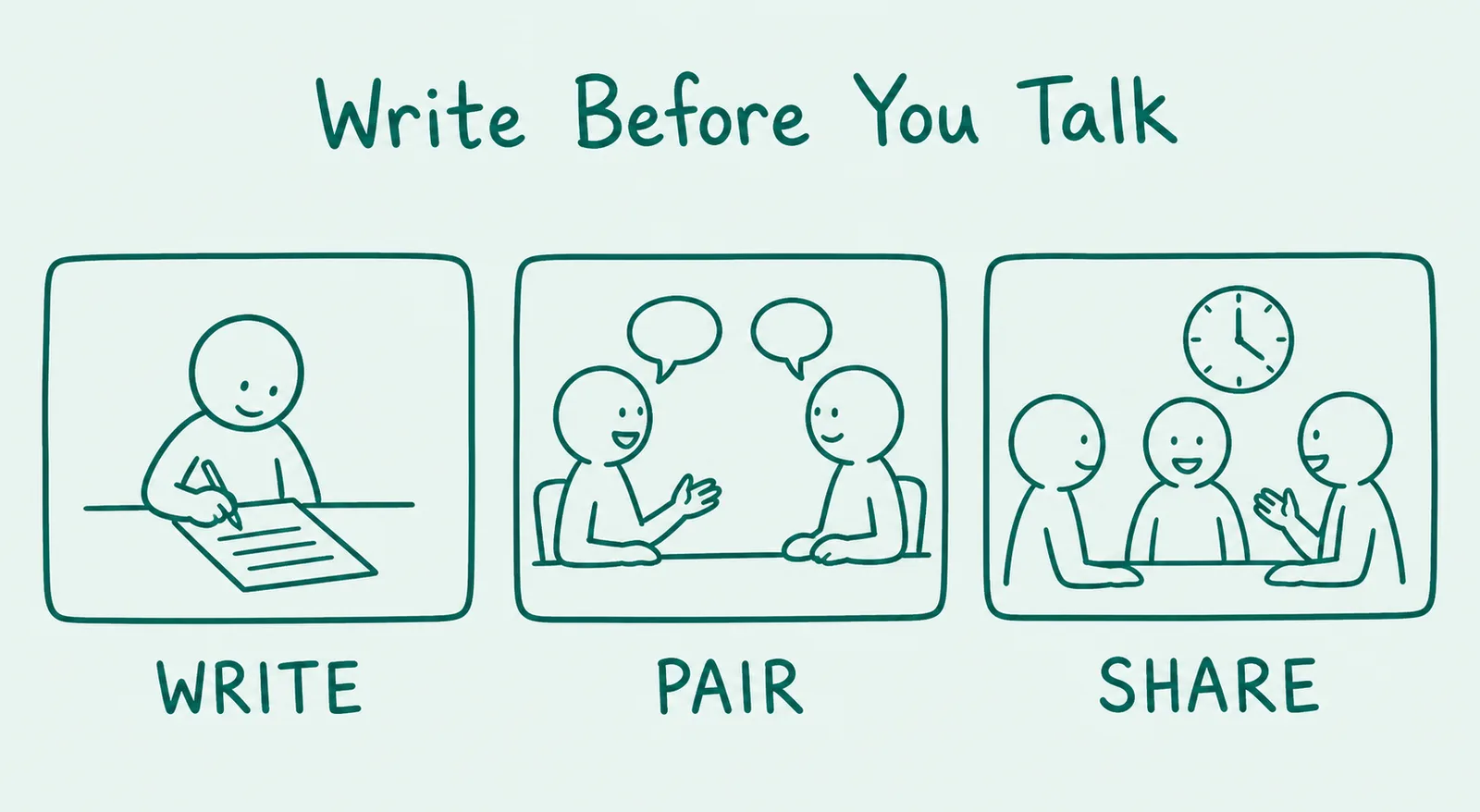
Everything below follows from the evidence rather than from taste. Keep the writing to a couple of minutes, ask for reasoning rather than an answer, circulate and actually read what is on the pages, use what you read to choose who speaks, and do it every lesson rather than only on the hard topics. The first rule is the one teachers break most.
Keep it short. One to two minutes. The meta-analysis found longer assignments did less, and a class asked to write for eight minutes will spend six of them not writing.
Ask for reasoning, not just an answer. "Write why you think that" rather than "write your answer". This is the moderator Bangert-Drowns found and Graham did not, so treat it as a good bet rather than a certainty. It costs nothing to write the prompt this way.
Circulate and read. The technique's biggest return is that thirty answers become visible. Read four or five and you know what to do next, which is the whole of checking for understanding in ninety seconds.
Use what you read to choose who speaks. Having read the answers you can call on the learner whose misconception is most useful, or whose phrasing is best, rather than on the fastest hand. That is what pairs Everybody Writes with cold calling in the same book.
Do it every lesson, not on hard days. Longer treatments produced larger effects. This is a habit. Everybody Writes is one of the 63 moves set out in our complete guide to Teach Like a Champion, and it pairs naturally with turn and talk, where the written answer becomes the thing partners compare.
A technique that makes writing the price of entry to a discussion excludes learners whose difficulty is with writing rather than with thinking. The adjustments keep the thinking and change the medium.
For a learner with dysgraphia or slow handwriting, two minutes of writing produces a fragment, and the discussion then starts without them. Accept a diagram, three words, or a spoken answer to a teaching assistant. The purpose is a rehearsed thought, and handwriting is not the thought.
For an EAL learner early in acquisition, writing in English is a second task on top of the first. Allowing a first draft in a home language, or a sketch, preserves the rehearsal without adding a language barrier to a content question.
For a learner with working memory difficulties, a blank page after a spoken question means holding the question while composing the answer. Leave the question on the board. This costs nothing and removes the whole problem.
For an anxious learner, this technique is usually a help rather than a hazard. Being asked to speak without preparation is the hard version. Having written something first turns a public performance into reading out a prepared line, which is why Everybody Writes is one of the better moves for a reluctant contributor.
The technique is well supported for a classroom technique and the support is thinner than it first appears. The evidence is for writing to learn in general rather than for this specific move, the pooled effect is modest at 0.30, and nobody has costed the minutes it takes out of every lesson. Three qualifications matter.
The evidence is for writing to learn, not for this technique. No study tests Everybody Writes. The meta-analyses cover writing about content in general, and the transfer to a two-minute pre-discussion write is inference. Reasonable inference, and inference.
The effect is modest. 0.30 across 56 experiments is a real and unremarkable effect. It is worth having and it will not transform a department.
It costs time in every lesson. Two minutes, several times a lesson, several lessons a day. Nothing in the literature compares that time against what else the minutes could have bought, because within-subject designs cannot see opportunity cost.
It is technique 38 in Teach Like a Champion 3.0. Every learner writes a response to a question before any discussion, so that all of them have rehearsed a thought rather than a few having volunteered one.
One to two minutes. The writing-to-learn meta-analysis found longer writing assignments produced smaller effects on learning, so the short version is the better instrument rather than a compromise.
No school study tests it. The nearest evidence, from undergraduate science, shows that committing to an individual answer before discussing improves performance, and that the improvement is not explained by copying.
Ask for the reasoning. One meta-analysis found metacognitive prompts raised the effect and a second found the features of the writing task moderated nothing, so treat it as a sensible bet rather than a settled finding. It costs nothing either way.
Change the medium, not the expectation. A diagram, three words, or a spoken answer all produce the rehearsed thought the technique is for. Handwriting speed is not what you are trying to develop in that ninety seconds.
Every reference below was checked twice: once to confirm it exists, and again to confirm the record it resolves to is the study being cited. Where two sources disagree, both are listed rather than the convenient one.