Updated on
September 23, 2026
Accountable Talk: The Three Standards, and the Evidence
Three accountabilities: to community, to accurate knowledge, to rigorous thinking. No randomised trial exists, and the nearest one disappoints in its table.


Updated on
September 23, 2026
Three accountabilities: to community, to accurate knowledge, to rigorous thinking. No randomised trial exists, and the nearest one disappoints in its table.
What is accountable talk?
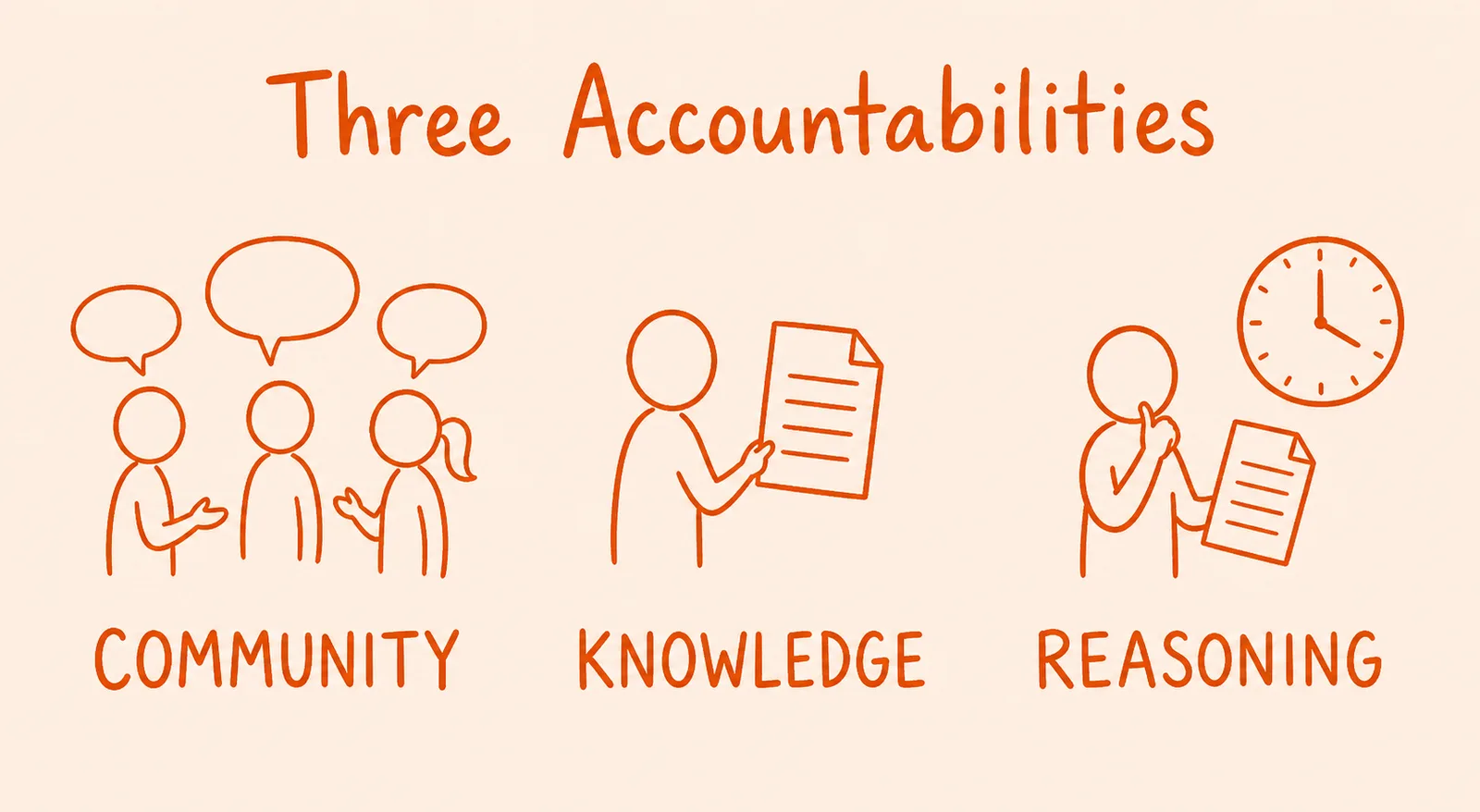
Accountable talk is classroom discussion held to three standards at once: accountability to the learning community, where learners address each other rather than only the teacher; accountability to accurate knowledge, where claims rest on checkable evidence; and accountability to rigorous thinking, where those claims are built into a coherent argument. It is a named framework developed by Lauren Resnick and colleagues at the University of Pittsburgh.
Accountable talk is the most carefully theorised talk framework in education and one of the least trialled. Both halves of that sentence matter, and neither appears on the pages currently explaining it.
Accountable talk is classroom discussion held to three standards at once: learners are accountable to the learning community, to accurate knowledge, and to rigorous thinking. It is a named framework developed by Lauren Resnick and colleagues at the University of Pittsburgh's Institute for Learning, not a generic term for good discussion.
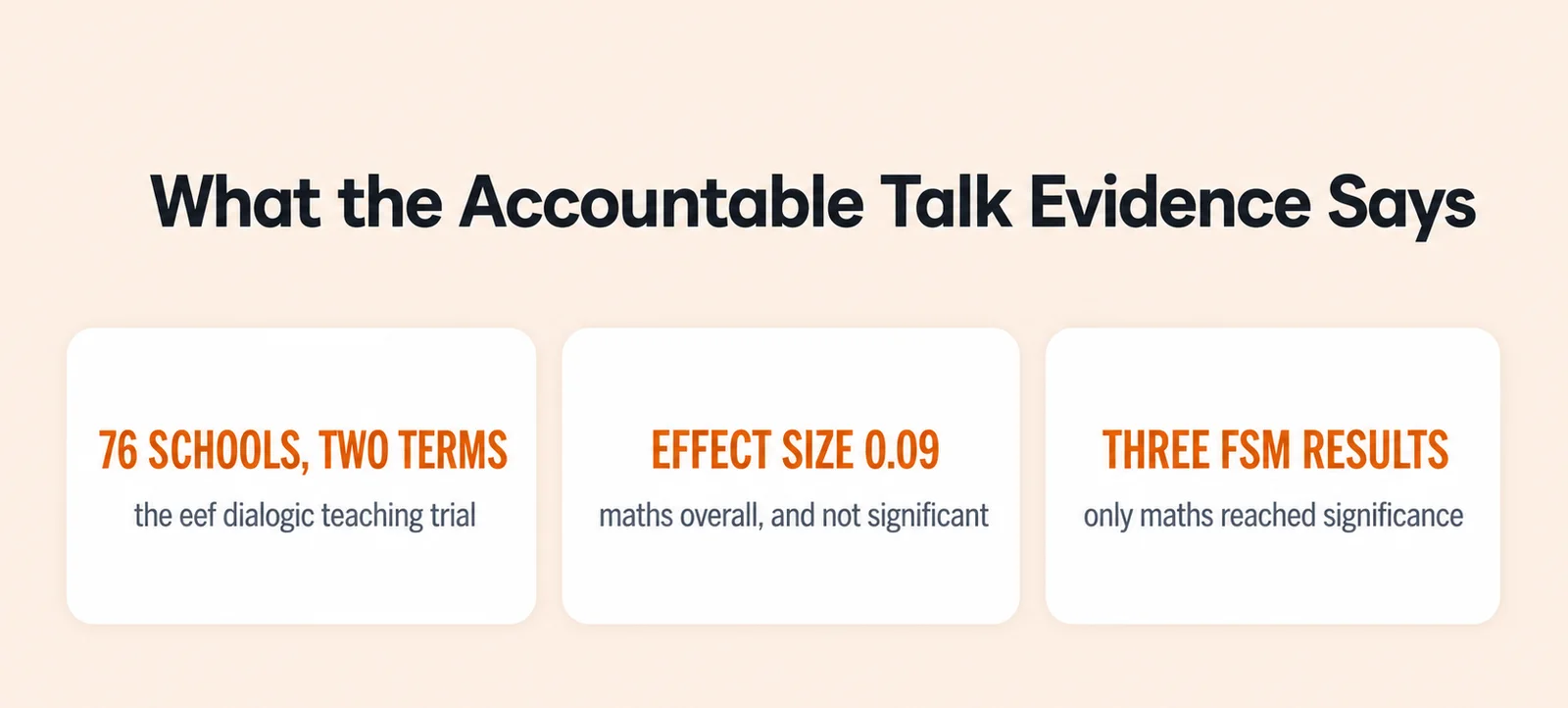
The foundational citation is Michaels, O'Connor and Resnick (2008), and it is worth knowing what kind of paper it is. It appears in Studies in Philosophy and Education and argues the case for accountable talk as deliberative discourse. It is a philosophical argument, carefully made, and it is not a study of whether the approach raises attainment. There is no randomised trial of accountable talk at all. The nearest thing, an Education Endowment Foundation trial of Alexander's dialogic teaching across 76 schools, produced effect sizes between 0.09 and 0.16, and half of them did not reach statistical significance.
The three accountabilities are the useful part, because they are independent. A discussion can satisfy one and fail another, and naming which one is missing is more useful than any amount of encouragement to discuss more. A Year 9 history class argues warmly about whether the Treaty of Versailles caused the war, everyone builds on everyone, and nobody opens the source booklet. That discussion is accountable to the community and not to knowledge, and from the back of the room it looks excellent.
Accountable talk is discussion in which contributions are held to three standards simultaneously. It is not a set of activities; it is a specification for what a good contribution has to do. That specification is what distinguishes it from a lesson where the class simply talks a lot.
Accountability to the learning community. Learners listen to each other and address each other's contributions, building on, challenging or refining them, rather than routing every utterance through the teacher. It includes speaking audibly enough that everyone can actually engage.
Accountability to accurate knowledge. Claims rest explicitly on facts, texts or other publicly accessible information that everyone in the room can check. Being specific about what is known, and about how it is known.
Accountability to rigorous thinking. Using that knowledge to build a coherent line of argument, with reasoning and evidence behind the claims.
The reason this framework is more useful than most is that the three are independent. A warm, inclusive discussion where everyone builds carefully on everyone else, and nobody checks a single fact, is accountable to the community and not to knowledge. That is an extremely common lesson, and it looks excellent from the back of the room.
Several frameworks occupy this ground and they are not interchangeable. Robin Alexander's dialogic teaching is the British one, and it is the one with a large trial behind it. Neil Mercer's work on exploratory talk describes the kind of talk that produces reasoning. Michaels and O'Connor's talk moves are the practical sentence-level tools, and they overlap heavily with accountable talk because the same people developed both.
If you want the theory of what a good contribution owes, accountable talk is the clearest. If you want the framework a British school can point to a trial for, that is dialogic teaching. Our guide to oracy in classroom learning covers how the family fits together.
The honest position is that accountable talk is well theorised, widely used, and has never been through a randomised controlled trial under its own name. The nearest rigorous test is of a comparable British framework, and its results are more modest than its own headline suggests.
The main body of supporting evidence is Project Challenge, a four-year federally funded project with disadvantaged elementary and middle school learners in the United States, which documented consistent use of accountable talk moves alongside significant mathematics gains and reported transfer to English language arts.
Two things follow. There was no randomised control group, and the talk work was part of a whole reform curriculum, so the effect of the talk component cannot be separated from everything else that changed. It is real, encouraging, and it is not a trial.
There is also a recent instrument validation study, Kofman Talmy and Mashal (2024), which shows the construct can be measured reliably. That is genuinely useful for research and says nothing about whether the approach raises attainment.
The Education Endowment Foundation ran an efficacy trial of Robin Alexander's dialogic teaching approach with Year 5 classes: 76 schools, 38 intervention with 2,492 learners against 38 control with 2,466, over two terms, at £52 per pupil per year. It carries a three-padlock security rating, meaning moderate confidence.
Its key conclusions state that children in dialogic teaching schools made two additional months' progress in English and science and one in maths, and that children eligible for free school meals made two additional months' progress in English, science and maths.
Now the table those conclusions are drawn from. Maths overall was an effect size of 0.09 with a confidence interval from -0.04 to 0.20 and p = 0.19. Science overall was 0.12 (0.01 to 0.23), p = 0.04. English overall was 0.15 (0.00 to 0.30), p = 0.05. Among free school meals learners, maths was 0.16 (0.01 to 0.30) at p = 0.03, science 0.11 (-0.04 to 0.26) at p = 0.14, and English 0.12 (-0.07 to 0.30) at p = 0.21.
Read those together and the picture changes. Of the three free school meals results reported as two months' progress, only maths reaches statistical significance. The science and English confidence intervals both cross zero. The one additional month in maths overall rests on a result with p = 0.19. The months-of-progress conversion is applied regardless of significance, which is why the summary reads more strongly than the table supports.
The evaluators flag the problem in one line, noting that the smaller number of free school meals pupils limits the security of that result. It is there, it is honest, and almost nobody who quotes the headline quotes it.
None of this means structured talk does not work. It means the best British trial of it produced small effects, most of which did not reach significance, and that is the state of the evidence rather than a reason to stop.
The framework becomes teachable when it turns into things you say. The talk moves developed alongside it are the practical layer, and each one is doing the work of one of the three accountabilities.
To build accountability to the community, ask learners to respond to each other rather than to you. "Who can say that back in their own words?" and "Do you agree with what she just said, and why?" both force the previous contribution to be heard rather than merely followed.
To build accountability to knowledge, ask for the source. "How do you know that?" and "Where in the text does it say so?" convert an opinion into a claim that can be checked. This is the accountability most commonly missing, and it is the cheapest to add.
To build accountability to rigorous thinking, ask for the link. "What makes you say that?" and "So what follows from that?" push a learner from a claim to an argument.
Give thinking time before any of it. None of these moves work at speed. The pause is doing as much work as the question, which is why wait time belongs alongside this rather than after it. Pairing the moves with turn and talk gets everyone rehearsing before anyone is asked to perform.
A framework built on public reasoning raises the demand on exactly the learners who find public reasoning hardest, and the adjustments are mostly about rehearsal rather than about lowering the standard.
Rehearse before performing. A learner with a language disorder can often produce a good contribution given time and a first attempt, and cannot produce one on demand. Paired talk before whole-class discussion means the public contribution is a second draft.
Give the stem, not the answer. Sentence stems carry the structure of the accountability so the learner can spend their effort on the content. "I agree with X because..." and "The text says... so I think..." are scaffolds for reasoning rather than substitutes for it. It is worth being honest that stems are a practitioner convention here: they are sensible, widely used, and the evidence that they improve the quality of reasoning specifically is thin.
Accountability to the community is not accountability to speak. A learner can be held to the standard through writing, through a partner reporting an agreed position, or through a non-verbal contribution agreed in advance. For a learner with selective mutism, requiring speech defeats the purpose entirely.
Watch what "audibly" is doing. The requirement that contributions be audible to everyone is sound pedagogy and a real barrier for quiet, anxious or hearing-impaired learners. Repeating a contribution yourself, or asking a partner to, gets the class the content without making volume the price of entry.
The framework is coherent and useful and its evidence base does not match its reputation. There is no randomised trial of it, its foundational paper is a philosophical argument rather than a study, the nearest comparable trial produced small and mostly non-significant effects, and it is a branded framework belonging to one institution. Four qualifications are worth carrying.
No randomised trial exists. Not of accountable talk under its own name. The supporting evidence is observational and quasi-experimental, and the strongest of it is confounded with a whole curriculum reform.
The foundational paper is philosophy. Michaels, O'Connor and Resnick (2008) is an argument in a philosophy of education journal. It is a good argument. It is not evidence of effect, and it is routinely cited as though it were.
The comparable trial produced small and mostly non-significant effects. Set out above. A school adopting this on the strength of "two months' progress" should read the table first.
It is a branded framework from one institution. Accountable talk is the property of a specific programme at the University of Pittsburgh, with its own materials and training. That is not a criticism of the ideas, and it does mean a school describing its own practice as accountable talk is using someone else's name for it.
Classroom discussion held to three standards at once: accountability to the learning community, to accurate knowledge, and to rigorous thinking. It is a named framework developed by Lauren Resnick and colleagues at the University of Pittsburgh, not a general term for good discussion.
Accountability to the learning community, which means learners address each other rather than only the teacher. Accountability to accurate knowledge, which means claims rest on checkable evidence. Accountability to rigorous thinking, which means those claims are built into a coherent argument.
Not in the trial sense. There is no randomised controlled trial of it under its own name. The supporting evidence is observational and quasi-experimental, and the foundational paper is a philosophical argument rather than an effectiveness study.
Accountable talk is American, from Resnick's group at Pittsburgh, and specifies what a good contribution owes. Dialogic teaching is Robin Alexander's British framework, and it is the one with a large EEF trial behind it. They overlap substantially in practice.
They are a widely used and sensible practitioner convention. The evidence that stems specifically improve the quality of reasoning is thin, so use them as scaffolding you intend to remove rather than as an intervention with a known effect.
Every reference below was checked twice: once to confirm it exists, and again to confirm the record it resolves to is the work being cited. Where a source is a theoretical argument or an evaluation report rather than a trial, that is stated.