Updated on
September 24, 2026
Precise Praise: The Three-to-One Ratio Does Not Exist
Nineteen schools, 151 classrooms, three years, and no praise-to-reprimand threshold anywhere in the data. More praise is better, with no number to hit.


Updated on
September 24, 2026
Nineteen schools, 151 classrooms, three years, and no praise-to-reprimand threshold anywhere in the data. More praise is better, with no number to hit.
What is precise praise?
Precise praise means naming the specific action or thinking being praised rather than issuing general approval, so that the praise carries information and stays credible. It is technique 60 in Teach Like a Champion 3.0. The widely taught three-to-one praise-to-reprimand ratio has been tested across 151 classrooms and no such threshold was found.
Every UK behaviour training course teaches the three-to-one rule: three praises for every reprimand. It has been tested across 151 classrooms and no such threshold exists.
Precise Praise means praising the specific thing a learner did rather than the learner, and doing it accurately enough that the class believes you. It is technique 60 in Teach Like a Champion 3.0 (Lemov, 2021), in the chapter on building motivation and trust.
The evidence for it is real, mixed, and much thinner in places than the confidence with which it is taught. Caldarella and colleagues (2020) analysed three years of data from 19 schools and 151 classrooms looking for a praise-to-reprimand threshold at which behaviour improves sharply. They did not find one, at three to one or anywhere else. What they found was a simple positive linear relationship: the higher the ratio, the more on-task behaviour. More praise is better, and there is no magic number to hit.
Precise praise names the specific behaviour or piece of thinking being praised, rather than issuing a general approval. "You changed your mind when the evidence changed" is precise. "Good work" is not. The precision does two things: it tells the class what the standard actually is, and it makes the praise credible, because a teacher who says "well done" to everything is saying nothing.
The technique also distinguishes praise from acknowledgement. Meeting an expectation is acknowledged. Exceeding it is praised. Blurring those two is how praise stops carrying information.
Four findings matter, and two of them cut against the way this is usually taught. The direction of travel is well supported, the famous ratio is not, the evidence base for behaviour-specific praise is small, and the wrong kind of praise does real damage to a specific group of learners.
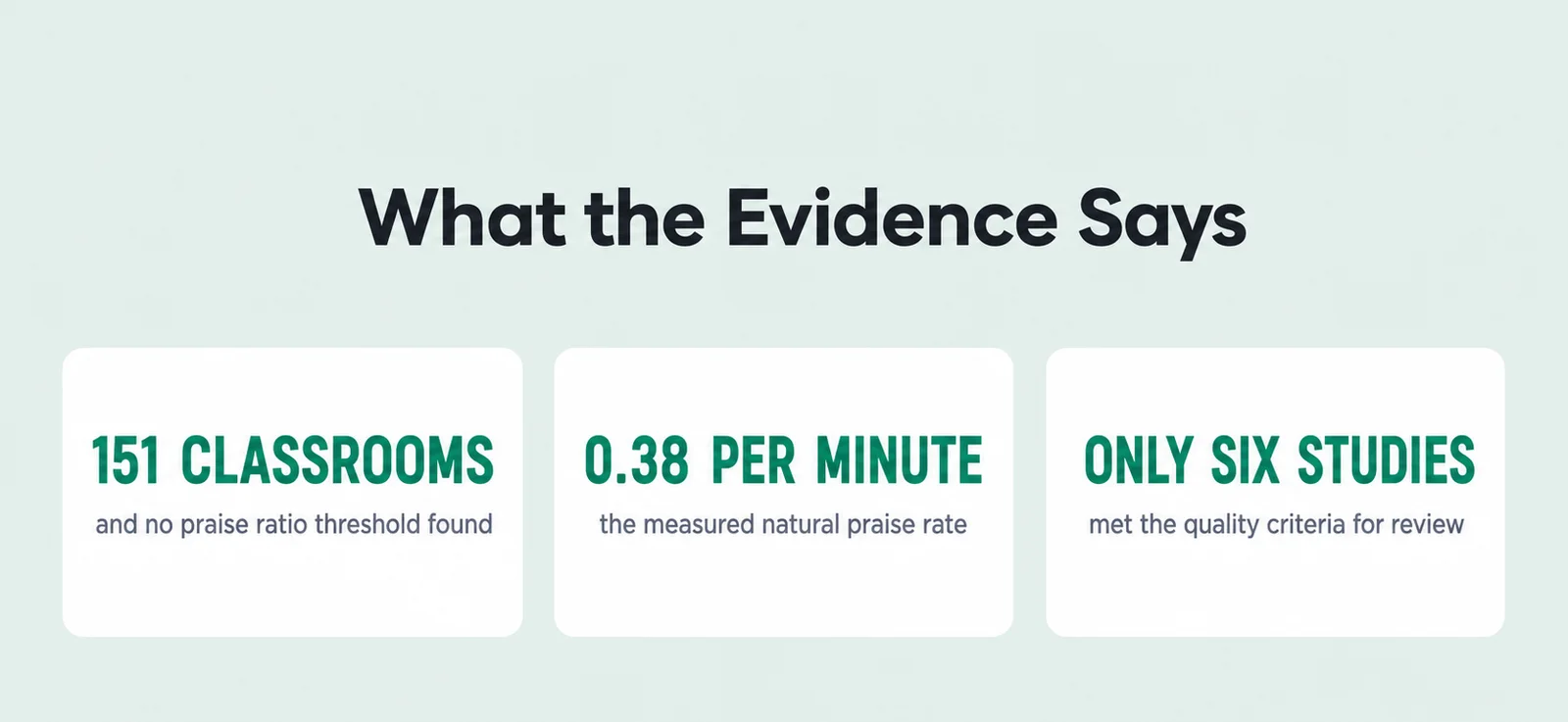
Caldarella and colleagues' study is the one that should change the CPD. Three years, 19 elementary schools, 151 classrooms, looking specifically for the point at which the praise-to-reprimand ratio produces a step change in on-task behaviour. There is no such point. The relationship is linear.
Practically that is liberating rather than deflating. You are not failing a target, and there is no ratio at which you can stop. Every increment helps a bit.
It is worth knowing where you are starting from. Floress and colleagues (2018) recorded 140 hours of direct observation across 28 general classrooms and found natural praise rates low, with grade-level means around 0.38 praise statements per minute at the low end. Most teachers who think they praise plenty are measured, and surprised.
Royer and colleagues (2019) systematically reviewed teacher-delivered behaviour-specific praise. It increased time on task, decreased inappropriate behaviour and reduced lateness. Then the qualification: only six studies met the Council for Exceptional Children's quality criteria, and the authors conclude that behaviour-specific praise is a potentially evidence-based practice.
That is a long way from how it is presented in training. It is probably right, and it is not established.
Mueller and Dweck (1998) ran six studies and found that praising children for intelligence rather than effort produced worse persistence and worse performance after a failure. Parts of the wider mindset literature have replicated poorly, and this specific person-versus-process distinction is the durable part of it. Our guide to what the growth mindset research actually shows sets out which claims survived.
Henderlong and Lepper (2002) reach the same place from a different direction: praise's effect on motivation depends on perceived sincerity, on what it attributes the success to, and on the standard it implies, rather than on how much of it there is.
Brummelman and colleagues (2014) ran three studies on inflated praise, the "that's incredibly beautiful" kind. Two results, and the combination is the problem. Adults are most inclined to give inflated praise to children with low self-esteem. And inflated praise decreased challenge-seeking in exactly those children, while increasing it in children with high self-esteem.
So the instinct to lay it on thick for the learner who seems to need it most produces the opposite of what is intended, reliably, and the teacher never sees the mechanism. Precision is the protection here: a specific, accurate observation cannot be inflated.
Four rules, all of them following from the evidence rather than from taste. Name the behaviour, keep it accurate, separate acknowledgement from praise, and raise your overall rate without chasing a ratio.
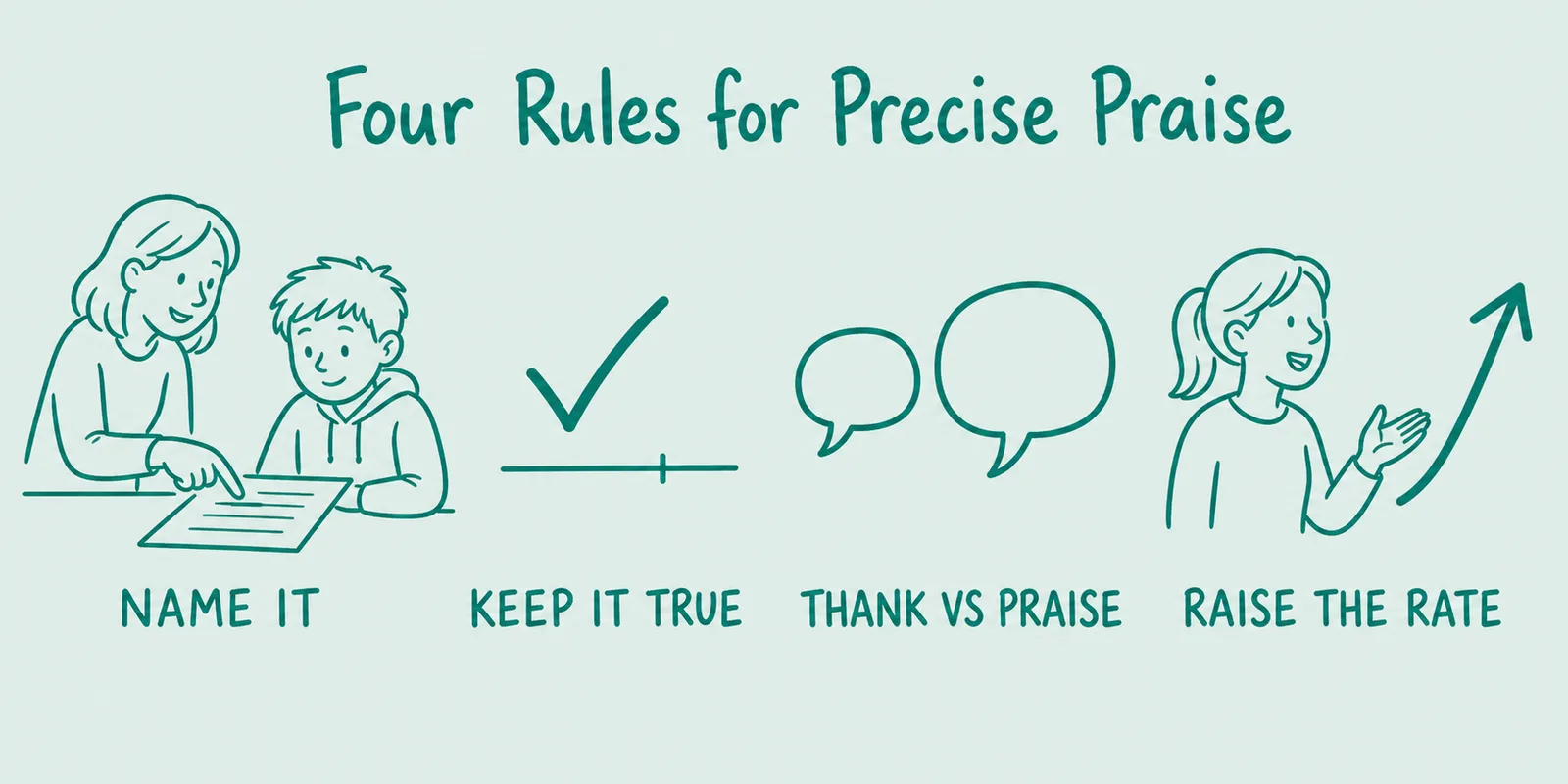
Name what they did. "You used the source rather than your memory" beats "excellent". The class learns the standard from the sentence.
Never inflate. If the work is fine, say it is fine. Superlatives spent on ordinary work are withdrawn from the learner who most needs to believe you.
Acknowledge compliance, praise achievement. "Thank you" for meeting the expectation. Praise for going past it. Praising a learner for doing what everyone else did without comment is a message about your expectations of them.
Raise the rate, not the ratio. There is no threshold. Start from a measured baseline of well under one praise statement a minute and go up.
Behaviour-specific praise rests on six qualifying studies and its own reviewers call it potentially evidence-based. The famous ratio does not exist. Deci, Koestner and Ryan (1999) add an age qualification that runs against a school audience: positive feedback enhanced free-choice behaviour at d = 0.33 and interest at d = 0.31, but verbal rewards were less enhancing for children than for college students. And no study establishes whether public behaviour-specific praise helps or harms autistic learners specifically, which is a gap worth naming rather than filling with confidence.
Praising the specific action or thinking a learner produced rather than the learner in general. It is technique 60 in Teach Like a Champion 3.0. The precision makes the standard visible and makes the praise credible.
No. A study across 19 schools and 151 classrooms looked for a threshold at which behaviour improves sharply and found none, at three to one or any other value. The relationship is linear, so more praise is better with no target to hit.
Yes, in two specific ways. Praising ability rather than effort worsened persistence after failure. And inflated praise reduced challenge-seeking in children with low self-esteem, who are the children adults are most inclined to give it to.
Precise Praise is one of the 63 moves in our complete guide to Teach Like a Champion.
Two techniques sit closest to this one: positive framing, its companion in the same chapter; and a culture of error, because praise only reads as honest where being wrong is safe.