Updated on
September 14, 2026
Classroom Routines: 7 Examples and a Free Design Canvas
Seven classroom routines for starts, transitions, discussion, help and endings. Includes an inclusive one-page routine design canvas.

Updated on
September 14, 2026
Seven classroom routines for starts, transitions, discussion, help and endings. Includes an inclusive one-page routine design canvas.
What are classroom routines?
Classroom routines are short sequences learners use for recurring moments such as entering, changing activities, asking for help and finishing a lesson.
A classroom routine is a short sequence learners use for a recurring classroom moment. Common examples cover entering the room, changing activities, asking for help and finishing a lesson. The teacher names and models the steps. Learners practise them and revisit them when they stop working.
Good routines protect learning time and make participation more predictable. They do not require every learner to move, speak or communicate in the same way.
Download the one-page Classroom Routine Design Canvas to plan one routine with your team. An accessible HTML canvas is also included for typing, printing and assistive technology.
A routine answers three practical questions:
In a lower-secondary science lesson, the transition into practical work begins when the safety slide appears. Learners read their assigned role, collect only the named equipment and check the first instruction with their group. The routine finishes when every group can state what it will do first.
A rule is different. A rule sets a boundary, such as using equipment safely. A routine turns that boundary into actions learners can practise.
A procedure describes the agreed steps. A routine is what those steps become after explicit teaching and practice.
This article uses classroom routines to mean organisational and participation routines. Thinking routines have a different job. They structure reasoning through prompts such as See, Think, Wonder.
The OECD Global Teaching InSights study recorded about 700 teachers and 17,500 learners. It covered secondary mathematics lessons across eight countries and economies. Observers considered routines, classroom monitoring and the handling of disruption as separate parts of classroom management.
The average routine score was high in every participating system. The share of classrooms with consistently organised and efficient routines ranged from 64 per cent in Mexico to 100 per cent in Shanghai and the participating Japanese regions. England recorded 93 per cent, Colombia 95 per cent and Madrid 94 per cent (OECD, 2020).
The study also found that more non-mathematical time was lost near the start of lessons. Organisational jobs included taking attendance, distributing equipment, asking questions and changing activity structure.
These observations show that routines are common and measurable. They do not prove that one prescribed routine raises attainment. The study covered mathematics lessons, used selected locations and found scores clustered near the top of its four-point scale.
For leaders, the useful question is not whether a room looks controlled. It is whether learners can recognise, access and increasingly carry out the sequence with less prompting.
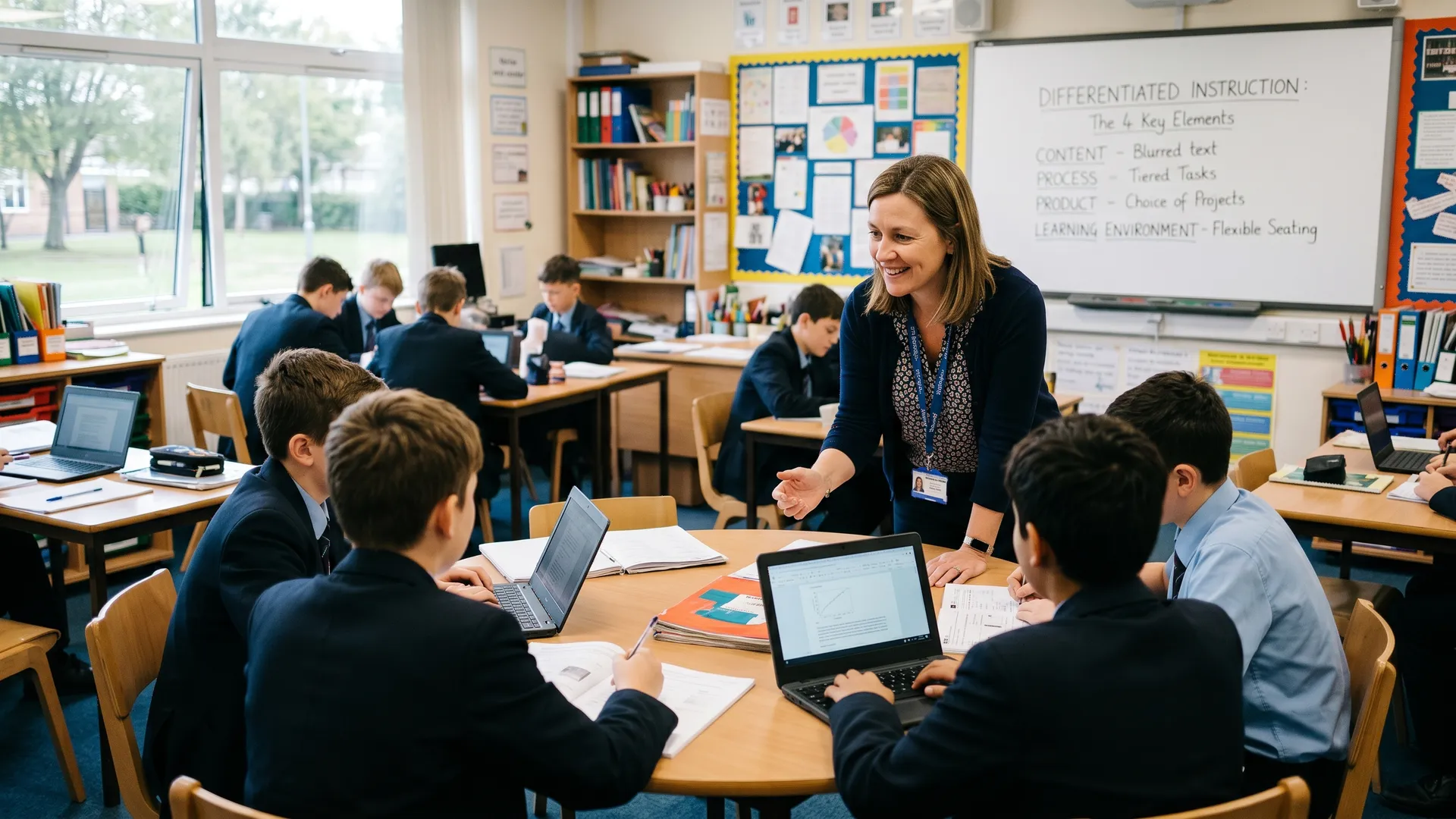
The following examples cover common lesson moments. The exact behaviour should fit the learners, subject, setting and local culture.
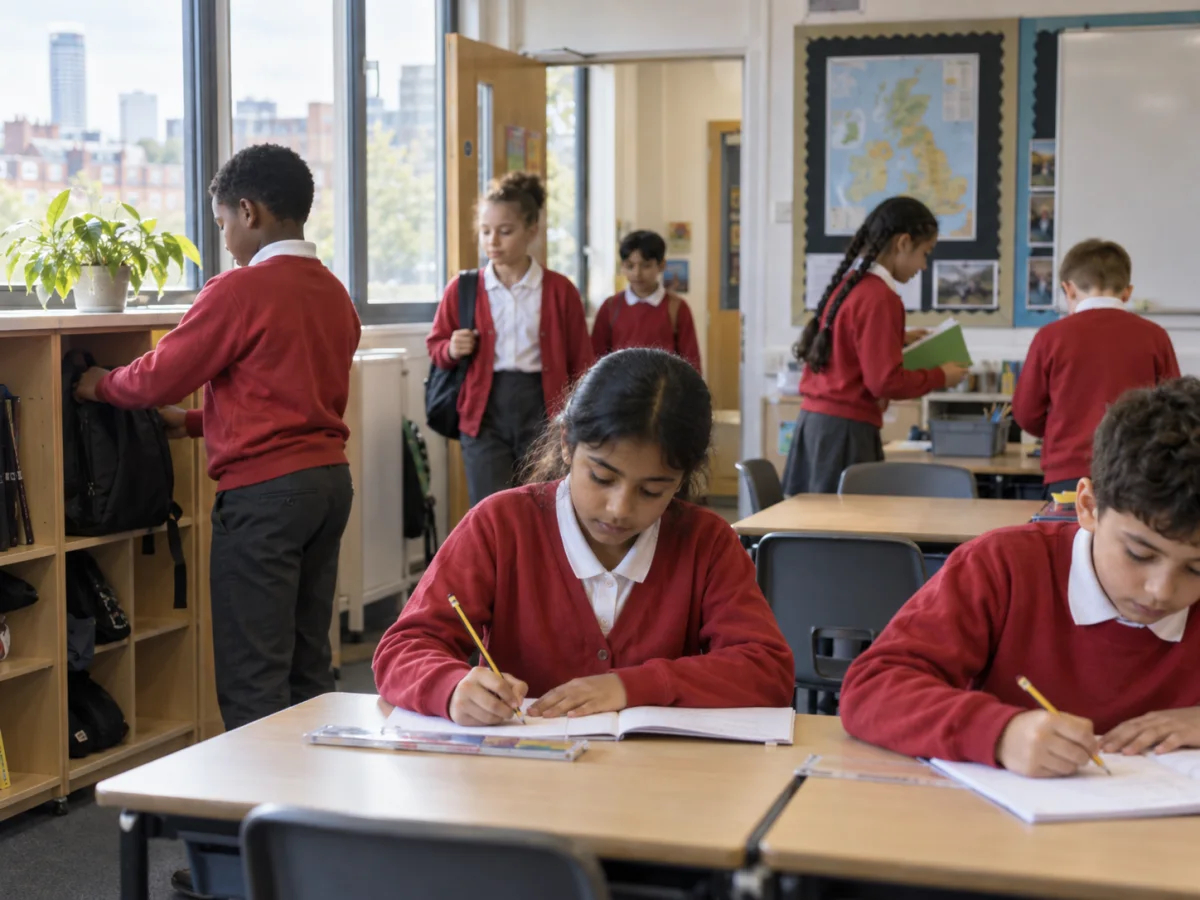
The routine creates a predictable route into learning. Learners locate the opening task, obtain what they need, identify the first action and begin or use an agreed support signal.
In a primary class, the board shows a familiar retrieval prompt and a simple visual sequence. One learner begins in writing. Another uses a communication aid to select an answer before discussing it with the teacher.
Do not turn greeting style, eye contact, handwriting or speed into the success measure. The learning action is beginning an accessible task. The Do Now guide shows how to design an opening task learners can start independently.
Transitions happen whenever learners move between teacher explanation, independent work, pairs, groups or practical activity. A reliable sequence removes repeated instructions.
In a secondary history lesson, the teacher gives a two-minute warning before paired source analysis. The board then shows the pair, the resource and the first question. Learners confirm the task before they move or turn.
Plan for mobility, personal space, sensory load and processing time. A slightly slower accessible transition is stronger than a fast transition that leaves some learners behind. See the detailed guide to classroom transitions.
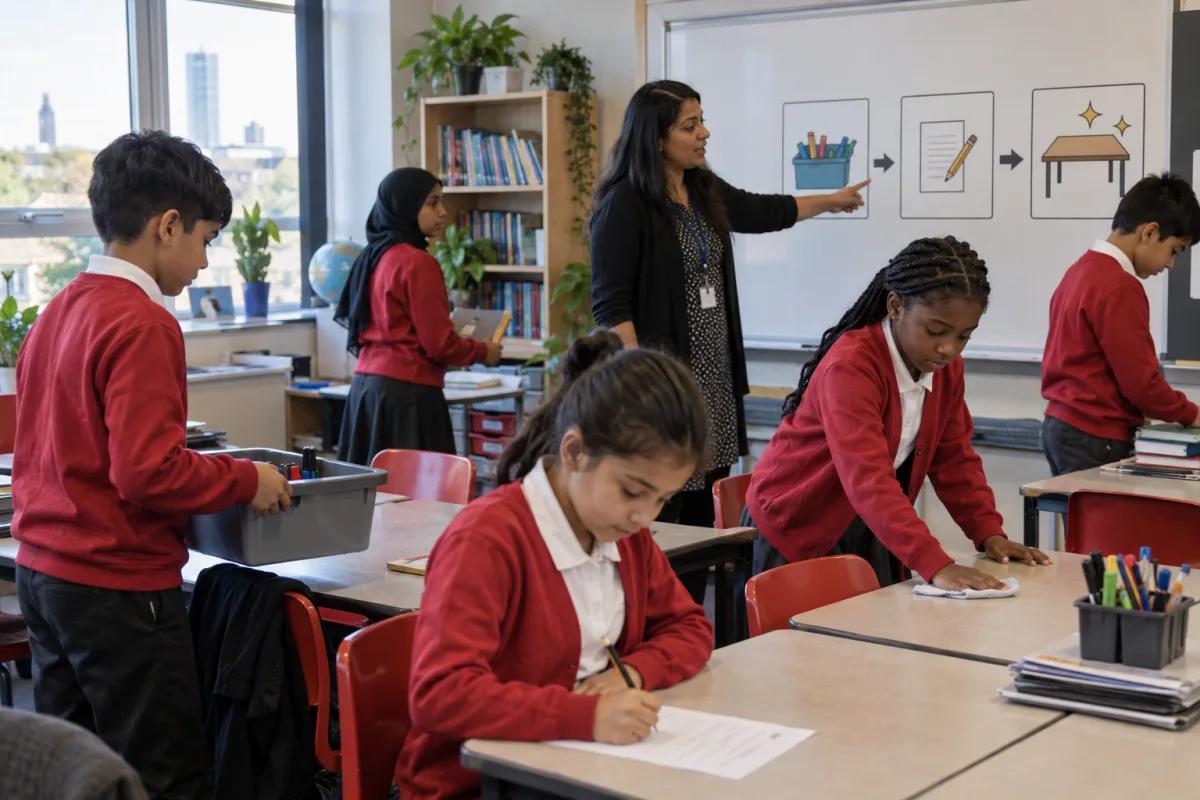
Equipment routines cover books, practical materials, art tools and technology. Learners identify what is needed, collect or open it, use it safely, return or close it and report a problem.
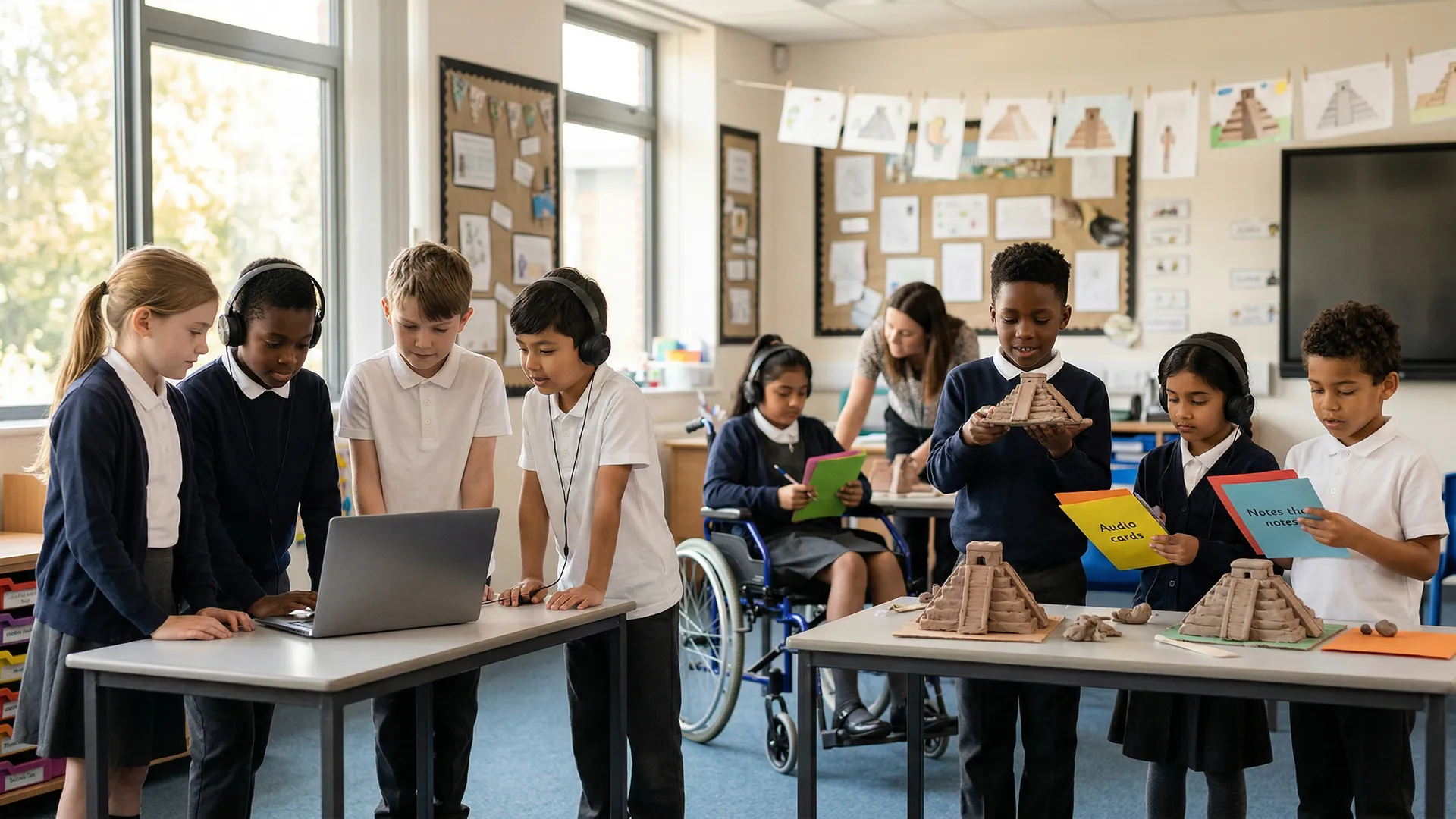
In a primary art lesson, table groups use one labelled tray. A picture checklist shows the materials and their return positions. The teacher checks access routes before expecting learners to collect anything independently.
The purpose is not a perfectly tidy shelf. It is keeping the equipment available, safe and ready for learning.
Participation routines give everyone time and a viable way to make thinking visible. Learners receive the prompt, think or record, choose an available response mode, share when invited and revise after hearing another idea.
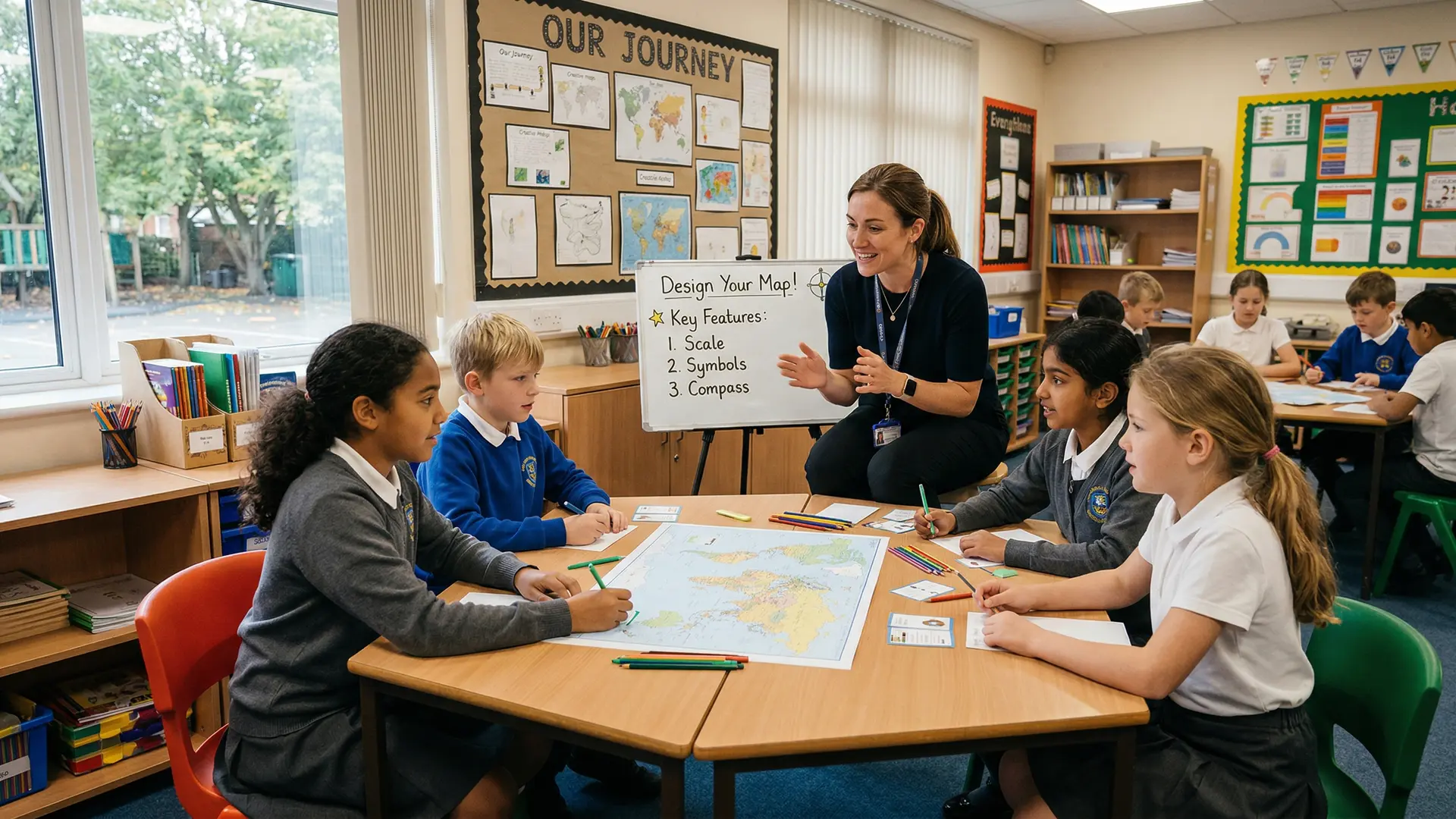
In a lower-secondary geography lesson, learners first mark a claim on a continuum. They may then explain through speech, writing or a prepared symbol card. The teacher samples responses across the room instead of relying on the quickest speakers.
Voluntary public speech must not be the only evidence of thinking. Our oracy and critical thinking guide can help teachers structure spoken participation without confusing confidence with understanding.
A discussion routine protects the intellectual work of listening, building and challenging. Learners clarify the shared goal, take an accessible role, contribute, respond to an idea and summarise progress.
In an international school literature lesson, a group uses three stems: "My evidence is...", "I see it differently because..." and "Our current view is...". The teacher does not reward one conversational style as the universal sign of respect.
Roles should not trap learners in fixed positions. Rotate them where useful and allow adaptations for language, communication and confidence.
This routine prevents being stuck from becoming withdrawal or disruption. Learners try an agreed first action, use a visible or discreet help signal, continue with an available part and rejoin after support.
In a mathematics lesson, the agreed first action is to reread the worked example and mark the exact line that stopped making sense. A learner can place a help card on the desk rather than announce uncertainty publicly.
The routine should never delay necessary help. It gives learners a route back into learning, not another test they must pass before receiving support.
An ending routine preserves evidence for the next teaching decision. Learners review the goal, show current understanding, identify a next step and return resources.
In an upper-secondary biology lesson, learners answer one diagnostic question and choose a confidence statement. The teacher sorts the responses before planning the next lesson. Packing the room is part of the sequence, but it is not the evidence of learning.
Use more than one reflection mode. A spoken exit response, short written answer or selected visual prompt can all reveal what a learner understands.
The Australian Education Research Organisation recommends introducing the purpose and expectation. Teachers then model the behaviour and give learners supported practice. Over time, learners move towards independence while feedback and further practice maintain the routine (AERO, 2024).
Use that sequence with one routine at a time.
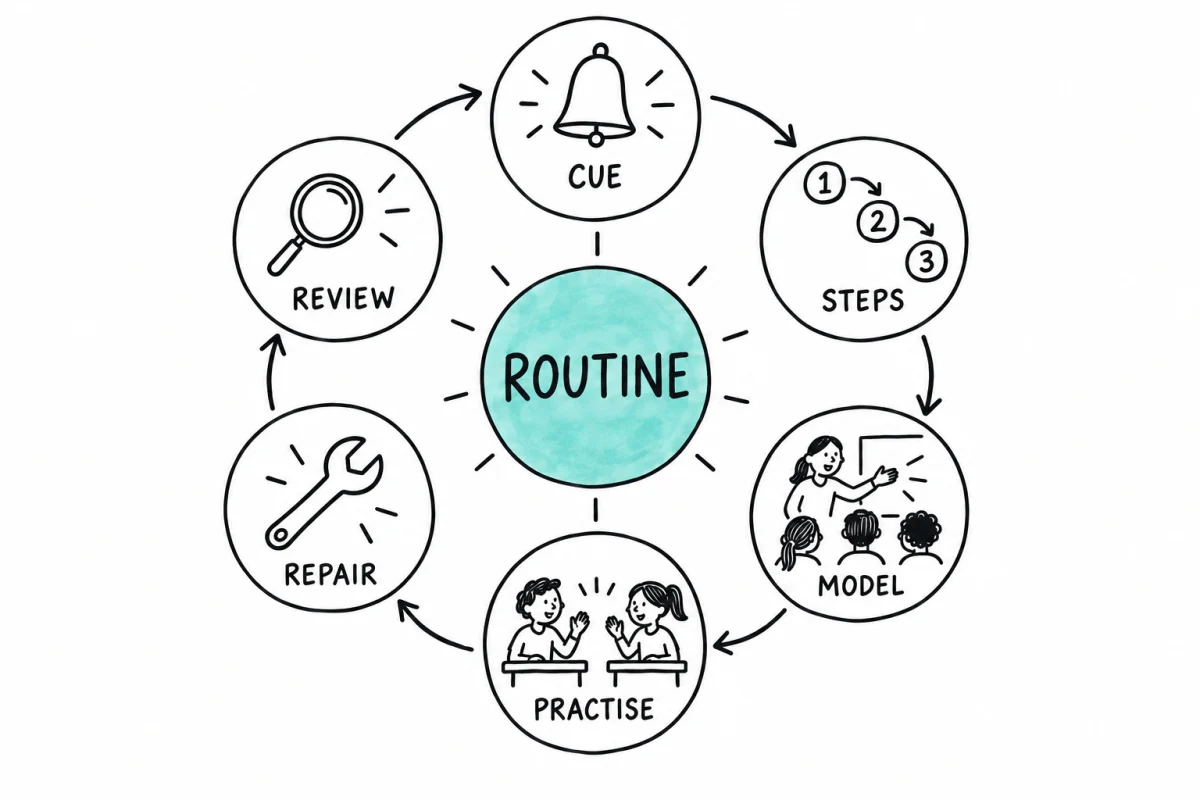
Tell learners what the routine helps them do. "This gives everyone thinking time before we hear answers" is more useful than "This is how we behave during questions".
Remove any step that serves appearance rather than learning, participation or safety.
Write three to five observable actions. Avoid labels such as "be ready" or "show respect" because learners cannot see where one action ends and the next begins.
For an entry routine, use this sequence: find the opening task, take the named materials, read the first prompt and begin or signal for help.
Demonstrate the routine. Then show one believable misunderstanding and ask learners to identify the difference.
If the help routine says "mark the step that is unclear", model a learner who circles the whole page. This makes the boundary visible without ridiculing anyone.
Give learners a short practice when no behaviour incident or deadline is driving the moment. Check what they do instead of asking whether they understand.
For elementary settings, the United States What Works Clearinghouse also recommends actively teaching and reinforcing behavioural skills. It advises adapting the learning environment to learner needs (IES, 2008).
Look for who starts, who waits and where the sequence creates friction. Give private, specific feedback about the action. Make the route back into learning clear.
"The first step is on the board. Start there and I will come back" gives a learner a way to re-enter. "You know our expectations" does not.
Re-teach after a long break or when a routine begins to decay. Ask learners what is unclear, unfair or difficult to access. Fade prompts only when learners no longer need them.
Use routine reviews to improve implementation, not to produce another teacher score.
A behaviour curriculum can establish shared language across a school. Broader behaviour management strategies should still leave room for subject, age, cultural and accessibility adaptations.
| Focus | Useful evidence | Ask learners |
|---|---|---|
| Purpose | Adults can explain what the routine protects or enables. | What does this routine help you do? |
| Teaching | The sequence has been modelled, practised and revisited. | How did you learn what to do? |
| Clarity | The cue and steps are recognisable without relying on memory alone. | How do you know what happens next? |
| Participation | Learners have meaningful ways to communicate and respond. | Is there a way to take part that works for you? |
| Repair | Feedback is specific and learners can return quickly. | What happens if someone is unsure or stuck? |
| Adaptation | Adults change the routine when evidence shows a barrier. | What would make it clearer or fairer? |
The OECD scale measured organisation and efficiency. A school review should add access, participation and repair. Otherwise, silence and speed can be mistaken for learning.
Start with one class. Pick one key point. Name the cue. Show each step. Let learners try. Ask what helps. Fix what gets in the way.
The one-page canvas helps a teacher, department or leadership team plan one recurring moment. It asks for the routine's purpose, cue, learner sequence, model, rehearsal, access routes, adult language, feedback, evidence and review date.
It is deliberately not a scored observation sheet. Schools can share a purpose and a few common words while allowing age, subject, cultural and accessibility adaptations.
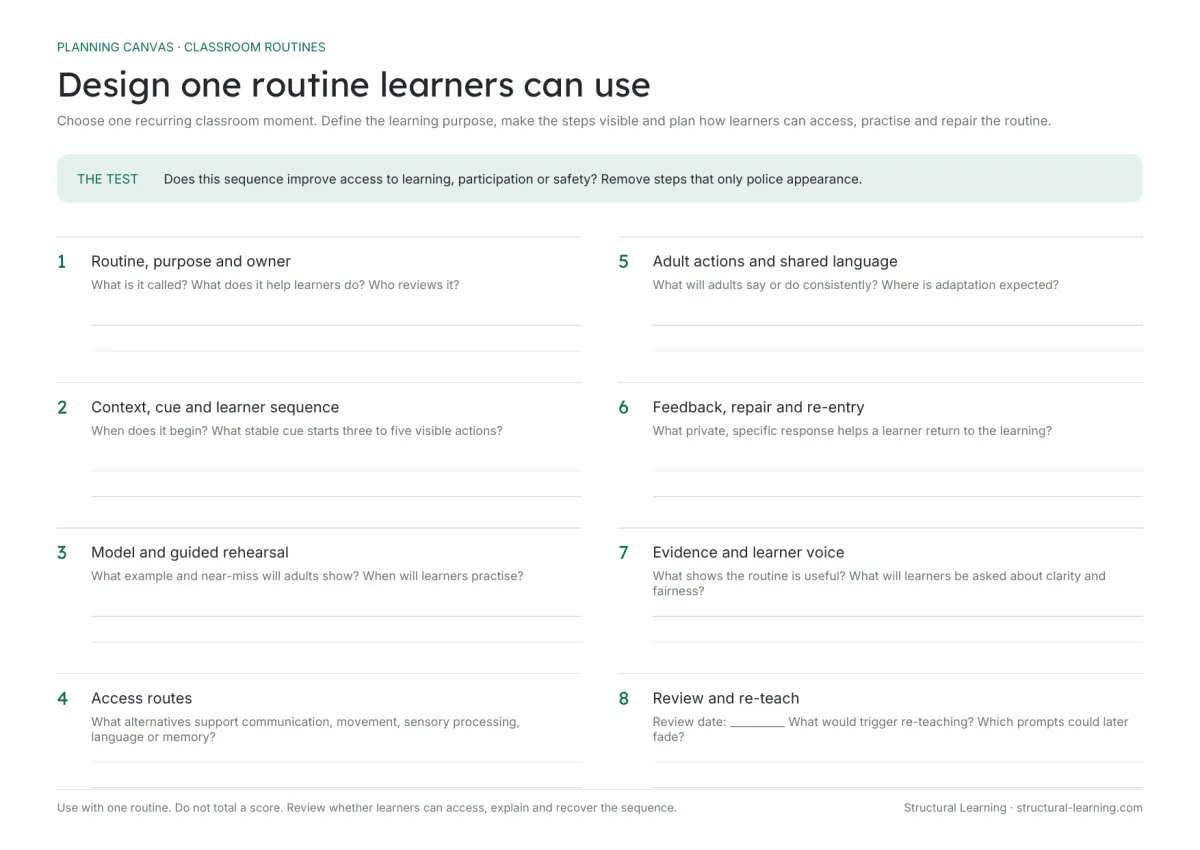
Download: Classroom Routine Design Canvas PDF or accessible HTML canvas.
Start with one moment that repeatedly costs attention or excludes participation. Complete the canvas with the people who teach it, practise the sequence with learners and review it after one week.