Updated on
September 9, 2026
Danielson Framework 2022: The 4 Domains Guide
The Danielson Framework for Teaching, 2022 edition: the four domains, the rubric levels, and what each means for teacher evaluation and observation.


Updated on
September 9, 2026
The Danielson Framework for Teaching, 2022 edition: the four domains, the rubric levels, and what each means for teacher evaluation and observation.
The Danielson Framework is a comprehensive teacher evaluation system that provides clear criteria for effective teaching across all classroom contexts. Developed by educational researcher Charlotte Danielson, this widely-adopted framework breaks down teaching excellence into four key domains: planning and preparation, classroom environment, instruction, and professional responsibilities. Used by school districts across the United States and gaining traction internationally, it serves as both an evaluation tool for administrators and a powerful self-reflection guide for teachers seeking to enhance their practise. Whether you're facing your first formal evaluation or looking to take your teaching to the next level, understanding this framework could transform how you approach your professional development.
Danielson (1996) created the Framework for Teaching at ETS in the mid-1990s. She used Praxis III criteria and teacher effectiveness research. The framework has 22 teaching components in four domains.
Danielson (2013) used cognitive load research to update descriptors. The revision now highlights how intellectually engaged the learner is. Teachers help learners take ownership, beyond managing the classroom.
Danielson's framework became popular because it addressed a real issue. Before Danielson (1996), teacher evaluation used checklists or opinions. Principals called lessons "good" but struggled to explain why. Danielson (1996) gave educators a shared language to discuss teaching.
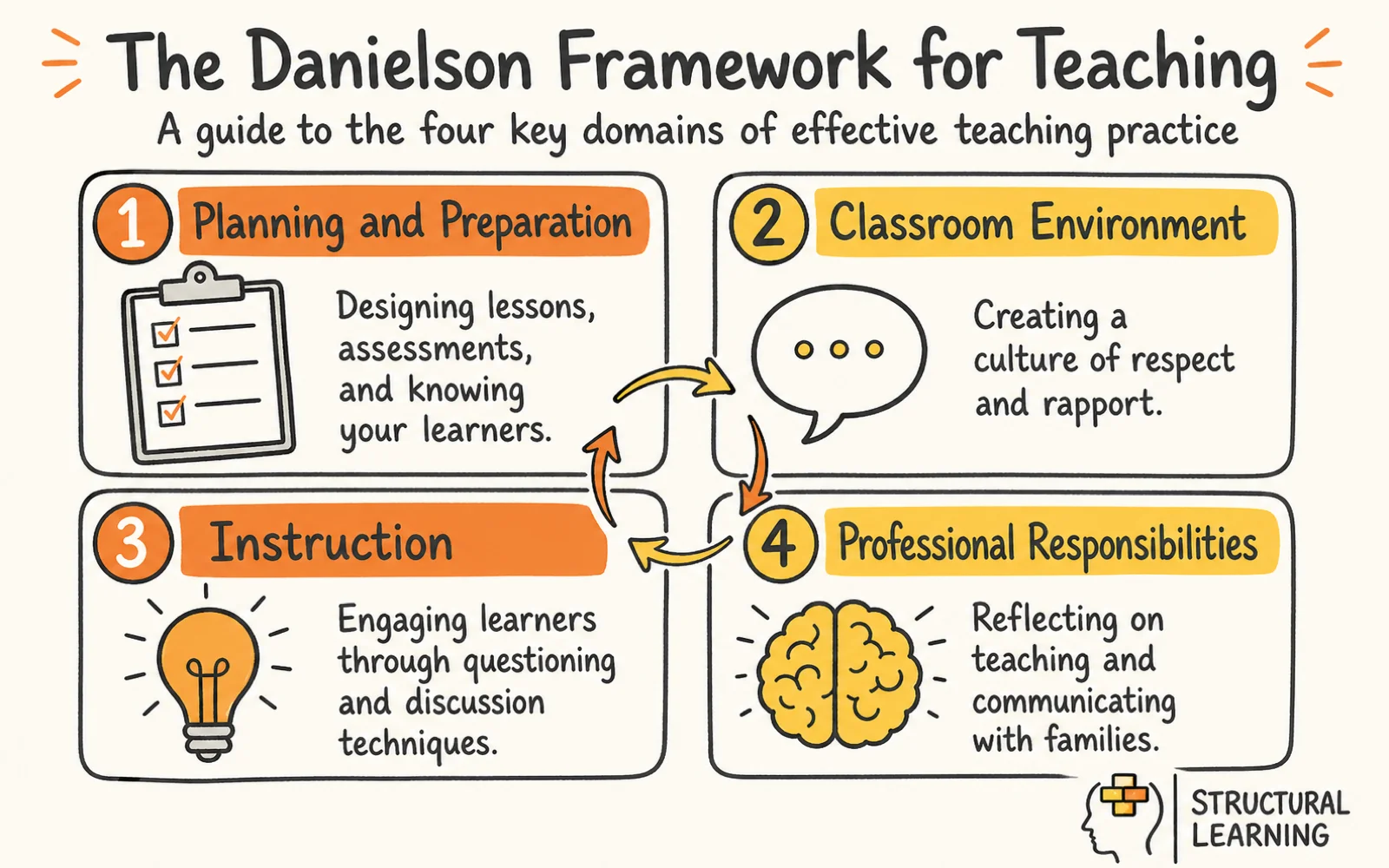
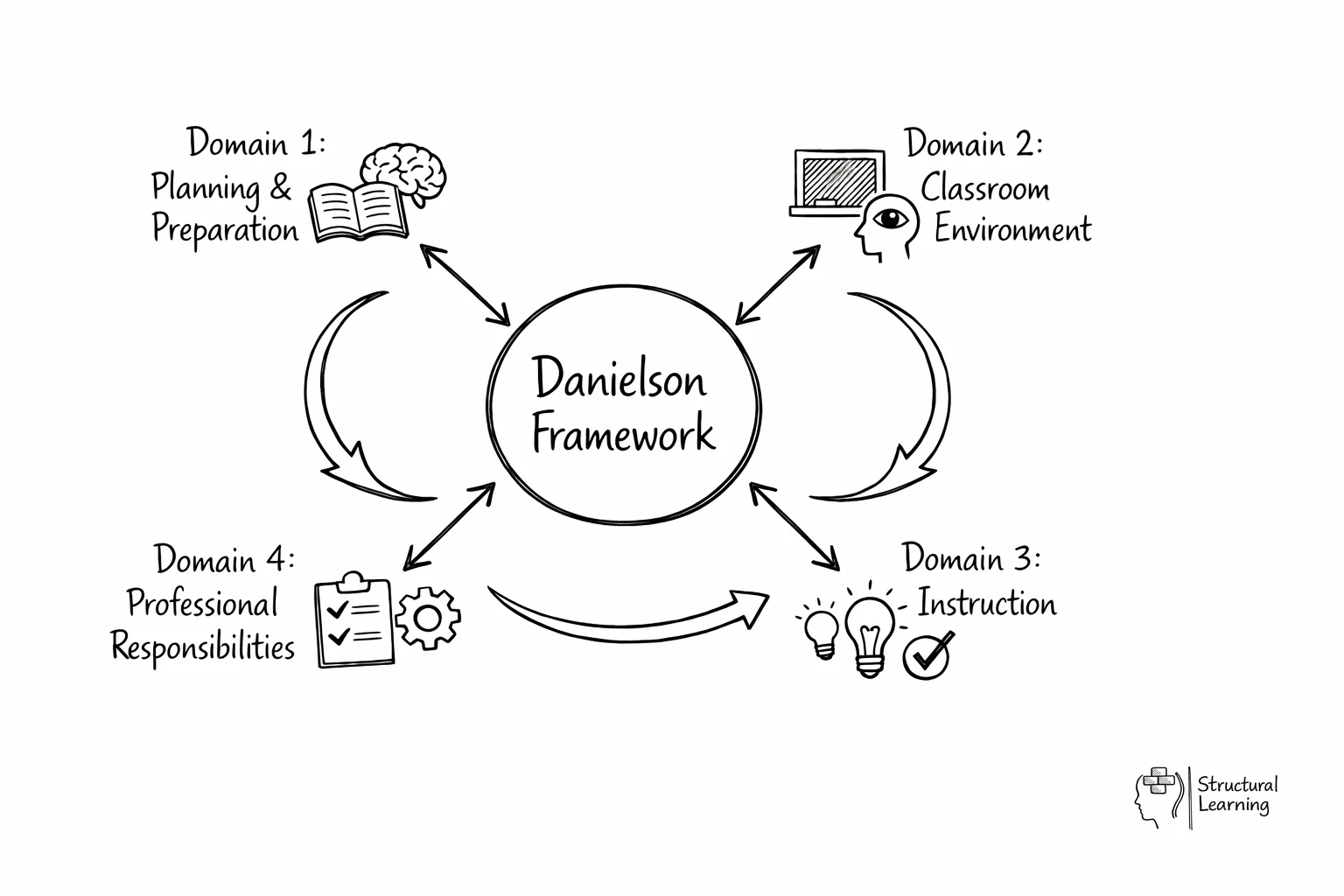
Each domain captures a distinct aspect of teaching. Domains 1 and 4 happen outside the classroom; Domains 2 and 3 are what you see during a lesson observation. All four interact. Strong planning (Domain 1) makes effective instruction (Domain 3) possible. A well-managed classroom environment (Domain 2) creates the conditions for intellectual risk-taking during instruction.
Domain 1 involves pre-lesson preparation. Teachers need subject and teaching knowledge. They must know their learners and plan clear lesson goals. Teachers design lessons that flow well. Assessments are also designed (Danielson, 2011). A Year 8 science teacher shows this by tackling chemical reaction misconceptions. They choose misconception-busting activities and use exit tickets (Shulman, 1986; Grossman, 1990).
Danielson (2011) specifies six Domain 1 parts. These include content knowledge and understanding learners. Teachers set learning goals and know available resources. Teachers design lessons and learner assessments. "Knowledge of learners" means understanding their development (Piaget, 1936; Vygotsky, 1978) and backgrounds.
Danielson (2011) says Domain 2 involves setting up learning. Teachers build respect and rapport with learners. They manage classroom procedures and learner behaviour. Routines make transitions quick. Learners do activities independently in under two minutes.
| Level | What It Looks Like | Learner Experience |
|---|---|---|
| Unsatisfactory | The teacher does not understand the concepts or apply the component | Learners are confused, disengaged, or unsafe |
| Basic | The teacher understands the concepts but application is inconsistent | Some learners learn some of the time |
| Proficient | The teacher clearly understands and consistently applies the component | Most learners are engaged and learning |
| Distinguished | The teacher leads; learners take ownership of learning | Learners drive inquiry, self-assess, and support peers |
Distinguished Domain 2 shows learners correcting behaviour. They hold each other accountable for effort (Danielson, 2011). Peer feedback without teacher prompting exemplifies this. One learner might ask, "Explain your reasoning?" (Danielson, 2011). This shows learning culture exceeds teacher authority.
Teaching involves talking to learners and asking questions. Discussion techniques engage learners in lessons (Danielson, 2011). Teachers use assessment to guide instruction and show flexibility (Wiliam, 2011; Hattie, 2012). Domain 3 is where teaching becomes practical.
A Proficient teacher in Domain 3 asks questions that promote thinking rather than simple recall. Instead of "What year did the Great Fire of London start?" they ask "Why did the fire spread so quickly, and what does that tell us about how London was built?" The second question requires learners to connect facts, reason about cause and effect, and demonstrate understanding rather than memory. At the Distinguished level, learners themselves formulate high-quality questions, essentially taking over the intellectual work of the lesson.
Danielson's Domain 3 highlights using assessment to inform teaching. In the 2013 Framework for Teaching evaluation instrument, component 3d focuses on using assessment in instruction: teachers check learner understanding, give feedback and adjust teaching in response (Danielson, 2013). Formative assessment is therefore central to the framework, not an extra technique added later.
Domain 4 covers work beyond lessons, such as reflection and communication. Danielson (2011) includes professionalism and community involvement here. Observation systems often miss this, according to Kane & Cantrell (2014). It's challenging to assess this area.
Distinguished teachers in Domain 4 lead professional development, not just attend it. They analyse data, finding patterns like maths teachers noticing fraction issues (Wiliam, 2018). This teacher designs interventions, shares with colleagues, and tracks impact, reflecting Domain 4's best practices (Hattie, 2009).
The four-level rubric helps teachers see learner progress. It shows growth, unlike simple pass/fail grades. Danielson (2013) says "Basic" teachers see what "Proficient" looks like. They can then aim for that level with clear goals. "Distinguished" is not always needed but shows top practise, says Danielson (2013).
Moving from Proficient to Distinguished means learners take more responsibility for the thinking. Proficient teachers pose good questions; Distinguished practice creates conditions where learners ask, refine and explore questions themselves. This aligns with metacognition and self-regulated learning research (Zimmerman, 2002; Wiliam, 2011), but it still needs clear teaching, modelling and feedback.
Danielson's Framework guides teaching observations. Learners reflect on their own practise. Schools use the Framework for professional learning (Danielson, 2007).
Formal observations involve a pre-meeting (Domain 1), a visit (Domains 2 & 3), and reflection (Domain 4). Observers and teachers use rubrics to discuss evidence. For example, instead of "good questioning," try "You asked six open questions. Four needed learners to justify reasoning, aligning with Component 3b."
Self-assessment works best for teachers. Use Component 3c to gauge learner engagement, as per Danielson (2011). Does learner work meet basic, proficient, or distinguished levels? This targeted reflection, with clear indicators, beats generic training (Hattie, 2012).
Use the framework to target professional development. Schools can address each learner's needs. For example, some teachers need help with Component 1e, others 3d (Danielson, 2007). This makes "improvement" specific and measurable.
Danielson and Marzano's frameworks help evaluate teachers in the US. Marzano (60 elements) offers specific strategies. Danielson (22 components) gives a broader view for self-reflection. Both use research from Hattie (2009) on learning.
Rosenshine (2012) offers clear lesson guidance. Danielson (2007) covers all teaching, including planning and development. Use Rosenshine for Domain 3 lesson planning. Consider Danielson for your wider professional growth.
Danielson's Framework complements Ofsted inspections. Ofsted assesses the school's overall quality. Danielson (2011) supports teacher development. The domains align with Ofsted's quality judgements. Domain 1 covers curriculum intent, and Domain 3 is implementation. Assessment connects to both areas (Danielson, 2011).
The most valuable use of the Danielson Framework is not being observed by someone else; it is observing yourself. Here is a practical self-assessment process you can use immediately.
| Framework | Focus | Structure | Best For |
|---|---|---|---|
| Danielson | Teaching quality across all aspects | 4 domains, 22 components, 4 levels | Comprehensive evaluation and growth |
| Marzano | Research-based instructional strategies | 4 domains, 60 elements, 5 levels | Detailed strategy-level coaching |
| Rosenshine | 10 principles of effective instruction | 10 principles, no formal levels | Lesson design and delivery |
| Ofsted (UK) | Quality of education, behaviour, leadership | 4 judgement areas, 4 grades | Whole-school accountability |
Step 1: Choose one component. Don't try to assess all 22 at once. Pick one that you suspect is a growth area. For example, Component 3b: Using Questioning and Discussion Techniques.
Read rubric descriptors. Basic (3b) means the teacher mixes question quality with few discussions. Proficient means teachers use questions to challenge learners' thinking (Danielson, 2014). Distinguished means learners ask questions, start topics, and contribute freely (Danielson, 2014).
Step 3: Record one lesson. Use a phone propped on your desk or ask a colleague to observe for 15 minutes. Count the number of open vs closed questions you ask. Note how many seconds you wait after asking a question. Count how many different learners contribute. This gives you data, not impressions.
Step 4: Rate yourself honestly. Most teachers find they are Proficient in their strongest areas and Basic in one or two areas they haven't thought about. This is normal and expected. The point is not to achieve Distinguished everywhere; it is to have a clear, specific target for growth.
Step 5: Set one micro-goal. If you rated yourself Basic in questioning, your micro-goal might be: "In every lesson this week, I will ask at least three questions that require learners to explain their reasoning, and I will wait at least five seconds before accepting an answer." That is specific, observable, and achievable. It moves you from Basic towards Proficient in one measurable step.
No framework is perfect, and teachers should approach the Danielson Framework with informed scepticism.
Ho and Kane (2013) showed classroom observation tools had reasonable reliability. Observers often disagreed, particularly at higher attainment levels. This creates issues when linked to decisions such as pay (Danielson).
Cultural bias exists within this framework. Developed in the US, it may not suit all cultures. Descriptors favour discussion, independent inquiry; (Wiggins & McTighe, 2005). Direct instruction achieves results in some contexts (Kirschner, Sweller, & Clark, 2006). It could favour one teaching style over another (Hattie, 2012).
A single lesson observation samples little of teaching. Danielson (2013) says her framework needs wider use. It should include learner work analysis, planning, and talks. Observation alone is not enough.
Proper use needs observer training and conference time. Calibration sessions help maintain reliability. Schools often lack resources for correct use (Kraft & Papay, 2014). This leads to surface-level changes that may harm morale (Hill & Grossman, 2013; Kane & Staiger, 2012). This may not support learner growth as intended (Wiliam, 2011).
Danielson's framework (2013) has limitations, but teachers use it widely. Marzano (2012) found self-reflection helps professional development. Stronge (2018) shows strengths matter more than evaluations if learners gain.
For related guidance, see our article on AI and EdTech Tools for Teachers.
Teaching practices in the Danielson Framework align with research. Some practices, like those from Hattie (2009) and Wiliam (2011), boost learner outcomes. Black and Wiliam (1998) showed assessment for learning works well. Shulman (1986) explored pedagogical content knowledge deeply.
Rosenshine (2012) links questioning to success in Domain 3. Component 3b supports this: teachers ask more questions (Rosenshine, 2012). These frameworks work well together, improving the learner experience.
Framework scaffolding appears in every domain. Teachers plan scaffolds in Domain 1. Domain 3 requires responsive scaffolding, consistent with Vygotsky's zone of proximal development (Vygotsky, 1978). Domain 4 needs reflection on scaffold effectiveness. Teachers transfer responsibility to learners, removing scaffolds as learners progress from Proficient to Distinguished.
Wiliam (2011) showed assessment for learning is vital, like Component 3d. Teachers use assessment data to change teaching, as Wiliam found. For instance, re-teaching a topic after a quick check shows proficient 3d.
This week, download the Danielson Framework rubric (freely available at danielsongroup.org) and read through Domain 3: Instruction. Pick the one component where you feel least confident. Record yourself teaching one lesson, focusing on that component. Use the rubric descriptors to rate yourself honestly. Write down one specific action you will take in your next lesson to move one level up. That single, targeted change is worth more than a year of unfocused professional development.
The Danielson Framework organises effective teaching into four interconnected domains, each capturing essential aspects of a teacher's professional practice. These domains work together to create a comprehensive picture of teaching excellence, from the careful planning that happens before learners arrive to the ongoing professional learning that continues throughout a teacher's career.
Domain 1: Planning and Preparation encompasses all the behind-the-scenes work that sets the stage for successful learning. This includes demonstrating knowledge of content and pedagogy, understanding your learners' backgrounds and learning needs, setting instructional outcomes, and designing coherent instruction. For instance, a Year 6 teacher preparing a unit on fractions would need to consider learners' prior knowledge from Year 5, plan differentiated activities for varying abilities, and create assessments that genuinely measure understanding rather than rote memorisation.
Domain 2: The Classroom Environment focuses on creating a space where all learners feel safe, respected, and ready to learn. This goes beyond attractive displays; it involves establishing clear routines, managing behaviour effectively, and building positive relationships. A secondary science teacher might demonstrate excellence here by implementing collaborative lab procedures where learners take responsibility for equipment and support each other's learning.
Domain 3: Instruction represents the heart of teaching practice, covering communication, questioning techniques, learner engagement, and assessment during lessons. This domain recognises that outstanding teachers adapt their instruction based on learner responses, ask questions that promote critical thinking, and ensure all learners actively participate. Research by Hattie (2009) confirms that these visible learning strategies have significant impact on learner achievement.
Domain 4: Professional Responsibilities extends beyond the classroom to include maintaining accurate records, communicating with families, contributing to the school community, and pursuing professional development. A primary teacher might excel here by creating detailed progress tracking systems that inform parent meetings and guide intervention strategies.
Successful implementation of the Danielson Framework requires thoughtful planning and a commitment to building a supportive professional culture. Schools that see the greatest benefit typically begin with a gradual rollout, introducing the framework's concepts through collaborative professional development sessions rather than imposing it as a top-down mandate. This approach allows teachers to explore the framework's components together, discussing what each looks like in their specific contexts.
Many schools find success by establishing peer observation networks where teachers can watch one another teach using the framework's rubrics as a shared language for feedback. For instance, a secondary school in Manchester created 'learning walks' where teachers observe three colleagues per term, focusing on one specific component of the framework each time. This practice transforms the framework from an evaluative tool into a collaborative learning experience, reducing anxiety whilst promoting genuine professional growth.
Training school leaders to use the framework supportively rather than punitively proves crucial for effective implementation. Successful headteachers schedule regular coaching conversations that reference the framework's language, helping teachers identify their own areas for development. One primary school in Birmingham dedicates staff meetings once per month to exploring a single framework component through video analysis of teaching, allowing educators to see excellence in action and discuss practical applications.
Schools should also consider how the framework aligns with existing initiatives and professional development priorities. Rather than treating it as an additional burden, effective implementation weaves the framework into current practices. For example, when planning department meetings or year group collaborations, teams can use framework components to structure their discussions about learner progress, assessment strategies, or behaviour management approaches.
AI teaching assistants and automated lesson analysis tools now need explicit consideration within Danielson Framework evaluations. DfE guidance on generative AI in education, updated in 2025, says AI can support teachers when used safely, effectively and with the right infrastructure, while also warning that AI outputs can be inaccurate, biased, out of date or unsafe. The Danielson lens should therefore focus on professional judgement, learner relationships, safeguarding, data protection and the quality of final teaching decisions.
Domain 1 (Planning and Preparation) can be supported by AI when teachers use it to draft options, surface misconceptions or adapt resources, then check the output against curriculum goals and learner needs. For example, a Year 7 geography teacher might use a generative AI tool to draft differentiated worksheet variations for a climate change unit, but the professional work remains in refining objectives, checking accuracy, protecting learner data and anticipating misconceptions.
Automated feedback can be useful as a prompt, but it should not be treated as an observation judgement. DfE guidance is clear that teachers, leaders and staff remain responsible for checking AI-generated content for appropriateness and accuracy. In Danielson terms, evidence for Domain 3 still needs to come from what teachers and learners actually do in lessons, including responsive teaching and flexibility.
Schools may need to adapt professional development conversations as AI tools become part of planning, feedback and administration. The framework's emphasis on reflective practice becomes more important when teachers can generate lesson materials quickly but still need to show deep understanding of how learners think. Evaluation criteria should therefore ask when AI use improved professional judgement, and when it created risks or weak shortcuts.
These studies examine the Danielson Framework's impact on teaching quality and student outcomes.
Enhancing Professional Practice: A Framework for Teaching
1,722 citations
Danielson (2007)
The foundational text that defines the four domains and 22 components. The second edition includes revised rubric descriptors and practical guidance for implementation in schools of all types.
Weisberg, D., Sexton, S., Mulhern, J. and Keeling, D. (2009). The New Teacher Project.
The Widget Effect report argued that many teacher evaluation systems failed to recognise meaningful differences in teacher effectiveness. It is a policy report, not a Danielson validation study, so it should be used only to explain why clearer evaluation rubrics became attractive to US districts.
Ensuring Fair and Reliable Measures of Effective Teaching
MET Project, Bill & Melinda Gates Foundation (2013).
The MET project found that observation evidence is stronger when it is combined with other measures such as learner surveys and achievement data. This supports cautious, multi-measure evaluation, not a claim that any one rubric is sufficient on its own.
Getting Teacher Evaluation Right
Darling-Hammond, L. (2013). Teachers College Press.
Darling-Hammond argues for teacher evaluation systems that support professional learning and use multiple forms of evidence. Use this source for broad evaluation-system design, not as proof that one observation rubric is sufficient on its own.
Validating Measures of Effective Teaching
Kane, T. J. and Staiger, D. O.; MET Project research team.
The MET research is useful because it tested teacher-observation scores alongside other measures and cautioned against relying on a single indicator. Use it to discuss fairer evaluation design, not to claim that Danielson scores alone confirm learning gains across assessments.