CPD for Schools: A Leadership Guide to Professional Development

Updated on  

March 10, 2026

CPD for Schools: A Leadership Guide to Professional Development

|

March 7, 2026

Professional development sits at the heart of school improvement. When it works, teachers refine their practice, pupil outcomes improve, and staff retention rises. When it fails, schools spend thousands of pounds on training days that change nothing in the classroom. The difference between effective and ineffective CPD is well-documented in the research literature, and school leaders now have clear evidence to guide their decisions.
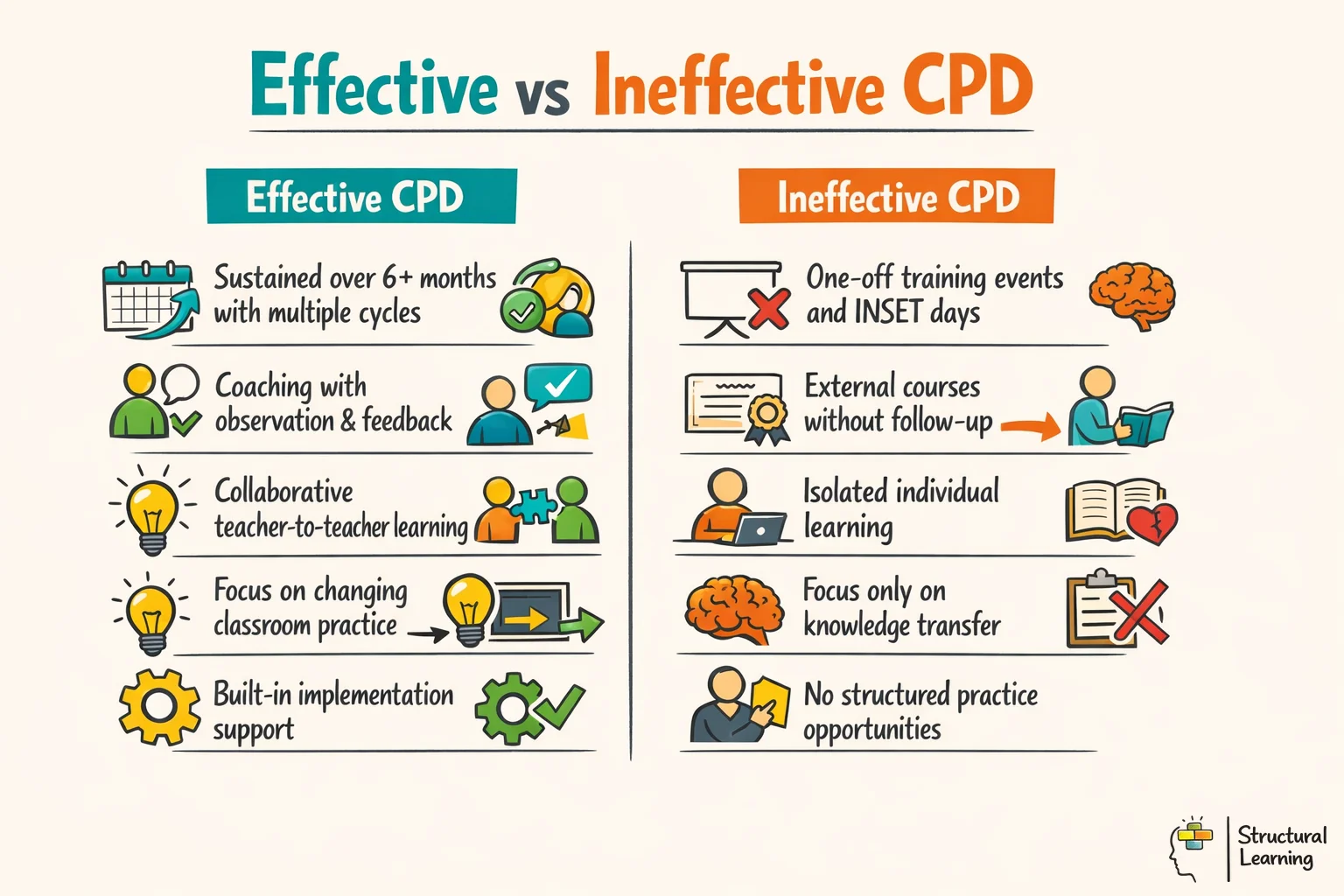
The Teacher Development Trust's landmark review, "Developing Great Teaching" (Cordingley et al., 2015), analysed over 1,200 studies and found that the quality of professional development is one of the strongest levers available to school leaders. Yet most schools still default to one-off training events and whole-staff INSET days that the evidence consistently shows to be ineffective. This guide sets out what works, why it works, and how to build a CPD programme that produces genuine change in classroom practice.

Key Takeaways

  1. One-off training rarely changes practice: EEF evidence shows that sustained, collaborative professional development over at least two terms produces measurable impact on pupil outcomes.
  2. Coaching beats courses: Instructional coaching with observation, feedback, and practice cycles is consistently more effective than external training days.
  3. Teachers learn best from teachers: Lesson study, peer observation, and professional learning communities create the conditions for genuine pedagogical growth.
  4. Impact must reach the classroom: CPD that changes teacher knowledge but not classroom behaviour is wasted investment. Plan for implementation from the start.

What Makes CPD Effective?

The research on teacher professional development has reached a clear consensus: duration, collaboration, and classroom focus are the three factors that most reliably predict impact. A single training day, however well-delivered, rarely produces lasting change. Timperley (2008), in her UNESCO review of the evidence, found that effective professional learning typically extends over six months or more and is deeply embedded in teachers' day-to-day work.

Darling-Hammond, Hyler, and Gardner (2017), in their Learning Policy Institute analysis of 35 studies meeting rigorous methodological criteria, identified seven features of effective professional development: it is content-focused, incorporates active learning, supports collaboration, uses models of effective practice, provides coaching and expert support, offers feedback and reflection, and is sustained over time. Schools that design CPD around these features consistently outperform those that rely on ad-hoc training.

Kennedy (2016) adds a further distinction that school leaders often overlook: the difference between CPD that changes what teachers know and CPD that changes what teachers do. Teachers can leave a training session with new knowledge about retrieval practice or cognitive load theory without making any change to their lessons. Effective CPD closes this gap by building in structured opportunities for teachers to try new approaches, receive feedback, and refine their practice over multiple cycles.

A concrete example: a secondary school in Manchester trained all staff in Rosenshine's Principles through a two-hour INSET session. Follow-up lesson observations showed almost no change in practice six weeks later. The following year, the same school introduced fortnightly coaching cycles linked to the principles, with each teacher receiving one observation and one feedback conversation per half-term. By the end of the year, independent observers rated the quality of instruction significantly higher across nine of the ten principles.

CPD Models That Work in Schools

Not all CPD models are equally effective, and school leaders need to make deliberate choices about which approaches to invest in. The table below compares the five most common models used in English schools, assessed against four criteria: evidence of impact, cost, time commitment, and sustainability over time.

CPD Model Evidence of Impact Cost Time Commitment Sustainability
External training courses Low (unless followed up with coaching) High (supply cover + course fees) Low (one to two days) Low (knowledge fades without application)
Instructional coaching High (Kraft et al., 2018: effect size 0.49) Medium (coach time, no supply needed) Medium (fortnightly cycles per teacher) High (builds internal capacity)
Lesson study High (strong in East Asian and UK contexts) Low (peer-based, internal time only) Medium (one cycle per half-term) High (becomes embedded in culture)
Professional Learning Communities (PLCs) Medium-High (depends on facilitation quality) Low (internal staff time) Medium (regular fortnightly or monthly meetings) High (self-sustaining when well-structured)
Teacher-led action research Medium (depends on rigour of design) Low (internal, with some reading time) High (runs across a full academic year) Medium (requires leadership support to sustain)

Instructional coaching consistently shows the strongest evidence base. Kraft, Blazar, and Hogan (2018) conducted a meta-analysis of 60 studies and found an average effect size of 0.49 standard deviations on instructional practice and 0.18 on pupil achievement. These are substantial effects in the context of educational interventions. The key mechanism is specificity: coaching targets a named teaching behaviour, practises it in a real classroom, and provides feedback tied to what pupils actually did in response.

A useful example from primary practice: a Year 3 teacher worked with an instructional coach on her use of questioning strategies. Over six weeks, the teacher moved from predominantly closed recall questions to a pattern of paired thinking time followed by cold-calling and then follow-up probing questions. Her coach observed two lessons per fortnight and provided five-minute feedback immediately after each observation. Pupil assessment data showed a measurable improvement in extended writing quality by the end of the term.

Lesson Study and Action Research

Lesson study originated in Japan and has been practised there for over a century. A small group of teachers, typically two to four, plan a single lesson collaboratively, with one teacher delivering it while the others observe. The observation focuses on specific pupils rather than the teacher, tracking how three target learners respond to each phase of the lesson. The group then meets to analyse what they observed, revise the lesson, and often teach it again to a different class.

The strength of lesson study lies in what it focuses attention on: pupil learning, not teacher performance. This distinction matters enormously for staff culture. When teachers know that observers are watching particular pupils rather than judging the teacher, the defensiveness that often accompanies lesson observation dissolves. Conversations become genuinely analytical rather than performative. A mathematics department using lesson study in a Midlands comprehensive reported that, for the first time, teachers were willing to admit when a particular explanation had not worked and to ask colleagues for alternatives.

Action research follows a similar inquiry cycle but is typically led by an individual teacher rather than a group. A teacher identifies a specific problem in their practice, formulates a question (for example: "Does structured peer feedback improve the quality of Year 10 essay redrafts?"), collects data over a term, reflects on findings, and adjusts their approach. When schools build action research into their CPD framework, with time allocated for reading, data collection, and sharing findings, it produces teachers who are genuinely reflective practitioners rather than recipients of top-down training.

The most effective schools combine both approaches. A geography team might use lesson study to investigate how to teach scaffolding for extended writing tasks, while individual teachers run parallel action research projects on their own specific challenges. The group inquiry provides shared vocabulary and collaborative energy; the individual projects address the particular needs of different classes and contexts.

One practical note on action research design: the most common failure mode is collecting too much data. Teachers who try to measure everything end up measuring nothing useful. The most productive action research projects focus on one specific, observable change in pupil behaviour (for example, the proportion of pupils who complete a full paragraph in a timed writing task) and track it consistently over six to eight weeks. Linking these findings to the school's existing formative assessment data strengthens both the research and the school's broader assessment practice.

Professional Learning Communities

A professional learning community is a group of teachers who meet regularly to examine their practice, share evidence, and improve pupil outcomes together. The term is used loosely in many schools to describe any staff meeting with a professional development element, but genuine PLCs have a more specific structure. They are small (four to eight people works best), they focus on a shared pedagogical question, they examine evidence from actual classrooms, and they meet consistently over time.

The research on PLCs is clear that structure determines effectiveness. A PLC that meets to discuss general teaching ideas produces collegial warmth but limited change. A PLC that asks a specific question ("Are our current approaches to differentiation actually closing the gap between our highest and lowest attainers in Year 7 science?") and examines pupil work, assessment data, and lesson observations to answer it produces real change in practice. The EEF's guidance on professional development (2021) emphasises that PLCs need a clear focus on a specific aspect of teaching and learning to be effective.

A secondary school in Yorkshire reorganised its CPD from whole-staff INSET days to subject-based PLCs that met every three weeks. Each PLC chose a focus from the school's teaching and learning framework (which included direct instruction, retrieval practice, and metacognitive strategies) and spent two terms examining evidence, trying approaches, and sharing findings. End-of-year surveys showed that 78% of staff rated this model as more useful than previous CPD arrangements, and middle leaders reported more substantive professional conversations in departmental meetings.

Leadership of PLCs matters as much as structure. The most effective PLCs are led by teachers with credibility among their peers, not necessarily by the most senior staff. A head of department who teaches the same pupils as their colleagues and can reference shared experiences is often a more effective PLC facilitator than a senior leader parachuted in from outside the department. Schools that invest in developing teacher-leaders for this role build sustainable CPD infrastructure that does not depend on external consultants or senior leadership bandwidth.

PLCs also provide a natural mechanism for building growth mindset among staff. When teachers share lessons that did not work, alongside those that did, they model for each other the intellectual honesty that they want to cultivate in pupils. Schools where leaders share their own teaching challenges in PLC settings consistently report stronger professional cultures than those where CPD feels like something done to teachers rather than with them.

Designing Your School CPD Calendar

A CPD calendar that produces change in classroom practice looks different from the standard model of six INSET days plus occasional twilight sessions. It integrates professional development into the rhythm of the school year, builds in multiple opportunities for practice and feedback, and connects individual teacher development to school improvement priorities.

Start with the school's teaching and learning priorities for the year, typically two or three specific aspects of practice that the school wants to improve. These might be: improving the use of metacognitive strategies in Years 7 to 9, embedding retrieval practice across all subjects, and strengthening the quality of teacher feedback. Each priority then becomes the focus for sustained CPD activity across the year, rather than a single training event.

A workable structure for a secondary school might look like this. September: launch the year's priorities with a half-day INSET that introduces the evidence base and gives teachers time to plan how they will approach each priority in their subject context. October and November: fortnightly department PLC meetings focused on the first priority, with one coaching observation per teacher in the half-term. December: brief whole-staff sharing session where PLCs present what they have learned. January to March: shift focus to the second priority, with the same PLC and coaching cycle. April to June: action research projects linked to the third priority, with a twilight session in June for teachers to share findings.

This structure uses the same total time as six INSET days and a handful of twilight sessions but distributes it very differently. The majority of professional learning happens in small groups and coaching conversations, close to classroom practice. The full-staff events serve to launch, connect, and celebrate rather than to deliver content.

Budget allocation should reflect this shift in model. A school that spends its entire CPD budget on external speakers and off-site courses might redirect a proportion of that spend towards training two or three internal coaches, buying cover for coaching observations, and providing teachers with time to read and discuss research. The return on internal capacity investment compounds over years; the return on a single external training day typically disappears within weeks.

For primary schools, the same principles apply but the structures look slightly different. Year group teams often work better than subject departments as the unit for PLCs. Lesson study works particularly well in primary because teachers across year groups can observe each other's practice with genuine curiosity. A four-teacher team covering Years 3 and 4 might run three lesson study cycles per year, each focused on a different aspect of working memory management in literacy lessons, building a substantial body of shared knowledge over the course of the year.

Measuring CPD Impact on Teaching

Measuring the impact of professional development is one of the most consistently neglected aspects of CPD design. Most schools evaluate training through end-of-session satisfaction surveys ("Was this session useful?") which tell you almost nothing about whether practice has changed. Guskey's (2000) five-level model of CPD evaluation remains the most practical framework available: participant reactions, participant learning, organisational support, participant use of new knowledge and skills, and student learning outcomes. Most schools evaluate only at level one; the levels that matter most are four and five.

A straightforward approach to level-four evaluation is structured lesson observation before and after a CPD cycle, using a specific observation framework tied to the CPD focus. If the school spent a term developing teachers' use of dual coding in explanations, observers should be looking specifically for evidence of dual coding in subsequent lessons. This is different from a general lesson observation; it is targeted evidence-gathering linked to a specific professional learning goal.

Pupil voice is an underused tool in CPD evaluation. Brief, structured conversations with pupils about their experience of specific teaching approaches can reveal whether changes in teacher behaviour are actually reaching pupils as intended. A science department that spent a term developing their use of worked examples and modelling can ask a sample of Year 8 pupils: "When your teacher shows you how to work through a problem before you try it yourself, how helpful do you find that?" Comparing responses before and after the CPD cycle gives a richer picture than any satisfaction survey.

Assessment data provides the strongest evidence of pupil learning impact, but it requires careful interpretation. Short-term assessment data (end of unit tests, in-class assessments) may not capture the full effect of changed teaching practice, which often shows up over longer time periods. Schools that track cohort-level performance over two to three years can begin to see whether sustained CPD investment is moving the dial on pupil outcomes. This is the level of analysis that governors and trust boards should be asking for, and that curriculum leaders should be prepared to present.

The EEF's guidance on professional development suggests using a logic model to make explicit the chain of reasoning from CPD activity to pupil outcome. A logic model for a metacognition CPD strand might read: teachers learn about metacognitive monitoring (input); teachers use think-aloud modelling in lessons (activity change); pupils develop better self-regulation habits (proximal outcome); pupil performance on extended tasks improves (distal outcome). Writing this logic model at the start of the CPD cycle focuses the evaluation on the right questions.

Ofsted and Professional Development

The 2019 Ofsted Education Inspection Framework marked a significant shift in how school inspection approaches professional development. The previous framework's heavy emphasis on lesson observation grades created perverse incentives: schools focused on teachers performing well in observed lessons rather than developing genuine expertise. The current framework evaluates CPD as part of the broader leadership and management judgement, and inspectors are trained to look for evidence of a coherent professional development strategy rather than a list of training events attended.

Inspectors typically gather evidence about CPD through conversations with teachers at different career stages, examination of the school's development planning and CPD documentation, and observation of teaching across multiple classrooms. They are looking for whether teachers can articulate what they are working on professionally, whether there is coherence between the school's stated priorities and what is actually happening in classrooms, and whether middle leaders have the knowledge and skills to develop their teams.

A common area of weakness identified in inspection reports is the gap between CPD intent and implementation. A school might have an impressive CPD strategy document and a well-structured calendar, but if teachers in conversations cannot explain what they are currently working on or how their practice has changed as a result of recent professional development, inspectors will note the disconnect. The quality of teacher talk about professional learning is itself evidence of whether CPD is working.

Ofsted also looks for evidence that CPD is differentiated to meet the needs of teachers at different stages of their careers. Early Career Teachers have specific statutory entitlements under the ECF, and inspectors will check that these are being met. Experienced teachers should have access to development opportunities that match their level of expertise, which may mean leadership development, curriculum design work, or specialist coaching roles. A one-size-fits-all CPD programme that treats a newly qualified teacher and a head of department identically is unlikely to serve either well.

The strongest CPD practice in Ofsted-graded outstanding schools tends to share several characteristics: leaders can articulate the evidence base for their chosen approaches; teachers have genuine ownership of their professional development goals; there are clear mechanisms for spreading effective practice across the school; and professional development is seen as a permanent feature of the school's culture rather than a compliance exercise.

Further Reading: Key Papers on Teacher Development

Further Reading

The following peer-reviewed papers and institutional reports provide the evidence base for the approaches described in this guide.

  1. Cordingley, P., Higgins, S., Greany, T., Buckler, N., Coles-Jordan, D., Crisp, B. & Saunders, L. (2015). Developing Great Teaching. Teacher Development Trust. Available at: https://tdtrust.org/about/dgt/
  2. Kraft, M.A., Blazar, D. & Hogan, D. (2018). The effect of teacher coaching on instruction and achievement. Review of Educational Research, 88(4), 547–588. Available at: https://journals.sagepub.com/doi/10.3102/0034654318759268
  3. Timperley, H. (2008). Teacher Professional Learning and Development. UNESCO IBE. Available at: https://www.iaoed.org/downloads/EdPractices_18.pdf
  4. Darling-Hammond, L., Hyler, M.E. & Gardner, M. (2017). Effective Teacher Professional Development. Learning Policy Institute. Available at: https://learningpolicyinstitute.org/product/effective-teacher-professional-development-report
  5. Kennedy, M. (2016). How does professional development improve teaching? Review of Educational Research, 86(4), 945–980. Available at: https://journals.sagepub.com/doi/10.3102/0034654315626800
Loading audit...

Professional development sits at the heart of school improvement. When it works, teachers refine their practice, pupil outcomes improve, and staff retention rises. When it fails, schools spend thousands of pounds on training days that change nothing in the classroom. The difference between effective and ineffective CPD is well-documented in the research literature, and school leaders now have clear evidence to guide their decisions.

The Teacher Development Trust's landmark review, "Developing Great Teaching" (Cordingley et al., 2015), analysed over 1,200 studies and found that the quality of professional development is one of the strongest levers available to school leaders. Yet most schools still default to one-off training events and whole-staff INSET days that the evidence consistently shows to be ineffective. This guide sets out what works, why it works, and how to build a CPD programme that produces genuine change in classroom practice.

Key Takeaways

  1. One-off training rarely changes practice: EEF evidence shows that sustained, collaborative professional development over at least two terms produces measurable impact on pupil outcomes.
  2. Coaching beats courses: Instructional coaching with observation, feedback, and practice cycles is consistently more effective than external training days.
  3. Teachers learn best from teachers: Lesson study, peer observation, and professional learning communities create the conditions for genuine pedagogical growth.
  4. Impact must reach the classroom: CPD that changes teacher knowledge but not classroom behaviour is wasted investment. Plan for implementation from the start.

What Makes CPD Effective?

The research on teacher professional development has reached a clear consensus: duration, collaboration, and classroom focus are the three factors that most reliably predict impact. A single training day, however well-delivered, rarely produces lasting change. Timperley (2008), in her UNESCO review of the evidence, found that effective professional learning typically extends over six months or more and is deeply embedded in teachers' day-to-day work.

Darling-Hammond, Hyler, and Gardner (2017), in their Learning Policy Institute analysis of 35 studies meeting rigorous methodological criteria, identified seven features of effective professional development: it is content-focused, incorporates active learning, supports collaboration, uses models of effective practice, provides coaching and expert support, offers feedback and reflection, and is sustained over time. Schools that design CPD around these features consistently outperform those that rely on ad-hoc training.

Kennedy (2016) adds a further distinction that school leaders often overlook: the difference between CPD that changes what teachers know and CPD that changes what teachers do. Teachers can leave a training session with new knowledge about retrieval practice or cognitive load theory without making any change to their lessons. Effective CPD closes this gap by building in structured opportunities for teachers to try new approaches, receive feedback, and refine their practice over multiple cycles.

A concrete example: a secondary school in Manchester trained all staff in Rosenshine's Principles through a two-hour INSET session. Follow-up lesson observations showed almost no change in practice six weeks later. The following year, the same school introduced fortnightly coaching cycles linked to the principles, with each teacher receiving one observation and one feedback conversation per half-term. By the end of the year, independent observers rated the quality of instruction significantly higher across nine of the ten principles.

CPD Models That Work in Schools

Not all CPD models are equally effective, and school leaders need to make deliberate choices about which approaches to invest in. The table below compares the five most common models used in English schools, assessed against four criteria: evidence of impact, cost, time commitment, and sustainability over time.

CPD Model Evidence of Impact Cost Time Commitment Sustainability
External training courses Low (unless followed up with coaching) High (supply cover + course fees) Low (one to two days) Low (knowledge fades without application)
Instructional coaching High (Kraft et al., 2018: effect size 0.49) Medium (coach time, no supply needed) Medium (fortnightly cycles per teacher) High (builds internal capacity)
Lesson study High (strong in East Asian and UK contexts) Low (peer-based, internal time only) Medium (one cycle per half-term) High (becomes embedded in culture)
Professional Learning Communities (PLCs) Medium-High (depends on facilitation quality) Low (internal staff time) Medium (regular fortnightly or monthly meetings) High (self-sustaining when well-structured)
Teacher-led action research Medium (depends on rigour of design) Low (internal, with some reading time) High (runs across a full academic year) Medium (requires leadership support to sustain)

Instructional coaching consistently shows the strongest evidence base. Kraft, Blazar, and Hogan (2018) conducted a meta-analysis of 60 studies and found an average effect size of 0.49 standard deviations on instructional practice and 0.18 on pupil achievement. These are substantial effects in the context of educational interventions. The key mechanism is specificity: coaching targets a named teaching behaviour, practises it in a real classroom, and provides feedback tied to what pupils actually did in response.

A useful example from primary practice: a Year 3 teacher worked with an instructional coach on her use of questioning strategies. Over six weeks, the teacher moved from predominantly closed recall questions to a pattern of paired thinking time followed by cold-calling and then follow-up probing questions. Her coach observed two lessons per fortnight and provided five-minute feedback immediately after each observation. Pupil assessment data showed a measurable improvement in extended writing quality by the end of the term.

Lesson Study and Action Research

Lesson study originated in Japan and has been practised there for over a century. A small group of teachers, typically two to four, plan a single lesson collaboratively, with one teacher delivering it while the others observe. The observation focuses on specific pupils rather than the teacher, tracking how three target learners respond to each phase of the lesson. The group then meets to analyse what they observed, revise the lesson, and often teach it again to a different class.

The strength of lesson study lies in what it focuses attention on: pupil learning, not teacher performance. This distinction matters enormously for staff culture. When teachers know that observers are watching particular pupils rather than judging the teacher, the defensiveness that often accompanies lesson observation dissolves. Conversations become genuinely analytical rather than performative. A mathematics department using lesson study in a Midlands comprehensive reported that, for the first time, teachers were willing to admit when a particular explanation had not worked and to ask colleagues for alternatives.

Action research follows a similar inquiry cycle but is typically led by an individual teacher rather than a group. A teacher identifies a specific problem in their practice, formulates a question (for example: "Does structured peer feedback improve the quality of Year 10 essay redrafts?"), collects data over a term, reflects on findings, and adjusts their approach. When schools build action research into their CPD framework, with time allocated for reading, data collection, and sharing findings, it produces teachers who are genuinely reflective practitioners rather than recipients of top-down training.

The most effective schools combine both approaches. A geography team might use lesson study to investigate how to teach scaffolding for extended writing tasks, while individual teachers run parallel action research projects on their own specific challenges. The group inquiry provides shared vocabulary and collaborative energy; the individual projects address the particular needs of different classes and contexts.

One practical note on action research design: the most common failure mode is collecting too much data. Teachers who try to measure everything end up measuring nothing useful. The most productive action research projects focus on one specific, observable change in pupil behaviour (for example, the proportion of pupils who complete a full paragraph in a timed writing task) and track it consistently over six to eight weeks. Linking these findings to the school's existing formative assessment data strengthens both the research and the school's broader assessment practice.

Professional Learning Communities

A professional learning community is a group of teachers who meet regularly to examine their practice, share evidence, and improve pupil outcomes together. The term is used loosely in many schools to describe any staff meeting with a professional development element, but genuine PLCs have a more specific structure. They are small (four to eight people works best), they focus on a shared pedagogical question, they examine evidence from actual classrooms, and they meet consistently over time.

The research on PLCs is clear that structure determines effectiveness. A PLC that meets to discuss general teaching ideas produces collegial warmth but limited change. A PLC that asks a specific question ("Are our current approaches to differentiation actually closing the gap between our highest and lowest attainers in Year 7 science?") and examines pupil work, assessment data, and lesson observations to answer it produces real change in practice. The EEF's guidance on professional development (2021) emphasises that PLCs need a clear focus on a specific aspect of teaching and learning to be effective.

A secondary school in Yorkshire reorganised its CPD from whole-staff INSET days to subject-based PLCs that met every three weeks. Each PLC chose a focus from the school's teaching and learning framework (which included direct instruction, retrieval practice, and metacognitive strategies) and spent two terms examining evidence, trying approaches, and sharing findings. End-of-year surveys showed that 78% of staff rated this model as more useful than previous CPD arrangements, and middle leaders reported more substantive professional conversations in departmental meetings.

Leadership of PLCs matters as much as structure. The most effective PLCs are led by teachers with credibility among their peers, not necessarily by the most senior staff. A head of department who teaches the same pupils as their colleagues and can reference shared experiences is often a more effective PLC facilitator than a senior leader parachuted in from outside the department. Schools that invest in developing teacher-leaders for this role build sustainable CPD infrastructure that does not depend on external consultants or senior leadership bandwidth.

PLCs also provide a natural mechanism for building growth mindset among staff. When teachers share lessons that did not work, alongside those that did, they model for each other the intellectual honesty that they want to cultivate in pupils. Schools where leaders share their own teaching challenges in PLC settings consistently report stronger professional cultures than those where CPD feels like something done to teachers rather than with them.

Designing Your School CPD Calendar

A CPD calendar that produces change in classroom practice looks different from the standard model of six INSET days plus occasional twilight sessions. It integrates professional development into the rhythm of the school year, builds in multiple opportunities for practice and feedback, and connects individual teacher development to school improvement priorities.

Start with the school's teaching and learning priorities for the year, typically two or three specific aspects of practice that the school wants to improve. These might be: improving the use of metacognitive strategies in Years 7 to 9, embedding retrieval practice across all subjects, and strengthening the quality of teacher feedback. Each priority then becomes the focus for sustained CPD activity across the year, rather than a single training event.

A workable structure for a secondary school might look like this. September: launch the year's priorities with a half-day INSET that introduces the evidence base and gives teachers time to plan how they will approach each priority in their subject context. October and November: fortnightly department PLC meetings focused on the first priority, with one coaching observation per teacher in the half-term. December: brief whole-staff sharing session where PLCs present what they have learned. January to March: shift focus to the second priority, with the same PLC and coaching cycle. April to June: action research projects linked to the third priority, with a twilight session in June for teachers to share findings.

This structure uses the same total time as six INSET days and a handful of twilight sessions but distributes it very differently. The majority of professional learning happens in small groups and coaching conversations, close to classroom practice. The full-staff events serve to launch, connect, and celebrate rather than to deliver content.

Budget allocation should reflect this shift in model. A school that spends its entire CPD budget on external speakers and off-site courses might redirect a proportion of that spend towards training two or three internal coaches, buying cover for coaching observations, and providing teachers with time to read and discuss research. The return on internal capacity investment compounds over years; the return on a single external training day typically disappears within weeks.

For primary schools, the same principles apply but the structures look slightly different. Year group teams often work better than subject departments as the unit for PLCs. Lesson study works particularly well in primary because teachers across year groups can observe each other's practice with genuine curiosity. A four-teacher team covering Years 3 and 4 might run three lesson study cycles per year, each focused on a different aspect of working memory management in literacy lessons, building a substantial body of shared knowledge over the course of the year.

Measuring CPD Impact on Teaching

Measuring the impact of professional development is one of the most consistently neglected aspects of CPD design. Most schools evaluate training through end-of-session satisfaction surveys ("Was this session useful?") which tell you almost nothing about whether practice has changed. Guskey's (2000) five-level model of CPD evaluation remains the most practical framework available: participant reactions, participant learning, organisational support, participant use of new knowledge and skills, and student learning outcomes. Most schools evaluate only at level one; the levels that matter most are four and five.

A straightforward approach to level-four evaluation is structured lesson observation before and after a CPD cycle, using a specific observation framework tied to the CPD focus. If the school spent a term developing teachers' use of dual coding in explanations, observers should be looking specifically for evidence of dual coding in subsequent lessons. This is different from a general lesson observation; it is targeted evidence-gathering linked to a specific professional learning goal.

Pupil voice is an underused tool in CPD evaluation. Brief, structured conversations with pupils about their experience of specific teaching approaches can reveal whether changes in teacher behaviour are actually reaching pupils as intended. A science department that spent a term developing their use of worked examples and modelling can ask a sample of Year 8 pupils: "When your teacher shows you how to work through a problem before you try it yourself, how helpful do you find that?" Comparing responses before and after the CPD cycle gives a richer picture than any satisfaction survey.

Assessment data provides the strongest evidence of pupil learning impact, but it requires careful interpretation. Short-term assessment data (end of unit tests, in-class assessments) may not capture the full effect of changed teaching practice, which often shows up over longer time periods. Schools that track cohort-level performance over two to three years can begin to see whether sustained CPD investment is moving the dial on pupil outcomes. This is the level of analysis that governors and trust boards should be asking for, and that curriculum leaders should be prepared to present.

The EEF's guidance on professional development suggests using a logic model to make explicit the chain of reasoning from CPD activity to pupil outcome. A logic model for a metacognition CPD strand might read: teachers learn about metacognitive monitoring (input); teachers use think-aloud modelling in lessons (activity change); pupils develop better self-regulation habits (proximal outcome); pupil performance on extended tasks improves (distal outcome). Writing this logic model at the start of the CPD cycle focuses the evaluation on the right questions.

Ofsted and Professional Development

The 2019 Ofsted Education Inspection Framework marked a significant shift in how school inspection approaches professional development. The previous framework's heavy emphasis on lesson observation grades created perverse incentives: schools focused on teachers performing well in observed lessons rather than developing genuine expertise. The current framework evaluates CPD as part of the broader leadership and management judgement, and inspectors are trained to look for evidence of a coherent professional development strategy rather than a list of training events attended.

Inspectors typically gather evidence about CPD through conversations with teachers at different career stages, examination of the school's development planning and CPD documentation, and observation of teaching across multiple classrooms. They are looking for whether teachers can articulate what they are working on professionally, whether there is coherence between the school's stated priorities and what is actually happening in classrooms, and whether middle leaders have the knowledge and skills to develop their teams.

A common area of weakness identified in inspection reports is the gap between CPD intent and implementation. A school might have an impressive CPD strategy document and a well-structured calendar, but if teachers in conversations cannot explain what they are currently working on or how their practice has changed as a result of recent professional development, inspectors will note the disconnect. The quality of teacher talk about professional learning is itself evidence of whether CPD is working.

Ofsted also looks for evidence that CPD is differentiated to meet the needs of teachers at different stages of their careers. Early Career Teachers have specific statutory entitlements under the ECF, and inspectors will check that these are being met. Experienced teachers should have access to development opportunities that match their level of expertise, which may mean leadership development, curriculum design work, or specialist coaching roles. A one-size-fits-all CPD programme that treats a newly qualified teacher and a head of department identically is unlikely to serve either well.

The strongest CPD practice in Ofsted-graded outstanding schools tends to share several characteristics: leaders can articulate the evidence base for their chosen approaches; teachers have genuine ownership of their professional development goals; there are clear mechanisms for spreading effective practice across the school; and professional development is seen as a permanent feature of the school's culture rather than a compliance exercise.

Further Reading: Key Papers on Teacher Development

Further Reading

The following peer-reviewed papers and institutional reports provide the evidence base for the approaches described in this guide.

  1. Cordingley, P., Higgins, S., Greany, T., Buckler, N., Coles-Jordan, D., Crisp, B. & Saunders, L. (2015). Developing Great Teaching. Teacher Development Trust. Available at: https://tdtrust.org/about/dgt/
  2. Kraft, M.A., Blazar, D. & Hogan, D. (2018). The effect of teacher coaching on instruction and achievement. Review of Educational Research, 88(4), 547–588. Available at: https://journals.sagepub.com/doi/10.3102/0034654318759268
  3. Timperley, H. (2008). Teacher Professional Learning and Development. UNESCO IBE. Available at: https://www.iaoed.org/downloads/EdPractices_18.pdf
  4. Darling-Hammond, L., Hyler, M.E. & Gardner, M. (2017). Effective Teacher Professional Development. Learning Policy Institute. Available at: https://learningpolicyinstitute.org/product/effective-teacher-professional-development-report
  5. Kennedy, M. (2016). How does professional development improve teaching? Review of Educational Research, 86(4), 945–980. Available at: https://journals.sagepub.com/doi/10.3102/0034654315626800

No Posts found.
Back to Blog