Updated on
September 11, 2026
Webb's DOK Levels: A Teacher's Guide to Depth of Knowledge
Webb's four DOK levels explained with classroom examples. Learn why DOK measures cognitive complexity, not difficulty, and align tasks with assessment.


Updated on
September 11, 2026
Webb's four DOK levels explained with classroom examples. Learn why DOK measures cognitive complexity, not difficulty, and align tasks with assessment.
What are Webb’s Depth of Knowledge levels?
Webb's Depth of Knowledge (DOK) is a four-level framework for judging the cognitive complexity of a task: recall, skill or concept, strategic thinking, and extended thinking. It asks how much reasoning and transfer a task demands, not how hard it sounds. For teachers, it helps match questions and assessments to the thinking you actually want.
Webb's DOK Levels: A Teacher's Guide to Depth of Knowledge describes a framework for checking the cognitive complexity of classroom tasks and assessments, based on Norman Webb's alignment work (Webb, 1997). DOK is not a list of hard verbs; it asks how much reasoning, evidence, transfer and planning a learner must use to complete the task.
For example, "describe the water cycle" may be Level 1 when a learner repeats taught stages, but Level 3 when they use rainfall data to explain why a local flood happened. This guide helps teachers plan questions, classroom activities and assessments that move learners from recall towards strategic and extended thinking without mistaking difficulty for depth.
This article is part of our thinking frameworks guide, which reviews 42 models and shows when to use each one.
The Depth of Knowledge model (Webb, 1997) shows how deeply learners need to think. It does more than check whether a task is difficult. The model has four distinct levels.
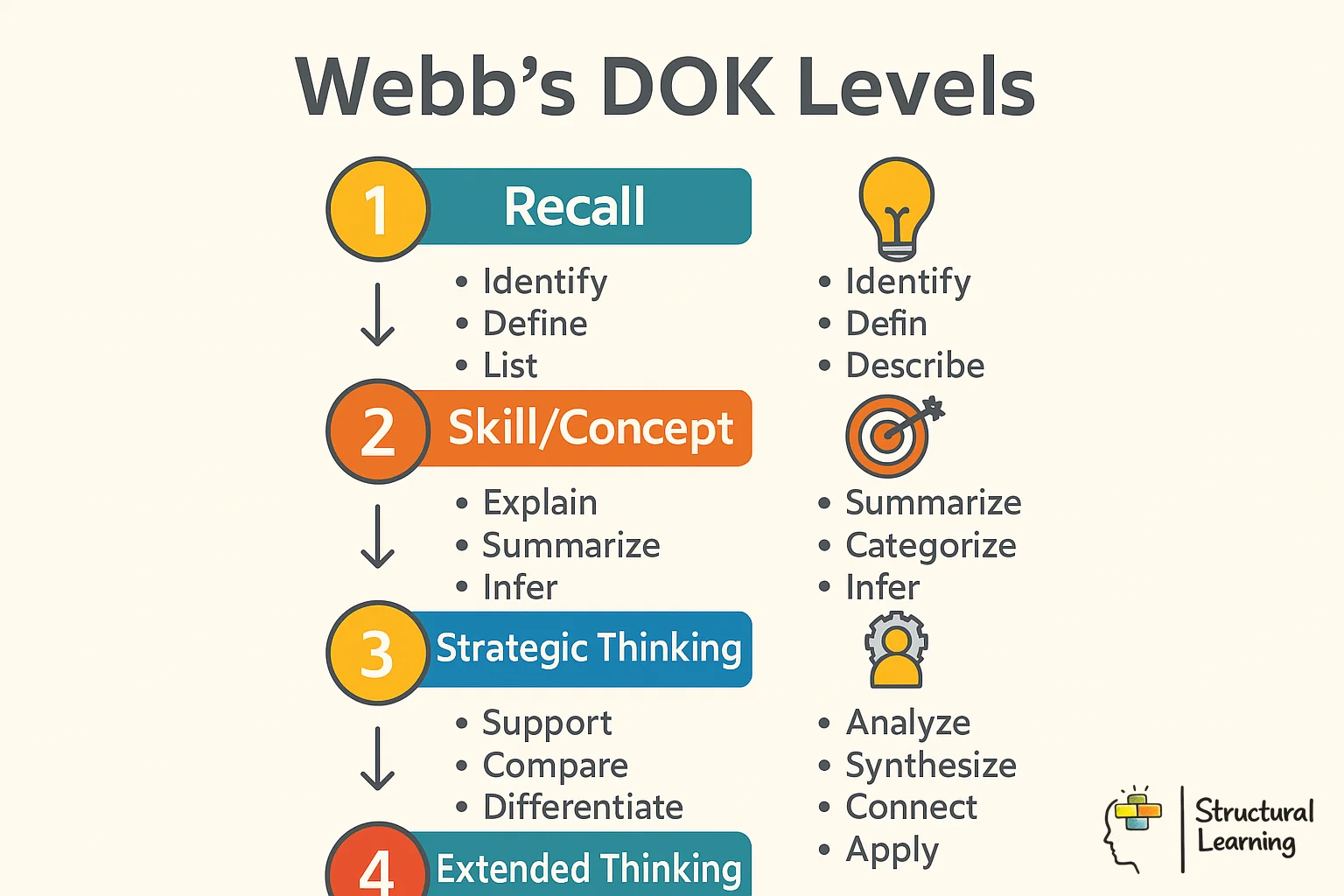
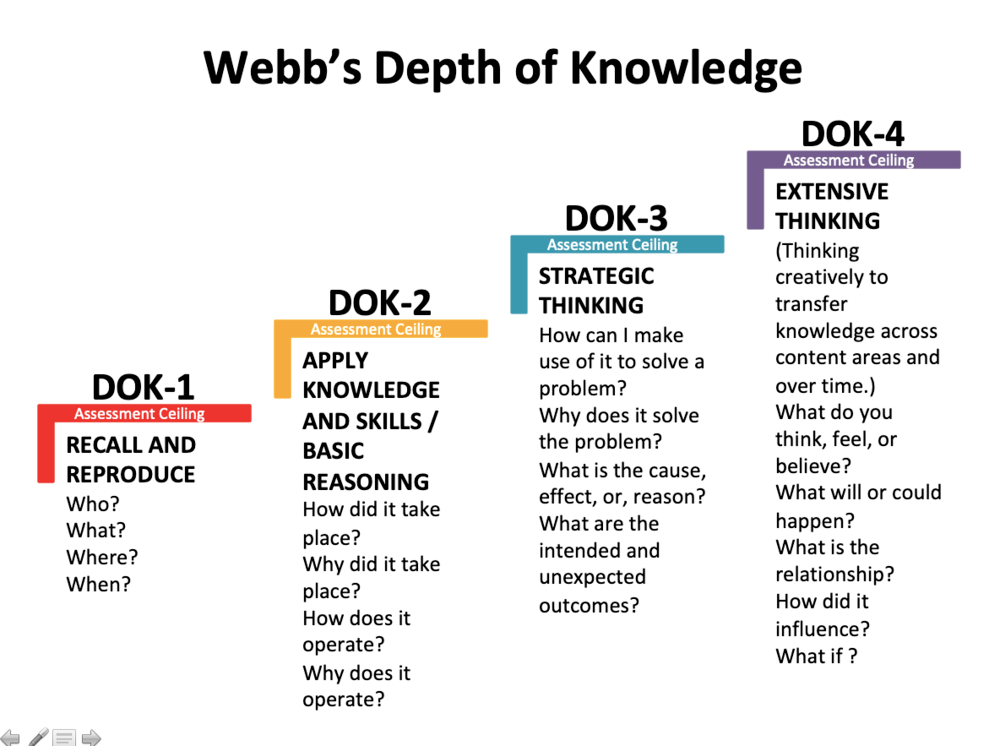
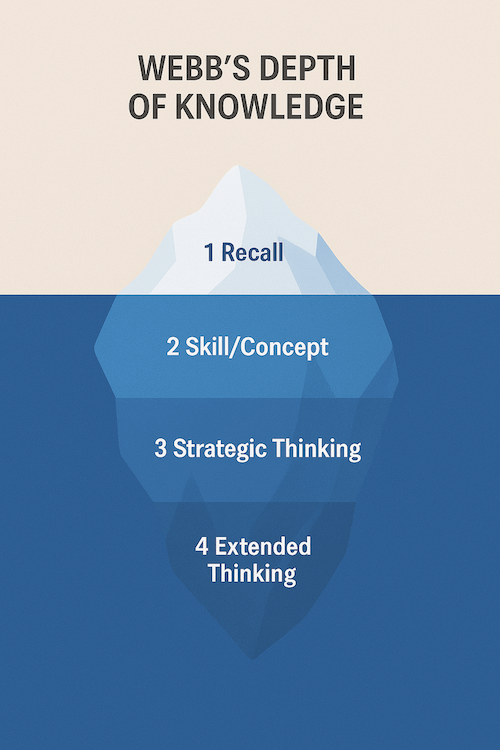
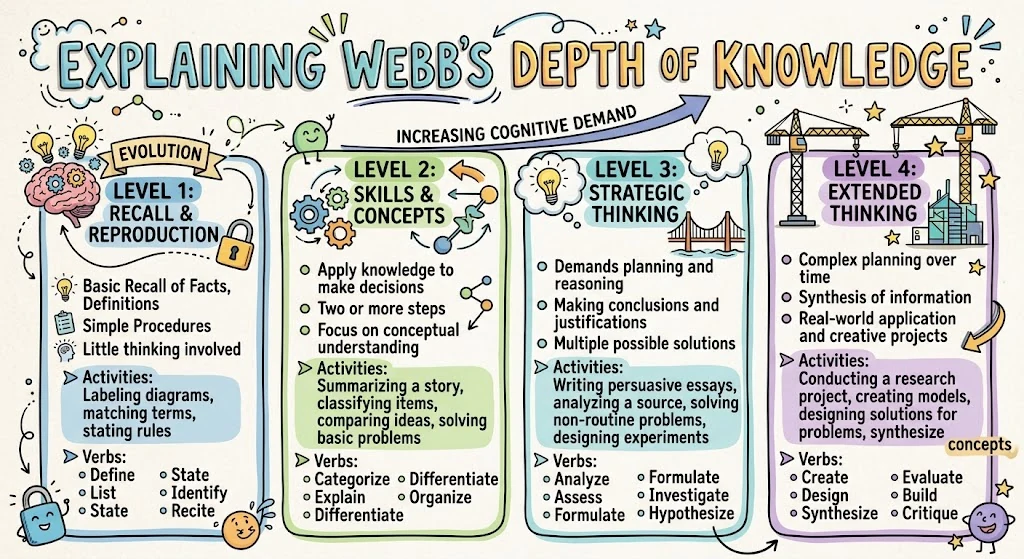
Level 1 asks learners to recall basic facts. Level 2 asks them to use skills and concepts. Level 3 needs strategic thinking and planning. Level 4 involves extended thinking over a longer period.
Norman Webb created DOK as an alignment tool for judging the cognitive demand of standards, assessments and classroom tasks (Webb, 1997). Teachers can use it to check whether a lesson asks learners to recall information, apply concepts, justify reasoning or investigate a problem over time.
Webb's Depth of Knowledge has four levels, from recall and reproduction to extended thinking; strategic thinking is Level 3. DOK helps teachers move learners beyond basic memorisation. Instead, learners analyse, evaluate and reflect on learning (Webb, 1997). This boosts cognitive challenge across all subjects.
Webb (1997) found Depth of Knowledge helps challenge learners. Hess (2006) showed it supports curriculum design and assessment. Many teachers use DOK, which started in big tests.
In the sections that follow, we'll explore how Webb's Depth of Knowledge can be applied in real classrooms, how it compares to other models of thinking, and why it plays a critical role in promoting meaningful, lasting learning.
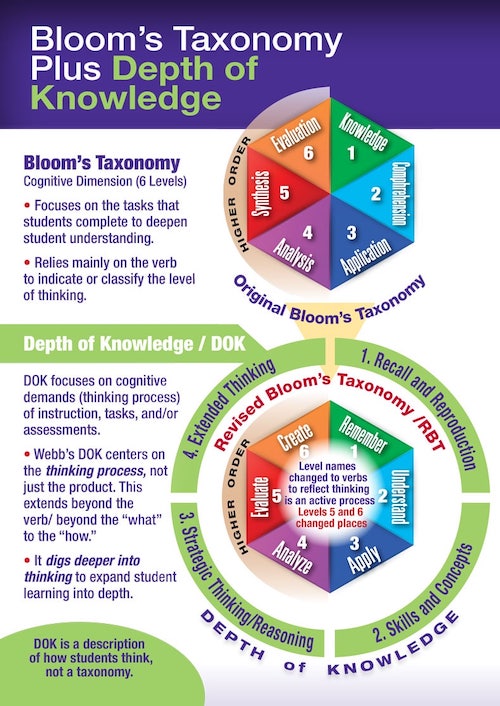
The DOK wheel is a planning aid, not Webb's framework. Webb did not create or endorse the wheel, and it can mislead teachers because it treats verbs as if they determine cognitive depth. In DOK, the level depends on the content, context, evidence required and independence of the reasoning (Webb, 1997; Hess et al., 2009).
A safer classroom test is to ask what comes after the verb. "Describe the character" may be DOK 1 if learners recall a taught description, but DOK 3 if they use several quotations to defend a judgement about motive.
Webb's Depth of Knowledge helps teachers design and review tasks by cognitive demand (Webb, 1997). It is useful for classroom assessment because it separates complexity from difficulty: difficulty is how hard learners find the task, while complexity is the kind of thinking the task requires.
There are four levels of Webb's Depth of Knowledge, each building on the previous level and requiring greater levels of cognitive complexity. The first level is recall, which requires learners to simply recall informatio n from memory. This may involve basic knowledge such as terms, definitions, or historical facts.
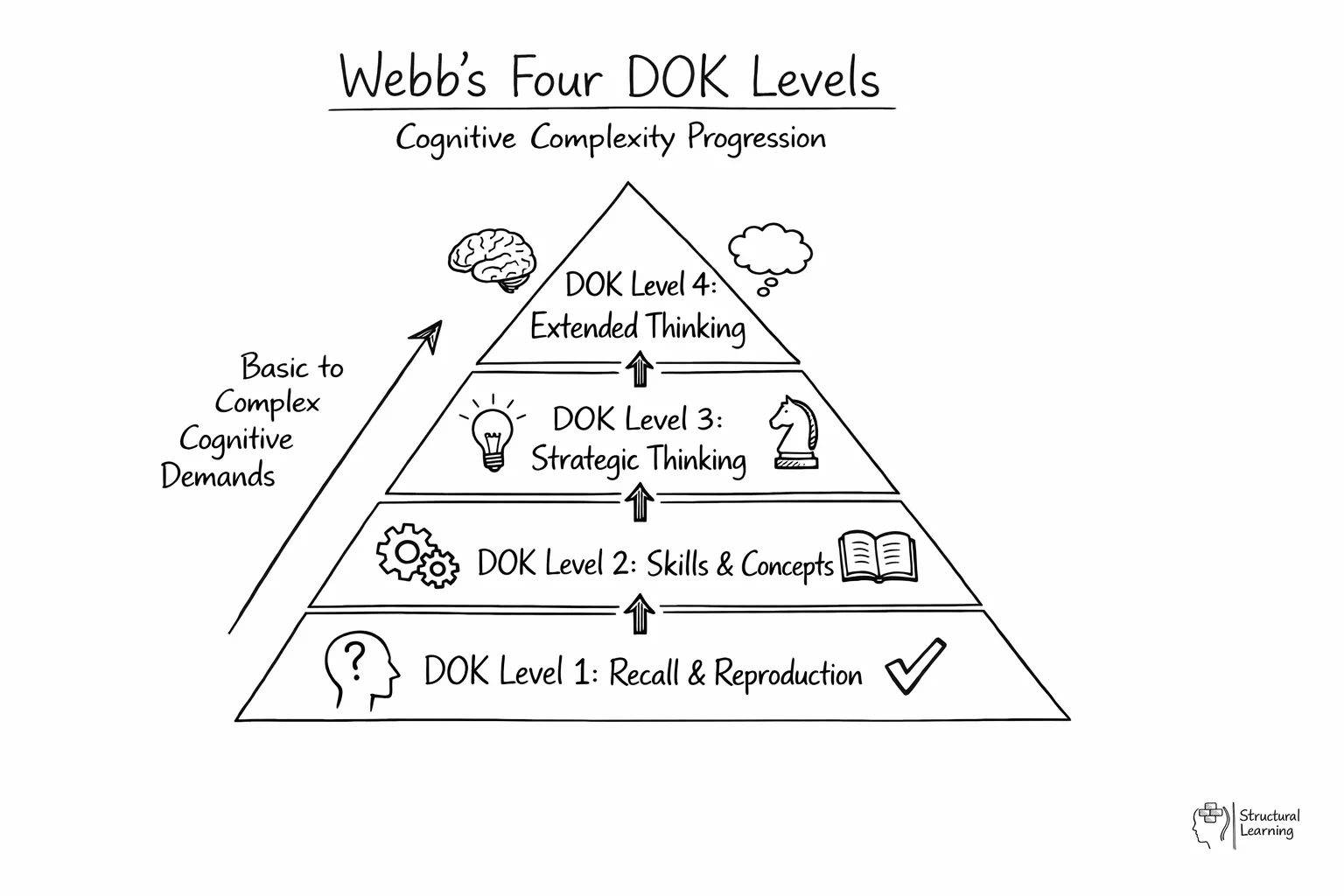
At the second level, learners must demonstrate understanding of a concept or skill. This includes activities such as explaining a concept, interpreting data to support a claim, or summarising key ideas from a text.
Level three of DOK asks learners to use knowledge in new ways. Learners may analyse sources to argue, (Bloom, 1956). They could develop a research question, (Anderson & Krathwohl, 2001). Learners may create projects combining subjects, (Marzano & Kendall, 2007).
DOK's fourth level asks learners to think critically. They must synthesise information and evaluate arguments (Webb, 2002). Learners may evaluate sources or create new knowledge. They may also develop solutions or judge an argument's validity (Webb, 2002).
Recognise that each level of DOK builds upon the previous level. At the first level, learners must recall basic knowledge, and at the second level, they must demonstrate understanding of the concept. In the third level, they must apply their knowledge in different contexts before finally engaging in critical thinking and synthesis at the highest level.
To further clarify the levels, consider a complex concept, such as climate change. At the recall level, learners may be asked to define climate change or name the greenhouse gases. At the understanding level, they may be asked to explain the causes of climate change or interpret data.
Learners use knowledge to cut carbon emissions (Anderson & Krathwohl, 2001). They combine sources, addressing climate change's effects (Bloom, 1956; Marzano, 2000). This shows more understanding and stretches each learner.
Webb's DOK helps teachers discuss cognitive skills, design tasks, and track learner progress. Considering its four levels lets teachers plan lessons to build learner knowledge (Webb, 2002).
Depth of Knowledge refers to the cognitive complexity required to complete a learning task, not the difficulty of the content itself. It measures how deeply learners must reason, connect evidence and transfer knowledge, rather than judging the task by its surface activity.
Depth of Knowledge (DOK) is an assessment-alignment framework introduced by Norman Webb (1997) to classify the cognitive demand of standards, classroom tasks and assessment items. It is not a learning theory and it should not be used to rate teacher performance from a short lesson snapshot.
The DOK wheel is a planning aid, not the framework itself. A question stem or command verb cannot determine the DOK level on its own; teachers need to examine the content, the context, the evidence required, the learner's prior knowledge and how independently learners must reason.
Webb's 1997 study gives teachers a framework for sorting DOK into four levels. These levels show rigour, or cognitive demand, depending on the context. Each level builds on the last and asks learners to think in more complex ways.
Note that the DOK levels are not fixed and may vary depending on age group, subject, and context. By using DOK, teachers can create tasks that challenge learners and encourage deeper learning.
| DOK Level | Question Stems |
| Level 1: Recall | Who, What, When, Where, Why? |
| How would you define.? | |
| Can you recall.? | |
| Level 2: Skill/Concept | Can you explain why.? |
| How would you use.? | |
| What may you infer from.? | |
| Level 3: Strategic Thinking | Can you formulate a theory for.? |
| What is your interpretation of.? | |
| How would you solve.? | |
| Level 4: Extended Thinking | How would you design a plan to.? |
| What evidence can you present for.? | |
| How can you prove/disprove.? | |
| These are just examples and the list can be expanded depending on the subject and the learning objectives. |
Webb's (2002) Depth of Knowledge sorts tasks by how hard learners must think. The levels progress from simple recall to advanced strategic reasoning. Teachers can use this framework (Webb, 2002) to plan lessons. Instruction should gradually build each learner's thinking skills.
The Webb learning theory label is misleading here: DOK is not a theory of how learners acquire knowledge. Norman Webb developed Depth of Knowledge in 1997 as part of a standards and assessment alignment method, with attention to whether assessment items reflect the cognitive demand of the intended curriculum.
Teachers can still use DOK for lesson and assessment design, but its strongest use is alignment. It helps staff ask whether learners are being taught and assessed on recall, routine application, strategic reasoning or extended investigation at the point where the curriculum expects that demand.
The DOK framework differs from Bloom's Taxonomy. It focuses less on needed task difficulty (Webb, 2002). Teachers can use DOK to design and assess learning. They can also guide instruction for deeper learner understanding.
At its core, the DOK framework has four levels. Each level shows rising rigour, or cognitive demand, depending on the context. Level 1 asks learners to recall basic information. Level 2 asks them to understand ideas or apply concepts and skills.
Level 3 asks learners to use their knowledge and understanding in new and varied contexts. Level 4 asks them to use higher-order thinking. This includes analysis, synthesis, and evaluation.
The DOK framework helps learners achieve deeper understanding. Teachers can use it to make activities require careful thought (Webb, 2002). This helps learners develop critical thinking and problem-solving skills. These skills are important for success in a changing world (Marzano & Kendall, 2007).
Used well, DOK helps teachers design better assessments. Used badly, it becomes a tick-box language of higher-order tasks, even when the underlying work is still recall. That difference matters for curriculum leaders.

Webb (1997) developed Depth of Knowledge as part of work on curriculum and assessment alignment. From 2010, Common Core developers used DOK to balance cognitive demand and reduce the risk that standards focused only on recall.
English activities often ask for strategic thinking at DOK 3. Maths builds problem-solving skills at DOK 3 starting from basic steps at DOK 1. UK teachers may link this to Ofsted's idea of "connected knowledge". This matches the national curriculum's shift from simple recall to applying ideas (Webb, 1997).
The DOK wheel is a widely circulated visual, but it is not a reliable way to identify DOK levels. A wheel of verbs cannot show whether a learner must use one fact, connect two ideas, justify a strategy or sustain an investigation over several lessons.
Researchers Norman Webb and colleagues (2005) created the Depth of Knowledge (DOK) chart. It has four levels: recall, skill/concept, strategic thinking, and extended thinking. The levels progress from basic recall to complex reasoning.
Bloom's Taxonomy focuses on the type of thinking skill used, whilst Webb's DOK measures the depth of cognitive processing required. DOK examines how deeply learners think about content, whereas Bloom's categorises different thinking verbs and processes.
While Bloom's Taxonomy (Bloom, 1956) sorts the type of thinking learners use, Webb's DOK (Webb, 1997) looks at how complex the task is. The Cognitive rigour or cognitive demand, depending on context Matrix brings both views together. For example, learners may analyse at DOK 2 when they compare two familiar texts. They may analyse at DOK 4 when they combine several sources to build and defend an original argument (Hess, Jones and Carlock, 2009).
Bloom's Taxonomy and Webb's Depth of Knowledge (DOK) guide learning. Teachers use them to aid learner progress. They are similar, but important differences exist between them.
Bloom's Taxonomy (Bloom, 1956) highlights different cognitive tasks, such as recall and abstract thought. Webb's DOK (Webb, 2002) emphasises the cognitive demand needed to finish tasks. Bloom focuses on thinking type, while Webb considers complexity level.
Another difference is assessment alignment. Bloom's Taxonomy helps teachers name the type of thinking attached to a content aim. Webb's DOK helps teachers check whether classroom assessments match the cognitive demand of curriculum standards and whether learners must use knowledge in the way the standard expects.
Models share common ground, focusing on analysis, synthesis, and evaluation (Bloom, 1956). Teachers can use either model to guide their teaching and improve learner progress (Marzano, 2000).
Teachers can use Bloom's Taxonomy by setting varied tasks. Learners recall facts (level 1), or analyse arguments (level 3). This encourages different thinking skills (Bloom, 1956).
Webb's DOK should be implemented through task analysis and moderation, not by choosing a verb from a wheel. Teachers should compare examples together, agree the evidence needed for each level and revisit ratings after looking at learner responses.
Bloom's Taxonomy (Bloom, 1956) builds critical thinking skills. Webb's DOK (Webb, 2002) boosts thinking across subjects. Teachers using both methods give learners richer educational growth.
Bloom's Taxonomy and Webb's Depth of Knowledge can work together when teachers use each model for its proper purpose: Bloom (1956) names the cognitive process, while Webb (1997) checks the depth and context of the task.

Biggs and Collis (1982) created the SOLO Taxonomy to sort learner answers by their complexity. The levels move from prestructural up to extended abstract. Webb's (2002) DOK measures how complex a task is to complete. Because SOLO looks at the quality of the answer, teachers can use both models together to understand learning better.
A DOK Level 3 task may receive a unistructural response from a struggling learner or an extended abstract response from one operating above expectations. Biggs and Collis (1982) developed Solo as an assessment tool, and pairing it with DOK allows teachers to diagnose whether the gap lies in task design or learner readiness.
For school leaders, the risk is the DOK illusion. A curriculum map can look ambitious when it labels tasks as DOK 3 or 4. But learners still need secure DOK 1 and 2 knowledge before they can reason well. If they cannot recall the vocabulary, procedures or examples, a strategic task can overload working memory instead of building deeper thinking.
Rigour means building cognitive demand in order. It does not mean skipping the basics. A Year 7 science team might first teach particle-model vocabulary. Then learners explain a change of state and justify which model best explains a new observation.
Webb's DOK helps with lesson planning. Teachers design tasks for each level. Level 1 activities ask learners to recall facts (Webb, 2002). For instance, learners identify key words from a text.
Level 2 tasks may involve applying knowledge and skills to new situations, such as asking learners to use mathematical equations to solve real-world problems.
These tasks need learners to analyse and combine information (Bloom, 1956). Learners may also need to use various strategies to finish (Anderson & Krathwohl, 2001). For example, compare arguments from two authors on a key issue (Marzano & Kendall, 2007).
Level 4 tasks stretch thinking beyond the classroom, according to researchers like Webb (2002). Learners use their knowledge to analyse real-world problems. For example, they may look at the environmental impact of a new local building project.
The DOK framework helps teachers strengthen classroom rigour. It looks at task complexity (Webb, 2002). Teachers can design tasks for each level of rigour.
This approach builds critical thinking and problem-solving (Anderson & Krathwohl, 2001). It also helps learners gain skills for future success (Marzano & Kendall, 2007).
Teachers using Webb's DOK should first check what thinking the curriculum and assessment actually require. DOK works best in planning and moderation meetings, where staff can inspect tasks and learner work together. It should not become a learning-walk checklist used to judge a teacher during a 20-minute visit.
Webb's (1997) Depth of Knowledge helps with activities and assessment. The framework has four levels to stretch learners' thinking skills. Using Webb's (1997) DOK helps teachers create appropriately challenging lessons.
Teachers use Webb's DOK by planning tasks for each complexity level. Level 1 tasks, like recalling key words, focus on simple information retrieval. Level 2 may have learners apply knowledge, for example, using equations to solve real problems.
Learners tackle complex Level 3 tasks, combining data from various sources. Teachers can create activities asking learners to compare arguments (Bloom et al., 1956). Use assessments where learners evaluate data to reach conclusions (Anderson & Krathwohl, 2001).
Level 4 tasks extend learning beyond the classroom. Teachers can boost critical thinking with real activities. Learners could assess the environmental impact of local building. Or, they could design solutions for traffic using problem-solving skills .
Webb's DOK helps teachers align teaching, activities and assessment, but differentiation should not mean assigning lower DOK levels to some learners by default. Adjust vocabulary, models, talk frames, worked examples and time so more learners can reach the intended cognitive demand (Webb, 1997).
It is also important for learners to use DOK to monitor their own learning progress. By understandin g the levels of complexity, learners can monitor their growth in critical thinking and problem-solving abilities. Learners can use DOK to set growth targets, reflect on their learning progress, and identify areas of strength and weakness.
Active learning helps learners at all levels through real tasks and teamwork. Webb's (2002) Depth of Knowledge framework helps teachers challenge thinking skills. This builds a rich learning environment for deeper understanding and knowledge retention, (Webb, 2002).
Challenge-based learning can lead to DOK Level 4 work when learners investigate a real problem over time. They use evidence from more than one source, test possible solutions, and justify their final recommendation. Treat this as an example of extended thinking, not as a separate source of evidence for the DOK framework.
Depth of Knowledge is subject specific. In maths, DOK 3 may involve selecting a strategy, representing a problem and justifying each step. In English, DOK 3 may involve weighing quotations, authorial intent and context to defend an interpretation. The same verb can carry different cognitive demand because each subject has different knowledge structures (Webb, 1997; Hess et al., 2009).
Webb's (1997) DOK model helps teachers plan lessons for all subjects. Teachers can challenge learners using different thinking skills. Activities and assessments should target problem-solving and critical thought. Hess et al. (2009) provide subject examples of DOK in action.
In ELA, teachers can use the DOK framework to create reading and writing activities that align with all four of Webb's levels of complexity. For example, at Level 1, learners could be asked to recall specific details from a text, such as identifying the main characters or setting. Level 2 tasks can challenge learners to apply their knowledge of literary devices to analyse the text, such as identifying symbols or interpreting metaphors.
Level 3 tasks ask learners to compare viewpoints or infer why a character acts in a certain way. Level 4 tasks involve longer pieces of writing that use critical thinking and creativity. Learners also explore text themes in real-world situations (Bloom, 1956; Anderson & Krathwohl, 2001).
In maths lessons, teachers can use DOK to challenge learners to apply their understanding of mathematical concepts to real-world problems. At Level 1, learners can recall number facts and basic formulae. As they progress to more complex tasks, they can apply those facts and formulae to problems such as calculating the area and volume of three-dimensional shapes.
Learners at Level 3 analyse data to predict trends. Learners at Level 4 apply maths to real situations, for example, designing a bridge .
In science classes, teachers can use DOK to challenge learners to apply their knowledge to real-world phenomena. At Level 1, learners could be asked to recall facts about the laws of physics or ecological systems.
Vygotsky (1978) believed that learners can manage harder thinking when teachers support them through talking and group work. At Level 3, learners can explain how the environment affects a species (Bronfenbrenner, 1979). They can also use scientific evidence to predict the results of an experiment (Piaget, 1936).
At Level 4, learners design experiments to explore real-world issues. These may look at new energy sources or the effects of climate change. This method actively involves learners in thinking like scientists (Bransford et al., 2000).
When planning assessments, teachers should map the intended DOK level before they write questions. A balanced end-of-unit assessment may include recall and routine application. It should also show where learners must justify a strategy, use evidence or sustain an investigation (Webb, 1997).
Maths exams often test different levels of thinking. Level 1 checks basic formulas, while Level 2 applies them to problems. Level 3 may ask learners to look closely at data (Bloom, 1956; Anderson & Krathwohl, 2001). Level 4 involves solving real-world challenges. Teachers can then adapt their lessons based on these test results (Wiliam, 2011).
Norman Webb developed the Depth of Knowledge framework to analyse the cognitive demand of standards and assessments (Webb, 1997; Webb, 2002). In simple terms, cognitive demand means the level of thinking a task needs. Hess et al. (2009) later linked DOK with Bloom's taxonomy through the Cognitive rigour or cognitive demand, depending on context Matrix.
Formative and summative uses of DOK need different maps. Formative checks ask what evidence the teacher needs today to adjust the next explanation, task or scaffold. Summative maps ask whether the final assessment matches the cognitive demand of the curriculum standard. Black and Wiliam (1998) showed why assessment evidence should change teaching, not merely record performance.
Free learning audit
Two quick ratings and two questions. We'll show you where your school sits and send you the learner observation toolkit (PDF).
AI tools can draft DOK-style question stems. Teachers still need to set the target level and check that the task really asks for analysis, justification or extended thinking. In 2026, many tools can produce plausible DOK 3 answers. So the stronger assessment question is whether learners can explain their reasoning, critique the AI output, connect it to class evidence and defend choices in an oral or written follow-up (Luckin, 2023; Ofqual, 2024).
Most formative assessment techniques default to DOK Level 1, checking recall through quick quizzes or thumbs up/down responses. Karpicke (2008) showed the value of retrieval for learning, but teachers still need to match the check for understanding to the cognitive demand of the lesson. For DOK 1, a brief retrieval quiz works well. For DOK 2, ask learners to explain the relationship between two concepts using a graphic organiser.
DOK 3 could see learners critique examples, pinpointing flawed logic. DOK 4 uses peer review of projects against set criteria. Wiliam (2011) says good formative assessment matches strategy to cognitive demand. Do not just check if learners understand.
Webb's DOK can be an equity check, not a reason to lower challenge. All learners, including those receiving intervention, SEND support or EAL support, should meet Level 3 and Level 4 thinking with appropriate scaffolds. Teachers can adjust vocabulary, worked examples, talk prompts, visual supports and time while keeping the cognitive demand ambitious (Webb, 1997).
In practice, DOK is not neutral across culture, language, or neurology. A learner may fail a DOK 3 task because the language load, executive-function demand, or unfamiliar context gets in the way. This does not always mean they cannot reason strategically. When teaching special education learners, separate the thinking demand from barriers you can remove.
Consider each learner's needs when using DOK, as per research. Factor in their communication, prior knowledge, and strengths when planning lessons. Forget "learning styles"; they don't work (Pashler et al., 2008). Use proven methods like scaffolding and retrieval practice instead. Tailor learning to suit individual strengths and limitations, challenging learners appropriately.
Teachers should use real world activities to capture learner interest. This approach gives learners a clear purpose and makes their lessons meaningful (Herrington & Oliver, 2000). Active learning platforms can also hold learner attention by offering interactive tasks .
Teachers can work with learning coaches to plan DOK materials. This supports the specific needs of special education learners. It helps each learner engage with suitably challenging work (Marzano, 2000; Hattie, 2012). It also supports appropriate cognitive demand for learners (Bloom, 1956).
Learners need individualised learning, real tasks, and team collaboration for effective DOK. Teachers can use these features to build rich learning experiences for special needs learners. Biggs and Collis (1982) show that Solo Taxonomy strengthens DOK implementation.
Depth of Knowledge gauges cognitive demand, not task difficulty. Activities that look complex may still require basic recall, while a short question can require strategic reasoning. Use department moderation to compare task evidence, agree the DOK level and note where prior knowledge or language demand may change what learners actually experience.
Use these foundational sources for DOK and related taxonomy work instead of the removed placeholder citations.
Distance learning can focus too much on simple recall tasks. Srivastava et al. suggest that lecturers use Depth of Knowledge (DOK) for online sessions. They can structure sessions in segments that target different DOK levels.
Start with retrieval (Level 1). Then ask learners to apply knowledge in discussions (Level 2). Finish with collaborative problem-solving that needs strategic thought (Level 3).
Asynchronous tasks should target DOK 4 by requiring learners to synthesise resources over days rather than minutes. The DOK framework offers a practical planning grid that works regardless of whether teaching takes place in a classroom or online.
Download this free Thinking Framework (Green/Orange/Blue/Red) resource pack for your classroom and staff room. Includes printable posters, desk cards, and CPD materials.
Evaluate the depth of knowledge in your assessment questions
Researchers like Norman Webb (1997) offer guidance. Teachers often ask about using Depth of Knowledge (DOK) levels in lessons. Many want to write questions demanding more thinking. They need help shifting learners from recall to strategic tasks (Webb, 2002).
Teachers often ask about Depth of Knowledge (DOK) levels and activity alignment. They also question how to progress learners through DOK levels (Webb, 2002). Teachers want to know how DOK differs from Bloom's Taxonomy (Anderson & Krathwohl, 2001). Grasping these basics helps teachers use DOK to raise cognitive demand (Hess, Carlock, Jones & Walkup, 2009).
Teachers use Webb's Depth of Knowledge (DOK) framework more often. This framework can seem complicated, causing questions. Teachers wonder about its purpose, use, and benefits for learner progress (Webb, 1997).
To address these questions, we have created a Frequently Asked Questions (FAQs) section on DOK that aims to give teachers a comprehensive guide to understanding this framework.
Depth of Knowledge (DOK) ideas are important for planning learning. We answer common questions and explain how teachers can put DOK into practice. This process supports learner development (Wiggins & McTighe, 2005; Marzano & Kendall, 2007; Hattie, 2012).
This section explains cognitive complexity, which can help you. Bloom's Taxonomy is a useful framework (Anderson & Krathwohl, 2001). You can use DOK levels to plan lessons and assessments that meet standards (Webb, 2002; Hess et al., 2009). Consider the right DOK level for each learner.
Q1: What is Webb's Depth of Knowledge (DOK)?
Webb's Depth of Knowledge framework classifies tasks by thinking complexity. You can use it to analyse cognitive demand in standards, activities, and assessments (Webb, 1997). This helps learners succeed.
Q2: How many levels are there in Webb's DOK?
Webb's DOK is made up of four levels. Level 1 involves recall and reproduction, Level 2 involves skills and concepts, Level 3 involves strategic thinking, and Level 4 involves extended thinking.
Q3: How does Webb's DOK differ from Bloom's Taxonomy?
Bloom's Taxonomy and Webb's DOK both help classify learning, but they answer different questions. Bloom (1956) describes the type of cognitive process, while Webb (1997) describes the complexity of thinking required by a task.
Q4: How can I use Webb's DOK in my teaching?
Webb's DOK helps you match tasks to different thinking skills. Use DOK levels to align teaching with assessments and aims (Webb, 1997). This improves the learner experience.
Q5: Can Webb's DOK be used to create assessments?
Yes, Webb's DOK is often used to guide the development of assessments, ensuring that they measure th e intended cognitive processes. For example, you may design some questions to target lower DOK levels (e.g., recall of information) and others to target higher DOK levels (e.g., strategic and extended thinking).
Q6: Does Webb's DOK align with Common Core State Standards?
Yes, Webb's DOK has been used in the development of the Common Core State Standards to indicate the level of cognitive demand associated with each standard. The intention is to ensure a good balance of cognitive demands across each grade level.
Does depth of knowledge assessment improve higher-order thinking?
The evidence here is indirect. Peer assessment and well-designed formative assessment can support critical thinking. But they do not, on their own, validate the DOK framework. Use these findings to support assessment routines that help learners explain, justify, and improve their thinking.
Classroom Takeaway
Ensure at least 30% of your questions sit at DOK Level 3-4. Higher-order assessment tasks do not just measure thinking; they actively develop it.
Domain-specific prior knowledge and learning A meta-analysis164 cited
Simonsmeier, B., Flaig, M., Deiglmayr, A. (2021). Educational Psychologist.
Research paper: Effects of online peer assessment on higher-order thinking. A meta-analysis.35 cited
Zhan, Y., Yan, Z., Wan, Z. (2023) · British Journal of Educational Technology ·
Situating Higher-Order Critical and Critical-Analytic Thinking in Problem and Project-Based Learning Environments. This study looks at how deeper thinking works in problem-based and project-based lessons.83 cited
Loyens, S., van Meerten, J., Schaap, L. (2023) · Educational Psychology Review ·
HIGHER ORDER THINKING SKILLS ASSESSMENT139 cited
Widana (2017) studied Indonesian learner assessment using JISAE. This research gives teachers useful ideas about assessment. Read Widana (2017) for the full details.
Reviewing assessment of learner learning in interdisciplinary STEM education. This paper looks at how teachers can assess learners across different science subjects.205 cited
Gao, X., Li, P., Shen, J. (2020) · International Journal of STEM Education ·
Evidence from peer-reviewed journals. All links to original publishers. Checked 25 Mar 2026.
Webb's DOK is useful, but it is not a universal measure of lesson quality. It was designed to analyse alignment between expectations and assessments. Schools should use it to improve task design, curriculum mapping and assessment moderation. They should not use it to score teachers during brief observations (Webb, 1997).
Teachers may not always agree on a task's DOK level. This is most likely near the line between Level 2 skill and Level 3 strategic thinking. Inter-rater reliability work shows that item writers can understand DOK features but still sort tasks in different ways across grades and subjects (Wyse and Viger, 2011). Teachers therefore need calibration using real learner work.
Risk of checkbox compliance. When schools mandate DOK alignment, teachers sometimes relabel existing tasks rather than redesigning them. A worksheet that asks learners to "analyse" may still require nothing more than recall if the information is provided on the same page. The label does not guarantee the cognitive demand (Hess, Jones and Carlock, 2009).
DOK also says little about motivation, classroom relationships, cultural knowledge or the social conditions that support extended thinking. A Level 4 inquiry can still fail if learners do not feel they belong. It can also fail if they lack language access or secure foundational knowledge. Combine DOK with formative assessment, explicit teaching and scaffolded discussion (Black and Wiliam, 1998).
Static levels vs. active learning. Learning rarely follows a neat progression from Level 1 to Level 4. A learner may need to revisit recall tasks midway through a strategic project. Treat DOK as a lens for alignment and cognitive demand, not as a rule that every lesson must finish at Level 4.
Advanced DOK applications show how the framework can support newer assessment problems. They also support open-ended projects, online learning, cognitive-load checks, teacher development, and tactile classroom routines. Treat these as uses of the core DOK lens, not as separate frameworks.
Generative AI changes the assessment problem. A tool can now draft a polished comparison, explanation or source-based answer that looks like DOK 3. The teacher's task is to design assessment evidence that shows human reasoning: planning notes, oral defence, source choices, revision decisions and reflection on why an answer is trustworthy (Luckin, 2023; Ofqual, 2024).
For UK exam boards and school leaders, DOK 4 should mean evidence of the learning process, not just a longer final product. Extended thinking can include fieldwork, class debate, practical investigation, draft work, teacher questions, and evidence of how learners respond when their first idea fails.
For example, a Year 9 history teacher might ask learners to compare an AI-generated explanation of the Treaty of Versailles with two primary sources and one historian's interpretation. The DOK 3 demand is not simply writing an evaluation. Learners must decide which evidence matters, spot weakness in the AI response and justify a revised judgement.
Teachers need to curate and adapt AI-generated questions. Review each output, check the evidence required, and add safeguards that make learner thinking visible. In the AI age, DOK 4 should assess transfer, judgement, metacognition and accountable use of evidence, not the smoothness of a submitted paragraph.
Webb's Depth of Knowledge (DOK) is a helpful tool for Challenge-Based Learning (CBL). It helps teachers design and grade classroom tasks. CBL asks learners to solve real problems rather than just memorising facts (Webb, 1997). DOK lets teachers check that every stage requires higher-order thinking.
DOK sorts tasks into four levels of cognitive complexity. This helps educators scaffold learning well within open-ended challenges. The approach helps learners build a range of skills, from basic recall to complex strategic and extended thinking. Teachers can use DOK to map the cognitive demands of each stage, from initial investigation to final solution presentation.
In a Challenge-Based Learning setting, DOK Level 1 tasks ask learners to recall facts about the challenge. They may name key terms or collect basic data to understand the problem. DOK Level 2 tasks ask learners to use ideas or skills. This could mean comparing different solutions or grouping useful details.
DOK Level 3 tasks require strategic thinking. Learners must make plans, explain their choices, and analyse complex details within a problem. Next, DOK Level 4 tasks demand extended thinking over a longer time. At this stage, learners design their own investigations, combine information from many sources, and create unique solutions.
For example, if learners are challenged to design a sustainable school garden, a DOK 1 task may be listing plants suitable for the local climate. A DOK 2 task could involve comparing different irrigation systems. A DOK 3 task would require learners to justify their chosen garden layout and plant selection based on water conservation principles. A DOK 4 task would involve learners implementing a prototype section of the garden, monitoring its progress, and evaluating its sustainability over several weeks.
| DOK Level | CBL Task Description | Learner Action Example |
|---|---|---|
| DOK 1: Recall & Reproduction | Identify basic facts or definitions related to the challenge. | Learners list common causes of local air pollution. |
| DOK 2: Skills & Concepts | Apply information, compare, or classify within the challenge context. | Learners compare the effectiveness of different public transport options for reducing emissions. |
| DOK 3: Strategic Thinking | Formulate a plan, justify a solution, or analyse complex aspects of the challenge. | Learners propose a strategy to encourage cycling in their community, justifying their choices with evidence. |
| DOK 4: Extended Thinking | Design and execute an investigation, synthesise multiple sources, or create an original solution over time. | Learners design and conduct a survey on local transport habits, analyse the data, and present a comprehensive policy recommendation to the school council. |
Teachers need to keep Webb's Depth of Knowledge (DOK) in mind when planning online lessons. This helps to make distance learning much more effective. We must set up tasks that push learners past basic memory work. This helps them truly understand and apply new ideas in different ways (Webb, 2002).
Online lessons can support DOK Level 1 (Recall) and Level 2 (Skills/Concepts) using short video clips. Teachers can follow these clips with quick quizzes or drag-and-drop tasks. For example, learners may watch a video about photosynthesis. Then, they could complete a digital worksheet to label the parts of a plant cell.
DOK Level 3 (Strategic Thinking) and Level 4 (Extended Thinking) need more complex online tasks. Teachers can set collaborative projects in virtual breakout rooms. They can also use asynchronous discussion forums where learners analyse complex scenarios. For instance, learners may research different historical interpretations of an event and then present their justified conclusions in a recorded video.
The following table illustrates how DOK levels can guide the creation of varied and challenging online lecture components.
| DOK Level | Online Lecture Strategy | Learner Activity Example | ||||||||||
|---|---|---|---|---|---|---|---|---|---|---|---|---|
| Level 1: Recall | Micro-lectures with embedded comprehension checks. | Learners answer multiple-choice questions recalling key terms from a short video. | ||||||||||
| Level 2: Skills/Concepts | Interactive simulations or guided problem-solving demonstrations. | Learners apply a mathematical formula to new data sets in an online spreadsheet. | ||||||||||
| Level 3: Strategic Thinking | Case study analysis in virtual breakout rooms or structured debates. | Learners collaboratively analyse a historical document, identifying biases and forming arguments. | ||||||||||
| Level 4: Extended Thinking | Long-term research projects or complex problem-based learning scenarios. | Learners design and present a solution to
Gamification and Interactive Digital PlatformsGame-based learning platforms, like Kahoot, can boost learner engagement and motivation. These tools share educational content in a fun and competitive way. This format encourages all learners to take an active part in the lesson. Research shows that these platforms can improve academic results, especially in complex subjects (Wang & Tahir, 2020). For instance, a science teacher may use a Kahoot quiz to review a hard chemistry topic such as chemical bonding. Learners answer multiple-choice questions, compete for points, and get feedback straight away. This active approach helps learners secure their understanding and spot areas that need more attention. Quick feedback and a competitive edge help to motivate learners. These features encourage children to think critically and remember facts well. Game-based learning brings this active recall to life. It supports deeper learning rather than just passively receiving facts. As a result, these platforms help to build higher-order thinking skills. Measuring Cognitive Load and Mental OverloadCognitive load means the total mental effort used in working memory during learning (Sweller, 1988). When a task exceeds a learner's processing capacity, they can feel mentally overloaded. This makes effective learning harder. Webb's Depth of Knowledge levels ask for different amounts of cognitive effort, and higher DOK levels usually need more complex mental processing. Teachers can learn about a learner's mental load in real time using different types of data. Physical signs can show exactly how hard a child is thinking. Eye-tracking technology can reveal changes in learner size or where a child looks. Heart rate changes can also link to mental effort. These methods offer clear measures that go beyond what learners say themselves. Watching for physical signs can help teachers spot when learners feel overwhelmed during DOK Level 3 or 4 tasks. A learner may struggle to read a complex historical source. If their eyes dart around or they seem stressed, the teacher can step in. To lower the mental demand, the teacher could simplify the task, provide a graphic organiser, or ask a helpful question. DOK for Teacher Professional DevelopmentWebb's Depth of Knowledge (DOK) gives school leaders a clear way to plan teacher training. Instead of just sharing facts, leaders can use DOK levels to guide how teachers learn and plan. This method challenges staff to use higher-order thinking skills. As a result, teachers experience the same high standards we expect from our learners. When you plan professional development, DOK levels can help you set the right level of challenge. A DOK 1 task may ask teachers to recall key safeguarding policies. A DOK 2 task could ask them to use these policies in a practice scenario. At DOK 3, teachers may review how well different assessment strategies work in their subject. They would then support their choices with clear evidence. A DOK 4 training task may ask teachers to create a new project that links different subjects. They would then run the project and check how it affects learning over time. This work requires them to combine information, solve problems, and use high-level strategic thinking (Webb, 2002). Tasks like this prepare teachers to lead major teaching changes in their schools.
Tactile DOK: Physicalising Cognitive RigourPhysical activity can deepen a child's understanding and mental effort. This is especially true for younger children and active learners. Adding hands-on elements to tasks makes a big difference. It helps learners grasp abstract ideas in a real and concrete way. This approach pushes learners far beyond passive learning. They must hold, build, and sort physical objects to understand a topic. Teachers can plan these activities to match Webb's Depth of Knowledge levels. This makes sure that hands-on tasks still require the right amount of brain power. DOK Level 1: Recall and ReproductionDOK Level 1 involves hands-on tasks where learners recall facts, definitions, or simple steps. They use physical actions to show what they know about basic topics. For instance, Year 2 learners may sort animal flashcards into 'mammals' and 'birds'. To do this, they recall the features of each group. The task strengthens memory because learners take an active role (Dunlosky et al., 2013). DOK Level 2: Skills and ConceptsDOK Level 2 tactile activities require learners to apply skills or understand concepts. They move beyond simple recall to demonstrate comprehension. A Year 4 science class could build a model of the water cycle using various materials like cotton wool for clouds and a plastic sheet for condensation. This task demands learners apply their understanding of the cycle's stages and processes to construct a representation. DOK Level 3: Strategic ThinkingHands-on tasks at DOK Level 3 need strategic thinking, planning, and clear reasoning. Learners must use evidence to solve problems or create new solutions. Secondary design and technology learners may build a prototype to solve a specific problem. For example, they could design a tool to reduce plastic waste in the school canteen. To show strategic thinking, they must plan their design and choose the right materials. They also need to explain their choices using clear criteria. DOK Level 4: Extended ThinkingDOK Level 4 tactile tasks demand extended thinking. Learners must carry out investigations and solve complex problems. They also need to combine ideas from several different sources. Because of this deep work, these physical projects usually take much longer to finish. Year 6 learners could design and build a small model of a green city. They may include ideas like solar power and clever waste sorting. This kind of project needs deep research and careful planning before the building begins. Finally, learners present their finished model and explain the reasons behind their design choices. ReferencesBlack, P. (1998). Inside the black box. Bloom, B. (1956). Taxonomy of educational objectives. Karpicke, J. (2008). The critical importance of retrieval for learning. Vygotsky, L. (1978). Mind in society: The development of higher psychological processes. Webb, N. (1997). Criteria for alignment of expectations and assessments. Further Reading: Key Research PapersThese peer-reviewed studies provide the research foundation for the strategies discussed in this article: Cognitive Complexity N. Webb (2020) Norman Webb's paper examines thinking skills in education, using his Depth of Knowledge framework. Teachers can use this to plan lessons needing different thinking levels. This moves learners beyond remembering facts to analysis and longer tasks. Researchers compared Korean and US curricula. They focused on how hard learners found adding and subtracting fractions. This comparison examined cognitive complexity. Ji-Won Son (2012) Choi and Hong (2016) compared fraction materials in Korea and the US. They explored the cognitive demands put on learners. Teachers can use this to choose materials that build better understanding. |