Updated on
September 24, 2026
US-UK SEND Terminology Guide: A Transatlantic Glossary
A glossary translating US special education terms into UK SEND equivalents: IEP to EHCP, RTI to the Graduated Approach, 504 Plans, IDEA and 30 more.


Updated on
September 24, 2026
A glossary translating US special education terms into UK SEND equivalents: IEP to EHCP, RTI to the Graduated Approach, 504 Plans, IDEA and 30 more.
US-UK SEND Terminology Guide: A Transatlantic Glossary is a practical guide to legal, policy and classroom terms. It covers special educational needs and disability in England and special education in the United States. It treats terminology as a way to plan school action, not as a label for its own sake. This matches the SEND Code of Practice's view that identification should decide what support a school provides (Department for Education and Department of Health, 2015).
For example, when a Year 5 learner arrives from a US school with an IEP, a UK SENCO cannot simply rename it an EHCP. The team needs to translate the evidence, provision and review cycle into the graduated approach, then decide whether SEN Support, an EHC needs assessment or ordinary classroom adjustments are the right next step.
US and UK special education terms differ, which can confuse educators. This guide translates core terms to help staff compare both systems without importing the wrong legal assumptions. UK teachers can use it when reading US frameworks such as IDEA, IEPs, RTI and PBIS; US educators can use it when they meet UK terms such as SEND, SENCO, EHCP and the graduated approach.
UK teachers often use international research, such as RTI from the US. Schools might also use UK provision mapping. But different terms can cause confusion about legal duties. This guide helps you compare terms accurately, use research in a valid way, and build effective partnerships.
It helps to know that the USA uses legal rights (IDEA), while the UK favours school support (SEND). This shapes the terminology and reflects different educational philosophies. These differences affect how you approach support for each learner.
Use this table for quick translations between UK and US terms. It helps when you see unfamiliar words or explain UK concepts to US colleagues, and vice versa.
Schools do not all identify SEND in the same way. In the US, schools use multi-disciplinary evaluation (MDE), where staff from different roles assess the learner, and testing for IDEA eligibility. They look at cognitive, academic, behavioural, and social-emotional skills. To qualify, a learner must have a disability under an IDEA category AND need special education.
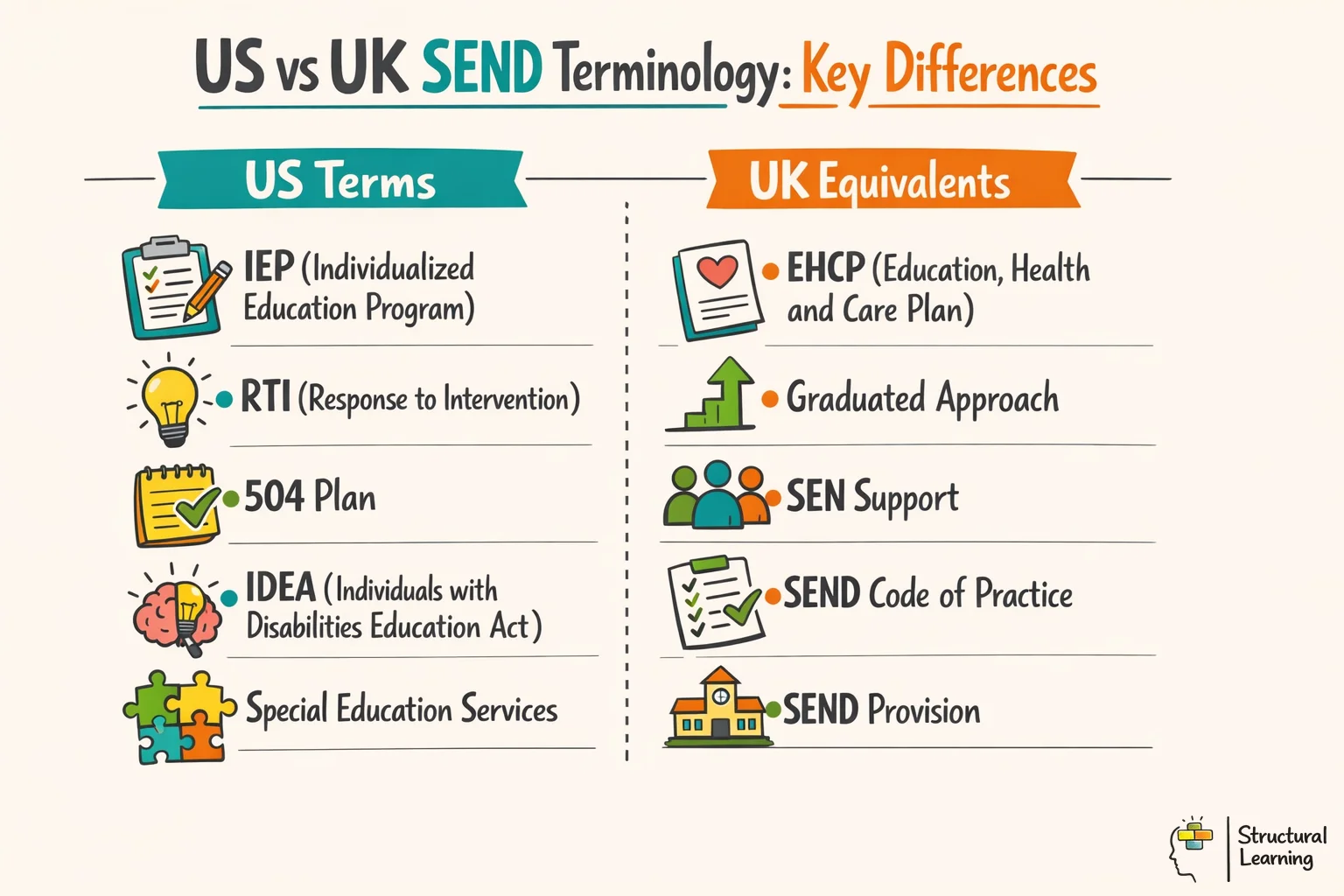
UK schools use ongoing checks to find SEND needs. If needed, specialists assess learners. A learner needs SEND support if they need help "additional to and different from" normal.
EHCPs use observations, teacher input, and specialist reports. Local authorities then decide if an EHCP is needed. (Based on guidance like the Code of Practice [DFE, 2015] and research by Norwich [1994] and Farrell [2009]).
In the US, the system has a legal focus. Evaluations start when a teacher or parent asks for one. After parental consent for an initial IDEA evaluation, the evaluation must be completed within 60 days unless the state has established a different timeframe. In the UK, SENCOs monitor all learners over time and talk with parents, adding support when needed.
Both systems expect early intervention. The US provides services under IDEA from age 3 (or birth under Part C for infants). The UK SEND Code of Practice covers ages 0-25. However, US services are legally mandated once identified; UK provision depends partly on school budgets and specialist commissioning.
Support for learners varies by system. In the US, IEPs set out current performance, yearly goals, services, accommodations, and modifications. Schools must provide these services and check progress often. IEPs also name exact support: speech therapy Tuesdays 2pm; maths help Mondays, Wednesdays, Fridays.
In the UK at SEND Support level, schools use provision mapping: a visual overview of what support each learner receives. An EHCP is similar to an IEP.
Both list outcomes and provision. The local authority is responsible for securing the special educational provision specified in an EHCP; named schools or institutions also have related legal duties, including admitting the child or young person where the statutory duty applies. Schools can and do update support without formal plan revision more flexibly than in the US.
US schools prioritise SMART goals (Specific, Measurable, Achievable, Relevant, Time-bound). They report learner progress on IEP goals often, compared to peers. UK schools use differentiation and interventions, like phonics groups. Formal annual goals are less common on SEND plans here.
Researchers like Fuchs et al. (1997) show US interventions use intensive methods. These might include 1-to-1 support or special school places. Conversely, in the UK, mainstream classes provide extra help and expert visits. Norwich and Nash (2011) note specialist schools are rarer in the UK.
In US schools, special education teachers and school psychologists often have formal roles. They may assess learners, help develop IEPs and provide specially designed instruction. Certification and delivery models vary by state and district, so do not treat "resource room" or "special education teacher" as one national model. School psychologists may carry out evaluations and recommend interventions within local procedures.
| Aspect | US System | UK SEND System |
|---|---|---|
| Core Law | IDEA 2004 and Section 504 of the Rehabilitation Act 1973 | SEND Code of Practice and Children and Families Act 2014 |
| Primary Document | Individualised Education Program (IEP) | Education, Health and Care Plan (EHCP) |
| Less Formal Support | 504 Plan (covers accommodations only) | SEND Support (graduated approach; provision map) |
| Age Range Covered | Ages 3-21 (IDEA); some services until 22 | Ages 0-25 (part of SEND Code of Practice) |
| Who Holds Authority | School district; federal oversight | School (SEND Support); local authority (EHCP) |
| Dispute Resolution | Due process hearing; mediation | SEND Tribunal; mediation |
SENCOs lead SEND work in UK schools. They are senior staff, often with SEND training. SENCOs coordinate support and liaise with agencies. Classroom teachers teach all learners, including those with SEND, with SENCO support.
IEP teams in US schools include teachers, administrators, psychologists, parents, and the learner (if appropriate). These meetings happen annually, but can occur sooner. EHCP reviews in the UK involve school staff, parents, the learner (if appropriate), and local authority staff. Schools then change learner support as needed between the annual reviews.
US parents can use IDEA dispute-resolution routes, including mediation, state complaints and due process hearings. In England, parents and young people can use mediation and can appeal to the SEND Tribunal for specified EHCP and SEND decisions. Both systems have formal routes, but the process, remedies and legal language are different, so do not translate one system's procedure directly into the other.
IDEA 2004 and Section 504 (1973) underpin the US system. Under IDEA, eligible children with disabilities are entitled to a free appropriate public education (FAPE). Section 504 protects anyone with a disability.
It demands reasonable adjustments for fair access. A learner may have a 504 plan without an IEP. For example, a learner with ADHD may get extra test time.
The UK system is built on the Children and Families Act 2014 and the SEND Code of Practice (statutory guidance). The Act establishes the legal framework; the Code explains how it should be implemented. UK law presumes mainstream education and requires schools and local authorities to support learners with SEND, but there is no equivalent to FAPE. Schools must provide appropriate support, but what counts as "appropriate" is less legally defined than in the US.
IDEA (US law) lists 13 disability categories. These include autism and deafness (amongst others). To qualify under IDEA, a learner needs both a category and special education.
The UK has no specific categories like IDEA (US law). In the UK, a learner has SEND if their needs require extra support.
Both systems let parents challenge decisions, but the remedies are different. In the US, IDEA disputes can involve due process hearings and procedural safeguards. In England, SEND Tribunal appeals usually focus on decisions such as assessment, EHCP contents, placement or cease-to-maintain decisions. Keep the comparison about process, rather than implying that both systems offer the same remedies.
Tip 1: When reading US resources (RTI, PBIS, SDI, etc.), map to UK equivalents. US research on Response to Intervention applies directly to UK schools. However, translate RTI's three-tier structure into the Graduated Approach.
| US Term | UK Equivalent | Notes |
|---|---|---|
| 504 Plan | Reasonable Adjustments / Access Arrangements | Both allow equal access without altering curriculum. UK term covers exams explicitly. See 504 accommodations guide for US context. |
| Accommodation | Reasonable Adjustment / Access Arrangement | Changes to how learning is delivered without changing what is taught. Examples: extra time, scribe, coloured overlays. See accommodations versus modifications for detailed comparison. |
| Modification | Differentiated Curriculum / Alternative Curriculum | Changes to what is taught; the curriculum content itself is altered. UK term reflects broader differentiation approach. |
| IDEA (Individuals with Disabilities Education Act) | SEND Code of Practice; Children and Families Act 2014 | IDEA is federal law guaranteeing FAPE. UK Code is statutory guidance; the Act provides the legal framework. Different enforcement mechanisms. |
| FAPE (Free Appropriate Public Education) | SEND Provision Duty | Both require schools to provide necessary support. FAPE is explicitly defined in IDEA; UK duty is in Part 3 of the Children and Families Act 2014. |
| IEP (Individualised Education Program) | EHCP (Education, Health and Care Plan) OR IEP | US IEP is school-based. UK EHCP is local authority-issued for high-need learners. Some UK schools use "IEP" for SEND Support level (informal). |
| LRE (Least Restrictive Environment) | Inclusive Education / Mainstream Provision | Both require inclusion in general education where possible. UK law presumes mainstream education unless mainstream cannot meet needs. See SEND Hub for UK context. |
| RTI (Response to Intervention) | Graduated Approach (Assess, Plan, Do, Review) | Both use tiered intervention. US RTI often emphasises Tier 1 (universal), Tier 2 (targeted group), Tier 3 (individual). UK graduated approach is more flexible. See RTI guide and Quality First Teaching. |
| MTSS (Multi-Tiered Systems of Support) | Whole-School SEND Approach / Whole-School Graduated Support | Both integrate academic and behavioural support systems. MTSS is more formally structured in US; UK approaches vary by school. |
| PBIS (Positive Behavioural Interventions and Supports) | Positive Behaviour Support / SEMH Strategies | Both emphasise preventive, evidence-based behaviour management. See PBIS guide for detailed framework. |
| IEP Team | EHCP Annual Review Team / SEND Support Review Group | Both include parents, teachers, specialists. US team meets annually; UK EHCP reviews are also annual. SEND Support reviews are less formal and school-based. |
| Special Education Teacher | SENCO / Special Educational Needs Teacher | US teacher holds SPED certification; UK SENCO is a specific leadership role (often SEND-qualified teacher). See SENCO role guide. |
| Paraprofessional / Aide | Teaching Assistant (TA) / Learning Support Assistant (LSA) | Both support teachers and learners in classrooms. US aides require specific certification in some states; UK TAs have varying qualifications. |
| School Psychologist | Educational Psychologist (EP) | Both conduct assessments and advise on interventions. US psychologists may work directly with schools; UK EPs are employed by local authorities or private services. |
| Related Services | Additional Support Services / Therapeutic Provision | Both include speech therapy, physiotherapy, occupational therapy. US IDEA mandates these; UK provision depends on EHCP or commissioning. |
| BIP (Behaviour Intervention Plan) | Behaviour Support Plan / Individual Behaviour Plan (IBP) | Both target specific challenging behaviours with interventions. US BIPs often follow FBA; UK plans may be less formally structured. |
| FBA (Functional Behaviour Assessment) | Functional Analysis / ABC Analysis (Antecedent, Behaviour, Consequence) | Both identify why a behaviour occurs. IDEA requires FBA before disciplinary action; UK schools use these informally more often. |
| Transition Planning | Preparing for Adulthood (PfA) / Transition Planning | Both prepare learners for post-secondary life. IDEA requires IEP transition goals by age 16; UK EHCP has PfA outcomes from age 14. |
| SDI (Specially Designed Instruction) | Quality First Teaching with Targeted Intervention | US term for curriculum modified to meet IEP goals. UK emphasis on universal excellent teaching plus targeted support. See Quality First Teaching guide. |
| Progress Monitoring | Progress Review / Assess-Plan-Do-Review Cycle | Both track learner progress against targets. US monitoring is frequent (weekly/monthly); UK reviews typically termly or annual. |
| Due Process | SEND Tribunal / Mediation | Both allow parents to challenge decisions. US due process includes hearings before independent officers; UK Tribunal is a formal court-like body. |
| ESY (Extended School Year) | Holiday Provision / Summer Catch-Up Programmes | US ESY prevents regression over long breaks. UK schools offer holiday programmes but not universally mandated; typically for learners with EHCP. |
| Assistive Technology (AT) | Assistive Technology | Same term, different funding. IDEA covers AT devices on IEP; UK schools fund via school budget or occasionally via local authority specialist services. |
| Gifted and Talented (G&T) | More Able / High Attainers / Able Learners | Both identify high-achieving learners. US G&T is often a separate programme; UK approach is typically differentiation within classroom. |
| ELL / ESL (English Language Learner / English as Second Language) | EAL (English as an Additional Language) | All terms describe learners learning English in school. ELL is current US term; ESL is older. EAL is standard UK terminology. |
| Manifestation Determination | No direct equivalent | IDEA requires schools to determine if misbehaviour is linked to disability before exclusion. UK schools use FBA informally; no statutory requirement for this formal determination. |
| Section 504 Coordinator | No direct equivalent | US schools designate staff to oversee 504 Plans. UK schools have SENCOs but no formal 504 coordinator role (reasonable adjustments are school-wide responsibility). |
| Child Find | Early Identification / Early Help | IDEA requires US schools to actively identify learners with disabilities. UK law presumes schools identify need; no formal universal screening mandate like Child Find. |
| Annual Review | Annual Review | Both terms used, but different processes. US IEPs must be reviewed at least annually by the IEP Team; in England, local authorities must review EHCPs at least annually, with review meetings often convened and led by the child or young person’s school or institution. |
| Inclusion | Inclusion / Inclusive Education | Same term broadly means educating learners with SEND in mainstream settings alongside peers. Both systems aim for this, with varying degrees of success. |
| Scaffolding | Scaffolding | Same term, rooted in Vygotsky (1978)'s Zone of Proximal Development. Both systems use this instructional strategy widely. See scaffolding guide. |
This means universal good teaching (Tier 1 / Quality First Teaching), targeted group intervention (Tier 2 / SEND Support), and individual specialist support (Tier 3 / EHCP or specialist placement). See the RTI guide and Quality First Teaching article to understand this bridge.
"Accommodations" and "modifications" mean different things in the US. Accommodations change HOW a learner accesses learning, such as extra time, not WHAT they learn (Gargiulo & Metcalf, 2016). Modifications change the curriculum itself (Rose & Meyer, 2002). The UK uses "reasonable adjustments" and "differentiated curriculum" (Tomlinson, 2014), so do not assume direct equivalency between US and UK terms.
Tip 3: Remember that a 504 Plan is not equivalent to an EHCP. A 504 Plan covers accommodations only and is school-based. An EHCP is local authority-issued and covers education, health, and care across settings.
A child on a 504 Plan might attend mainstream classes with accommodations. A child with an EHCP might attend mainstream school, specialist classes part-time, or a specialist school. See 504 accommodations guide for US context and the SEND Hub for UK equivalents.
Tip 4: When hearing about IEPs, ask: which system? US IEPs are school-based, annual, and legally binding. Some UK schools use 'IEP' informally for SEND Support learners, but this is not standard practice.
The formal equivalent is an EHCP for high-need learners or a school-based provision map. Ask colleagues which system they mean to avoid confusion.
Tip 5: US behaviour language focuses on function; UK language focuses on support. US schools use FBA (Functional Behaviour Assessment) to ask "What is the behaviour doing for the child?" This leads to BIPs (Behaviour Intervention Plans) that target the function. UK schools ask "What support does the child need to behave differently?" This leads to behaviour support plans and positive behaviour strategies. Both are evidence-based, but the framing differs.
Tip 6: Know the difference between SEND support and a legal category in the US. In the US, you might hear 'She's a special ed learner' or 'He's categorised as emotional disturbance.' This legal categorisation gives rights and can trigger due process protections. In the UK, saying a learner has SEND does not imply a diagnosis or legal category; it simply means they need additional support. This is culturally significant: UK SEND is less stigmatised because it is not category-based.
Technically, yes, but it is not standard practice. UK schools following an EHCP must align with local authority requirements and the SEND Code of Practice. At SEND Support level, schools can design their own documentation.
Some UK schools have adopted US IEP templates if staff were trained in the US system, but this is rare. If you move from the US to the UK, expect to adapt your IEP format. You will need to match the EHCP structure or your school's provision map approach.
No. A diagnosis is evidence, but SEND status in the UK depends on need. A learner diagnosed with ADHD might have good strategies in place. They may need no extra school support. In this case, they would not be flagged as SEND.
Conversely, a learner with similar symptoms but no diagnosis might be SEND because they need targeted support. UK schools focus on impact and need, not diagnosis alone. Diagnoses help SENCOs understand likely difficulties and design support, but they do not automatically determine SEND status.
A 504 Plan is not legally recognised in UK schools. However, the accommodations listed are still relevant and should be implemented. Inform the new UK school of the 504 Plan details, and request a meeting with the SENCO to discuss reasonable adjustments.
The school will likely document this via their own provision map or a school-based support plan. If the learner has significant needs, the SENCO may recommend requesting an EHCP assessment through the local authority. See 504 accommodations guide for what accommodations typically look like in the US context.
Both use a tiered, problem-solving approach to intervention. US RTI typically follows a strict three-tier structure. Tier 1 is universal good teaching with evidence-based screening. Tier 2 is small-group intervention for at-risk learners.
Tier 3 is intensive individual support. The UK Graduated Approach is less rigid: schools start with universal good Quality First Teaching, then add targeted SEND Support, then pursue an EHCP if needed.
RTI emphasises frequent progress-monitoring and data-based decision-making; the Graduated Approach emphasises observation, planning, and review cycles (often termly rather than weekly). Both work; the US system is more formalised and data-intense, whilst the UK system is more flexible. See the RTI guide for details on the US approach.
An EHCP details a learner's support, such as behaviour support. PBIS strategies (Sugai & Horner, 2009) benefit all learners, even those with EHCPs.
UK schools use PBIS as behaviour management (Bradshaw et al., 2009). Learners with challenging behaviour have EHCP plans and PBIS access. These systems work together.
Vygotsky (1978) helps explain why adult mediation, peer talk and cultural tools matter in SEND practice, but his work should not be used as a direct policy manual. One criticism is conceptual drift. Chaiklin (2003) argued that the Zone of Proximal Development is often separated from Vygotsky's wider theory of development, so classroom scaffolding is treated as a simple technique rather than a claim about learning over time.
A second limit is cultural transfer. Rogoff (2003) showed that community practices, family roles and local expectations shape learning routines. So, a term may look the same in the US and UK but carry different ideas about independence, diagnosis, family advocacy and teacher responsibility. This matters when US special education categories are mapped onto England's broader SEND areas of need.
Third, there are methodological limits. Much of Vygotsky's work was unfinished, then later translated and rebuilt through secondary interpretation, a problem noted by Wertsch (1985) and Daniels (2001). This makes it harder to apply the theory precisely to statutory documents, intervention tiers or EHCP evidence than many teacher guides suggest.
Finally, critics of categorical SEND systems, including Norwich (2014), warn that labels can focus attention on deficits rather than participation. Even with these limits, Vygotsky's theory remains valuable because it keeps attention on language, relationships and the forms of support that help learners take part in shared learning.
Vygotsky, L. (1978). Mind in society: The development of higher psychological processes.
v>
Use these sources for legal and policy terminology. Academic inclusion texts can help with interpretation, but cross-national glossary claims should start with current primary guidance.
SEND Code of Practice: 0 to 25 Years View GOV.UK guidance
Statutory guidance
Department for Education and Department of Health (2015)
The statutory guidance explains SEND support, the graduated approach and Education, Health and Care Plan processes in England.
Individuals with Disabilities Education Act (IDEA) View US Department of Education page
Federal law
US Department of Education
Use this for IDEA, FAPE, IEP and US statutory context rather than relying on older secondary summaries.
Section 504 View US Department of Education page
Federal civil-rights law
US Department of Education
Use this for Section 504 and disability discrimination context, especially when comparing 504 plans with UK reasonable adjustments.
Frequently Asked Questions: Section 504 FAPE View OCR FAQ
Federal guidance
Office for Civil Rights, US Department of Education
Use this for FAPE under Section 504 and to avoid equating 504 plans with UK EHCPs.
The Salamanca Statement and Framework for Action on Special Needs Education View UNESCO record
UNESCO (1994)
Use this as international inclusion context, not as a direct source for current UK statutory duties or US federal special-education procedures.
US and UK SEND terms differ, so teachers need to understand the system behind each term. Both systems aim to support learners with SEND or disabilities, but their legal tests, planning documents and dispute routes are not interchangeable. Use this glossary for unfamiliar terms, then check the primary guidance for the jurisdiction you are working in.
Start with the system overview table, then dive into the complete glossary. For deeper context on any topic, follow the internal links to our specialist articles on RTI, PBIS, accommodations versus modifications, and the UK SEND Hub.
This guide helps UK teachers exploring US evidence. It also helps US educators discovering effective UK methods. Either way, you can work through it with confidence.