Accommodations vs Modifications: What Teachers Need to KnowAccommodations vs modifications in education classroom comparison

Updated on  

March 6, 2026

Accommodations vs Modifications: What Teachers Need to Know

|

March 6, 2026

It's 2:15 PM on a Thursday. You're grading a stack of seventh-grade science lab reports, and you get to Leo's paper. Leo has an IEP for a specific learning disability in written expression. The assignment was to write a three-paragraph analysis of a cell osmosis experiment. Leo submitted four bullet points.
You pause, your red pen hovering over the page. Did I accommodate him by accepting less writing, or did I just modify the entire standard? Wait, does his IEP even allow for modifications? Am I legally allowed to grade this on a curve? You stare at the rubric, your coffee goes cold, and you realise a frustrating truth: no one ever actually taught you where the exact line is between "levelling the playing field" and "lowering the bar."

If you've ever felt this mid-grading panic, you aren't alone. Let's clear up the single biggest point of confusion in special education policy.

Key Takeaways

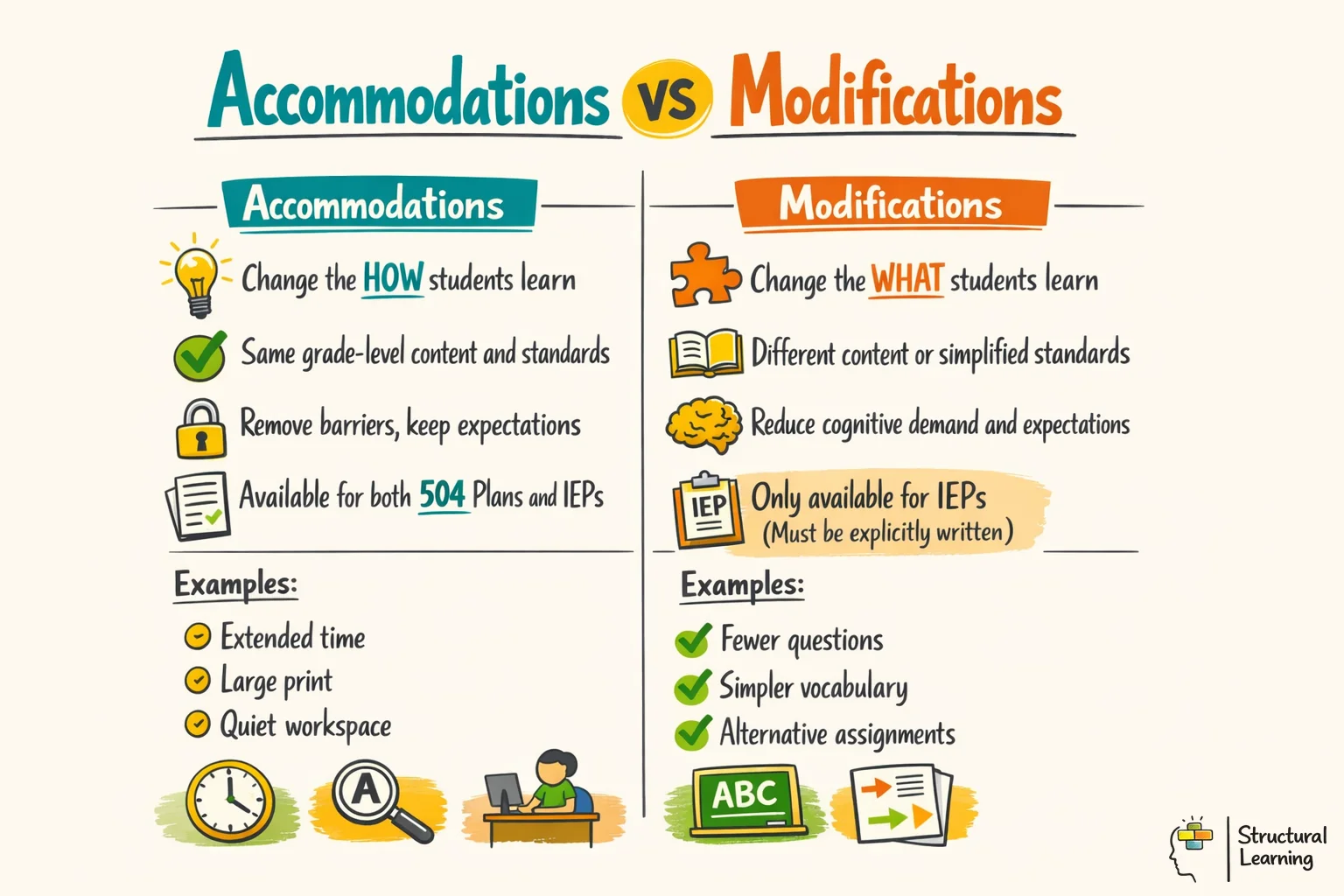
  1. Accommodations change the HOW, not the WHAT: A student receives accommodations to access the same curriculum at the same grade level standard.
  2. Modifications change the WHAT, not the HOW: A student receives modifications when the curriculum content or standard itself is fundamentally different.
  3. 504 plans use accommodations only: Students on 504 plans cannot legally receive modifications; they must access grade-level standards.
  4. IEPs can include both: IEPs can include accommodations, modifications, or both, but modifications must be explicitly written in the IEP document.
  5. Grading is the acid test: If you're grading a student on a completely different rubric, you've modified the standard.

The Core Difference

Here's the simplest way to think about it: accommodations are about access. Modifications are about content. An accommodation gives a student the same assignment in a format they can work with. A modification gives them a different assignment altogether.

When you give a deaf student an interpreter so they can listen to your history lecture, you are accommodating. When you give a student a simpler history question because the original question is too hard, you are modifying. The distinction matters legally, ethically, and for your student's future success.

504 plans use accommodations only. IEPs can include modifications. This is the rule that trips up most teachers, and it will come up when you're discussing a student's placement or services.

UK Educator? In UK schools, "accommodations" are called reasonable adjustments, and "modifications" are handled through differentiation and adapted curriculum planning.

See our guide: Differentiation Strategies: A Teacher's Guide.

What Is an Accommodation?

An accommodation is a change to the process of learning or assessment that does not reduce the rigour of the content or lower the grade-level standard. It is a tool or strategy that gives a student equal access to the curriculum they are supposed to learn.

Think of an accommodation as removing barriers without removing expectations. If a student uses a wheelchair, a wheelchair ramp is an accommodation. The student still has to climb the same number of stairs in a metaphorical sense; they just have a different way to get there. If you remove the stairs entirely and create a completely separate path, that's a modification.

Common accommodations include extended time on tests, large-print versions of assignments, speech-to-text software, a quiet place to work, or a checklist to help with organisation. None of these change what the student is learning. They only change how the student accesses or demonstrates that learning.

What Is a Modification?

A modification is a change to the content, standard, or expectations themselves. When you modify, the student is learning something fundamentally different from their grade-level peers, or learning the same topic at a lower depth of thinking.

Modifications happen when you reduce the quantity AND remove the cognitive demand. They happen when you change the skill being assessed. A student with a modification may be learning third-grade mathematics while their class is doing fifth-grade work. Or they may be listening to a simplified version of a story instead of reading the grade-level text.

Modifications must be explicitly written into an IEP. They cannot be given under a 504 plan. And they carry significant weight for graduation tracking, special education certificates, and transcript notation in many schools.

Side-by-Side Comparison Table

Feature Accommodation Modification
Core Definition Changes HOW a student accesses or demonstrates learning Changes WHAT a student is expected to learn
The Standard Grade-level standard remains exactly the same Grade-level standard is lowered, simplified, or removed
Who Can Get This? Students with 504 plans AND students with IEPs Only students with IEPs (explicitly written in the plan)
Grading & Rubrics Student is graded using the same rubric as general education peers Student is graded against a customised, individualised rubric
Quantity Example 10 maths problems instead of 20, covering all required concepts 10 maths problems by removing all complex word problems
Assessments Extended time, quiet room, calculator, text-to-speech Open-book test, hints provided, fewer answer choices
Graduation Track Keeps student on track for standard high school diploma May affect diploma type or place student on alternate certificate track
The Analogy Giving prescription glasses so a student can read the tenth-grade textbook Taking away the tenth-grade book and handing them a fifth-grade book instead

Accommodation Examples by Subject

Here are real classroom examples where accommodations are the right choice. In each case, the student gets the same assignment, same rubric, and same grade-level standard.

Mathematics: Extended Time on Problem-Solving. Sarah is taking an eighth-grade algebra test on solving two-step equations. The general education class gets 40 minutes. Sarah takes the exact same 20 questions in a quiet resource room and is allowed 60 minutes. She's working on the same problems at the same rigour level, just with more processing time to show what she knows. This is an accommodation.

Reading/Language Arts: Text-to-Speech for Decoding Issues. Marcus is in fourth grade and is reading "Charlotte's Web" with his class. He has dyslexia and struggles with fluency, not comprehension. He listens to the audiobook while following along in the text. He writes the same comprehension responses, answers the same discussion questions, and identifies the same theme. The accommodation is removing the decoding barrier so he can access the content. This is an accommodation.

Science: Paired Practicum Work for Fine Motor Delays. Jamal is conducting a plant growth experiment. He has fine motor delays and struggles with fragile glassware. He partners with a peer who handles the beakers, while Jamal records observations, predicts outcomes, and writes the lab report. He is learning and demonstrating the same scientific method as his classmates. The accommodation is removing the motor barrier. This is an accommodation.

Social Studies: Graphic Organiser for Executive Functioning. Chloe is writing a Document-Based Question essay on the causes of the Cold War. She receives a graphic organiser three days early that helps her map her thesis, claims, and evidence before she drafts. She writes the same argumentative essay as her peers and is graded on the same rubric. The accommodation is removing the executive functioning barrier to planning. This is an accommodation.

Modification Examples by Subject

Here are real classroom examples where modifications happen. In each case, the student is learning something fundamentally different from their grade-level peers.

Mathematics: Alternate Curriculum for Conceptual Gaps. David is a fifth grader, but he has not mastered third-grade place value concepts. His teachers work with his parents and special education team to modify his maths curriculum. While his class is learning division of multi-digit numbers, David is working on tens and ones, counting, and basic addition. He is learning a different curriculum altogether. This is a modification.

Reading/Language Arts: Alternate Text and Lower Cognitive Demand. Ava is a seventh grader, but she reads at a second-grade level due to severe dyslexia. Her IEP includes a modification: instead of reading the seventh-grade novel, she reads a high-interest, second-grade level book. Instead of writing an analytical essay, she draws a comic strip about the story. The content and cognitive demand are fundamentally different. This is a modification.

Science: Worksheet Instead of Practicum Engagement. James is a sixth grader with severe autism and significant communication delays. During a lab on plant germination, his IEP modification states he will complete a vocabulary matching worksheet about plant parts while the class conducts the experiment. He is not learning the scientific method. He is not forming hypotheses or analysing results. This is a modification.

Social Studies: Fact Recall Instead of Analysis. Kai is a ninth grader. While his class is writing analytical essays about world wars, Kai's modified curriculum asks him to fill in a timeline and answer multiple-choice questions about basic historical facts. The cognitive demand is significantly lower. This is a modification.

When to Use Each

The decision to accommodate or modify is not a teacher's choice alone. It must be made by the IEP team or 504 team, and it must be based on a student's needs and abilities.

Use an Accommodation when: A student understands the grade-level content but has a barrier (sensory, motor, attention, processing speed, anxiety) that prevents them from demonstrating what they know. The accommodation removes that barrier without changing the content. Students on 504 plans typically need accommodations only.

Use a Modification when: A student's disability is so significant that accessing grade-level content, even with accommodations, is not realistic. The modification allows the student to learn meaningful skills at their developmental level. Modifications must be in an IEP and explicitly written by the IEP team.

A 504 plan focuses on accommodations only and is used for students who don't need special education services, while an IEP is for students identified with disabilities under special education law and can include accommodations, modifications, or both.

Here's the key question to ask yourself: Is the student capable of learning the grade-level standard with supports, or do they need a completely different standard? If it's the former, accommodate. If it's the latter, modify (with IEP team approval). Understanding how to use cognitive load theory to manage student working memory is one way to distinguish between a processing barrier (accommodation-worthy) and a conceptual limitation (modification-worthy).

How This Affects Grading

Grading is where accommodations and modifications make the biggest practical difference in your classroom.

Grading with an Accommodation: A student who receives an accommodation gets the same grade-level rubric as their peers. If the rubric says a fourth-grade essay needs an introduction, three supporting paragraphs, and a conclusion, that student must also write an introduction, three supporting paragraphs, and a conclusion. If they do, they get an A. If they only write an introduction and one paragraph, they get a C or D, just like any other student. The accommodation (perhaps a graphic organiser, speech-to-text, or extra time) does not change the grading standard.

Grading with a Modification: A student who receives a modification gets a customised rubric. Your second-grade level reader on a seventh-grade team will not be graded on the seventh-grade essay rubric. Their rubric might ask: Does the student write three complete sentences? Can they identify the main idea? This is a completely different standard. The grades cannot be compared directly to their general education peers, and this should be noted on the report card.

If you find yourself thinking, "I'm grading this student on effort rather than mastery" or "I'm giving them points for trying," you have crossed from accommodation into hidden modification. A grade should measure mastery of the stated standard, not effort. If you are lowering your expectations to be kind, you are modifying, and it should be documented and agreed upon by the team.

Common Teacher Mistakes

These are the most frequent ways teachers blur the lines between accommodation and modification without realising it.

Mistake 1: Shortening an Assignment Without Preserving Rigour. You see a student struggling with a 50-problem maths worksheet, so you give them 25 problems. But you only select the easy problems. You've modified, not accommodated. To truly accommodate, give them 25 problems that still require them to solve two-step equations, multi-step word problems, and all the required skills. Shorter is fine; less rigorous is not.

Mistake 2: Reading a Reading Test Aloud. If the test is measuring reading decoding and fluency (like a DIBELS or phonological awareness assessment), reading it aloud removes the skill you're supposed to assess. That's a modification. If the test is measuring reading comprehension or vocabulary, and the student can do the thinking but struggles with decoding, reading it aloud is an accommodation. The key is: what is the test actually measuring?

Mistake 3: Giving Grades for Effort Instead of Mastery. A student works twice as hard as their peers to get a D on a test. You feel bad, so you bump them to a C "for effort." This is a hidden modification. It falsifies the transcript and misleads the next teacher. If the student has not mastered the standard, they should not receive a passing grade, even if their effort is admirable. Instead, document the accommodation and focus on whether the student is making progress toward the standard.

Mistake 4: Allowing a Student to Skip Part of an Assignment. Your class reads a novel, completes a comprehension test, and writes an essay. A student only wants to write the essay and skip the test. This is only an accommodation if the test and essay measure the same skill and the student needs only one way to demonstrate learning. If the test measures understanding of plot and the essay measures analysis, skipping the test is a modification. The student is being assessed on a different standard. Multiple formative assessment strategies allow you to check understanding in different ways, but the standard being measured should remain consistent.

Mistake 5: Not Documenting Your Accommodation or Modification. If an accommodation or modification is not written in the IEP or 504 plan, you are making unilateral decisions about a student's education. If another teacher questions your grading, you have no documentation. Always verify what is actually written in the official plan before you make changes. Using graphic organisers as documented accommodations is one way to formalise your support before implementing it.

Making the Right Choice for Your Students

So, back to Leo and the lab report. Leo's IEP says he has a specific learning disability in written expression. This means he struggles with the physical act of writing, organisation, and expression of ideas in written form. His IEP allows for accommodations in all subjects.

The accommodation would be: Leo completes the lab report using speech-to-text software, dictating his hypothesis, procedure, and conclusion to his computer while his classmates write theirs by hand. He is still required to have a clear hypothesis, describe his procedure, and draw accurate conclusions. He's graded on the same rubric. This is an accommodation because the barrier (writing) is removed, but the standard (scientific communication) remains.

The modification would be: Leo submits four bullet points instead of three paragraphs. This lowers the standard of written expression itself, which was the whole point of the lab report. Unless Leo's IEP explicitly includes a modification in science, this is not permitted.

Your responsibility as a teacher is to implement the accommodations and modifications that are written in the IEP or 504 plan. You are not free to add accommodations on your own (though you can certainly request them through the IEP process). You cannot give a student modifications unless they are explicitly written in an IEP by the entire team.

Evidence-based accommodations for conditions like ADHD are well researched, and your school's special education team can guide you toward best practices. If you ever feel unsure whether your decision is an accommodation or modification, ask your special education coordinator or the student's case manager.

The confusion you felt at 2:15 PM on a Thursday is not a personal failing. The distinction between accommodation and modification is deliberately taught in special education training, but often glossed over for classroom teachers. Now that you understand the difference, you can make grading decisions with confidence, communicate clearly with special education teams, and ensure your accommodations and modifications are legally sound and pedagogically fair.

Here are some related resources that go deeper into special education policy and differentiation strategies to support all your students. If you're working with a 504 plan, understand how 504 plans differ from IEPs. For more on using Response to Intervention to identify students who need support, that's another key part of the special education referral process. Scaffolding strategies can serve as powerful accommodations for many students. And for classroom teachers who want to understand special education better, an overview of special education law and process can help you navigate the system with confidence.

Key Takeaways: Accommodation Vs Modification

Remember these five key points whenever you're designing an assignment or grading a student's work.

1. Accommodations are about access. They remove barriers to learning without changing the standard. Extended time, text-to-speech, a quiet room, and a graphic organiser are all accommodations.

2. Modifications are about content. They change what the student is expected to learn. A lower-level curriculum, a different assignment, or a simplified rubric are all modifications.

3. 504 plans include accommodations only. Students on 504 plans are not eligible for modifications under law. They must access grade-level standards.

4. IEPs can include both. Students with IEPs can receive accommodations, modifications, or both, but modifications must be explicitly written and agreed upon by the IEP team.

5. Grading is your acid test. If you're using the same rubric and assessing the same standard, it's an accommodation. If you've created a completely different rubric or lowered the expectation, it's a modification.

When in doubt, ask your special education team. They exist to support you and to ensure every student gets a fair shot at learning.


Written by the Structural Learning Research Team

Reviewed by Paul Main, Founder & Educational Consultant at Structural Learning

Further Reading

Loading audit...

It's 2:15 PM on a Thursday. You're grading a stack of seventh-grade science lab reports, and you get to Leo's paper. Leo has an IEP for a specific learning disability in written expression. The assignment was to write a three-paragraph analysis of a cell osmosis experiment. Leo submitted four bullet points.

You pause, your red pen hovering over the page. Did I accommodate him by accepting less writing, or did I just modify the entire standard? Wait, does his IEP even allow for modifications? Am I legally allowed to grade this on a curve? You stare at the rubric, your coffee goes cold, and you realise a frustrating truth: no one ever actually taught you where the exact line is between "levelling the playing field" and "lowering the bar."

If you've ever felt this mid-grading panic, you aren't alone. Let's clear up the single biggest point of confusion in special education policy.

Key Takeaways

  1. Accommodations change the HOW, not the WHAT: A student receives accommodations to access the same curriculum at the same grade level standard.
  2. Modifications change the WHAT, not the HOW: A student receives modifications when the curriculum content or standard itself is fundamentally different.
  3. 504 plans use accommodations only: Students on 504 plans cannot legally receive modifications; they must access grade-level standards.
  4. IEPs can include both: IEPs can include accommodations, modifications, or both, but modifications must be explicitly written in the IEP document.
  5. Grading is the acid test: If you're grading a student on a completely different rubric, you've modified the standard.

The Core Difference

Here's the simplest way to think about it: accommodations are about access. Modifications are about content. An accommodation gives a student the same assignment in a format they can work with. A modification gives them a different assignment altogether.

When you give a deaf student an interpreter so they can listen to your history lecture, you are accommodating. When you give a student a simpler history question because the original question is too hard, you are modifying. The distinction matters legally, ethically, and for your student's future success.

504 plans use accommodations only. IEPs can include modifications. This is the rule that trips up most teachers, and it will come up when you're discussing a student's placement or services.

UK Educator? In UK schools, "accommodations" are called reasonable adjustments, and "modifications" are handled through differentiation and adapted curriculum planning.

See our guide: Differentiation Strategies: A Teacher's Guide.

What Is an Accommodation?

An accommodation is a change to the process of learning or assessment that does not reduce the rigour of the content or lower the grade-level standard. It is a tool or strategy that gives a student equal access to the curriculum they are supposed to learn.

Think of an accommodation as removing barriers without removing expectations. If a student uses a wheelchair, a wheelchair ramp is an accommodation. The student still has to climb the same number of stairs in a metaphorical sense; they just have a different way to get there. If you remove the stairs entirely and create a completely separate path, that's a modification.

Common accommodations include extended time on tests, large-print versions of assignments, speech-to-text software, a quiet place to work, or a checklist to help with organisation. None of these change what the student is learning. They only change how the student accesses or demonstrates that learning.

What Is a Modification?

A modification is a change to the content, standard, or expectations themselves. When you modify, the student is learning something fundamentally different from their grade-level peers, or learning the same topic at a lower depth of thinking.

Modifications happen when you reduce the quantity AND remove the cognitive demand. They happen when you change the skill being assessed. A student with a modification may be learning third-grade mathematics while their class is doing fifth-grade work. Or they may be listening to a simplified version of a story instead of reading the grade-level text.

Modifications must be explicitly written into an IEP. They cannot be given under a 504 plan. And they carry significant weight for graduation tracking, special education certificates, and transcript notation in many schools.

Side-by-Side Comparison Table

Feature Accommodation Modification
Core Definition Changes HOW a student accesses or demonstrates learning Changes WHAT a student is expected to learn
The Standard Grade-level standard remains exactly the same Grade-level standard is lowered, simplified, or removed
Who Can Get This? Students with 504 plans AND students with IEPs Only students with IEPs (explicitly written in the plan)
Grading & Rubrics Student is graded using the same rubric as general education peers Student is graded against a customised, individualised rubric
Quantity Example 10 maths problems instead of 20, covering all required concepts 10 maths problems by removing all complex word problems
Assessments Extended time, quiet room, calculator, text-to-speech Open-book test, hints provided, fewer answer choices
Graduation Track Keeps student on track for standard high school diploma May affect diploma type or place student on alternate certificate track
The Analogy Giving prescription glasses so a student can read the tenth-grade textbook Taking away the tenth-grade book and handing them a fifth-grade book instead

Accommodation Examples by Subject

Here are real classroom examples where accommodations are the right choice. In each case, the student gets the same assignment, same rubric, and same grade-level standard.

Mathematics: Extended Time on Problem-Solving. Sarah is taking an eighth-grade algebra test on solving two-step equations. The general education class gets 40 minutes. Sarah takes the exact same 20 questions in a quiet resource room and is allowed 60 minutes. She's working on the same problems at the same rigour level, just with more processing time to show what she knows. This is an accommodation.

Reading/Language Arts: Text-to-Speech for Decoding Issues. Marcus is in fourth grade and is reading "Charlotte's Web" with his class. He has dyslexia and struggles with fluency, not comprehension. He listens to the audiobook while following along in the text. He writes the same comprehension responses, answers the same discussion questions, and identifies the same theme. The accommodation is removing the decoding barrier so he can access the content. This is an accommodation.

Science: Paired Practicum Work for Fine Motor Delays. Jamal is conducting a plant growth experiment. He has fine motor delays and struggles with fragile glassware. He partners with a peer who handles the beakers, while Jamal records observations, predicts outcomes, and writes the lab report. He is learning and demonstrating the same scientific method as his classmates. The accommodation is removing the motor barrier. This is an accommodation.

Social Studies: Graphic Organiser for Executive Functioning. Chloe is writing a Document-Based Question essay on the causes of the Cold War. She receives a graphic organiser three days early that helps her map her thesis, claims, and evidence before she drafts. She writes the same argumentative essay as her peers and is graded on the same rubric. The accommodation is removing the executive functioning barrier to planning. This is an accommodation.

Modification Examples by Subject

Here are real classroom examples where modifications happen. In each case, the student is learning something fundamentally different from their grade-level peers.

Mathematics: Alternate Curriculum for Conceptual Gaps. David is a fifth grader, but he has not mastered third-grade place value concepts. His teachers work with his parents and special education team to modify his maths curriculum. While his class is learning division of multi-digit numbers, David is working on tens and ones, counting, and basic addition. He is learning a different curriculum altogether. This is a modification.

Reading/Language Arts: Alternate Text and Lower Cognitive Demand. Ava is a seventh grader, but she reads at a second-grade level due to severe dyslexia. Her IEP includes a modification: instead of reading the seventh-grade novel, she reads a high-interest, second-grade level book. Instead of writing an analytical essay, she draws a comic strip about the story. The content and cognitive demand are fundamentally different. This is a modification.

Science: Worksheet Instead of Practicum Engagement. James is a sixth grader with severe autism and significant communication delays. During a lab on plant germination, his IEP modification states he will complete a vocabulary matching worksheet about plant parts while the class conducts the experiment. He is not learning the scientific method. He is not forming hypotheses or analysing results. This is a modification.

Social Studies: Fact Recall Instead of Analysis. Kai is a ninth grader. While his class is writing analytical essays about world wars, Kai's modified curriculum asks him to fill in a timeline and answer multiple-choice questions about basic historical facts. The cognitive demand is significantly lower. This is a modification.

When to Use Each

The decision to accommodate or modify is not a teacher's choice alone. It must be made by the IEP team or 504 team, and it must be based on a student's needs and abilities.

Use an Accommodation when: A student understands the grade-level content but has a barrier (sensory, motor, attention, processing speed, anxiety) that prevents them from demonstrating what they know. The accommodation removes that barrier without changing the content. Students on 504 plans typically need accommodations only.

Use a Modification when: A student's disability is so significant that accessing grade-level content, even with accommodations, is not realistic. The modification allows the student to learn meaningful skills at their developmental level. Modifications must be in an IEP and explicitly written by the IEP team.

A 504 plan focuses on accommodations only and is used for students who don't need special education services, while an IEP is for students identified with disabilities under special education law and can include accommodations, modifications, or both.

Here's the key question to ask yourself: Is the student capable of learning the grade-level standard with supports, or do they need a completely different standard? If it's the former, accommodate. If it's the latter, modify (with IEP team approval). Understanding how to use cognitive load theory to manage student working memory is one way to distinguish between a processing barrier (accommodation-worthy) and a conceptual limitation (modification-worthy).

How This Affects Grading

Grading is where accommodations and modifications make the biggest practical difference in your classroom.

Grading with an Accommodation: A student who receives an accommodation gets the same grade-level rubric as their peers. If the rubric says a fourth-grade essay needs an introduction, three supporting paragraphs, and a conclusion, that student must also write an introduction, three supporting paragraphs, and a conclusion. If they do, they get an A. If they only write an introduction and one paragraph, they get a C or D, just like any other student. The accommodation (perhaps a graphic organiser, speech-to-text, or extra time) does not change the grading standard.

Grading with a Modification: A student who receives a modification gets a customised rubric. Your second-grade level reader on a seventh-grade team will not be graded on the seventh-grade essay rubric. Their rubric might ask: Does the student write three complete sentences? Can they identify the main idea? This is a completely different standard. The grades cannot be compared directly to their general education peers, and this should be noted on the report card.

If you find yourself thinking, "I'm grading this student on effort rather than mastery" or "I'm giving them points for trying," you have crossed from accommodation into hidden modification. A grade should measure mastery of the stated standard, not effort. If you are lowering your expectations to be kind, you are modifying, and it should be documented and agreed upon by the team.

Common Teacher Mistakes

These are the most frequent ways teachers blur the lines between accommodation and modification without realising it.

Mistake 1: Shortening an Assignment Without Preserving Rigour. You see a student struggling with a 50-problem maths worksheet, so you give them 25 problems. But you only select the easy problems. You've modified, not accommodated. To truly accommodate, give them 25 problems that still require them to solve two-step equations, multi-step word problems, and all the required skills. Shorter is fine; less rigorous is not.

Mistake 2: Reading a Reading Test Aloud. If the test is measuring reading decoding and fluency (like a DIBELS or phonological awareness assessment), reading it aloud removes the skill you're supposed to assess. That's a modification. If the test is measuring reading comprehension or vocabulary, and the student can do the thinking but struggles with decoding, reading it aloud is an accommodation. The key is: what is the test actually measuring?

Mistake 3: Giving Grades for Effort Instead of Mastery. A student works twice as hard as their peers to get a D on a test. You feel bad, so you bump them to a C "for effort." This is a hidden modification. It falsifies the transcript and misleads the next teacher. If the student has not mastered the standard, they should not receive a passing grade, even if their effort is admirable. Instead, document the accommodation and focus on whether the student is making progress toward the standard.

Mistake 4: Allowing a Student to Skip Part of an Assignment. Your class reads a novel, completes a comprehension test, and writes an essay. A student only wants to write the essay and skip the test. This is only an accommodation if the test and essay measure the same skill and the student needs only one way to demonstrate learning. If the test measures understanding of plot and the essay measures analysis, skipping the test is a modification. The student is being assessed on a different standard. Multiple formative assessment strategies allow you to check understanding in different ways, but the standard being measured should remain consistent.

Mistake 5: Not Documenting Your Accommodation or Modification. If an accommodation or modification is not written in the IEP or 504 plan, you are making unilateral decisions about a student's education. If another teacher questions your grading, you have no documentation. Always verify what is actually written in the official plan before you make changes. Using graphic organisers as documented accommodations is one way to formalise your support before implementing it.

Making the Right Choice for Your Students

So, back to Leo and the lab report. Leo's IEP says he has a specific learning disability in written expression. This means he struggles with the physical act of writing, organisation, and expression of ideas in written form. His IEP allows for accommodations in all subjects.

The accommodation would be: Leo completes the lab report using speech-to-text software, dictating his hypothesis, procedure, and conclusion to his computer while his classmates write theirs by hand. He is still required to have a clear hypothesis, describe his procedure, and draw accurate conclusions. He's graded on the same rubric. This is an accommodation because the barrier (writing) is removed, but the standard (scientific communication) remains.

The modification would be: Leo submits four bullet points instead of three paragraphs. This lowers the standard of written expression itself, which was the whole point of the lab report. Unless Leo's IEP explicitly includes a modification in science, this is not permitted.

Your responsibility as a teacher is to implement the accommodations and modifications that are written in the IEP or 504 plan. You are not free to add accommodations on your own (though you can certainly request them through the IEP process). You cannot give a student modifications unless they are explicitly written in an IEP by the entire team.

Evidence-based accommodations for conditions like ADHD are well researched, and your school's special education team can guide you toward best practices. If you ever feel unsure whether your decision is an accommodation or modification, ask your special education coordinator or the student's case manager.

The confusion you felt at 2:15 PM on a Thursday is not a personal failing. The distinction between accommodation and modification is deliberately taught in special education training, but often glossed over for classroom teachers. Now that you understand the difference, you can make grading decisions with confidence, communicate clearly with special education teams, and ensure your accommodations and modifications are legally sound and pedagogically fair.

Here are some related resources that go deeper into special education policy and differentiation strategies to support all your students. If you're working with a 504 plan, understand how 504 plans differ from IEPs. For more on using Response to Intervention to identify students who need support, that's another key part of the special education referral process. Scaffolding strategies can serve as powerful accommodations for many students. And for classroom teachers who want to understand special education better, an overview of special education law and process can help you navigate the system with confidence.

Key Takeaways: Accommodation Vs Modification

Remember these five key points whenever you're designing an assignment or grading a student's work.

1. Accommodations are about access. They remove barriers to learning without changing the standard. Extended time, text-to-speech, a quiet room, and a graphic organiser are all accommodations.

2. Modifications are about content. They change what the student is expected to learn. A lower-level curriculum, a different assignment, or a simplified rubric are all modifications.

3. 504 plans include accommodations only. Students on 504 plans are not eligible for modifications under law. They must access grade-level standards.

4. IEPs can include both. Students with IEPs can receive accommodations, modifications, or both, but modifications must be explicitly written and agreed upon by the IEP team.

5. Grading is your acid test. If you're using the same rubric and assessing the same standard, it's an accommodation. If you've created a completely different rubric or lowered the expectation, it's a modification.

When in doubt, ask your special education team. They exist to support you and to ensure every student gets a fair shot at learning.
Written by the Structural Learning Research Team

Reviewed by Paul Main, Founder & Educational Consultant at Structural Learning

Further Reading

No Posts found.
Back to Blog