Updated on
September 4, 2026
Teacher Professional Development: UK Evidence Guide
Master professional development for teachers with our UK guide. Explore evidence-based strategies, from ECT support to NPQs, to improve pupil outcomes.


Updated on
September 4, 2026
Master professional development for teachers with our UK guide. Explore evidence-based strategies, from ECT support to NPQs, to improve pupil outcomes.
Professional development is how teachers keep getting better at the job long after their training ends. Good professional development changes classroom practice. For instance, a science teacher might improve her questioning after a lesson study. Alternatively, a department might adopt retrieval practice together after an INSET day. This guide sets out what the evidence says makes teacher CPD effective, the UK frameworks that shape it (from the Early Career Framework to National Professional Qualifications), and how to build development that genuinely improves learner outcomes.
Professional development for teachers is the continuous, structured process of refining pedagogical knowledge and classroom practice. It is the mechanism by which educators update their skills to meet changing classroom demands. This is not about sitting through a passive INSET day listening to a generic presentation. True professional learning requires active engagement, deliberate practice and sustained feedback.
Effective teacher development moves beyond mere compliance to focus on genuine adaptability. The modern education system requires teachers to constantly evaluate their methods against the latest evidence. Well-designed professional development gives staff a clear path to follow. It guides teachers from basic skills to expert practice.
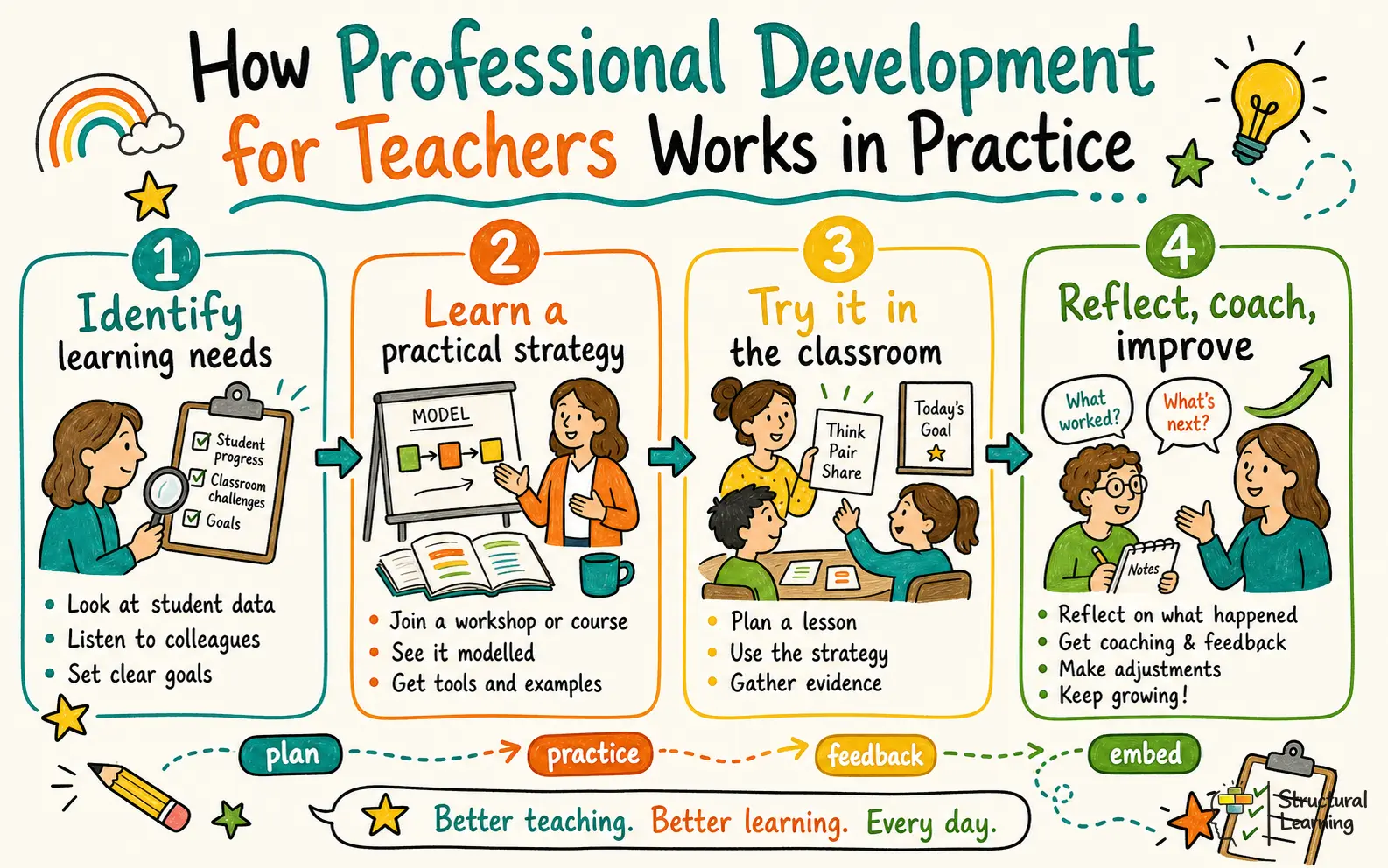
Educational researchers agree on five stages of professional development (Kennedy, 2016). First, schools must build knowledge by introducing new concepts clearly. Second, leaders must motivate teachers by showing how these concepts solve real classroom problems. Third, staff need time to develop techniques through safe rehearsal. Fourth, teachers must embed practice by trying new methods in their actual lessons. Finally, schools must sustain change through ongoing coaching and review.
We can also view this through the lens of the 5 P's of professional growth. Purpose gives teachers a clear reason to change their practice. Passion sustains them through the difficulty of learning new habits. Planning ensures new strategies fit into existing curriculum structures. Practice allows them to refine the mechanics of teaching. Persistence ensures they do not abandon a new technique when a lesson inevitably goes wrong.
In the Classroom: A teacher reads research on retrieval practice (Roediger & Karpicke, 2006) during a department meeting. The teacher then designs a five-question starter activity for their next lesson. The learners enter the room, sit down and immediately recall material from the previous week.
The quality of teaching is the single most important in-school factor affecting learner achievement (Hattie, 2009). Research consistently shows a direct correlation between research-informed practices and improved learner outcomes. Coe et al. (2014) demonstrated that specific, structured interventions significantly boost learner learning. When teachers improve their questioning, feedback and explanation techniques, learners learn more effectively.
Teacher professional development also plays a critical role in staff retention. Teachers who feel supported and see themselves improving are far more likely to remain in the profession (Sims, 2017). Conversely, educators who receive poor training often feel overwhelmed by workload and behaviour management. Providing high-quality, actionable training is a primary responsibility for school leaders aiming to keep their best staff.
School leaders must manage the cognitive load of their staff carefully. Fletcher-Wood and Zuccollo (2020) highlight the importance of designing training that respects teachers' time constraints. Implementing the 80/20 rule for teachers is a highly effective strategy here. This rule suggests spending 80 percent of training on the 20 percent of teaching strategies that work best.
Schools must avoid bombarding staff with multiple new initiatives every term. Focusing intensely on one clear pedagogical goal yields better results than attempting five changes simultaneously. High-quality professional development narrows the focus. This allows teachers to master specific techniques before tackling new challenges.
In the Classroom: A mentor helps a science teacher apply the 80/20 rule to their marking workload. The teacher stops writing long comments. Instead, they give whole-class spoken feedback based on cognitive load theory (Sweller, 1988). The learners receive immediate, actionable corrections during the lesson and correct their work instantly.
The UK education system offers several formal structures to guide qualifications and professional development. The Early Career Framework (Department for Education, 2019) has transformed support for new teachers. This provides a funded, two-year package of structured training and mentoring for new teachers. The ECF ensures that novices do not face the classroom alone, grounding their early experiences in cognitive science.
For experienced staff, National Professional Qualifications (NPQs) provide specialised leadership pathways. These qualifications cover specific domains such as leading teaching, behaviour or teacher development. NPQs allow educators to gain recognised credentials without necessarily leaving the classroom for administrative roles. They represent a significant shift towards evidence-based leadership training in the UK.
Local Authorities and School Trusts also play a vital role by facilitating collaborative peer networks. These networks allow schools to share resources, moderate assessments and observe excellent practice across different contexts. Working with other schools stops teachers from feeling isolated. It lets them see how different students respond to similar teaching strategies.
Higher Education institutions and research bodies provide the theoretical foundation for these programmes. Insights from organisations like UCL, the National Institute of Teaching and the OECD shape national policy. By translating high-level policy guidelines (OECD, 2019) into tangible school routines, leaders can actively reduce teacher workload. Online platforms like FutureLearn offer specialised content that you can access from anywhere. This lets teachers learn from subject experts that their own school might not have.
In the Classroom: An early career teacher meets their ECF mentor to discuss pacing and working memory limits. The teacher scripts their transitions between activities to reduce dead time. Learners experience a faster lesson pace. This greatly reduces low-level disruption and keeps their attention on the learning objective.
Moving from theory to practice requires specific, actionable strategies. The following frameworks bridge the gap between institutional theory and daily classroom realities.
In the Classroom: A head of year runs a CPD session on explicit vocabulary instruction (Quigley, 2018). The teacher then implements the Frayer Model in their next lesson. Pupils use the graphic organiser to define new terms. They then write highly accurate sentences with the new vocabulary.
Continuous improvement relies on daily, routine classroom reflection. Teachers must evaluate their lessons systematically rather than relying on gut feelings. The 5 C's of teaching provide an excellent framework for this reflection. These stand for clarity, classroom climate, challenge, checking for understanding and consolidation.
By isolating one of these elements, teachers can record micro-moments of their lessons for specific analysis. This prevents the overwhelm of trying to improve everything at once. Small, incremental changes to daily habits produce massive long-term improvements in teaching quality.
In the Classroom: A new teacher records their lesson's audio to check if their instructions are clear. The teacher notices they use too many filler words when explaining a task. The learners, previously confused by complex instructions, respond much better the next day when the teacher uses short, numbered steps.
Observation should not be a high-stakes appraisal tool. It is most effective when used within collaborative peer networks for formative growth. Schools can use the Universal Thinking Framework to provide a shared language for these observations. This framework gives teachers specific criteria to look for regarding how learners process information.
During a peer observation, the observer focuses entirely on the cognitive steps the learners are taking. They do not judge the teacher's performance, but rather collect data on learner responses. This objective data forms the basis of a constructive, developmental conversation afterwards.
In the Classroom: Two history teachers observe each other using the Universal Thinking Framework. The observer tallies how many times learners are asked to compare and contrast sources. The learners engage in deep analytical talk because the teacher has deliberately planned higher-order questioning prompts based on the observer's feedback.
Professional development is highly effective when tied directly to curriculum design. Departments can use a strategy called Block Building during their joint planning time. This involves physically mapping out the sequence of a curriculum before anyone plans individual lessons.
This collaborative process ensures that all teachers understand the progression of the topic. This acts as subject-specific CPD. Expert teachers explain their reasons for teaching topics in a certain order. This is far more useful than generic pedagogical training divorced from subject content.
In the Classroom: A maths department spends an hour ordering the specific steps needed to teach fractions. A novice teacher learns exactly which misconceptions to anticipate at step three. Learners benefit from a logically ordered unit. This builds their confidence slowly, without sudden leaps in difficulty.
Several persistent myths limit the effectiveness of teacher development programmes. Addressing these directly is important for school leaders.
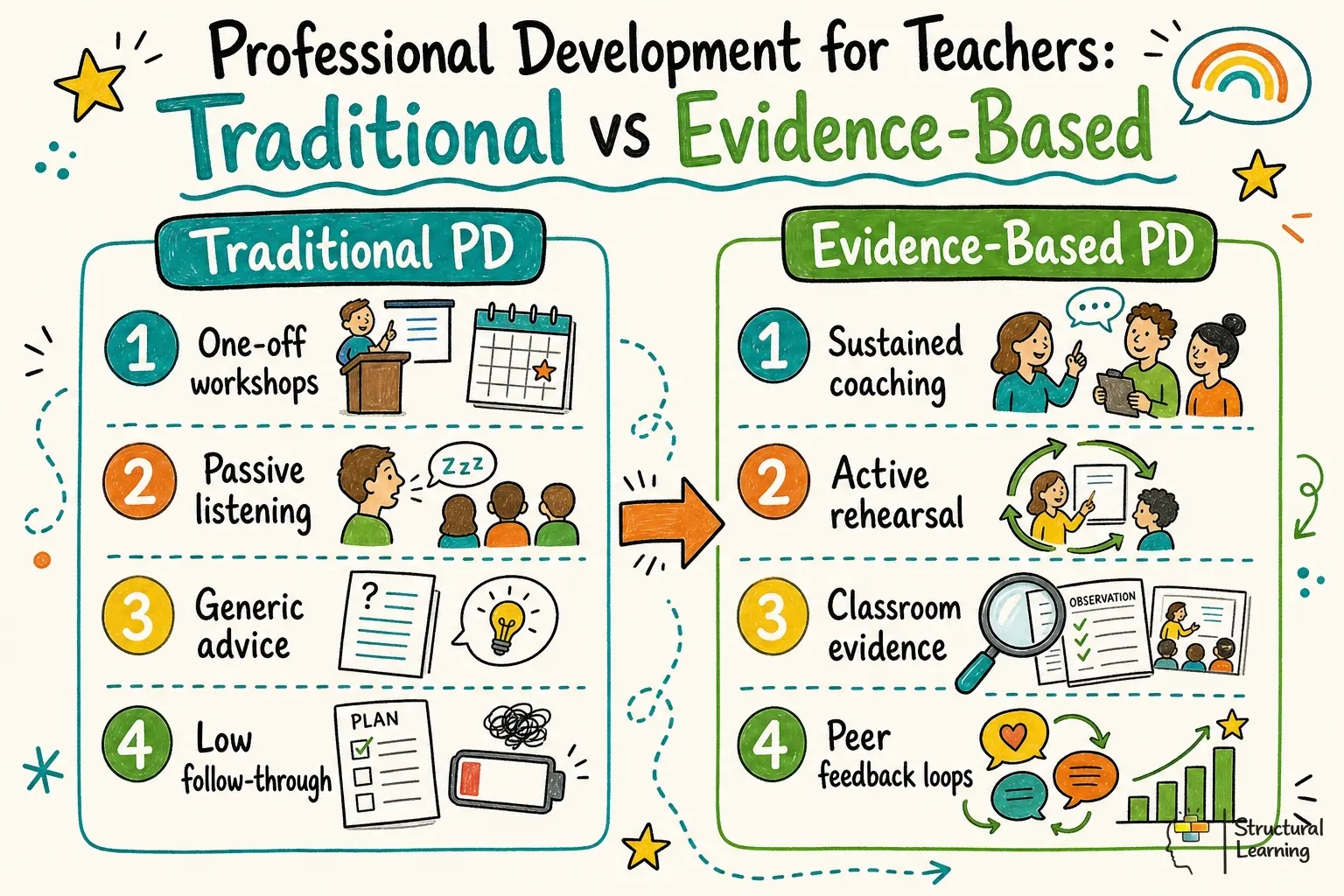
Misconception 1: Passive listening changes habits. Many schools still rely on bringing an external speaker into a hall to talk at staff for two hours. Sims et al. (2021) demonstrate that this rarely changes classroom practice. Correction: Changing ingrained habits requires sustained instructional coaching, rehearsal and specific feedback over multiple weeks.
Misconception 2: CPD is separate from teaching. Teachers often view professional development as an extra administrative burden added to their workload. Correction: High-quality professional learning actually reduces workload in the long run. By mastering efficient routines and effective explanations, teachers save time on behaviour management and reteaching.
Misconception 3: Experience guarantees expertise. Many people believe that spending ten years in the classroom automatically makes a teacher an expert. Correction: Teachers need focused practice and outside feedback (Ericsson, 2008). Without this, experience often means repeating mistakes for years. Expertise requires actively seeking out criticism and refining specific techniques.
Misconception 4: Online courses alone are sufficient. Completing modules on platforms like FutureLearn is often treated as the end goal of a training cycle. Correction: Gaining theoretical knowledge is only the first of the five stages of professional development. This knowledge is useless unless school leaders provide time and coaching. Teachers need support to build these ideas into daily routines.
In the Classroom: A head of department stops running traditional staff meetings and replaces them with strict rehearsal sessions. The teacher physically practises standing at the front of the room delivering an instruction. The learners receive perfectly clear, confident directions because the teacher has already rehearsed the exact phrasing.
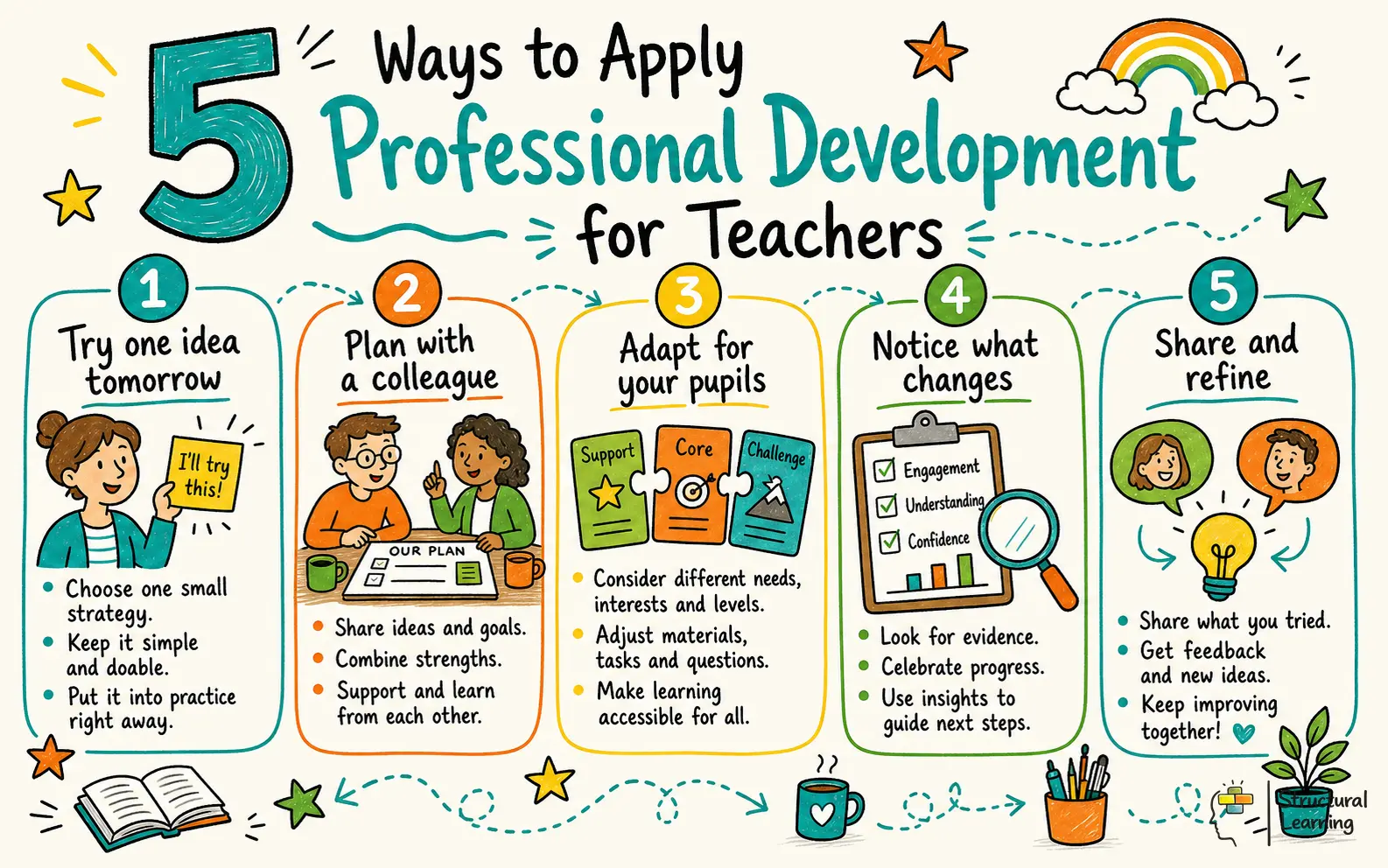
Transforming your own practice requires a deliberate, structured approach. Follow this step-by-step guide to use effective professional development for teachers in your own routine.
Step 1: Identify a highly specific gap. Do not set a broad goal like improving behaviour. Set a specific goal like reducing the time it takes learners to start a written task. The narrower the focus, the easier it is to change the habit.
Step 2: Source evidence-based techniques. Consult research from the Education Endowment Foundation or the National Institute of Teaching. Find one specific strategy that addresses your identified gap. Do not try to use three strategies at once.
Step 3: Plan and script the change. Write down exactly what you will say and do. If you are improving transitions, script the exact countdown and the exact instruction. Mental planning is insufficient for changing habits under pressure.
Step 4: Rehearse away from learners. Stand in an empty classroom and physically deliver the script. Speak out loud. This may feel uncomfortable at first. However, it builds the muscle memory needed to teach smoothly when thirty learners are watching.
Step 5: Execute and record. Try the strategy in a live lesson. If possible, set up a camera at the back of the room, or record the audio on your phone. You only need five minutes of footage.
Step 6: Review against the 5 C's. Watch the footage back. Evaluate the strategy against clarity, classroom climate, challenge, checking for understanding or consolidation. Identify one single tweak for the next lesson.
In the Classroom: A geography teacher identifies that learners struggle to read maps accurately. The teacher sources evidence on dual coding (Paivio, 1971) and plans a new way to present the key. The teacher explicitly models how to use the key while pointing at the board. The learners accurately locate grid references because the teacher removed distracting text from the slide.
Generic teaching strategies often fail because they ignore the specific demands of different disciplines. Professional development must be contextualised within the subject being taught.
In the Classroom: A department lead runs a subject-specific CPD session on misconception management. The teacher identifies three common errors in their upcoming topic. The learners receive targeted corrective feedback immediately, preventing the misconceptions from taking root.
Mathematical professional development must focus heavily on variation theory and cognitive load. Teachers need training on how to design question sets that carefully isolate specific concepts. In the Classroom: A maths teacher attends a workshop on intelligent practice. The teacher designs a worksheet where only one variable changes per question. The learners notice the mathematical pattern independently because the worksheet design guides their attention perfectly.
English departments require professional learning focused on explicit vocabulary instruction and sentence-level structures. Generic literacy training is less effective than specific models for deconstructing texts. In the Classroom: An English teacher receives coaching on the "I Do, We Do, You Do" model for paragraph construction. The teacher writes a model paragraph live under a visualiser. The learners produce significantly better essays because they watched the teacher narrate the writing process in real-time.
Science teachers face the dual challenge of teaching complex concepts while managing hazardous environments. Professional development here must address how to split practical instructions from theoretical explanations. In the Classroom: A science teacher works with a mentor to script a practical demonstration. The teacher explains the theory first with all equipment hidden, then demonstrates the practical in silence. The learners conduct the experiment safely because their working memory was not overloaded with competing information.
Computing teachers must stay updated with rapidly changing industry standards and programming methodologies. CPD courses must help teachers turn complex algorithms into simple, unplugged activities before starting screen-based coding. In the Classroom: An IT teacher updates their curriculum after an industry seminar on computational thinking. The teacher shows the class how to write an algorithm using physical blocks on their desks. The learners successfully code their Python loops later because they fully understood the logic offline first.
Effective development is subject-specific, sustained over time and involves instructional coaching (Kraft et al., 2018). It must include opportunities for deliberate practice and regular, low-stakes feedback.
The ECF is a two-year statutory entitlement for new teachers in England. It provides funded time away from lessons, dedicated mentoring, and a clear curriculum based on cognitive science.
NPQs are voluntary, specialised qualifications for teachers and leaders. They offer evidence-based training for specific roles, such as leading literacy, developing teacher practice or heading a department.
School leaders must protect directed time for professional learning. Leaders can use the 80/20 rule to reduce admin work, like written marking. This frees up time for coaching and curriculum planning.
Routine reflection stops teachers from relying on automated, sometimes flawed, habits. By consistently reviewing practice against the 5 C's of teaching, educators make small, manageable improvements that compound over a career.
No. Online platforms like FutureLearn are excellent for the first stage of development: building knowledge. However, embedding that knowledge into practice requires in-person coaching, rehearsal and contextual feedback.
In the Classroom: A school leader schedules thirty minutes of protected time each week to answer these teaching questions. The teacher uses this time to review their recent NPQ module on behaviour management. Learners experience a calmer classroom. This is because the teacher used a new de-escalation routine they learned during protected time.