Maria Montessori: The Montessori Method and Its Impact on Modern Education
|
March 5, 2026
A teacher's guide to Maria Montessori and the Montessori Method. Covers core principles, sensitive periods, the prepared environment, and practical strategies for mainstream UK classrooms.
Maria Montessori (1870–1952) was an Italian physician, educator, and innovator who fundamentally changed how we think about childhood learning. Born in Rome, she became Italy's first female doctor—a remarkable achievement in the late nineteenth century—before dedicating her life to understanding how children naturally learn.
Montessori's transformation from medicine to education came through observation. While working with children with intellectual disabilities, she noticed they learned better through manipulating objects than through verbal instruction. This insight sparked a profound question: what if all children learned this way? In 1906, she opened the first Casa dei Bambini (Children's House) in a working-class Rome neighbourhood, where she applied her principles to typically developing children. The results astonished educators across Europe and America. Children as young as three taught themselves to read and write, solve mathematical problems, and work with deep concentration, without coercion.
Her method wasn't based on philosophy alone but on decades of meticulous observation, careful notation, and continuous refinement. This scientific approach to early childhood education established Montessori as a pioneer in understanding how children's minds actually work, rather than how adults expected them to work.
The Core Principles of the Montessori Method
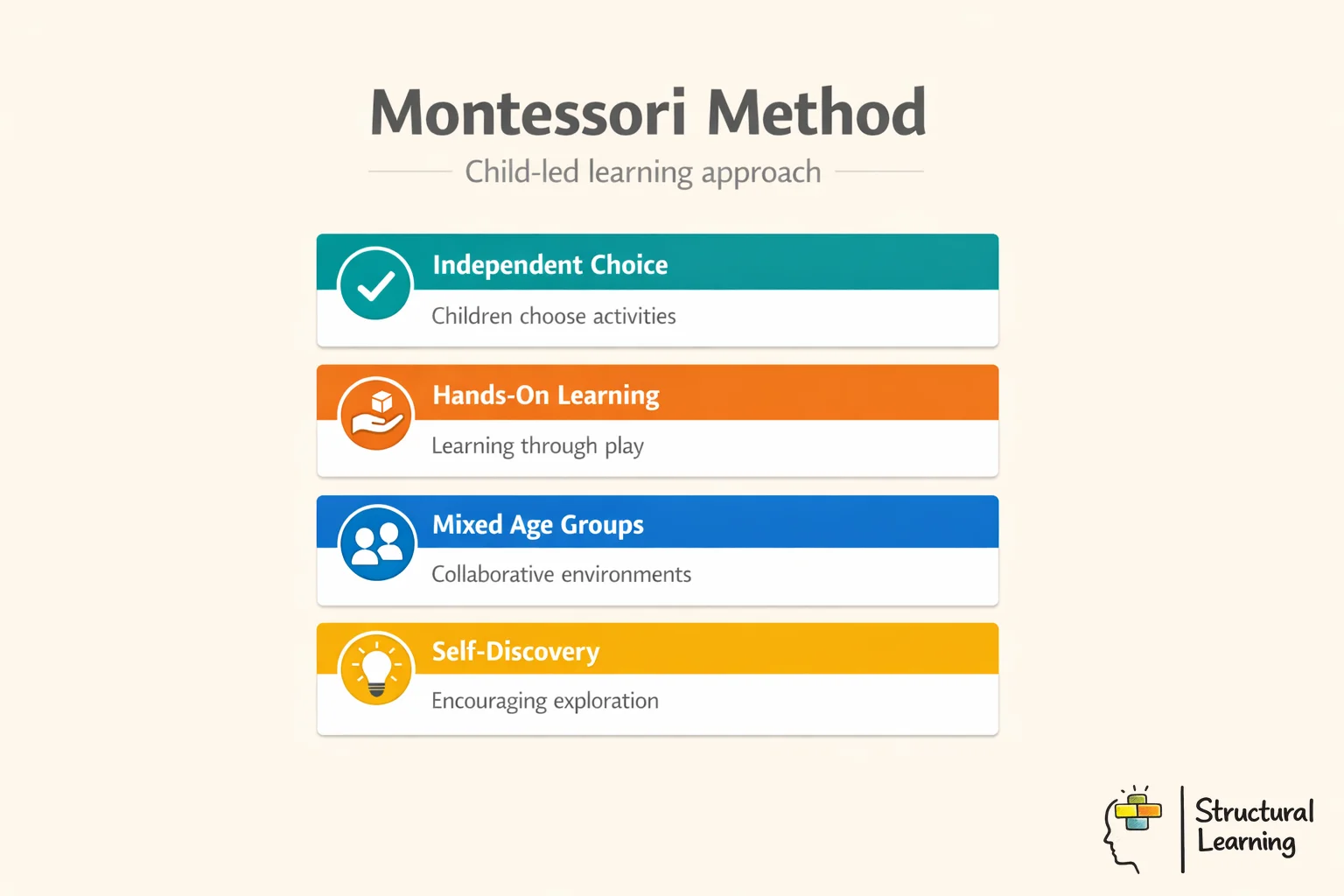
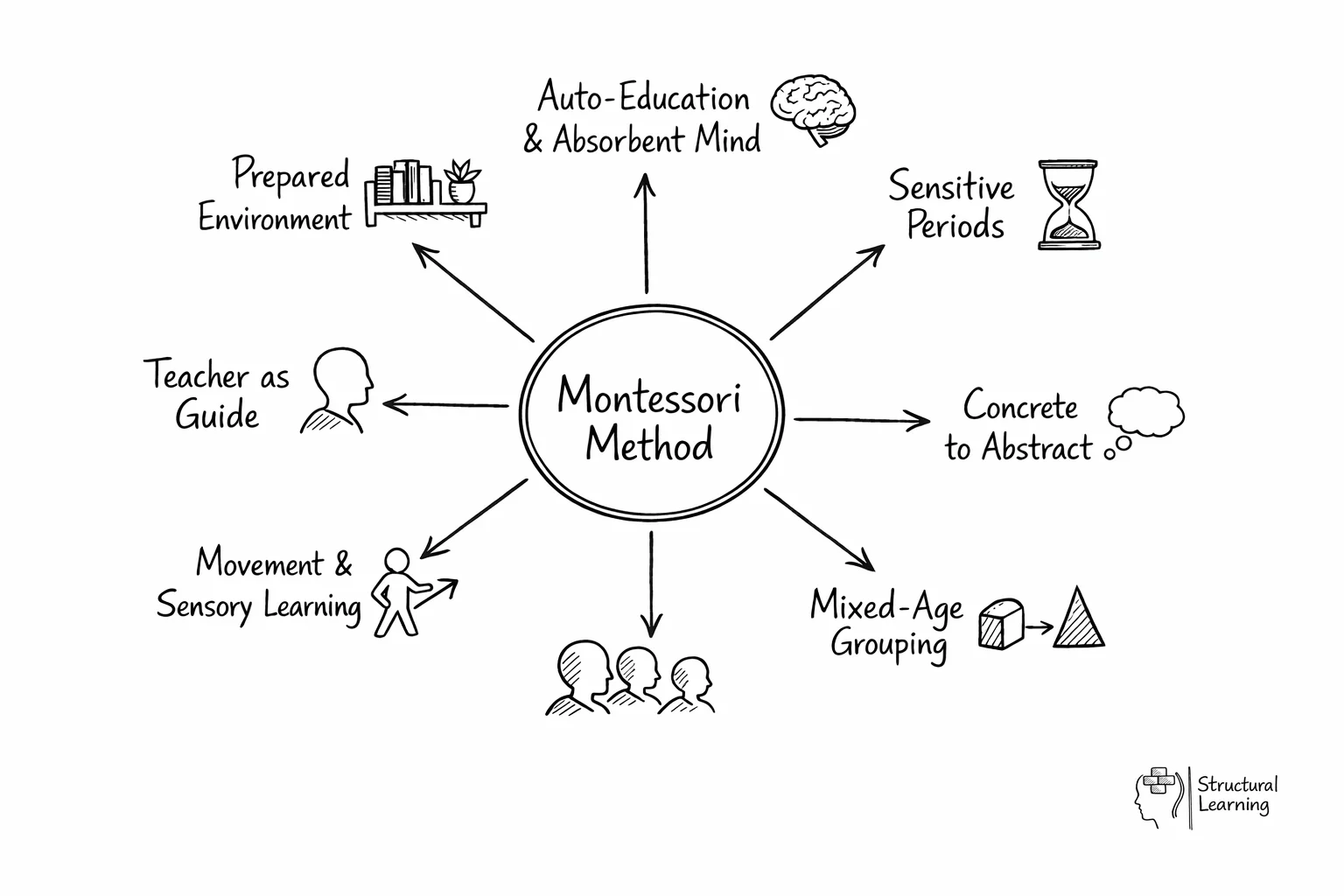
The Montessori Method rests on several interconnected principles that fundamentally differ from traditional schooling:
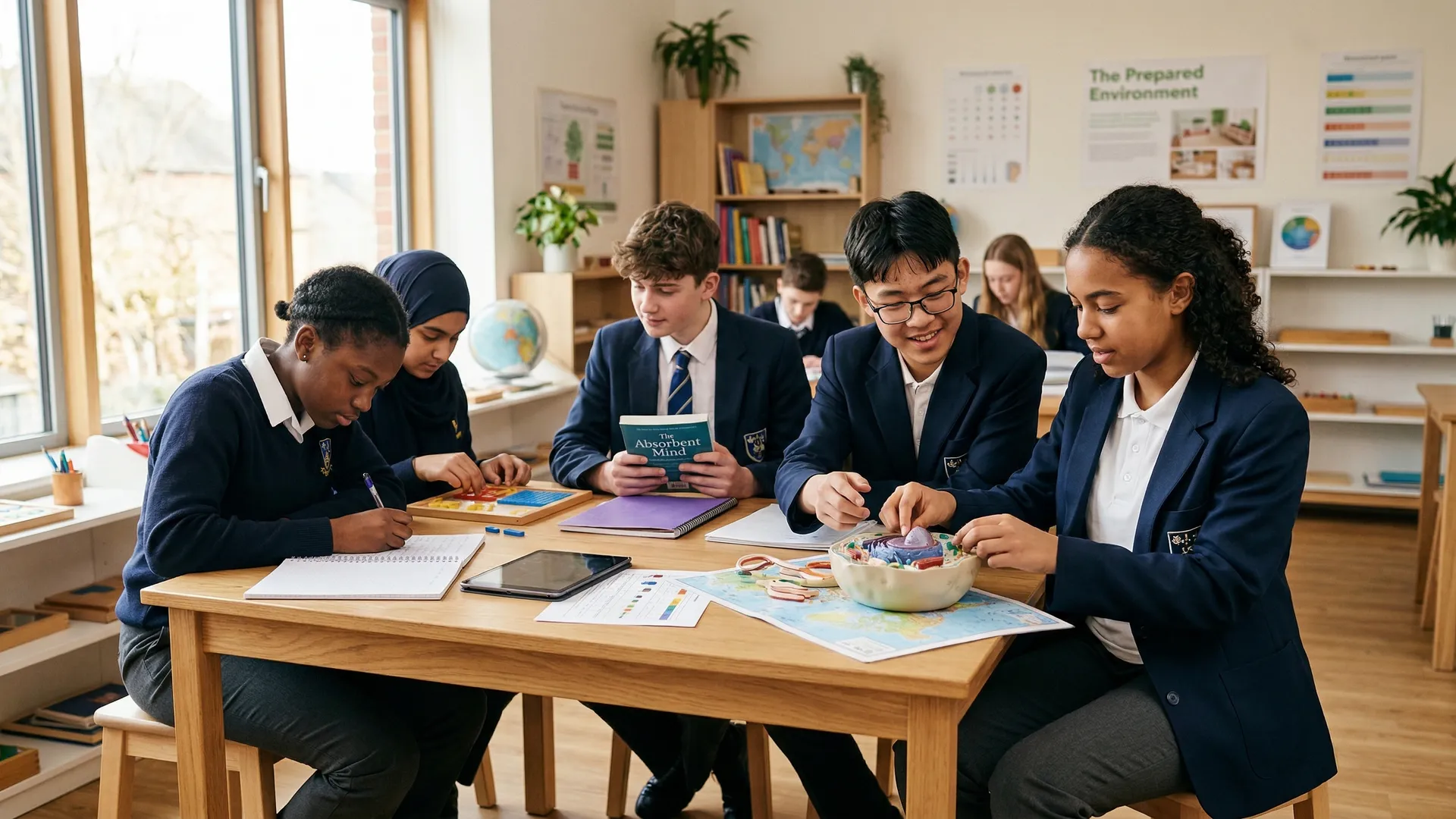
The Prepared Environment
A Montessori classroom is deliberately organised to invite learning. Every object has a purpose, is placed at child height, and reflects real-world proportions (not scaled-down toys). The environment includes:
Practical Life materials , pouring, sweeping, buttoning, care of self and environment
Academic materials , bead bars for mathematics, moveable alphabet for reading
Cultural studies , geography puzzles, biology charts, history timelines
This isn't random chaos. Each area is colour-coded, materials progress from simple to complex, and children can see exactly what's available. The environment itself teaches order, respect for materials, and responsibility. In the UK context, this aligns closely with EYFS principles of creating enabling environments.
Auto-Education and the Absorbent Mind
Montessori believed young children have an absorbent mind, an unconscious ability to absorb their surroundings effortlessly. Unlike adults who must consciously study, children learn through sensory experience and movement. This led her to the principle of auto-education: when the right material meets the child's developmental readiness, the child teaches themselves. The teacher doesn't "pour in" knowledge; the child draws it from the environment through self-directed activity.
Sensitive Periods
Montessori observed that children move through windows of heightened sensitivity to particular types of learning. A child might suddenly become obsessed with letters, colours, order, or movement. These sensitive periods are temporary and self-limiting, if missed, they don't return with the same intensity. Teachers who understand sensitive periods recognise when a child is ready for a concept and strike while this readiness peaks. This concept connects to broader understanding of Piaget's stages of cognitive development, though Montessori's framework emphasises individual variation.
Concrete to Abstract
Montessori children rarely encounter abstract symbols divorced from physical experience. A child learning numbers first handles golden beads (ten unit beads, ten in a bar, ten bars in a square, ten squares in a cube), seeing and feeling the quantity. Only after this concrete experience with place value do they move to writing numerals. This progression, real object, picture, symbol, ensures deep understanding rather than rote memorisation.
Mixed-Age Grouping
In a Montessori classroom, three-year-olds, four-year-olds, and five-year-olds work together. This isn't accidental, it's deliberate. Younger children observe and learn from older peers, whilst older children consolidate knowledge by explaining and helping. There's no artificial "year group" barrier. Mixed-age grouping also allows children to progress at their own pace without the pressure of age-based grade progression.
Movement and Sensory Learning
Montessori recognised that young children think through their bodies. The classroom features gross motor activities (walking a line, carrying trays), fine motor refinement (pincer-grip exercises, pouring activities), and sensory exploration. This understanding preceded modern neuroscience by decades, but brain imaging now confirms that motor and sensory cortices are tightly integrated with learning.
The Role of the Teacher as Guide
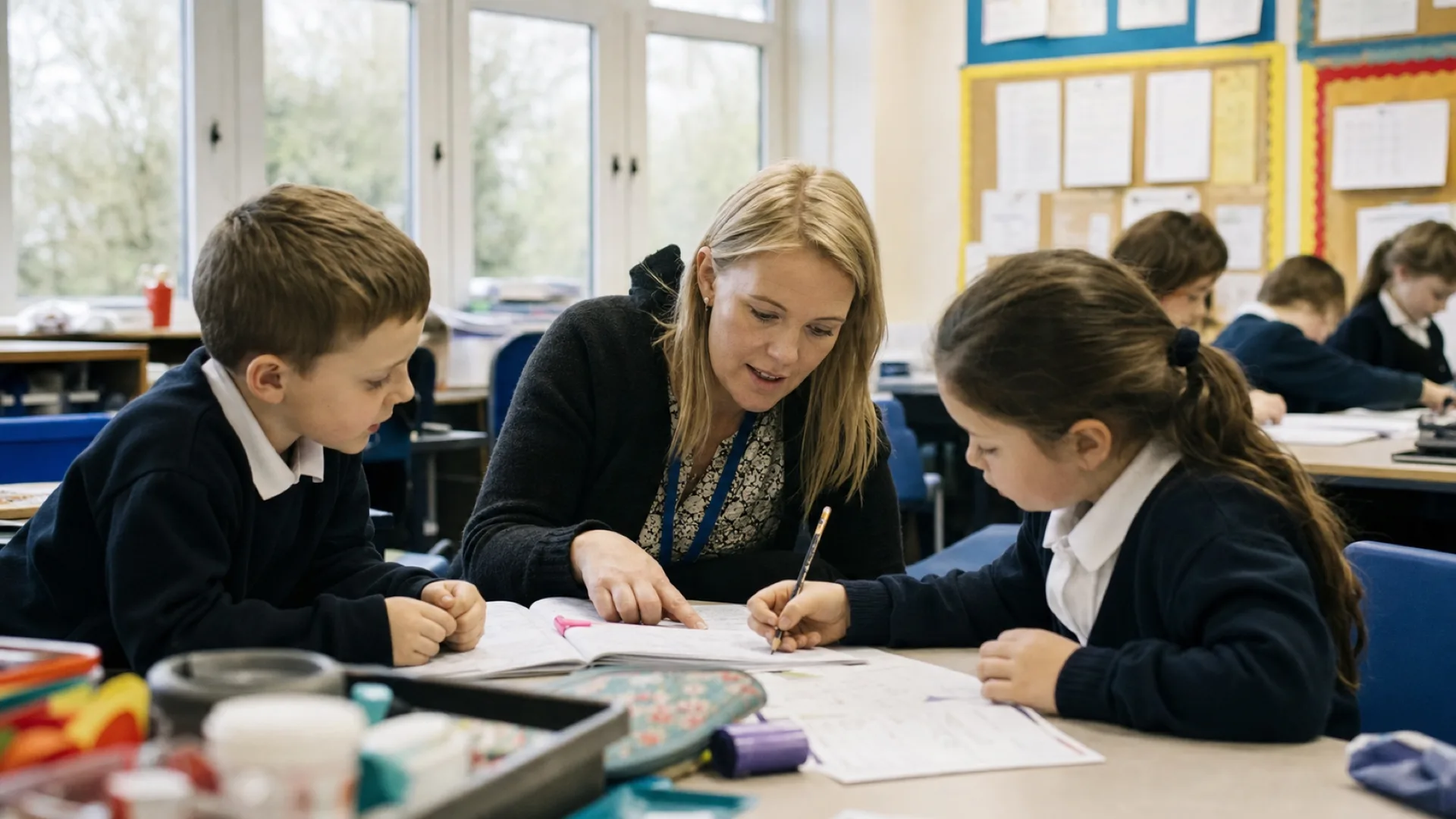
Perhaps the most radical shift in Montessori education concerns the teacher's role. The teacher is not the source of knowledge or the centre of attention. Instead, they are a guide, observer, and facilitator.
The Montessori teacher's responsibilities include:
Observing carefully , noting which materials captivate each child, which concepts they've mastered, where frustration or boredom emerges
Introducing materials precisely , when a child is ready, the teacher demonstrates a material in a focused, unhurried lesson (usually 3–5 minutes)
Stepping back , once introduced, the child works with the material independently. The teacher resists the urge to correct, praise, or interrupt
Maintaining the environment , ensuring materials are available, broken items are repaired, and the room invites exploration
Fostering independence , encouraging children to solve problems, ask peers for help, and develop self-correction through the material itself
This requires a fundamentally different mindset from traditional teaching. Instead of standing at the front delivering a lesson to 30 children simultaneously, the Montessori teacher moves quietly around the room, watching, listening, and responding to individual readiness. For many UK teachers used to whole-class direct instruction, this represents a significant shift in how scaffolding is applied, moving from teacher-provided support to self-correcting materials.
Montessori vs. Traditional Teaching: Key Differences
To understand the Montessori impact, it helps to contrast it with conventional approaches:
Aspect
Traditional Teaching
Montessori Method
Pacing
Whole class moves through curriculum together, on a fixed schedule
Each child progresses at their own pace through mixed-age environments
Teacher Role
Instructor, authority figure, knowledge dispenser
Observer, guide, facilitator of self-directed learning
Materials
Textbooks, worksheets, abstract symbols from the start
Concrete, manipulative materials that progress from sensory to abstract
Motivation
External rewards (grades, stickers, praise) and consequences
Intrinsic motivation through interest, concentration, and competence
Assessment
Tests, grades, comparison to peers
Observation, self-correction, mastery of concepts
Discipline
Rules enforced by adults; behaviour management systems
Freedom within limits; natural consequences; community responsibility
Neither approach is inherently right or wrong, but they reflect different assumptions about children, learning, and the teacher's role. Traditional education often prioritises efficiency (teaching many at once) and standardised outcomes. Montessori prioritises individual development, intrinsic motivation, and deep understanding.
Montessori in the UK Context
The UK has no official Montessori curriculum, but Montessori principles align surprisingly well with policy frameworks. The Early Years Foundation Stage emphasises child-led play, observation-based planning, and creating enabling environments, core Montessori values. EYFS practitioners who adopt Montessori thinking often find it strengthens their practice around sustained shared thinking and respecting children's interests.
However, there are practical differences. EYFS teachers in state nurseries typically work with 8–13 children per adult and must balance Montessori ideals (which assume smaller, dedicated classrooms and trained staff) with larger groups and tighter budgets. Similarly, Ofsted inspectors evaluate state schools against the National Curriculum and inclusion standards, which sit alongside but aren't identical to Montessori philosophy.
Montessori schools in the UK operate as independent settings and must balance authentic Montessori practice with:
Registration with Ofsted (where they're inspected against general early years standards)
The expectation that children transition into National Curriculum schools by age five or seven
Parent demand for evidence of "academic progress" (letters, numbers, phonics) visible within traditional frameworks
Cost constraints, genuine Montessori materials are expensive, and small class sizes limit affordability
In practice, UK Montessori schools range from highly faithful (trained staff, all materials, mixed-age Casa model) to schools that adopt Montessori language whilst incorporating more traditional instruction. This pragmatism reflects the reality that pure Montessori requires conditions that UK state education can rarely provide.
Montessori's approach is one of several influential child development theories that continue to shape how educators understand children's learning and growth.
Montessori drew significant inspiration from Friedrich Froebel, the inventor of kindergarten, whose carefully designed Gifts and Occupations anticipated many of the Montessori materials.
Montessori's prepared environment and child-led exploration represent a structured form of play-based learning that continues to influence early years practice worldwide.
Criticisms and Limitations of the Montessori Approach
Montessori's influence is substantial, but it faces legitimate critiques:
Cost and Accessibility
Authentic Montessori equipment is expensive. A fully stocked classroom can cost £15,000–£40,000. Trained Montessori teachers (requiring specific certification beyond standard teacher training) command higher salaries. This creates a socioeconomic inequality: Montessori is often available only to affluent families, even though Montessori herself designed it for children in poverty. UK state schools rarely have the budget to implement this approach.
Academic Rigour Concerns
Some research and parental concerns focus on whether Montessori children develop strong phonics skills and mathematical fluency compared to traditional instruction. Studies yield mixed results: Montessori children often excel in reading comprehension, problem-solving, and motivation but sometimes show delays in phonetic decoding if they haven't yet had a sensitive period for letter sounds. The Montessori approach trusts that if the child isn't ready, pushing harder is counterproductive, but this requires patience that pressured exam-focused systems don't afford.
Transition Challenges
A child educated in a Montessori Casa until age six suddenly enters a traditional Year 1 classroom with 30 peers, a set curriculum, and whole-class instruction. This discontinuity can be jarring. Some thrive, adapting quickly. Others struggle with the shift from self-directed exploration to teacher-directed learning.
Assumption of Intrinsic Motivation
The Montessori method assumes that when given a prepared environment and freedom, children naturally want to learn. This is often true but not universal. Some children, especially those with ADHD, attachment difficulties, or trauma histories, require more external structure, adult guidance, and positive reinforcement than the classical Montessori framework prioritises. The approach works beautifully for many children but isn't a panacea.
Limited Evidence on Long-Term Outcomes
Whilst some longitudinal studies (particularly in the USA) show Montessori graduates perform well on social-emotional and academic measures, research is not extensive. The number of Montessori schools, the variation in fidelity to the method, and the self-selection of families choosing Montessori all complicate claims about causation.
What Can Mainstream Teachers Borrow from Montessori?
You don't need a Montessori classroom to apply Montessori principles. Many ideas are practical, low-cost, and powerfully effective in state schools.
1. Observation-Based Planning
Instead of planning a lesson and delivering it regardless of where children are, observe first. What are children fascinated by? Where do they struggle? Use this intelligence to follow their lead. In EYFS, this is already practice. In Key Stage 1, it's less common but equally valuable.
2. Concrete Materials Progression
When teaching number, start with objects children can touch and move (counters, bead strings, base-10 blocks). Progress to pictorial representations (drawing, dots, tallies). Only then move to abstract numerals. This CPA progression (Concrete-Pictorial-Abstract) is now central to mastery approaches in maths.
3. Mixed-Age Reading Groups
Rather than rigid ability bands, try flexible groups where younger and older children work together. The older child reads aloud; the younger child listens and absorbs. Older children often consolidate fluency through helping younger ones.
4. Practical Life Activities
Incorporate everyday activities: wiping tables, watering plants, sorting laundry, cutting vegetables. These develop fine motor skills, responsibility, and concentration, often more effectively than contrived worksheet tasks.
5. Reduced Teacher Talk
Montessori teachers speak less. When you do introduce something, be concise and unhurried. Then step back and let children work. Notice how much talk fills traditional lessons, much of it unnecessary. Try reducing it and observe what happens. Children often rise to the challenge.
6. Purposeful Environment
Arrange your classroom so everything is intentional. Remove clutter. Label shelves and resources clearly. Create distinct areas for different types of work. Children learn from the environment itself when it's well organised.
7. Encouraging Independence
Before helping, ask: Can they figure this out? Resist the urge to correct immediately. Let children make mistakes, notice them, and try again. Self-correction builds confidence and understanding faster than adult correction.
8. Natural Consequences
Instead of punishment, let natural consequences teach. If a child rushes through work carelessly, the work speaks for itself. If they're disruptive during a lesson, they miss it. This is gentler and more effective than adult punishment, and it respects the child's agency.
These ideas don't require expensive equipment or a complete overhaul. Small shifts in how you observe, structure materials, and respond to children often yield remarkable changes in motivation, focus, and learning outcomes.
Montessori and Child-Centred Learning: Connections to Other Theorists
Montessori didn't work in isolation. Her ideas align with and inform other progressive education philosophies:
Lev Vygotsky and Montessori differed in emphasis: Vygotsky stressed the role of social interaction and the more knowledgeable other, whilst Montessori emphasised individual discovery. Contemporary practice often weaves both, allowing individual exploration within a social community.
Play-based learning philosophies share Montessori's belief that children learn through doing and exploring, though Montessori structured this exploration more tightly.
Understanding these connections helps teachers see that child-centred, developmentally responsive teaching isn't a single ideology but a shared commitment to following children's readiness and respecting their agency.
Key Takeaways
Maria Montessori's method was grounded in observation, not ideology. She watched children carefully, noticed patterns, and designed materials and environments to support what she saw.
The prepared environment teaches. When a classroom is thoughtfully organised with purposeful materials at child height, children can direct their own learning with minimal adult instruction.
Sensitive periods are windows of readiness. Children pass through periods of heightened interest in particular concepts (letters, numbers, order, movement). Observant teachers recognise and support these windows.
The teacher's role is fundamentally different. Rather than instructing a whole class, a Montessori-influenced teacher observes, introduces materials individually, and steps back to allow self-directed learning.
Concrete materials scaffold abstract thinking. Manipulating real objects, beads, blocks, textured materials, helps children build understanding before encountering symbols and abstract notation.
UK state schools can adopt Montessori principles without full commitment. Observation-based planning, concrete materials progression, practical life activities, and reduced teacher talk are all implementable even in traditional classrooms and align well with EYFS and mastery approaches.
Montessori isn't perfect. It's expensive, requires specific training, doesn't suit every child, and creates transition challenges. But its core insight, that children learn best when respected as active thinkers and given appropriate freedom and structure, is profound.
Further Reading
Academic sources on Montessori:
Lillard, A. S., Lerner, M. D., Hopkins, E. J., Dore, R. A., Smith, E. D., & Palmquist, C. M. (2013). The impact of pretend play on children's development: A review of the evidence. Psychological Bulletin, 139(1), 1–34. , Examines how Montessori's emphasis on purposeful play supports child development.
Montessori, M. (1966). The Secret of Childhood (M. J. Costello, Trans.). Orient Blackswan. , Montessori's own reflections on child development and the philosophy underlying her method.
Lillard, A. S. (2005). Montessori: The Science Behind the Genius. Oxford University Press. , A comprehensive, evidence-based examination of Montessori principles and what research says about their effectiveness.
Boehnlein, M., & Boehnlein, J. (2020). Montessori nears century mark: Exploring the past, present and future of Montessori education. International Journal of Early Childhood, 52, 29–47. , A contemporary overview of Montessori's continuing relevance and global variations.
UK-specific resources:
The Montessori Society, UK (online) , Directory of Montessori schools and training programmes in the UK.
Department for Education. (2021). Statutory Framework for the Early Years Foundation Stage. , Shows alignment between EYFS characteristics of effective learning and Montessori principles.
Books for practitioners:
Kahlaoui, K. (2015). The Montessori Toddler: A Parent's Guide to Raising Curious, Capable Children. Workman. , Practical guidance for parents and educators on adapting Montessori ideas at home and in school.
Maria Montessori (1870–1952) was an Italian physician, educator, and innovator who fundamentally changed how we think about childhood learning. Born in Rome, she became Italy's first female doctor—a remarkable achievement in the late nineteenth century—before dedicating her life to understanding how children naturally learn.
Montessori's transformation from medicine to education came through observation. While working with children with intellectual disabilities, she noticed they learned better through manipulating objects than through verbal instruction. This insight sparked a profound question: what if all children learned this way? In 1906, she opened the first Casa dei Bambini (Children's House) in a working-class Rome neighbourhood, where she applied her principles to typically developing children. The results astonished educators across Europe and America. Children as young as three taught themselves to read and write, solve mathematical problems, and work with deep concentration, without coercion.
Her method wasn't based on philosophy alone but on decades of meticulous observation, careful notation, and continuous refinement. This scientific approach to early childhood education established Montessori as a pioneer in understanding how children's minds actually work, rather than how adults expected them to work.
The Core Principles of the Montessori Method
The Montessori Method rests on several interconnected principles that fundamentally differ from traditional schooling:
The Prepared Environment
A Montessori classroom is deliberately organised to invite learning. Every object has a purpose, is placed at child height, and reflects real-world proportions (not scaled-down toys). The environment includes:
Practical Life materials , pouring, sweeping, buttoning, care of self and environment
Academic materials , bead bars for mathematics, moveable alphabet for reading
Cultural studies , geography puzzles, biology charts, history timelines
This isn't random chaos. Each area is colour-coded, materials progress from simple to complex, and children can see exactly what's available. The environment itself teaches order, respect for materials, and responsibility. In the UK context, this aligns closely with EYFS principles of creating enabling environments.
Auto-Education and the Absorbent Mind
Montessori believed young children have an absorbent mind, an unconscious ability to absorb their surroundings effortlessly. Unlike adults who must consciously study, children learn through sensory experience and movement. This led her to the principle of auto-education: when the right material meets the child's developmental readiness, the child teaches themselves. The teacher doesn't "pour in" knowledge; the child draws it from the environment through self-directed activity.
Sensitive Periods
Montessori observed that children move through windows of heightened sensitivity to particular types of learning. A child might suddenly become obsessed with letters, colours, order, or movement. These sensitive periods are temporary and self-limiting, if missed, they don't return with the same intensity. Teachers who understand sensitive periods recognise when a child is ready for a concept and strike while this readiness peaks. This concept connects to broader understanding of Piaget's stages of cognitive development, though Montessori's framework emphasises individual variation.
Concrete to Abstract
Montessori children rarely encounter abstract symbols divorced from physical experience. A child learning numbers first handles golden beads (ten unit beads, ten in a bar, ten bars in a square, ten squares in a cube), seeing and feeling the quantity. Only after this concrete experience with place value do they move to writing numerals. This progression, real object, picture, symbol, ensures deep understanding rather than rote memorisation.
Mixed-Age Grouping
In a Montessori classroom, three-year-olds, four-year-olds, and five-year-olds work together. This isn't accidental, it's deliberate. Younger children observe and learn from older peers, whilst older children consolidate knowledge by explaining and helping. There's no artificial "year group" barrier. Mixed-age grouping also allows children to progress at their own pace without the pressure of age-based grade progression.
Movement and Sensory Learning
Montessori recognised that young children think through their bodies. The classroom features gross motor activities (walking a line, carrying trays), fine motor refinement (pincer-grip exercises, pouring activities), and sensory exploration. This understanding preceded modern neuroscience by decades, but brain imaging now confirms that motor and sensory cortices are tightly integrated with learning.
The Role of the Teacher as Guide
Perhaps the most radical shift in Montessori education concerns the teacher's role. The teacher is not the source of knowledge or the centre of attention. Instead, they are a guide, observer, and facilitator.
The Montessori teacher's responsibilities include:
Observing carefully , noting which materials captivate each child, which concepts they've mastered, where frustration or boredom emerges
Introducing materials precisely , when a child is ready, the teacher demonstrates a material in a focused, unhurried lesson (usually 3–5 minutes)
Stepping back , once introduced, the child works with the material independently. The teacher resists the urge to correct, praise, or interrupt
Maintaining the environment , ensuring materials are available, broken items are repaired, and the room invites exploration
Fostering independence , encouraging children to solve problems, ask peers for help, and develop self-correction through the material itself
This requires a fundamentally different mindset from traditional teaching. Instead of standing at the front delivering a lesson to 30 children simultaneously, the Montessori teacher moves quietly around the room, watching, listening, and responding to individual readiness. For many UK teachers used to whole-class direct instruction, this represents a significant shift in how scaffolding is applied, moving from teacher-provided support to self-correcting materials.
Montessori vs. Traditional Teaching: Key Differences
To understand the Montessori impact, it helps to contrast it with conventional approaches:
Aspect
Traditional Teaching
Montessori Method
Pacing
Whole class moves through curriculum together, on a fixed schedule
Each child progresses at their own pace through mixed-age environments
Teacher Role
Instructor, authority figure, knowledge dispenser
Observer, guide, facilitator of self-directed learning
Materials
Textbooks, worksheets, abstract symbols from the start
Concrete, manipulative materials that progress from sensory to abstract
Motivation
External rewards (grades, stickers, praise) and consequences
Intrinsic motivation through interest, concentration, and competence
Assessment
Tests, grades, comparison to peers
Observation, self-correction, mastery of concepts
Discipline
Rules enforced by adults; behaviour management systems
Freedom within limits; natural consequences; community responsibility
Neither approach is inherently right or wrong, but they reflect different assumptions about children, learning, and the teacher's role. Traditional education often prioritises efficiency (teaching many at once) and standardised outcomes. Montessori prioritises individual development, intrinsic motivation, and deep understanding.
Montessori in the UK Context
The UK has no official Montessori curriculum, but Montessori principles align surprisingly well with policy frameworks. The Early Years Foundation Stage emphasises child-led play, observation-based planning, and creating enabling environments, core Montessori values. EYFS practitioners who adopt Montessori thinking often find it strengthens their practice around sustained shared thinking and respecting children's interests.
However, there are practical differences. EYFS teachers in state nurseries typically work with 8–13 children per adult and must balance Montessori ideals (which assume smaller, dedicated classrooms and trained staff) with larger groups and tighter budgets. Similarly, Ofsted inspectors evaluate state schools against the National Curriculum and inclusion standards, which sit alongside but aren't identical to Montessori philosophy.
Montessori schools in the UK operate as independent settings and must balance authentic Montessori practice with:
Registration with Ofsted (where they're inspected against general early years standards)
The expectation that children transition into National Curriculum schools by age five or seven
Parent demand for evidence of "academic progress" (letters, numbers, phonics) visible within traditional frameworks
Cost constraints, genuine Montessori materials are expensive, and small class sizes limit affordability
In practice, UK Montessori schools range from highly faithful (trained staff, all materials, mixed-age Casa model) to schools that adopt Montessori language whilst incorporating more traditional instruction. This pragmatism reflects the reality that pure Montessori requires conditions that UK state education can rarely provide.
Montessori's approach is one of several influential child development theories that continue to shape how educators understand children's learning and growth.
Montessori drew significant inspiration from Friedrich Froebel, the inventor of kindergarten, whose carefully designed Gifts and Occupations anticipated many of the Montessori materials.
Montessori's prepared environment and child-led exploration represent a structured form of play-based learning that continues to influence early years practice worldwide.
Criticisms and Limitations of the Montessori Approach
Montessori's influence is substantial, but it faces legitimate critiques:
Cost and Accessibility
Authentic Montessori equipment is expensive. A fully stocked classroom can cost £15,000–£40,000. Trained Montessori teachers (requiring specific certification beyond standard teacher training) command higher salaries. This creates a socioeconomic inequality: Montessori is often available only to affluent families, even though Montessori herself designed it for children in poverty. UK state schools rarely have the budget to implement this approach.
Academic Rigour Concerns
Some research and parental concerns focus on whether Montessori children develop strong phonics skills and mathematical fluency compared to traditional instruction. Studies yield mixed results: Montessori children often excel in reading comprehension, problem-solving, and motivation but sometimes show delays in phonetic decoding if they haven't yet had a sensitive period for letter sounds. The Montessori approach trusts that if the child isn't ready, pushing harder is counterproductive, but this requires patience that pressured exam-focused systems don't afford.
Transition Challenges
A child educated in a Montessori Casa until age six suddenly enters a traditional Year 1 classroom with 30 peers, a set curriculum, and whole-class instruction. This discontinuity can be jarring. Some thrive, adapting quickly. Others struggle with the shift from self-directed exploration to teacher-directed learning.
Assumption of Intrinsic Motivation
The Montessori method assumes that when given a prepared environment and freedom, children naturally want to learn. This is often true but not universal. Some children, especially those with ADHD, attachment difficulties, or trauma histories, require more external structure, adult guidance, and positive reinforcement than the classical Montessori framework prioritises. The approach works beautifully for many children but isn't a panacea.
Limited Evidence on Long-Term Outcomes
Whilst some longitudinal studies (particularly in the USA) show Montessori graduates perform well on social-emotional and academic measures, research is not extensive. The number of Montessori schools, the variation in fidelity to the method, and the self-selection of families choosing Montessori all complicate claims about causation.
What Can Mainstream Teachers Borrow from Montessori?
You don't need a Montessori classroom to apply Montessori principles. Many ideas are practical, low-cost, and powerfully effective in state schools.
1. Observation-Based Planning
Instead of planning a lesson and delivering it regardless of where children are, observe first. What are children fascinated by? Where do they struggle? Use this intelligence to follow their lead. In EYFS, this is already practice. In Key Stage 1, it's less common but equally valuable.
2. Concrete Materials Progression
When teaching number, start with objects children can touch and move (counters, bead strings, base-10 blocks). Progress to pictorial representations (drawing, dots, tallies). Only then move to abstract numerals. This CPA progression (Concrete-Pictorial-Abstract) is now central to mastery approaches in maths.
3. Mixed-Age Reading Groups
Rather than rigid ability bands, try flexible groups where younger and older children work together. The older child reads aloud; the younger child listens and absorbs. Older children often consolidate fluency through helping younger ones.
4. Practical Life Activities
Incorporate everyday activities: wiping tables, watering plants, sorting laundry, cutting vegetables. These develop fine motor skills, responsibility, and concentration, often more effectively than contrived worksheet tasks.
5. Reduced Teacher Talk
Montessori teachers speak less. When you do introduce something, be concise and unhurried. Then step back and let children work. Notice how much talk fills traditional lessons, much of it unnecessary. Try reducing it and observe what happens. Children often rise to the challenge.
6. Purposeful Environment
Arrange your classroom so everything is intentional. Remove clutter. Label shelves and resources clearly. Create distinct areas for different types of work. Children learn from the environment itself when it's well organised.
7. Encouraging Independence
Before helping, ask: Can they figure this out? Resist the urge to correct immediately. Let children make mistakes, notice them, and try again. Self-correction builds confidence and understanding faster than adult correction.
8. Natural Consequences
Instead of punishment, let natural consequences teach. If a child rushes through work carelessly, the work speaks for itself. If they're disruptive during a lesson, they miss it. This is gentler and more effective than adult punishment, and it respects the child's agency.
These ideas don't require expensive equipment or a complete overhaul. Small shifts in how you observe, structure materials, and respond to children often yield remarkable changes in motivation, focus, and learning outcomes.
Montessori and Child-Centred Learning: Connections to Other Theorists
Montessori didn't work in isolation. Her ideas align with and inform other progressive education philosophies:
Lev Vygotsky and Montessori differed in emphasis: Vygotsky stressed the role of social interaction and the more knowledgeable other, whilst Montessori emphasised individual discovery. Contemporary practice often weaves both, allowing individual exploration within a social community.
Play-based learning philosophies share Montessori's belief that children learn through doing and exploring, though Montessori structured this exploration more tightly.
Understanding these connections helps teachers see that child-centred, developmentally responsive teaching isn't a single ideology but a shared commitment to following children's readiness and respecting their agency.
Key Takeaways
Maria Montessori's method was grounded in observation, not ideology. She watched children carefully, noticed patterns, and designed materials and environments to support what she saw.
The prepared environment teaches. When a classroom is thoughtfully organised with purposeful materials at child height, children can direct their own learning with minimal adult instruction.
Sensitive periods are windows of readiness. Children pass through periods of heightened interest in particular concepts (letters, numbers, order, movement). Observant teachers recognise and support these windows.
The teacher's role is fundamentally different. Rather than instructing a whole class, a Montessori-influenced teacher observes, introduces materials individually, and steps back to allow self-directed learning.
Concrete materials scaffold abstract thinking. Manipulating real objects, beads, blocks, textured materials, helps children build understanding before encountering symbols and abstract notation.
UK state schools can adopt Montessori principles without full commitment. Observation-based planning, concrete materials progression, practical life activities, and reduced teacher talk are all implementable even in traditional classrooms and align well with EYFS and mastery approaches.
Montessori isn't perfect. It's expensive, requires specific training, doesn't suit every child, and creates transition challenges. But its core insight, that children learn best when respected as active thinkers and given appropriate freedom and structure, is profound.
Further Reading
Academic sources on Montessori:
Lillard, A. S., Lerner, M. D., Hopkins, E. J., Dore, R. A., Smith, E. D., & Palmquist, C. M. (2013). The impact of pretend play on children's development: A review of the evidence. Psychological Bulletin, 139(1), 1–34. , Examines how Montessori's emphasis on purposeful play supports child development.
Montessori, M. (1966). The Secret of Childhood (M. J. Costello, Trans.). Orient Blackswan. , Montessori's own reflections on child development and the philosophy underlying her method.
Lillard, A. S. (2005). Montessori: The Science Behind the Genius. Oxford University Press. , A comprehensive, evidence-based examination of Montessori principles and what research says about their effectiveness.
Boehnlein, M., & Boehnlein, J. (2020). Montessori nears century mark: Exploring the past, present and future of Montessori education. International Journal of Early Childhood, 52, 29–47. , A contemporary overview of Montessori's continuing relevance and global variations.
UK-specific resources:
The Montessori Society, UK (online) , Directory of Montessori schools and training programmes in the UK.
Department for Education. (2021). Statutory Framework for the Early Years Foundation Stage. , Shows alignment between EYFS characteristics of effective learning and Montessori principles.
Books for practitioners:
Kahlaoui, K. (2015). The Montessori Toddler: A Parent's Guide to Raising Curious, Capable Children. Workman. , Practical guidance for parents and educators on adapting Montessori ideas at home and in school.