Updated on
September 30, 2026
Format Matters: Raising Expectations Without Policing
Academic register genuinely predicts comprehension. Correcting a child's dialect in the name of aspiration is a different act, and UK research says so plainly.


Updated on
September 30, 2026
Academic register genuinely predicts comprehension. Correcting a child's dialect in the name of aspiration is a different act, and UK research says so plainly.
What is Format Matters?
Format Matters is technique 18 in Teach Like a Champion 3.0. Learners are held to the grammar, vocabulary and completeness of a full academic answer, not only to its content, on the argument that register is part of knowing a subject. The distinction that decides whether it is teaching or policing is between correcting incompleteness and correcting dialect.
A learner answers "cos it went up". The teacher says "in a full sentence, please". Whether that exchange was teaching or policing depends on something the technique itself does not tell you, and getting it wrong has consequences that reach well beyond the lesson.
Format Matters means holding learners to the grammar, vocabulary and completeness of a full academic answer, not just its content. It is technique 18 in Teach Like a Champion 3.0 (Lemov, 2021), in the chapter on academic ethos, and its argument is that a learner who cannot say it in the register of the subject does not yet fully have it.
There is a real premise underneath. Uccelli and colleagues (2015) found academic language proficiency predicted reading comprehension over and above vocabulary, meaning register is a distinct, learnable and consequential thing rather than a matter of manners.
And there is a serious live critique from UK linguistics that any honest treatment has to engage. Cushing's work argues that English schools' language policies police non-standard forms in ways presented as raising expectations and functioning as social sorting.
Format Matters is the practice of correcting the form of an answer as well as its substance: asking for a complete sentence, for subject-specific vocabulary, for audibility. Its stated purpose is access. The argument is that learners who habitually speak in the register the subject uses find it easier to write in it, and that letting a fragment stand is a small act of low expectation.
The three formats usually named are grammatical, audible and unit-of-measure. The first is where the whole argument lives.
The strongest support for this technique is not about correctness at all. It is about structure, and the best of it comes from UK classrooms. Academic register predicts comprehension independently of vocabulary, and teaching children explicit ground rules for how to talk raised their individual reasoning scores. Both findings support the technique's premise without supporting the correction of anybody's grammar.
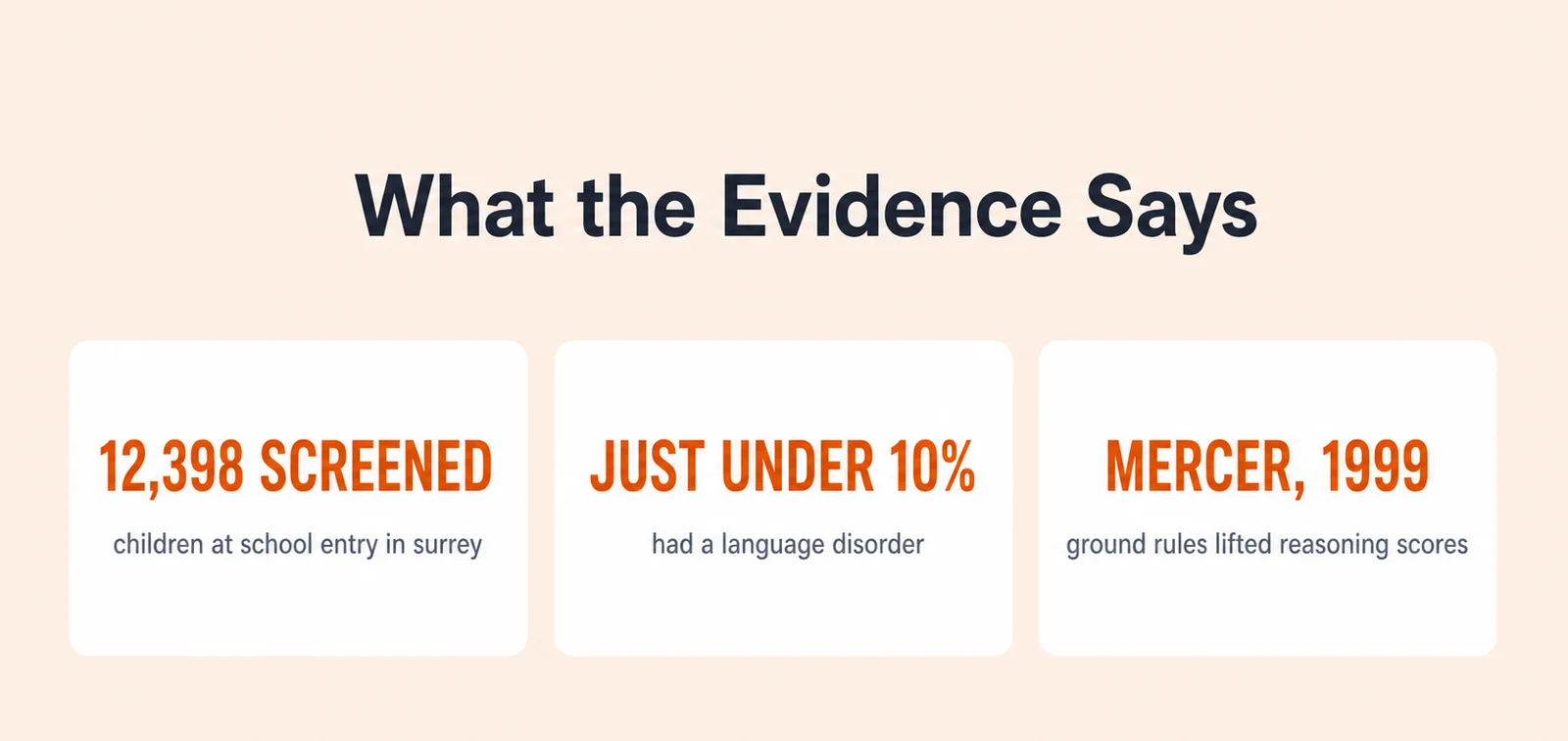
Uccelli and colleagues (2015) showed that academic language proficiency is separable from vocabulary and predicts comprehension in its own right. That gives the technique a target worth having: not politeness, but a register learners need in order to read their subject.
Mercer, Wegerif and Dawes (1999) found that teaching children explicit ground rules for exploratory talk improved both the quality of their talk and their individual reasoning scores. Note carefully what that study taught: the structure of talk, how to challenge, justify and agree, not the correctness of its forms. That distinction is the escape route from most of the criticism below.
Howe and colleagues (2019) then add the necessary caution: not every feature of what looks like good classroom talk actually predicts attainment. Some of what we insist on is convention rather than mechanism.
This is the part missing from every practitioner treatment of this technique. A body of UK linguistics research argues that school language policies police non-standard forms in ways presented as raising expectations, and that this functions as social sorting. A publisher writing about Format Matters for British teachers without engaging that work would look either unaware or evasive.
Ian Cushing's research examines how language is policed in English schools. Cushing (2020) analyses school language policies and argues they target non-standard forms in ways framed as aspiration and operating as social sorting. Cushing (2023) traces the resurgence of "word gap" deficit discourse in England's education policy and its raciolinguistic assumptions. Cushing and Snell (2023) extend the analysis to the listening practices of the schools inspectorate.
The argument is not that academic register is worthless. It is that correcting a child's home language in the name of aspiration is a raciolinguistic act with measurable consequences for who gets heard. A teacher who says "we don't say ain't" has not made a neutral technical correction; they have ranked two varieties of English in front of the class.
The honest line, and the one this article will defend: insisting on a complete sentence is a different act from correcting a dialect feature. The technique does not keep those two apart. The teacher has to.
Four distinctions do the work, and they are all about what you correct rather than how firmly you correct it. Target incompleteness rather than dialect, add the subject's register instead of replacing the learner's answer, do most of the correcting in writing rather than in speech, and never stop a learner to fix a verb before you have their idea.
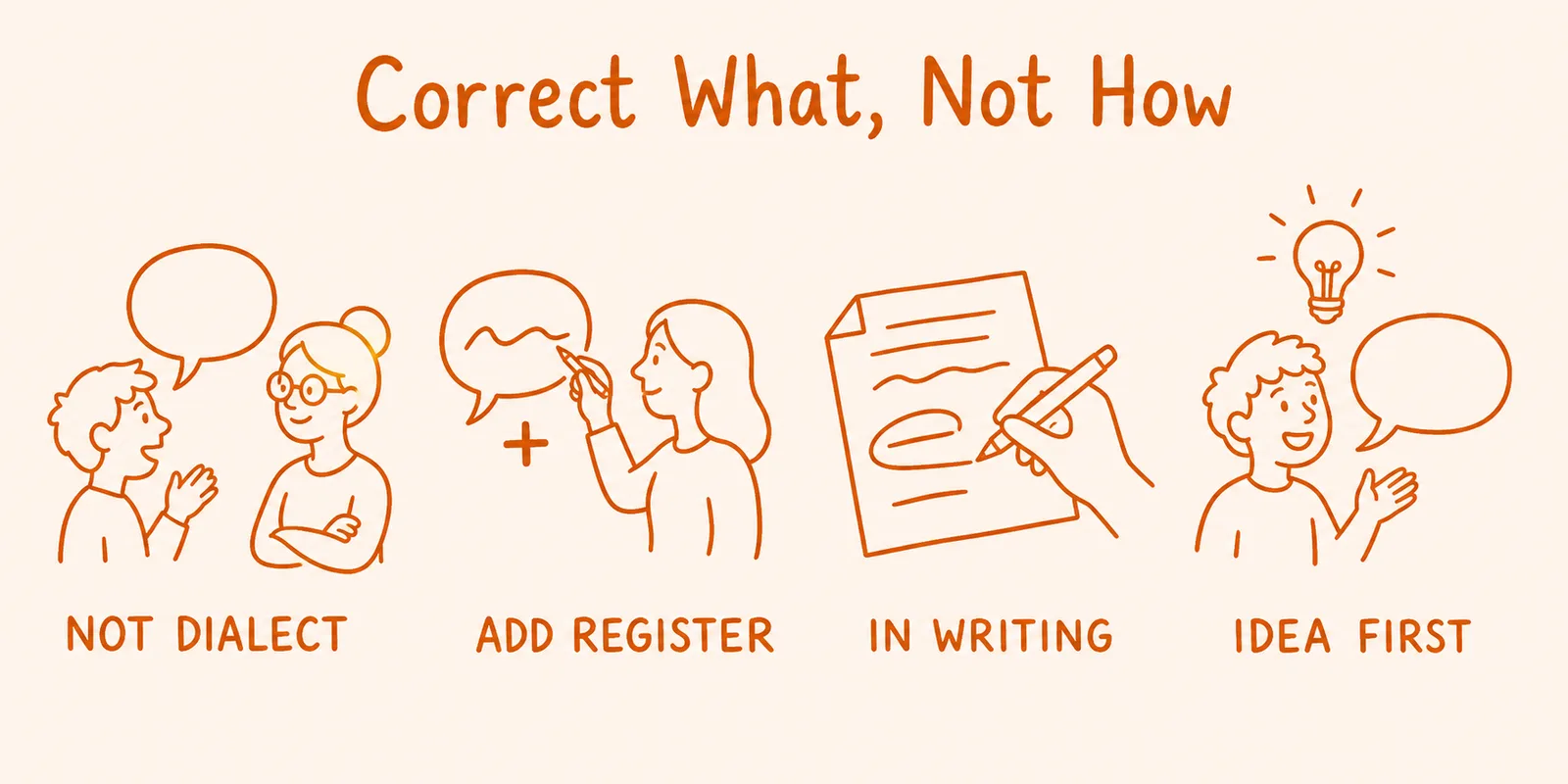
Correct incompleteness, not dialect. "Can you give me the whole thought?" targets structure. "We say were, not was" targets a variety of English that is grammatically systematic and belongs to the learner's family. The first is teaching. The second is a judgement about whose English counts.
Add the register, do not replace the answer. "Yes, and in science we would say the rate increased" gives the learner the subject's phrasing while accepting what they said. Nothing has been taken away.
Correct in writing more than in speech. Standard written English is the assessed variety and learners need it. Speech is where identity sits, and it is where public correction costs most.
Never correct form before you have the content. If a learner has the idea, take the idea first. Reformatting can wait a turn; a learner who is stopped mid-thought to fix a verb often loses the thought.
A requirement to produce a well-formed sentence on demand measures expression, and for some learners expression is the difficulty rather than the understanding. Two groups are affected most directly: learners with a developmental language disorder, who are more numerous than most teachers assume, and learners who stammer, for whom the length of a full sentence is precisely the problem.
Norbury and colleagues (2016), screening 12,398 children at school entry in Surrey, found language disorder prevalence just under 10 per cent, which they describe as roughly two children in every class of thirty and call a minimum, since it excludes children in special schools and children learning English as an additional language. For those learners, insisting on the full form measures the disorder.
McAllister, Collier and Shepstone (2012) followed a birth cohort and documented the educational and employment consequences of adolescent stammering. A requirement to answer in a full, well-formed sentence falls hardest on a learner who stammers, because length is exactly what is difficult.
The adjustment is not lower expectations. Take the content in whatever form arrives, and build the register in writing, where there is no clock and no audience.
The premise is supported and the practice is contested. Academic register genuinely predicts comprehension, and no study tests Format Matters as a technique. The UK critical literature is strong, current and specifically about English schools, and it is not answered by pointing at the technique's good intentions. Nobody has tested whether correcting spoken form transfers to written form, which is the whole justification.
It is technique 18 in Teach Like a Champion 3.0. Learners are held to the grammar, vocabulary and completeness of a full academic answer, not only to its content, on the argument that register is part of knowing the subject.
It depends what you correct. Asking for a complete thought targets structure. Correcting a dialect feature ranks two varieties of English in front of the class, and UK research argues that this functions as social sorting rather than as raised expectations.
Requiring a full, well-formed sentence on demand measures their expression rather than their understanding, and length is the hardest part for a learner who stammers. Take the content in whatever form it arrives and build register in writing.
Format Matters is one of the 63 moves in our complete guide to Teach Like a Champion, and it sits beside accountable talk, which specifies what a contribution owes without specifying its grammar.
Two techniques sit closest to this one: right is right, which holds the same line on content rather than form; and everybody writes, where register can be built without an audience.