Updated on
September 24, 2026
Right Is Right: Holding Out for the Whole Answer
Bare right-or-wrong feedback is worth d = 0.05. Everything of value is in what you add. And over a third of feedback interventions make performance worse.


Updated on
September 24, 2026
Bare right-or-wrong feedback is worth d = 0.05. Everything of value is in what you add. And over a third of feedback interventions make performance worse.
What is Right Is Right?
Right Is Right is technique 16 in Teach Like a Champion 3.0. The teacher does not accept a partially correct answer as though it were complete: they name what is right, say specifically what is missing, and return the question rather than finishing it for the learner.
A learner gives you three quarters of the answer. Accepting it and finishing the sentence for them is the most natural thing in teaching, and it is the moment this technique exists to interrupt.
Right Is Right means holding out for the whole answer rather than rounding up a partial one. It is technique 16 in Teach Like a Champion 3.0 (Lemov, 2021), in the chapter on academic ethos, and the claim is that a teacher who completes learners' answers teaches them that approximately right is the standard.
The feedback research supports the core of this and quantifies it usefully. Van der Kleij, Feskens and Eggen (2015) meta-analysed 40 studies and 70 effect sizes. Telling a learner merely whether they were right or wrong produced d = 0.05. Supplying the correct answer produced 0.32. Elaborated feedback produced 0.49, and was especially better for higher-order outcomes.
Read that as an instruction. "No, not quite, try again" on its own is worth almost nothing. Everything of value is in what you add.
Right Is Right is the practice of not accepting a partially correct answer as if it were complete. When a learner gets most of it, the teacher names what is right, says what is missing, and returns the question rather than filling the gap themselves. Its purpose is to keep the standard where it is when it would be easier to move it.
The four situations it names are the almost-right answer, the right answer to a different question, the answer that arrives before the reasoning, and the answer that lacks the technical term. All four are places where a teacher's helpfulness quietly lowers the bar.
The feedback literature supports the technique's core and attaches a serious condition to it. Elaborated feedback works well, bare correctness feedback does almost nothing, and feedback that turns attention onto the learner rather than the work makes things worse often enough to matter.
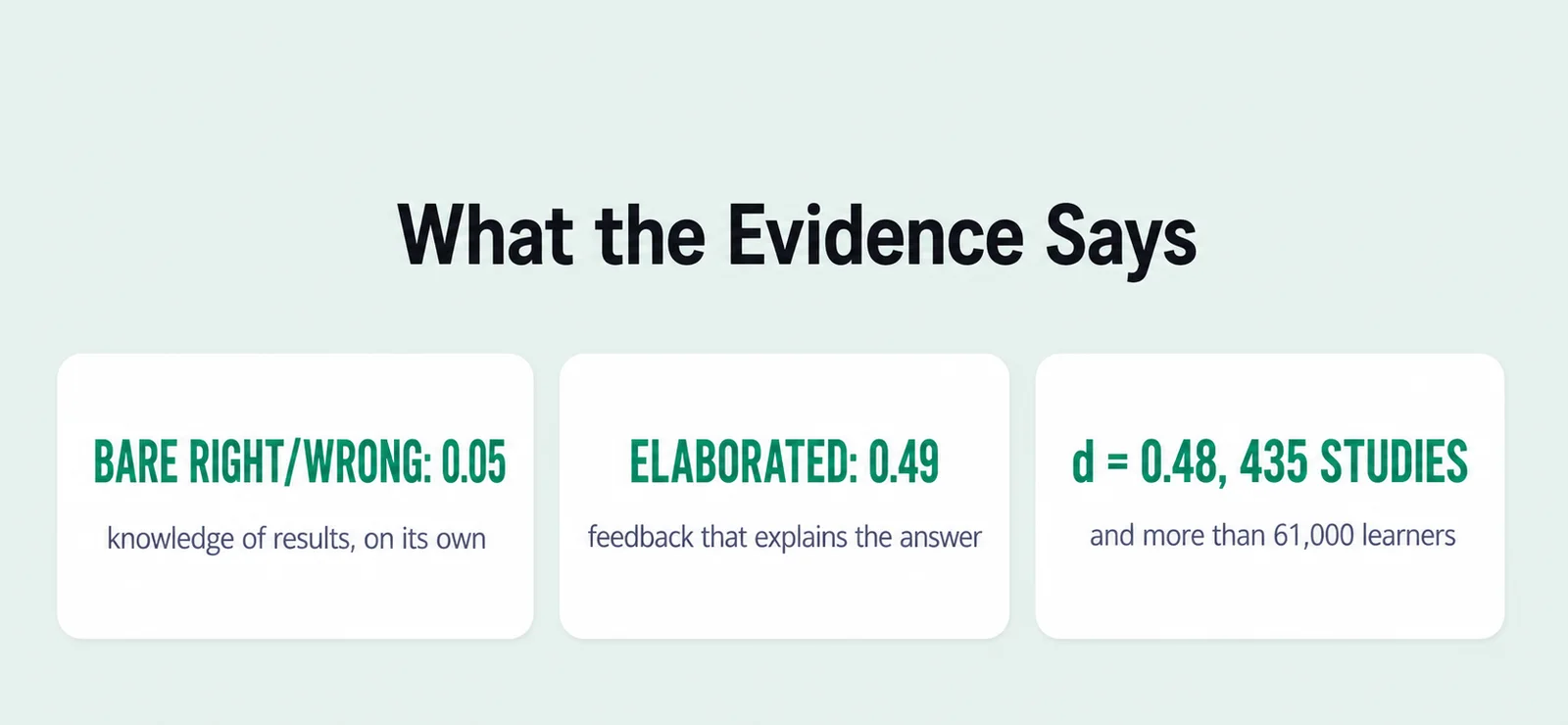
Van der Kleij and colleagues' meta-analysis is the most useful single source here because it separates three kinds of feedback and prices them. Knowledge of results alone, meaning simply right or wrong, comes in at 0.05. Supplying the correct answer reaches 0.32. Elaborated feedback, which explains, reaches 0.49, and does better still on higher-order outcomes. Their effect sizes ranged from -0.78 to 2.29, so averages hide a great deal.
Wisniewski, Zierer and Hattie (2020) reach a similar place across 435 studies and more than 61,000 learners, with an overall d = 0.48 and significant heterogeneity. Their own conclusion is that feedback cannot be treated as one consistent thing, which is the right note of caution to carry.
Kluger and DeNisi (1996) remains the paper every teacher should know about feedback. Across 607 effect sizes and 23,663 observations the average was 0.41, and over a third of feedback interventions made performance worse. The negative cases cluster where feedback shifts a learner's attention from the task to themselves.
Holding out publicly for a better answer is precisely a manoeuvre that can shift attention from the task to the self. Hattie and Timperley (2007) draw the same boundary: feedback at task, process and self-regulation level works, and feedback at the level of the self does not.
So the technique is defensible exactly as long as the exchange stays on the work. "That's not the whole answer" is about the answer. "Come on, you can do better than that" is about the person, and it is in the failure region.
Four moves keep the standard up and keep the exchange on the work. Name what was right first, say specifically what is missing, hand the question back rather than completing it, and keep every sentence about the answer rather than the learner.
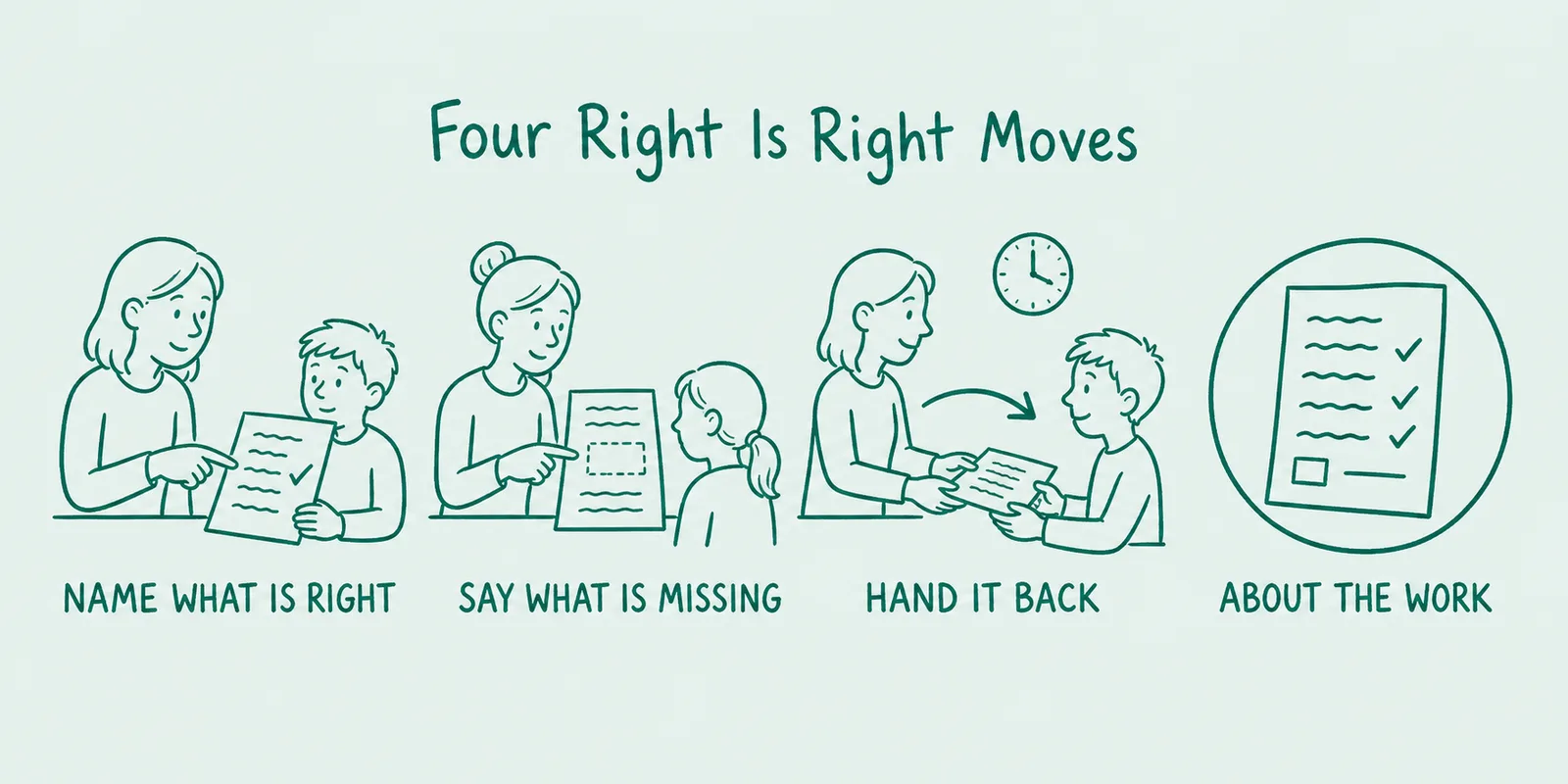
Name the correct part explicitly. "You've got the mechanism, you haven't got the reason" tells the learner what to keep. A bare "not quite" makes them start again from nothing.
Say what is missing, not that something is missing. This is the elaboration the meta-analysis prices at ten times the value of bare correctness feedback.
Return the question to the same learner. Moving to another hand is how the standard drops, and it teaches the class that a partial answer gets you released.
Keep it about the work. Never about effort, character or how much they should know by now. That is the boundary the evidence draws.
Insisting on a fully formed answer measures the learner's ability to produce it on demand, which is not always the same as whether they know it. For a learner with a developmental language disorder the concept can be secure and the sentence still unbuildable, and for a learner who stammers holding out extends the exposure at exactly the wrong moment. Both are common enough to plan for rather than react to.
Norbury and colleagues (2016) screened 12,398 children at school entry and found language disorder prevalence just under 10 per cent, roughly two children in every class of thirty, described by the authors as a minimum. A learner with a language disorder may hold the concept perfectly and be unable to assemble it into the sentence you are waiting for. Holding out then measures expression.
The adjustment is to separate the two. Take the content in whatever form arrives, then offer the full formulation yourself and ask them to repeat it. The standard is intact, the assessment is honest, and the learner has heard the sentence they could not build.
For a learner who stammers, holding out extends the exposure at exactly the wrong moment. McAllister, Collier and Shepstone (2012) followed a birth cohort and documented the educational and employment consequences of adolescent stammering, which is a reason to take this seriously rather than treat it as sensitivity.
No study tests Right Is Right by name. The supporting evidence is the feedback literature, which is large, heterogeneous and contains a substantial failure region. It is also mostly not about spoken exchanges in school classrooms: Van der Kleij's meta-analysis is of computer-based learning environments. The transfer from a computer supplying elaborated feedback to a teacher holding a pause in front of thirty people is an assumption, and a public exchange carries a social cost the software does not.
It is technique 16 in Teach Like a Champion 3.0. The teacher does not accept a partially correct answer as complete, but names what is right, says what is missing, and returns the question rather than finishing it for the learner.
It depends entirely on what the exchange is about. Feedback on the task and the process helps; feedback aimed at the learner does not, and over a third of feedback interventions in the largest meta-analysis reduced performance. Keep the sentence about the answer.
Take the content in whatever form it arrives, then model the full formulation and ask them to repeat it. That keeps the standard while measuring understanding rather than the ability to produce a sentence on demand.
Right Is Right is one of the 63 moves in our complete guide to Teach Like a Champion, and it works alongside wait time, because holding out for a better answer requires leaving the pause in which it can be built.
Two techniques sit closest to this one: a culture of error, without which holding out just raises the stakes; and checking for understanding, which is what the held-out answer is for.