Cognitivism: How Cognitive Learning Theory Shapes TeachingSecondary students aged 12-14 in maroon sweatshirts using tablets in a cognitive learning group activity.

Updated on  

March 12, 2026

Cognitivism: How Cognitive Learning Theory Shapes Teaching

|

December 9, 2022

Cognitivism learning theory explained for teachers: how students process, store, and retrieve information, with evidence-based strategies for the classroom.

Course Enquiry
Copy citation

Main, P (2022, December 09). Cognitivism Learning Theories: A teachers guide. Retrieved from https://www.structural-learning.com/post/cognitivism-learning-theories

What Is Cognitivism in Learning?

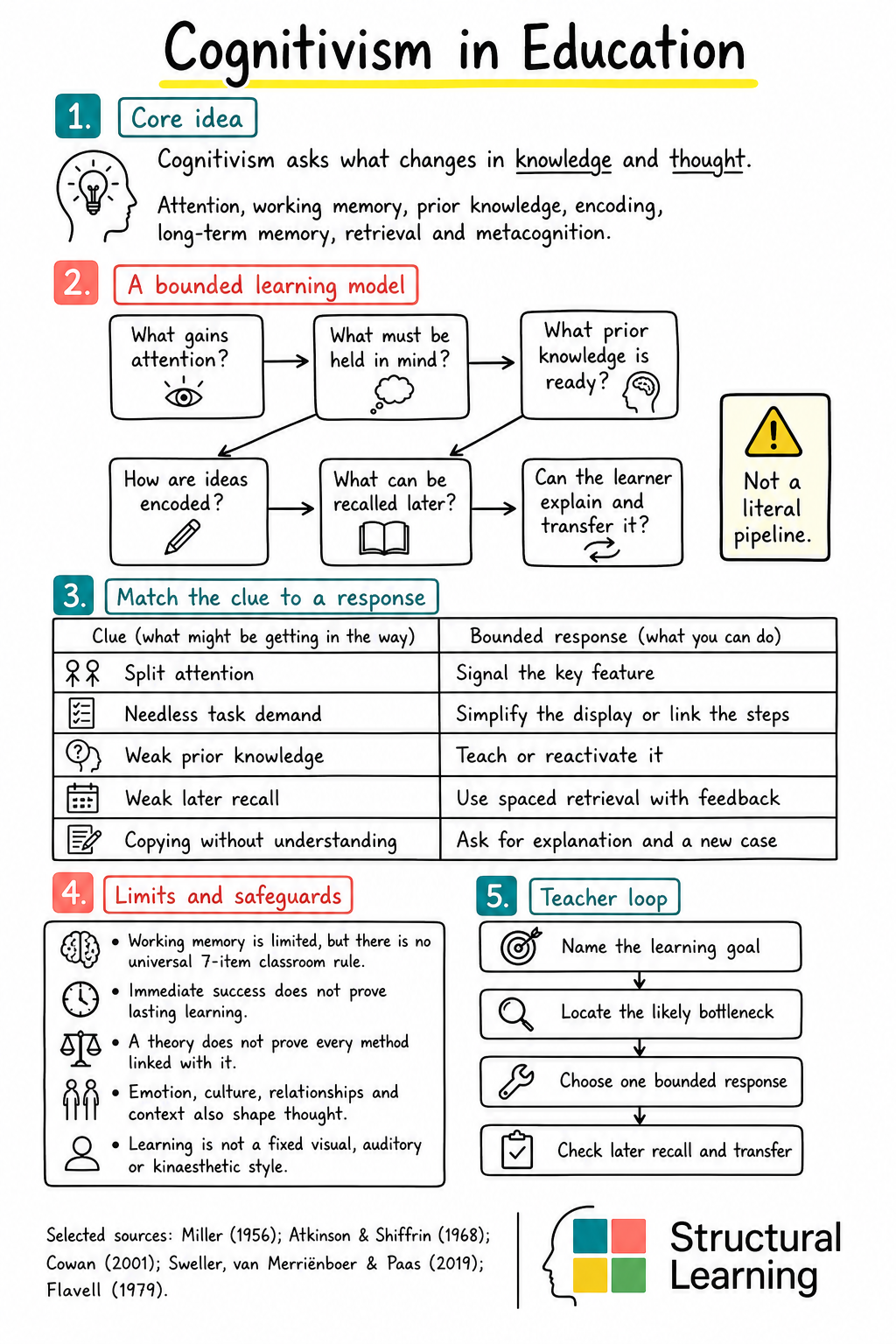
Cognitivism is a theory of learning that focuses on the internal processes of the mind, how information is received, organised, stored, and retrieved. Unlike behaviourist theories that focus on observable actions, cognitivism sees learning as an active, mental process shaped by experience, memory, and prior knowledge. It views the mind as an information processor, similar to a computer, where new information is constantly compared with existing knowledge and adapted accordingly.

Key Takeaways

  1. Cognitivism fundamentally redefines learning as an active, internal process of information processing. This perspective views the mind as an intricate system that encodes, stores, and retrieves information, moving beyond behaviourist focus on observable actions to mental operations like those described in the multi-store model of memory (Atkinson & Shiffrin, 1968). For teachers, this means understanding how pupils actively construct knowledge, rather than merely receiving it.
  2. Prior knowledge and effective memory strategies are paramount for meaningful cognitive learning. Learning is most effective when new information can be meaningfully integrated with existing cognitive structures, a concept central to Ausubel's theory of meaningful learning (Ausubel, 1968). Teachers should actively assess and activate pupils' existing schemas to facilitate deeper understanding and retention.
  3. Cognitive theory offers a robust framework for designing instruction that optimises mental processing and reduces cognitive load. Effective lesson design, guided by principles such as Cognitive Load Theory, aims to manage the demands on pupils' working memory, ensuring that instructional materials and tasks are presented in a way that facilitates learning without overwhelming the learner (Sweller, 1988). This involves careful sequencing, clear explanations, and appropriate scaffolding to support complex tasks.
  4. Technology serves as a powerful enabler for supporting and enhancing cognitive learning processes in the classroom. Digital tools can be strategically employed to facilitate active information processing, provide opportunities for practice and feedback, and help manage cognitive load, aligning with principles of effective instruction (Bruner, 1960). This allows teachers to create dynamic learning environments that cater to diverse cognitive needs and promote deeper engagement among pupils.

What does the research say? Hattie's Visible Learning synthesis (2009) found that metacognitive strategies, a core application of cognitivist theory, produce an effect size of 0.69 on student achievement. The EEF Teaching and Learning Toolkit rates metacognition and self-regulation as providing +7 months of additional progress at very low cost. Dunlosky et al. (2013) reviewed 10 learning techniques and rated practise testing and distributed practise, both grounded in cognitive information processing theory, as the two most effective strategies across all learner ages.

In the classroom, a cognitivist approach supports environments that promote thinking, reflection, and problem-solving. Rather than relying on repetition or rote memorisation, this model encourages students to engage in activities that help them make sense of ideas, connect concepts, and apply knowledge to new situations. For example, asking learners to explore open-ended questions or analyse a real-world problem helps them move beyond surface understanding to deeper comprehension.

How Does Cognitivism vs Behaviorism Apply in Education?

Understanding the differences between cognitivism and behaviourism is crucial for teachers choosing effective classroom strategies. While behaviourism focuses on observable actions and external rewards, cognitivism emphasises the internal mental processes that drive learning.

Aspect Cognitivism Behaviourism
Definition Focuses on internal mental processes like memory, thinking, and problem-solving to understand how learning occurs Focuses on observable behaviours and external responses to stimuli, ignoring internal mental processes
Learning Process Active mental construction where students process, organise, and connect new information to prior knowledge Passive response to environmental stimuli through repetition, practise, and reinforcement
Teacher's Role Facilitator who activates prior knowledge, guides thinking, and helps students make connections Director who delivers information, provides clear instructions, and manages rewards and consequences
Classroom Strategies Concept mapping, questioning techniques, problem-solving activities, and metacognitive reflection Drill and practise, immediate feedback, reward systems, and structured repetition
Assessment Focus Understanding, application, and transfer of knowledge to new situations Correct responses, accuracy, and measurable behavioural changes
Best Used For Complex problem-solving, critical thinking, and developing deep conceptual understanding Skill acquisition, habit formation, and teaching specific procedures or routines

Both approaches have their place in modern classrooms, but cognitivism proves more effective for developing critical thinking and lasting understanding. Teachers often combine elements of both theories, using behaviourist techniques for basic skill building whilst applying cognitive strategies for deeper learning and conceptual development.

Memory serves as the foundation for cognitive learning by storing, processing, and retrieving information that enables learners to build knowledge, make connections, and apply previous experiences to new situations.

Infographic comparing cognitivism and behaviorism <a href=learning theories in education" loading="lazy">
Cognitivism vs. Behaviorism in Education

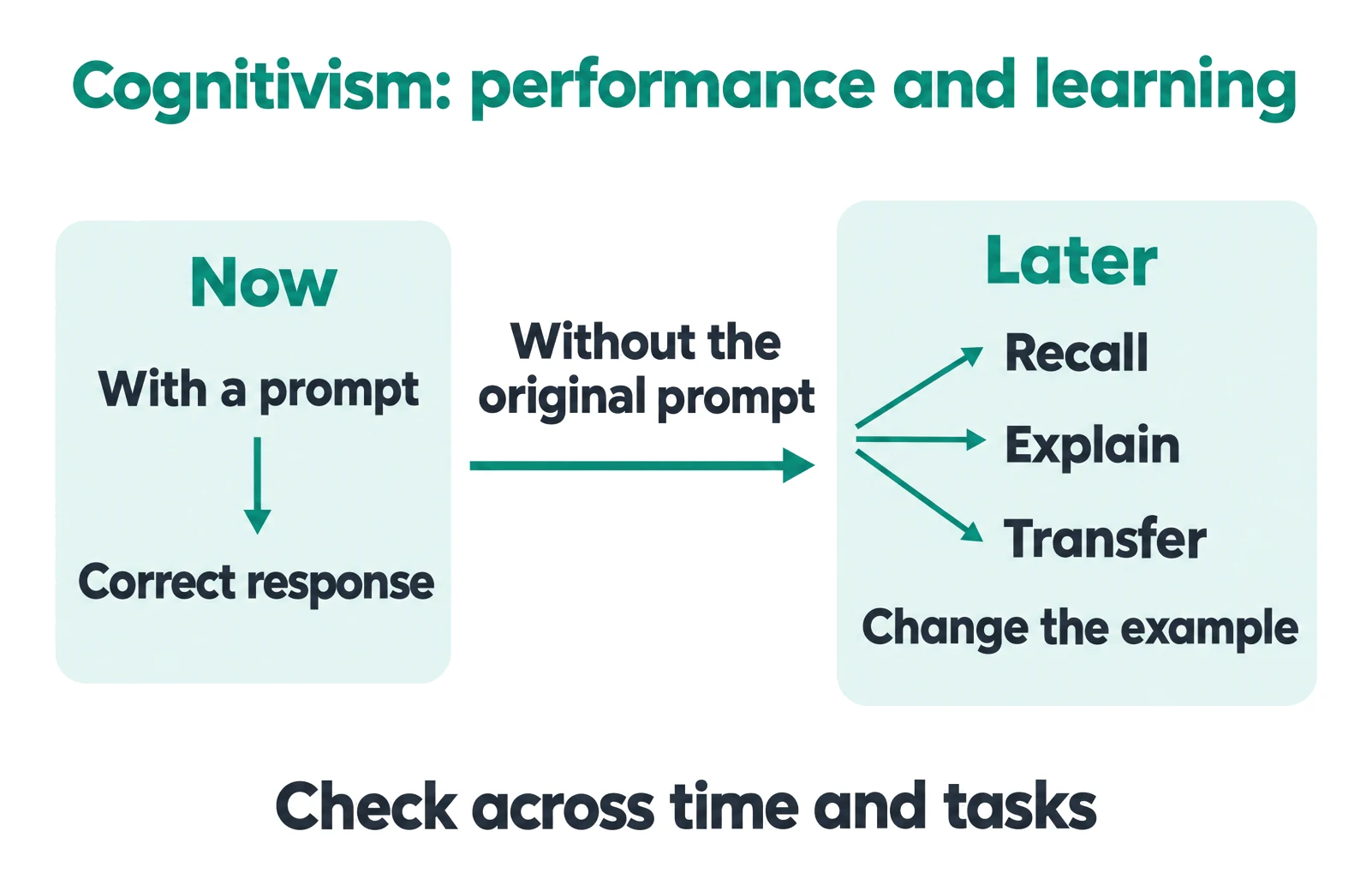
Cognitivist learning theory assumes that knowledge is constructed, not simply absorbed. Learning happens when students are challenged to apply their own reasoning, draw on existing frameworks, and revise their thinking in light of new information. This is why strategies such as questioning, concept mapping, and retrieval practise are so effective, they support the mental work of learning.

You may recognise the influence of cognitivism in the work of theorists such as Jean Piaget, David Ausubel, Albert Bandura, and David Kolb. If you're interested in how these perspectives have shaped our understanding of thinking and learning, and how they differ from behaviourist or constructivist models, the key principles, classroom strategies, and practical applications of cognitive theory in education.

Memory is the bedrock of cognition learning by storing, organising, and obtaining information that facilitates learners' build upon prior knowledge and develop complex understanding.

◆ Structural Learning
Inside the Mind: How Cognitivism Shaped Teaching
A deep-dive podcast for educators

This podcast explores how cognitive learning theories transformed education, from information processing to schema theory and their practical implications for classroom practice.

Cognition is underpinned by memory learning by storing, processing, and fetching information that enables learners to build upon previous knowledge and develop complex understanding.

Cognitive Learning Theory Lesson Design

Design lessons by structuring content in logical sequences that build on students' existing knowledge, using graphic organisers and concept maps to show relationships between ideas. Include activities that require students to actively process information, such as comparing and contrasting concepts or solving problems that apply new knowledge. Incorporate regular opportunities for students to reflect on their learning process and articulate how new information connects to what they already know.

Cognitivist learning theory offers practical principles that help educators support how students absorb, organise, and apply new information. At its core, cognitivism views learning not as a passive transfer of facts but as a process of building and refining internal knowledge structures. This means instruction should be purposefully designed to enhance understanding, make connections to prior learning, and strengthen long-term memory.

Comparison chart showing differences between cognitivist and behaviorist educational approaches
Side-by-side comparison table: Cognitivism vs Behaviorism in Education

One of the key ideas in cognitivism is that new knowledge is most effective when it builds on what learners already know. By activating prior knowledge, helping students see patterns, and supporting them to mentally organise content, teachers can make learning more meaningful and easier to retain.

Here are several guiding principles that underpin a cognitive approach to instruction:

  • Learning should be intentional and focused, with clear goals and relevant tasks.
  • Students benefit from being self-directed, taking ownership of how and what they learn.
  • Learning happens through a process of analysis, questioning, and discovery, not passive consumption.
  • Organising information into schemas helps students construct mental models that support understanding.
  • Encoding information into long-term memory is strengthened when content is chunked, revisited, and connected across lessons.
  • Curriculum should be well-sequenced and structured to show how each part fits into the wider learning process.
  • These principles provide a foundation for designing learning environmentsthat nurture deeper understanding and cognitive growth.

    Gagné's Nine Events of Instruction

    Robert Gagné (1965) translated cognitive learning theory into a practical instructional design framework. His nine events of instruction map directly onto how the brain processes and stores information: (1) gain attention, (2) inform learners of objectives, (3) stimulate recall of prior learning, (4) present the content, (5) provide learning guidance, (6) elicit performance, (7) provide feedback, (8) assess performance, and (9) enhance retention and transfer.

    The framework remains one of the most widely used lesson-planning structures in teacher education worldwide. Event 3 (stimulate recall) corresponds to activating prior schema; Event 5 (provide guidance) aligns with scaffolding within the ZPD; Event 9 (enhance transfer) addresses the cognitive challenge of applying knowledge to new contexts. A maths teacher structuring a lesson on ratio might gain attention with a real-world scaling problem (Event 1), recall equivalent fractions (Event 3), model the procedure with worked examples (Event 5), and set a transfer task using an unfamiliar context such as map scales (Event 9). The events are sequential, not optional (Gagné, Briggs, and Wager, 1992).

    Memory's Role in Cognitive Learning

    Cognitivism learning theories
    Cognitivism learning theories

    Cognitive Learning Classroom Examples

    Cognitive learning is more than absorbing facts, it’s about helping students think better. It involves guiding learners to become aware of how they learn, connect ideas meaningfully, and actively process information rather than memorising it. In the classroom, cognitive learning strategies promote long-term understanding, encourage self-reflection, and deepen student engagement with content.

    Unlike passive learning, which centres on repetition, cognitive learning focuses on mental effort. Learners are encouraged to explore, interpret, and reframe ideas. It’s about developing metacognitive awareness, helping students think about their thinking, and using that awareness to improve how they approach new learning tasks.

    Some effective strategies that reflect cognitive learning principles include:

    • Using visual aids such as diagrams or concept maps to clarify abstract ideas and support recall.
    • Encouraging learners to explain their thinking, justify choices, or teach a concept to a peer.
    • Facilitating connections between concepts, past knowledge, and real-life contexts.
    • Engaging in deeper discussions to uncover layers of meaning and challenge surface-level understanding.
    • Prompting reflection, asking students what they’ve learned, what surprised them, or what remains unclear.
    • Creating opportunities for discovery, where learners generate solutions rather than receive them.
    • By embedding these strategies into daily teaching, educators can promote more meaningful learning experiences and equip students with the cognitive tools they need to learn independently and flexibly.

      Cognitivism and connectivism
      Cognitivism and connectivism

      Instructional Goals in Cognitive Theory

      Cognitive theory establishes three primary instructional goals: facilitating knowledge acquisition, developing effective learning strategies, and promoting meaningful understanding rather than rote memorisation. To achieve the main goal of instruction students are encouraged to use the most beneficial cognitive strategies to gain knowledge.Cognitivist learning theories explain that the primary goal of instruction is to achieve academic achievement through the Acquisition Of Knowledge in the most effective way. To achieve the main goal of instruction students are encouraged to use the most beneficial cognitive strategies to gain knowledge.

      Self-regulated learning is the process of monitoring, controlling and managing student behaviours, thoughts, emotions, and interactions with the environment, including social interactions and task performance. Due to its large scope, self-regulated learning gives opportunities for learners to know how responses can be organised across a wide range of coping strategies and skills (E.G., Self-Planning cognitive restructuring, self-talk, etc.). With such a broad focus, self-regulated learning enables an individual to explain the loss of control which may occur due to engaging in a wide range of less desirable behaviours such as excessive drinking.

      Cognitive Teaching Methods and Strategies

      Cognitivist Theories and Behavioural Theories of learning are both these instructional theories that have a dominant position in educational psychology. Cognitive developmenttheory was proposed by psychologist Jean Piagetin response to behaviorism proposed by B. F. Skinner and John B. Watson during the early 20th century. There is a major difference between cognitive learning theories and behavioural theories of education. The cognitive learning theories focus on cognitive development or cognitive processes involving internal mental processes and the primary approach of behaviorism is focused on external factors or external observable behaviours. The behavioural theory believes that a student is a passive blank slate shaped by external forces or both negative and positive reinforcement.

      Cognitivist and Behavioural learning theories
      Cognitivist and Behavioural learning theories

      How Does Information Processing Theory Apply in Education?

      The Two-store Model or dual memory model is an early model of cognitivism. This specific approach to learning assumes that there is a connection between long-term memory and working memory. The two-store model of cognitive theory is now considered incomplete and simplistic but seen as a beginning point to understanding cognitive learning theories. The expansion in the field of developmental psychology has led to the development of more theories of cognitivism. Hence, in Educational Psychology there is no universally accepted theory or cognitive model.

      Technology Tools for Cognitive Learning

      Cognitive Load Theory proposes that when the mind's cognitive abilities get overloaded it stops the learning process in the students. . However, Cognitive Load Theorists believe that Educational Technology may help reduce cognitive abilities overload. The main goal of instruction is to use Educational technology to keep students focused on the learning process of the target lesson.

      From an instructional design perspective, we can use technology to break down complex tasks and scaffold the learning experience. Advanced knowledge acquisition is dependent upon how well a student has thought about the curriculum content. Instructional design practices can be enhanced by providing learning tools that lessen the load on the working memory.

      Cognitivist Learning Model

      Mobile Learning and Cognitive Theory

      Mobile technology supports cognitive learning by providing interactive apps that allow students to manipulate information, receive immediate feedback, and practise skills at their own pace. Educational apps can present information in multiple formats (visual, auditory, text) to accommodate different learning styles and help students organise and retrieve knowledge more effectively. Mobile devices also enable students to access learning resources anywhere, promoting spaced practise and review that strengthens memory retention.

      As digital tools become more integrated into education, mobile learning offers new opportunities to support how students think, process, and apply information. When used with purpose, mobile applications and platforms can provide flexible, accessible ways for students to engage in active learning, both in and beyond the classroom.

      Mobile learning supports the development of cognitive skills by creating environments where students can interact with content, revisit key concepts, and access real-time feedback. Many tools are designed to prompt reflection, support recall, and scaffold problem-solving, core elements of a cognitive approach.

      Research suggests that mobile learning can enhance student motivation and engagement, which are key drivers of higher-order thinking. With the right tools and structure, students can develop essential 21st-century skills such as critical thinking, collaboration, and information management.

      When thoughtfully implemented, mobile learning:

      • Increases accessibility to learning materials and feedback.
      • Allows students to learn at their own pace, supporting self-regulated learning.
      • Encourages interactive, problem-based engagement that supports deeper understanding.
      • Cognitivism Learning Theory
        Cognitivism Learning Theory

        Proven Cognitive Teaching Strategies

        Effective cognitivist strategies include think-alouds where teachers model their thought processes, scaffolding that gradually reduces support as students gain competence, and metacognitive activities like learning journals. Teachers should use questioning techniques that prompt students to explain their reasoning, make connections between concepts, and evaluate their own understanding. Collaborative problem-solving activities and case studies help students apply mental models to real situations while developing critical thinking skills.

        In the classroom, a cognitive approach focuses on how students make sense of new content, not just whether they can recall it. Rather than prioritising repetition, cognitivist strategies encourage students to engage actively with ideas, organise information meaningfully, and reflect on their own thinking.

        This means designing lessons that help learners make connections between prior knowledge and new material, as well as supporting them to retrieve, apply, and explain their understanding. It also involves teaching students how to manage their own learning, whether they prefer visual tools, auditory cues, or hands-on tasks.

        Here’s how cognitive strategies support effective learning in practise:

        • Helping learners choose strategies that suit their learning style and task (e.g., diagrams, note-taking, talk routines).
        • Building skills for long-term retention of key ideas through repetition with variation and retrieval tasks.
        • Encouraging learners to see how small concepts contribute to larger ideas, moving from detail to the ‘big picture’.

        When applied consistently, these approaches help students think more clearly, learn more independently, and develop skills that support academic achievement.

        Using memory processes for stronger memory
        Using memory processes for stronger memory

        Cognitive Learning in Workplace Training

        Cognitivism in workplace training focuses on helping employees build mental models of processes and systems through scenario-based learning, simulations, and problem-solving exercises. Organisations implement cognitivist principles by providing training that connects new procedures to existing knowledge and encourages employees to reflect on their learning through debriefs and peer discussions. This approach helps workers develop transferable skills and adapt their knowledge to new situations rather than simply memorizing procedures.

        Cognitive theory isn’t limited to schools, it also plays a role in workplace learning and decision-making. In professional settings, cognitive strategies help individuals solve unfamiliar problems by drawing on familiar frameworks. The emphasis is on recognising patterns, applying previous knowledge, and making reasoned decisions under new conditions.

        For example, consider a workplace scenario where a training manager asks an intern to carry out a cost-benefit analysis. The intern may not have performed this task before, but if they’ve encountered similar structured thinking in another context, such as weighing options or mapping out outcomes, they can transfer that cognitive pattern to the new task.

        This approach reflects the core principle of transferable thinking, the idea that cognitive strategies developed in one area can be adapted and applied elsewhere. It's a reminder that effective learning isn’t just about acquiring facts, but about developing the mental habits that support problem-solving in real-world situations.

        Question 1 of 12
        According to Lev Vygotsky, what is the 'Zone of Proximal Development' (ZPD)?
        AThe gap between what a learner can do independently and what they can achieve with guidance.
        BThe psychological stage where a child has mastered all foundational cognitive structures.
        CA fixed biological limit on how much information a child's brain can process at once.
        DThe distance between a child's social speech and their internalized inner speech.

        Cognitive Learning Theory Criticisms

        The main criticisms of cognitive learning theory include its oversimplification of learning through computer-mind comparisons, neglect of emotional and social factors, and difficulty implementing strategies with younger learners lacking metacognitive skills. Some educators point out that the theory's focus on individual mental processes may undervalue collaborative and social aspects of learning that are crucial in real classrooms. Additionally, cognitivist approaches can be challenging to implement with younger learners who may lack the metacognitive skills needed for self-directed learning strategies.Critics argue that cognitivism oversimplifies learning by comparing the human mind to a computer, potentially overlooking emotional, social, and cultural factors that influence learning. Some educators point out that the theory's focus on individual mental processes may undervalue collaborative and social aspects of learning that are crucial in real classrooms. Additionally, cognitivist approaches can be challenging to implement with younger learners who may lack the metacognitive skills needed for self-directed learning strategies.

        Together, these articles offer a critical examination of cognitivism, suggesting that while it has provided valuable insights into the cognitive processes, its scope may be too narrow, overlooking the importance of social context, nonrational processes, and the subjective experience of individuals.

        This critique calls for a broader, more integrative approach to understanding cognition that encompasses both rational and nonrational elements, as well as the interplay between individual minds and their social and physical environments.

        1. The extent of cognitivismby V. Arponen (2013). This article explores the critique of cognitivism, especially in the context of human action and social surroundings, inspired by Wittgenstein's philosophy. It discusses the concept of shared knowledge as a driving force behind human action, highlighting latent cognitivism within the critique itself. The study provides an insightful examination of cognitivism's scope and its implications for understanding human behaviour and social interaction. 

        2. The nature and plausibility of Cognitivism by John Haugeland (1978). Haugeland's paper explores into cognitivism's scientific underpinnings, differentiating it from mathematical physics and emphasising its focus on interpreted states and processes. It argues for cognitivism's empirical rigor, despite its theoretical novelty, and discusses its stance on reductionism and the meaningfulness of cognitive processes. 

        3. Where Did the Word 'Cognitive' Come From Anyway? by C. D. Green (1996). Green traces the philosop hical history of the term "cognitive," showing its evolution from early 20th-century ethical theories through logical positivism. The paper argues that cognitivism, by focusing on truth-evaluable aspects of the mental, offers a scientific framework that excludes certain problematic aspects of mentalism, such as consciousness and emotion.

        4. Escape From Cognitivism: Exercise as Hedonic Experience by P. Ekkekakis and Zachary Zenko (2016). This article critiques cognitivism's dominance in exercise psychology, arguing for a more nuanced understanding of exercise behaviour that incorporates nonrational processes. It suggests a dual-process model that better accounts for the complex motivations behind exercise, proposing that hedonic experiences play a significant role. 

        5. The holy grail of cognitivism: a response to Adams and Aizawa by Richard Menary (2010). Menary addresses Adams and Aizawa's definition of cognitivism, challenging their stance on cognitive representation and content determination. He advocates for cognitive integration, arguing against the strict dichotomy between derived and underived content and emphasising the empirical research that blurs these distinctions. 

        Key Figures in Cognitive Learning Theory

        Cognitive learning theory emerged in the 1950s and 1960s as a direct response to the limitations of behaviourism, which had dominated educational psychology since the early 20th century. Whilst behaviourists like B.F. Skinner focused exclusively on observable behaviours and external reinforcement, educators began noticing that this approach couldn't explain complex mental processes like problem-solving, language acquisition, or creative thinking.

        The philosophical groundwork for this shift had been laid considerably earlier. Dewey's functional psychology challenged the reflex-arc model of stimulus-response psychology as far back as 1896, arguing that the mind actively constructs meaning from experience rather than passively registering inputs, a premise that the cognitive revolution would later formalise in laboratory terms (Dewey, 1896).

        The shift began with pioneering work from psychologists like Jean Piaget, who studied how children's thinking develops through distinct stages, and Jerome Bruner, who introduced the concept of discovery learning. Perhaps most influential was the rise of information processing theory in the 1960s, which compared the human mind to a computer, processing, storing, and retrieving information. This metaphor transformed how teachers understood learning; suddenly, memory wasn't just a passive storage system but an active, organised network where new knowledge connects with existing understanding.

        In UK classrooms today, these historical insights shape everyday practise. When a Year 5 teacher uses concept mapping to help pupils connect new science vocabulary to prior knowledge, they're applying Bruner's ideas about building on existing mental structures. Similarly, when secondary English teachers encourage students to predict story endings before reading them, they're using schema theory developed by cognitive psychologist Frederic Bartlett at Cambridge University in the 1930s.

        The cognitive revolution also introduced metacognition, or thinking about thinking, which transformed assessment practices. Rather than simpl y marking answers right or wrong, teachers now ask pupils to explain their reasoning, helping them understand their own learning processes. This historical shift from treating students as passive recipients to active processors of information continues to influence how we design lessons, structure curriculum, and support learners in developing independent thinking skills.

        Piaget's Learning Mechanisms: Assimilation and Accommodation

        Piaget (1952) identified two complementary processes through which schemas change. Assimilation occurs when new information fits comfortably within an existing schema: a child who knows "dogs have four legs" encounters a new breed and files it under the existing category without difficulty. Accommodation occurs when new information cannot fit the existing schema, forcing it to change: a child who encounters a whale and learns it is a mammal, not a fish, must restructure their category for "things that live in the sea."

        The driver of both processes is equilibration. When new experience creates a mismatch with existing schemas, the learner experiences cognitive disequilibrium, an uncomfortable state of "not making sense" that motivates them to resolve the conflict through accommodation. Teachers can use this mechanism deliberately. Presenting a counter-intuitive demonstration, such as showing that a heavy and light object fall at the same rate, creates disequilibrium that makes pupils receptive to the explanation that follows. Without this initial disturbance, new information is simply assimilated into existing misconceptions rather than prompting genuine schema change (Piaget, 1985).

        Ausubel's Subsumption Theory and Advance Organisers

        David Ausubel (1968) argued that the single most important factor influencing learning is what the learner already knows. His subsumption theory explains how new information is absorbed into existing cognitive structures. When a pupil encounters new material, the brain does not store it in isolation; it subsumes it under broader, more inclusive concepts already held in long-term memory.

        Ausubel identified two types of subsumption. Correlative subsumption occurs when new information extends or modifies an existing concept (a pupil who understands fractions learns that decimals are another way of expressing the same idea). Derivative subsumption occurs when new information is simply a specific example of something already known (a pupil who understands "mammal" easily subsumes "dolphin" under that category).

        His most practical contribution was the advance organiser: a brief, abstract overview presented before the main lesson that activates relevant prior knowledge and provides a conceptual scaffold. Unlike a simple introduction, an advance organiser operates at a higher level of abstraction than the lesson content itself. For example, before teaching photosynthesis, a teacher might present a diagram showing how all living things transform energy from one form to another. This gives pupils a cognitive anchor to which they can attach the specific details that follow.

        In practice, effective advance organisers take three forms: expository organisers (used when the content is entirely new, providing a broad framework), comparative organisers (used when pupils have some prior knowledge, highlighting similarities and differences), and narrative organisers (a story or analogy that connects the new topic to familiar experience). A Year 9 teacher introducing the causes of World War One might use a comparative organiser showing how the causes of a playground argument (alliances, escalation, misunderstanding)

        Ausubel's Meaningful Learning and Advance Organisers

        David Ausubel (1968) drew a fundamental distinction between meaningful learning and rote learning. Meaningful learning occurs when new information is connected to existing knowledge structures through subsumption; rote learning occurs when information is memorised without connection to prior understanding. Ausubel's famous dictum captures this: "The most important single factor influencing learning is what the learner already knows. Ascertain this and teach accordingly" (Ausubel, 1968, p. vi).

        Ausubel's practical contribution was the advance organiser: a brief, abstract introduction presented before new material that activates relevant prior knowledge and provides a conceptual framework for what follows. A science teacher introducing photosynthesis might begin with a 60-second overview connecting the concept to what pupils already know about food, energy, and plants. This is not a summary of the lesson; it is a cognitive scaffold that gives incoming information somewhere to attach. Research consistently shows that advance organisers improve comprehension and retention, particularly for lower-attaining pupils (Mayer, 2003).

        Vygotsky's Zone of Proximal Development

        Lev Vygotsky (1978) proposed that cognitive development is fundamentally social. His Zone of Proximal Development (ZPD) describes the gap between what a learner can do independently and what they can achieve with guidance from a More Knowledgeable Other (MKO), whether that is a teacher, peer, or even a well-designed digital tool.

        The ZPD is not a fixed zone. It shifts as the learner develops: today's assisted performance becomes tomorrow's independent capability. Vygotsky's insight was that instruction should target this zone, not what the pupil can already do (too easy, no learning) and not what is beyond reach even with support (too hard, leads to frustration and disengagement).

        The MKO does not need to be the teacher. Peer tutoring, collaborative group work, and structured partner talk all place pupils in the role of MKO for each other. A Year 5 pupil who has mastered column subtraction can serve as MKO for a classmate still working on regrouping, and the act of explaining deepens the tutor's own understanding (Roscoe and Chi, 2007).

        Vygotsky's framework directly connects to scaffolding, a term coined by Wood, Bruner, and Ross (1976) to describe the temporary support structures teachers provide within the ZPD. Effective scaffolding has three features: it is contingent (adjusted in response to the learner's current performance), it fades as competence grows, and it transfers responsibility progressively from teacher to pupil. A writing frame that structures every paragraph in September should be reduced to sentence starters by December and removed entirely by March.

        For cognitivist classroom design, Vygotsky's contribution means that the level of cognitive challenge must be calibrated to each pupil's current ZPD, not to a class average. Differentiation is not optional; it is the mechanism through which cognitive learning theory operates in practice.

        The Zone of Proximal Development and the More Knowledgeable Other

        Vygotsky (1978) defined the Zone of Proximal Development (ZPD) as the distance between what a learner can do independently and what they can achieve with guidance from a More Knowledgeable Other (MKO). The ZPD is not a fixed property of the learner; it shifts as understanding develops and varies across different tasks and domains. A pupil might operate independently in narrative writing but require substantial support in persuasive writing, placing these two tasks in different zones.

        The MKO need not be the teacher. Peer tutoring, collaborative group work, and even carefully designed digital tools can function as more knowledgeable others, provided they operate within the learner's ZPD rather than below it (too easy, no learning) or above it (too difficult, no access). A Year 5 teacher pairing a confident reader with a developing reader for reciprocal reading is deploying the MKO principle. The critical condition is that the support is calibrated: the MKO provides just enough assistance to keep the learner progressing, then withdraws as competence builds. Vygotsky called this "what the child can do today with help, they will do tomorrow independently" (Vygotsky, 1978, p. 87).

        How Does Cognitivism Compare to Behaviourism: Key Educational Differences?

        Whilst behaviourism dominated educational psychology for decades, cognitivism emerged in the 1960s as educators realised that observable behaviours alone couldn't explain the complexity of human learning. The fundamental difference lies in their focus: behaviourism concentrates on external, measurable responses to stimuli, whilst cognitivism examines the internal mental processes that occur between stimulus and response. This shift from 'what students do' to 'how students think' revolutionised classroom practise.

        In behaviourist classrooms, teachers rely on repetition, rewards, and consequences to shape learning. A Year 3 teacher might use star charts to encourage times table practise, focusing on correct answers rather than mathematical understanding. Cognitivist approaches, however, prioritise understanding over performance. That same teacher would explore number patterns, encourage students to explain their reasoning, and connect multiplication to real-world problems, recognising that meaningful learning happens when students actively construct knowledge.

        The practical implications are significant. Behaviourist strategies work well for establishing routines or teaching basic skills; think of how effectively a token economy system can improve classroom behaviour. Yet when students face complex tasks requiring transfer of knowledge, behaviourist methods fall short. Research by Mayer (2002) demonstrated that discovery learning without cognitive guidance often fails because students lack the mental frameworks to organise new information effectively.

        Consider teaching reading comprehension. A behaviourist approach might reward students for answering questions correctly, whilst a cognitivist teacher explicitly models thinking processes: 'When I read this paragraph, I'm connecting it to what we learned about Victorian England yesterday.' This metacognitive modelling helps students develop internal strategies they can apply independently, creating learners who understand not just what to learn, but how to learn.

        Cognitivism Core Principles Explained

        Cognitivism rests on several fundamental principles that directly shape how teachers design lessons and support student learning. Understanding these core concepts helps educators move beyond traditional teaching methods to create more effective learning experiences.

        Information Processing: The mind actively processes information through distinct stages: attention, encoding, storage, and retrieval. In practise, this means teachers must capture students' attention before introducing new concepts. For instance, starting a maths lesson with a puzzling problem engages attention more effectively than diving straight into formulae. Research by Atkinson and Shiffrin (1968) demonstrates that information must pass through sensory memory and working memory before reaching long-term storage.

        Schema Theory: Students organise knowledge into mental frameworks called schemas. These structures help learners categorise new information and make predictions. A Year 4 teacher introducing fractions might activate existing schemas by connecting to students' experiences of sharing pizza or dividing chocolate bars equally. This connection between new content and existing knowledge structures significantly improves comprehension and retention.

        Cognitive Load: Working memory has limited capacity, typically holding 5-9 items simultaneously. Effective teaching requires managing this cognitive load carefully. Breaking complex tasks into smaller steps, using visual aids, and providing worked examples all help prevent cognitive overload. For example, when teaching essay writing, introducing structure, evidence, and analysis separately proves more effective than presenting all elements at once.

        Active Construction: Learning occurs through active mental effort, not passive reception. Students must engage with material, reorganise information, and create their own understanding. Techniques like concept mapping, where students visually connect related ideas, or think-pair-share activities that require learners to articulate their understanding, exemplify this principle in action.

        For further reading on this topic, explore our guide to Mindfulness-Based Cognitive Therapy.

        Cognitive Load Theory in Classroom Design

        Understanding how the brain processes information transforms how we structure lessons and support student learning. Cognitive learning theory identifies three essential processes: attention, encoding, and retrieval. Each plays a crucial role in moving information from fleeting awareness into long-term understanding.

        Attention acts as the gateway to learning. Without focused attention, information never enters working memory for processing. In practise, this means limiting distractions and using techniques like varied voice tone, visual cues, or movement to capture students' focus. For instance, starting a maths lesson with a puzzling problem or unexpected demonstration activates attention far more effectively than launching straight into explanations.

        Encoding determines whether information sticks. The brain doesn't simply record facts; it actively constructs meaning by connecting new information to existing knowledge. This explains why teaching fractions becomes more effective when linked to students' experiences of sharing pizza or dividing sweets. Research by Bransford and Johnson (1972) demonstrated that meaningful contexts improve recall by up to 400%, highlighting why abstract concepts need concrete anchors.

        Retrieval strengthens learning through practise. Each time students recall information, neural pathways strengthen, making future access easier. This principle underpins effective revision strategies. Rather than re-reading notes, activities like concept mapping, peer teaching, or solving varied problems force active retrieval. A Year 8 science teacher might ask students to explain photosynthesis to a partner without notes, then check understanding through application questions.

        Working memory limitations shape these processes. Miller's research established that we can hold only 7±2 items simultaneously, explaining why breaking complex topics into smaller chunks improves comprehension. Teaching the water cycle works better as distinct stages (evaporation, condensation, precipitation) before connecting the complete system.

        Written by the Structural Learning Research Team

        Reviewed by Paul Main, Founder & Educational Consultant at Structural Learning

        Cognitive Load Effects: Practical Implications for Teachers

        Sweller and colleagues identified several specific instructional effects that translate cognitive load theory into classroom design principles. The split-attention effect occurs when learners must mentally integrate information from separate sources, such as a diagram on one page and its explanation on another; the solution is to physically integrate text and visuals (Sweller, Ayres, and Kalyuga, 2011). The redundancy effect occurs when the same information is presented in multiple formats simultaneously, such as reading slides aloud word for word; the solution is to remove the redundant source.

        The worked example effect demonstrates that novices learn more efficiently from studying solved problems than from attempting to solve problems independently, because worked examples reduce extraneous load and direct attention to the solution procedure (Sweller and Cooper, 1985). However, the expertise reversal effect shows that as learners gain proficiency, worked examples become redundant and can actually impair learning; at this point, independent problem-solving becomes more effective. Teachers must therefore adjust their instructional approach as pupils progress from novice to competent, fading worked examples and increasing independent practice over time (Kalyuga, 2007).

        Dual Coding and AI-Enhanced Cognitive Processing

        Dual coding theory fundamentally changes how we understand student learning when they interact with AI-generated content that combines text, images, and audio. Paivio's research (1971) demonstrates that information processed through both visual and verbal channels creates stronger memory pathways than single-mode processing. When students work with multimodal AI tools, they engage visual-verbal integration systems that can either overwhelm cognitive capacity or dramatically enhance understanding.

        Generative AI platforms now produce content that activates multiple cognitive processing channels simultaneously. A Year 9 geography teacher using AI to generate climate change explanations with accompanying infographics must consider how students process both linguistic explanations and visual data representations. Without careful cognitive load management, pupils become overwhelmed by competing information streams rather than benefiting from multimodal learning advantages.

        AI scaffolding works most effectively when teachers deliberately sequence visual and verbal elements to support, rather than compete with, cognitive processing. For instance, when students use AI-assisted cognition tools to analyse historical sources, presenting the visual document first, then the AI-generated textual analysis, allows dual coding pathways to reinforce rather than interfere with each other. This approach reduces extraneous cognitive load while maximising the benefits of visual-verbal integration.

        The key lies in understanding that AI-enhanced cognitive processing requires active teacher mediation, not passive consumption. Teachers must structure AI interactions to align with how dual coding theory predicts students will process multimodal information, ensuring that technological capability serves cognitive science principles rather than overwhelming them.

        Frequently Asked Questions

        Defining Cognitivism vs Traditional Methods

        Cognitivism shapes teaching by encouraging educators to focus on mental processes, promote active knowledge construction, and use strategies that help students connect new information to their existing understanding. Unlike traditional methods that rely on rote memorisation and repetition, cognitivism emphasises mental effort, reflection, and problem-solving to achieve deeper, long-term retention.Cognitivism is a learning theory that focuses on internal mental processes, viewing learning as an active process where students construct knowledge by connecting new information to existing understanding. Unlike traditional methods that rely on rote memorisation and repetition, cognitivism emphasises mental effort, reflection, and problem-solving to achieve deeper, long-term retention.

        Activating Students' Prior Knowledge Effectively

        Start lessons by asking students what they already know about a topic, use brainstorming activities, or present familiar examples that connect to new concepts. This approach transforms abstract ideas into meaningful connections, making new information easier to understand and remember because it builds on existing mental frameworks.

        Implementing Cognitive Theory in Classrooms

        Use visual aids like concept maps to show relationships between ideas, encourage students to explain their thinking to peers, and create opportunities for discovery learning where students generate solutions rather than receive them. Incorporate regular reflection activities asking students what they've learned and what remains unclear to develop their metacognitive awareness.

        Metacognitive Learning in Practise

        Metacognitive learning involves teaching students to think about their thinking, such as asking them to explain their problem-solving strategies or reflect on what learning methods work bes t for them. This creates independent learners who can tackle complex problems without constant teacher support and take ownership of their learning process.

        Sequencing Curriculum with Cognitive Principles

        Design lessons in logical sequences that build on students' existing knowledge, ensuring each part clearly connects to the wider learning process. Use activities that require active information processing, such as comparing concepts or applying knowledge to real-world problems, rather than passive information delivery.

        Benefits of Cognitivist vs Behaviorist Approaches

        Cognitive approaches promote deeper understanding and long-term retention by focusing on mental processes rather than observable behaviours. Students develop critical thinking skills, become self-directed learners, and can transfer knowledge to new situations because they understand underlying concepts rather than just memorising facts.

        Building Deep Learning vs Surface Understanding

        Engage students in open-ended questioning, real-world problem analysis, and deeper discussions that uncover layers of meaning rather than accepting simple answers. Encourage students to make connections between concepts, past knowledge, and real-life contexts whilst regularly challenging their initial understanding through guided discovery activities.

        Implications of Cognitive Learning Theory in ICT Education View study ↗

        Suresh Bahadur Diyal & Vijaya Malla (2025)

        This comprehensive study of 65 ICT teachers reveals how cognitive learning principles can be successfully integrated with digital teaching tools to improve student attention, memory, and self-awareness of learning. The research provides concrete examples of how technology can support the mental processes that drive effective learning, rather than simply digitizing traditional methods. Educators working with educational technology will discover evidence-based strategies for making their digital lessons more cognitively effective and engaging for students.

        Pre-teaching to enhance inclusive learning: connecting cognition, motivation, volition, and emotion View study ↗
        1 citations

        Barbara Blanc et al. (2025)

        This research introduces the INVO model, which shows how pre-teaching strategies can help students with diverse backgrounds and learning needs succeed in mainstream classroom activities. The study demonstrates that addressing cognitive, motivational, and emotional barriers before formal lessons begin significantly improves participation and learning outcomes for struggling students. Teachers will gain practical insights into preparing students for success, especially those facing language barriers, knowledge gaps, or learning differences.

        'Will this be on the exam?' Teaching what really matters: Accelerating A-level learning by combining high-impact strategies, mastery learning and metacognition, to make time for student enrichment and development View study ↗

        Harriet Ennis (2025)

        This case study proves that combining mastery learning with metacognitive strategies can accelerate student progress so effectively that teachers gain time for deeper academic exploration and enrichment activities. The research shows how A-level Psychology students achieved better outcomes while engaging in meaningful discussions and independent research rather than just exam preparation. Secondary teachers will discover how evidence-based cognitive strategies can transform packed curricula from stressful cramming sessions into confident, value-added learning experiences.

        The Learning Situation According to the Constructivist Theory and the Social Constructivist Theory in the Curricula of the Second Generation for Primary Education (From Conception to Application) View study ↗

        Makhloufi Ali (2025)

        This research examines how primary education curricula successfully integrate both Piaget's individual cognitive development theory and Vygotsky's social learning approach into practical teaching methods. The study emphasises that teachers must understand these psychological foundations to implement modern curricula effectively in their classrooms. Primary educators will gain crucial insights into why current educational approaches emphasise both independent thinking skills and collaborative learning, helping them bridge theory with daily practise.

    Information Processing Model: Where Does It Break Down?

    Cognitivism models the mind as an information processor with three stages: Sensory Memory (brief input), Working Memory (active processing, limited capacity) and Long-Term Memory (permanent storage). For each classroom problem, identify where in the processing chain the breakdown is occurring.

    Cognitivism: A Visual Guide for Teachers

    Visual guide to cognitive learning theories, information processing models, and practical strategies for embedding cognitive science into your teaching.

    ⬇️ Download Slide Deck (.pptx)
    PowerPoint format. Structural Learning.

    Free Resource Pack

    Download this free Working Memory, Cognitive Load & Dual Coding resource pack for your classroom and staff room. Includes printable posters, desk cards, and CPD materials.

    Free Resource Pack

    Working Memory, Cognitive Load & Dual Coding

    4 evidence-informed resources to optimise learning and lesson design, reducing cognitive load.

    Working Memory, Cognitive Load & Dual Coding , 4 resources
    Working Memory Cognitive Load Dual Coding CPD Visual Quick Reference Planning Template Student Strategy Instructional Design

    Download your free bundle

    Fill in your details below and we'll send the resource pack straight to your inbox.

    Quick survey (helps us create better resources)

    How confident do you feel in your understanding of Working Memory, Cognitive Load, and Dual Coding principles?

    Not Confident
    Slightly Confident
    Moderately Confident
    Confident
    Very Confident

    To what extent do you feel your school or colleagues effectively integrate principles of Working Memory and Cognitive Load into teaching practices?

    Not at all
    To a small extent
    To some extent
    To a large extent
    Fully integrated

    How frequently do you consciously apply Dual Coding strategies in your lesson design and delivery?

    Never
    Rarely
    Sometimes
    Often
    Always

    Your resource pack is ready

    We've also sent a copy to your email. Check your inbox.

    Further Reading: Key Research Papers

    These peer-reviewed studies examine how cognitive learning theories, including information processing, schema formation and cognitive load, apply to classroom instruction.

    Cognitive Learning Theory for Clinical Teaching View study ↗
    31 citations

    McSparron & Vanka (2019)

    This paper translates core cognitivist principles into practical teaching strategies. It explains how encoding, storage and retrieval work during instruction and identifies specific teaching behaviours that support each stage. While written for clinical educators, the principles, including chunking, elaboration and spaced retrieval, apply directly to any classroom context.

    Theory-Based Instructional Models Applied in Classroom Contexts View study ↗
    31 citations

    Pham (2011)

    This study compares multiple theory-based instructional models, including cognitivist approaches, and evaluates their effectiveness in real classroom settings. It demonstrates that models grounded in information processing theory, specifically those that sequence instruction to match how the brain encodes information, produce better learning outcomes than atheoretical teaching. The practical comparison helps teachers choose appropriate approaches for different types of content.

    Conditional Indirect Effects of Clarity on Students' Information Processing: Disentangling the Roles of Attention and Cognitive Load View study ↗
    6 citations

    Bolkan & Goodboy (2024)

    This study examines how teacher clarity affects students' cognitive processing during instruction. It found that clear explanations improved learning by increasing selective attention and reducing extraneous cognitive load simultaneously. The finding directly supports cognitivist instructional design: how information is presented matters as much as what information is presented, because processing capacity is limited.

    A Novel Teaching Strategy in Nursing Pharmacology: Learning Using Cognitive Load Theory View study ↗
    6 citations

    Mauldin (2021)

    This study applied cognitive load theory to redesign a dense factual course, reducing extraneous load through worked examples and increasing germane load through progressive problem sets. Student performance improved significantly compared to previous cohorts. The practical approach demonstrates how any teacher can audit their lessons for unnecessary cognitive demands and restructure material to align with how working memory processes information.

    Addressing Educational Overload with Generative AI through Dual Coding and Cognitive Load Theory View study ↗
    3 citations

    Mehta & Benjamin (2025)

    This recent paper examines how generative AI tools can be designed using cognitivist principles, specifically dual coding theory and cognitive load theory. It demonstrates how AI-generated visual summaries reduce cognitive overload while supporting schema formation. Teachers exploring AI tools for the classroom will find this paper valuable for understanding which AI applications are grounded in established cognitive science and which are not.

Loading audit...

What Is Cognitivism in Learning?

Cognitivism is a theory of learning that focuses on the internal processes of the mind, how information is received, organised, stored, and retrieved. Unlike behaviourist theories that focus on observable actions, cognitivism sees learning as an active, mental process shaped by experience, memory, and prior knowledge. It views the mind as an information processor, similar to a computer, where new information is constantly compared with existing knowledge and adapted accordingly.

Key Takeaways

  1. Cognitivism fundamentally redefines learning as an active, internal process of information processing. This perspective views the mind as an intricate system that encodes, stores, and retrieves information, moving beyond behaviourist focus on observable actions to mental operations like those described in the multi-store model of memory (Atkinson & Shiffrin, 1968). For teachers, this means understanding how pupils actively construct knowledge, rather than merely receiving it.
  2. Prior knowledge and effective memory strategies are paramount for meaningful cognitive learning. Learning is most effective when new information can be meaningfully integrated with existing cognitive structures, a concept central to Ausubel's theory of meaningful learning (Ausubel, 1968). Teachers should actively assess and activate pupils' existing schemas to facilitate deeper understanding and retention.
  3. Cognitive theory offers a robust framework for designing instruction that optimises mental processing and reduces cognitive load. Effective lesson design, guided by principles such as Cognitive Load Theory, aims to manage the demands on pupils' working memory, ensuring that instructional materials and tasks are presented in a way that facilitates learning without overwhelming the learner (Sweller, 1988). This involves careful sequencing, clear explanations, and appropriate scaffolding to support complex tasks.
  4. Technology serves as a powerful enabler for supporting and enhancing cognitive learning processes in the classroom. Digital tools can be strategically employed to facilitate active information processing, provide opportunities for practice and feedback, and help manage cognitive load, aligning with principles of effective instruction (Bruner, 1960). This allows teachers to create dynamic learning environments that cater to diverse cognitive needs and promote deeper engagement among pupils.

What does the research say? Hattie's Visible Learning synthesis (2009) found that metacognitive strategies, a core application of cognitivist theory, produce an effect size of 0.69 on student achievement. The EEF Teaching and Learning Toolkit rates metacognition and self-regulation as providing +7 months of additional progress at very low cost. Dunlosky et al. (2013) reviewed 10 learning techniques and rated practise testing and distributed practise, both grounded in cognitive information processing theory, as the two most effective strategies across all learner ages.

In the classroom, a cognitivist approach supports environments that promote thinking, reflection, and problem-solving. Rather than relying on repetition or rote memorisation, this model encourages students to engage in activities that help them make sense of ideas, connect concepts, and apply knowledge to new situations. For example, asking learners to explore open-ended questions or analyse a real-world problem helps them move beyond surface understanding to deeper comprehension.

How Does Cognitivism vs Behaviorism Apply in Education?

Understanding the differences between cognitivism and behaviourism is crucial for teachers choosing effective classroom strategies. While behaviourism focuses on observable actions and external rewards, cognitivism emphasises the internal mental processes that drive learning.

Aspect Cognitivism Behaviourism
Definition Focuses on internal mental processes like memory, thinking, and problem-solving to understand how learning occurs Focuses on observable behaviours and external responses to stimuli, ignoring internal mental processes
Learning Process Active mental construction where students process, organise, and connect new information to prior knowledge Passive response to environmental stimuli through repetition, practise, and reinforcement
Teacher's Role Facilitator who activates prior knowledge, guides thinking, and helps students make connections Director who delivers information, provides clear instructions, and manages rewards and consequences
Classroom Strategies Concept mapping, questioning techniques, problem-solving activities, and metacognitive reflection Drill and practise, immediate feedback, reward systems, and structured repetition
Assessment Focus Understanding, application, and transfer of knowledge to new situations Correct responses, accuracy, and measurable behavioural changes
Best Used For Complex problem-solving, critical thinking, and developing deep conceptual understanding Skill acquisition, habit formation, and teaching specific procedures or routines

Both approaches have their place in modern classrooms, but cognitivism proves more effective for developing critical thinking and lasting understanding. Teachers often combine elements of both theories, using behaviourist techniques for basic skill building whilst applying cognitive strategies for deeper learning and conceptual development.

Memory serves as the foundation for cognitive learning by storing, processing, and retrieving information that enables learners to build knowledge, make connections, and apply previous experiences to new situations.

Infographic comparing cognitivism and behaviorism <a href=learning theories in education" loading="lazy">
Cognitivism vs. Behaviorism in Education

Cognitivist learning theory assumes that knowledge is constructed, not simply absorbed. Learning happens when students are challenged to apply their own reasoning, draw on existing frameworks, and revise their thinking in light of new information. This is why strategies such as questioning, concept mapping, and retrieval practise are so effective, they support the mental work of learning.

You may recognise the influence of cognitivism in the work of theorists such as Jean Piaget, David Ausubel, Albert Bandura, and David Kolb. If you're interested in how these perspectives have shaped our understanding of thinking and learning, and how they differ from behaviourist or constructivist models, the key principles, classroom strategies, and practical applications of cognitive theory in education.

Memory is the bedrock of cognition learning by storing, organising, and obtaining information that facilitates learners' build upon prior knowledge and develop complex understanding.

◆ Structural Learning
Inside the Mind: How Cognitivism Shaped Teaching
A deep-dive podcast for educators

This podcast explores how cognitive learning theories transformed education, from information processing to schema theory and their practical implications for classroom practice.

Cognition is underpinned by memory learning by storing, processing, and fetching information that enables learners to build upon previous knowledge and develop complex understanding.

Cognitive Learning Theory Lesson Design

Design lessons by structuring content in logical sequences that build on students' existing knowledge, using graphic organisers and concept maps to show relationships between ideas. Include activities that require students to actively process information, such as comparing and contrasting concepts or solving problems that apply new knowledge. Incorporate regular opportunities for students to reflect on their learning process and articulate how new information connects to what they already know.

Cognitivist learning theory offers practical principles that help educators support how students absorb, organise, and apply new information. At its core, cognitivism views learning not as a passive transfer of facts but as a process of building and refining internal knowledge structures. This means instruction should be purposefully designed to enhance understanding, make connections to prior learning, and strengthen long-term memory.

Comparison chart showing differences between cognitivist and behaviorist educational approaches
Side-by-side comparison table: Cognitivism vs Behaviorism in Education

One of the key ideas in cognitivism is that new knowledge is most effective when it builds on what learners already know. By activating prior knowledge, helping students see patterns, and supporting them to mentally organise content, teachers can make learning more meaningful and easier to retain.

Here are several guiding principles that underpin a cognitive approach to instruction:

  • Learning should be intentional and focused, with clear goals and relevant tasks.
  • Students benefit from being self-directed, taking ownership of how and what they learn.
  • Learning happens through a process of analysis, questioning, and discovery, not passive consumption.
  • Organising information into schemas helps students construct mental models that support understanding.
  • Encoding information into long-term memory is strengthened when content is chunked, revisited, and connected across lessons.
  • Curriculum should be well-sequenced and structured to show how each part fits into the wider learning process.
  • These principles provide a foundation for designing learning environmentsthat nurture deeper understanding and cognitive growth.

    Gagné's Nine Events of Instruction

    Robert Gagné (1965) translated cognitive learning theory into a practical instructional design framework. His nine events of instruction map directly onto how the brain processes and stores information: (1) gain attention, (2) inform learners of objectives, (3) stimulate recall of prior learning, (4) present the content, (5) provide learning guidance, (6) elicit performance, (7) provide feedback, (8) assess performance, and (9) enhance retention and transfer.

    The framework remains one of the most widely used lesson-planning structures in teacher education worldwide. Event 3 (stimulate recall) corresponds to activating prior schema; Event 5 (provide guidance) aligns with scaffolding within the ZPD; Event 9 (enhance transfer) addresses the cognitive challenge of applying knowledge to new contexts. A maths teacher structuring a lesson on ratio might gain attention with a real-world scaling problem (Event 1), recall equivalent fractions (Event 3), model the procedure with worked examples (Event 5), and set a transfer task using an unfamiliar context such as map scales (Event 9). The events are sequential, not optional (Gagné, Briggs, and Wager, 1992).

    Memory's Role in Cognitive Learning

    Cognitivism learning theories
    Cognitivism learning theories

    Cognitive Learning Classroom Examples

    Cognitive learning is more than absorbing facts, it’s about helping students think better. It involves guiding learners to become aware of how they learn, connect ideas meaningfully, and actively process information rather than memorising it. In the classroom, cognitive learning strategies promote long-term understanding, encourage self-reflection, and deepen student engagement with content.

    Unlike passive learning, which centres on repetition, cognitive learning focuses on mental effort. Learners are encouraged to explore, interpret, and reframe ideas. It’s about developing metacognitive awareness, helping students think about their thinking, and using that awareness to improve how they approach new learning tasks.

    Some effective strategies that reflect cognitive learning principles include:

    • Using visual aids such as diagrams or concept maps to clarify abstract ideas and support recall.
    • Encouraging learners to explain their thinking, justify choices, or teach a concept to a peer.
    • Facilitating connections between concepts, past knowledge, and real-life contexts.
    • Engaging in deeper discussions to uncover layers of meaning and challenge surface-level understanding.
    • Prompting reflection, asking students what they’ve learned, what surprised them, or what remains unclear.
    • Creating opportunities for discovery, where learners generate solutions rather than receive them.
    • By embedding these strategies into daily teaching, educators can promote more meaningful learning experiences and equip students with the cognitive tools they need to learn independently and flexibly.

      Cognitivism and connectivism
      Cognitivism and connectivism

      Instructional Goals in Cognitive Theory

      Cognitive theory establishes three primary instructional goals: facilitating knowledge acquisition, developing effective learning strategies, and promoting meaningful understanding rather than rote memorisation. To achieve the main goal of instruction students are encouraged to use the most beneficial cognitive strategies to gain knowledge.Cognitivist learning theories explain that the primary goal of instruction is to achieve academic achievement through the Acquisition Of Knowledge in the most effective way. To achieve the main goal of instruction students are encouraged to use the most beneficial cognitive strategies to gain knowledge.

      Self-regulated learning is the process of monitoring, controlling and managing student behaviours, thoughts, emotions, and interactions with the environment, including social interactions and task performance. Due to its large scope, self-regulated learning gives opportunities for learners to know how responses can be organised across a wide range of coping strategies and skills (E.G., Self-Planning cognitive restructuring, self-talk, etc.). With such a broad focus, self-regulated learning enables an individual to explain the loss of control which may occur due to engaging in a wide range of less desirable behaviours such as excessive drinking.

      Cognitive Teaching Methods and Strategies

      Cognitivist Theories and Behavioural Theories of learning are both these instructional theories that have a dominant position in educational psychology. Cognitive developmenttheory was proposed by psychologist Jean Piagetin response to behaviorism proposed by B. F. Skinner and John B. Watson during the early 20th century. There is a major difference between cognitive learning theories and behavioural theories of education. The cognitive learning theories focus on cognitive development or cognitive processes involving internal mental processes and the primary approach of behaviorism is focused on external factors or external observable behaviours. The behavioural theory believes that a student is a passive blank slate shaped by external forces or both negative and positive reinforcement.

      Cognitivist and Behavioural learning theories
      Cognitivist and Behavioural learning theories

      How Does Information Processing Theory Apply in Education?

      The Two-store Model or dual memory model is an early model of cognitivism. This specific approach to learning assumes that there is a connection between long-term memory and working memory. The two-store model of cognitive theory is now considered incomplete and simplistic but seen as a beginning point to understanding cognitive learning theories. The expansion in the field of developmental psychology has led to the development of more theories of cognitivism. Hence, in Educational Psychology there is no universally accepted theory or cognitive model.

      Technology Tools for Cognitive Learning

      Cognitive Load Theory proposes that when the mind's cognitive abilities get overloaded it stops the learning process in the students. . However, Cognitive Load Theorists believe that Educational Technology may help reduce cognitive abilities overload. The main goal of instruction is to use Educational technology to keep students focused on the learning process of the target lesson.

      From an instructional design perspective, we can use technology to break down complex tasks and scaffold the learning experience. Advanced knowledge acquisition is dependent upon how well a student has thought about the curriculum content. Instructional design practices can be enhanced by providing learning tools that lessen the load on the working memory.

      Cognitivist Learning Model

      Mobile Learning and Cognitive Theory

      Mobile technology supports cognitive learning by providing interactive apps that allow students to manipulate information, receive immediate feedback, and practise skills at their own pace. Educational apps can present information in multiple formats (visual, auditory, text) to accommodate different learning styles and help students organise and retrieve knowledge more effectively. Mobile devices also enable students to access learning resources anywhere, promoting spaced practise and review that strengthens memory retention.

      As digital tools become more integrated into education, mobile learning offers new opportunities to support how students think, process, and apply information. When used with purpose, mobile applications and platforms can provide flexible, accessible ways for students to engage in active learning, both in and beyond the classroom.

      Mobile learning supports the development of cognitive skills by creating environments where students can interact with content, revisit key concepts, and access real-time feedback. Many tools are designed to prompt reflection, support recall, and scaffold problem-solving, core elements of a cognitive approach.

      Research suggests that mobile learning can enhance student motivation and engagement, which are key drivers of higher-order thinking. With the right tools and structure, students can develop essential 21st-century skills such as critical thinking, collaboration, and information management.

      When thoughtfully implemented, mobile learning:

      • Increases accessibility to learning materials and feedback.
      • Allows students to learn at their own pace, supporting self-regulated learning.
      • Encourages interactive, problem-based engagement that supports deeper understanding.
      • Cognitivism Learning Theory
        Cognitivism Learning Theory

        Proven Cognitive Teaching Strategies

        Effective cognitivist strategies include think-alouds where teachers model their thought processes, scaffolding that gradually reduces support as students gain competence, and metacognitive activities like learning journals. Teachers should use questioning techniques that prompt students to explain their reasoning, make connections between concepts, and evaluate their own understanding. Collaborative problem-solving activities and case studies help students apply mental models to real situations while developing critical thinking skills.

        In the classroom, a cognitive approach focuses on how students make sense of new content, not just whether they can recall it. Rather than prioritising repetition, cognitivist strategies encourage students to engage actively with ideas, organise information meaningfully, and reflect on their own thinking.

        This means designing lessons that help learners make connections between prior knowledge and new material, as well as supporting them to retrieve, apply, and explain their understanding. It also involves teaching students how to manage their own learning, whether they prefer visual tools, auditory cues, or hands-on tasks.

        Here’s how cognitive strategies support effective learning in practise:

        • Helping learners choose strategies that suit their learning style and task (e.g., diagrams, note-taking, talk routines).
        • Building skills for long-term retention of key ideas through repetition with variation and retrieval tasks.
        • Encouraging learners to see how small concepts contribute to larger ideas, moving from detail to the ‘big picture’.

        When applied consistently, these approaches help students think more clearly, learn more independently, and develop skills that support academic achievement.

        Using memory processes for stronger memory
        Using memory processes for stronger memory

        Cognitive Learning in Workplace Training

        Cognitivism in workplace training focuses on helping employees build mental models of processes and systems through scenario-based learning, simulations, and problem-solving exercises. Organisations implement cognitivist principles by providing training that connects new procedures to existing knowledge and encourages employees to reflect on their learning through debriefs and peer discussions. This approach helps workers develop transferable skills and adapt their knowledge to new situations rather than simply memorizing procedures.

        Cognitive theory isn’t limited to schools, it also plays a role in workplace learning and decision-making. In professional settings, cognitive strategies help individuals solve unfamiliar problems by drawing on familiar frameworks. The emphasis is on recognising patterns, applying previous knowledge, and making reasoned decisions under new conditions.

        For example, consider a workplace scenario where a training manager asks an intern to carry out a cost-benefit analysis. The intern may not have performed this task before, but if they’ve encountered similar structured thinking in another context, such as weighing options or mapping out outcomes, they can transfer that cognitive pattern to the new task.

        This approach reflects the core principle of transferable thinking, the idea that cognitive strategies developed in one area can be adapted and applied elsewhere. It's a reminder that effective learning isn’t just about acquiring facts, but about developing the mental habits that support problem-solving in real-world situations.

        Question 1 of 12
        According to Lev Vygotsky, what is the 'Zone of Proximal Development' (ZPD)?
        AThe gap between what a learner can do independently and what they can achieve with guidance.
        BThe psychological stage where a child has mastered all foundational cognitive structures.
        CA fixed biological limit on how much information a child's brain can process at once.
        DThe distance between a child's social speech and their internalized inner speech.

        Cognitive Learning Theory Criticisms

        The main criticisms of cognitive learning theory include its oversimplification of learning through computer-mind comparisons, neglect of emotional and social factors, and difficulty implementing strategies with younger learners lacking metacognitive skills. Some educators point out that the theory's focus on individual mental processes may undervalue collaborative and social aspects of learning that are crucial in real classrooms. Additionally, cognitivist approaches can be challenging to implement with younger learners who may lack the metacognitive skills needed for self-directed learning strategies.Critics argue that cognitivism oversimplifies learning by comparing the human mind to a computer, potentially overlooking emotional, social, and cultural factors that influence learning. Some educators point out that the theory's focus on individual mental processes may undervalue collaborative and social aspects of learning that are crucial in real classrooms. Additionally, cognitivist approaches can be challenging to implement with younger learners who may lack the metacognitive skills needed for self-directed learning strategies.

        Together, these articles offer a critical examination of cognitivism, suggesting that while it has provided valuable insights into the cognitive processes, its scope may be too narrow, overlooking the importance of social context, nonrational processes, and the subjective experience of individuals.

        This critique calls for a broader, more integrative approach to understanding cognition that encompasses both rational and nonrational elements, as well as the interplay between individual minds and their social and physical environments.

        1. The extent of cognitivismby V. Arponen (2013). This article explores the critique of cognitivism, especially in the context of human action and social surroundings, inspired by Wittgenstein's philosophy. It discusses the concept of shared knowledge as a driving force behind human action, highlighting latent cognitivism within the critique itself. The study provides an insightful examination of cognitivism's scope and its implications for understanding human behaviour and social interaction. 

        2. The nature and plausibility of Cognitivism by John Haugeland (1978). Haugeland's paper explores into cognitivism's scientific underpinnings, differentiating it from mathematical physics and emphasising its focus on interpreted states and processes. It argues for cognitivism's empirical rigor, despite its theoretical novelty, and discusses its stance on reductionism and the meaningfulness of cognitive processes. 

        3. Where Did the Word 'Cognitive' Come From Anyway? by C. D. Green (1996). Green traces the philosop hical history of the term "cognitive," showing its evolution from early 20th-century ethical theories through logical positivism. The paper argues that cognitivism, by focusing on truth-evaluable aspects of the mental, offers a scientific framework that excludes certain problematic aspects of mentalism, such as consciousness and emotion.

        4. Escape From Cognitivism: Exercise as Hedonic Experience by P. Ekkekakis and Zachary Zenko (2016). This article critiques cognitivism's dominance in exercise psychology, arguing for a more nuanced understanding of exercise behaviour that incorporates nonrational processes. It suggests a dual-process model that better accounts for the complex motivations behind exercise, proposing that hedonic experiences play a significant role. 

        5. The holy grail of cognitivism: a response to Adams and Aizawa by Richard Menary (2010). Menary addresses Adams and Aizawa's definition of cognitivism, challenging their stance on cognitive representation and content determination. He advocates for cognitive integration, arguing against the strict dichotomy between derived and underived content and emphasising the empirical research that blurs these distinctions. 

        Key Figures in Cognitive Learning Theory

        Cognitive learning theory emerged in the 1950s and 1960s as a direct response to the limitations of behaviourism, which had dominated educational psychology since the early 20th century. Whilst behaviourists like B.F. Skinner focused exclusively on observable behaviours and external reinforcement, educators began noticing that this approach couldn't explain complex mental processes like problem-solving, language acquisition, or creative thinking.

        The philosophical groundwork for this shift had been laid considerably earlier. Dewey's functional psychology challenged the reflex-arc model of stimulus-response psychology as far back as 1896, arguing that the mind actively constructs meaning from experience rather than passively registering inputs, a premise that the cognitive revolution would later formalise in laboratory terms (Dewey, 1896).

        The shift began with pioneering work from psychologists like Jean Piaget, who studied how children's thinking develops through distinct stages, and Jerome Bruner, who introduced the concept of discovery learning. Perhaps most influential was the rise of information processing theory in the 1960s, which compared the human mind to a computer, processing, storing, and retrieving information. This metaphor transformed how teachers understood learning; suddenly, memory wasn't just a passive storage system but an active, organised network where new knowledge connects with existing understanding.

        In UK classrooms today, these historical insights shape everyday practise. When a Year 5 teacher uses concept mapping to help pupils connect new science vocabulary to prior knowledge, they're applying Bruner's ideas about building on existing mental structures. Similarly, when secondary English teachers encourage students to predict story endings before reading them, they're using schema theory developed by cognitive psychologist Frederic Bartlett at Cambridge University in the 1930s.

        The cognitive revolution also introduced metacognition, or thinking about thinking, which transformed assessment practices. Rather than simpl y marking answers right or wrong, teachers now ask pupils to explain their reasoning, helping them understand their own learning processes. This historical shift from treating students as passive recipients to active processors of information continues to influence how we design lessons, structure curriculum, and support learners in developing independent thinking skills.

        Piaget's Learning Mechanisms: Assimilation and Accommodation

        Piaget (1952) identified two complementary processes through which schemas change. Assimilation occurs when new information fits comfortably within an existing schema: a child who knows "dogs have four legs" encounters a new breed and files it under the existing category without difficulty. Accommodation occurs when new information cannot fit the existing schema, forcing it to change: a child who encounters a whale and learns it is a mammal, not a fish, must restructure their category for "things that live in the sea."

        The driver of both processes is equilibration. When new experience creates a mismatch with existing schemas, the learner experiences cognitive disequilibrium, an uncomfortable state of "not making sense" that motivates them to resolve the conflict through accommodation. Teachers can use this mechanism deliberately. Presenting a counter-intuitive demonstration, such as showing that a heavy and light object fall at the same rate, creates disequilibrium that makes pupils receptive to the explanation that follows. Without this initial disturbance, new information is simply assimilated into existing misconceptions rather than prompting genuine schema change (Piaget, 1985).

        Ausubel's Subsumption Theory and Advance Organisers

        David Ausubel (1968) argued that the single most important factor influencing learning is what the learner already knows. His subsumption theory explains how new information is absorbed into existing cognitive structures. When a pupil encounters new material, the brain does not store it in isolation; it subsumes it under broader, more inclusive concepts already held in long-term memory.

        Ausubel identified two types of subsumption. Correlative subsumption occurs when new information extends or modifies an existing concept (a pupil who understands fractions learns that decimals are another way of expressing the same idea). Derivative subsumption occurs when new information is simply a specific example of something already known (a pupil who understands "mammal" easily subsumes "dolphin" under that category).

        His most practical contribution was the advance organiser: a brief, abstract overview presented before the main lesson that activates relevant prior knowledge and provides a conceptual scaffold. Unlike a simple introduction, an advance organiser operates at a higher level of abstraction than the lesson content itself. For example, before teaching photosynthesis, a teacher might present a diagram showing how all living things transform energy from one form to another. This gives pupils a cognitive anchor to which they can attach the specific details that follow.

        In practice, effective advance organisers take three forms: expository organisers (used when the content is entirely new, providing a broad framework), comparative organisers (used when pupils have some prior knowledge, highlighting similarities and differences), and narrative organisers (a story or analogy that connects the new topic to familiar experience). A Year 9 teacher introducing the causes of World War One might use a comparative organiser showing how the causes of a playground argument (alliances, escalation, misunderstanding)

        Ausubel's Meaningful Learning and Advance Organisers

        David Ausubel (1968) drew a fundamental distinction between meaningful learning and rote learning. Meaningful learning occurs when new information is connected to existing knowledge structures through subsumption; rote learning occurs when information is memorised without connection to prior understanding. Ausubel's famous dictum captures this: "The most important single factor influencing learning is what the learner already knows. Ascertain this and teach accordingly" (Ausubel, 1968, p. vi).

        Ausubel's practical contribution was the advance organiser: a brief, abstract introduction presented before new material that activates relevant prior knowledge and provides a conceptual framework for what follows. A science teacher introducing photosynthesis might begin with a 60-second overview connecting the concept to what pupils already know about food, energy, and plants. This is not a summary of the lesson; it is a cognitive scaffold that gives incoming information somewhere to attach. Research consistently shows that advance organisers improve comprehension and retention, particularly for lower-attaining pupils (Mayer, 2003).

        Vygotsky's Zone of Proximal Development

        Lev Vygotsky (1978) proposed that cognitive development is fundamentally social. His Zone of Proximal Development (ZPD) describes the gap between what a learner can do independently and what they can achieve with guidance from a More Knowledgeable Other (MKO), whether that is a teacher, peer, or even a well-designed digital tool.

        The ZPD is not a fixed zone. It shifts as the learner develops: today's assisted performance becomes tomorrow's independent capability. Vygotsky's insight was that instruction should target this zone, not what the pupil can already do (too easy, no learning) and not what is beyond reach even with support (too hard, leads to frustration and disengagement).

        The MKO does not need to be the teacher. Peer tutoring, collaborative group work, and structured partner talk all place pupils in the role of MKO for each other. A Year 5 pupil who has mastered column subtraction can serve as MKO for a classmate still working on regrouping, and the act of explaining deepens the tutor's own understanding (Roscoe and Chi, 2007).

        Vygotsky's framework directly connects to scaffolding, a term coined by Wood, Bruner, and Ross (1976) to describe the temporary support structures teachers provide within the ZPD. Effective scaffolding has three features: it is contingent (adjusted in response to the learner's current performance), it fades as competence grows, and it transfers responsibility progressively from teacher to pupil. A writing frame that structures every paragraph in September should be reduced to sentence starters by December and removed entirely by March.

        For cognitivist classroom design, Vygotsky's contribution means that the level of cognitive challenge must be calibrated to each pupil's current ZPD, not to a class average. Differentiation is not optional; it is the mechanism through which cognitive learning theory operates in practice.

        The Zone of Proximal Development and the More Knowledgeable Other

        Vygotsky (1978) defined the Zone of Proximal Development (ZPD) as the distance between what a learner can do independently and what they can achieve with guidance from a More Knowledgeable Other (MKO). The ZPD is not a fixed property of the learner; it shifts as understanding develops and varies across different tasks and domains. A pupil might operate independently in narrative writing but require substantial support in persuasive writing, placing these two tasks in different zones.

        The MKO need not be the teacher. Peer tutoring, collaborative group work, and even carefully designed digital tools can function as more knowledgeable others, provided they operate within the learner's ZPD rather than below it (too easy, no learning) or above it (too difficult, no access). A Year 5 teacher pairing a confident reader with a developing reader for reciprocal reading is deploying the MKO principle. The critical condition is that the support is calibrated: the MKO provides just enough assistance to keep the learner progressing, then withdraws as competence builds. Vygotsky called this "what the child can do today with help, they will do tomorrow independently" (Vygotsky, 1978, p. 87).

        How Does Cognitivism Compare to Behaviourism: Key Educational Differences?

        Whilst behaviourism dominated educational psychology for decades, cognitivism emerged in the 1960s as educators realised that observable behaviours alone couldn't explain the complexity of human learning. The fundamental difference lies in their focus: behaviourism concentrates on external, measurable responses to stimuli, whilst cognitivism examines the internal mental processes that occur between stimulus and response. This shift from 'what students do' to 'how students think' revolutionised classroom practise.

        In behaviourist classrooms, teachers rely on repetition, rewards, and consequences to shape learning. A Year 3 teacher might use star charts to encourage times table practise, focusing on correct answers rather than mathematical understanding. Cognitivist approaches, however, prioritise understanding over performance. That same teacher would explore number patterns, encourage students to explain their reasoning, and connect multiplication to real-world problems, recognising that meaningful learning happens when students actively construct knowledge.

        The practical implications are significant. Behaviourist strategies work well for establishing routines or teaching basic skills; think of how effectively a token economy system can improve classroom behaviour. Yet when students face complex tasks requiring transfer of knowledge, behaviourist methods fall short. Research by Mayer (2002) demonstrated that discovery learning without cognitive guidance often fails because students lack the mental frameworks to organise new information effectively.

        Consider teaching reading comprehension. A behaviourist approach might reward students for answering questions correctly, whilst a cognitivist teacher explicitly models thinking processes: 'When I read this paragraph, I'm connecting it to what we learned about Victorian England yesterday.' This metacognitive modelling helps students develop internal strategies they can apply independently, creating learners who understand not just what to learn, but how to learn.

        Cognitivism Core Principles Explained

        Cognitivism rests on several fundamental principles that directly shape how teachers design lessons and support student learning. Understanding these core concepts helps educators move beyond traditional teaching methods to create more effective learning experiences.

        Information Processing: The mind actively processes information through distinct stages: attention, encoding, storage, and retrieval. In practise, this means teachers must capture students' attention before introducing new concepts. For instance, starting a maths lesson with a puzzling problem engages attention more effectively than diving straight into formulae. Research by Atkinson and Shiffrin (1968) demonstrates that information must pass through sensory memory and working memory before reaching long-term storage.

        Schema Theory: Students organise knowledge into mental frameworks called schemas. These structures help learners categorise new information and make predictions. A Year 4 teacher introducing fractions might activate existing schemas by connecting to students' experiences of sharing pizza or dividing chocolate bars equally. This connection between new content and existing knowledge structures significantly improves comprehension and retention.

        Cognitive Load: Working memory has limited capacity, typically holding 5-9 items simultaneously. Effective teaching requires managing this cognitive load carefully. Breaking complex tasks into smaller steps, using visual aids, and providing worked examples all help prevent cognitive overload. For example, when teaching essay writing, introducing structure, evidence, and analysis separately proves more effective than presenting all elements at once.

        Active Construction: Learning occurs through active mental effort, not passive reception. Students must engage with material, reorganise information, and create their own understanding. Techniques like concept mapping, where students visually connect related ideas, or think-pair-share activities that require learners to articulate their understanding, exemplify this principle in action.

        For further reading on this topic, explore our guide to Mindfulness-Based Cognitive Therapy.

        Cognitive Load Theory in Classroom Design

        Understanding how the brain processes information transforms how we structure lessons and support student learning. Cognitive learning theory identifies three essential processes: attention, encoding, and retrieval. Each plays a crucial role in moving information from fleeting awareness into long-term understanding.

        Attention acts as the gateway to learning. Without focused attention, information never enters working memory for processing. In practise, this means limiting distractions and using techniques like varied voice tone, visual cues, or movement to capture students' focus. For instance, starting a maths lesson with a puzzling problem or unexpected demonstration activates attention far more effectively than launching straight into explanations.

        Encoding determines whether information sticks. The brain doesn't simply record facts; it actively constructs meaning by connecting new information to existing knowledge. This explains why teaching fractions becomes more effective when linked to students' experiences of sharing pizza or dividing sweets. Research by Bransford and Johnson (1972) demonstrated that meaningful contexts improve recall by up to 400%, highlighting why abstract concepts need concrete anchors.

        Retrieval strengthens learning through practise. Each time students recall information, neural pathways strengthen, making future access easier. This principle underpins effective revision strategies. Rather than re-reading notes, activities like concept mapping, peer teaching, or solving varied problems force active retrieval. A Year 8 science teacher might ask students to explain photosynthesis to a partner without notes, then check understanding through application questions.

        Working memory limitations shape these processes. Miller's research established that we can hold only 7±2 items simultaneously, explaining why breaking complex topics into smaller chunks improves comprehension. Teaching the water cycle works better as distinct stages (evaporation, condensation, precipitation) before connecting the complete system.

        Written by the Structural Learning Research Team

        Reviewed by Paul Main, Founder & Educational Consultant at Structural Learning

        Cognitive Load Effects: Practical Implications for Teachers

        Sweller and colleagues identified several specific instructional effects that translate cognitive load theory into classroom design principles. The split-attention effect occurs when learners must mentally integrate information from separate sources, such as a diagram on one page and its explanation on another; the solution is to physically integrate text and visuals (Sweller, Ayres, and Kalyuga, 2011). The redundancy effect occurs when the same information is presented in multiple formats simultaneously, such as reading slides aloud word for word; the solution is to remove the redundant source.

        The worked example effect demonstrates that novices learn more efficiently from studying solved problems than from attempting to solve problems independently, because worked examples reduce extraneous load and direct attention to the solution procedure (Sweller and Cooper, 1985). However, the expertise reversal effect shows that as learners gain proficiency, worked examples become redundant and can actually impair learning; at this point, independent problem-solving becomes more effective. Teachers must therefore adjust their instructional approach as pupils progress from novice to competent, fading worked examples and increasing independent practice over time (Kalyuga, 2007).

        Dual Coding and AI-Enhanced Cognitive Processing

        Dual coding theory fundamentally changes how we understand student learning when they interact with AI-generated content that combines text, images, and audio. Paivio's research (1971) demonstrates that information processed through both visual and verbal channels creates stronger memory pathways than single-mode processing. When students work with multimodal AI tools, they engage visual-verbal integration systems that can either overwhelm cognitive capacity or dramatically enhance understanding.

        Generative AI platforms now produce content that activates multiple cognitive processing channels simultaneously. A Year 9 geography teacher using AI to generate climate change explanations with accompanying infographics must consider how students process both linguistic explanations and visual data representations. Without careful cognitive load management, pupils become overwhelmed by competing information streams rather than benefiting from multimodal learning advantages.

        AI scaffolding works most effectively when teachers deliberately sequence visual and verbal elements to support, rather than compete with, cognitive processing. For instance, when students use AI-assisted cognition tools to analyse historical sources, presenting the visual document first, then the AI-generated textual analysis, allows dual coding pathways to reinforce rather than interfere with each other. This approach reduces extraneous cognitive load while maximising the benefits of visual-verbal integration.

        The key lies in understanding that AI-enhanced cognitive processing requires active teacher mediation, not passive consumption. Teachers must structure AI interactions to align with how dual coding theory predicts students will process multimodal information, ensuring that technological capability serves cognitive science principles rather than overwhelming them.

        Frequently Asked Questions

        Defining Cognitivism vs Traditional Methods

        Cognitivism shapes teaching by encouraging educators to focus on mental processes, promote active knowledge construction, and use strategies that help students connect new information to their existing understanding. Unlike traditional methods that rely on rote memorisation and repetition, cognitivism emphasises mental effort, reflection, and problem-solving to achieve deeper, long-term retention.Cognitivism is a learning theory that focuses on internal mental processes, viewing learning as an active process where students construct knowledge by connecting new information to existing understanding. Unlike traditional methods that rely on rote memorisation and repetition, cognitivism emphasises mental effort, reflection, and problem-solving to achieve deeper, long-term retention.

        Activating Students' Prior Knowledge Effectively

        Start lessons by asking students what they already know about a topic, use brainstorming activities, or present familiar examples that connect to new concepts. This approach transforms abstract ideas into meaningful connections, making new information easier to understand and remember because it builds on existing mental frameworks.

        Implementing Cognitive Theory in Classrooms

        Use visual aids like concept maps to show relationships between ideas, encourage students to explain their thinking to peers, and create opportunities for discovery learning where students generate solutions rather than receive them. Incorporate regular reflection activities asking students what they've learned and what remains unclear to develop their metacognitive awareness.

        Metacognitive Learning in Practise

        Metacognitive learning involves teaching students to think about their thinking, such as asking them to explain their problem-solving strategies or reflect on what learning methods work bes t for them. This creates independent learners who can tackle complex problems without constant teacher support and take ownership of their learning process.

        Sequencing Curriculum with Cognitive Principles

        Design lessons in logical sequences that build on students' existing knowledge, ensuring each part clearly connects to the wider learning process. Use activities that require active information processing, such as comparing concepts or applying knowledge to real-world problems, rather than passive information delivery.

        Benefits of Cognitivist vs Behaviorist Approaches

        Cognitive approaches promote deeper understanding and long-term retention by focusing on mental processes rather than observable behaviours. Students develop critical thinking skills, become self-directed learners, and can transfer knowledge to new situations because they understand underlying concepts rather than just memorising facts.

        Building Deep Learning vs Surface Understanding

        Engage students in open-ended questioning, real-world problem analysis, and deeper discussions that uncover layers of meaning rather than accepting simple answers. Encourage students to make connections between concepts, past knowledge, and real-life contexts whilst regularly challenging their initial understanding through guided discovery activities.

        Implications of Cognitive Learning Theory in ICT Education View study ↗

        Suresh Bahadur Diyal & Vijaya Malla (2025)

        This comprehensive study of 65 ICT teachers reveals how cognitive learning principles can be successfully integrated with digital teaching tools to improve student attention, memory, and self-awareness of learning. The research provides concrete examples of how technology can support the mental processes that drive effective learning, rather than simply digitizing traditional methods. Educators working with educational technology will discover evidence-based strategies for making their digital lessons more cognitively effective and engaging for students.

        Pre-teaching to enhance inclusive learning: connecting cognition, motivation, volition, and emotion View study ↗
        1 citations

        Barbara Blanc et al. (2025)

        This research introduces the INVO model, which shows how pre-teaching strategies can help students with diverse backgrounds and learning needs succeed in mainstream classroom activities. The study demonstrates that addressing cognitive, motivational, and emotional barriers before formal lessons begin significantly improves participation and learning outcomes for struggling students. Teachers will gain practical insights into preparing students for success, especially those facing language barriers, knowledge gaps, or learning differences.

        'Will this be on the exam?' Teaching what really matters: Accelerating A-level learning by combining high-impact strategies, mastery learning and metacognition, to make time for student enrichment and development View study ↗

        Harriet Ennis (2025)

        This case study proves that combining mastery learning with metacognitive strategies can accelerate student progress so effectively that teachers gain time for deeper academic exploration and enrichment activities. The research shows how A-level Psychology students achieved better outcomes while engaging in meaningful discussions and independent research rather than just exam preparation. Secondary teachers will discover how evidence-based cognitive strategies can transform packed curricula from stressful cramming sessions into confident, value-added learning experiences.

        The Learning Situation According to the Constructivist Theory and the Social Constructivist Theory in the Curricula of the Second Generation for Primary Education (From Conception to Application) View study ↗

        Makhloufi Ali (2025)

        This research examines how primary education curricula successfully integrate both Piaget's individual cognitive development theory and Vygotsky's social learning approach into practical teaching methods. The study emphasises that teachers must understand these psychological foundations to implement modern curricula effectively in their classrooms. Primary educators will gain crucial insights into why current educational approaches emphasise both independent thinking skills and collaborative learning, helping them bridge theory with daily practise.

    Information Processing Model: Where Does It Break Down?

    Cognitivism models the mind as an information processor with three stages: Sensory Memory (brief input), Working Memory (active processing, limited capacity) and Long-Term Memory (permanent storage). For each classroom problem, identify where in the processing chain the breakdown is occurring.

    Cognitivism: A Visual Guide for Teachers

    Visual guide to cognitive learning theories, information processing models, and practical strategies for embedding cognitive science into your teaching.

    ⬇️ Download Slide Deck (.pptx)
    PowerPoint format. Structural Learning.

    Free Resource Pack

    Download this free Working Memory, Cognitive Load & Dual Coding resource pack for your classroom and staff room. Includes printable posters, desk cards, and CPD materials.

    Free Resource Pack

    Working Memory, Cognitive Load & Dual Coding

    4 evidence-informed resources to optimise learning and lesson design, reducing cognitive load.

    Working Memory, Cognitive Load & Dual Coding , 4 resources
    Working Memory Cognitive Load Dual Coding CPD Visual Quick Reference Planning Template Student Strategy Instructional Design

    Download your free bundle

    Fill in your details below and we'll send the resource pack straight to your inbox.

    Quick survey (helps us create better resources)

    How confident do you feel in your understanding of Working Memory, Cognitive Load, and Dual Coding principles?

    Not Confident
    Slightly Confident
    Moderately Confident
    Confident
    Very Confident

    To what extent do you feel your school or colleagues effectively integrate principles of Working Memory and Cognitive Load into teaching practices?

    Not at all
    To a small extent
    To some extent
    To a large extent
    Fully integrated

    How frequently do you consciously apply Dual Coding strategies in your lesson design and delivery?

    Never
    Rarely
    Sometimes
    Often
    Always

    Your resource pack is ready

    We've also sent a copy to your email. Check your inbox.

    Further Reading: Key Research Papers

    These peer-reviewed studies examine how cognitive learning theories, including information processing, schema formation and cognitive load, apply to classroom instruction.

    Cognitive Learning Theory for Clinical Teaching View study ↗
    31 citations

    McSparron & Vanka (2019)

    This paper translates core cognitivist principles into practical teaching strategies. It explains how encoding, storage and retrieval work during instruction and identifies specific teaching behaviours that support each stage. While written for clinical educators, the principles, including chunking, elaboration and spaced retrieval, apply directly to any classroom context.

    Theory-Based Instructional Models Applied in Classroom Contexts View study ↗
    31 citations

    Pham (2011)

    This study compares multiple theory-based instructional models, including cognitivist approaches, and evaluates their effectiveness in real classroom settings. It demonstrates that models grounded in information processing theory, specifically those that sequence instruction to match how the brain encodes information, produce better learning outcomes than atheoretical teaching. The practical comparison helps teachers choose appropriate approaches for different types of content.

    Conditional Indirect Effects of Clarity on Students' Information Processing: Disentangling the Roles of Attention and Cognitive Load View study ↗
    6 citations

    Bolkan & Goodboy (2024)

    This study examines how teacher clarity affects students' cognitive processing during instruction. It found that clear explanations improved learning by increasing selective attention and reducing extraneous cognitive load simultaneously. The finding directly supports cognitivist instructional design: how information is presented matters as much as what information is presented, because processing capacity is limited.

    A Novel Teaching Strategy in Nursing Pharmacology: Learning Using Cognitive Load Theory View study ↗
    6 citations

    Mauldin (2021)

    This study applied cognitive load theory to redesign a dense factual course, reducing extraneous load through worked examples and increasing germane load through progressive problem sets. Student performance improved significantly compared to previous cohorts. The practical approach demonstrates how any teacher can audit their lessons for unnecessary cognitive demands and restructure material to align with how working memory processes information.

    Addressing Educational Overload with Generative AI through Dual Coding and Cognitive Load Theory View study ↗
    3 citations

    Mehta & Benjamin (2025)

    This recent paper examines how generative AI tools can be designed using cognitivist principles, specifically dual coding theory and cognitive load theory. It demonstrates how AI-generated visual summaries reduce cognitive overload while supporting schema formation. Teachers exploring AI tools for the classroom will find this paper valuable for understanding which AI applications are grounded in established cognitive science and which are not.

Cognitive Development

Back to Blog

{"@context":"https://schema.org","@graph":[{"@type":"Article","@id":"https://www.structural-learning.com/post/cognitivism-learning-theories#article","headline":"Cognitivism: How Cognitive Learning Theory Shapes Teaching","description":"Cognitivism learning theory explained for teachers: how students process, store, and retrieve information, with evidence-based strategies for the classroom.","datePublished":"2022-12-09T16:27:17.921Z","dateModified":"2026-03-08T14:53:40.112Z","author":{"@type":"Person","name":"Paul Main","url":"https://www.structural-learning.com/team/paulmain","jobTitle":"Founder & Educational Consultant"},"publisher":{"@type":"Organization","name":"Structural Learning","url":"https://www.structural-learning.com","logo":{"@type":"ImageObject","url":"https://cdn.prod.website-files.com/5b69a01ba2e409e5d5e055c6/6040bf0426cb415ba2fc7882_newlogoblue.svg"}},"mainEntityOfPage":{"@type":"WebPage","@id":"https://www.structural-learning.com/post/cognitivism-learning-theories"},"image":"https://cdn.prod.website-files.com/5b69a01ba2e409501de055d1/69a1f29bf57b826a8b7c3d0a_69a1f297f649004d54eed100_cognitive-processing-flow-nb2-infographic.webp","wordCount":5996},{"@type":"BreadcrumbList","@id":"https://www.structural-learning.com/post/cognitivism-learning-theories#breadcrumb","itemListElement":[{"@type":"ListItem","position":1,"name":"Home","item":"https://www.structural-learning.com/"},{"@type":"ListItem","position":2,"name":"Blog","item":"https://www.structural-learning.com/blog"},{"@type":"ListItem","position":3,"name":"Cognitivism: How Cognitive Learning Theory Shapes Teaching","item":"https://www.structural-learning.com/post/cognitivism-learning-theories"}]}]}