Updated on
September 4, 2026
Will AI Replace Teachers? What Schools Should Plan For
Will AI replace teachers? A practical answer for schools on teacher workload, classroom judgement, assessment, safeguarding and future roles.

Updated on
September 4, 2026
Will AI replace teachers? A practical answer for schools on teacher workload, classroom judgement, assessment, safeguarding and future roles.
Ofsted's 2025 research and the EEF Teacher Choices study both reach the same conclusion. AI will not replace teachers in any realistic school setting. AI will change, reduce or replace certain tasks. These tasks include drafting resources, creating quizzes, and writing admin text. AI can also translate, write feedback prompts, and plan alternatives. Teachers are still needed. Learning relies on relationships, explanations, and accurate assessment judgements. Safeguarding, motivation, and curriculum choices also cannot be left to an AI tool.
Schools should not ask if AI will replace teachers. Instead, ask which tasks AI can help with, and which must remain human. This leads to better policies, fairer workloads, and fewer false promises.
AI can take on parts of teaching work that are repetitive, text-heavy and easy to check. Teachers can ask AI for retrieval questions, different explanations, or topic glossaries. They can also use it to draft parent letters or find examples to correct misconceptions. These are useful tasks because the teacher can inspect the output quickly.
The EEF ran a trial on using ChatGPT for lesson planning. It focused on preparing lessons and resources for KS3 science. This is the right kind of claim to test. It involves a clear task, a known subject area and an outcome linked to teacher time. It is much more useful than a broad claim that AI will transform schooling.
In practice, schools should begin with tasks like these.
These uses do not replace the teacher. They reduce blank-page time. They are close to the model in AI lesson planning and AI tools for teachers.
AI does not know the learners in front of it. AI cannot notice when a quiet learner stops working or a group needs a new example. It also cannot see that an answer is partly right because a learner's reasoning is still developing. It can infer patterns from text, but it does not hold professional responsibility.
Teachers do more than deliver information. Teachers decide the curriculum, choose examples, and respond to misconceptions. Teachers also build trust and notice risks. Furthermore, teachers change the pace of a lesson. They know when to stop, reteach, or extend it. A chatbot can generate a plausible explanation. AI cannot decide if an explanation fits the lesson sequence or class history. It also cannot judge the learner's current understanding.
This is why DfE guidance makes each school and college responsible for its own AI use. AI output needs checking for accuracy, suitability and safety. For schools, that means accountability remains with trained adults.
Teaching is partly technical and partly relational. The technical work includes curriculum sequencing, subject explanation, formative assessment and feedback. The relational work includes trust, belonging, motivation, behaviour, emotional regulation and professional judgement.
AI can help with the technical surface of some tasks. It can draft a model paragraph or generate a list of questions. AI cannot replace the moment a teacher sees that a learner is confused. It cannot step in to provide a concrete example when needed. AI cannot judge why a learner is avoiding work. It does not know if the material is too easy, too hard, too public or too emotional.
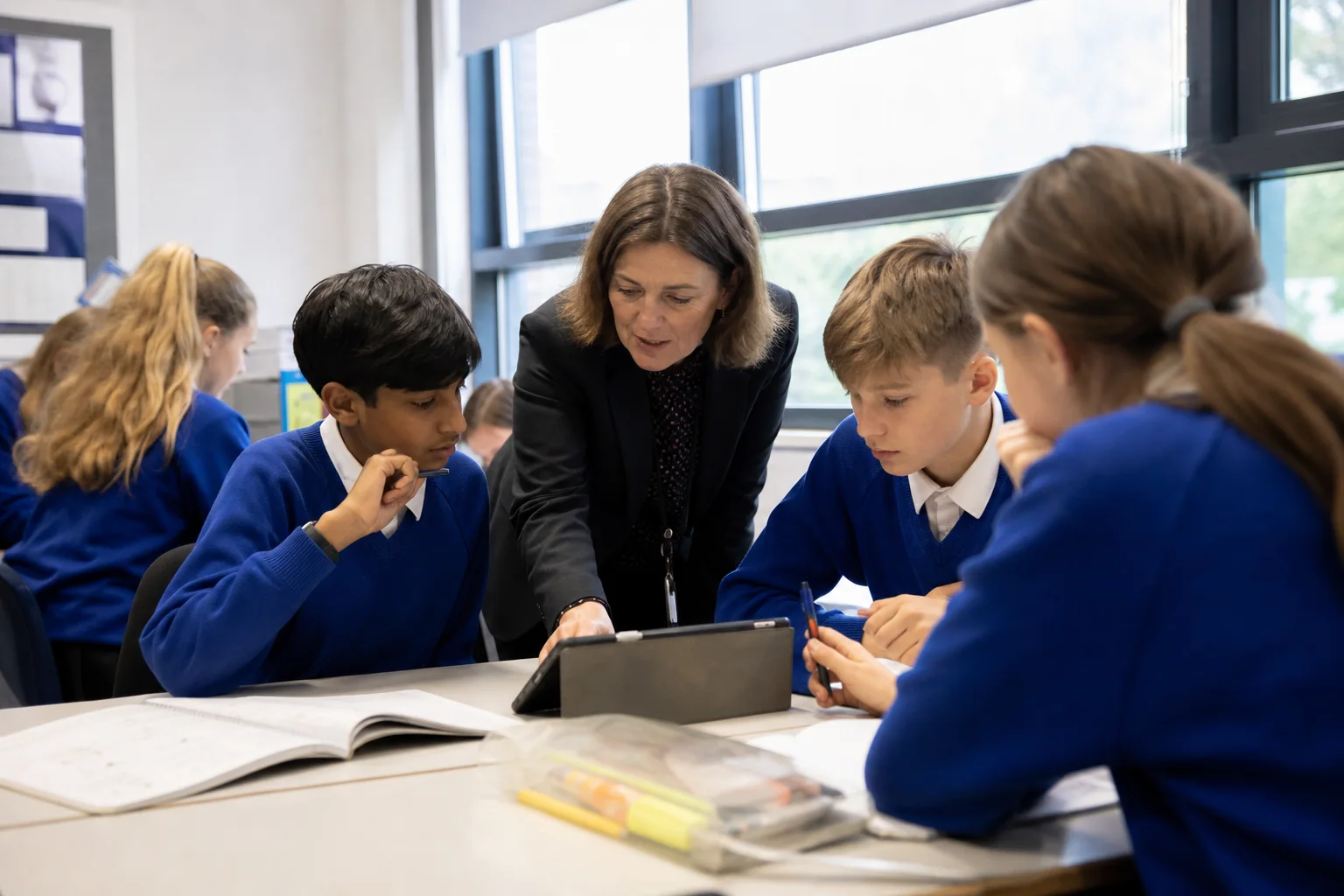
This matters for learners with SEND. AI can help a SENCO simplify resources or draft checklists. However, AI should not decide what support a learner needs or interpret a diagnosis. It must not replace human conversations with learners and families. See AI in special education and AI SEND administration for safer boundaries.
The strongest near-term case for AI is workload reduction. Teachers spend large amounts of time drafting, adapting, rewording and preparing. AI can reduce some of that time if the task is clear and the output is checked.
But workload reduction is not automatic. A weak prompt can produce a weak resource. A confident but wrong answer can take longer to fix than writing from scratch. A school that asks teachers to use ten different AI tools may create more work, not less.
Leaders should treat AI as a workload experiment. Pick one task, define the quality standard and compare the result with normal practice. For example, a science department can test whether AI helps create hinge questions. Teachers must check if the questions reveal learner misconceptions. They also check if wrong answers are diagnostic and if the wording suits the class's reading level.
The most useful school question is: did this use of AI save time while keeping or improving quality? If not, stop or redesign the task.
AI marking tools are attractive because feedback is time-heavy. They are also risky because feedback depends on knowing the task, the success criteria, the learner and the curriculum sequence.
AI can help draft feedback comments, group similar errors or suggest next-step prompts. The teacher should decide what feedback is accurate, proportionate and useful. This distinction matters. A feedback comment can sound polished while missing the real misconception.
Schools should not use AI as an independent marker for formal assessments. They must first have a tested, clear, and accountable process in place. Even then, a human should own the judgement. See AI marking and feedback, AI academic integrity and AI retrieval practice quizzes for more detailed classroom uses.
Learners also need to learn how to use AI without hiding their thinking. A good task might ask learners to critique an AI answer. They could also improve a weak explanation or compare AI feedback to a teacher's model. A poor task simply asks for a final answer that can be pasted from a tool.
AI replacement claims often ignore safeguarding. Schools hold sensitive information about children. Teachers and leaders make decisions that affect welfare, access, support and family communication. Those decisions require context, legal duties and professional care.
The Information Commissioner's Office guidance on AI is very important. This is because many AI systems use personal data. Schools must know what data is entered and where it goes. They must also check if suppliers use it for training and how records are kept.
The National Cyber Security Centre's AI and cyber security guidance also matters. AI tools can create convincing messages, summaries and documents. Staff must be alert to phishing, impersonation, false confidence, and unsafe tool integrations.
| Task | AI role | Human role |
|---|---|---|
| Retrieval quiz draft | Generate options | Check accuracy and misconceptions |
| Lesson explanation | Suggest versions | Select, edit and teach |
| Feedback comment | Draft wording | Diagnose and approve |
| SEND adaptation | Suggest accessible wording | Check need, dignity and provision |
| Safeguarding note | None | Record and act through school systems |
| Formal grade | At most administrative support | Make accountable assessment judgement |
| Parent message | Draft neutral wording | Check tone, facts and context |
Simply put, never use AI as an unapproved place to store learner information. Never ask it to make a safeguarding judgement. Never let it replace the record that a school is required to keep.
Ofsted's early-adopter report on AI in schools and further education shows that some settings are already using AI for teaching support and administration. The report is useful because it avoids fantasy. It focuses on adoption, leadership, and risk management. It does not promise that AI will solve schooling.
The caution is just as important. Evidence of impact on educational outcomes remains limited, especially for long-term learner learning. That should shape school planning. Use AI where the task is clear and the risk is low. Measure whether it helps. Avoid replacing teacher work that depends on judgement, care or knowledge of learners.
This matches the position in DfE guidance on AI in schools and AI classroom implementation: start with governance, staff training and controlled pilots.
Use this matrix when deciding whether AI should handle a task.
This kind of matrix prevents the replacement debate from becoming abstract. It tells staff what AI can do and what it must not do.
AI will change teacher work. Teachers will need to write better prompts and check AI outputs faster. They must also discuss AI with learners and design tasks that make thinking visible. Departments may build shared prompt banks, approved examples and quality checks. Leaders may ask staff to log when AI has helped with policies, assessments, or communications.
This is a change in professional practice, not the end of the profession. Teachers who use AI well spend less time creating first drafts. This gives them more time to improve explanations, check understanding, and plan responsive teaching. Teachers who cannot judge AI output may face new risks. These include believable mistakes, basic resources, and hidden learner use.
That is why AI literacy for teachers matters. Staff do not need to become engineers. They do need to understand prompts, hallucinations, bias, data protection, copyright and classroom boundaries.
For the wider picture, explore our AI and EdTech tools hub, our home for evidence-based AI guidance across policy, lesson planning, and classroom practice.