Updated on
September 24, 2026
Threshold and Strong Start: The One With a Randomised Trial
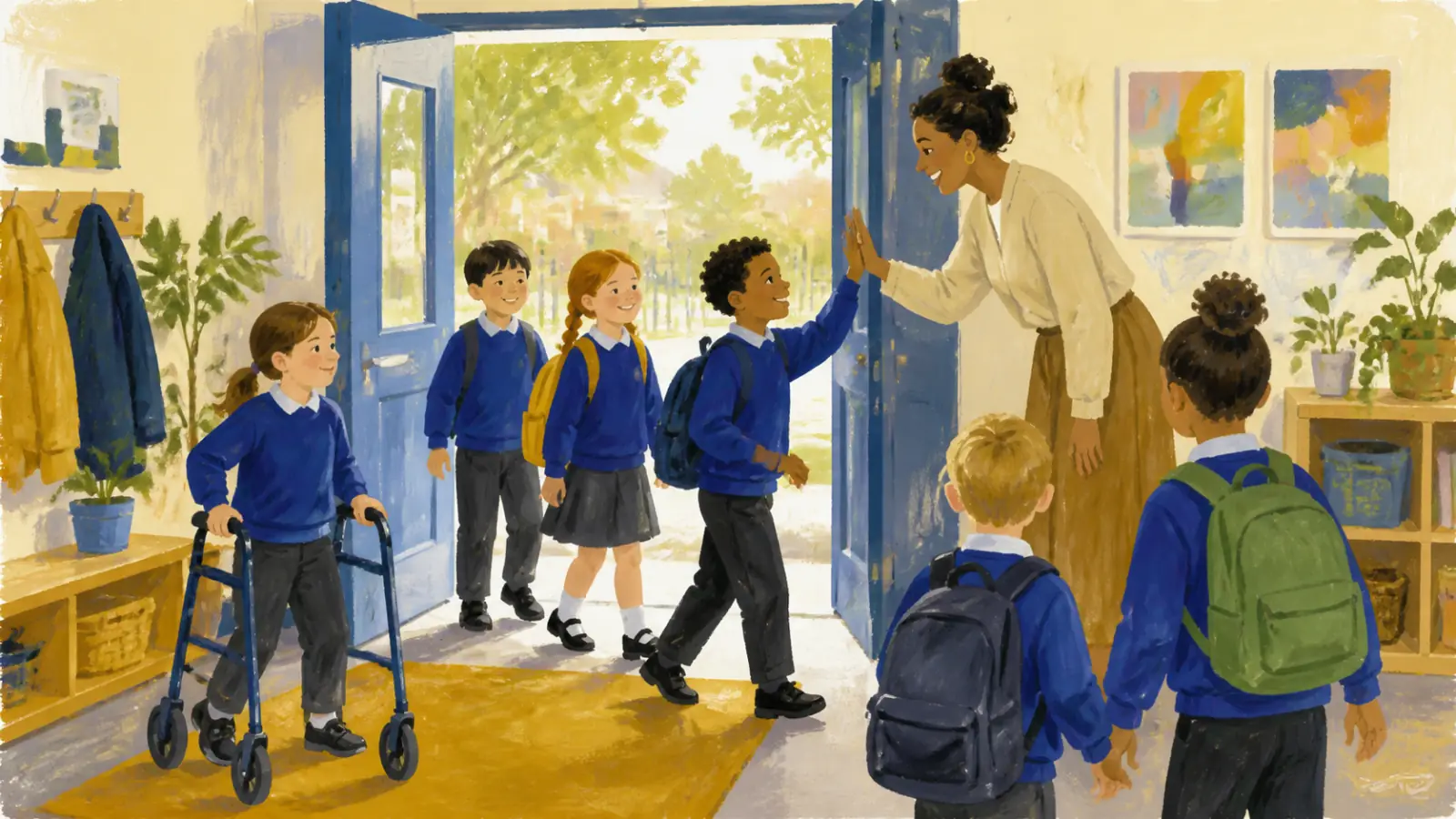
Greeting learners at the door was randomised and tested: more academic engaged time, less interruption, and teachers found it feasible.

Updated on
September 24, 2026
Greeting learners at the door was randomised and tested: more academic engaged time, less interruption, and teachers found it feasible.
What is Threshold in Teach Like a Champion?
Threshold and Strong Start is technique 47 in Teach Like a Champion 3.0. The teacher greets each learner individually at the door and sets the tone before the lesson formally begins, and the first minutes then run on a routine rather than on instructions. The greeting half has a randomised evaluation behind it, which is rare for a classroom technique.
Of the twelve techniques in this part of the book, this is the only one with a randomised trial behind it, and the trial is of the simplest thing in it: standing at the door and greeting people.
Threshold and Strong Start means meeting learners at the door, setting the tone before the lesson formally begins, and having the first minutes run on a routine rather than on instructions. It is technique 47 in Teach Like a Champion 3.0 (Lemov, 2021), in the chapter on procedures and routines.
Cook and colleagues (2018) randomly assigned middle-school teachers either to greet learners positively at the door or to an attention control. The greeting condition produced significant improvements in academic engaged time and significant reductions in behaviour that interrupts the lesson, and teachers rated it highly feasible. That is a properly designed trial of an actual classroom practice, which makes it unusual in this literature.
Threshold is the practice of standing at the classroom door and greeting each learner individually as they enter, using their name and setting the expectation for the lesson in the same breath. Strong Start is what happens in the first few minutes inside: a routine the class runs without being told, usually a written task already waiting.
The two halves do different jobs. The greeting is relational. The start is procedural. They are usually taught as one technique and they are evidenced separately, which is worth keeping in mind when someone claims research support for the whole thing.
The greeting is unusually well evidenced for a classroom technique, the routine half is supported more indirectly, and the problem both are solving has been measured. Three strands, and it is worth keeping them apart.
Cook and colleagues' study is a randomised evaluation in real middle-school classrooms, with an attention control rather than a do-nothing comparison, and it found significant gains in academic engaged time and significant reductions in behaviour that interrupts the lesson. A widely circulated figure of a twenty-point improvement attaches itself to this study online; it is not quoted here, because it could not be confirmed from the paper's own abstract.
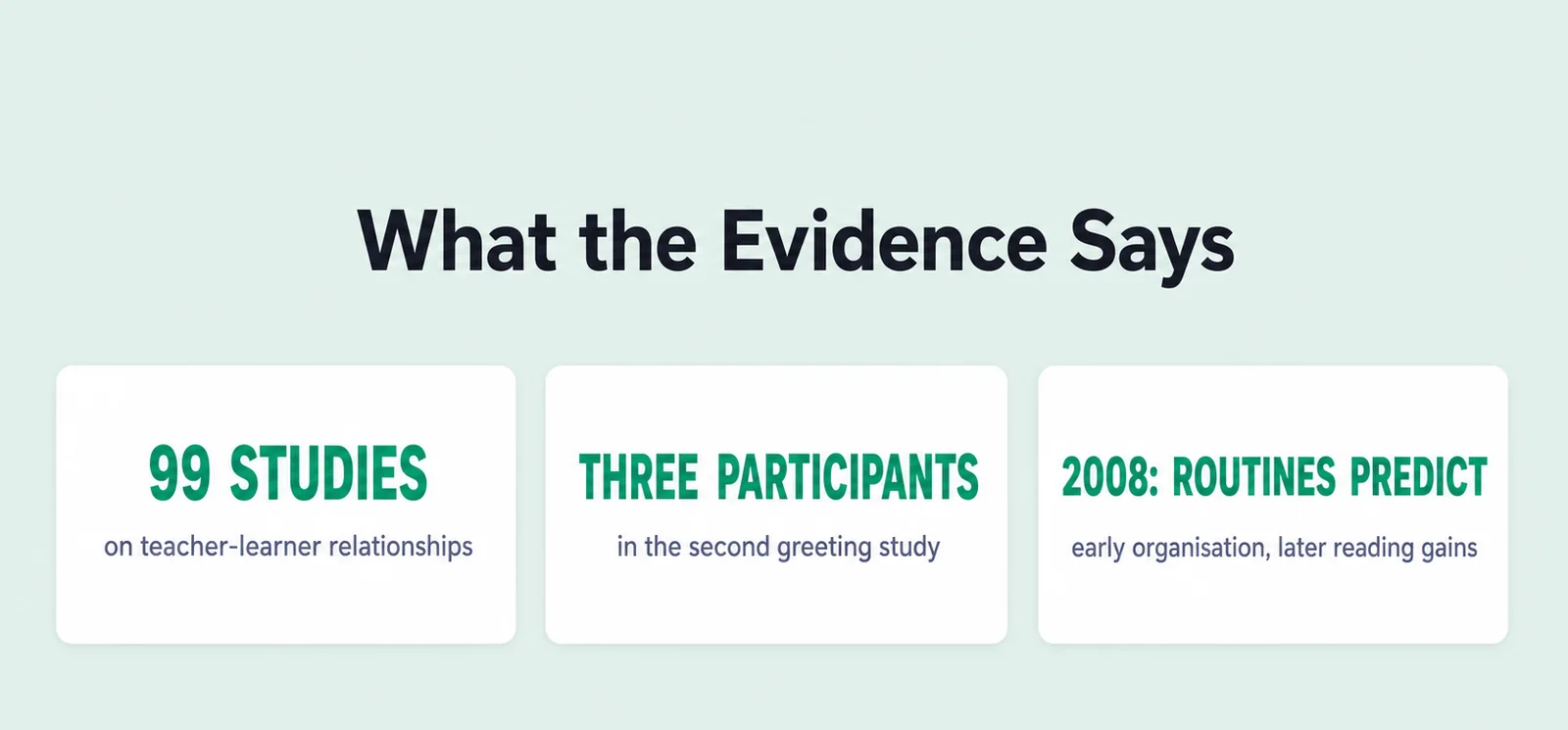
Allday and Pakurar (2007) point the same way and are much smaller: a three-participant single-case design. Worth citing, and worth saying the n out loud.
Roorda and colleagues (2011) supply the mechanism for why a greeting might matter at all. Their meta-analysis of 99 studies found teacher-learner relationships had medium to large associations with engagement, and small to medium associations with achievement. That is the relational half of this technique, and note which of the two outcomes it moves more.
Cameron and colleagues (2008) found that time spent on classroom organisation early in the year predicted later reading gains in first grade. That gives the "invest in routines early" argument an actual outcome measure rather than an assertion.
Godwin and colleagues (2016) quantify the problem being solved, measuring how much instructional time is genuinely lost to off-task behaviour in elementary classrooms and to what. The thing Threshold is trying to prevent is real and measurable, which is more than can be said for the lost-time figures usually quoted at teachers.
Four things, and the first is the one with the trial behind it. Be at the door, use names, make the first task wait on the desk rather than in your instructions, and hold the routine long enough for it to become automatic.
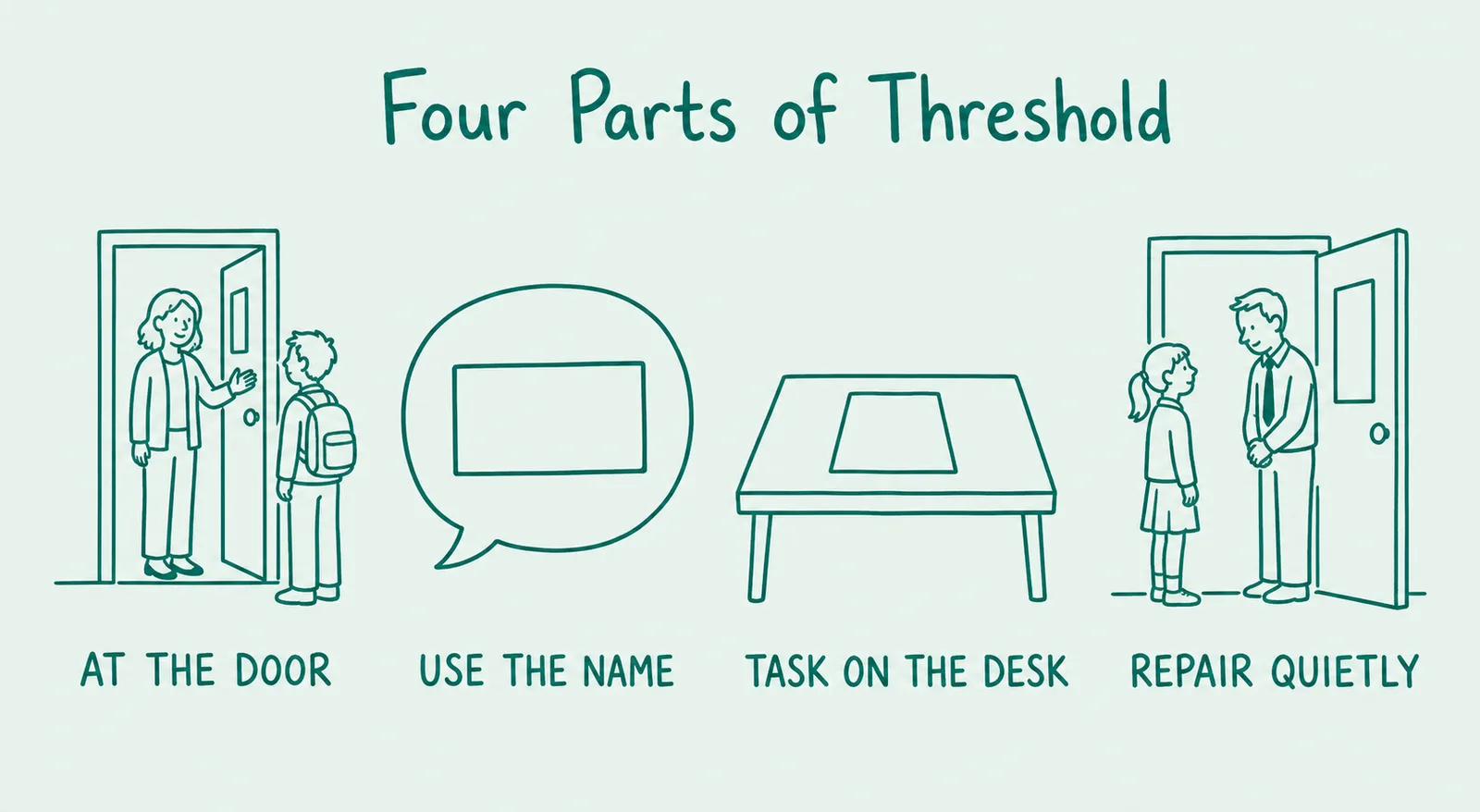
Be physically at the door. Not at the desk, not writing on the board. The greeting is the intervention that was tested.
Use the name. An unnamed greeting is a broadcast. A named one is an acknowledgement, and it is the relational mechanism the meta-analysis describes.
Put the first task on the desk. A Do Now that is already waiting means the lesson starts without an instruction, which is the whole point of Strong Start.
Repair at the door, quietly. The threshold is the cheapest place to reset a relationship after a difficult lesson, because it is private, brief and before anything has gone wrong today.
A doorway at changeover is the loudest, most crowded, least predictable place in the school day, and it is where several groups of learners are least able to receive anything.
Shield and Dockrell (2008) studied London primary schools and found external and classroom noise had a significant negative effect on standardised test performance, with larger effects for older children. Klatte, Bergstrom and Lachmann (2013) review the wider evidence on noise and children's cognitive performance. A verbal greeting delivered into corridor noise may not arrive at all for a learner with a hearing impairment or auditory processing difficulty.
For autistic learners the transition itself is the demand, and an unpredictable social exchange at the door adds to it. Predictability is the adjustment: the same greeting, in the same place, in the same words, is far easier to process than a warm improvisation. A nod agreed in advance is a perfectly good greeting.
For a learner who finds physical proximity difficult, standing in a doorway is a narrow space with an adult in it. Position yourself so the doorway is not blocked, and the same technique costs nothing.
The trial evidence covers the greeting, not the whole technique, and it is a single study in American middle schools. The routine half rests on one first-grade reading study and on inference. Nothing here has been tested in a UK secondary school, and the outcome measures are engagement and behaviour rather than attainment, which is exactly the distinction the teacher-relationship meta-analysis warns about: relationships move engagement more reliably than they move results.
It is technique 47, Threshold and Strong Start. The teacher greets each learner individually at the door and sets the tone before the lesson formally begins, then the first minutes run on a routine rather than on instructions.
It is the best-evidenced practice in this part of the book. A randomised evaluation in middle schools found significant improvements in academic engaged time and significant reductions in behaviour that interrupts the lesson, with teachers rating it feasible.
Agree something else in advance. For an autistic learner or one who finds the doorway difficult, a predictable nod is a better greeting than a warm improvisation, and it does the same job.
Threshold and Strong Start is one of the 63 moves in our complete guide to Teach Like a Champion, and it pairs directly with classroom transitions.
Two techniques sit closest to this one: bell ringers, the American name for the same slot.