Updated on
September 23, 2026
Classroom Transitions: Teaching the Six Lost Minutes
Transitions happen seven times a lesson and are never taught. How to teach them, what the lost-time research says, and why SEND learners find them hardest.


Updated on
September 23, 2026
Transitions happen seven times a lesson and are never taught. How to teach them, what the lost-time research says, and why SEND learners find them hardest.
What is a classroom transition?
A classroom transition is any point where a class stops one activity and starts another: arriving and settling, moving from teacher input to independent work, getting equipment out, moving into pairs, and packing away. There are usually six or seven in a lesson. A transition is a routine, which means it can be named, modelled, practised and timed like any other piece of teaching.
Transitions are the least planned part of a lesson and one of the most expensive. Nobody writes them into a lesson plan, and they happen six or seven times a period.
A classroom transition is any move between one activity and the next: getting in and settled, swapping from teacher exposition to independent work, getting books or equipment out, moving into pairs and back, and packing away. A transition is a routine, which means it can be taught, practised and made faster, in the same way a fire drill can.
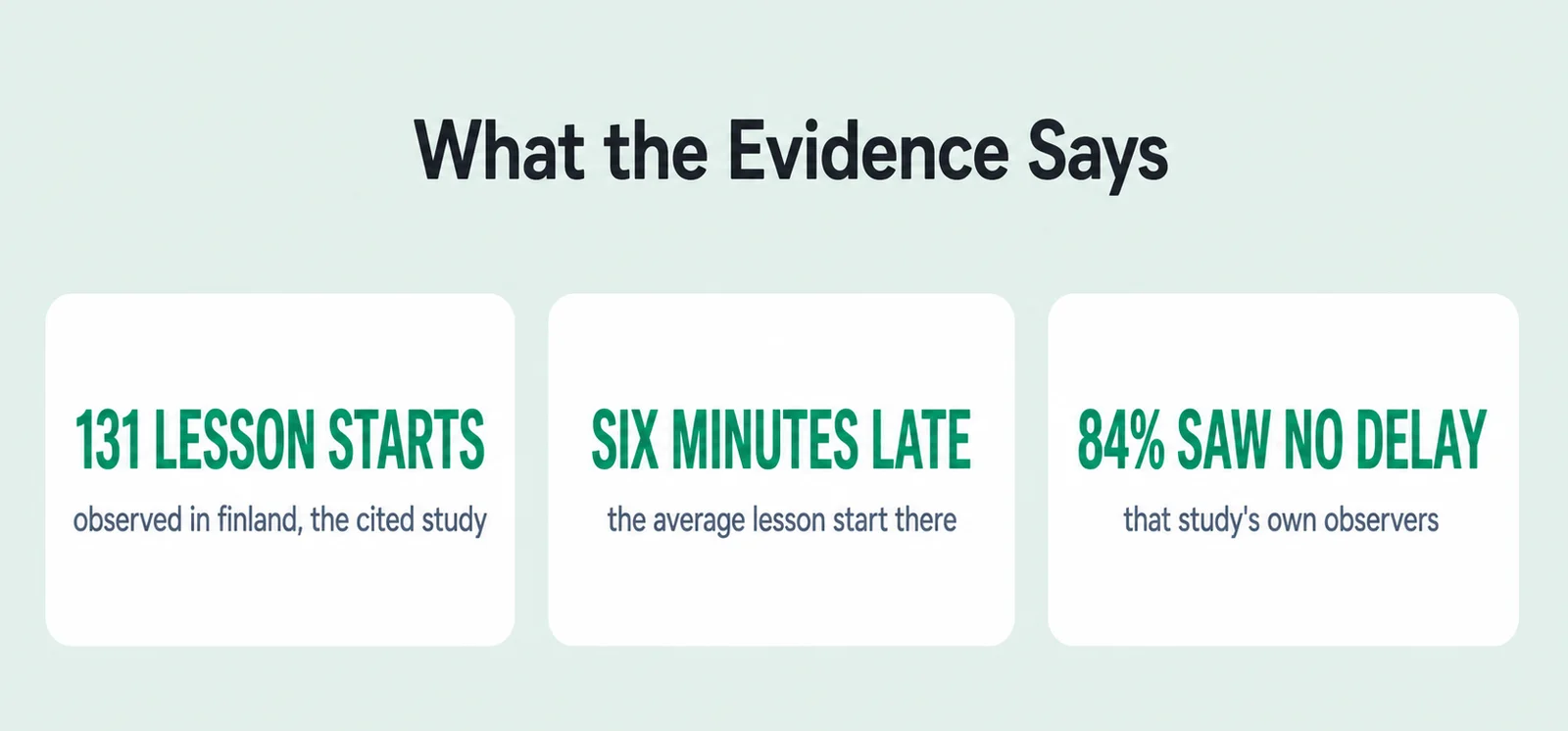
The honest evidence position matters here, because the numbers quoted about lost time are shakier than they look. The most-cited study is Saloviita's (2008) observation of 131 lesson starts in Finland, which found the teacher arrived on average two minutes late and the lesson began on average six minutes late. Three things need saying alongside that. The paper calls itself a preliminary study in its own title. Its own summary reports that 84 per cent of observers judged that lessons began without delay and in good order. And Finnish schools do not run bells for lesson starts the way English or American ones do. The widely repeated "five weeks a year" figure is arithmetic done on the six-minute average, not something anyone observed.
So the case for teaching transitions is not that a study proved you are losing five weeks. It is simpler: a routine that happens seven times a day and has never been taught is the cheapest thing in your week to improve.
A transition is any point where the class stops doing one thing and starts another. There are usually six or seven in a lesson, and they cluster at predictable places: arrival, the shift from input to practice, equipment changes, moving into and out of pairs or groups, and packing away. Each one is a small routine, and each is teachable.
Doug Lemov gives this territory a whole chapter in Teach Like a Champion 3.0, on procedures and routines, with Threshold and Strong Start as technique 47 and Routine Building as 50. Threshold covers arrival specifically, which is the transition with the largest effect on everything after it.
Almost always it is the instruction rather than the learners. Four causes account for most failed transitions: the instruction is compound, it is given while the teacher is moving, the destination is vague, or there is nothing waiting to be done on arrival. All four are the teacher's to fix, and none of them is a behaviour problem.
The instruction is compound. "Right, pack away, get your planners out, line up by the door and don't forget your homework" is four instructions delivered as one. The class executes the first, forgets the third, and the room becomes noise. Give one instruction, let it land, then the next.
It is given while moving. An instruction delivered on the way to the cupboard tells the class it is optional. Stand still, say it, then move.
The destination is unclear. "Get into groups" leaves every learner solving a social problem in public. "Threes, with the people either side of you, stay where you are" is one instruction with no ambiguity in it.
There is nothing to do on arrival. A learner who finishes the transition first and has nothing waiting will start something of their own. This is exactly what a Do Now is for at the start of a lesson, and the same principle applies at every other transition. Rosenshine (2012) makes the same point from the other direction: the most effective teachers he describes opened with a short review that was already waiting, so the lesson had begun before anyone had to be told to begin it.
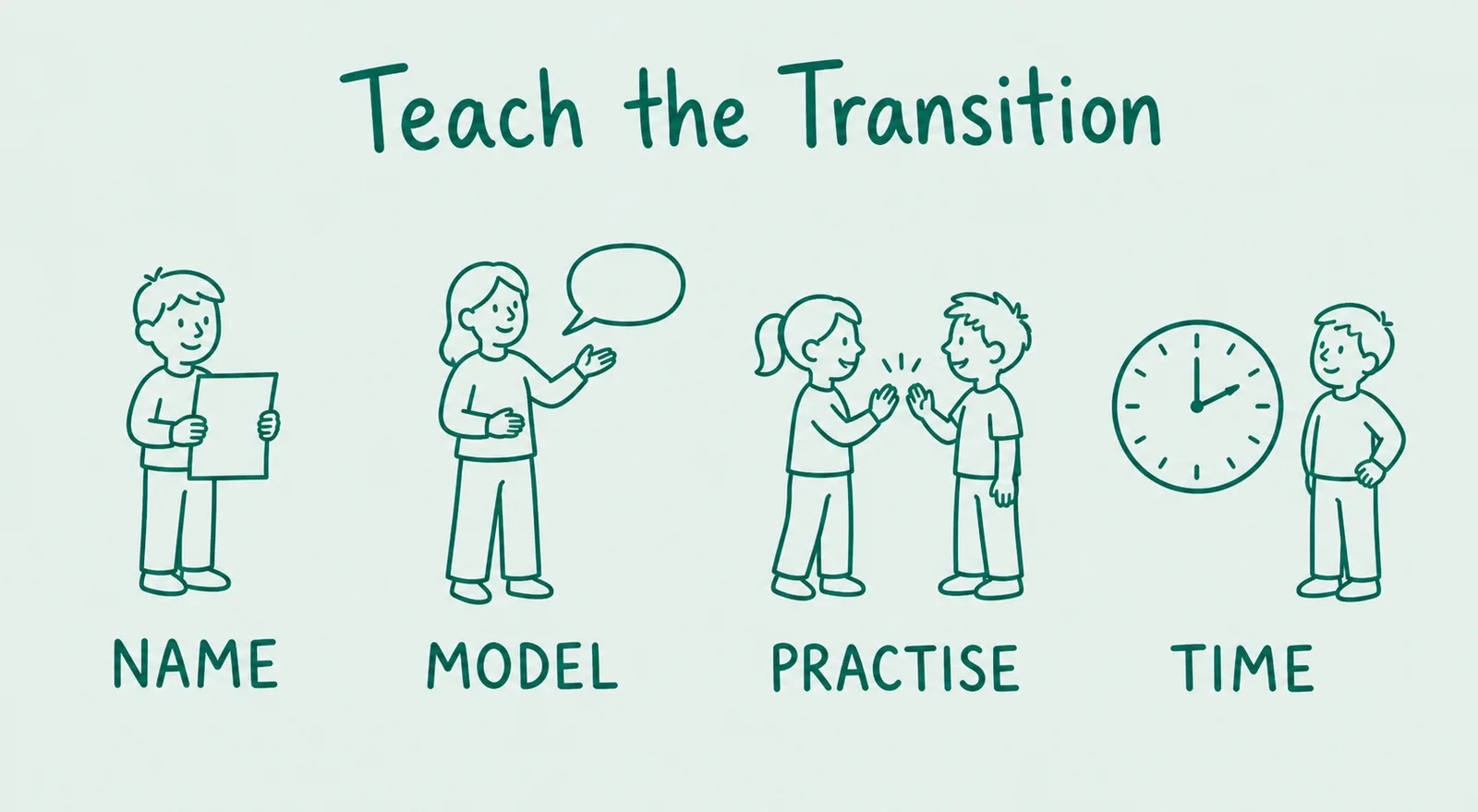
Treat it as content. You would not expect a class to do long division because you asked them to, and a transition is no different. Four steps, and the third is the one everyone skips.
Name it. Give the routine a short name the class knows, so you can call it in three words rather than describing it each time. "Pairs, ready" is faster than a sentence and cannot be misheard as a suggestion.
Model it. Show what it looks like, including how long it takes and how loud it is. Most classes have genuinely never been told what an acceptable noise level is during a transition, and are then told off for guessing wrong.
Practise it cold. Run it once or twice when nothing depends on it, at the start of a lesson you have time in. This feels like an odd use of five minutes and it is the whole technique. A routine practised when it does not matter works when it does.
Time it, visibly. Put a countdown on the board. A clock does the chivvying so you do not have to, and it converts your nagging into a neutral fact about the room. Thirty seconds is realistic for most transitions and much shorter than teachers expect.
For several groups of learners the transition, not the work, is the hardest part of the lesson. This is the part of the topic that behaviour-focused advice tends to miss entirely.
For autistic learners, the change itself is the difficulty. An unannounced switch of activity removes the predictability that makes a classroom manageable. Warning helps and specificity helps more: "two more minutes, then we pack away and get the textbooks" is a different event from "right, moving on". A visual timetable or a written running order gives the same information without needing anyone to remember it.
For anxious learners, unstructured moments are the exposed ones. The gap between activities has no task in it, which makes it the point in the lesson where social difficulty is most visible. Giving the transition an explicit job removes that gap.
For learners with slower processing, speed is the barrier. A thirty-second transition is an accessibility decision as much as an efficiency one. Give the instruction earlier for those learners rather than expecting them to move faster, and check the instruction was heard rather than assuming it was ignored.
For learners with a demand avoidant profile, a briskly issued instruction is a demand. Offering the same move as a choice, or phrasing it indirectly, gets the transition without triggering the refusal. The standard is unchanged; the framing is not.
Predictability serves all four groups and costs the rest of the class nothing, which makes it one of the better returns available in a SEND-friendly classroom.
Transitions are worth teaching and the case for it is practical rather than evidential. The research base is thin, the popular numbers are weak, and the technique carries a real risk of being taken too far.
The evidence is thin and mostly descriptive. There is no trial of teaching transitions. The lost-time literature is a small number of observation studies in Nordic school systems, and the best-known of them describes itself as preliminary.
Speed is not the goal, and it is the thing that gets measured. A thirty-second transition into an activity nobody understands has saved nothing. Time recovered from a transition is only worth what you spend it on.
Drilling a routine can become the point. Re-running a transition until it is perfect is a technique that shades quickly into a collective consequence, where the class is made to repeat something because of a few learners. That is worth watching for, particularly since the learners who struggle most with transitions are often the ones least able to comply faster.
Any point where the class stops one activity and starts another: arriving, swapping from teacher input to independent work, getting equipment out, moving into pairs, packing away. There are usually six or seven in a lesson.
Around thirty seconds for most in-lesson transitions, which is shorter than most teachers expect. Put a visible countdown on the board so the clock does the prompting rather than you.
Less certainly than the figures suggest. The most-quoted study observed lessons starting an average of six minutes late, but described itself as preliminary and reported that 84 per cent of its observers judged lessons began without delay. Treat the popular "five weeks a year" figure as arithmetic rather than an observation.
Tell the class what noise level is acceptable, which most have never been told. Then give one instruction at a time, standing still, with a clear destination and something waiting to be done on arrival.
Because the transition removes the structure. For autistic learners the unpredictability is the difficulty, for anxious learners the unstructured gap is the exposed moment, and for learners with slower processing the pace is the barrier. Warning, specificity and a visible timer help all three.
References below were checked to confirm they exist and resolve to the work being cited. This topic has a notably thin research base, so two of the three sources here are practitioner texts rather than studies, and that is stated in each entry rather than left for the reader to work out.
Classroom transitions are part of the wider set of routines covered in our complete guide to Teach Like a Champion, and they sit alongside behaviour management strategies as the everyday machinery of a lesson.