Updated on
September 23, 2026
Bell Ringer Activities: 45 That Respect the Evidence
Bell ringers work when they review learning already taught. The one classroom experiment found previewing today's lesson did nothing. Plus 45 by subject.


Updated on
September 23, 2026
Bell ringers work when they review learning already taught. The one classroom experiment found previewing today's lesson did nothing. Plus 45 by subject.
What is a bell ringer activity?
A bell ringer is a short independent task learners begin the moment they arrive, usually three to five minutes long, done without any instruction from the teacher. American schools also call it bell work or a warm-up, and British schools call the same slot a starter. On the best classroom evidence it should review learning already taught rather than preview today’s lesson.
Every list of bell ringer ideas online tells you to hook the class, settle them fast and get the lesson started. None of them mention the one classroom experiment that tested where in a lesson that task should sit. It found the bell ringer slot was the weak one.
A bell ringer is a short task learners begin the moment they arrive, usually three to five minutes long, done independently and without teacher input. American teachers also call it bell work, morning work or a warm-up. British teachers call the same slot a starter, and teachers trained through Teach Like a Champion call it a Do Now.
The evidence matters here because it points at one design decision. McDaniel and colleagues (2011) ran quizzes with 139 eighth-grade science learners at three different points: before the teacher taught the material, straight after, and 24 hours before the unit test. Quizzing before the lesson produced no significant gain over not quizzing at all. Quizzing after the lesson worked. Quizzing near the test worked best of all. So in a real classroom, measured a month later, a bell ringer that reviews last week's learning is doing the thing that worked and one that previews today's topic is doing the thing that did not. That is not the whole story, and the part the ranking pages never reach is set out below.
That is the whole article in one paragraph, and it changes what you put on the board tomorrow. If you are in a hurry, skip to the 45 bell ringers and come back for the evidence. The rest is the evidence in more detail, the honest limits of it, and 45 bell ringers by subject that respect the finding.
A bell ringer is a short, independent task waiting for learners as they walk in, designed to be started without instruction from the teacher. It typically runs three to five minutes, is written rather than spoken, and is marked or reviewed quickly before the main lesson begins. Its usual justification is that it recovers time otherwise lost to the start of a lesson.
They describe the same slot in the timetable and they come from different systems with different purposes. Knowing which one you mean stops you borrowing a rationale that does not apply.
The practical difference is real. A starter was designed to teach. A bell ringer was designed to settle. If you run a bell ringer and expect the learning gains reported for retrieval practice, you need it to be doing retrieval, not compliance. Our full guide to the Do Now and its five design rules covers the codified version.
The honest position is that the underlying mechanism is exceptionally well evidenced in laboratories, moderately well evidenced in classrooms, and untested in the exact form most teachers use it. Three findings do real work for a teacher, and one of them contradicts standard bell ringer advice.
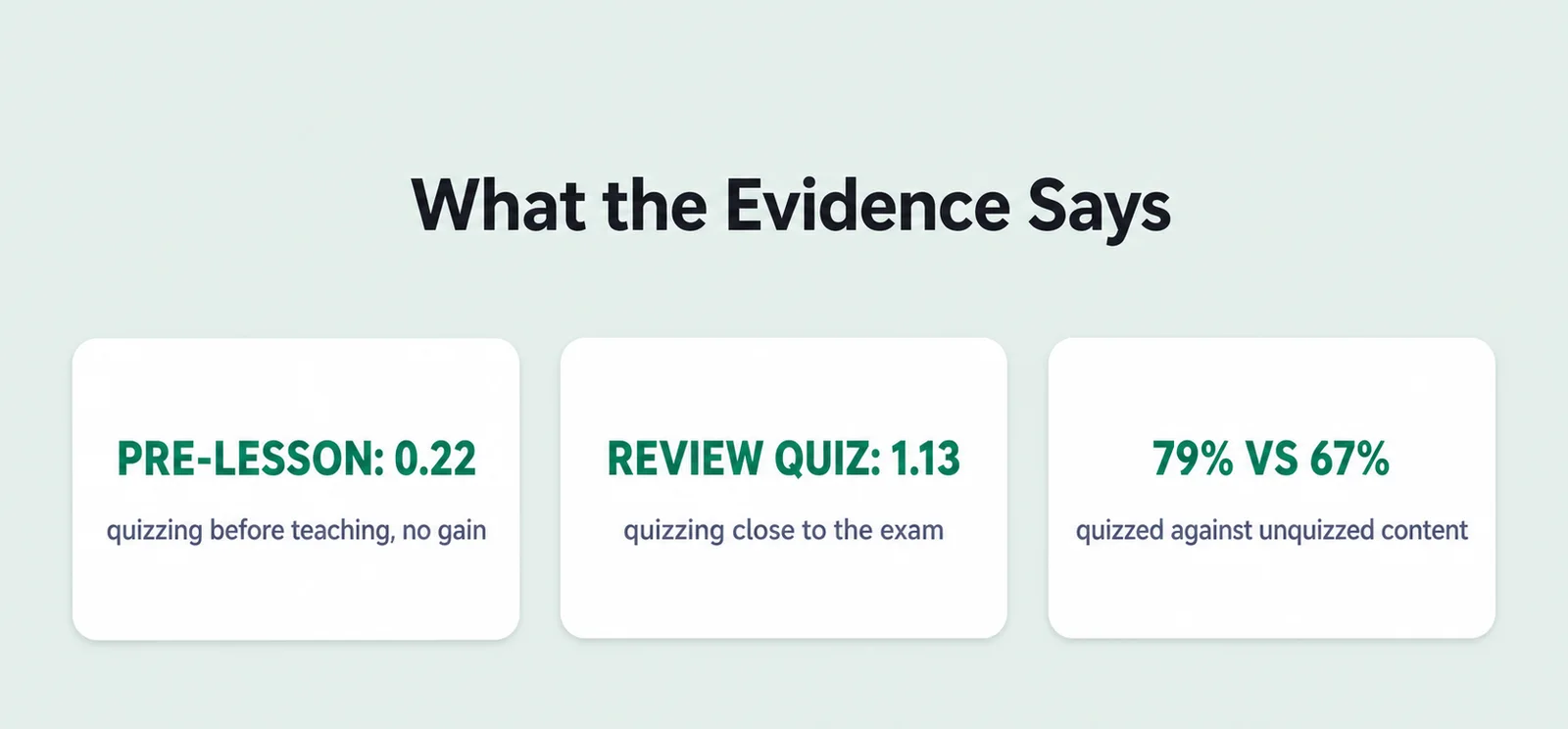
McDaniel, Agarwal, Huelser, McDermott and Roediger (2011) worked with 139 eighth-grade science learners across five curriculum units in a public middle school. Low-stakes multiple-choice quizzes with feedback were delivered at three placements: pre-lesson, after learners had read the chapter but before the teacher taught it; post-lesson, immediately after teaching; and review, 24 hours before the unit exam. The teacher left the room during pre-lesson quizzes so she could not bias her teaching toward quizzed items. The unit exam came around 31 days later.
On the unit exam, non-quizzed content scored .64. Pre-lesson quizzing scored .69, an effect size of 0.22 that did not reach significance. Post-lesson quizzing scored .77. Review quizzing scored .86, an effect size of 1.13. Combining pre-lesson quizzing with either of the others added nothing.
The authors also checked whether a pre-lesson quiz at least primed learners to absorb the lesson that followed. It did not: 78 per cent on content quizzed beforehand against 76 per cent on content not quizzed beforehand, a difference that went nowhere.
Read plainly, that says the retrieval benefit comes from quizzing material learners have already been taught, and the closer to the assessment the better. A bell ringer reviewing last week's lesson is a review quiz that happens to sit at the start of today's. That is the strong condition. A bell ringer previewing today's new topic is the pre-lesson condition, and in that study it did nothing.
An honest article has to carry the other half of this, because the pretesting literature does not agree with the classroom finding above.
Pan and Sana (2021) ran five experiments with a combined 1,573 participants studying expository passages, each paired with either a pretest or a posttest. Both beat a no-test control, and pretesting produced the higher overall scores, an advantage that held across test formats. Richland, Kornell and Kao (2009) had already shown that even unsuccessful retrieval attempts before studying can enhance later learning. King-Shepard and colleagues (2025) have since meta-analysed the prequestion literature.
So why did the classroom study find nothing? The reconciliation that holds is about scope. Pretesting reliably helps the specific material the prequestion asked about, and does little or nothing for the material it did not ask about. Review quizzing strengthens everything it covers. In the classroom study, a pre-lesson quiz covered a fraction of a unit and the exam came a month later, which is the condition where that difference bites hardest. In the laboratory studies, learners studied the passage immediately and were tested within two days.
The usable rule for a teacher is narrower and more honest than "preview does not work". If you preview, you are buying attention on the one point you asked about, and paying for it everywhere else. That is sometimes exactly the trade you want, on the day's hardest idea. It is a poor default for a daily five-minute routine covering a whole unit, which is why the strategies below review.
Roediger, Agarwal, McDaniel and McDermott (2011) ran low-stakes clicker quizzes with 142 sixth-grade social studies learners on their real course material, using the actual graded chapter and semester exams as outcomes. On the end-of-semester exam, quizzed content scored 79 per cent against 67 per cent for content that was not quizzed. On the anxiety worry teachers always raise, 65 per cent of learners said the quizzes decreased their test anxiety, though that is self-reported attitude data and should be offered as reassurance rather than proof.
Agarwal, Nunes and Blunt (2021) then screened nearly 2,000 abstracts to produce a systematic review of retrieval practice in real schools: 50 experiments, 49 effect sizes, 5,374 learners. The headline is that most effects were positive. The honest breakdown is more useful: 16 large, 12 medium, 18 small or very small, and three negative. The authors flag publication bias themselves. They also report something awkward, which is that classroom results ran opposite to the laboratory on the effect of delay, with larger effects at short delays rather than long ones. Only 6 per cent of the experiments came from non-WEIRD countries, which matters if you teach in an international school.
Roediger and Karpicke's (2006) foundational laboratory study is usually reported as "testing beats studying". What it actually found is more useful. At five minutes, repeated studying beat repeated testing. At two days and one week, testing beat studying substantially.
So the benefit is delayed, and it costs you performance in the short run. A teacher who runs a bell ringer quiz and judges it by how the class does that morning is measuring the one interval where the effect runs backwards. Judge it on the end-of-unit test. This is the same mechanism described in our guide to retrieval practice.
Three claims made confidently on competing pages have no good evidence behind them, and saying so is more useful than repeating them.
That a daily bell ringer routine raises attainment. The classroom studies quiz specific curriculum items at controlled points across a unit. That is not the same intervention as running a task every single morning for a year, and no trial of the latter appears in the literature.
That bell ringers recover lost teaching time. The most-quoted number here traces to Saloviita's (2008) Finnish study of 131 lesson starts, which found the teacher arrived on average two minutes late and the lesson began on average six minutes late. Three things need saying. The paper calls itself a preliminary study in its own title. Its own summary reports that 84 per cent of observers judged that the lesson began without delay and in good order. And Finnish schools do not use bell ringers, and barely use bells for lesson starts at all. The widely repeated "five weeks a year" figure is arithmetic performed on that six-minute average, not an observation.
That drilling recall builds the ability to apply. Pan and Rickard's (2018) meta-analysis of transfer found the testing effect is strongest for the exact material retrieved and transfers less readily to new formats and contexts. A bell ringer drilling definitions is building recall of definitions.
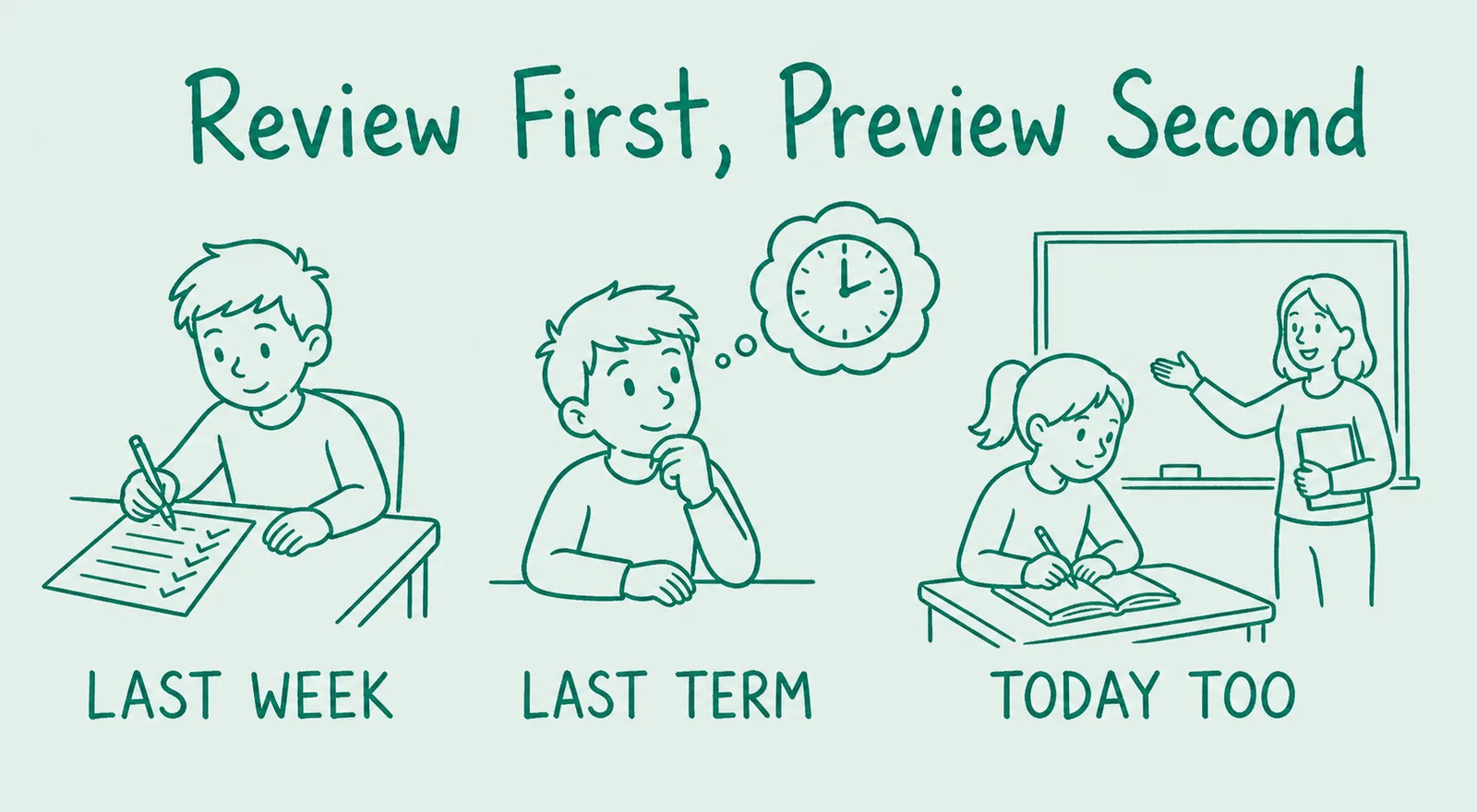
Both are cited constantly in support of bell ringers, and both say something slightly different from what is attributed to them. Rosenshine's first principle is about review, not preview. Lemov's fourth criterion permits both, and on the placement evidence one half of it is weaker than the other.
The heading reads: "Begin a lesson with a short review of previous learning: Daily review can strengthen previous learning and can lead to fluent recall." On timing, he writes that the most effective teachers in the studies "began their lessons with a five- to eight-minute review of previously covered material".
Two honest notes. His supporting example in the article is a single elementary mathematics experiment in which teachers spent eight minutes a day on review, and he gives no citation for it in the body text. And Principles of Instruction is a synthesis published in a teachers' union magazine, adapted from an earlier practitioner report, not a study or a meta-analysis. It is influential and broadly consistent with the evidence, and it is routinely miscited in school CPD as research in its own right. Our guide to Rosenshine's principles sets out all ten.
What matters for your board is the word "previous". Principle 1 is not a preview and not a settling activity.
Lemov sets four criteria. The task sits in the same place every day so starting becomes a habit. It is fully independent, and if you have to give directions it is not independent enough. It takes three to five minutes and requires putting pencil to paper. And it either previews the day's lesson or reviews a recent one.
The commonest failure he names is not the task but the review of it: teachers lose track of time and spend fifteen minutes going over a five-minute activity. His cap is five minutes for the review.
The fourth criterion is where practitioner advice and classroom evidence part company. Preview and review are offered as equivalent options. The placement experiment tested exactly that comparison and found them a long way from equivalent. Nothing stops you previewing. It just should not be described as retrieval practice, because it is not doing what retrieval practice does. Do Now is one of the 63 moves in our complete guide to Teach Like a Champion.
Jump straight to your subject: Works in Any Subject (12) · English (8) · Maths (8) · Science (7) · Humanities (6) · Languages (4). Every item reviews something already taught, can be started without instruction, needs nothing beyond pen and paper, and fits inside five minutes.
Every item below reviews something already taught, can be started without instruction, needs nothing beyond pen and paper, and fits inside five minutes. Anything requiring the teacher to explain it first has been left out on purpose, because that is the criterion most bell ringer lists quietly break.
Mini app · Build It · Routines
Put it on the board and the clock does the chivvying, so you do not have to.
Do Now
04:00
ReadyFour minutes, on your own, in silence.
Routines
It ends in silence on purpose. A timer that shouts across a room of learners working is a second interruption, not a signal.
The design of the task matters less than the four routines around it, and those routines are where most bell ringers quietly fail. Same place every day, a hard cap on the review, answers the class can check themselves, and content pulled from further back than yesterday. Get those four right and almost any sensible task will work.
Put it in the same place every day. If learners have to ask where it is, you have given an instruction, and the independence has gone.
Cap the review. Five minutes maximum going over it. This is the single commonest failure, and it converts a five-minute routine into a twenty-minute one that eats the lesson.
Make the answers available. A task learners can mark themselves gives immediate feedback, which is the condition under which the classroom quizzing studies produced their effects.
Reach back further than yesterday. Spacing matters. Cepeda and colleagues (2006) found in their synthesis of verbal recall studies that distributing practice beats massing it, and their 2008 work found the optimal gap grows with how long you need the material to last. A bell ringer that only ever revisits yesterday is massed practice with a nice routine around it. Pull from last week and last term as well, which is what a retrieval grid is designed to make easy.
An independent written task at the start of a lesson is harder than it looks for several groups of learners, and the standard advice to "just start" ignores all of them.
For learners with slow processing or writing difficulty, the three-minute cap is the barrier rather than the content. Shorten the task rather than extending the time, so the class finishes together. Three questions beat five.
For learners with working memory difficulties, a blank page with an open prompt is the hardest possible format. Give a partly completed version: a gapped paragraph, a labelled diagram with two labels missing, a table with the first row filled in.
For anxious learners, an unfamiliar task on arrival is an unpredictable event at the point of the day they are least regulated. Predictability does the work here. A format that is identical every day, with only the content changing, removes the uncertainty while keeping the retrieval.
For learners who arrive late or dysregulated, treat the bell ringer as a re-entry ramp rather than a test. A task that is impossible to start halfway through will be refused. One that can be joined at any point will be attempted.
None of this lowers the expectation. It changes the format so the retrieval can happen, which is the point of the five minutes.
The retrieval mechanism underneath bell ringers is sound, and the specific routine is far less well evidenced than its popularity suggests. The gap between those two sentences is where most confident advice on this subject lives. Four qualifications are worth holding on to before you build a department policy.
The daily routine has never been trialled. Everything above is inference from studies that quizzed specific items at specific points. It is reasonable inference. It is not the same as evidence that the routine works.
Nearly all classroom studies are within-subject. They compare quizzed and unquizzed items inside the same class, which controls beautifully for differences between learners and controls for nothing about whether the five minutes would have been better spent another way. The opportunity cost of a daily bell ringer has not been measured.
The classroom and laboratory literatures disagree. Agarwal and colleagues found larger effects at short delays, the opposite of the laboratory pattern. When two literatures disagree on a central parameter, the lab findings should not be transferred unexamined.
The evidence base is narrow geographically. Six per cent of the experiments in the systematic review came from non-WEIRD countries. For an international school with a multilingual intake, that is a real limitation rather than a footnote.
A bell ringer is a short independent task learners begin as soon as they enter, usually three to five minutes, done without teacher instruction. American schools also call it bell work or a warm-up. British schools call the same slot a starter.
Three to five minutes for the task, and no more than five minutes to review it. Overrunning the review is the commonest way the routine fails, and it converts a short habit into a large chunk of the lesson.
Review, for most starters. In the classroom experiment that compared placements, quizzing before the teacher taught produced no significant gain, while quizzing material already taught produced large ones. Pretesting does have its own supportive literature, and it buys attention on the specific point you asked about rather than across the unit.
Nearly. Do Now is the codified version from Teach Like a Champion, with stricter criteria: same place daily, fully independent, pencil to paper, three to five minutes. Bell ringer is the looser American term and is more often justified as settling than as teaching.
The retrieval mechanism underneath them has good classroom evidence, though effects vary widely and three of 49 in the largest review were negative. Whether a daily bell ringer routine specifically raises attainment has not been tested.
Not yet. Retrieval costs short-term performance and pays back later. In the foundational study, repeated studying beat repeated testing at five minutes and lost to it at two days and a week. Judge it on the end-of-unit assessment.
Every reference below was checked twice: once to confirm it exists, and again to confirm the record it resolves to is the study being cited. Links go to the original publisher rather than to an aggregator. Where a source is a practitioner synthesis rather than a study, that is stated.