Updated on
September 24, 2026
Silent Solo: Why Longer Writing Time Is Not Better
Writing about content works at an effect size of 0.30. Longer writing assignments produced smaller effects, so protect the silence rather than extending it.

Updated on
September 24, 2026
Writing about content works at an effect size of 0.30. Longer writing assignments produced smaller effects, so protect the silence rather than extending it.
What is Silent Solo?
Silent Solo is technique 39 in Teach Like a Champion 3.0: a protected stretch of individual, silent writing in which nobody speaks, including the teacher. Its purpose is to give every learner an uninterrupted run at thinking in writing, and the evidence on length suggests five to ten minutes rather than twenty.
A Year 10 class is given ten minutes of silent writing. Four learners produce a page, twenty produce a paragraph, and six produce a title and a lot of anxiety. The silence was the same for all of them and it did not mean the same thing.
Silent Solo means a period of individual, silent, sustained writing, protected from interruption including by the teacher. It is technique 39 in Teach Like a Champion 3.0 (Lemov, 2021), in the chapter on building ratio through writing, next to Everybody Writes at 38.
The evidence for writing to learn supports it cleanly. Graham, Kiuhara and MacKay (2020) pooled 56 experiments on writing about content and found it reliably enhanced learning at an effect size of 0.30, equally across science, social studies and mathematics and across primary, middle and secondary learners.
The evidence on length, though, cuts against the instinct that longer silence is better. Bangert-Drowns, Hurley and Wilkinson (2004) found that longer writing assignments produced smaller effects, and that metacognitive prompts produced larger ones.
Silent Solo is protected individual writing time. Nobody talks, including the teacher, and nobody circulates asking how it is going. Its purpose is to give every learner an uninterrupted stretch in which to think in writing, on the argument that thinking of any depth needs a run at it.
What distinguishes it from ordinary independent work is the protection. The teacher's own well-meant interruptions, "remember to include", "some of you are doing this well", are the thing the technique is guarding against.
Three findings bear on it, and two of them qualify how it should be run. Writing about content works, longer stretches do not work better, and working alone before instruction has a clean age boundary that a secondary teacher should know about.
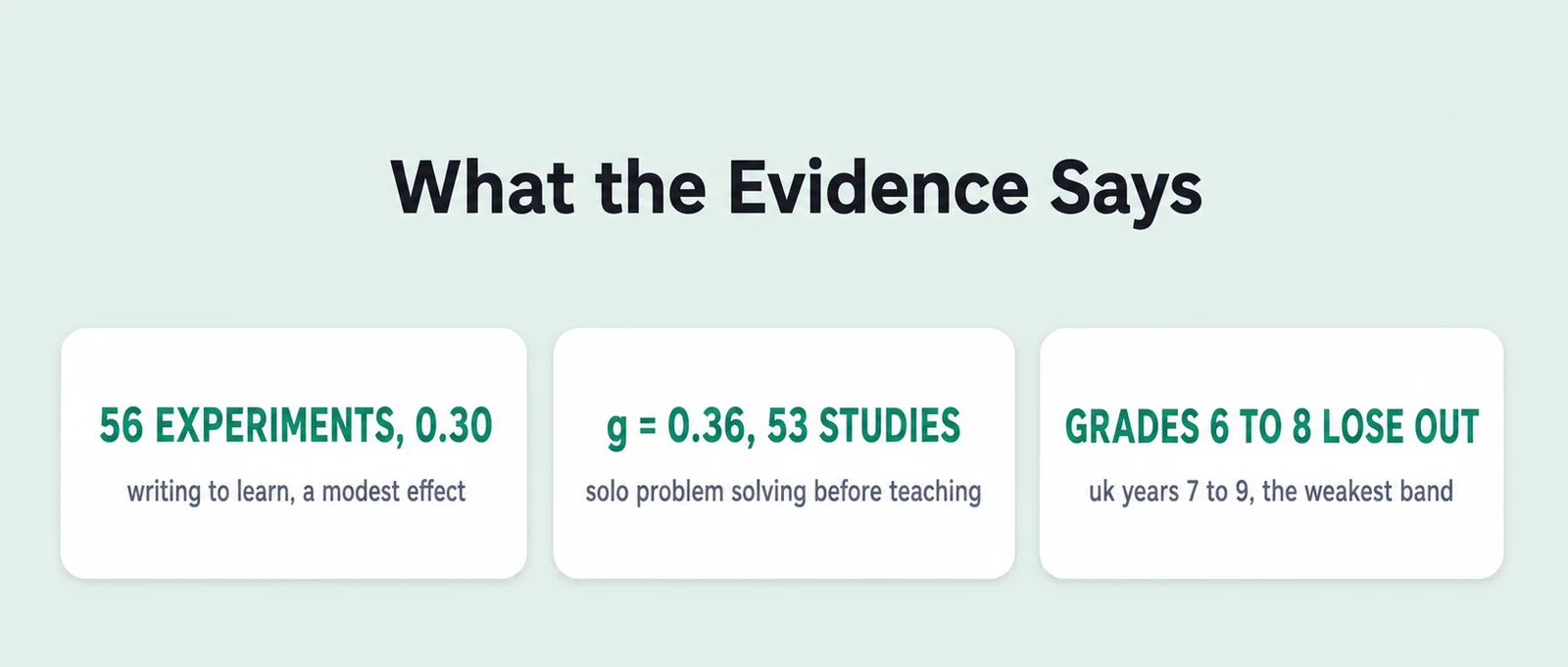
Graham and colleagues' meta-analysis is the cleanest single warrant available for this technique: 56 experiments, a reliable effect of 0.30, and no moderation by subject, age or study quality. It is a modest effect and it is consistent.
Bangert-Drowns and colleagues found the moderators. Metacognitive prompts raised the effect and longer treatment duration raised it. Two things lowered it: implementation in grades 6 to 8, which is UK Years 7 to 9 almost exactly, and longer writing assignments.
That last one is directly actionable. The instinct when silent writing is going well is to extend it. The evidence says a short prompt that makes learners think about their own thinking beats a long one.
Silent Solo is often used before instruction, so learners struggle with a problem first. Sinha and Kapur (2021) meta-analysed exactly this, across 53 studies and 166 comparisons, and found g = 0.36 favouring individual problem solving before instruction, rising to between 0.37 and 0.58 where implementation fidelity was high.
Then the boundary, and it is unusually clean. The effect reversed for second to fifth graders and for domain-general skills, where instruction first won. So struggle-then-teach is a secondary technique on this evidence, and a primary teacher using it is working against the finding.
Four rules, and three of them are about what the teacher does not do. Keep the stretch short, say what the writing is for, protect the silence absolutely, and give a way in for learners who cannot start.
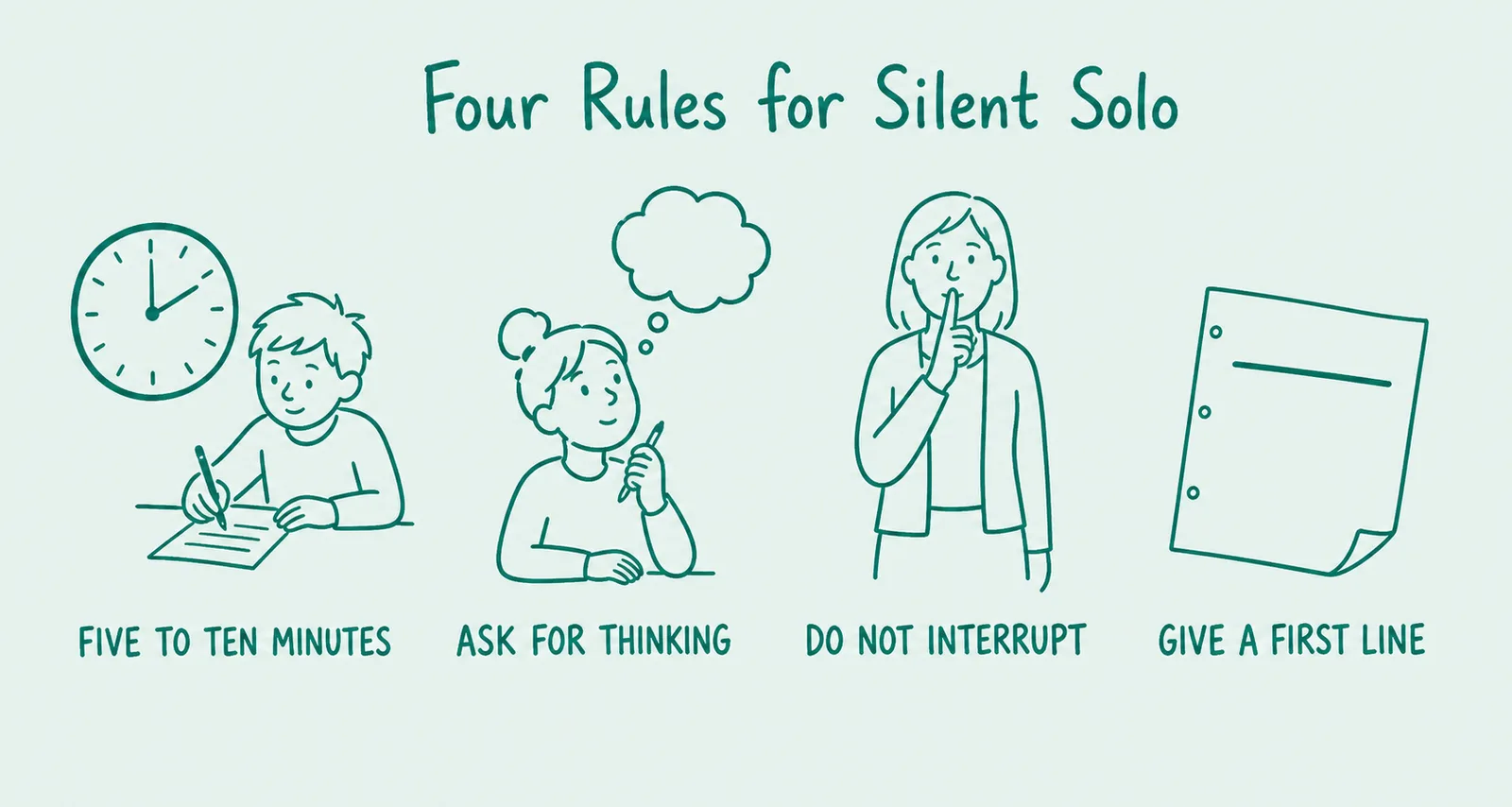
Five to ten minutes, not twenty. Longer assignments did less. If the class can sustain twenty minutes, that is a good sign and it is not evidence that twenty is better than eight.
Ask for thinking, not output. "Explain how you decided" beats "write your answer", on the moderator that Bangert-Drowns found.
Do not interrupt, at all. Not to clarify, not to praise, not to remind. Every interruption restarts thirty trains of thought to save one.
Give a first line to anyone who needs one. A learner staring at a blank page is not thinking, they are stuck. A sentence stem on the board costs nothing and rescues them without an announcement.
Sustained silent writing is the format that most directly disadvantages learners whose barrier is transcription rather than thought, and the silence makes the difficulty invisible. Two groups are affected most: learners with a coordination difficulty, for whom handwriting is itself effortful, and learners with low working memory, who cannot hold a question and a structure and a sentence at once for ten minutes.
Prunty and colleagues (2014), working in the UK, examined writing pauses in the handwriting of children with developmental coordination disorder and found the pattern of pausing differs. For those learners a ten-minute silent stretch is ten minutes of a physically effortful task, and the output underneath measures the handwriting rather than the thinking.
Alloway and colleagues (2009) describe the roughly one child in ten for whom low working memory is the constraint. Holding a question, a structure and a sentence at once for ten minutes is a demand that group cannot meet without something written down to hold the structure for them.
Three adjustments cover most of it. Leave the question and any structure visible so nothing has to be held. Accept notes, bullet points or a diagram as the product where transcription is the barrier. And allow a laptop or a scribe without making it an event.
For an anxious learner the silence itself can be the problem, because a room where everyone else is visibly writing is a room in which not writing is conspicuous. A stem, and a quiet check that does not draw attention, resolves most of that.
No study tests Silent Solo by name. The support comes from writing-to-learn meta-analyses, which cover writing about content in general rather than protected silent stretches specifically, and from a productive failure meta-analysis about problem solving rather than writing. The effect sizes are modest, one of the two meta-analyses finds the moderators the other does not, and neither has anything to say about whether the silence is the active ingredient.
It is technique 39 in Teach Like a Champion 3.0: a protected stretch of individual, silent writing in which nobody speaks, including the teacher. Its purpose is an uninterrupted run at thinking in writing.
Five to ten minutes is plenty. The writing-to-learn meta-analysis found longer writing assignments produced smaller effects on learning, so extending the silence because it is going well is not supported.
In secondary, the evidence supports it: individual problem solving before instruction produced g = 0.36 across 53 studies. The effect reversed for younger primary learners, where instruction first won, so it is not a universal move.
Silent Solo is one of the 63 moves in our complete guide to Teach Like a Champion, and it is the longer relative of Everybody Writes.
Two techniques sit closest to this one: the Do Now, its short relative at the start of a lesson; and wait time, the spoken version of the same protected pause.