Updated on
October 8, 2026
ShREC Approach: Early Years Conversations and Examples
Use the four ShREC components in everyday early-years conversations, with fictional examples and an editable reflection strip for adult choices.

Updated on
October 8, 2026
Use the four ShREC components in everyday early-years conversations, with fictional examples and an editable reflection strip for adult choices.
What is the ShREC approach?
The ShREC approach is an early-years interaction mnemonic used by the Education Endowment Foundation: Share attention, Respond, Expand and Conversation. It reminds adults to join a learner’s focus, acknowledge their communication, add relevant language and leave room for another turn. Use it to reflect on everyday conversations rather than score a learner’s language.
Begin with what a learner is doing. Notice a word, gesture or action, then choose a response that stays with that focus. A useful next move may be a short comment, a relevant phrase or room for another turn.
The Education Endowment Foundation (EEF) uses four names: Share attention, Respond, Expand and Conversation. Its original ShREC guidance, by Fliss James, is dated 1 July 2025. The names give adults a shared vocabulary for reviewing interaction during everyday early-years activity.
| Component | Adult consideration |
|---|---|
| Share attention | Join the learner’s interest in an activity, object or event. |
| Respond | Acknowledge their verbal or non-verbal contribution in a way that fits the moment. |
| Expand | Build on that contribution with relevant language. |
| Conversation | Keep room for another contribution and a back-and-forth exchange. |
Use the names to think about a moment, rather than to tick off a lesson sequence. Sharing attention can continue while you respond. An expansion may open another turn. The learner’s next action may also give you a reason to pause. Your choice depends on the activity and the contribution you notice.
For settings and materials through which to try this, explore early-years creative play. The activity provides the context. ShREC draws attention to the adult’s contribution within it.
EEF describes showing interest in what the learner is focused on and sensitively joining their chosen activity. Watch before deciding what to say. A learner moving a vehicle, arranging fabric or comparing seed pots gives you a starting point. Your first comment can show that you noticed the same thing.
An adult can accidentally change the subject by asking for a colour name while the learner is interested in movement. Stay with the action first: “Your car went under the bridge.” The example is an authored possibility, rather than a required phrase. Its useful feature is the connection to the activity.
Think about the place of adult participation when planning play-based learning. Choose when to join the moment.
EEF includes verbal and non-verbal communication. Notice words, pointing, actions and other contributions in context. A warm acknowledgement can be a comment about the activity, an action that joins the play, or a brief response to what the learner said. It need not become a question.
| Contribution in this fictional moment | Possible adult response | What to observe next |
|---|---|---|
| A learner points to a fallen block. | “That block tipped over.” | Do they continue building, show another piece or offer a word? |
| A learner says “again” beside a rolling vehicle. | “You want another turn with the car.” | Do they repeat the action, change it or respond? |
| A learner brings fabric to a play figure. | “You’re wrapping the figure in the blanket.” | What does their next action show about the play? |
If you are unsure what a contribution means, keep your response tentative. Acknowledge what you can see and leave room for clarification. Avoid treating your first interpretation as a fact about the learner’s intentions. For a wider account of classroom talk, see our introduction to oracy.
In EEF’s guidance, an expansion builds on the learner’s contribution. The adult models language connected to what is happening. Choose a phrase that adds something useful to this exchange. More words alone do not make the response more helpful.
A learner’s “big one” might become “You chose the wide block for the bottom.” That adds a relevant description while preserving the meaning of the choice. It gives the learner something to hear. An action or gesture can be another contribution.
Separate modelling from testing. You can offer language without asking the learner to repeat it. A reflection might ask whether the words fitted the focus, whether your comment was manageable, and what happened next. They review the adult’s choice.
EEF recommends commenting more and questioning less to support back-and-forth conversation. It also says questions can be useful when used sparingly and sensitively. The aim is a responsive exchange. A question earns its place when it helps the conversation, rather than simply requiring an answer the adult already knows.
Consider an ordinary observation: “The tower moved when that block went on.” A learner may investigate, comment or indicate another piece. Follow what they contribute before adding your next idea. You can leave a pause without setting a universal waiting time or counting turns.
When a shared puzzle develops, sustained shared thinking offers a related planning lens. For a bank of wider classroom contexts, see speaking and listening topics. Choose a prompt that fits the activity you are observing.
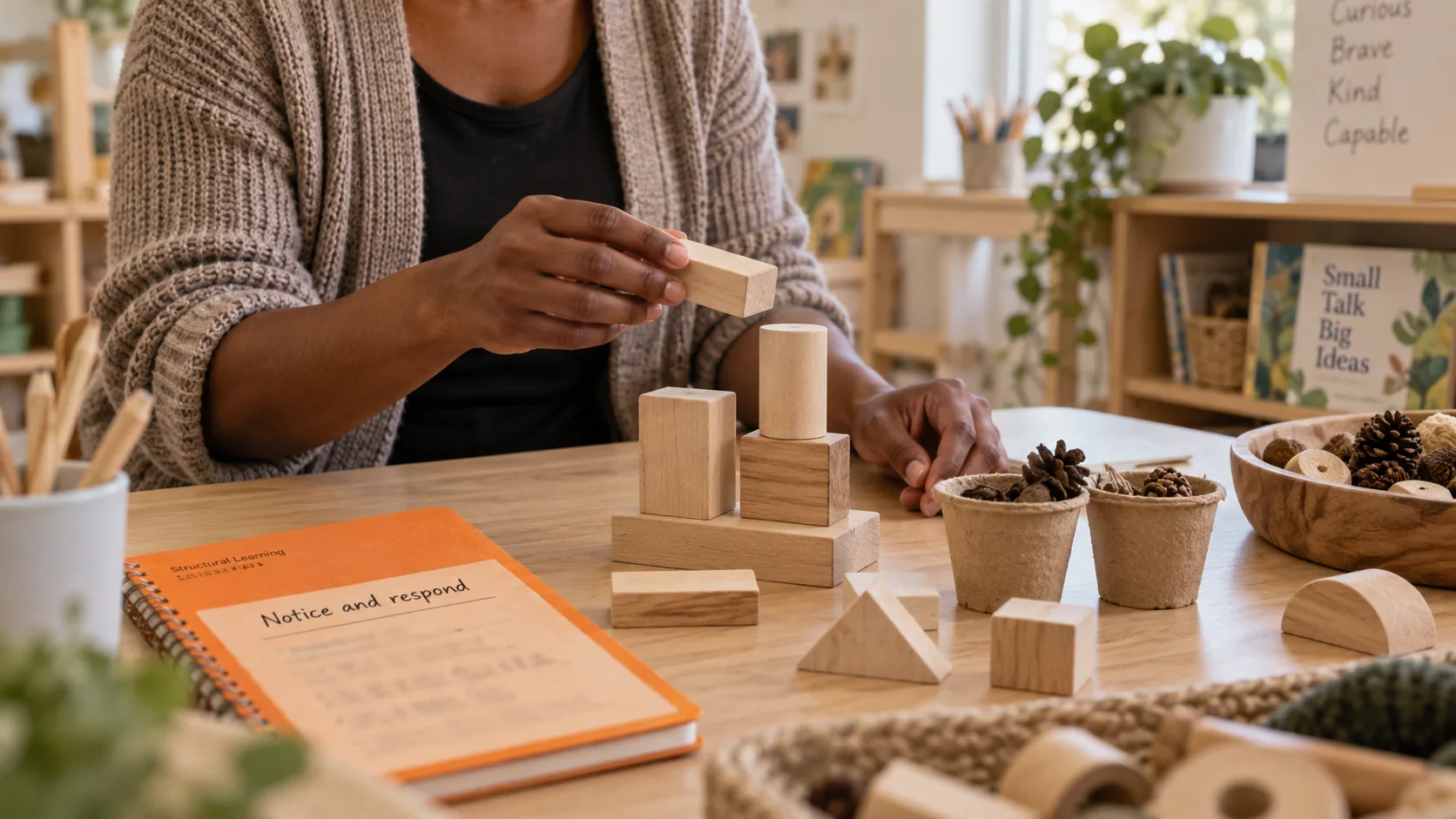
Fictional nursery block-play exchange. The learner, materials and dialogue below are invented. They illustrate adult choices, rather than reporting a classroom result.
| Learner contribution | Adult contribution | Teacher consideration |
|---|---|---|
| Places a block on top and says “Tall.” | “Your tower is getting taller.” | Acknowledge the focus and expand the word. |
| A block falls. The learner points to it. | “That block tipped over.” | Respond to the action without demanding speech. |
| Chooses a wider block and says “Big one.” | “You chose the wide block for the bottom.” | Add language relevant to the choice. |
| Places another block, then taps the base. | The adult watches and leaves room for another contribution. | Follow the play before choosing another comment. |
The useful observation is whether the adult stayed with the building and responded to the learner’s contributions. If the adult had moved straight to testing colour names, the next attempt could begin with an action comment instead. If the expansion took over the activity, the adult could make the next comment shorter.
Fictional Reception exchange. In this example, one pot has two visible shoots and another has one. The observations and conversation are invented. The teacher is discussing what is visible, rather than testing a science explanation.
| Learner contribution | Adult contribution | Decision to review |
|---|---|---|
| Points to one pot: “More.” | “This pot has two shoots. That one has one shoot.” | Expand the comparison using the visible example. |
| Moves a finger between the pots. | “You’re looking from this pot to that pot.” | Acknowledge the action without assigning an unobserved intention. |
| “Another here,” pointing beside a shoot. | “You’re showing me this part beside the shoot.” | Stay with what was indicated; ask for clarification if needed. |
A series of naming questions would change this exchange. A relevant comment keeps the comparison in view and gives the learner room to contribute. If the teacher is uncertain which part was indicated, the next response can acknowledge that uncertainty. It need not supply an explanation that the example has not established.
Story contexts offer another occasion to observe an adult turn. See storytelling and story acting in early years. For later story composition, Talk for Writing provides a separate set of routines. Keep the purpose of each approach clear.
Responsive-conversation reflection (one-page PDF)
Review an adult response, relevant added language and room for another turn. This authored example records reflection, rather than a learner’s language score.
Record one moment, then choose what you will try next. The strip leaves the interpretation with you. Use fictional or anonymised notes. Its result records your entries, and its print action includes the reflection rather than the whole article.
Following one learner’s focus can be difficult while other responsibilities need attention. This is an authored planning consideration, rather than a quotation from a practitioner. Start with an ordinary occasion that fits the setting’s routines and responsibilities. A short exchange can give you something concrete to review.
Choose one adult consideration for reflection. You might notice whether a response acknowledged the activity, or whether an expansion left room for another contribution. Keep the interpretation open to revision.
For wider staff discussion about talk, use the oracy and critical-thinking hub. ShREC’s specific contribution here is a vocabulary for reviewing an adult turn during early-years interaction.
The sources support the definition and describe its professional-learning context. EEF’s page is practice guidance. The original Ang and colleagues paper analyses the development of the Neighbourhood Early Language Project through participatory work with researchers and practitioners. It reports a ten-month project involving eight early-years settings and six primary schools in one English borough.
| Source | What it supports here | Boundary |
|---|---|---|
| EEF, 1 July 2025 | The four component names and descriptions of responsive adult choices. | Practice guidance, not a test of these authored conversations. |
| Ang and colleagues, 2025 | Programme development, interaction mnemonic and contextual implementation lessons. | Participatory professional-learning analysis, not an isolated ShREC randomised trial or established child-language gain. |
The paper discusses professional learning, including coaching and support within settings. It also calls for further research on wider impact and feasibility across types of provision. It establishes no effect for completing this reflection strip.
These fictional conversations illustrate adult choices. They are not recorded learner work, a validated interaction assessment or evidence of an attainment gain. An edited or printed reflection records what its user entered. It cannot establish a learner’s language development, needs or understanding.
The project’s fourteen sites are settings and schools, not a child sample of fourteen. Its context was one English borough over ten months. No individual participant count, universal practice dose or isolated causal ShREC effect is adopted here. EEF’s guidance and the programme paper also share a development context.
Use this guide for ordinary classroom interaction. Established individual communication arrangements and professional processes remain outside this reflection. There is no requirement to speak, copy an utterance, make eye contact or complete a specified number of turns. If an interaction ends, observe the context before choosing another opportunity.
Share attention, Respond, Expand and Conversation are the literal EEF component names. The paper also describes developing conversation.
Use the mnemonic to reflect on adult choices within an exchange. The guide sets no compulsory sequence, language score or turn quota.
EEF suggests commenting more and questioning less. Questions can still be useful when chosen sparingly and sensitively for the conversation.
The inspected EEF definition is an adult-child interaction mnemonic. The guide provides no signing instruction or individual communication-treatment programme.
It records an observation, adult choices and a possible next attempt. It is a planning record, not proof of learner progress or of the approach’s effects.
Keep the activity, the contribution you notice and one adult choice together in your next plan. Open the lesson planner to develop the wider activity around that focus.