Updated on
September 24, 2026
Positive Framing: Say What You Want, Not What to Stop
Inflated praise reduced challenge-seeking in children with low self-esteem, and those are exactly the children adults are most inclined to give it to.


Updated on
September 24, 2026
Inflated praise reduced challenge-seeking in children with low self-esteem, and those are exactly the children adults are most inclined to give it to.
What is positive framing?
Positive Framing is technique 59 in Teach Like a Champion 3.0. Corrections and directions are worded in terms of what you want and what comes next, rather than what has gone wrong, while assuming the best about the learner’s intentions. It is about the direction of a correction, not its emotional temperature.
The child who looks like they need encouragement most is the child for whom laying it on thick does the most damage. That is not a hunch, it is a finding, and it is the reason this technique needs handling carefully.
Positive Framing means correcting and directing learners in language that assumes the best of them: describing the solution rather than the problem, and talking about what to do rather than what went wrong. It is technique 59 in Teach Like a Champion 3.0 (Lemov, 2021), in the chapter on building motivation and trust.
The premise is well supported. Henderlong and Lepper (2002) reviewed the effects of praise on children's intrinsic motivation and concluded the effect depends on perceived sincerity, on what the praise attributes success to, on autonomy and on the standards it conveys, rather than on quantity. How you frame a thing genuinely changes what it does.
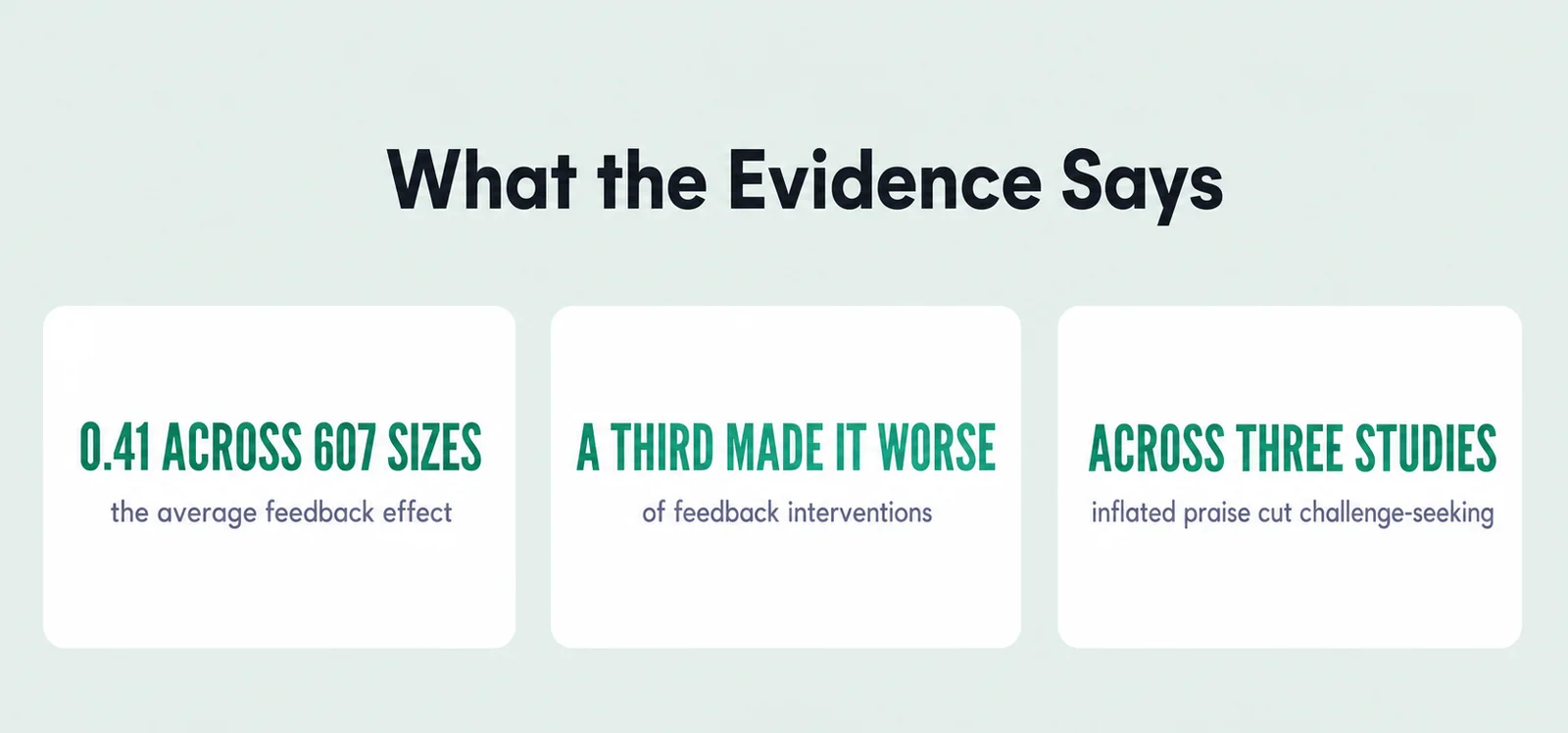
The warning comes from Brummelman and colleagues (2014), and it is specific enough to act on. Across three studies, adults were most inclined to give inflated praise to children with low self-esteem, and inflated praise decreased challenge-seeking in exactly those children while increasing it in children with high self-esteem.
Positive framing is a set of habits in how corrections are worded. It means naming what you want rather than what you do not, assuming the best about why something has gone wrong, keeping the correction anonymous where possible, and talking about the next action rather than the last failure. "Pens down and eyes here" instead of "stop talking".
It is not relentless cheerfulness, and treating it as cheerfulness is how it goes wrong. The technique is about the grammatical direction of a correction, not about its emotional temperature.
The premise that framing matters is well supported. The practice has one clear failure mode, backed by a precise finding, and one general one, backed by the largest feedback meta-analysis. Both are about the same thing: what the language points at.
Henderlong and Lepper's review is the canonical statement. Praise is not a quantity to be increased; its effect depends on whether the learner finds it sincere, what it attributes their success to, whether it preserves their sense of autonomy, and what standard it implies. Two teachers can say the same number of positive things and produce opposite effects.
Sullivan and colleagues (2014) support the technique's premise from the behaviour side. Most classroom behaviour is low-level disengagement rather than defiance, and teacher responses skew punitive. Framing a correction as a direction rather than a reprimand is a proportionality fix as much as a motivational one.
Brummelman and colleagues' finding is the one to hold on to, because the mechanism is invisible from the front of the room. Inflated praise, the extra adjective, the "that's incredibly good", is given disproportionately to children who seem to need building up. In those children it reduced the willingness to attempt harder things.
The teacher never sees this happen. They see a child who is doing less challenging work and conclude that more encouragement is needed. The evidence says the encouragement is part of the loop.
The protection is precision. An accurate observation cannot be inflated, which is why positive framing and precise praise work as a pair rather than separately.
Kluger and DeNisi (1996) found that across 607 effect sizes, feedback averaged 0.41 and over a third of interventions reduced performance. The negative cases cluster where feedback moves the learner's attention from the task to themselves.
Positive framing is language about a person's intentions, which puts it structurally close to that failure region. "I know you want to do well" is about the learner. "Page 40, first question" is about the work. The second is safer, and it is also less satisfying to say.
Allen and colleagues (2018) add the other side of the ledger, meta-analysing school belonging as a measured construct with real outcome links. Framing that preserves a learner's standing in the room is doing something that shows up in the data.
Four habits, all of them about direction rather than tone. Describe the solution rather than the problem, assume the best out loud, keep corrections anonymous where you can, and never inflate.
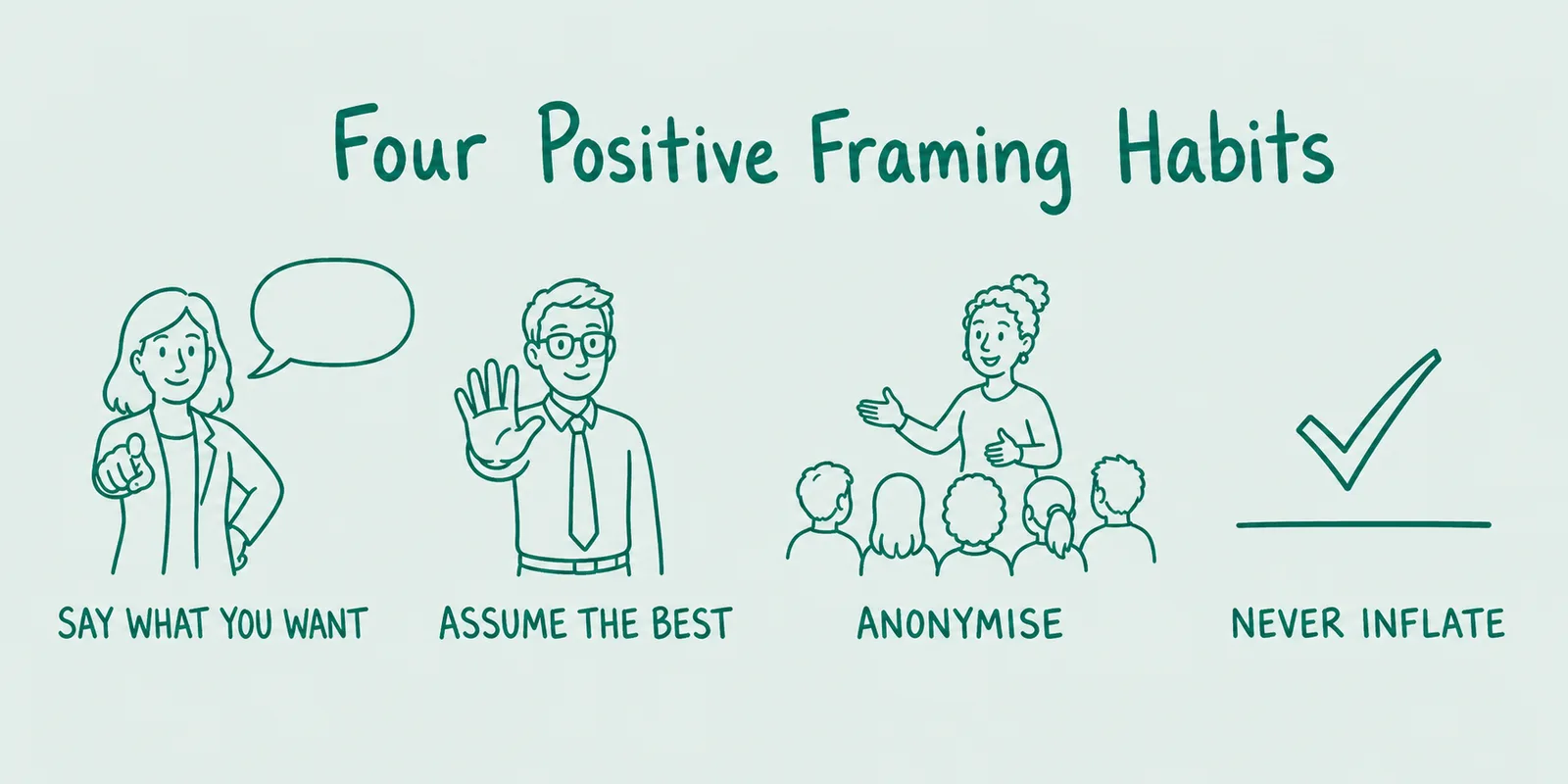
Say what you want. "Pens down, eyes here" tells the room what to do. "Stop talking" tells them what to stop, which leaves the next action unspecified.
Assume the best, audibly. "You may not have heard me" gives a learner a way back that does not require them to lose. It is also frequently true.
Anonymise the correction. "We should all be writing" costs nobody their standing, and the learner who needed it still hears it.
Never inflate. If it is fine, say it is fine. Superlatives spent on ordinary work are borrowed from the learner who most needs to believe you.
Positive framing has no direct evidence base. The support is the praise and feedback literature, which is about what is said to a learner rather than about this specific bundle of habits. A dedicated study of positive framing with learners who have special educational needs is not established, and the Brummelman finding concerns self-esteem rather than any diagnosed need. And the technique's own instinct, to be warmer with the learner who seems to be struggling, is the exact behaviour that finding warns about.
It is technique 59 in Teach Like a Champion 3.0: wording corrections and directions in terms of what you want and what comes next, rather than what has gone wrong, while assuming the best about the learner's intentions.
Yes, in one specific and well-evidenced way. Inflated praise reduced challenge-seeking in children with low self-esteem, and those are exactly the children adults are most inclined to give inflated praise to.
No. It is about the grammatical direction of a correction, not its emotional temperature. A demanding correction can be positively framed, and a warm one can point entirely at the learner rather than the work.
Positive Framing is one of the 63 moves in our complete guide to Teach Like a Champion.
Two techniques sit closest to this one: strong voice, which carries the same correction without volume; and the warm demander stance, the broader version of the same idea.