Updated on
September 24, 2026
Warm Demander: Warmth and High Expectations Together
What a warm demander is, where the idea came from, how thin the evidence under it is, and what to do for learners who cannot meet a demand.


Updated on
September 24, 2026
What a warm demander is, where the idea came from, how thin the evidence under it is, and what to do for learners who cannot meet a demand.
What is a warm demander?
A warm demander is a teacher who holds genuinely high, non-negotiable expectations of every learner while making it obvious in ordinary daily behaviour that they care about them personally. The two run at once rather than in alternation. The phrase is credited to Judith Kleinfeld’s 1975 study of effective teachers in Alaskan schools, and the stance was named as a pedagogy by Franita Ware in 2006.
Search for warm demander and you will find a hundred pages telling you to be warm and demanding. Almost none of them tell you where the idea came from, how thin the evidence under it is, or what it does to a learner who cannot meet a demand.
A warm demander is a teacher who holds genuinely high expectations of every learner while making it obvious, in ordinary daily behaviour, that they care about them personally. The two things run at once rather than in alternation. The stance is usually summarised as high warmth plus high demand, and its point is that neither half works without the other.
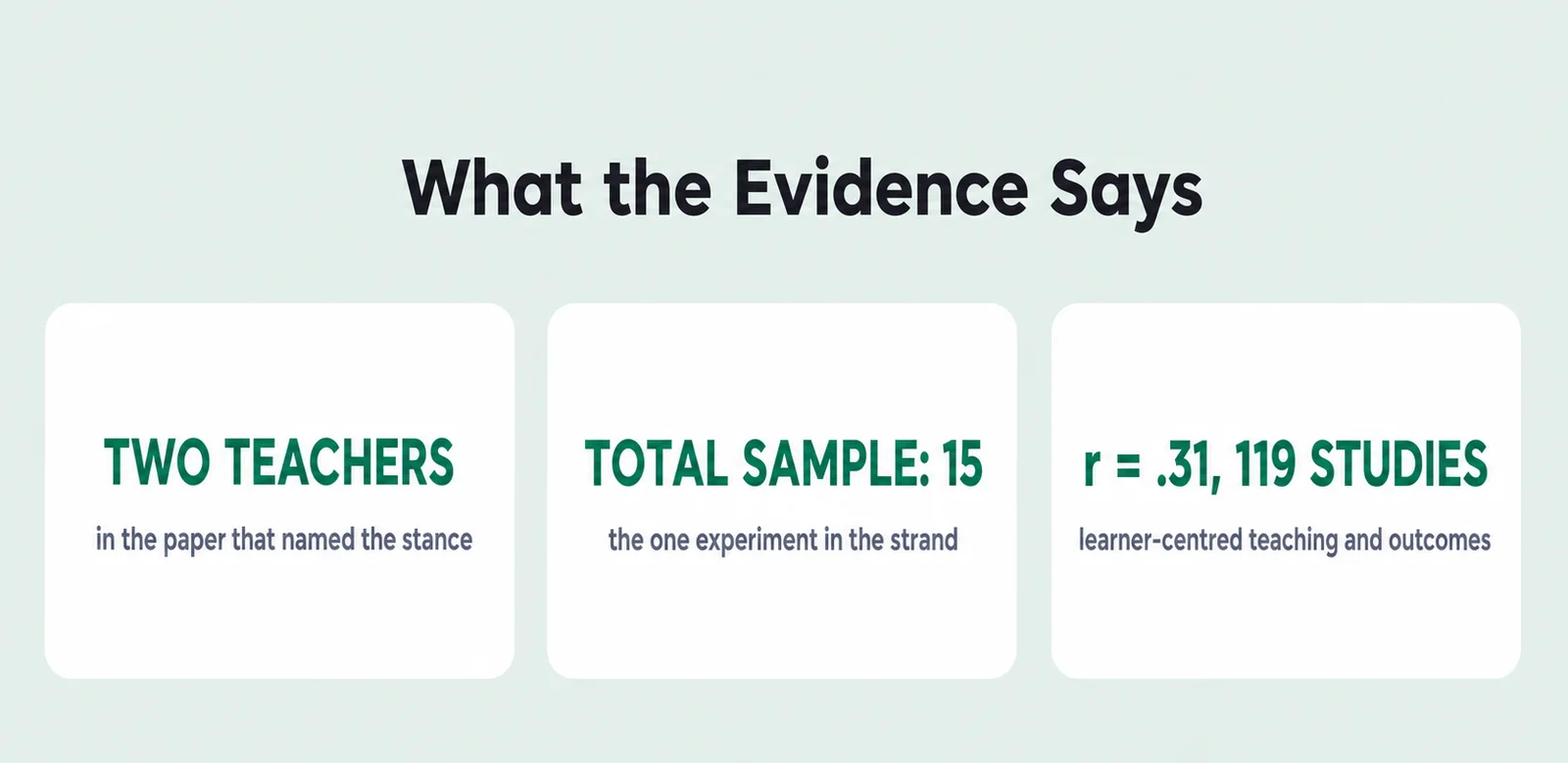
The idea has a real research lineage and a much weaker evidence base than its popularity implies. The paper that named the pedagogy studied two teachers. Ware (2006) observed and interviewed two African American urban teachers and proposed warm demander pedagogy as a component of culturally responsive teaching. That is a careful qualitative study, and it is not a trial. The broader claim underneath it, that warm teacher relationships help learners, is better supported: Roorda et al. (2011) meta-analysed 99 studies and found associations with engagement medium to large, but associations with achievement only small to medium. Warmth moves how learners behave more reliably than it moves what they score.
Here is where the gap shows up in a classroom. A Year 9 learner has not started. The warm demander script says hold the line, express belief, insist. So the teacher does, kindly and firmly, three times. The learner still has not started, because the task requires a step they cannot do and will not say so in front of the class. The stance was correct. It was also, on its own, useless.
A warm demander insists on high standards and, at the same time, behaves in ways that make clear the insistence is on the learner's side. Bondy and Ross (2008) describe it as communicating "both warmth and a nonnegotiable demand for student effort and mutual respect". The demand is not negotiable. The relationship is what makes the demand land as care rather than as attack.
The distinction that matters is against the two easier stances either side of it. A teacher can be warm and undemanding, which feels kind and quietly writes learners off. A teacher can be demanding and cold, which produces compliance and no trust. Warm demanding is harder than both because it asks you to do the difficult thing without letting go of the relationship.
Almost every page on this subject says Judith Kleinfeld coined "warm demander" in 1975. The report version of that study is freely readable, it runs to 75 pages, and the phrase does not appear in it once.
Kleinfeld observed teachers of ninth-grade Indian and Eskimo students across two boarding schools and five integrated urban high schools in Alaska during the 1970 to 1971 school year, videotaping lessons and interviewing teachers and learners. She built a two-by-two, and the axes are not the ones the retelling uses. They are personal warmth against professional distance, and active demandingness against passive understanding. Her four types are Traditionalists, Sophisticates, Sentimentalists, and, for the effective quadrant, Supportive Gadflies.
Two things follow that matter in a staffroom. The low pole is not low expectations, it is sympathetic non-intervention, which Kleinfeld attributes to too much cultural deference rather than too little ambition. And demandingness in her account is "expressed as an aspect of the teacher's personal concern for the student, rather than a concern for subject matter". The demand is about the person, not the syllabus.
The phrase itself arrived later. Irvine and Fraser's 1998 Education Week piece, which is where most practitioners first met it, credits James Vasquez rather than Kleinfeld. Bondy and Ross credit Kleinfeld in 2008, and most subsequent writing follows them. The construct is Kleinfeld's. Who first said the words is genuinely unsettled, and anyone telling you otherwise has not opened the report.
Her title uses the word for Alaska Native people that was standard in 1975. It is reproduced in the reference list below because that is the paper's actual title, and it is not the language to use now.
This is the confusion the ranking pages never clear up. Doug Lemov's Teach Like a Champion 3.0 contains a technique called Warm/Strict, number 61, in the chapter on building student motivation and trust. It sounds identical and it is not doing the same job.
Warm demander is a stance that came out of research on culturally responsive teaching, and it is about the relationship between a teacher and learners whose community has often been failed by schools. Warm/Strict is a technique in a book of techniques, and it is about how you deliver a consequence without the consequence reading as personal dislike. One is an account of who you are being. The other is an instruction about your voice and face in the ten seconds after a learner does something you have to address.
They are compatible. They are not interchangeable, and treating them as the same thing quietly relocates an equity argument into a behaviour-management one. You can see the whole book's structure in our guide to Teach Like a Champion's 63 techniques.
The honest summary is that the stance is well described, widely believed and lightly tested. Three separate bodies of evidence sit underneath it and they are not equally strong. The warm demander literature itself is small and qualitative. The wider work on teacher-learner relationships is large and correlational. Only one component, the way critical feedback is worded, has been tested experimentally, and that is the part worth taking into a classroom first.
This is the fact that should change how the stance is quoted. Kleinfeld considered achievement-test gains as her outcome and rejected them as impractical at secondary level. What she measured instead was an intermediate criterion: "the intellectual level of students' verbal participation in the academic work of the classroom", with the cognitive level of learner talk judged against Bloom's taxonomy.
So the founding study asked whether learners spoke, and how sophisticated their speech was. It did not ask whether they learned more. Anyone citing Kleinfeld as evidence that warm demanding raises attainment is citing something the study explicitly declined to measure.
One experiment sits in the same research programme, and it is small. Kleinfeld (1974) randomly assigned learners to a non-verbally warm or a non-verbally cold examiner and retested them on two intelligence subtests. Warmth beat coldness on both. The total sample was 15, in groups of seven and eight, and Kleinfeld's own verdict was that "in view of the small sample, this study should be regarded as exploratory". Note also what that design does and does not cover: warmth was manipulated, demandingness never has been. The two-by-two everyone draws has never been tested as a two-by-two.
Ware (2006), published in Urban Education, is the paper that turned the description into a named pedagogy, and it is the most-cited work in the strand. It examined two African American urban teachers through observation and interview, and argued that a warm demander both displays care and projects authority, with the two working together rather than trading off.
That is a legitimate and useful piece of qualitative research. It is also two teachers. The Florida group around Bondy, Ross, Hambacher and Acosta then built a genuine run of peer-reviewed studies on top of it, which is where the empirical substance of the strand actually lives, and all of it is observational.
The stance was developed by and about African American teachers of African American learners, in a specific American context. Whether it transfers to a teacher who does not share their learners' background is the obvious question, and the literature mostly does not ask it.
Ford and Sassi (2014) do ask it. They examine authority in cross-racial teaching and reconsider directly whether warm demander approaches transfer. For a British teacher in a London secondary, or a teacher from anywhere working in an international school, that paper is more relevant than the founding literature, because it is about the situation you are actually in.
The warmth half rests on much firmer ground, because teacher-learner relationships have been meta-analysed properly.
Roorda et al. (2011) synthesised 99 studies from preschool to high school. Positive and negative relationships both showed medium to large associations with engagement, and small to medium associations with achievement. Cornelius-White (2007) reviewed around 1,000 articles to synthesise 119 studies covering 355,325 students, and reported a mean correlation of r = .31 between learner-centred teacher behaviours and outcomes.
Read those two together and the finding is specific. Warm relationships are strongly associated with how engaged learners are, and less strongly associated with what they achieve. Both are correlational. A teacher who is warm to the learners who are already doing well produces the same statistic as a teacher whose warmth caused the engagement.
There is a single move inside the warm demander stance that has real experimental support, and it is worth more to a teacher than the rest of the literature combined.
Cohen, Steele and Ross (1999) ran two studies on how learners respond to critical feedback. Black students who received unbuffered criticism responded less favourably than White students, rating the evaluator as more biased and reporting lower task motivation. When the same criticism was delivered alongside an invocation of high standards and an assurance that the student could reach them, Black students responded as positively as White students, and both groups reported stronger identification with the subject. Yeager et al. (2014) later replicated and extended this in school settings.
That is the warm demander stance compressed into one sentence of feedback, and it is the version that has been tested. It also tells you the sequence: the assurance is not decoration on the criticism, it is what makes the criticism usable.
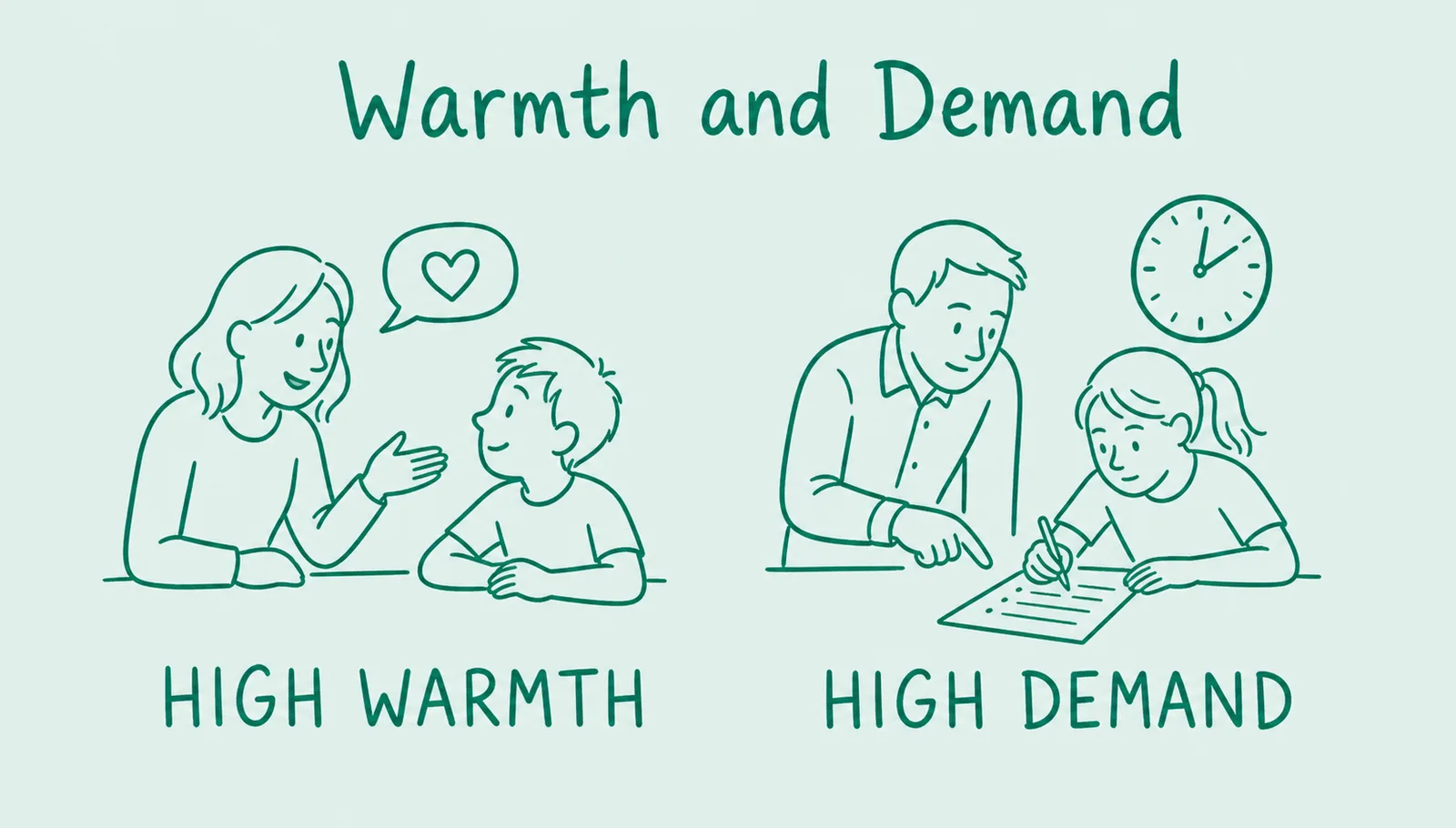
The stance only becomes teachable when it is broken into things you actually say and do. Warmth and demand each have a version that works and a version that looks like it and does not.
Demand means the standard does not move when the learner pushes back. It does not mean the volume rises.
Give the instruction once, plainly, and then leave a pause instead of repeating yourself. Repeating an instruction faster and louder communicates that you expect to be ignored. Standing still and waiting communicates the opposite. If a learner does not start, the next move is to find out what is stopping them, not to restate the demand a third time. Our guide to task avoidance and cognitive shutdown covers what that usually turns out to be.
Keep the consequence and the relationship in separate sentences. "That is a detention. I will see you at half three, and I still want your essay because your last one was the best argument in the class." The consequence is not softened. The relationship is not withdrawn.
Warmth here is specific rather than general. General warmth is a friendly manner, and every learner gets it, so no learner reads anything from it. Specific warmth is evidence you have noticed this person.
Naming what a learner actually did carries more than praise does. "You changed your mind halfway through and said so out loud" is warmer than "great work", because it proves you were listening. This is the same principle that makes praise for effort work or fail depending on how it is worded.
The wise-feedback structure from Cohen and colleagues gives you a reusable sentence. State the standard. Say the work is not there yet. Say you are giving the feedback because you believe they can reach it. Three clauses, in that order, and the order matters: an assurance offered before the criticism reads as softening, and an assurance offered after it reads as belief.
The commonest failure is warmth that arrives only after compliance. If the smile appears when the learner does as asked and disappears when they do not, the learner learns that your regard is conditional, and the stance has collapsed into ordinary behaviour management with better vocabulary.
The second commonest is demand without diagnosis. Insisting harder on a task a learner cannot yet do produces avoidance, not effort. Demand assumes the learner has the means. Check that before you raise it.
This is the section the ranking pages do not have, and the warm demander literature does not have it either. That absence is worth naming. "Demanding" is not a neutral dial that can be turned up for everyone, and for several identifiable groups of learners turning it up produces less of the thing you asked for, not more.
Remember what Kleinfeld's effective teachers were effective at: getting learners to talk. She is explicit that persistent classroom silence, in the learners she studied, "may be used as a passive strategy of aggression against the teacher".
Now set that beside current UK guidance on selective mutism, which is an anxiety disorder. NHS and local authority guidance converges on the opposite advice: do not place a demand on the child to speak, use comments rather than direct questions, and let the child move at their own pace, because pressure to speak makes speech less likely. For that group of children, the founding study's measure of good teaching is the exact thing clinical guidance says you must not push for.
That is not a reason to discard the stance. It is a reason to know which learner is in front of you before applying it.
For a learner with a demand avoidant profile, the demand itself is the trigger, and it fires even for activities the learner wants to do. The National Autistic Society's guidance is to reduce or remove demands where at all possible, to phrase things indirectly, and to flatten the hierarchy of the exchange. The PDA Society recommends a low-arousal approach, fewer demands, more choices and less direct control, because the avoidance is driven by anxiety about losing autonomy.
A stance whose defining feature the original researcher called "active demandingness" is, for these learners, close to a contraindication. That is a reversal rather than a caveat, and it is the reason the phrase should never become a whole-school policy without this paragraph attached.
For an anxious learner, public demand and private demand are different events. A quiet instruction at the desk can be met when the same instruction from the front cannot, because the audience is the unmanageable part.
For a learner with attachment difficulties, the warmth half is the riskier half. Sudden, intense personal warmth can destabilise a child for whom adult warmth has been unreliable. Predictable and low-key beats effusive. Consistency is the warmth.
This is the distinction that resolves the whole section, and almost nobody makes it.
The Education Endowment Foundation's guidance on special educational needs in mainstream schools does not tell teachers to be demanding. It recommends scaffolding as temporary support that is withdrawn when it is no longer needed, explicit instruction, flexible grouping, cognitive and metacognitive strategies, and assistive technology. High expectation is delivered through high support and an accurate reading of what a learner can currently do.
Warm demander rhetoric collapses expectation into demand. Keep them apart. The expectation stays exactly where it is, and the route to it changes, which is what a SEND-friendly classroom is for and what scaffolding is actually doing.
Kleinfeld knew this and said so. Non-verbal warmth cues differ across cultures, and sustained direct eye contact, a standard Western signal of warm attention, can read as anger or challenge. In an international school that is not a footnote, it is Tuesday. The ranking pages present warmth as self-evident. The researcher who studied it did not.
The stance is well described and lightly tested, it generalises further than its own research does, and its defining feature is a poor fit for some learners. Five qualifications matter enough to state plainly before anyone builds a policy on it.
The evidence is descriptive, not causal. The core warm demander literature is qualitative, observational and small. Warmth has been manipulated experimentally once, on 15 learners, as an examiner effect on intelligence subtests. Demandingness has never been manipulated at all. Nobody knows whether the effect is the warmth, the demand, the combination, or the kind of teacher who arrives at both.
Teacher expectation effects are smaller than the folklore. Warm demanding leans on the idea that high expectations raise attainment. Jussim and Harber (2005) reviewed decades of self-fulfilling prophecy research and concluded the effects are real but typically small, and that the field's most famous study has been widely over-read. Raudenbush's (1984) meta-analysis found expectancy effects on IQ depended heavily on how well the teacher already knew the learner. Expectations matter. They do not do the heavy lifting alone.
It can license harshness. Because the stance says a demanding manner is care, it can be used to justify treatment that is simply harsh, and the "warm" half is unfalsifiable from the outside. Golann's (2015) ethnography, 18 months inside a no-excuses school with interviews across 92 administrators, teachers and students, found that the emphasis on order as a precondition for achievement produced learners practised in compliance rather than in the self-direction the school was aiming at. Cushing (2021) makes a related argument from an English secondary school about how discipline gets encoded in language.
It was a claim about cultural match, not about teaching in general. Kleinfeld's finding was about which teaching styles worked with Alaska Native learners specifically, and Ware's was about African American teachers and learners. Generalising it into universal advice for all teachers and all children is a move nobody in the original literature made. Asking why "demanding" is prescribed for some children and not others is a fair question, and the literature answers it less often than it should.
It individualises a structural problem. A stance is a property of a teacher. Framing attainment gaps as answerable by teacher disposition puts the whole load on individuals, and is convenient for everyone above them.
A warm demander is a teacher who holds high, non-negotiable expectations of every learner while showing consistently that they care about that learner personally. Both run at once. The idea comes from Judith Kleinfeld's study of effective teachers in Alaskan schools, published in 1975, although the phrase itself was attached to her work later.
No. Warm/Strict is technique 61 in Doug Lemov's Teach Like a Champion 3.0 and describes how to deliver a consequence without personal coldness. Warm demander is a broader stance from the culturally responsive teaching literature. They are compatible but they answer different questions.
Partly. The specific warm demander literature is qualitative and small, and the founding study observed two teachers. The wider evidence that warm teacher relationships help is strong for engagement and weaker for attainment. The one component with experimental support is wise feedback: criticism paired with high standards and an assurance the learner can meet them.
Keep the standard fixed and the volume flat. Say it once, then wait rather than repeat. Put the consequence and the relationship in separate sentences so neither cancels the other. If a learner still does not start, diagnose before you insist again.
Not as written, for some. For a learner with a demand avoidant profile, increasing demand increases avoidance, so the effective response is to lower the direct demand while keeping the standard. Keep the expectation and change the route to it.
The construct is Judith Kleinfeld's, from her 1972 to 1975 Alaska study, though her own report never uses the phrase and calls the effective type "Supportive Gadflies". Irvine and Fraser's 1998 Education Week piece credits James Vasquez with the words. Franita Ware's 2006 paper named it as a pedagogy, and Lisa Delpit and Zaretta Hammond brought it to a wide readership.
Every reference below was checked twice: once to confirm it exists, and again to confirm the record it resolves to is the paper being cited. Links go to the original publisher rather than to an aggregator. Where a source is paywalled or is a practitioner article rather than a study, that is stated.