Updated on
September 24, 2026
Strong Voice: Classroom Authority Without Volume
Teacher clarity accounts for around 13 per cent of the variance in learning. The formality half of this technique is complicated by the immediacy research.


Updated on
September 24, 2026
Teacher clarity accounts for around 13 per cent of the variance in learning. The formality half of this technique is complicated by the immediacy research.
What is Strong Voice in Teach Like a Champion?
Strong Voice is technique 58 in Teach Like a Champion 3.0: a set of habits that let a teacher carry authority without volume. Economy of language, not talking over the room, standing still while giving an instruction, dropping rather than raising the voice, and squaring up to the person being addressed.
A teacher gives an instruction on the way to the cupboard, over the top of two people talking, in nineteen words. Nobody moves. Strong Voice is the technique most often mistaken for its opposite: teachers hear the name and think volume, and the whole point is that you stop needing it.
Strong Voice is a set of small, mostly non-verbal habits that let a teacher carry authority without raising their voice: standing still, using fewer words, finishing the sentence you started, and not talking over the room. It is technique 58 in Teach Like a Champion 3.0, in the chapter on high behavioural expectations.
The reason it matters is arithmetic. A teacher who gets louder has one move and it can only be used once. A teacher who gets quieter and stiller has a move that works every time. The clarity half of this has real support: Titsworth and colleagues (2015), pooling 144 effects across 73,281 learners, found teacher clarity accounts for roughly 13 per cent of the variance in learning.
Strong Voice describes how a teacher's posture, stillness, pace and word count communicate that an instruction is real. It is not a tone of voice and it is not sternness. It is the difference between an instruction that sounds like a request and one that sounds like a description of what is about to happen. Lemov groups it with the behaviour techniques, and it underpins most of the others in that chapter.
Economy of language. Say the fewest words that could work. "Pens down" beats "Right, everyone, if you could just put your pens down for me now please." The second version buries the instruction inside softeners and gives the class time to decide whether to comply.
Do not talk over. If two people are talking, stop. Wait. Then start the sentence again from the beginning. Talking over noise teaches the room that your voice is background.
Stillness. Give the instruction, then stop moving. A teacher who issues an instruction while walking to the cupboard has told the class it does not matter enough to stand still for.
Quiet power. When you want more attention, take volume off rather than adding it. A class has to get quieter to hear you.
Formal register. Square your shoulders to the person you are speaking to. Standing at an angle, half turned away, reads as tentative even when the words are firm.
This is a technique you rehearse rather than adopt, and it is best practised on the boring instructions where nothing is at stake. Try one habit at a time for a week.
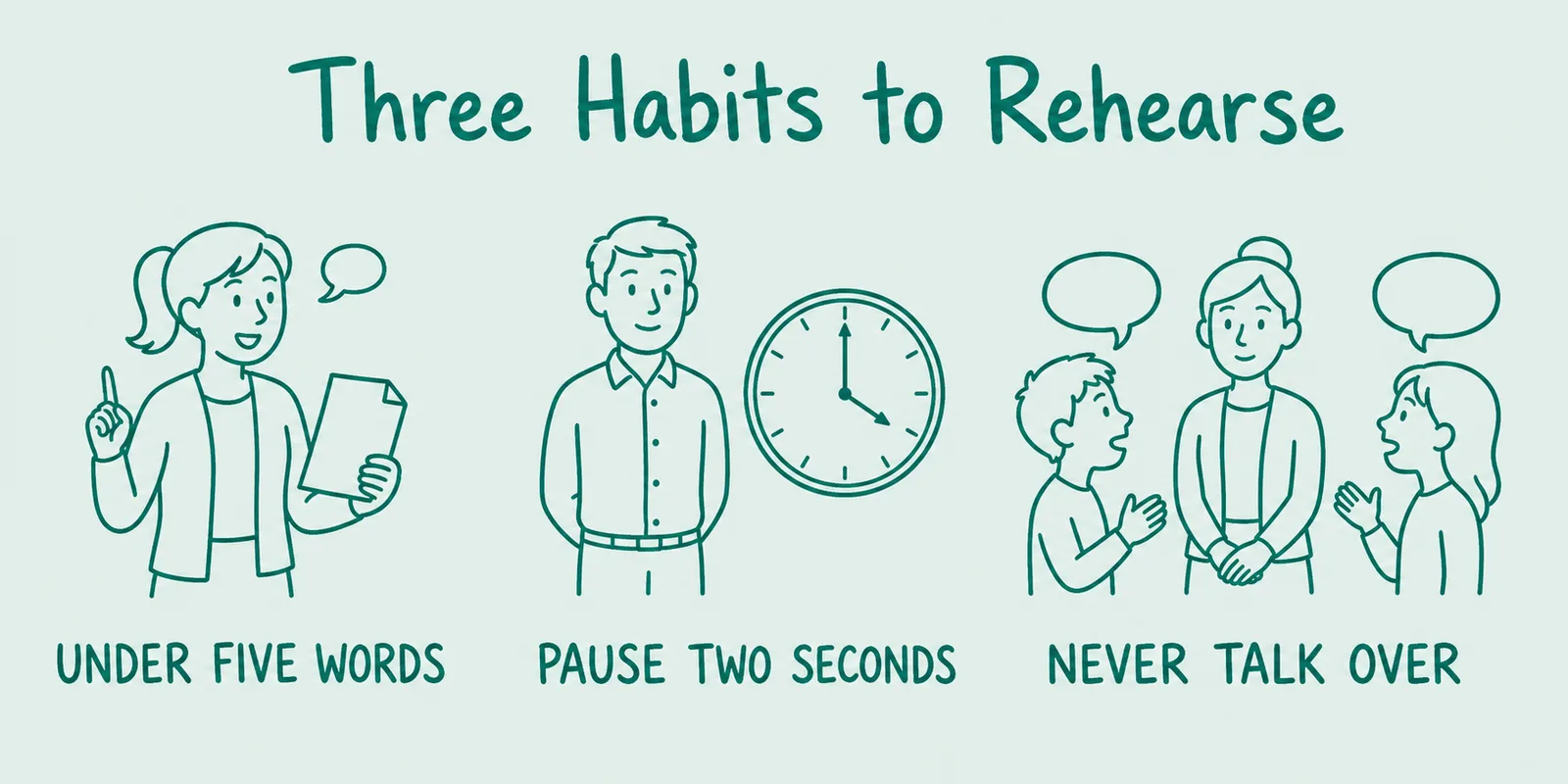
Start with economy. Write down the three instructions you give most often and cut each to under five words. Then practise the pause: give the instruction, then count two seconds in your head before you do anything else, including looking away. Most teachers discover they have never once waited after an instruction.
The hardest habit is not talking over. It requires you to stop mid-sentence, which feels like losing. It is the opposite: a teacher who never competes with noise is a teacher whose voice always means something.
It gets read as coldness. Stillness and economy on their own can read as displeasure. The techniques in Lemov's motivation chapter, and the broader idea of a warm demander, exist precisely to stop authority reading as dislike. Keep the warmth in a separate sentence from the instruction.
It becomes performance. A teacher doing a Strong Voice impression, over-slow and over-still, is more distracting than a normal one. The technique is invisible when it works.
Fewer words is harder for some learners. This is the qualification the technique does not carry on its own. A very short instruction is a high-density instruction, and for a learner with a language disorder "pens down, books open, page 40" is three instructions with no gaps. Norbury and colleagues (2016), screening 12,398 children at school entry in Surrey, put language disorder prevalence at just under 10 per cent, which the authors describe as roughly two children in every class of thirty and call a minimum. Keep the economy for the class and give those learners the same content in steps, or in writing.
Quiet does not work in a loud room. Dropping your voice relies on enough quiet to be heard. In a genuinely loud room you need a different signal first, and then the quiet voice.
Strong Voice as a named bundle has never been tested. What has been tested is either side of it, and the two sides do not point the same way, which is the most useful thing to know before adopting it wholesale.
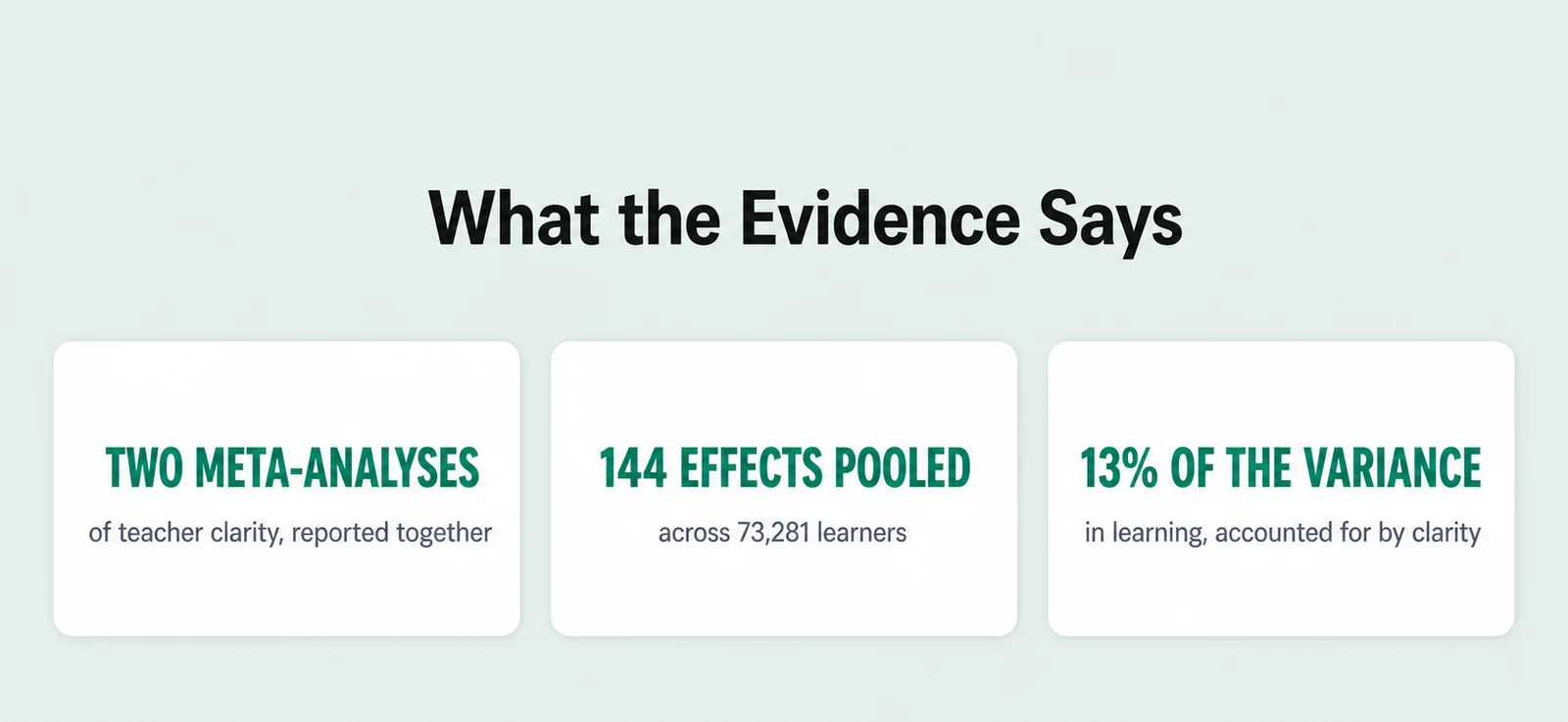
The clarity half is supported. Titsworth and colleagues (2015) report two meta-analyses of teacher clarity. The first pooled 144 reported effects across 73,281 learners and found clarity accounts for roughly 13 per cent of the variance in learning. Two qualifications come with it: the effect was larger for affective learning than for cognitive learning, and the samples are heavily higher-education communication studies rather than schools.
The formality half is complicated by the immediacy research. Witt, Wheeless and Allen (2004) meta-analysed teacher immediacy, meaning warmth, approach behaviours and reduced distance, and found it positively related to learning. Strong Voice trains formal register, a square stance, economy and stillness. Immediacy research associates roughly the opposite cluster with learning. The two are not strictly incompatible, and it would be dishonest to present the evidence as pointing one way.
And the premise itself has a challenger. Pace and Hemmings (2007) review the research on classroom authority and conclude it is negotiated and relational rather than a property a teacher projects. Strong Voice assumes authority is performed. That is a real theoretical disagreement rather than a quibble.
Strong Voice is a practitioner technique with no trial behind it. The adjacent evidence supports economy and clarity, does not clearly support formality and stillness, and the immediacy literature arguably points the other way. Its plausibility rests on the experience of teachers who use it, which is a reasonable basis for a habit and a poor basis for a policy.
It is technique 58, a set of habits that let a teacher carry authority without volume: economy of language, not talking over the room, standing still while giving an instruction, dropping rather than raising the voice, and squaring up to the person you are addressing.
No. It is about how an instruction is delivered, not how demanding it is. A warm teacher and a strict teacher can both have a strong voice, and both can have a weak one.
Change what happens before the shout. Shouting is usually the end of a chain that began with an instruction given while walking away, over noise, in too many words. Fix the start of the chain and the end of it stops arriving.