Kolb's Learning Cycle: 4 Stages Applied to the Classroom
Kolb's experiential learning cycle explained with practical classroom examples. How to use the 4 stages to design lessons that build deeper understanding across every subject.

Kolb's experiential learning cycle explained with practical classroom examples. How to use the 4 stages to design lessons that build deeper understanding across every subject.
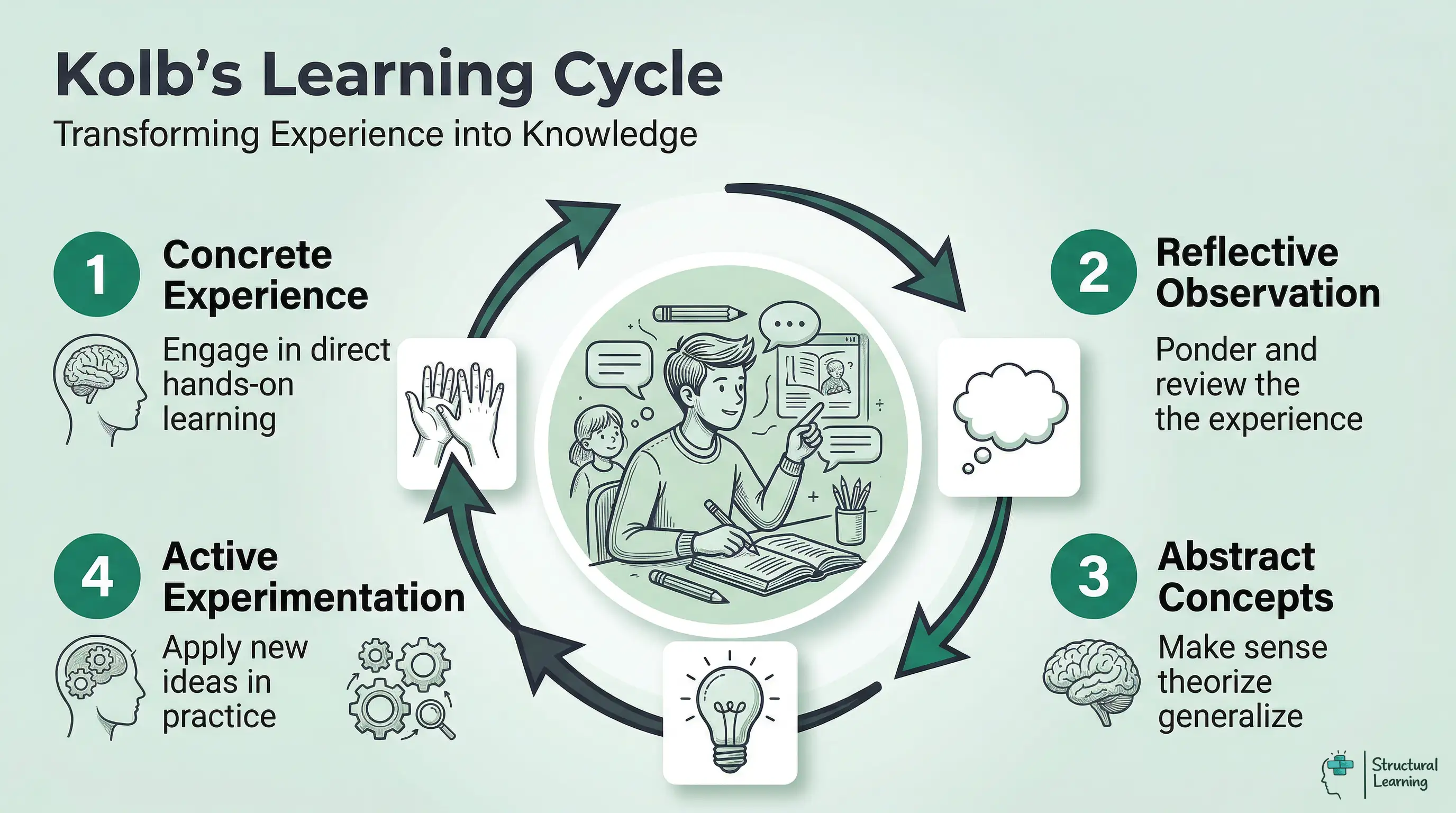
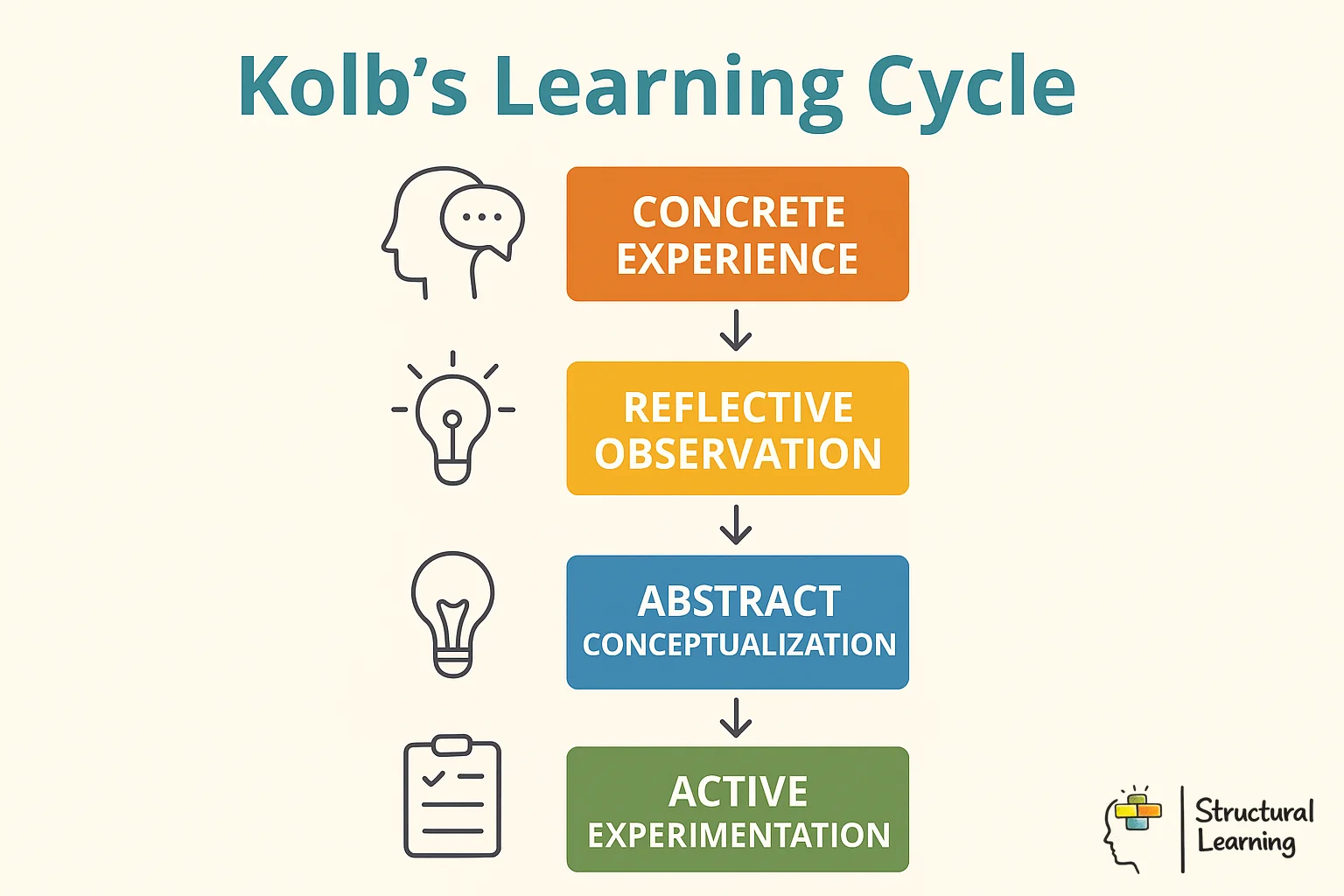
Kolb's Learning Cycle is a four-stage model of learning by doing. It shows how learners move from experience to reflection, understanding, and action. The cycle has four stages. These are concrete experience, reflective observation, abstract conceptualisation, and active experimentation. It gives teachers a clear frame to plan lessons that build true understanding. In class, you might start with a hands-on task. Then, you help learners reflect on what happened. Next, you draw out the key idea, and
David Kolb gave us the gift of Experiential Learning, the idea that people learn by doing, reflecting, conceptualizing, and experimenting. It's a solid observation. But then his framework spawned a monster: the learning styles hypothesis. This is the widespread belief that students have innate learning preferences, some are "visual," others "auditory" or "kinesthetic", and that tailoring teaching to these styles improves outcomes. It's everywhere in UK schools: questionnaires asking students to identify their learning style, lesson plans designed with "something for the visual learners" and "something for the kinaesthetic learners." It's intuitive. It's also unsupported. When Pashler and his team (2008) conducted a comprehensive review of decades of educational research, they found the number of methodologically sound studies providing evidence that matching instruction to learning styles improves learning was "nearly zero." Not "limited." Not "mixed." Nearly zero. The effect doesn't exist at scale, yet teachers continue to spend planning time on it, and learners continue to be sorted and pigeonholed by false categories. Kolb's experiential cycle is worth keeping. The learning styles mythology is worth discarding.
Chris Argyris and Donald Schon (1978) introduced a distinction that extends Kolb's model, one of the most well-known learning theories, in an important direction. Single-loop learning, in their account, occurs when a learner detects and corrects an error without questioning the underlying assumptions that produced the error in the first place. This is roughly what Kolb's cycle describes: you have an experience, reflect on it, form a revised concept, and try something different next time. Double-loop learning goes further. It involves questioning the governing values, assumptions, or strategies that frame your actions, not just adjusting your behaviour within an existing frame.
Teachers find this difference useful for their practice. A teacher who changes wording after a lesson uses single-loop learning. A teacher might question how they understand learners' concept grasping. That is double-loop learning. Argyris and Schon (1978) said single-loop learning tackles routine issues. They believed double-loop learning drives professional growth. It helps to solve stubborn problems.
Mezirow's (1991) learning theory values reflection highly. He said deep learning changes a person’s worldview. Mezirow, informed by Habermas, thought learners revise understanding through critical thinking. This involves questioning cultural norms. For teachers doing CPD, the aim is professional identity change, not just improved lessons (Mezirow, 1991).
Boud, Keogh and Walker (1985) said emotions matter in reflection, unlike Kolb. They saw reflection as reviewing experiences and feelings. Moon (1999) mapped reflection levels, from noticing to deep change. These frameworks help trainee teachers reflect. Consider Kolb's cycle a base when aiming for professional growth.
A Kolb Cycle lesson planner is a clear framework. It helps you design learning in four stages. These are experience, reflection, thinking and active testing. First, learners have an experience. Then, they reflect on it. Next, they form new concepts. Finally, they test these ideas actively. This cycle helps them apply rules in new situations.
Plan a full Kolb cycle for any topic, then download your lesson structure.
What is your lesson topic?
Plan one activity for each stage
Learners do or encounter something. This is the 'doing' phase: an activity, experiment, or real-world encounter that gives them raw experience to work with.
Learners step back and think about what happened. Discussion, journalling, and pair-share activities all belong here. The aim is careful observation, not yet explanation.
Learners generalise and link what they see to theories. Teachers introduce formal words, diagrams, and rules. They base these on earlier experience (Piaget, 1936). This helps learners grasp complex ideas (Vygotsky, 1978).
Learners apply what they have understood to a new or extended context. This tests whether the concept has transferred, and generates fresh concrete experience for the next cycle.
Your cycle at a glance
Kolb's Learning Cycle is a four-stage model of learning through experience, reflection, conceptual understanding and active experimentation. Learners have experiences, then reflect on them. They form ideas and try new things. Despite style critiques, it aids active learning design.
Learners grasp information through doing, thinking, and reflection. Kolb's (1984) cycle explains this. Teachers see how learners engage, reflect, and form concepts. They then test ideas, informed by social learning theory (Bandura, 1977).
Kolb's framework helps design active learning connected to real experiences. Understanding how experience becomes learning is vital, whatever key stage you teach. Kolb's cycle offers ways to design meaningful, learner-centred lessons that avoid rote learning. Explore Mantle of the Expert for immersive drama-based inquiry.
(Kolb, 1984). Teachers who reflect on their own learning preferences can differentiate instruction more effectively (Honey & Mumford, 1986). Doing so helps build a classroom that supports diverse learner needs and promotes greater understanding (Gardner, 1983). This approach enables learners to connect new information with existing knowledge (Ausubel, 1968). Ultimately, it boosts learner engagement and improves long-term retention (Craik & Lockhart, 1972).
How does experience become learning? This podcast explores Kolb's four-stage cycle and learning styles. It also asks what the evidence really says about experiential education.
Experiential learning focuses on student-led tasks. Didactic teaching relies on teacher instruction. Kolb's theory looks at the student's personal growth and views. In experiential learning, the student guides their own progress. This differs from traditional methods.
Experiential learning helps learners use knowledge in real life. This boosts engagement and critical thinking skills (Kolb, 1984). Learners build problem-solving and teamwork skills, plus communication abilities (Dewey, 1938; Piaget, 1970).
Conventional, didactic methods include lectures, textbooks, and homework assignments. These methods teach facts and concepts, but not necessarily how to apply them in real world situations.
Experiential learning helps learners remember facts (citation needed). Teachers can use it well. Research by Kolb (1984) and Dewey (1938) backs this idea. Boud's work (1985) also supports it.
When teaching students, we often use Kolb's Learning Cycle to help them understand experiential learning. The following model helps illustrate this process:
Orientation helps learners grasp subjects through real-world experience. Reflection also aids learning (Kolb, 1984). Schön (1983) points out the value of reflective practice. Vygotsky (1978) notes that social interaction boosts knowledge. Finally, Dewey (1933) supports learning by doing for deeper understanding.
2. Cognitive Processing. Students explore the topic through practical tasks.
3. Retrieval, Students recall the content through memory and repetition.
4. Consolidation, Students integrate the new information into long term memory.
5. Motivation and Evaluation. Students judge if the activity was useful.
6. Integration. Students link new facts to what they already know.
7. Application, Students apply the new information to solve problems.
8. Exploration, Students continue to explore the topic further.
Kolb (1984) says learners benefit from online experiential activities. Learners actively apply knowledge through these tasks. Dewey (1938) showed experience improves learning retention. Plan short tasks learners complete, keeping them engaged (Yardley et al., 2012).
Here is a quick overview of the 4-stages of the Kolb learning styles:
You can apply Kolb's theory in your classroom by planning specific activities. Move learners through experience, reflection, thinking and testing. Use practical strategies for every stage. This helps your class to learn well.
Kolb's Learning Cycle provides engaging learning. (Kolb, 1984) Design experiences covering all four stages. This helps learners move past passive learning. Instead, learners actively engage, reflect, and apply knowledge.
Kolb's (1984) learning cycle is useful, but can be tricky to use well. Teachers may face common issues. We offer solutions for these challenges below.
The conclusion is a summary of how Kolb's Learning Cycle supports engaging lesson design through four connected stages. It has four stages: concrete experience, reflective observation, abstract conceptualisation, active experimentation (Kolb, date not provided). Use these stages to build critical thinking and problem-solving skills. This builds a lifelong love of learning in learners.
By moving beyond traditional didactic methods and embracing experiential learning, teachers can helps students to become active participants in their own education. This not only enhances their understanding of the subject matter but also equips them with the skills and dispositions needed to succeed in an ever-changing world. Kolb's cycle isn't just a theory; it's a practical guide to creating learning that sticks.
Teachers use Kolb's model for practical classroom tasks. The steps are concrete experience, reflection, conceptualisation, and experimentation. Think about a Year 7 science lesson on plant growth. Students do not start with textbook facts. Instead, they plant seeds in different conditions. This is a concrete experience.
Kolb's (1984) experiential learning cycle guides this. Learners observe changes for two weeks, noting patterns with peers. These observations help them form ideas about plant needs. Next, learners design tests to check their ideas, like music's effect on growth (Kolb, 1984). They actively experiment, refining knowledge through testing (Kolb, 1984).
Kolb (1984) said that learners understand maths by doing it. Sharing pizza models shows fractions. This is concrete experience. Learners then talk about pizza sizes. This is reflective observation. Next, they link parts to wholes. This is abstract conceptualisation. Finally, learners solve sharing problems. This is active experimentation.
Kolb's (1984) cycle helps English learners. Learners perform Shakespeare, gaining experience. They write about characters, reflecting on their actions. Groups analyse Shakespeare's themes, building understanding. Learners adapt texts, actively showing what they know.
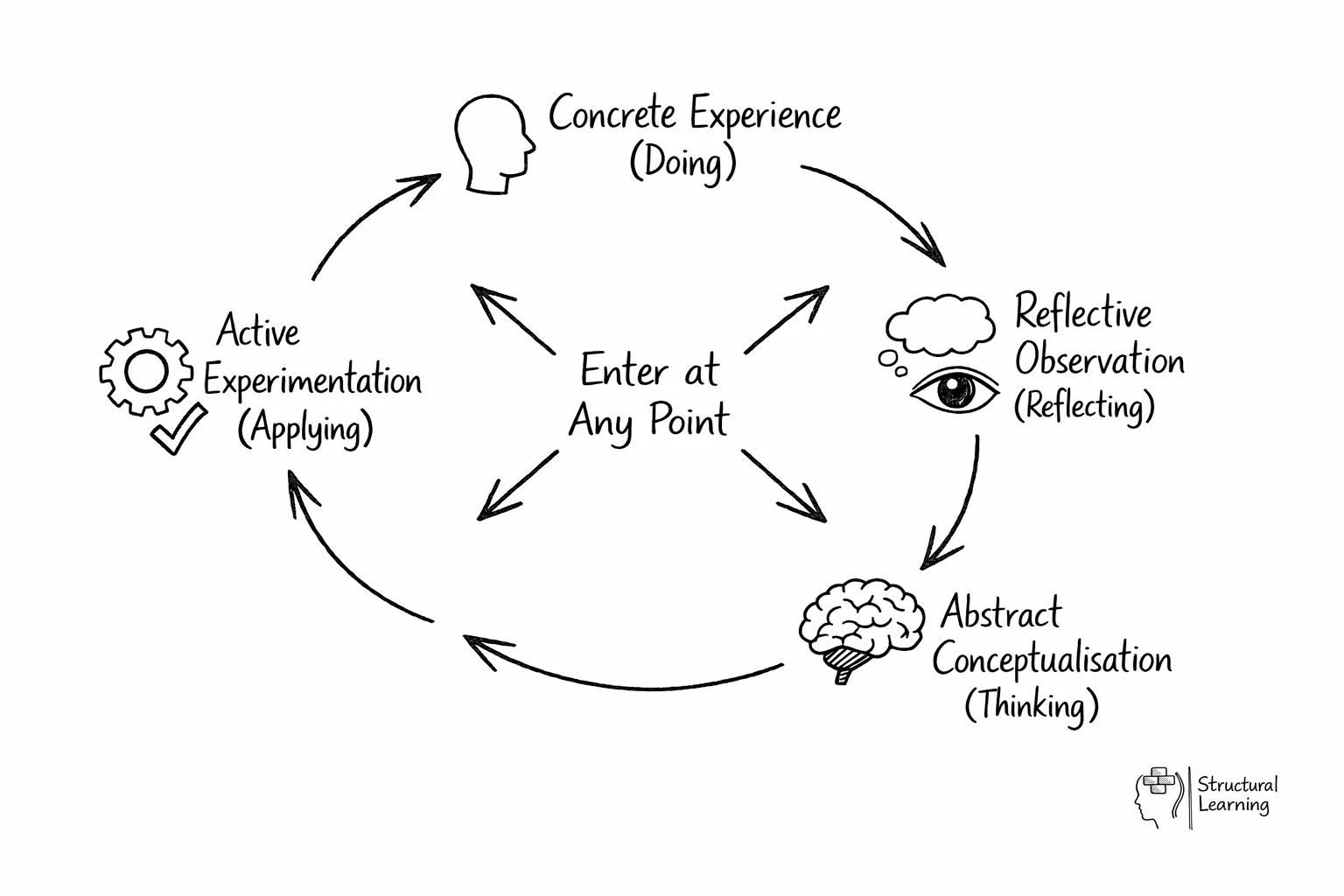
Kolb's cycle means learning isn't linear. Teachers can start with primary sources (reflective observation). Or, they can launch role-play debates (active experimentation). Ensure learners complete the full cycle. This transforms activities into connected experiences (Kolb, 1984).
Experiential learning theory is a model of learning through experience developed by David Kolb from earlier educational thinkers. He used Dewey, Piaget, and Lewin's work. Kolb, an American theorist, taught at Case Western Reserve. He developed experiential learning theory.
Kolb (1984) found learners retain information best through active tasks. His research showed learning mirrors real skills. Learners use experience, reflection, concepts, and testing (Kolb, 1984).
Kolb's background shows teachers why his learning cycle works (Kolb, 1984). Studying psychology and social work, Kolb knew learning involved emotions and social aspects (Kolb, 1984). A learner grasps photosynthesis better through hands-on experiments than textbooks (Kolb, 1984).
Kolb's research with adult learners in professional settings also offers valuable insights for classroom teachers. He discovered that people enter the learning cycle at different points based on their preferences and prior experiences. This finding suggests
Jarvis (1987) critiqued Kolb's model, saying it oversimplifies experience and learning. He noted experience does not always lead to learning. Learners may repeat experiences without reflection, argued Jarvis. His extended model covers non-learning, like presumption and rejection. This matters to teachers, as Kolb's cycle assumes learner readiness (Jarvis, 1987).
Miettinen (2000) said Kolb got Dewey's ideas wrong. Miettinen argued that Kolb turned Dewey's inquiry into a solo learning cycle. Kolb's model lacked social parts. This made it less useful for workplace learners (Miettinen, 2000).
Bergsteiner, Avery, and Neumann (2010) found flaws in Kolb's model. They questioned if learning stages occur in sequence. Researchers argued Kolb's axes are not independent. This weakens the four-quadrant learning style idea (Bergsteiner, Avery, & Neumann, 2010). A faulty model impacts the Learning Style Inventory's accuracy for each learner.
Pashler et al. (2008) found no proof matching teaching to learning styles improves results. Their review challenges the "meshing hypothesis". This doesn't disprove Kolb's learning cycle model. The cycle still describes learning through experience. It questions classifying learners by style for lesson planning.
Kolb's Learning Styles Inventory is an assessment tool that identifies learners' preferred ways of moving through the learning cycle. Kolb's LSI shows each learner's preferred style. These preferences create four styles: Diverging, Assimilating, Converging, and Accommodating. Each style uses different approaches (Kolb, 1984).
Pashler et al. (2009) question if learning styles improve outcomes. Teachers can recognise learners' starting points. Some learners observe (Kolb, 1984), others experiment (Honey & Mumford, 1986).
Use knowledge of learning styles to give learners multiple access points in lessons. For example, in fraction multiplication, offer manipulatives, worked examples, and reflection prompts. This approach, from (Kolb, 1984) and (Honey & Mumford, 1982), supports all learners in the learning cycle.
Consider using learning journals where students identify which stage of the cycle feels most natural to them in different subjects. A Year 8 student might discover they prefer starting with experimentation in science but need concrete examples first in languages. This metacognitive awareness helps students recognise when they need to push themselves through less comfortable stages, building more complete understanding. The goal isn't to cater to preferences but to help students recognise and work through all four stages, regardless of their starting point.
Honey and Mumford (1982) changed Kolb's learning model for management training. They found Kolb's Learning Style Inventory too abstract. They made four learner types: Activist, Reflector, Theorist, and Pragmatist. These types relate to Kolb's stages but focus on actions.
Kolb (1984) connects Activists with real experience. These learners like doing things and try new activities quickly. Reflectors observe carefully and gather data before making choices. Theorists prefer logic and models, using abstract ideas (Kolb, 1984). Pragmatists test ideas to fix problems practically (Honey & Mumford, 1986).
Honey and Mumford's LSQ differs from Kolb's LSI. The LSQ uses behavioural statements for agreement, not ranked words. Ranked words in Kolb's test caused scoring problems. Practitioners found Honey and Mumford's format easier to use. This helped its adoption in UK training (Honey & Mumford, 1982).
The evidence base for both instruments, however, is contested. Coffield et al. (2004) conducted a systematic review of 13 influential learning styles models for the Learning and Skills Research Centre and found that Honey and Mumford's model had limited construct validity and weak evidence of reliability across studies. The reviewers noted that the LSQ had not been subjected to adequate independent testing. That critique did not prevent the model's continued use in teacher training and staff development, but it should prompt you to treat LSQ profiles as starting points for professional dialogue rather than fixed descriptors of how individuals learn.
Professional development using Kolb's cycle is a structured approach that guides teachers through experience, reflection, theory and application. Learners should experience all four stages. Avoid rushing from teaching to testing; give them time to engage.
Researchers suggest hands-on experiments first in primary science. When teaching plant growth, learners observe seeds sprouting and record changes. They discuss observations and compare notes with peers, aiding reflection (Kolb, 1984).
Teach abstract concepts like photosynthesis alongside learners' existing knowledge. Learners then plan growing conditions, testing variables like light and water (Wiggins & McTighe, 2005). This reinforces understanding (Bloom, 1956; Anderson & Krathwohl, 2001).
Kolb's cycle helps history teachers plan units using inquiries. Learners study letters and photos. Teachers should let learners think about sources and questions (Kolb, 1984). Avoid explaining the context right away.
Before sharing interpretations, guide learners to make hypotheses about the period. Learners then build their own historical arguments using evidence. This encourages them to try out historical methods (Lee, 1983; Seixas, 1993). The cycle finishes when learners craft historical arguments (Counsell, 2004; Riley & Chapman, 2017).
Professional development works best with practical approaches. Instead of lectures, teachers should try new methods in micro-teaching (Wood & Hilton, 2023). Allow structured time for peer observation and discussion, but avoid instant criticism.
Teachers link experiences to research by Hattie (2009) and Black and Wiliam (1998). Give learners chances to try strategies, like those from Petty (2009), in class. This shifts CPD from passive to active, improving teaching practice.
Kolb and Kolb (2005) said physical and social "learning spaces" impact each cycle stage. Transmission teaching classrooms limit experience and reflection. They shifted focus to designing contexts supporting all stages. This benefits every learner's needs, whatever their preference.
Yardley, Teunissen and Dornan (2012) found Kolb's framework helpful for workplace learning. They said it works if you don't see it as a strict sequence. Learners often move between reflection and practise, based on case complexity. Experience, not stage order, is the model's strength for professional knowledge.
Schon's (1983) reflection concept is like Kolb's cycle for teachers. Schon saw reflection-on-action (after lessons) and reflection-in-action (during lessons). These relate to Kolb's reflective observation and abstract thought. Schon valued experienced teachers' knowledge over trainable steps. UK training uses both frameworks with journals and lesson study.
John Dewey (1938) believed real learning stems from experience and reflection. He said some experiences hinder growth. Educative experiences create opportunities, Dewey argued. Kolb turned this idea into a cycle. The model assumes all four stages are always accessible.
Kolb's four learning stages form a loop. These are concrete experience, reflective observation, abstract conceptualisation, and active experimentation. Active experimentation lets learners test new ideas (Kolb, 1984). Teachers should plan tasks for all stages of Kolb's (1984) cycle. This helps learners engage better.
Concrete experience starts the learning cycle. Learners "do" an activity or meet new material (Kolb, 1984). Year 7 science learners could handle objects to see what floats (Dewey, 1938). This active learning creates memories and helps retention (Piaget, 1936). Teachers use experiments, role-play, trips or case studies (Vygotsky, 1978).
The Reflective Observation stage encourages learners to step back from their immediate experience and consider what they observed, felt, and noticed. Following the density experiment, students might work in pairs to discuss their observations, noting patterns in which materials floated versus those that sank. This stage is crucial for processing experiences before jumping to conclusions.
Teachers can use discussions, journals, interviews, or observation sheets to support reflection. Gibbs (1988) found structure is vital for deep reflection. Teacher guidance is therefore essential during this stage.
Abstract Conceptualisation is where learners link experiences to theories (Kolb, 1984). Learners examining density observations can grasp the floating principle. They understand the mass, volume, and buoyancy relationship. This stage turns experiences into knowledge. Teachers aid this with lectures, research, mapping, or readings linking experience to theory (Kolb, 1984; Gibbs, 1988; Fry, 1993).
Active Experimentation finishes the learning cycle. Learners use new understanding to test theories in new situations (Kolb, 1984). Learners apply density principles. They predict if mystery objects float or design boats (Honey & Mumford, 1982). Teachers create chances for testing learning. Use problem-solving, projects, or simulations (Fry, 1975).
Kolb's cycle needs planned activities for each stage. Learners may prefer specific stages (Kolb, 1984). Lessons can start with experience, then reflection, theory, and testing. This cycle supports all learning styles and builds skills (Kolb, 1984; Smith, 2001).
Does Kolb's experiential learning cycle improve learning outcomes?
Yes, with nuance. A systematic review of 583+ citations found Kolb's cycle effectively structures learning when all four stages are completed. However, the model works best when combined with critical reflection and contextually rich experiences.
Classroom Takeaway
Kolb's (1984) cycle includes experiencing, reflecting, conceptualising, and experimenting. Kolb & Fry (1975) found less reflection hinders learning. Boud, Keogh, & Walker (1985) also show reflection matters greatly.
Experiential learning a systematic review and revision of Kolb model 583 cited
Morris, T. (2019) · Interactive Learning Environments · View study ↗
. Experiential learning, as defined by Kolb (1984), involves a four-stage cycle. These stages are concrete experience, reflective observation, abstract conceptualization, and active experimentation. Moon (2004) suggests reflection is key for deeper learning. Jarvis (1987) emphasizes that learning occurs when individuals confront disjunctures in their experiences. Through these processes, learners construct knowledge from experiences (Kolb, 1984; Moon, 2004; Jarvis, 1987). Experiential learning follows Kolb's (1984) four stages. Learners experience, reflect, conceptualise, and experiment. Moon (2004) says reflection builds understanding. Jarvis (1987) links learning to challenging experiences. Learners gain knowledge through these steps (Kolb, 1984; Moon, 2004; Jarvis, 1987).
Chan, C. (2012) · European Journal of Engineering Education · View study ↗
The SIMBA study uses Kolb's learning theory in simulation-based learning. This approach improves the confidence of participants. It has been cited 49 times.
Davitadze, M., Ooi, E., Ng, C. (2021) · BMC Medical Education · View study ↗
Virtual simulation helps medical learners gain skills. Kolb (1984) showed it teaches well using his model. Cant and Cooper (2017) and Okuda et al. (2009) found benefits through experience. Simulation is a useful, hands-on teaching tool.
Wei, H., Sheng, N., Wang, X. (2025) · Advances in Medical Education and Practise · View study ↗
An experiential view to children learning in museums with Augmented Reality 91 cited
Moorhouse, N., tom Dieck, M., Jung, T. (2019) · Museum Management and Curatorship · View study ↗
Evidence from peer-reviewed journals. All links to original publishers. Checked 25 Mar 2026.
The Kolb Resource Pack is a free set of classroom and staff room materials for hands-on, inquiry and concept-based teaching. Includes printable posters, desk cards, and CPD materials.
Here is a collection of useful teaching resources. They encourage deeper understanding and active learning. They use inquiry and conceptual approaches.

Fill in your details below and we'll send the resource pack straight to your inbox.
We've also sent a copy to your email. Check your inbox.
Beyond the learner's cycle, Kolb also outlined distinct roles for educators guiding this process. The Kolb Educator Role Profile (KERP) describes how teachers must consciously shift between four specific pedagogical stances to effectively support students through each stage of experiential learning. This framework ensures that instruction aligns with the natural progression of learning by doing, reflecting, conceptualising, and experimenting.
The first role is the Facilitator, which is crucial during the Concrete Experience stage. Here, the teacher's primary task is to create a safe and engaging environment for hands-on activity. They provide the necessary resources, set up the task, and encourage active participation without immediately directing outcomes. For example, a science teacher might provide materials for an experiment on circuits, saying, "Explore how these components connect to light the bulb. What do you notice?"
As learners move into Reflective Observation, the teacher transitions into the role of Standard-Setter/Evaluator. In this phase, the educator helps students critically examine their experiences and articulate their observations. They might prompt questions like, "What happened during the experiment? What patterns did you observe?" The teacher also helps establish criteria for effective reflection, guiding students to consider different perspectives and identify discrepancies. This involves providing feedback on the depth and accuracy of their observations, guiding them beyond mere recounting to analysis.
For the Abstract Conceptualisation stage, the teacher adopts the role of Subject Expert. This is when the educator introduces relevant theories, models, and established concepts that help learners make sense of their reflections. They explain the scientific principles behind the circuit, clarify terminology, and connect the students' observations to broader knowledge. A teacher might present Ohm's Law or discuss the properties of conductors and insulators, ensuring students build a robust conceptual understanding (Kolb & Kolb, 2005).
Finally, in the Active Experimentation stage, the teacher becomes a Coach. Here, the focus shifts to helping students apply their new understanding to new situations or challenges. The teacher encourages learners to test hypotheses, plan further investigations, or solve problems using the concepts they have grasped. They provide constructive feedback on students' attempts, offer guidance for refinement, and motivate them to take initiative. For instance, the teacher might challenge students: "Now that you understand circuits, design a circuit that includes a switch and two bulbs. Predict what will happen when you open or close the switch."
The KERP highlights that effective teaching is not static; it requires dynamic adaptation to the learner's current stage in the cycle. By consciously shifting between these four roles, educators can provide targeted support that nurtures deeper learning and skill development. This structured approach ensures that all aspects of experiential learning are addressed, from direct engagement to thoughtful application.
This flexible approach prevents teachers from becoming stuck in a single mode, such as always being the 'sage on the stage' or solely a 'guide on the side'. Instead, it advocates for responsive pedagogy, where the teacher's actions are dictated by student learning needs at each point in the cycle. This ensures students receive the right support at the right time, building comprehensive understanding and practical competence.
Kolb’s initial work on learning styles evolved significantly. Recognising limitations of four fixed types, Kolb and Kolb (2018) developed a more nuanced framework: the Nine Learning Styles. This updated model, integrated into Experiential Learning Theory (ELT) 4.0, describes how individuals prefer to engage with the different stages of the learning cycle, moving beyond static labels.
These Nine Learning Styles are not rigid classifications but represent dynamic approaches learners adopt as they move through concrete experience, reflective observation, abstract conceptualisation, and active experimentation. They describe where a learner typically feels most comfortable entering the cycle or what aspect of learning they naturally gravitate towards. Understanding these preferences helps teachers design more
Self-directed learning (SRL) describes a process where students take initiative and responsibility for their own learning. This involves setting goals, monitoring their progress, and adjusting strategies as needed. Key components of SRL include student autonomy, intrinsic motivation, and the ability to self-monitor their understanding and performance.
Navigating Kolb's Learning Cycle naturally cultivates these essential SRL skills. Students are not passive recipients of information; instead, they actively construct their knowledge and regulate their learning process. Teachers guide students through each stage, gradually transferring responsibility for learning management to them.
During the Concrete Experience stage, students engage directly with a task or problem. This initial engagement provides opportunities for students to make choices about their approach, building a sense of autonomy. For example, in a design technology lesson, students might choose specific materials or tools for a prototype, taking ownership of their initial design decisions.
The Reflective Observation stage is crucial for developing self-monitoring capabilities. Students are prompted to consider their actions and the outcomes of their experience. Asking "What happened?" and "Why did it happen that way?" encourages critical self-assessment, a core skill in self-regulated learning (Zimmerman, 2000).
In a history class, after a simulation of a historical event, students reflect on their decisions and the resulting consequences. They might consider if their strategy was effective or if they overlooked crucial information. This internal questioning strengthens their ability to analyse their own learning process.
Moving into Abstract Conceptualisation, students form generalisations and theories from their reflections. This stage helps them understand the underlying principles and effective strategies, building metacognitive awareness. They learn not just what worked, but why it worked, allowing them to transfer this knowledge to new contexts.
Finally, Active Experimentation allows students to apply their new understanding and refined strategies. This stage demonstrates their developed autonomy and intrinsic motivation to improve. Students test their modified approaches, adjusting their methods based on real-time feedback and their evolving understanding.
Consider a writing task where students draft an essay (Concrete Experience). They then engage in peer review, reflecting on feedback and identifying areas for improvement (Reflective Observation). Next, they might identify common structural issues or effective persuasive techniques (Abstract Conceptualisation). Finally, they revise their essay, applying new strategies to strengthen their argument (Active Experimentation).
This iterative process within Kolb's cycle supports students in becoming more independent learners. Teachers scaffold this development by providing clear prompts for reflection and opportunities for students to apply their learning. Over time, students internalise these processes, becoming proficient at managing their own learning and growth.
The principles of Universal Design for Learning (UDL) offer a powerful framework for applying Kolb's Learning Cycle in an inclusive classroom. UDL aims to remove barriers to learning by providing multiple means of engagement, representation, and action and expression for all pupils (CAST, 2018). This approach ensures that the experiential learning cycle is accessible and effective for diverse learners.
Kolb's emphasis on concrete experience and active experimentation naturally aligns with UDL's principle of providing multiple means of engagement. Teachers can offer varied entry points to a topic, allowing pupils to choose how they interact with initial experiences. For example, some pupils might prefer a hands-on experiment, while others might engage more deeply with a simulated experience or a real-world case study.
Furthermore, the cycle's progression from concrete experience to reflective observation and abstract conceptualisation supports UDL's principle of providing multiple means of representation. Information can be presented through diverse formats, such as visual diagrams, oral explanations, written texts, or multimedia resources. This ensures that pupils can grasp concepts regardless of their preferred mode of processing information.
Finally, UDL's principle of providing multiple means of action and expression is well-supported by Kolb's active experimentation stage. Pupils can demonstrate their understanding and apply new knowledge in various ways, moving beyond traditional written assignments. This might include creating a presentation, building a model, conducting a debate, or designing a practical solution to a problem.
Consider a science lesson on circuits. The teacher might begin with a concrete experience, providing various components for pupils to build simple circuits (Kolb's Concrete Experience). For UDL, pupils could choose from pre-made kits, digital circuit simulators, or physical components. During reflective observation, pupils might discuss what happened, draw diagrams, or write short reflections, offering multiple avenues for processing.
For abstract conceptualisation, the teacher could present the concepts of voltage, current, and resistance using a combination of direct instruction, interactive simulations, and concept maps. Finally, for active experimentation, pupils could design their own circuit to solve a specific problem, such as lighting multiple bulbs or creating a buzzer, or they could explain the circuit's function to a peer using their own chosen method. This integration of Kolb's cycle with Universal Design for Learning ensures that all pupils can fully participate and achieve deep understanding.
The OODA Loop, developed by military strategist John Boyd (1987), offers an alternative framework for understanding learning and decision-making, particularly in fast-paced, unpredictable environments. While Kolb's cycle provides a robust model for reflective learning and conceptual development, the OODA Loop addresses situations demanding rapid adaptation and continuous adjustment. It describes a continuous cycle of Observe, Orient, Decide, and Act. The first stage, Observe, involves gathering information from the environment. This includes data, events, and external circumstances. In a classroom, this might mean pupils noticing specific details in a text, observing the reactions of chemicals, or listening to opposing arguments in a debate. Next, Orient refers to making sense of the observed information. This stage is crucial as it involves filtering data through existing knowledge, cultural traditions, genetic heritage, and prior experiences. Pupils interpret what they have observed, forming hypotheses or initial understandings based on their current mental models. For example, after observing a chemical reaction, they might orient themselves by recalling previous lessons on acids and bases. The Decide stage involves forming a hypothesis or choosing a course of action based on the orientation. This is where learners formulate a plan or make a judgement about what to do next. Following the chemical reaction, a pupil might decide to test the pH of the resulting solution, or to adjust the variables for a repeat experiment. Finally, Act is the execution of the chosen decision. This action then feeds back into the observation stage, initiating a new cycle. Pupils carry out their planned test or adjustment, and then observe the new outcomes, creating a continuous loop of learning and adaptation. The OODA Loop's strength lies in its iterative and rapid nature, making it highly suitable for learning contexts where conditions change quickly or information is ambiguous. Unlike Kolb's more sequential model, which often implies a structured progression through reflection, the OODA Loop emphasises speed and agility in processing new information and adjusting behaviour. This continuous feedback loop allows for constant refinement of understanding and strategy. In a science lesson involving an open-ended investigation, for instance, pupils might encounter unexpected results. A teacher guiding them through an OODA-inspired approach would encourage them to observe the anomalous data, then orient by discussing why it might have occurred, perhaps by questioning their initial assumptions. They would then decide on a new experimental parameter or a different hypothesis to test, and act by implementing the change. This rapid cycling through the OODA stages helps pupils quickly adapt their scientific inquiry. While Kolb's cycle excels at building deep conceptual understanding through structured reflection, the OODA Loop provides a powerful framework for developing adaptive expertise in dynamic situations. It highlights the importance of rapid sense-making and agile decision-making, complementing Kolb's emphasis on experiential learning by offering a model for continuous learning in unpredictable environments. Both models offer valuable perspectives for designing effective learning experiences.Kolb's Experiential Learning Cycle is deeply rooted in Constructivist Theory, an educational philosophy asserting that learners actively build their understanding and knowledge of the world through experiencing and reflecting on those experiences. Rather than passively receiving information, individuals construct meaning by integrating new information with their existing mental frameworks. This active process of meaning-making is central to how learning occurs (Bruner, 1966).
The initial stages of Kolb's cycle, Concrete Experience and Reflective Observation, directly embody constructivist principles. When pupils engage in a hands-on activity, they are not just following instructions; they are interacting with their environment and generating raw data from their actions. For instance, in a science lesson, pupils might build a simple circuit, and their direct experience of the circuit working or failing provides the foundation for their learning.
Following this, Reflective Observation encourages pupils to process their experience, asking "What happened?" and "Why did it happen?". This internal dialogue is crucial for constructing personal meaning from the event. The subsequent stage, Abstract Conceptualisation, involves learners forming generalisations or theories from their reflections, connecting specific observations to broader concepts and actively building a more sophisticated understanding of underlying principles.
Finally, Active Experimentation sees learners testing their newly constructed understanding in different contexts. They might apply their learned concept to a new problem or design an experiment to verify their theory. This iterative process of experiencing, reflecting, conceptualising, and experimenting allows learners to continually refine and strengthen their knowledge structures, aligning perfectly with the constructivist view of learning as an ongoing process of adaptation and assimilation (Piaget, 1952).
Consider a history lesson on the causes of World War I. A teacher might begin with a Concrete Experience by having pupils role-play a diplomatic negotiation between pre-war European powers, using simplified information cards. During Reflective Observation, pupils discuss their decisions and the outcomes, considering "What choices did we make?" and "How did those choices lead to conflict?". For Abstract Conceptualisation, the teacher guides them to identify recurring themes like alliances or nationalism, helping them construct a conceptual model of the war's origins.
Finally, in Active Experimentation, pupils might write an essay arguing which cause was most significant, using their constructed understanding to support their claims, or predict how a different diplomatic decision might have altered history. This approach ensures pupils are not merely memorising facts but are actively building a nuanced understanding of historical causality, consistent with Constructivist Theory. The teacher's role shifts from a dispenser of knowledge to a facilitator, guiding pupils through their own knowledge construction.
Kolb's Learning Cycle extends its utility significantly beyond traditional K-12 classrooms, serving as a foundational model for workplace and corporate Learning & Development (L&D). Adult learners, often driven by practical application and immediate relevance, benefit greatly from an experiential approach to skill acquisition and professional growth. This model helps instructional designers create training programmes that are not merely informative but transformative, leading to tangible behavioural changes and improved performance.
In corporate L&D, the four stages of Kolb's cycle guide the design of training interventions. Concrete Experience might involve a simulation, a role-play, or a real-world project task. Reflective Observation follows, prompting learners to analyse their performance and outcomes. Abstract Conceptualisation then helps them derive principles or theories from their observations, while Active Experimentation encourages them to apply these new insights in different scenarios (Kolb, 1984).
Instructional designers frequently adapt Kolb's cycle into more specific frameworks tailored for the corporate environment. For instance, models like Maestro's Discover, Plan, Apply, Reflect directly mirror Kolb's stages. "Discover" aligns with Concrete Experience, where learners engage with new information or challenges. "Plan" corresponds to Reflective Observation and Abstract Conceptualisation, as learners analyse and strategise based on their discoveries. "Apply" is the Active Experimentation phase, putting new skills into practice, and "Reflect" integrates learning through evaluation and feedback.
Consider a training programme for new sales managers. The Concrete Experience stage could involve participating in a simulated client negotiation or shadowing an experienced manager. For Reflective Observation, the new managers might debrief their experiences, discussing what went well and what could be improved. Abstract Conceptualisation would then involve a session on negotiation tactics or leadership principles, perhaps using case studies. Finally, Active Experimentation would see them apply these strategies in real client meetings or team leadership scenarios, followed by further reflection and coaching.
This structured approach ensures that learning is not passive but deeply engaging and directly relevant to job performance. By cycling through experience, reflection, conceptualisation, and application, corporate learners develop a robust understanding and practical mastery of new skills. This systematic application of Kolb's cycle in L&D builds continuous improvement and supports organisational objectives by building competent and adaptable workforces.
Kolb's Abstract Conceptualization stage requires learners to move beyond specific observations to form generalisations, theories, and abstract concepts. Teachers guide pupils to identify underlying principles and construct mental models from their reflections. This stage is critical for developing deep understanding, moving pupils from knowing what happened to understanding why it happened and how it relates to broader ideas.
To effectively assess this complex stage, teachers require methods that reveal the structure and interconnectedness of a pupil's knowledge. Concept Mapping Assessment provides a robust methodology for quantifying a pupil's progression and the sophistication of their knowledge network. It allows teachers to visualise how pupils organise information and establish relationships between different concepts.
A concept map is a graphical tool where pupils represent concepts as nodes and relationships between concepts as labelled lines or arrows. The process of creating a concept map compels pupils to articulate their understanding explicitly, making their cognitive structures visible (Novak & Gowin, 1984). Teachers can then evaluate the accuracy of concepts, the validity of the links, and the hierarchical organisation of ideas.
For example, after a history lesson on the causes of World War I, a teacher might ask pupils to create a concept map. Pupils would place "World War I" at the centre, then connect it to concepts like "Imperialism," "Militarism," "Alliances," and "Nationalism," using linking phrases such as "was caused by" or "led to." The teacher can then assess if pupils correctly identify key causes, understand their interdependencies, and avoid superficial connections.
This assessment method offers significant diagnostic power for teachers. It quickly highlights misconceptions, missing connections, or areas where a pupil's understanding remains fragmented. By observing how pupils link concepts, teachers gain insight into their reasoning processes and can tailor subsequent instruction to address specific learning gaps.
Furthermore, the act of constructing a concept map is a powerful learning activity in itself. It encourages pupils to actively process, synthesise, and organise new information, reinforcing their conceptual understanding. This active engagement supports the transition from concrete experiences to abstract thought, solidifying learning outcomes.
Teachers can quantify progression by using rubrics to score concept maps based on criteria such as the number of valid concepts, the accuracy of relationships, and the presence of cross-links between different conceptual branches. Tracking these scores over time provides concrete evidence of a pupil's developing knowledge network. This systematic approach ensures that the abstract conceptualisation stage is not just experienced, but demonstrably mastered.
The "Reflective Observation" stage of Kolb's Learning Cycle is not merely about passively observing what happened; it requires active cognitive engagement, particularly metacognition. Metacognition, a term popularised by John Flavell (1979), refers to thinking about one's own thinking. It involves an awareness and understanding of one's cognitive processes and the ability to regulate them.
During reflective observation, learners engage in metacognitive awareness by consciously reviewing their concrete experience. They consider not just what they did or saw, but how they processed that information, what strategies they used, and what assumptions they held. This internal dialogue helps learners to identify discrepancies between their expectations and actual outcomes.
For example, after a group task where pupils designed a bridge, the teacher might ask, "What was your initial plan for the bridge's strength, and how did your thinking change when it started to sag?" A pupil might reflect, "I thought more glue would make it stronger, but then I realised it just made it heavier and less stable. I need to think about weight distribution next time." This demonstrates metacognitive monitoring and evaluation.
Teachers can explicitly cultivate metacognitive skills during this stage by posing questions that prompt self-reflection and self-assessment. Instead of just asking "What happened?", teachers can ask, "What did you find challenging about that task, and why?" or "What strategies did you use, and were they effective?" Such prompts encourage learners to articulate their thought processes and evaluate their own learning.
Developing strong metacognitive awareness allows learners to become more autonomous and effective problem-solvers. They learn to monitor their understanding, identify gaps in their knowledge, and adjust their learning strategies accordingly. This capacity for self-regulation is crucial for moving beyond simple recall to deeper conceptual understanding and successful application of knowledge in new contexts.
By integrating explicit metacognitive prompts into the reflective observation phase, teachers help pupils develop the ability to think critically about their experiences. This moves them from simply doing to truly understanding their learning process. It ensures that the insights gained from concrete experiences are robust and transferable to future learning challenges.
David Kolb's original work on experiential learning also identified four learning styles, which are distinct from the discredited VAK model. These styles describe individuals' preferences for engaging with different stages of the learning cycle (Kolb, 1984). They emerge from the intersection of two key dimensions: the processing continuum (how we approach a task, from active experimentation to reflective observation) and the perception continuum (how we think and feel, from concrete experience to abstract conceptualisation).
The first style is Diverging, strong in Concrete Experience and Reflective Observation. Individuals with this preference are imaginative and good at seeing situations from multiple perspectives, often excelling in brainstorming and idea generation. The second is Assimilating, characterised by strengths in Abstract Conceptualisation and Reflective Observation. Learners with this style are adept at creating theoretical models, inductive reasoning, and valuing logical soundness over practical application.
The third style is Converging, which combines Abstract Conceptualisation and Active Experimentation. These learners are skilled at problem-solving, decision-making, and finding practical applications for ideas. They prefer technical tasks over interpersonal ones. Finally, Accommodating learners excel in Concrete Experience and Active Experimentation, preferring hands-on learning, adapting to change, and taking risks. They often rely on intuition rather than logical analysis.
Teachers can observe these preferences in the classroom, not as fixed types, but as tendencies in how pupils approach tasks. For example, during a science experiment, a teacher might notice a 'diverging' pupil generating many hypotheses, while a 'converging' pupil immediately focuses on testing one specific variable. Understanding these tendencies allows teachers to offer varied activities that engage all stages of the learning cycle, encouraging pupils to develop flexibility across all four modes of learning.
Kolb's experiential learning model draws significant theoretical foundations from the work of social psychologist Kurt Lewin. Lewin's pioneering work in group dynamics and social change profoundly influenced the development of experiential learning theory. His emphasis on learning as a cyclical process of planning, acting, observing, and reflecting directly foreshadowed Kolb's four-stage cycle.
Lewin is widely credited with coining the term action research, which describes a process of inquiry that integrates theory and practise to solve real-world problems (Lewin, 1946). This approach involves individuals or groups actively participating in changing their environment, then observing and reflecting on the outcomes. Furthermore, Lewin's development of T-group training, or sensitivity training, provided a practical framework for learning through direct, unscripted social interaction. Participants learned about group behaviour and their own reactions by experiencing them firsthand.
These Lewinian principles are clearly visible in Kolb's stage of Active Experimentation. This stage requires learners to apply new concepts and theories in practical situations, much like participants in a T-group test new behaviours or action research participants implement changes. It is not enough to understand a concept; learners must actively test its validity and utility through direct engagement. This involves taking risks, making decisions, and observing the consequences of their actions.
In a science classroom, after pupils have conceptually understood the principles of levers and fulcrums, the teacher might ask them to design and build a simple machine to lift a specific weight using only provided materials. Pupils actively experiment with different lever lengths and fulcrum positions, observing which configurations successfully lift the weight. This hands-on application allows them to test their abstract understanding and refine their practical skills, embodying Lewin's emphasis on learning through doing and observing the results.
Jean Piaget's foundational work on cognitive development offers a crucial lens through which to understand the mechanisms of learning within Kolb's experiential cycle. Piaget proposed that individuals construct their understanding of the world through active engagement with their environment. This process involves two key cognitive functions: assimilation and accommodation.
Assimilation occurs when learners integrate new experiences or information into their existing mental structures, known as schemata. For instance, if pupils have a schema for "mammals" that includes cats and dogs, they will assimilate a new animal like a rabbit into this existing schema if it shares similar characteristics. The new information is fitted into what they already know, reinforcing their current understanding.
Conversely, accommodation happens when new experiences cannot be readily assimilated into existing schemata. This creates a state of cognitive disequilibrium, prompting learners to modify their existing mental structures or create entirely new ones (Piaget, 1952). Imagine pupils initially believe all liquids are water-like. When they encounter treacle or oil, they must accommodate this new information, revising their schema for "liquid" to include a wider range of viscosities and properties.
In the classroom, applying Kolb's cycle means teachers intentionally create opportunities for both assimilation and accommodation. A concrete experience, such as a science experiment where a non-metallic material unexpectedly conducts electricity, forces pupils to reflect on their prior assumptions. This reflective observation then drives the need for accommodation, leading to new abstract conceptualisations about conductivity.
Teachers can guide this process by asking probing questions during the reflective observation stage, challenging pupils' initial assumptions and encouraging them to articulate discrepancies. This deliberate engagement with disequilibrium, a core concept in Piaget's theory, is vital for deep learning and the construction of robust understanding. It moves learners beyond simply adding facts to truly restructuring their knowledge.
Lev Vygotsky (Socio-cultural Perspective) offers a powerful lens through which to view and enhance Kolb's learning cycle, particularly by emphasising the social nature of learning. Vygotsky argued that higher mental functions, including reflection and abstract thought, develop primarily through social interaction and the use of cultural tools like language (Vygotsky, 1978). This perspective suggests that learners do not simply reflect in isolation but often construct meaning collaboratively.
Vygotsky's concept of the Zone of Proximal Development (ZPD) is highly relevant to guiding learners through Kolb's stages. The ZPD describes the space between what a learner can achieve independently and what they can accomplish with the support of a more knowledgeable other. During Kolb's "reflective observation" and "abstract conceptualisation" stages, teachers can provide scaffolding to help pupils articulate and refine their understanding.
For example, after a group completes a practical design and technology task (concrete experience), the teacher might facilitate a structured discussion. They could ask, "What problems did your team encounter, and how did you overcome them?" This prompts pupils to reflect socially, with peers and the teacher guiding their observations and helping them move towards abstract principles of problem-solving. The teacher acts as a More Knowledgeable Other, asking probing questions that push pupils within their ZPD.
Furthermore, Vygotsky's ideas support the "active experimentation" stage by advocating for guided practice and collaborative application. When pupils are tasked with applying new concepts, such as writing a persuasive argument, the teacher can provide a writing frame or sentence starters as cultural tools. This scaffolding enables pupils to practise new skills successfully, gradually internalising the structure and process until they can perform it independently (Vygotsky, 1978).
The Kolb Learning Style Inventory (LSI) is a self-assessment questionnaire developed by David Kolb to help individuals identify their preferred learning styles based on his experiential learning theory. It aims to describe how individuals learn from experience by assessing their relative strengths across the four stages of the learning cycle: concrete experience, reflective observation, abstract conceptualisation, and active experimentation. This psychometric tool has been widely used in educational and professional development settings since its inception (Kolb, 1984).
The LSI employs an ipsative design, meaning respondents rank a series of statements or adjectives according to how well they describe their own learning preferences, rather than rating them on a scale. This forced-choice format compares an individual's preference for one learning mode against their preference for others, providing a profile unique to that person. Administering the LSI typically involves learners completing a questionnaire, often with 9-12 items, where they assign ranks to different descriptors within each item.
After completing the questionnaire, scores are calculated to indicate an individual's dominant learning style, such as Converger, Diverger, Assimilator, or Accommodator. For example, a teacher might have historically used the Kolb Learning Style Inventory in a professional development session to encourage colleagues to reflect on their own learning tendencies. A teacher might say, "Consider if you naturally prefer hands-on tasks or deep theoretical analysis when learning something new." This process helps individuals understand their own approach to learning, even if the direct application of "learning styles" to instruction lacks empirical support (Pashler et al., 2008). The LSI primarily serves as a descriptive tool for self-reflection on learning preferences.
Kolb's experiential learning model finds its philosophical roots in the work of John Dewey. Dewey, a leading figure in American pragmatism, fundamentally reshaped educational thought by advocating for "learning by doing." He argued that true understanding emerges not from passive reception of facts, but from active engagement with the world and critical reflection on those experiences (Dewey, 1938).
This progressive approach challenged traditional didactic teaching methods, asserting that education should mirror life. Dewey believed learners construct knowledge by actively participating in meaningful activities. For instance, instead of merely reading about plant growth, pupils might plant seeds, observe their development, and record data over time.
This hands-on experience provides the concrete foundation for later conceptualisation, directly influencing Kolb's first two stages. Dewey's philosophy posits that knowledge is built through a continuous cycle of experience, reflection, and adaptation. Teachers applying Dewey's principles design lessons where pupils encounter problems, explore solutions, and evaluate outcomes.
This process encourages intellectual curiosity and develops problem-solving skills, moving beyond rote memorisation. The emphasis on practical application and reflective thought in Dewey's work laid the groundwork for later experiential learning theories. Kolb's cycle, with its progression from concrete experience to abstract conceptualisation and active experimentation, directly reflects Dewey's belief that education is a continuous reconstruction of experience.
The Kolb Educator Role Profile (KERP) describes four distinct roles educators adopt to guide learners through the experiential learning cycle. These roles ensure that students fully engage with each stage, moving from concrete experience to abstract understanding and application (Kolb & Kolb, 2005).
Teachers effectively scaffold the learning process by consciously shifting between these roles. This approach helps students develop a deeper understanding and apply their knowledge in varied contexts.
| KERP Role | Learning Cycle Stage | Educator Focus |
|---|---|---|
| Facilitator | Concrete Experience | Creating a safe, supportive environment for direct engagement and exploration. |
| Subject Expert | Reflective Observation | Guiding reflection, providing frameworks for analysis, and helping students make sense of observations. |
| Standard-Setter/Evaluator | Abstract Conceptualisation | Introducing relevant theories, concepts, and ensuring accurate understanding of principles. |
| Coach | Active Experimentation | Supporting application of knowledge, encouraging experimentation, and providing feedback on new actions. |
As a Facilitator, the teacher designs activities that immerse pupils in direct experience. For instance, in a science lesson, a teacher might say, "Today, you will build a simple circuit and observe what happens when you add more components." Pupils then physically construct the circuit, noting their observations.
Transitioning to the Subject Expert role, the teacher then prompts pupils to reflect on their experience. The teacher might ask, "What did you notice about the brightness of the bulb as you added more batteries? What patterns emerged from your observations?" This encourages pupils to articulate their findings and initial thoughts.
In the Standard-Setter/Evaluator role, the teacher introduces the underlying scientific principles. They might explain Ohm's Law or the concept of resistance, ensuring pupils connect their observations to established theory. For example, the teacher states, "Your observations align with Ohm's Law, which describes the relationship between voltage, current, and resistance."
Finally, as a Coach, the teacher challenges pupils to apply their new understanding. They might ask, "How could you design a circuit to make the bulb brighter using fewer batteries?" Pupils then plan and test new circuit configurations, applying the concepts learned.
Kolb's Learning Cycle provides a valuable framework for understanding how experience drives learning. However, applying it effectively for neurodiverse learners requires thoughtful adaptation. Teachers must consider how sensory processing, executive function, and communication differences impact each stage of the cycle.
A neurodiversity-affirming approach recognises that learners process information and interact with the world in diverse ways. It moves beyond a deficit model, instead focusing on designing inclusive learning experiences that cater to a range of cognitive profiles. This ensures all pupils can fully engage with and benefit from experiential learning opportunities.
For neurodiverse learners, concrete experiences can be overwhelming if not carefully structured. Teachers should provide clear expectations and minimise sensory distractions. Offering choices in how pupils engage with a hands-on task can also reduce anxiety and increase participation.
For example, in a Key Stage 2 science lesson involving a plant dissection, the teacher might offer pre-cut specimens for some pupils or provide noise-cancelling headphones. Clear, visual step-by-step instructions, perhaps on a laminated card, ensure all pupils understand the process and can work independently (Rosenshine, 2012).
Reflecting on an experience requires metacognitive skills and the ability to articulate observations. Neurodiverse learners may benefit from highly structured reflection prompts or alternative methods of expression. This helps them process their thoughts and feelings without the pressure of spontaneous verbalisation.
A Key Stage 3 history teacher, after a role-play activity about historical events, could provide a graphic organiser with sentence starters like "I noticed..." or "One challenge was...". Pupils might also be given the option to draw their reflections or record a short audio message, rather than writing a lengthy paragraph.
Moving from concrete observations to abstract understanding can be challenging for some neurodiverse learners. Teachers should use multiple representations and explicitly connect new concepts to existing knowledge. Breaking down complex ideas into smaller, manageable chunks also reduces cognitive load (Sweller, 1988).
When teaching abstract mathematical concepts to Key Stage 4 pupils, a teacher might use concrete manipulatives first, then transition to diagrams and visual models. Explicitly linking the physical action of grouping objects to the abstract concept of multiplication helps bridge the gap between experience and theory.
Applying new concepts through active experimentation requires planning, problem-solving, and self-regulation. Teachers should provide scaffolded opportunities for practice and varied ways for pupils to demonstrate their understanding. Constructive feedback is crucial for guiding further learning (Wiliam, 2011).
In a Key Stage 1 literacy lesson, after learning about sentence structure, pupils could be given a writing frame with picture prompts to create their own sentences. Offering different output options, such as typing on a tablet or using magnetic letters, allows pupils to experiment with their new knowledge in a way that suits their strengths.
These peer-reviewed studies provide the research base for the methods discussed in this article:
This study is about learning by doing in the classroom. It looks at an accounting cycle simulation project. You can view the study to learn more. It has 11 citations.
Richard S. Sathe (2021)
This study looks at a virtual simulation in the classroom. It brings in Kolb's four-stage learning model. Students made their own activities to gain real experiences. This deepened their grasp of complex ideas. Teachers can see the value of practical, hands-on tasks here. They move students from passive listening to active, reflective learning.
The Integrative Business Experience: A Practical Approach for Learning by Doing. View study, 3 citations.
L. Michaelsen & M. McCord (2011)
This paper outlines a new curriculum. It links classroom theory to real community and business projects. The researchers show that running a real project boosts student focus and skills. Teachers can use these ideas to plan cross-curricular tasks. These tasks ask students to solve real-world problems.
Experiments in the classroom: examples of inductive learning with simple lab kits. View study ↗ 27 citations.
S. Moor & P. Piergiovanni (2003)
This research shares ways to support inductive learning with simple lab kits. The authors show that starting with a practical test helps students find rules themselves. This gives teachers a clear plan to move from lectures to inquiry lessons. These lessons spark student curiosity.
How do male and female faculty members view and use classroom strategies? View study ↗
L. Ross et al. (2016)
This study looks at how different teachers view and use teaching methods in class. The results show how teachers plan lessons and engage learners based on their own views. Knowing these different ways can help teachers reflect on their own habits. It can also help them find new ways to reach all learners well.