Updated on
September 24, 2026
EBSA and School Refusal: A SENCO's Complete Guide
A practical SENCO guide to emotionally based school avoidance: Kearney's four-function model, week-by-week response plan, legal duties, EHCP evidence.


Updated on
September 24, 2026
A practical SENCO guide to emotionally based school avoidance: Kearney's four-function model, week-by-week response plan, legal duties, EHCP evidence.
One in five children in England now has difficulties attending school regularly. Department for Education absence statistics show persistent absence rose from 10.9% in 2018/19 to 21.2% in 2022/23, and in the autumn term 2024/25 the rate for learners with an Education, Health and Care plan reached 33.3%. For SENCOs, emotionally based school avoidance (EBSA) is no longer an exceptional case requiring specialist referral. It is a routine part of the caseload, and most schools lack a structured, legally defensible response framework.
Selective mutism links to anxiety, affecting school attendance. Learners freeze, anxiety drives this, not defiance (Muris & Ollendick, 2000). A patient, low-demand approach helps learners, like with EBSA support (Remsing, 2021).
This guide combines insights from UK EBSA toolkits and statutory attendance guidance (DfE, 2024). It reads the Ofsted Education Inspection Framework in force from November 2025 alongside Kearney and Silverman's four-function model. It is a resource SENCOs can bookmark to coordinate support for each learner.
Emotionally based school avoidance describes a pattern of missing school caused by emotional or psychological distress. It is not deliberate truancy. The West Sussex Educational Psychology Service (2019) established EBSA as the preferred term for UK settings. A 2025 analysis of 48 UK local authority guidance documents found that 67% now use EBSA as their standard term (Taylor & Francis, 2025).
The term matters because it shapes how professionals respond. "School refusal" suggests choice, while "Truancy" suggests a deliberate rule break. Neither term is accurate for a child whose anxiety about school leads to real somatic symptoms, panic attacks, or psychological shutdown. The SEND Code of Practice classifies significant anxiety as a social, emotional and mental health (SEMH) need, which carries specific legal obligations under the Children and Families Act 2014.
EBSA differs from school phobia. School phobia is an outdated term (Heyne, 2023). It is also different from separation anxiety, a diagnosis (APA, 2013).
Bereavement absence is also different (Field, 2011). A table clarifies these differences for you.
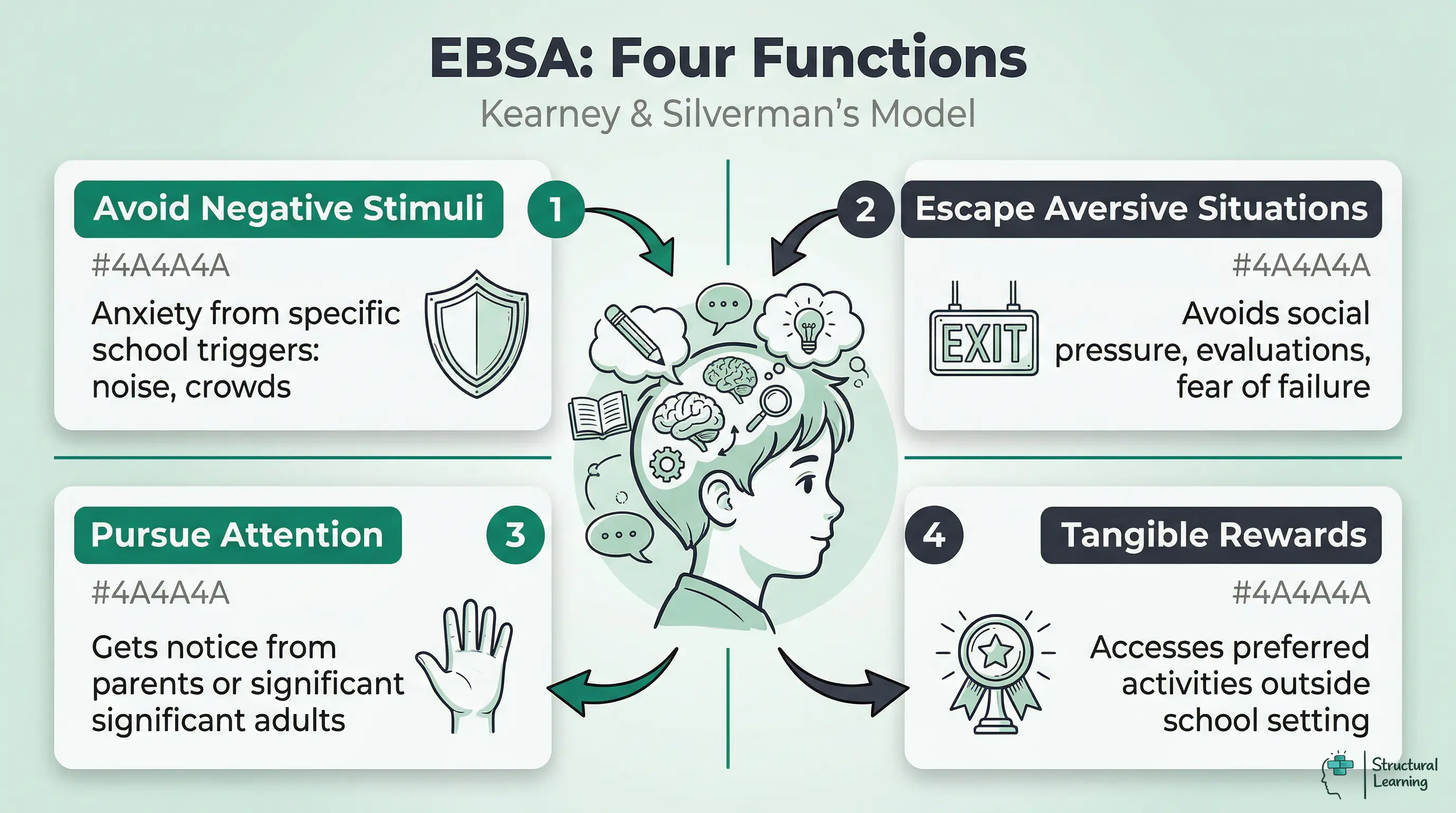
Kearney and Silverman (1990, 1993) proposed that school avoidance behaviour has one of four distinct functions. Their model is the basis for the School Refusal Assessment Scale-Revised (SRAS-R).
It also underpins most UK local authority assessment frameworks. Before designing an intervention, a SENCO needs to understand the function. This is the most important diagnostic step.
These functions involve avoiding negative feelings, escaping social pressures, seeking attention, and gaining rewards (Cole et al., 2003; Kern et al., 2007; Oliver et al., 2011). Learners can show multiple functions, but usually one stands out as most important (Lambert et al., 2006).
ANA and ESE functions benefit from CBT, exposure, and adjusted environments (Kearney, 2002). PAS needs family support with school adult input (Kearney, 2002). PTR, the rarest, needs changed reinforcement, making school better than home (Kearney, 2002).
A practical diagnostic starting point is to note when the distress peaks. If distress is highest at the threshold of school and dissipates once the learner is inside (or at home), you are likely seeing ANA, ESE, or PAS. If the learner shows little apparent anxiety but simply prefers home, PTR is more probable. The SRAS-R questionnaire (available in child and parent versions from Kearney's original publications) gives a scored assessment of the primary function.
EBSA grows through clear stages. Early action means easier reintegration. Lancashire EPS (2023) and Thambirajah et al. (2008) describe three stages. These are emerging, developing, and entrenched.
At the emerging stage, a learner may attend inconsistently, produce somatic complaints on Sunday evenings, or request to leave school early. At the developing stage, avoidance becomes more frequent, distress more visible, and academic disengagement more pronounced. At the entrenched stage, the learner may have been absent for weeks or months, family and school relationships are strained, and the gap between the learner and peers widens daily.
Monday and Friday absences may suggest that learners struggle with the move between home and school. Spikes after holidays can fit with anxiety during unstructured time. Absences from specific lessons may point to ANA or ESE functions. Record these patterns clearly, because EHCP assessments will ask about them.
The 15-day threshold is legally significant. Under Section 19 of the Education Act 1996, the local authority has a duty to arrange suitable alternative education for learners who cannot attend due to health reasons once absence has continued for 15 days. SENCOs need to know when they are approaching this threshold and what the notification procedure is in their LA.
Use this interactive screening checklist to spot warning signs of EBSA in a specific learner. It is based on Kearney and Silverman's four-function model. It gives risk-level guidance and recommended next steps for your setting.
The biggest gap in the existing EBSA literature is the absence of a structured timeline. Most guidance describes what to do but not when. The following six-week plan draws on Lancashire EPS guidance, Barnet's EBSA toolkit, and the Oxfordshire EPS EBSA School Toolkit (2025).
When a concern is raised, the SENCO's first task is information gathering, not diagnosis. Meet with the class teacher or form tutor to establish the pattern: when did concerns start, what triggers have been observed, and what has already been tried. Make direct, low-key contact with the family using a support-first approach rather than a compliance-first tone. The DfE's "Working Together to Improve School Attendance" (2024) is explicit that early contact should feel collaborative, not punitive.
Check the learner's file for any SEND documents, previous EP involvement, or reported medical conditions. From this point, record attendance data in your APDR format, even if there is no formal plan yet. Records written at the time carry much more evidential weight than accounts written later.
Use this period to assess the function of avoidance. The SRAS-R has parent and child versions, and each takes about 15 minutes to complete. If you do not have the full tool, use the West Sussex EBSA risk and resilience factor checklist as a useful structured option. Where executive function difficulties may be adding to avoidance, a short classroom audit can show whether planning, inhibition, or emotional regulation demands are driving distress.
Gather the learner's voice directly. Use a 1:1 conversation with a trusted adult, or a written tool if the learner finds spoken disclosure difficult. Learners with PDA profiles or high working memory difficulties may need alternative voice-gathering methods. Document everything: what the learner said, how they presented, and what the trusted adult observed.
Consider whether to request EP involvement at this stage. If the case involves complex autism, a PDA profile, significant trauma, or if the function of avoidance is unclear, an EP consultation is warranted. Most LAs will consider an early consultation request reasonable at the developing stage.
With assessment complete, write an APDR plan using the Assess-Plan-Do-Review cycle. The plan should specify: the identified function(s), the learner's named strengths and triggers, the specific adjustments being made, who is responsible for each element, and the review date.
Match interventions to the main function you have found. Do not use general anxiety help without considering the function. Sensory changes for an ANA-driven profile will not help a learner whose avoidance is maintained by pursuit of tangible reinforcement ().
Use Kearney's model to map intervention to function. Use differentiation in the learner's reduced timetable to keep them engaged while reintegration is staged ().
Write your initial APDR plan at this point and share it with parents. Multi-agency referrals, including CAMHS and school nursing, should be initiated now if not already in place. Document these referrals and their outcomes as part of your evidence base.
If the learner has been significantly absent, full-time reintegration is almost never the right first step. A graduated return programme should start from whatever the learner can currently manage (sometimes as little as one hour per week in a safe space) and increase in small, planned increments. Each step should be agreed in advance with the learner and family, with explicit criteria for moving forward and explicit provision for stepping back if distress increases.
| Term | Definition | Key distinguishing feature | SENCO implication |
|---|---|---|---|
| EBSA / EBSNA | Emotionally driven non-attendance; anxiety or distress underlies avoidance | Present at home, distressed by school; no concealment | Treat as SEMH need; graduated approach, not sanctions |
| Truancy | Deliberate absence without parental knowledge | Parents unaware; learner elsewhere during school hours | Attendance/safeguarding response; different legal pathway |
| School phobia | Historical term; phobic anxiety specifically about school environment | Specific, identifiable phobic triggers; now subsumed within EBSA | Treat as EBSA; phobia-specific CBT if EP confirms specific phobic component |
| Separation anxiety | Diagnosable anxiety disorder; distress at separation from attachment figure | Distress peaks at point of separation; present across settings | May co-exist with EBSA; CAMHS referral likely needed |
| Persistent absence (PA) | Missing 10% or more of sessions; includes all absence types | Statistical threshold, not a diagnosis or explanation | EBSA is one possible cause; needs individual assessment |
Identify a key adult: a named member of staff whom the learner trusts, who has protected time for daily check-ins, and who can help the graduated return. The key adult role is not a teaching assistant deployment question. It is a relational intervention with a named, consistent person.
Review the APDR plan at no longer than six-weekly intervals. Review more frequently if the learner's attendance changes significantly in either direction. At each review, ask: what has improved, what has not changed, what does the learner say about the interventions, and does the plan need to change?
Write down what happened at every review meeting. Include who was there, what was agreed, and where people did not agree. This record becomes the evidence base for any future EHCP needs assessment request.
EBSA intersects with at least four pieces of legislation and statutory guidance. SENCOs who do not understand this framework risk both legal exposure for their school and poorer outcomes for learners.
On attendance coding: EBSA absences should be coded as illness (code I) where a medical or psychological basis has been established. Where the basis is not yet clear, use code O (other authorised). Do not use unauthorised absence codes as a pressure mechanism in EBSA cases where the emotional basis is documented. The 2024 School Attendance (Learner Registration) Regulations updated coding requirements and SENCOs should review their LA's guidance on this.
Reduced timetables sit in a legally unclear position. They are not formally set out in legislation, but schools use them widely, and DfE and LA guidance refer to them as a time-limited, transitional measure. The DfE expects reduced timetables to be temporary, documented, agreed with parents, and linked to a plan for reintegration to a full timetable; most LA guidance suggests a maximum of eight weeks. If a reduced timetable goes beyond eight weeks without review, the LA's Section 19 duty may have been triggered.
SENCOs often ask at what point EBSA warrants an EHCP needs assessment request. The answer is not defined by a specific absence threshold. It is defined by the question of whether the learner's needs can be met through SEN support alone.
A needs assessment suits learners with two APDR cycles of SEN support. This support must not sufficiently improve attendance or wellbeing. Credible evidence (school, EP, or medical) must show significant needs. These needs then require an EHCP to specify and fund provision.
EBSA can be the primary presenting need in an EHCP request. Anxiety severe enough to prevent school attendance constitutes a significant SEMH need under the SEND Code of Practice. The EHCP needs assessment process itself requires the LA to seek evidence from the school, the family, an EP, and any other professionals involved. The SENCO's role is to prepare a thorough school advice document that covers: the history of the EBSA, the APDR records, the outcomes of each intervention, the learner's voice, and the family's views.
The evidence file for an EHCP request should include all APDR records from SEN support. It should also include any EP reports or consultation notes, plus medical evidence (GP letters, CAMHS reports). Add attendance data with context, the learner's own account of their experience, and evidence of reasonable adjustments made under the Equality Act. A request without APDR records written at the time is much harder to argue.
EHCPs can include support for EBSA, such as therapy hours, a keyworker, and reintegration. They may also include alternative arrangements and changes to the school environment. Annual EHCP reviews for learners with EBSA must include attendance data, progress against targets, and EP views (Carpenter, 2022; Frederickson & Cline, 2009).
At annual review, attendance targets in EHCPs need careful framing. A target of "full attendance" for a learner in entrenched EBSA is not realistic and risks the review becoming adversarial. A better frame is: "X sessions per week, with a planned increment schedule reviewed each half-term." This is measurable, achievable, and demonstrates that the provision is working.
A graduated return is more than a reduced timetable. It is a clear plan with named steps, clear rules for moving on, and room to adjust. Research on graduated exposure (Kearney & Albano, 2004; Finning et al., 2019) shows that avoidance maintains anxiety. The longer a learner stays away from the feared situation, the more the anxiety becomes fixed, so a gradual return with support works better than a long absence followed by a sudden full-time return.
| Function | What drives it | Classroom signs | First-line intervention |
|---|---|---|---|
| 1. Avoidance of negative stimuli (ANA) | Anxiety provoked by specific school stimuli: noise, crowding, transitions, sensory overwhelm, particular lessons | Somatic complaints before specific lessons; panic at transitions; hypervigilance in corridors; distress during assemblies | Environmental modification; sensory audit; predictable routines; safe space access; gradual exposure to identified triggers |
| 2. Escape from social or evaluative situations (ESE) | Fear of humiliation, failure, peer judgement, or academic performance | Absence peaks before assessments, presentations, PE; refuses to read aloud; avoids group work; catastrophic thinking about mistakes | Anxiety management; cognitive restructuring; graded exposure to feared situations; low-stakes performance opportunities |
| 3. Pursuit of attention from significant others (PAS) | Separation distress; desire to remain with parents or caregivers | Distress peaks at separation, not throughout the day; settles once parent leaves; frequent calls home requesting collection; follows staff | Structured separation routines; attachment-based key adult; parent coaching; reducing secondary gain from staying home |
| 4. Pursuit of tangible reward outside school (PTR) | School offers less reinforcement than home: gaming, screens, freedom, comfort | No apparent anxiety; calm when absent; school environment experienced as inherently less rewarding; often denied by family | Contingency management; reduce home reinforcement; increase school engagement; strengthen school relationships |
The key principles of a graduated return are: start from what the learner can currently manage (even if that is one hour in a quiet room). Increase in small steps agreed in advance, ensure each step feels achievable, and never remove a step without explicit agreement with the learner. The pace is determined by the learner's distress levels, not by the school's desire to normalise attendance quickly.
A practical graduated return programme should begin with what the learner can manage now. In the first week, the learner attends for one to two hours in a low-demand space with the key adult. In week two, the sessions increase and the learner joins one or two lower-anxiety lessons, such as a preferred subject, a small group, or a class taught by trusted teachers.
In weeks three and four, add one session at a time, with each change agreed and explained before it happens. By weeks six to eight, the aim is at least a half timetable that the learner can attend without daily rescue arrangements.
The safe space is a physical resource that makes graduated return viable. It needs to be quiet, consistently available, supervised by someone the learner trusts, and not used as a punitive or withdrawal space for other learners. The learner should know they can access it when distress levels become unmanageable, but with a clear expectation that they return to self-directed learning: a school guide once regulated. Scaffolding strategies used by the key adult during safe space time can maintain curriculum engagement without the full demands of the classroom.
Two things consistently undermine graduated returns. The first is staff inconsistency: if the learner encounters a different key adult, a changed room, or a broken agreement, trust collapses and the step is lost. The second is home routines: if staying home still brings high reinforcement, such as games, screens or undisturbed time, each step back into school becomes harder.
From November 2025, the Ofsted inspection framework brought in the biggest changes to school inspection in a decade. It introduced a five-grade scale: Exceptional, Strong standard, Expected standard, Needs attention, and Urgent improvement. It also changed the evaluation areas. Under the new state-funded school inspection toolkit, inspectors judge attendance with behaviour as one combined area, not as a separate strand.
The key shift is this: inspectors are now required to understand the reasons behind absence data, not simply the numbers. A school with 18% persistent absence that can demonstrate clear, personalised support for every EBSA learner is in a much stronger position. This is better than a school with 15% persistent absence that treats all absence as a compliance issue. The inspection toolkit (Ofsted, 2025) explicitly asks inspectors to examine whether "the school understands why learners are absent and takes effective action to support their return."
Inspectors want a clear attendance policy, applied consistently. It should distinguish absence causes. Schools must know EBSA learners and understand their needs, personalising support. A key adult should invest in relationships.
Schools must remove attendance barriers, not pressure learners, in line with the support-first approach set out in Working Together to Improve School Attendance (DfE, 2024).
When an inspector asks about a specific learner with high absence, you need to explain: the nature of the difficulty, the assessment completed, and the support in place. You should also cover the involvement of family and other agencies, and the progress made. You do not need to demonstrate that the learner now attends full-time. You need to demonstrate that the school's response is thoughtful, evidence-informed, and proportionate.
Schools that have strong SENCO systems for tracking EBSA cases, with documented APDR records and clear multi-agency communication, are the schools that perform well in this inspection strand. The documentation is your evidence that the school's approach is systematic rather than reactive.
Educational psychologists can help with Emotionally Based School Avoidance (EBSA). They use assessment tools to understand why a learner avoids school. They can also lead systemic meetings, which bring schools, families, and other services together. This helps teams build plans around learner needs (Murray et al., 2021; Frederickson & Cline, 2015).
Request EP help with EBSA when avoidance is unclear (Reid et al., 2011). Also request it for possible PDA or autism (Christie et al., 2011). Ask after two APDR cycles show no progress (Frederickson & Cline, 2002).
Seek support if family disagreements exist or EHCP assessment looms (Norwich, 2008). Early EP advice is better than delayed help with complex cases (Farrell, 2010).
To make effective use of limited EP time, prepare a focussed referral. Rather than "learner is not attending, please help," write: "Learner has been attending 40% of sessions since September. We have completed one APDR cycle using ANA-function interventions with limited improvement. We are uncertain whether the primary function is ANA or ESE, and we would like an EP consultation to clarify the formulation and advise on next steps." focussed referrals get faster responses and more useful outcomes.
| Stage | Attendance pattern | Behavioural indicators | Emotional indicators | SENCO action |
|---|---|---|---|---|
| Emerging | Occasional Mondays/Fridays; post-holiday dips; specific lesson avoidance | Repeated requests to go home; somatic complaints (headaches, stomach aches); tearfulness at drop-off | Mild anxiety; some reluctance; settles once engaged | Early monitoring; tutor check-ins; parental conversation; note pattern |
| Developing | 15-40% sessions missed; predictable trigger pattern; increasing frequency | Morning meltdowns; physical resistance; escalating somatic complaints; withdrawal from peers | Visible anxiety; low mood; fatigue; social withdrawal; academic disengagement | SENCO referral; start APDR cycle; assess function; consider EP referral |
| Entrenched | 50%+ sessions missed; full non-attendance common; weeks or months absent | Refuses to leave home; panic attacks; complete shutdown; family in crisis | Severe anxiety or depression; social isolation; significant academic regression | Multi-agency response; Section 19 consideration; EHCP needs assessment; CAMHS referral |
When the EP report arrives, read it alongside the APDR records. Identify which recommendations are already in place, which need extra resource, and which need a new referral. Turn the report's recommendations into clear APDR actions, with named responsible parties and review dates. EP recommendations that disappear into filing are wasted.
The move from primary to secondary school can trigger EBSA. Anxious learners may struggle with new environments, social issues, increased work, and losing friends. Post-pandemic data (PMC, 2024) shows higher Year 7 autumn term EBSA rates than before 2020.
Enhanced EBSA transition includes summer visits to the secondary school. Key adults should meet the learner before September. A sensory audit of the environment helps the learner and family.
Share clear information about routines and expectations. Use a transition plan, like an EBSA passport, to note triggers and supports.
At the Year 6 to Year 7 transition, pass on the APDR records and any EHCP. Also share the identified function of avoidance, the specific triggers, the key adult relationship, and the safe space arrangements. Include any reasonable adjustments already in place and the family's preferred communication channel. Gaps in this handover are one of the most preventable causes of EBSA escalation in Year 7.
Within-school transitions also matter. Moving from Year 9 to Year 10 (with new option subjects and new teachers), and from Year 11 to post-16 (with a completely new environment), are both identified EBSA escalation points. For learners with ADHD, autism, or PDA profiles, these transitions warrant the same level of planning as the primary to secondary transition.
The transition plan should be written by the SENCO in collaboration with the learner, shared with the receiving setting at least one term in advance, and followed up at the start of the new academic year. The SENCO's role does not end at the handover meeting.
Autistic learners often avoid school, Munkhaugen et al. (2017) showed. School refusal affects 53% of autistic learners, compared to 5-10% of all learners. Sensory issues and masking exhaustion drive avoidance for many autistic learners. They may not just fear social judgement or separation (Kearney).
Autistic learners avoid school when sensory input overwhelms them. Neurotypical children with EBSA may avoid specific anxiety triggers. Schools overload autistic learners with bright lights and noise.
Unpredictable schedules add to this. When overwhelmed, school avoidance is a survival response. (Strand and Lindegaard, 2021) found the same.
Sensory Overload as a Trigger
Brereton and Tonge (2005) found 89% of autistic learners have strong sensory sensitivities. Sensory avoidance is different from anxiety avoidance because it responds to stimuli happening in the moment. A learner in a loud hall is not simply anxious, they feel genuine distress. A learner shutting down in assembly is experiencing sensory overload.
SENCOs face a clear challenge: sensory EBSA and anxiety EBSA can look similar on records. Both involve absence and reluctance to attend (Kearney, 2002). The difference is in the pattern: sensory distress is linked to specific times or places (Evans et al., 2018), while anxiety avoidance spreads to school itself (Elliott & Place, 2019). Sensory EBSA often improves when the setting changes, but anxiety needs graded exposure (Muris & Field, 2011).
Masking, Burnout, and the Avoidance Cycle
| Legal framework | Key duty | SENCO action | Evidence required |
|---|---|---|---|
| Education Act 1996, Section 19 | LA must provide suitable education when a learner cannot attend due to illness or exclusion after 15 consecutive or cumulative days | Notify LA when threshold approaches; request alternative provision; document that school provision is no longer accessible due to health | Medical or EP evidence that attendance is not possible; school's record of attempts made |
| Equality Act 2010 | Anxiety meeting the disability threshold (substantial, long-term effect on normal day-to-day activities) triggers duty of reasonable adjustments | Document adjustments made; ensure they are not just planned but implemented; revisit if ineffective | Adjustment log; evidence of effect; any medical confirmation of disability status |
| SEND Code of Practice (2015) | SEMH is a recognised category of SEND; graduated approach applies; EHCP available where needs cannot be met through SEN support alone | Follow APDR cycle; document impact of SEN support; request EHCP assessment if SEN support insufficient | APDR records; evidence of provision and impact; pupil voice; parental views |
| DfE Attendance Guidance (August 2024) | Statutory guidance places EBSA within a support-first framework; penalty notices inappropriate where emotional factors are identified | Classify absence correctly; do not apply penalty notices to EBSA cases; use support plan, not prosecution pathway | Accurate attendance codes; support plan documentation; evidence of communication with family |
| Children Missing Education (CME) | Schools must notify the LA if a learner's whereabouts become unknown or if home education becomes a concern | Maintain welfare contact; notify LA if contact is lost; do not remove from roll without LA agreement | Contact log; LA notification records; roll maintenance documentation |
Cage et al. (2018) found autistic learners often mask to meet social norms. This takes much energy and, over time, causes burnout. Burnout shows as tiredness and withdrawal, not always depression (Cage et al., 2018). Eventually, learners become unwilling to continue masking (Cage et al., 2018).
For some autistic learners, school avoidance emerges not because school itself has changed, but because the energy cost of maintaining a masked presentation has exceeded their reserves. They may have coped successfully for years, then suddenly begin missing days. This pattern can puzzle schools and families, who see a previously compliant learner suddenly refusing school without an obvious trigger. The trigger is internal: depletion.
PDA (Pathological Demand Avoidance) and EBSA
Some autistic learners may show a PDA profile, which can bring anxiety and a strong need for control. Demands can be hard for these learners (Totsika et al., 2011). Schools place many demands on learners, so lessons and social expectations can feel like pressure to comply. This can create high anxiety and lead to non-attendance (Totsika et al., 2011).
PDA profiles show anxiety-like symptoms like distress (Christie et al., 2011). Standard anxiety treatments often fail and may worsen avoidance (O'Nions et al., 2016). Anxiety relates to perceived control loss, not a specific thing (Newson et al., 2003). Reducing demands and offering choices benefits PDA learners (Gillberg, 1999).
Practical Adjustments for Autistic Learners with EBSA
Research shows some adjustments work better than anxiety interventions for autism-related EBSA. These adjustments prevent problems, rather than just reacting to them (indicated by prior research such as that of Kern et al., 2015; and Sofronoff et al., 2005).
Sensory audit. Conduct a detailed environmental audit using the learner as the expert.
What times of day are most overwhelming? Which spaces are intolerable? Which transitions trigger shutdown?
Use this data to create a timetable that minimises unavoidable sensory load. If assembly is unbearable, can the learner join via video link or in a smaller, quieter space? If the dining hall is a sensory nightmare, can lunch be taken elsewhere?
Reduced and predictable timetable. A flexible plan can help a learner re-engage more than full-time mainstream inclusion. The key is to make routines specific and known. For example, a learner who attends three mornings and one afternoon, with the same subjects, spaces, and staff, may engage more and feel less distress than on a full timetable with changing subjects and staff.
Safe space. Unlike a traditional "calm corner," an effective safe space for an autistic learner is genuinely low-demand. No therapeutic check-ins, no "how are you feeling?" conversations, no implicit expectations to regulate. Simply a quiet, predictable space with the same trusted adult available (not present, but available) if needed.
Visual structures and schedules help learners. Use written and visual timetables. Pre-teach changes, as ambiguity can cause anxiety (Hodgdon, 1995). Clear visuals lower sensory and cognitive burdens (Mesibov et al., 2005).
Key adult consistency. Assign one named key adult who is consistent and understands autism. This adult should avoid over-scaffolding, which means giving more help than the learner needs, and should respect autonomy. They become the anchor point and guide the graduated return.
When to Consider Autism Assessment
Consider an autism assessment when learners with EBSA do not respond to standard anxiety support, such as graded exposure, reassurance, or CBT (Gillberg, 2010). This is especially important if the avoidance includes sensory issues, demand avoidance, strong interests, or communication differences (Strang et al., 2020). Many autistic learners, especially girls and those from minority groups, are not diagnosed until later (Lai et al., 2015). Concern about EBSA at school can be the first time their support needs are formally recognised (Rotheram-Fuller et al., 2019).
Murray (2018) notes that autism is often underdiagnosed in girls because many learn to mask autistic traits at school. A learner may seem quiet, compliant, and well-organised on paper, but still be struggling deeply inside. EBSA can be the main concern that finally leads to proper assessment.
| EBSA trigger (autistic learner) | Why it differs from neurotypical | EBSA trigger (neurotypical learner) |
|---|---|---|
| Sensory environment (fluorescent lights, noise, crowding) | Real-time sensory pain, not anxiety. Cannot be "managed" through coping strategies alone. | Social or evaluative anxiety (fear of humiliation, peer judgment) |
| Unpredictable schedules, sudden changes, transitions | Cognitive overload; breaks predictive models; causes shutdown rather than panic | Specific feared situations (presentations, assessments) |
| Masking demands; need to suppress autistic presentation | Neurotypical presentation is not required; fatigue is cumulative over months/years | Absence of anxiety triggers; avoidance emerges suddenly |
| Perceived demands; perceived loss of autonomy (PDA) | Anxiety is about demand itself, not content of the demand. Reassurance worsens it. | Separation from attachment figure; desire for parental attention |
| Mismatch between processing speed and social pace | Creates shame and withdrawal; slow processing speed is not accommodated | Academic performance fear; worry about test results |
If you suspect unidentified autism, raise this directly with parents and the educational psychologist. You can ask for autism to be considered as part of an EP assessment at any stage of the APDR cycle. This is especially important if standard interventions are not working.
EBSA guidance is useful, but the evidence base is uneven. Heyne et al. (2019) warn that school attendance problems are often grouped under loose labels such as refusal, truancy or withdrawal, even when several causes operate at once. A learner with sensory overload, family stress and fear of peer judgement can be misread if the four-function model is applied as a fixed checklist rather than as a working formulation.
The evidence for intervention is also mixed. Maynard et al. (2018) found that psychosocial interventions can improve attendance. However, short-term effects on anxiety were less secure, and many studies had small samples, weak follow-up, and varied measures. In the UK, there is another limit: much EBSA advice comes from local authority toolkits, attendance policy, and practitioner judgement, so controlled trials do not always back it.
Use two learning theories in EBSA planning with care. Vygotsky (1978) helps explain guided participation and graded support, but argued that the zone of proximal development is often made too simple and is hard to measure in the same way across tasks and cultures. supports retrieval practice for memory, yet Pan and Rickard (2018) found that transfer depends on how well the task matches the learning and on feedback. In practice, this means quizzes cannot fix anxiety, sensory distress or unsafe peer contexts on their own.
Cultural limits matter. Most evidence comes from Western school systems and may underrepresent autistic learners, minoritised families and learners with limited access to mental-health services. Even so, these theories remain valuable when SENCOs treat them as disciplined tools for inquiry, not scripts, and adapt them to the learner's context.
EBSA stems from intense anxiety (Kearney, 2008). Learners stay home, parents know. Truancy involves hidden absences; parents are unaware.
Standard attendance procedures are needed. Treat EBSA as a social, emotional and mental health concern.
Kearney and Silverman (1996) found four school avoidance reasons. Learners may avoid negative stimuli, escape social pressure, seek caregiver attention, or want rewards. Knowing the reason is key, as each needs different support.
SENCOs should start a graduated approach straight away, using the Assess, Plan, Do, Review cycle. First, identify the specific function behind the avoidance with assessment tools such as the School Refusal Assessment Scale. Schools must also keep detailed records of all interventions. This evidence is critical if an EHCP needs assessment becomes necessary.
Section 19 of the Education Act 1996 is triggered when a child has been absent for 15 days due to health reasons, which includes severe anxiety. At this point, the local authority must provide suitable alternative education. Schools should proactively coordinate with the local authority and provide clear evidence of the child's distress to ensure this legal duty is met.
Teachers can change learning areas to cut sensory overload and build routines. If learners fear being judged, remove reading aloud tasks for a time. Safe spaces and quiet exits help lower anxiety, as suggested by Muris et al (2001) and Rapee & Spence (2004).
EBSA is often wrongly handled like standard attendance issues, which increases learner distress. Schools struggle to help without knowing why the learner avoids school. Document the graduated approach promptly, or future support applications will fail (Reid, 1983).
Karpicke, J. (2008). The critical importance of retrieval for learning.
Vygotsky, L. (1978). Mind in society: The development of higher psychological processes.
The following studies underpin the assessment frameworks and intervention principles described in this guide. Each is directly relevant to SENCOs designing EBSA support.
Measuring the function of school refusal behavior: The School Refusal Assessment Scale
Kearney, C.A. & Silverman, W.K. (1993). Journal of Clinical Child Psychology, 22(1), 85-96.
This is the foundational paper introducing the four-function model of school refusal behaviour (avoidance of stimuli, escape from aversive situations, attention seeking, and pursuit of tangible reinforcement). For SENCOs, identifying the maintaining function before intervention is the diagnostic step that determines whether reintegration support will work.
Finning, K., Ukoumunne, O.C., Ford, T., Danielsson-Waters, E., Shaw, L., Romero De Jager, I., Stentiford, L. & Moore, D.A. (2019). BMJ Open, 9(6).
This systematic review of 36 studies establishes the two-way relationship between school absence and mental-health difficulties: anxiety contributes to absence, and absence in turn increases anxiety. The practical implication for SENCOs is that waiting for external mental-health input before starting reintegration can worsen outcomes; school-based support needs to start in parallel.
Understanding School Refusal: A Handbook for Professionals in Education, Health and Social Care
Thambirajah, M.S., Grandison, K.J. & De-Hayes, L. (2008). Jessica Kingsley Publishers.
The leading UK practitioner text on school refusal. It offers assessment frameworks, an emerging-developing-entrenched stage model, and multi-agency intervention principles that translate directly into SENCO planning.
An analysis of UK local authority (LA) emotionally based school avoidance (EBSA) guidance
Hammond Price, C., Bond, C., Hatton-Corcoran, S. & Lyons, R. (2025). Educational Psychology in Practice.
This review analysed 48 UK local authority EBSA guidance documents collected between June and August 2023 using a newly developed evaluation tool. It maps which themes, principles, evidence bases and practical resources are common across English LAs and where guidance diverges. For SENCOs working across authority boundaries, it is the most current map of UK practice.
Emotionally Based School Avoidance in the post-COVID-19 pandemic context: a perfect storm
Lester, K.J. & Michelson, D. (2024). BMJ Mental Health, 27(1), e300944.
The paper sets out why EBSA rose after 2020: disrupted routines, heightened anxiety, regressed social skills and reduced in-school mental-health capacity. It identifies the learner-level characteristics that make early identification more reliable, which is directly useful for SENCO triage at the assessment stage.
Start your EBSA response by identifying which of Kearney's four functions is driving the avoidance, then build your APDR plan around that specific function. The function determines the intervention. Without that diagnostic step, even well-resourced support plans produce inconsistent results.