Updated on
September 24, 2026
Dynamo Maths: A Teacher's Guide to Dyscalculia
Dynamo Maths is a research-based dyscalculia screening and intervention programme. A SENCO guide to assessment, intervention planning and alternatives.


Updated on
September 24, 2026
Dynamo Maths is a research-based dyscalculia screening and intervention programme. A SENCO guide to assessment, intervention planning and alternatives.
Dynamo Maths: A Teacher's Guide to Dyscalculia helps teachers use Dynamo Maths to screen and support learners with lasting difficulties in number sense, calculation and mathematical reasoning (Dowker, 2024). This matters because dyscalculia is not laziness or number dyslexia. It is a specific learning difficulty that can affect quantity, magnitude, arithmetic fact retrieval and working memory.
In a Year 3 lesson, a learner may read 47 correctly but still struggle to say whether 47 is closer to 40 or 50, or use fingers for addition within ten while peers move to column methods. Dynamo Maths helps a SENCO turn that pattern into assessment evidence, targeted practice and a classroom plan that combines digital tasks with concrete resources.
Dynamo Maths supports learners with lasting difficulty in number sense. Dynamo Education built the programme around the NumberSenseMMR framework. This framework has reported correlational validation from University of Oxford researchers, rather than recent peer-reviewed RCT evidence (Dowker, 2016; Dowker, 2024). The programme screens for difficulties with number meaning, magnitude and relationships, then links the results to focused practice and support planning.
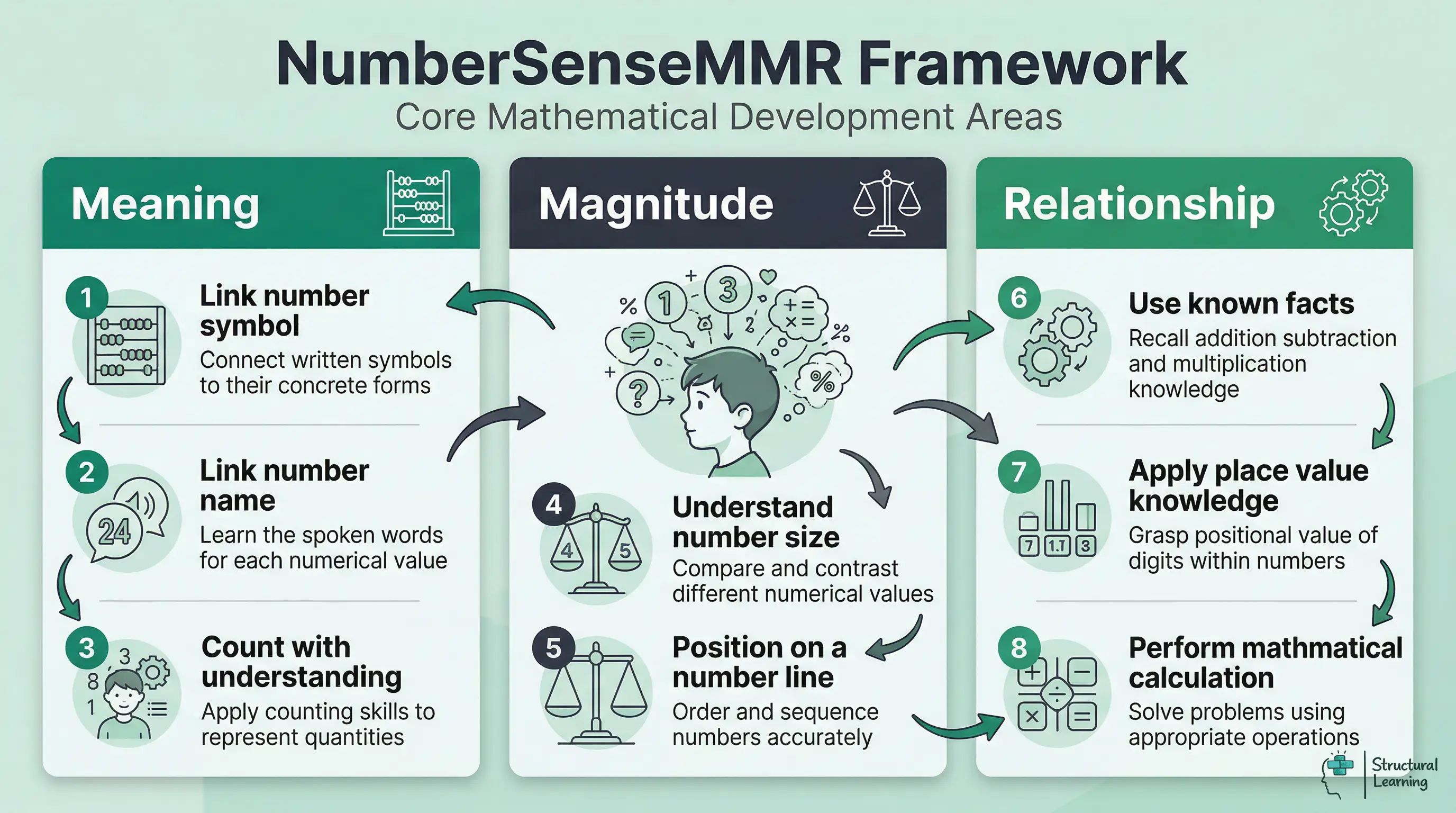
The NumberSenseMMR framework guides the programme. It breaks down maths learning into Meaning, Magnitude and Relationship, a structure that aligns with wider research on separable components of numerical cognition (Dehaene, 1992; Dowker, 2024).
Meaning links symbols to number names and counting. Magnitude covers number size understanding (Wright et al., 2012). Relationship focuses on using facts and place value for calculations (Gray & Tall, 1994).
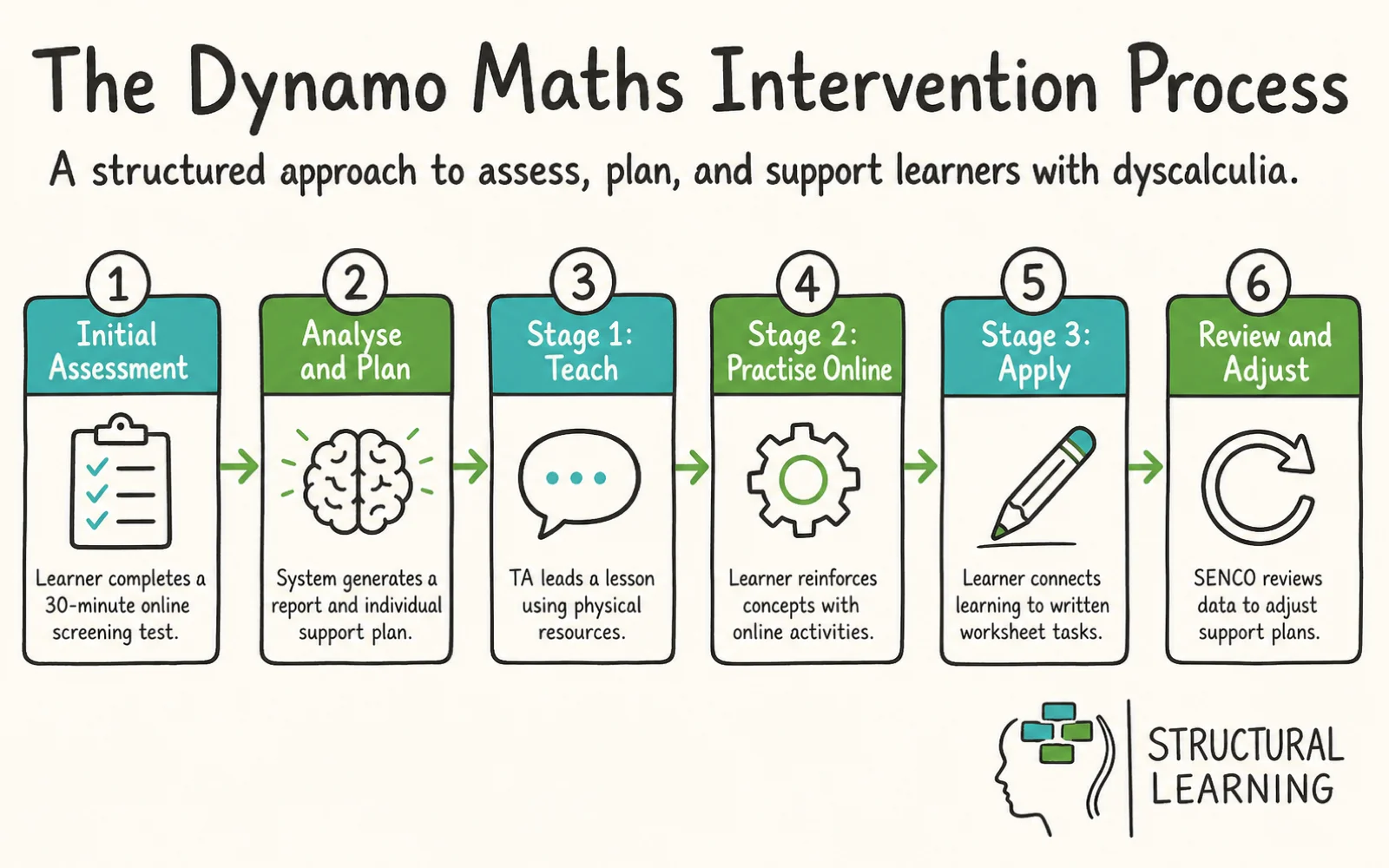
A SENCO uses the Dynamo Assessment to investigate why a Year 3 learner has made little progress despite extra support. After the learner completes the thirty-minute online test, the teacher receives a heatmap of strengths and gaps. The teacher can see that the learner understands number names but cannot compare the magnitude of two numbers. This evidence helps the teacher explain the difficulty to parents and plan concrete work with counters, number lines and comparison language.
Tick the behaviours you observe in a learner. This is not a diagnostic tool, but helps identify children who may benefit from a formal dyscalculia screening such as Dynamo Maths.
From Structural Learning | structural-learning.com
The programme is for learners in Key Stage 1 and Key Stage 2 who are behind their peers in maths. The designers made it for children with developmental dyscalculia, a specific learning difficulty that affects arithmetic skills. It can also support learners with gaps caused by absence, poor working memory, or general learning difficulties.
Schools often use the tool for learners with spiky profiles of attainment. These children can achieve expected standards in literacy but fall behind in numeracy. The tool supports learners with Special Educational Needs and Disabilities (SEND) who require a highly structured, small-step approach to learning. This includes learners with autism or ADHD, but schools should check co-occurring dyslexia, language and working-memory needs rather than assuming a single-label profile (Morsanyi et al., 2018; Moll et al., 2021).
A teacher identifies a learner in Year 5 who consistently fails weekly mental maths tests as a candidate for the programme. While the class moves on to fractions, this learner still relies on counting fingers for simple addition within ten. The learner demonstrates high levels of anxiety during maths lessons. Working through the Dynamo activities reduces their stress levels through predictable structure and immediate feedback.
The programme starts with the Dynamo Assessment. This screening takes 20 to 30 minutes. It measures a learner's NumberSenseMMR skills against age expectations. The system shows weaknesses, a score, and percentile.
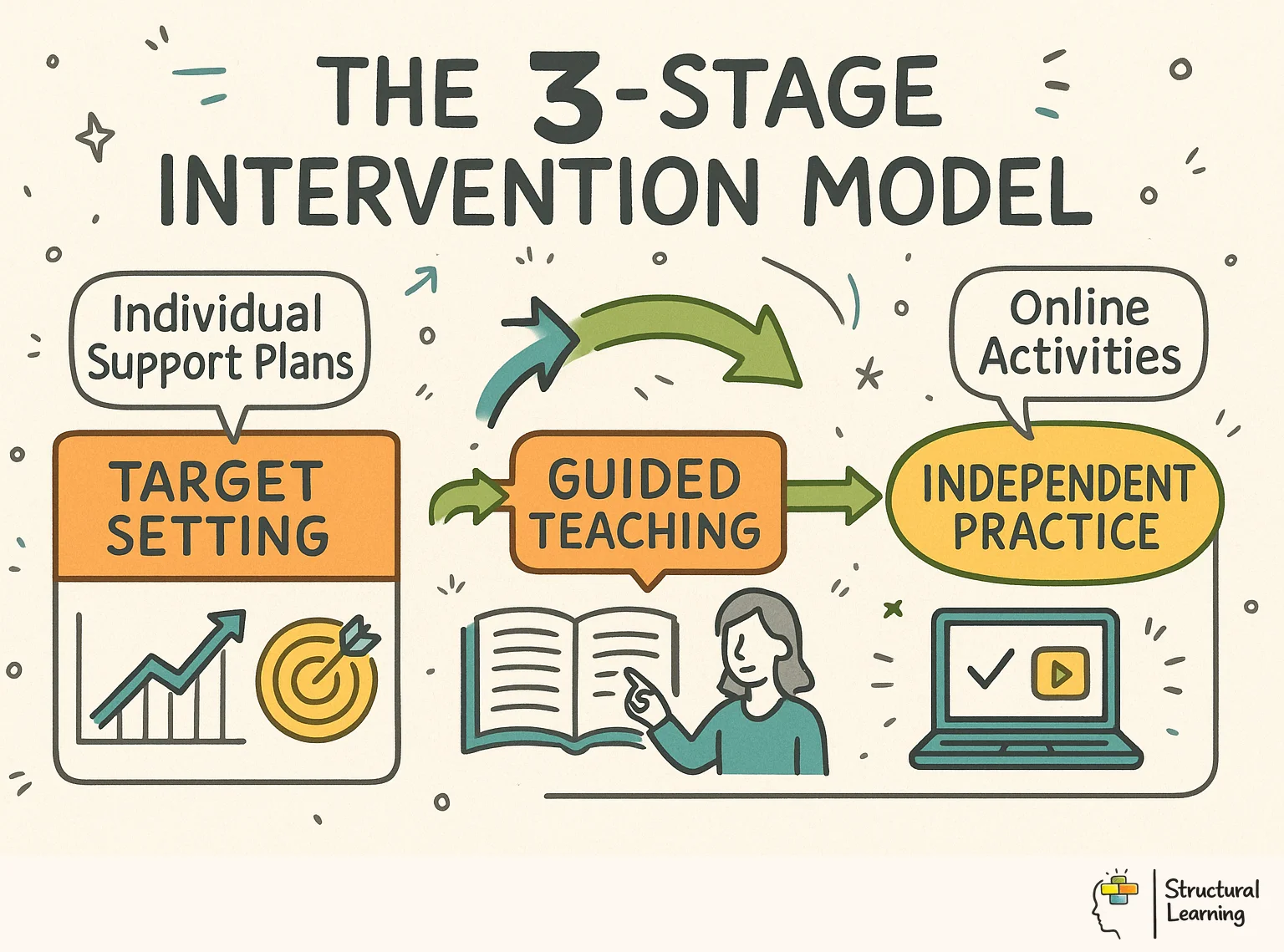
After assessment, the system creates an Individual Support Plan. This plan shows needed lesson plans and online activities for each learner's gaps. The intervention uses a three-stage teaching model.
First, the teaching assistant teaches a lesson using resources. Second, the learner completes online tasks for quick reinforcement. Third, the learner uses worksheets to connect to written work.
A teaching assistant works with a Year 2 learner on the concept of more or less. The assistant starts by using physical counters and a printed lesson plan to show that five counters are more than three. The learner then moves to the computer to play a game where they click on the larger of two sets of dots. Finally, the learner completes a worksheet where they write the greater than or less than symbols between pairs of numbers.
The strongest evidence for Dynamo Maths is that it aligns with numerical cognition research. It is not yet definitive proof that the programme causes long-term gains. Butterworth (2005) links dyscalculia to weak number processing.

Dehaene's triple-code model separates Arabic numerals, verbal number forms and quantity representations (Dehaene, 1992). Dynamo tasks that ask learners to subitise, compare quantities and estimate on number lines fit this account.
Oxford University confirmed that the assessment tasks measure maths skills accurately. Butterworth and Yeo (2004) say early help supports long-term maths success. Identifying number sense weaknesses helps prevent the Matthew Effect. Sweller's (1988) Cognitive Load Theory informs the programme, so learners' memory is not overwhelmed.
A SENCO uses this evidence base when drafting an EHCP application. They write that the learner's standard score of 72 indicates a significant deficit in core number sense, placing them in the lowest 3 per cent of the population. They cite research to explain that without intensive intervention at the magnitude level, the learner will struggle to access the curriculum (Dehaene, 1992). This level of academic rigour strengthens the school's case for additional funding.
Begin by reviewing current numeracy support through the graduated approach, or through an MTSS or RTI model. Universal classroom teaching remains Tier 1. Dynamo screening can help identify learners for targeted Tier 2 practice.
Persistent non-response should trigger SENCO review, family discussion and, where appropriate, specialist assessment (Fuchs & Fuchs, 2006; Ouyang et al., 2024). The SENCO identifies learners for assessment, trains staff to read reports and plans funding through SEND, Pupil Premium or intervention budgets.
Consistency determines the success of the programme. Schools that see significant gains schedule the intervention for at least three sessions per week. Each session lasts around fifteen to twenty minutes to avoid cognitive fatigue. The SENCO sets up a system for data review, meeting with intervention leads once every half term to adjust individual support plans.
A SENCO organises a meeting with the Year 4 teaching team to discuss the implementation. They decide the intervention will take place in the school library every Tuesday, Wednesday, and Thursday at 9:15 am. The SENCO produces an intervention handbook for the teaching assistant containing login details and a schedule. When the assistant notices a learner is stuck, they record this in the handbook for the SENCO to review.
Compare interventions by what learners actually do, not by the platform name. Dynamo Maths gives assessment data and planned digital practice. Numicon and other CPA approaches use objects, gestures and spatial patterns to make quantity visible. For dyscalculic learners, this matters: number thinking is built through seeing, moving and using the physical environment (Alibali & Nathan, 2012).
| Feature | Dynamo Maths | Numicon | Power of 2 | 1stClass @Number |
|---|---|---|---|---|
| Delivery Model | Online activities and lesson plans | Physical tiles and hands-on resources | Daily 1 to 1 coaching with a book | Small groups led by a teacher or TA |
| Target Age | 5 to 11 (plus older SEN) | Early Years to Key Stage 3 | Key Stage 2, 3, and adults | Key Stage 1 and 2 |
Dyscalculia screening helps teachers spot learners who need support (Butterworth, 2010). Visual and tactile tools, which learners can see and touch, build number understanding (Wynn, 1992). Practice improves mental calculation skills (Gray & Tall, 1994). Small group work helps build basic numeracy skills (Dowker, 2004).
Assessment choices vary. Standardised screeners (e.g., Hodgen & Marks, 2013) give data quickly.
Teachers use informal assessments daily (Black & Wiliam, 1998). Some skip formal entry tests. Many use pre and post tests (Coe, 2013).
A screen-based task can spot a magnitude gap, or difficulty judging size and quantity. Concrete materials then help the learner feel and reorganise that gap. Before a Year 2 learner clicks the larger dot set on screen, the teaching assistant can build both quantities with counters and ask the learner to move them into five-frames. The learner can then match the representation to the digital task, keeping Dynamo within a concrete-pictorial-abstract route rather than replacing it (Bruner, 1966; Education Endowment Foundation, 2022).
A school leadership team uses this table to decide which programme to invest in. They conclude that while Numicon supports general classroom learning, they need Dynamo Maths for vulnerable learners who require diagnostic assessment. The headteacher purchases a ten-learner licence for Dynamo to target those with potential dyscalculia. They use Numicon as the universal support tool in every classroom.
A SENCO in Manchester noticed that TAs were skipping the offline lesson plans. To fix this, the SENCO held a breakfast briefing where they modelled a five-minute lesson plan on place value. They showed the TAs how to use physical base-ten blocks to represent the numbers on the screen. The TAs felt more confident in teaching the concepts, and the learners' progress scores began to rise.
The platform pinpoints learners needing extra support with number skills. It pairs assessment with a three-stage intervention (Butterworth, 2010). The system uses the NumberSenseMMR framework, breaking maths into simpler parts (Bryant, 2005; Thompson, 2009).
Online assessment tasks check the learner's number understanding (Butterworth, 2010). The tool measures magnitudes and relationships against age norms. The report identifies cognitive gaps linked to dyscalculia (Geary, 2004; Mazzocco & Myers, 2003).
The pricing varies depending on the number of learner licenses and the subscription length. It is sold as an annual licence. Many schools fund the cost through their SEND or pupil premium budgets.
The tool draws on theories of numerical cognition and a reported Oxford correlation study (Dowker, 2016; Dowker, 2024). Teachers should still distinguish framework validation from direct intervention efficacy, which means proof that the intervention itself improves outcomes. It uses the Concrete-Pictorial-Abstract (CPA) approach. Experts in dyscalculia (Butterworth, 2010) pinpointed its focus on basic learner skills.
The programme is designed for learners in the primary age range, from 5 to 11 years old. It is also used with older learners in secondary school who have significant learning needs.
Dynamo reports can support EHCP conversations because they give standardised scores, percentile ranks and dated evidence of response to intervention. They should be used alongside qualitative evidence: work samples, teacher observations, parent accounts and learner voice. This mix is stronger than one heatmap. It shows both the learner's cognitive profile and the learning context (Bronfenbrenner, 1979; Vygotsky, 1978; Creswell & Plano Clark, 2018).
The programme's core teaches number skills. Learners recognise and count numbers. Learners also compare numbers and estimate (Geary, 1994). Finally, they learn how numbers work together (Jordan et al., 2008; Siegler et al., 2009).
A teacher uses these FAQs to explain a child's progress to a parent. The teacher says that the Dynamo assessment shows the child has a specific difficulty in the Magnitude part of the framework. This means the child finds it hard to see that 10 is twice as much as 5. This explanation shifts the conversation from blame to support and provides a clear path forwards.
Check your school's tracking data this afternoon to identify three learners in Key Stage 2 who are making the least progress in mathematics.
Dynamo Maths gives teachers useful assessment data, but its evidence base needs careful reading. The reported Oxford work on NumberSenseMMR is correlational. This means it can support construct validity, or whether the tool measures what it claims to measure, but it cannot prove that the intervention causes lasting gains.
A stronger claim would need independent trials, active comparison groups and evidence that learners use their gains in classwork, not only in the programme interface. This near-transfer problem is well documented in cognitive training research (Simons et al., 2016).
A second critique concerns pedagogy, or how learners are taught. Dyscalculic learners often need concrete materials, gesture, talk and spatial representations before they use abstract symbols. A screen-based programme can miss these embodied routes. Teachers can reduce this risk by pairing tasks with counters, ten frames, number lines and oral reasoning (Alibali & Nathan, 2012; Education Endowment Foundation, 2022).
Third, dyscalculia is not one clear category. It can overlap with ADHD, dyslexia, language needs and maths anxiety. Some learners with high anxiety still have adequate mathematical competence (Devine et al., 2018; Morsanyi et al., 2018). Dowker (2024) also argues that mathematical ability is better understood through different component skills, not one global label.
Cultural and methodological limits also matter. Standardised scores based mainly on English-speaking curricula may not apply neatly across other languages, curricula or teaching traditions. Recent work with Hong Kong kindergarten children shows that early signs of number difficulty can vary by context and method (Ouyang et al., 2024). Even so, Dynamo Maths remains useful when it is one part of a wider assessment and teaching cycle, not a standalone diagnosis.
These peer-reviewed studies provide the
Dynamo Maths helps learners struggling with basic number. It uses NumberSenseMMR to organise maths learning around number meaning, magnitude and relationships (Butterworth, 2010; Dowker, 2024). The programme identifies cognitive issues (Attwood et al, 2011; Holmes & Adams, 2006). It offers activities to improve learner progress (Barth et al, 2019).
Teachers use a three-stage model. A teaching assistant first delivers a lesson, using resources (Jones, 2003). The learner then does online tasks for instant practice. Finally, learners complete worksheets to link to writing.
Structured routines and prompt feedback lower anxiety and stress. Learners systematically practise arithmetic, avoiding abstract overload. Standardised scores objectively support EHCP applications and yearly reviews.
Butterworth (2010) links dyscalculia to difficulties in basic number processing, especially magnitude. Dynamo Maths reflects that theory by assessing subitising, comparison and number relationships. The research support is strongest for those underlying constructs, while direct evidence for Dynamo-specific long-term transfer remains more limited (Dowker, 2016; Dowker, 2024).
Schools achieve the best results when they commit to short, regular sessions where learners practise targeted skills. The recommended frequency is three to four sessions per week. Each intervention period should last between 15 and 20 minutes to maintain learner focus and maximise retention.
Learners often start written maths before they have secure quantity, order and magnitude ideas. Teachers can mistake this for low effort or general difficulty rather than a problem with processing quantity (Butterworth, 2010). Interventions can fail when they rely on worksheets alone, skip subitising practice or use timed tests that add anxiety and working-memory load (Devine et al., 2018; Lievore et al., 2025).
Geary and colleagues found that learners with mathematical learning disability develop number-line understanding later and more variably than typically developing peers (Geary et al., 2008). More study here could help struggling learners progress in maths.
D. Geary et al. (2008)
This research provides evidence for dyscalculia assessment and intervention in school settings.
Kaufmann et al. (2011) looked at basic skills and maths links. Their research explores if number sense affects Year 3 learner arithmetic. Domain-general abilities also impact mathematical learning disability (Kaufmann et al., 2011). They suggest interventions for both could help struggling learners.
R. Cowan & Daisy Powell (2013)
Butterworth (2010) explored maths skills and learning difficulties. Alloway and Passolunghi (2011) considered memory and language as general factors. De Smedt et al. (2011) found numerical factors are also important for learner success.
Early maths screeners help identify learners needing support (Chong et al., 2022). This helps teachers provide timely interventions, says Clements (2004). Research by Clarke & Shinn (2004) shows early identification improves outcomes. Effective tools allow targeted support, as suggested by Gersten et al. (2005).
David J. Purpura et al. (2015)
This research provides evidence for dyscalculia assessment and intervention in school settings.
, was carried out. The original study, by Wilson et al. (2006), showed promise; however, more research is needed for definitive conclusions. A more recent study by Butterworth et al. (2011) suggests that computer games can be an engaging way to improve maths skills in learners with difficulties. The Number Race may offer a fun, alternative approach to support these learners.
Further studies should explore its long-term impact and effectiveness in diverse classroom settings. This could lead to better targeted interventions. Wilson et al. (2006) found promise for The Number Race.
Butterworth et al. (2011) suggest games engage learners. The Number Race could help struggling learners enjoy maths. More research will show its long-term impact. Classrooms need targeted interventions for all learners.
Anna J Wilson et al. (2006)
Wilson and colleagues describe software for dyscalculia remediation that tackles core number-sense deficits. It addresses problems linking number sense to symbols. The hypothesis builds on work by Butterworth (2010) and Dehaene (2011).
Learners at risk of maths difficulties show early number-processing problems. Chu and colleagues call for further work to understand how those early gaps relate to later mathematical attainment.
Felicia W. Chu et al. (2013)
Libert and Feigenson's 2023 study looked at number sense and maths learning. They tested if number sense affects maths difficulties. Researchers assessed 68 young learners at risk of struggling in school. They used maths tasks and measured intelligence (Libert & Feigenson, 2023).
Barth et al (2019).
Butterworth (2005).
Butterworth (2010).
Chong et al. (2022).
Coe (2013).
Dehaene (1992).
Dowker (2024).
Dowker (2000).
Dowker (2004).
Geary (1994).
Geary et al. (2008).
Gersten et al. (2005).
Jones (2003).
Kaufmann et al. (2011).
Ouyang et al. (2024).
Simons et al. (2016).
Wright et al. (2012).
Wynn (1992).