Updated on
September 23, 2026
Do It Again: What the Research Actually Calls This Technique
Making learners repeat a routine is classified in behaviour analysis as overcorrection, which is a punishment procedure. That changes how to describe it.


Updated on
September 23, 2026
Making learners repeat a routine is classified in behaviour analysis as overcorrection, which is a punishment procedure. That changes how to describe it.
What is Do It Again in Teach Like a Champion?
Do It Again is technique 51 in Teach Like a Champion 3.0. Learners repeat a routine that was not done to standard, such as entering the room or packing away, until it meets the standard. In applied behaviour analysis the same procedure is called positive practice overcorrection and is classified as punishment, which is worth knowing before it becomes a school policy.
A Year 7 class comes in noisily. The teacher sends them out and has them enter again, properly, in silence. It works, the room settles, and the technique that just happened has a name in the research literature that most teachers using it would not recognise.
Do It Again means having learners repeat a routine until it meets the standard: re-entering a room, packing away again, redoing a transition. It is technique 51 in Teach Like a Champion 3.0 (Lemov, 2021), in the chapter on procedures and routines, and its stated logic is practice rather than punishment.
There is no direct research on Do It Again as a classroom technique. What there is instead is a behaviour-analytic literature on the procedure it actually is. Axelrod, Brantner and Meddock (1978) reviewed overcorrection, and "positive practice", making a person repeat the correct form of a behaviour after an error, is classified there as an overcorrection procedure, which is to say a punishment procedure, with the ethical constraints that classification carries.
That does not settle whether to use it. It settles how to describe it. Presenting a punishment procedure as ordinary rehearsal is the thing this article will not do.
Do It Again is the instruction to repeat a routine that was not done to standard. The class walks in again, or packs away again, until it is right. Its purpose in the book is to set the standard by demonstrating it rather than describing it, and to make the standard non-negotiable without a confrontation.
It is fast, it needs no paperwork, and it usually works in the moment. Those three properties are why it spreads.
No study tests Do It Again by name. Two literatures bear on it. One is about practice, and it is weaker support than it looks. The other is about the behavioural procedure and about who gets it, and it is the more important of the two.
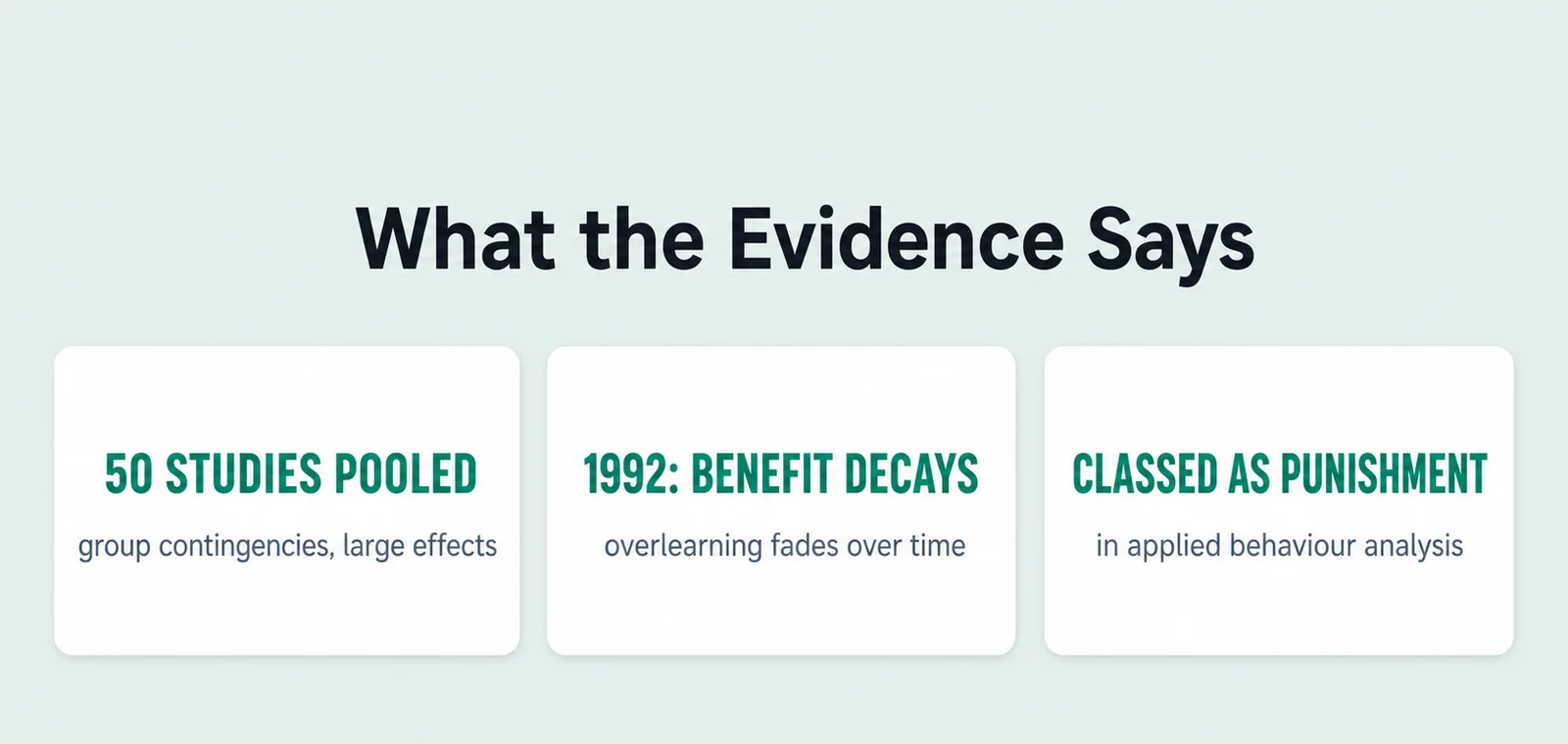
The rehearsal case rests on overlearning: practise past the point of first success and retention improves. Driskell, Willis and Copper (1992) meta-analysed it and found a real retention benefit that decayed substantially over the retention interval. Repeating a routine is not an inoculation. Whatever it buys, it fades, which is an argument for routine building over time rather than for dramatic corrections.
Whole-class contingencies do have a strong evidence base. Little, Akin-Little and O'Neill (2015) meta-analysed 50 studies of group contingency interventions and reported large effects. One caution before anyone quotes that number: single-case-design effect sizes are calculated on a different metric from the Cohen's d figures used elsewhere in education, and putting them side by side would mislead every reader.
This is the part that is missing everywhere else. In applied behaviour analysis, requiring a person to repeatedly perform a correct form of behaviour after an error is positive practice overcorrection. Axelrod and colleagues' review sets out both its effectiveness and the ethical constraints attached to it, because it is categorised as punishment.
A teacher may reasonably decide that a thirty-second re-entry is a proportionate and humane thing to ask. That is a defensible position. What is not defensible is describing it as neutral practice while the discipline that developed it classifies it otherwise.
Do It Again requires a teacher to judge, in the moment, that a routine was not good enough. That judgement is discretionary, and discretion is where the evidence on school discipline is least comfortable.
Skiba and colleagues (2002) found that racial and gender disproportionality in school punishment concentrates in subjectively judged offences rather than in objectively defined ones. Demie (2021) documents the experience of Black Caribbean learners in school exclusion in England. A "that was not good enough" call is precisely the subjective category those studies identify.
That is not a reason never to use the technique. It is a reason to notice which classes you use it on, and to be able to answer the question honestly.
Making thirty learners repeat an entrance because two of them talked is a collective consequence, and it works through the group's displeasure at the two. Tangney, Stuewig and Mashek (2007) review the moral emotions and find that shame, unlike guilt, predicts withdrawal, externalising and hostility rather than repair. The collective version of Do It Again is a shame mechanism by design.
Allen and colleagues (2018) meta-analysed school belonging, which is a measured construct with real outcome links. Whatever compliance the repetition buys, the belonging cost is not nothing.
Four constraints follow directly from the evidence above, and together they keep the technique proportionate rather than punitive. Keep it to one short repetition, name the standard instead of the people, use it while a routine is being taught rather than when you are annoyed, and never apply it to a learner whose profile makes repeated demands an escalation.
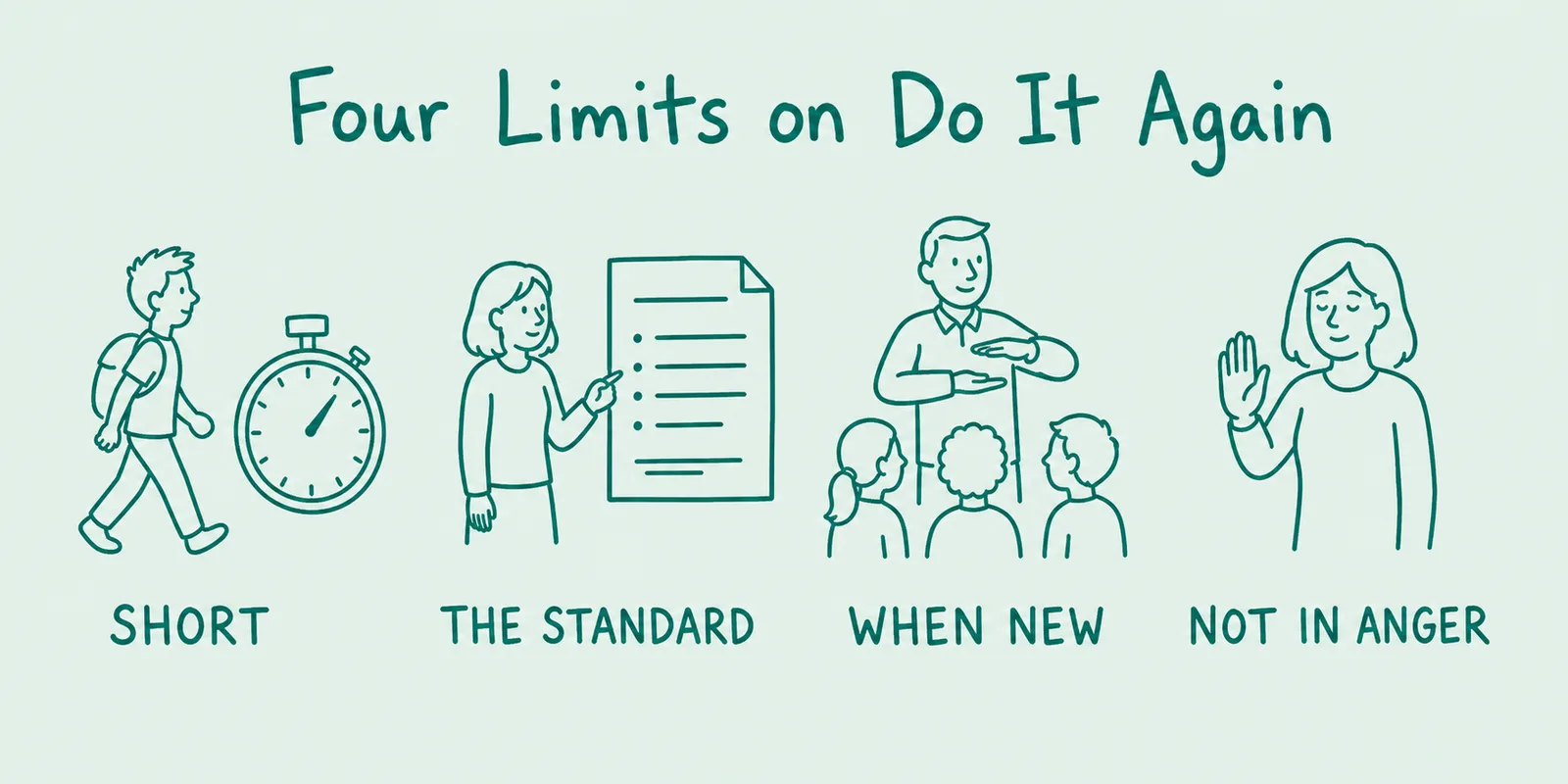
Keep it short and immediate. Thirty seconds, once. A repetition that runs three times has stopped being practice.
Name the standard, not the people. "Again, and this time silent from the door" describes what you want. "Some of you were talking, so we are all going again" tells the class who to blame.
Do it when the routine is new, not when you are annoyed. The practice argument works at the point of teaching a routine. Reaching for it in irritation is the version the critique describes.
Never use it on an individual with a demand-avoidant profile. For a learner with a demand avoidant presentation, a repeated compliance demand is the single most reliable escalation trigger available to a teacher. O'Nions and colleagues (2016) describe the features; the PDA Society's guidance is to reduce and reframe demands rather than repeat them.
The technique has no direct evidence base at all. The supporting literature is about skill practice, not compliance, and it shows decay. The nearest exact match in the research is a punishment procedure with ethical constraints attached. And the discretion it depends on is the discretion the disproportionality evidence flags. That combination should make any department think carefully before writing it into a policy, and it does not mean a single quiet re-entry is wrong.
It is technique 51, in the chapter on procedures and routines. Learners repeat a routine that was not done to standard, such as entering the room or packing away, until it meets the standard.
In behaviour-analytic terms, yes. Requiring repetition of a correct behaviour after an error is positive practice overcorrection, which is classified as a punishment procedure. Teachers may still judge it proportionate, and they should describe it accurately.
It is a collective consequence that works through group displeasure, which makes it a shame mechanism. Shame predicts withdrawal and hostility rather than repair, so the collective version carries a cost the individual version does not.
Do It Again is one of the 63 moves in our complete guide to Teach Like a Champion, and it sits alongside classroom transitions as part of the same routines chapter.
Two techniques sit closest to this one: threshold and strong start, which prevents most of the entrances worth repeating; and least invasive intervention, the smaller move to try first.