Updated on
September 23, 2026
Least Invasive Intervention: Why the Smallest Fix Wins
Correction can cause the next incident. The escalating cycle between teacher and learner is documented, and most misbehaviour is disengagement, not defiance.


Updated on
September 23, 2026
Correction can cause the next incident. The escalating cycle between teacher and learner is documented, and most misbehaviour is disengagement, not defiance.
What is Least Invasive Intervention?
Least Invasive Intervention is technique 55 in Teach Like a Champion 3.0. The teacher uses the smallest correction that will work, starting from a non-verbal signal, so that teaching continues and the learner does not become the focus of the room. The standard does not change; only the volume of the correction does.
A teacher stops mid-sentence to address a learner who is talking. The class turns round. Thirty seconds later two more learners are off task, and the teacher has to address those too. That escalating loop has been documented, and it is the reason this technique exists.
Least Invasive Intervention means using the smallest possible correction that will work, and preserving the flow of the lesson while you do it. It is technique 55 in Teach Like a Champion 3.0 (Lemov, 2021), in the chapter on high behavioural expectations.
Nelson and Roberts (2000) documented the mechanism directly, observing the reciprocal cycle in which a teacher's correction provokes further disruption, which provokes a stronger correction. That is the citation that explains why a small intervention beats a large one, rather than merely asserting that it does.
The premise about proportion also holds up. Sullivan and colleagues (2014) found that most reported classroom behaviour is low-level disengagement rather than defiance, yet teacher responses skew punitive.
Least Invasive Intervention is a scale of responses, used from the bottom up. The teacher chooses the quietest move that will do the job, so that teaching continues and the learner is not made the centre of the room's attention. The point is not leniency. The standard does not change; only the volume of the correction does.
The usual rungs run roughly: non-verbal signal, positive group correction, anonymous individual correction, private individual correction, lightning-quick public correction, then consequence. Each rung costs more attention than the one below it.
The mechanism is documented, the proportionality premise is supported, and the wider classroom-management literature identifies the practices this belongs to. What is missing is any test of the scale itself.
Nelson and Roberts observed ongoing reciprocal interactions involving disruptions in general education classrooms and documented the cycle: correction provokes further behaviour, which provokes stronger correction. This is the whole argument for starting small, and it is an observed mechanism rather than a plausible story.
Sullivan and colleagues supply the other half. If most of what teachers face is low-level disengagement rather than defiance, then most corrections are being pitched above the behaviour they answer, which is exactly the condition that starts the cycle.
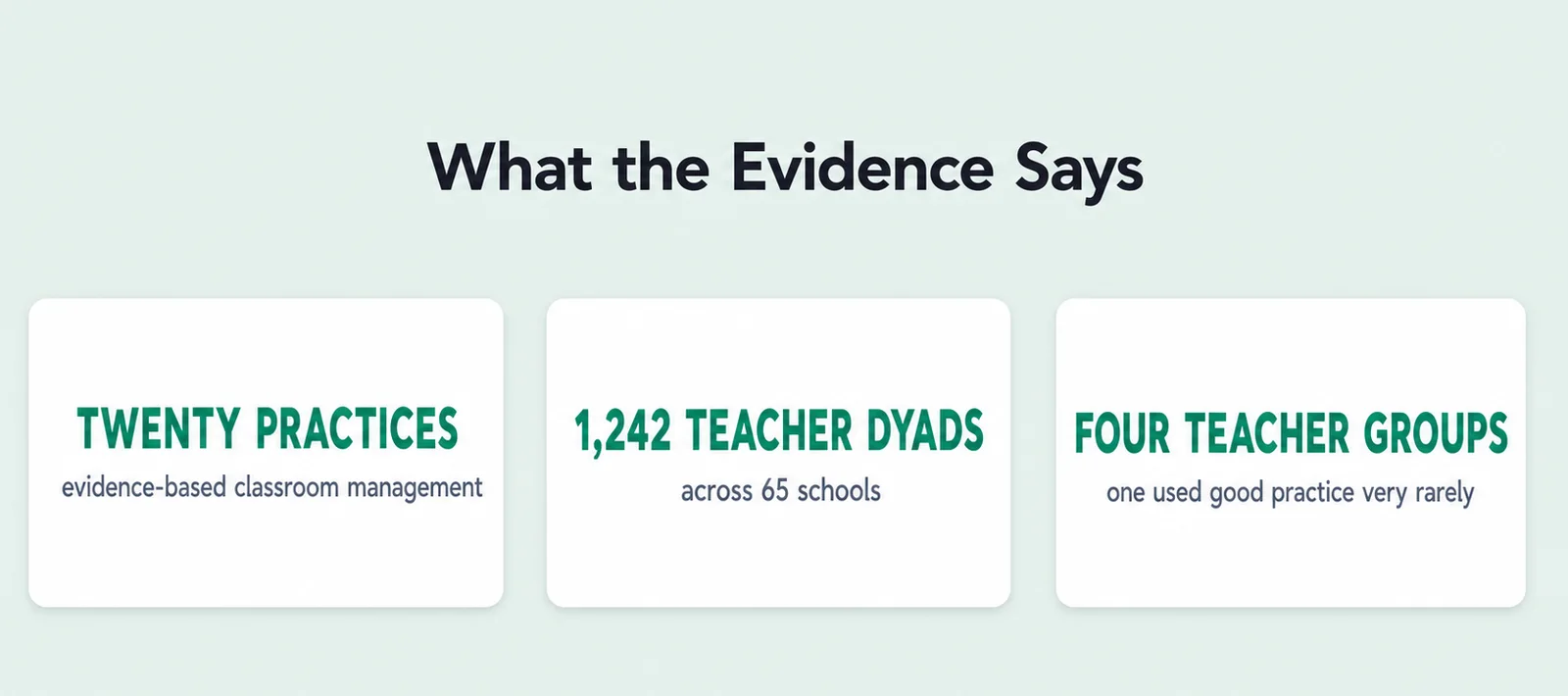
Simonsen and colleagues (2008) identify twenty evidence-based classroom management practices, which is the standard reference for what actually has support in this area. Chaffee and colleagues (2017) meta-analyse class-wide interventions for supporting behaviour.
Gage and colleagues (2018) give the field a quotable scale: 1,242 teacher-learner dyads across 65 schools, with latent class analysis finding four distinct groups of teachers, including one implementing evidence-based practice at very low rates. The variation between teachers is large, which is an argument for teaching these moves explicitly rather than assuming them.
For a UK audience the obvious anchor is the Education Endowment Foundation's guidance report on improving behaviour in schools, which is guidance rather than a study and is the document a British school will actually be held to.
Four habits, and the first two are where most teachers gain the most. Start at the bottom of the scale, keep teaching while you correct, make the correction private wherever it can be, and check that the smallest signal was actually received before you climb.
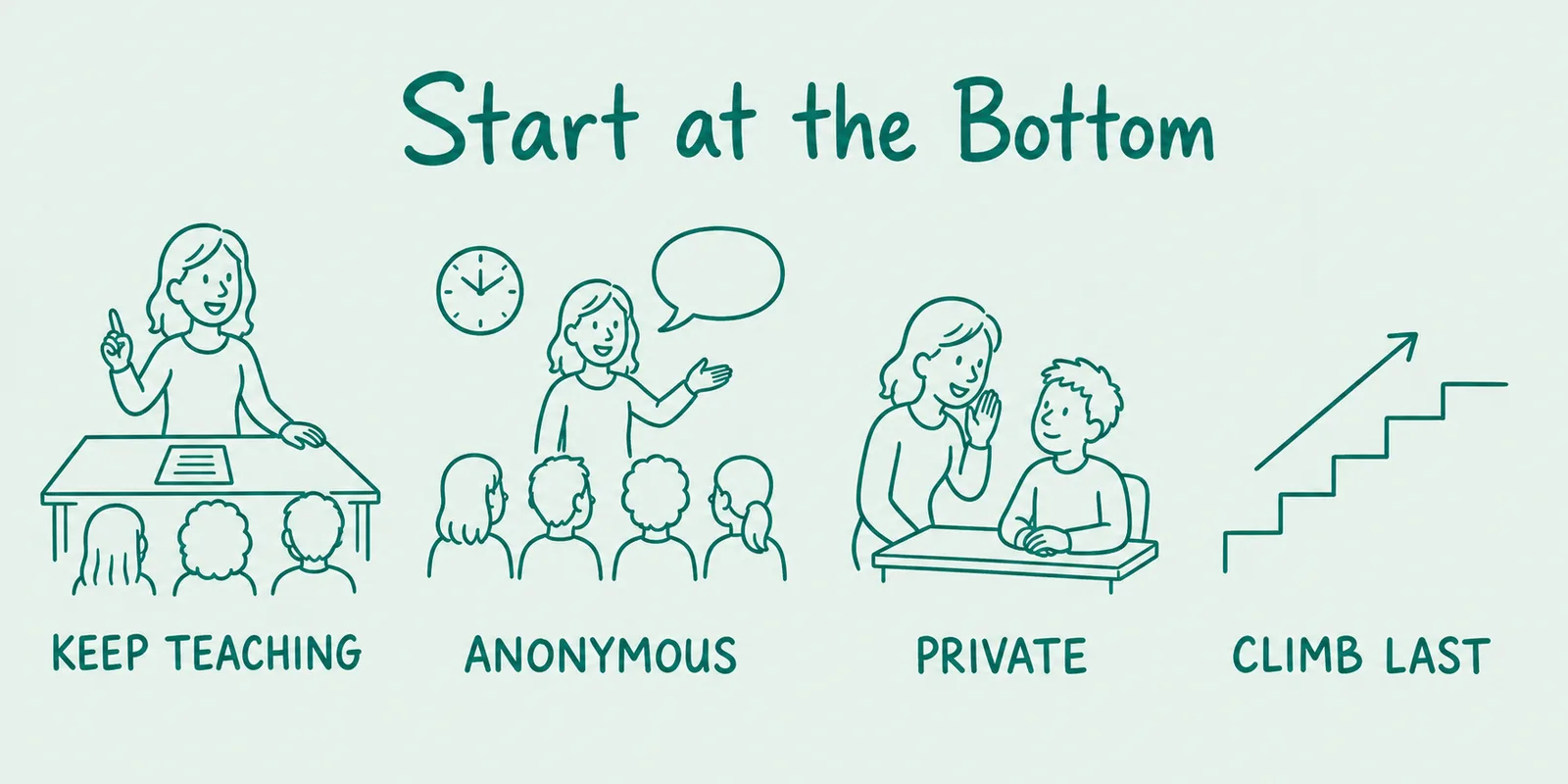
Correct without stopping. A hand on a desk, a look, a name dropped into the middle of your sentence. The lesson does not pause, so the correction costs the class nothing.
Anonymous before individual. "We should all be writing" addresses the room. It gives the learner a way back without an audience, which removes the incentive to defend themselves.
Private before public. A quiet word at the desk is a different event from the same words from the front. The content can be identical and the social cost is not.
Climb only when the rung below has demonstrably failed. Not when you are irritated. That distinction is the technique.
The scale assumes the learner perceives the signal, understands it as a correction, and can act on it. For several groups any of those three can fail, and a failed signal read as refusal is how a small thing becomes a big one.
For a learner with ADHD, the quiet signal may not register at all. DuPaul, Eckert and Vilardo (2012) meta-analysed school-based interventions for attention deficit hyperactivity disorder, and the practical implication here is direct: a non-verbal redirect assumes attention was available to catch it. When it was not, escalating reads as defiance when it is a perception failure.
For a learner with a language disorder, an indirect correction may not be understood as one. "We should all be writing" is a hint. Hints require inference. Say the thing plainly and quietly instead.
For a learner with a demand avoidant profile, climbing the scale is the trigger. Each rung is a firmer demand, which is the mechanism that escalates. Going sideways, offering a choice or changing the task, works where going up does not.
For an anxious learner, the public rungs cost far more than they appear to. A lightning-quick public correction is quick for the teacher and not for the learner receiving it.
No study tests the least-invasive scale itself, or the order of its rungs. What is evidenced is the escalation cycle it is designed to avoid, the disproportion between typical behaviour and typical response, and the general set of classroom management practices it belongs to. The specific claim that a quieter correction produces better outcomes than a louder one, all else equal, is a reasonable inference and not a finding.
It is technique 55 in Teach Like a Champion 3.0. The teacher uses the smallest correction that will work, from a non-verbal signal upwards, so that teaching continues and the learner does not become the focus of the room.
No. Every rung on the scale is a correction, and the standard does not move. What changes is how much attention the correction costs. Ignoring is not on the scale.
Because correction can generate the next incident. The reciprocal cycle between teacher correction and further behaviour is documented, and most classroom behaviour is low-level disengagement rather than defiance, so a large response is usually pitched above what it answers.
Least Invasive Intervention is one of the 63 moves in our complete guide to Teach Like a Champion, and it works alongside behaviour management strategies.
Two techniques sit closest to this one: strong voice, which is how the smallest rungs are delivered; and do it again, the move at the far end of the same scale.