Concrete Pictorial Abstract (CPA): A Maths Teaching Guide
The CPA approach explained: concrete manipulatives, pictorial representations, and abstract symbols. Based on Bruner's model with worked examples across primary maths.


The CPA approach explained: concrete manipulatives, pictorial representations, and abstract symbols. Based on Bruner's model with worked examples across primary maths.
Concrete, Pictorial, Abstract (CPA) is an effective method for teaching that offers a sustainable and deep understanding of maths to the students. Often marked as the concrete, representational, abstract framework, CPA was first proposed by the American psychologist Jerome Bruner.
Mastery learning in mathematics is detailed in our guide. It gives educators practical classroom strategies. We cite research by Bloom (1968), Carroll (1963) and Guskey (1997). This resource aids effective learner progress.
From Structural Learning , structural-learning.com
| Feature | Concrete Stage | Pictorial Stage | Abstract Stage |
|---|---|---|---|
| Best For | Initial concept introduction and hands-on exploration | Bridging physical understanding to symbolic thinking | Advanced problem-solving and mathematical reasoning |
| Key Strength | Multi-sensory learning through physical manipulation | Visual representation without physical constraints | Efficient symbolic manipulation and generalisation |
| Limitation | Requires physical materials and storage space | May oversimplify complex relationships | Too abstract for early learners |
| Age Range | Early years to elementary (ages 3-10) | Elementary to middle school (ages 6-14) | Upper elementary onwards (ages 10+) |

CPA approach is a crucial strategy to teach maths for mastery in Singapore. Through our work with schools, we have seen first hand how physical experiences can shape thinking. Many of the concepts children encounter within the curriculum are too abstract to fully understand during their early exposure. Learners need to be able to explore the problem using multi sensory approaches.
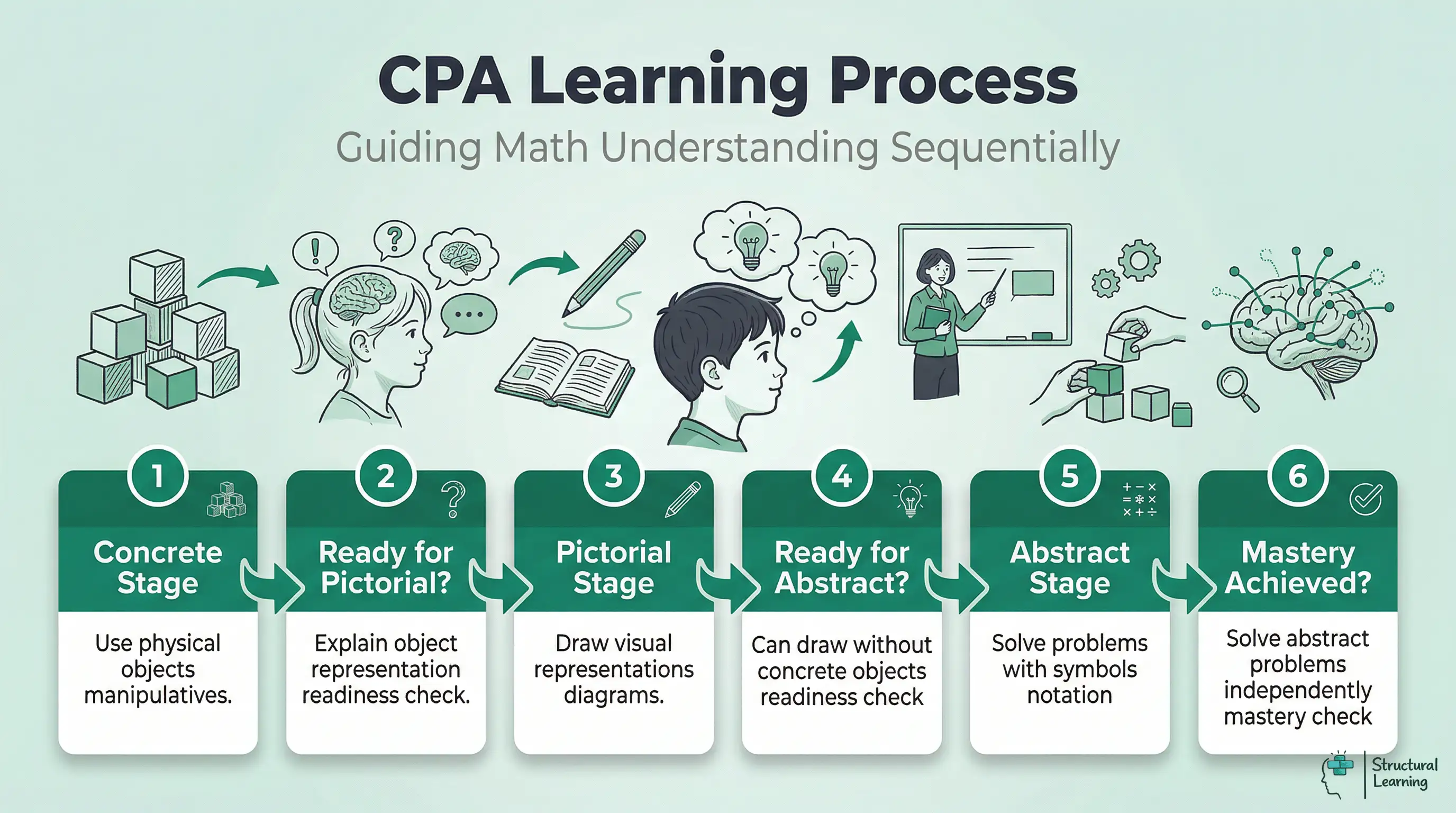
The CPA approach teaches maths using objects first, then abstract ideas. This helps learners understand concepts (Bruner, 1966). They develop mathematical thought with objects and models (Skemp, 1976; Piaget, 1954).
Researchers (no date given) find the CPA approach helps learners grasp maths concepts. Start with objects, then move to abstract ideas for strong understanding. This builds a firm base for later learning and problem solving.
Research shows that CPA boosts learner maths engagement. It uses visuals and real examples, making maths more relevant. This method helps learners to find maths more interesting. This increases their motivation (researchers, undated).
CPA starts with real objects, helping learners grasp maths concepts. For instance, use apples to teach addition, (Bruner, 1966). This solidifies understanding over simple memorisation. It also aids working memory (Baddeley, 2000) by anchoring abstract concepts.
Block models use real objects (Bruner, 1966). Learners use coloured blocks to picture maths (Dienes, 1960). Blocks link multiplication and area, connecting concepts to life. Questioning builds learner understanding (Vygotsky, 1978).
Use pictorial models to show maths problems. These models help learners see maths ideas, not objects. For example, use pictures for fractions; learners grasp parts of a whole (Bruner, 1966). Visuals support the move from concrete to abstract thought (Piaget, 1936).
Abstract maths uses bar and part-whole models (Bruner, 1966). Bar models show relationships between two amounts. Part-whole models show part and whole links (Skemp, 1971). Use this stage to check learner understanding (Black & Wiliam, 1998).
Our research has also shown us that this teaching approach shouldn't be limited to just Maths. The CPA method develops crucial thinking skills that transfer across subjects, and teachers can provide effective feedback at each stage to support learning.across all areas of learning.
Feedback improves learner outcomes significantly (Hattie & Timperley, 2007). Dylan Wiliam (2011) provides strategies for formative assessment in classrooms.
There are several benefits to using the Concrete Pictorial Abstract (CPA) approach in the classroom. Some of these benefits include:
Here are some tips for implementing the Concrete Pictorial Abstract approach in the classroom:
Teachers often rush the concrete and pictorial stages of CPA (Richard Skemp). Learners need enough time to understand concepts fully. Rushing to abstract maths undermines the approach. Relational understanding, built with objects and visuals, creates stronger maths knowledge (Richard Skemp).
Unsuitable resources can confuse learners, impacting maths understanding. Coloured counters risk distracting from place value structure (Uttal et al., 2009). Teachers should choose materials that clearly show maths relationships (McNeil & Jarvin, 2007). Clear, accurate pictures are better than just attractive images (Cook, 2007).
Teachers check if learners are ready to progress through CPA stages. Do learners show confidence with materials and explain concepts clearly? Questioning acts as formative assessment to check learner understanding. This supports each learner's progress (Bruner, 1966; Skemp, 1976; Piaget, 1952).
CPA effectiveness relies on adapting to age (Bruner). Early years teachers should stress concrete tools. Give learners time to explore materials before pictures. This builds strong maths foundations (Bruner).
Sweller's research (n.d.) shows that learners gain from using manipulatives, whatever their age. Learners grasp algebra and geometry concepts better with these tools. Frame them as problem-solving aids.
Teachers must adjust CPA pace for each age group. Younger learners might need weeks on concrete and pictorial tasks. Older learners progress faster but still need visuals (Bruner, 1966). Consider learners' past maths and confidence (Skemp, 1976) for choosing materials and abstract concepts (Piaget, 1936).
The Concrete Pictorial Abstract (CPA) approach helps learners understand maths. Teachers use real examples before abstract ideas. This gives learners a deeper grasp of the topic. CPA improves problem-solving and builds learner confidence (Jerome Bruner, 1966).
Researchers like Bruner (1966) show CPA builds conceptual understanding. It changes how learners perceive maths, making it more accessible. Skemp (1976) also supports this approach, increasing enjoyment.
CPA methods reshape maths learning over time. Learners build firm mental models using concrete, pictorial, abstract steps. This supports transfer, as Bransford et al. (2000) found. For example, fractions taught visually help learners understand percentages later (Bruner, 1966).
Research by Bruner (1966) shows concrete learning helps learners later. Give learners time with pictures and objects, as suggested by Clements and Sarama (2009). Avoid rushing to abstract maths too quickly. Learners gain confidence if they deeply understand each stage, according to Skemp (1976).
a deeper conceptual understanding for learners (Bruner, 1966). When learners grasp mathematical concepts more thoroughly, they can then apply their knowledge to new and challenging problems (Skemp, 1976). This approach supports the development of crucial problem-solving skills that learners can transfer across subjects (Boaler, 1998). Ultimately, effective CPA teaching methods foster a classroom culture where learners feel empowered to explore mathematical ideas, take risks, and engage in meaningful mathematical discourse with both their peers and educators (Vygotsky, 1978). *** CPA builds maths understanding (Bruner, 1966). Learners apply knowledge to new problems when they grasp concepts (Skemp, 1976). Problem-solving skills transfer across subjects (Boaler, 1998). Learners explore ideas and discuss maths confidently (Vygotsky, 1978).
Bruner (1966) described the Concrete Pictorial Abstract (CPA) approach. This method helps learners understand maths concepts well. Learners use objects (Concrete), then pictures (Pictorial). Finally, they use symbols (Abstract), as stated by Skemp (1971).
This approach allows learners to build solid mathematical foundations (Bruner, 1966). Start with physical objects to introduce new ideas. Next, use drawings so learners connect concrete and abstract (Kilpatrick et al., 2001). Finally, use symbols for advanced problem-solving (Skemp, 1971). Check if learners are ready before moving on.
Bruner (1966) and Piaget (1954) found the Concrete Pictorial Abstract approach aids learning. Skemp (1976) showed CPA boosts learners' problem-solving skills. This method also makes learning more interesting and useful.
These errors hinder learners' understanding (Piaget, 1936). Check learners' readiness before you progress to the next stage (Bruner, 1966). Too much focus on abstract symbols can confuse learners (Vygotsky, 1978). Smooth transitions between stages are vital for success (Ausubel, 1968).
Evidence for CPA's impact comes from learners applying concepts elsewhere. Engagement and symbol mastery also show success. Use regular checks and feedback to track learner progress (Bruner, 1966; Skemp, 1976; Piaget, 1954).
Visual, kinaesthetic, and multi-sensory resources are available now. This free pack includes posters and desk cards for learners. CPD materials are also provided for staff (Pashler et al., 2008).
3 evidence-informed resources to support diverse learning styles in your classroom.

Fill in your details below and we'll send the resource pack straight to your inbox.
We've also sent a copy to your email. Check your inbox.
Bruner's (1966) work explores learning through action, imagery, and symbols. Skemp (1971) discusses understanding maths using relational and instrumental approaches. Vygotsky (1978) highlights social interaction's role in learner knowledge construction. These papers offer insights into the Concrete Pictorial Abstract method.

Generate structured lessons that develop metacognition, oracy, and critical thinking. Backed by cognitive science, designed for the realities of the classroom.
Try the Thinking FrameworkOpen a free account and help organise learners' thinking with evidence-based graphic organisers. Reduce cognitive load and guide schema building dynamically.

{"@context":"https://schema.org","@graph":[{"@type":"Article","@id":"https://www.structural-learning.com/post/concrete-pictorial-abstract-approaches-in-the-classroom#article","headline":"Concrete-Pictorial-Abstract (CPA): Bruner's Model for","description":"The CPA approach moves from physical objects to visual representations to abstract symbols. Based on Bruner's enactive-iconic-symbolic model.","datePublished":"2021-11-29T12:35:18.974Z","dateModified":"2026-03-02T11:01:41.913Z","author":{"@type":"Person","name":"Paul Main","url":"https://www.structural-learning.com/team/paulmain","jobTitle":"Founder & Educational Consultant"},"publisher":{"@type":"Organization","name":"Structural Learning","url":"https://www.structural-learning.com","logo":{"@type":"ImageObject","url":"https://cdn.prod.website-files.com/5b69a01ba2e409e5d5e055c6/6040bf0426cb415ba2fc7882_newlogoblue.svg"}},"mainEntityOfPage":{"@type":"WebPage","@id":"https://www.structural-learning.com/post/concrete-pictorial-abstract-approaches-in-the-classroom"},"image":"https://cdn.prod.website-files.com/5b69a01ba2e409501de055d1/696a248fc3cf646a206e1c14_696a2488bde78487fd8794f0_concrete-pictorial-abstract-approaches-in-the-classroom-illustration.webp","wordCount":2116},{"@type":"BreadcrumbList","@id":"https://www.structural-learning.com/post/concrete-pictorial-abstract-approaches-in-the-classroom#breadcrumb","itemListElement":[{"@type":"ListItem","position":1,"name":"Home","item":"https://www.structural-learning.com/"},{"@type":"ListItem","position":2,"name":"Blog","item":"https://www.structural-learning.com/blog"},{"@type":"ListItem","position":3,"name":"Concrete-Pictorial-Abstract (CPA): Bruner's Model for","item":"https://www.structural-learning.com/post/concrete-pictorial-abstract-approaches-in-the-classroom"}]}]}