Elaborative Interrogation: A Teacher's GuideElaborative Interrogation: A Teacher's Guide - educational concept illustration

Updated on  

February 19, 2026

Elaborative Interrogation: A Teacher's Guide

|

February 19, 2026

Elaborative interrogation prompts students to explain why facts are true, building deeper schema and more durable memory. Subject-specific prompts, age-phase adaptations, and a five-week implementation guide.

Most teachers spend a significant portion of lesson time explaining things to students. Yet the research on memory formation consistently points in the opposite direction: explanations that students generate themselves are far more durable than explanations they receive passively. Elaborative interrogation is the structured practice of prompting students to ask "why?" and "how?" questions about the content they are learning, and it is one of the most underused high-utility strategies available to teachers at any key stage.

Key Takeaways

    • Elaborative interrogation requires students to generate explanations: Rather than receiving information, students answer "why?" and "how?" questions about facts they are learning. The act of explanation construction is what produces durable memory, not the act of reading or listening.
    • The strategy works by activating prior knowledge: When students explain why something is true, they must connect new material to what they already know. This integration process builds stronger schema and improves later retrieval, particularly on transfer tasks.
    • Dunlosky's 2013 meta-analysis rated it moderately high utility: Elaborative interrogation has consistent evidence of benefit across subject areas and age groups, though its effectiveness depends on students having enough prior knowledge to generate accurate explanations.
    • Subject-specific prompt design matters: Generic "why?" questions are less effective than carefully designed discipline-specific prompts. A Science teacher's elaborative interrogation questions look structurally different from a History teacher's, though both share the same underlying mechanism.

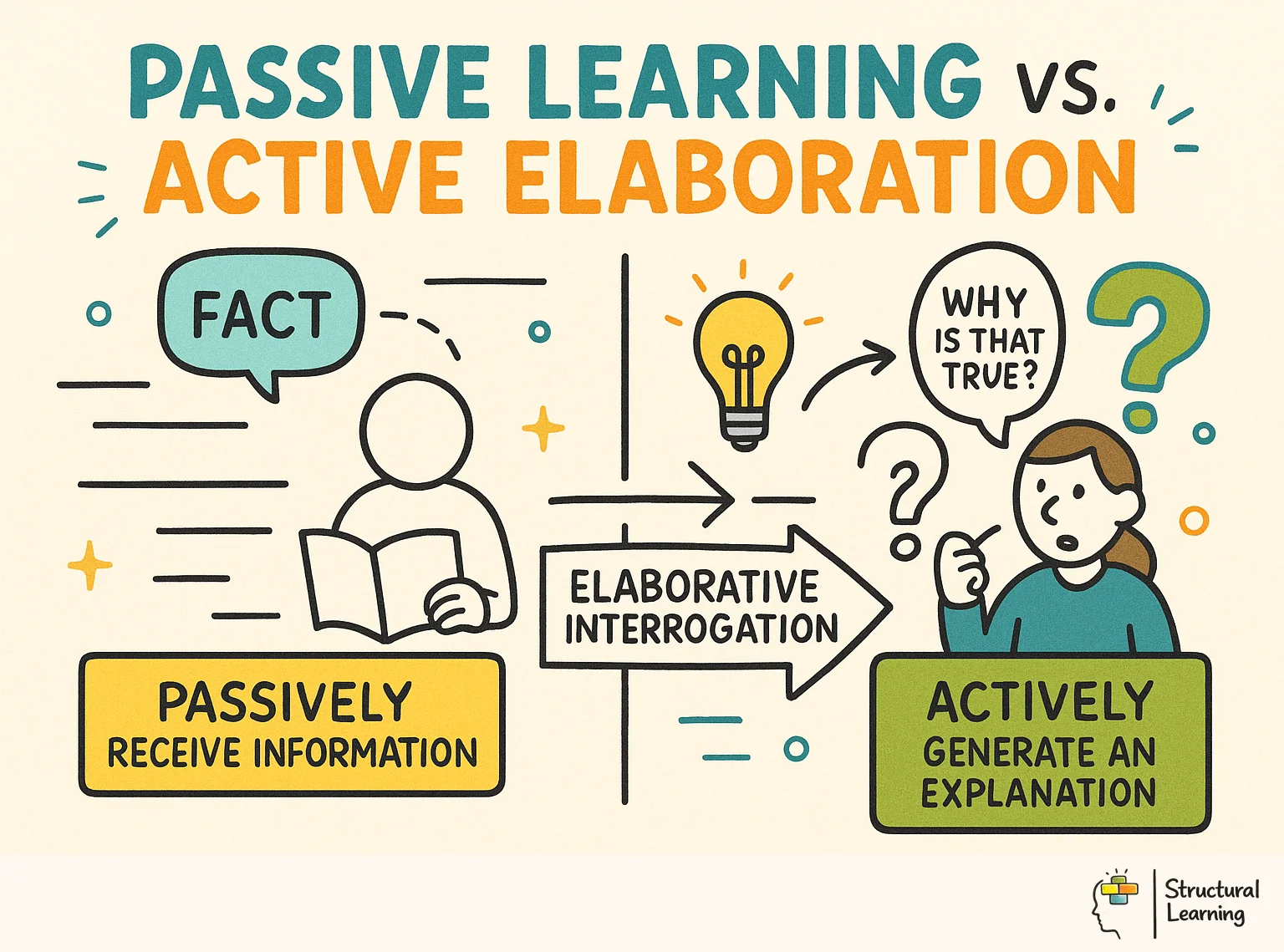
Passive Learning vs. Active Elaboration infographic for teachers
Passive Learning vs. Active Elaboration

What Elaborative Interrogation Is

Elaborative interrogation is a learning strategy in which students respond to "why?" and "how?" questions about factual statements they are studying. The term was coined by Michael Pressley and colleagues in a 1987 paper that demonstrated a striking effect: students who were prompted to explain why facts were true recalled significantly more of those facts than students who simply read the same information.

The core mechanism is straightforward. When a student reads "The Romans built roads in straight lines," they may process that sentence at a surface level and move on. When a student is asked "Why did the Romans build roads in straight lines?", they are forced to search existing knowledge, make an inference, and construct an explanation. That search-and-construct process encodes the fact more deeply. It also links the new information to existing knowledge structures, what cognitive scientists call schema, which makes later retrieval more reliable.

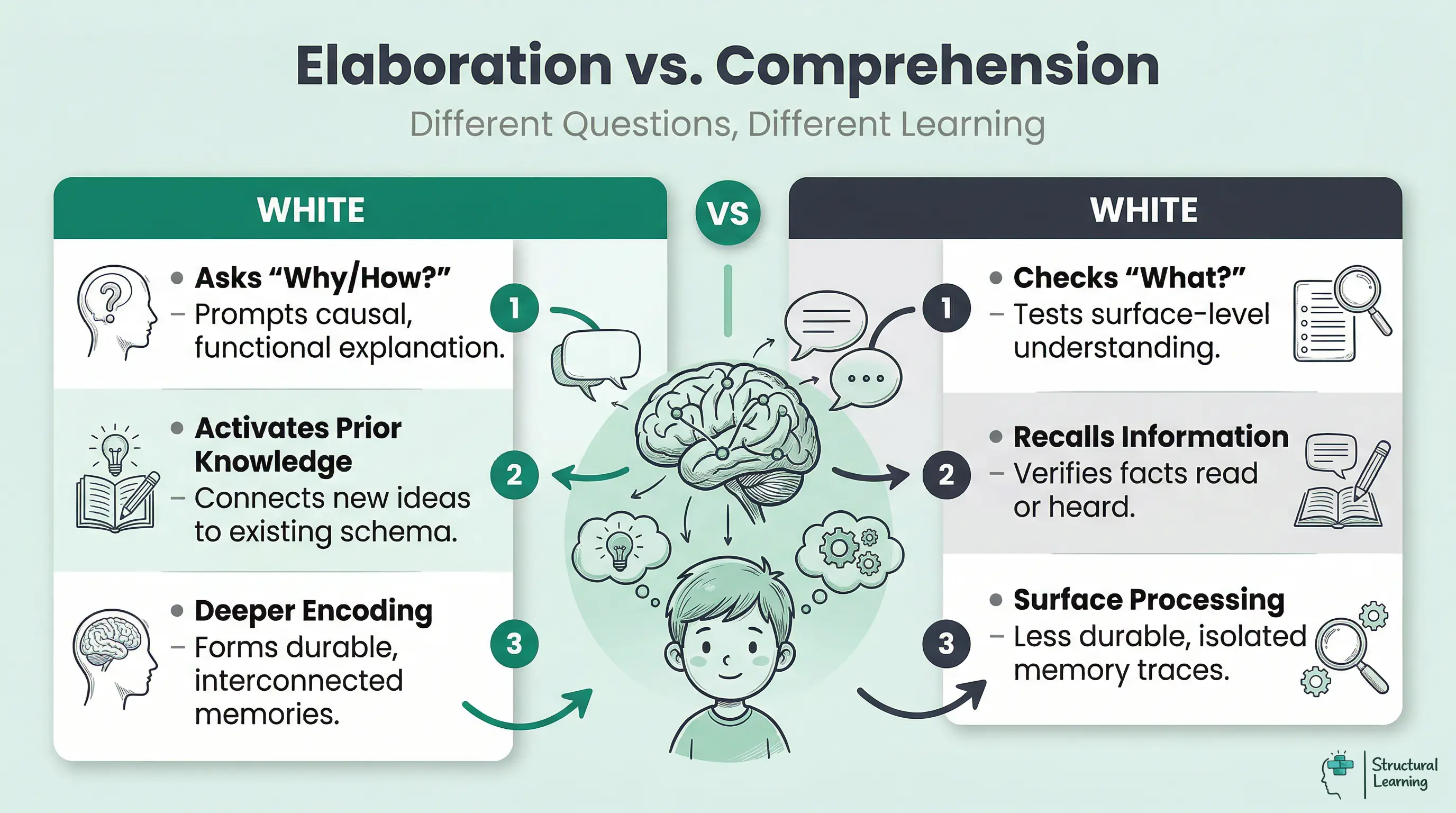
Elaborative interrogation is distinct from simple comprehension questioning. A comprehension question checks whether the student read carefully ("What did the Romans build?"). An elaborative interrogation question requires the student to produce a causal or functional explanation ("Why did they build it that way?"). The distinction matters for teaching because the two question types produce very different cognitive processes and, consequently, very different memory outcomes.

The Research Behind Elaborative Interrogation

The foundational study is Pressley et al. (1987), published in the Journal of Educational Psychology. Participants who elaborated on why animal-fact pairs were true recalled substantially more facts than control participants, even when the elaboration time was relatively brief. Pressley and colleagues followed this with a programme of research through the late 1980s and early 1990s examining which conditions make elaborative interrogation most effective.

Mark McDaniel and colleagues extended this work by comparing elaborative interrogation to other study strategies and examining the role of prior knowledge. Their findings added an important qualifier: elaborative interrogation works best when students have enough prior knowledge to generate plausible explanations. When students have very little background knowledge, they may generate incorrect elaborations, which can actually harm learning by building inaccurate connections in memory.

John Dunlosky's landmark 2013 meta-analysis in Psychological Science in the Public Interest evaluated ten learning strategies across six dimensions of utility. Elaborative interrogation received a rating of "moderate utility." That may sound underwhelming compared to retrieval practice (rated high utility), but it is worth putting in context: most strategies teachers commonly use, including highlighting, re-reading, and summarising, received ratings of "low utility." Elaborative interrogation performed consistently well across age groups, subject areas, and material types. The key caveat Dunlosky noted was the prior knowledge requirement, which has direct implications for when in a learning sequence you introduce the strategy.

Pooja Agarwal, whose work on retrieval practice has been widely adopted in UK schools, has written about elaborative interrogation as a complementary strategy. Where retrieval practice asks "Can you recall it?", elaborative interrogation asks "Can you explain it?" The two strategies address different aspects of understanding and work well in combination, particularly in subjects where factual recall alone is insufficient.

How Elaborative Interrogation Strengthens Memory

To understand why this strategy works, it helps to consider what actually happens in memory when a student encounters a new fact. According to the levels of processing framework developed by Craik and Lockhart (1972), deeper processing, which involves meaning-making, connections, and elaboration, produces more durable memories than shallow processing such as reading or repeating.

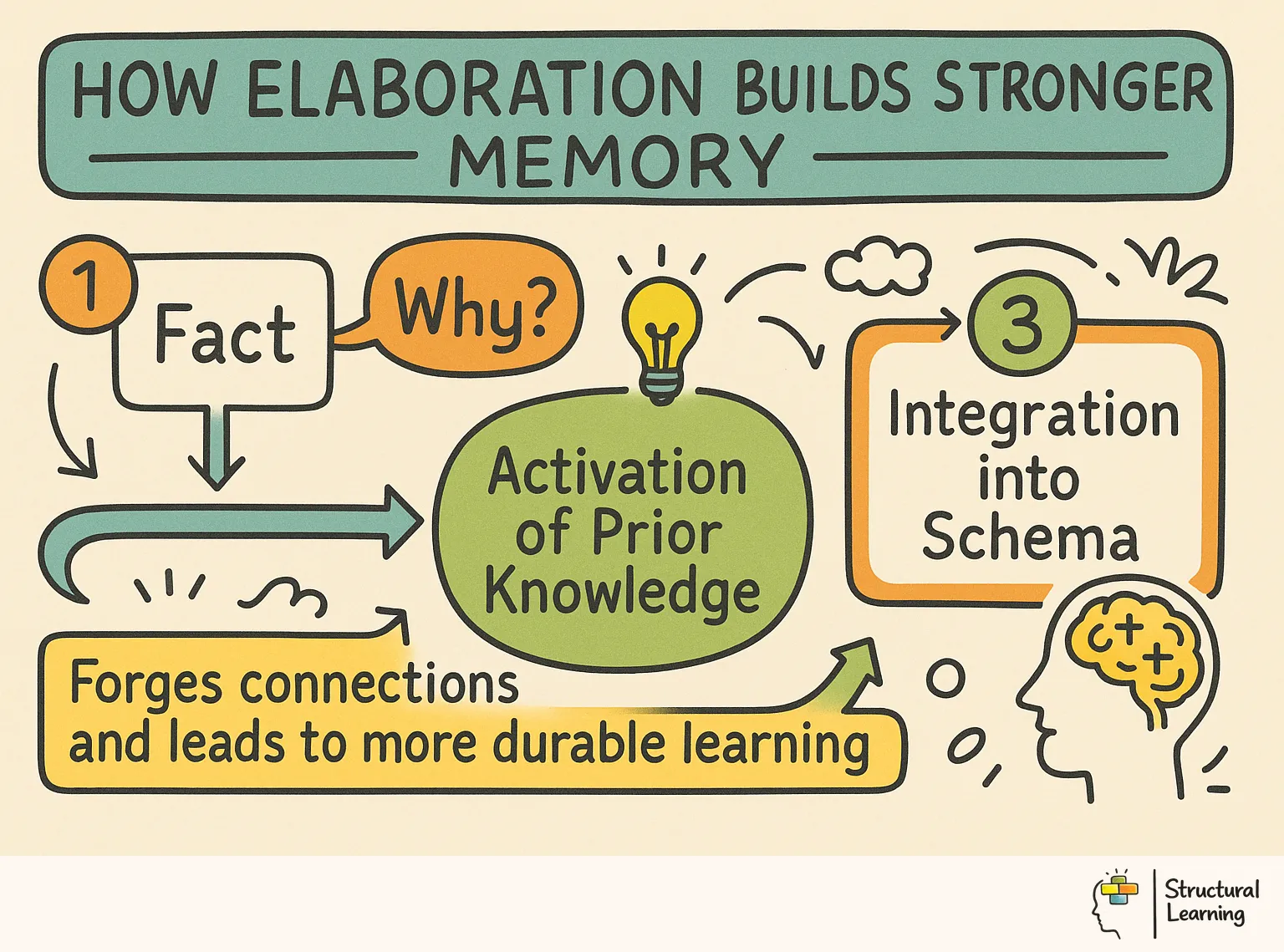
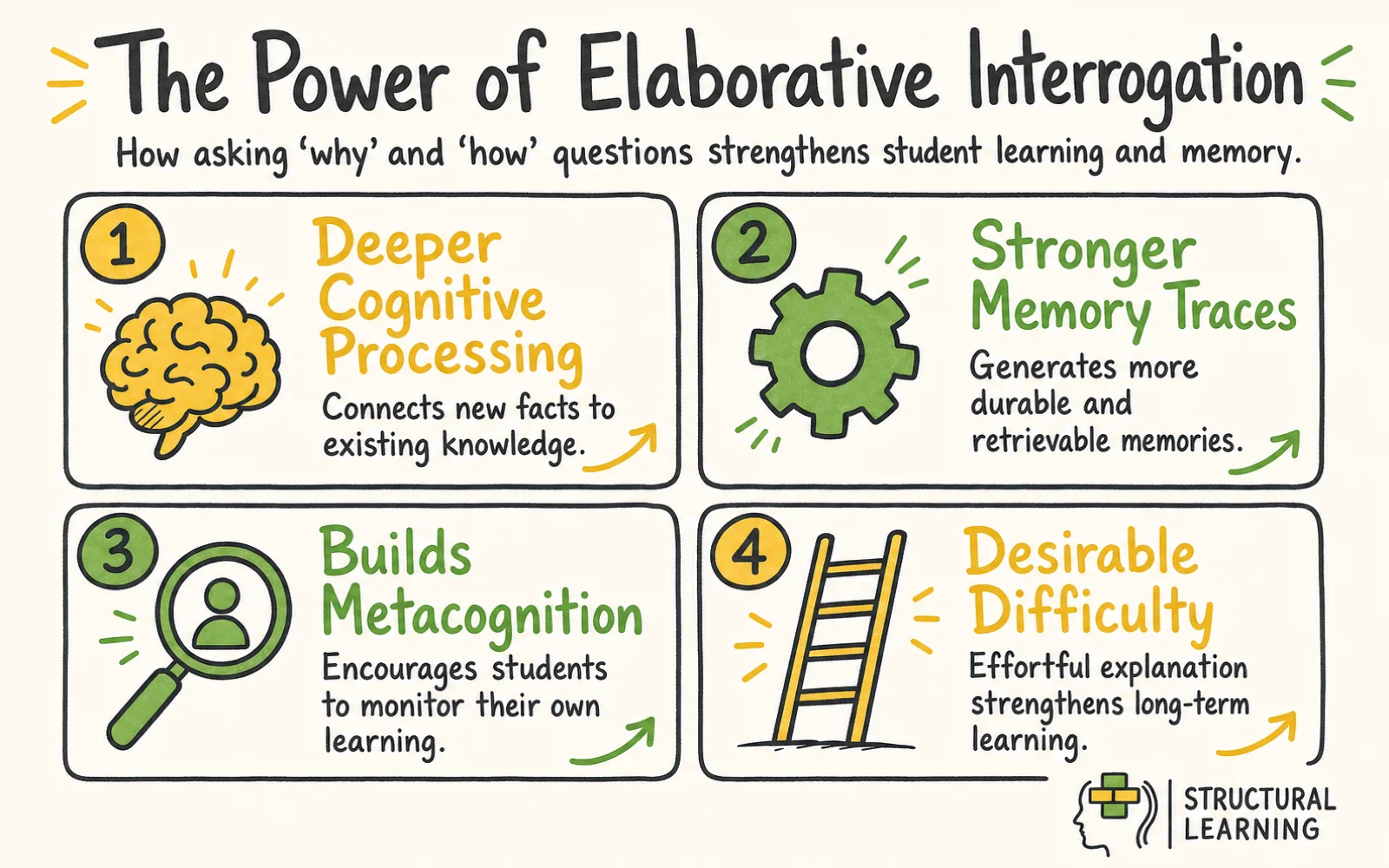
When a student constructs an explanation in response to a "why?" prompt, several things happen simultaneously. First, they must activate relevant prior knowledge to search for a plausible answer. This activation process itself strengthens the retrieval pathways for that prior knowledge. Second, they integrate the new fact with existing knowledge, creating a richer, more connected representation in memory. Third, the effort involved in generating the explanation, what Bjork has called a desirable difficulty, produces stronger encoding than receiving the same explanation passively.

The connection to Robert Bjork's desirable difficulties framework is important here. Bjork's research established that conditions which slow down initial learning often produce better long-term retention. Elaborative interrogation introduces a productive difficulty: it is harder for students to generate an explanation than to read one, and that difficulty is precisely what makes the strategy effective. The effort required to construct an explanation is not a bug but a feature. Working memory capacity also matters here: students who are overloaded with other cognitive demands during elaboration will struggle to generate useful explanations, which is why managing cognitive load is an important consideration when designing elaborative interrogation tasks. Teachers new to this area will benefit from understanding how working memory functions before designing elaboration tasks for complex content.

It is also worth noting what elaborative interrogation does for schema formation. When students repeatedly explain why facts are true in a given domain, they are not just learning isolated facts. They are building a web of causal and functional relationships that constitutes genuine understanding of that domain. A student who has explained why photosynthesis requires light, why it produces glucose, and why it occurs in chloroplasts, has a richer and more interconnected representation of photosynthesis than a student who has merely read the same facts. This is why elaborative interrogation tends to show its largest advantages on transfer tasks, problems that require applying knowledge in new contexts, rather than simple cued recall.

Elaborative Interrogation vs Other Questioning Strategies

Teachers use a range of questioning strategies, and it is useful to understand how elaborative interrogation compares to each. The table below summarises the key distinctions.
Strategy Core question type Cognitive demand Best used for Prior knowledge required?
Elaborative interrogation Why? How? What is the reason? Explanation generation, causal reasoning Deepening understanding of facts; building schema Yes, moderate prior knowledge needed
Socratic questioning What do you mean? How do you know? What if? Critical thinking, assumption-testing Evaluating arguments; examining assumptions Yes, substantial prior knowledge needed
Bloom's higher-order questions Can you analyse? How would you evaluate? Analysis, synthesis, evaluation Extended tasks; written responses Yes, high prior knowledge needed
Retrieval practice questions What is? Name the. Define. Memory retrieval, cued recall Consolidating facts; checking retention Yes, content must have been taught
Comprehension questions What happened? Who did? Literal reading, surface recall Checking reading accuracy No, answers are in the text
Cold calling Any type, directed at individuals Attention and retrieval Formative assessment; engagement Depends on question type

The key distinction between elaborative interrogation and most other questioning strategies is the specific cognitive process it targets. Elaborative interrogation is not designed to evaluate, challenge, or assess. It is designed to cause students to generate causal explanations, which is the process that builds durable long-term memory. Teachers who are familiar with Bloom's taxonomy will notice that elaborative interrogation operates primarily at the "understanding" and "applying" levels, making it a strong entry point before moving to analysis and evaluation tasks. Teachers who already use questioning strategies well often find elaborative interrogation a natural complement rather than a replacement.

Subject-Specific Elaborative Interrogation Prompts

Generic "why?" questions are a starting point, but subject-specific prompt design makes elaborative interrogation considerably more effective. The examples below are grouped by subject and include the type of factual statement the question would accompany in a lesson.

Mathematics

In Maths, elaborative interrogation prompts should target the reasoning behind procedures and properties, not just the steps.

  • "We know that multiplying two negative numbers gives a positive result. Why does this make sense on a number line?"
  • "The area of a triangle is calculated as half the base times the height. Why is it half, and not the full base times height?"
  • "A square has equal diagonals that bisect each other at right angles. Why must the diagonals be at right angles specifically?"
  • "We use equivalent fractions when adding fractions with different denominators. Why does this work without changing the value of the fraction?"

A Year 9 class studying Pythagoras's theorem might be told: "In a right-angled triangle, the square of the hypotenuse equals the sum of the squares of the other two sides." A traditional approach would move to worked examples. An elaborative interrogation approach adds: "Why do you think this relationship only works for right-angled triangles? What is it about the right angle that makes this true?" Students who work through this question, even if their answers are imprecise, encode the theorem in relation to the geometric properties of the right angle, producing a richer representation than memorising the formula alone.

Science (Biology, Chemistry, Physics)

Science elaborative interrogation prompts should link facts to mechanisms and functions.

  • "Enzymes are described as biological catalysts. Why does the body need catalysts at all? What would happen to chemical reactions in cells without them?"
  • "The cell membrane is described as selectively permeable. Why is it an advantage for a membrane to be selectively permeable rather than completely permeable?"
  • "Metals conduct electricity well. Why is this linked to the structure of metals at the atomic level?"
  • "We say that the Earth's core is thought to be iron and nickel. Why would these particular elements be at the centre rather than lighter elements like oxygen or carbon?"

In a GCSE Biology lesson on osmosis, rather than simply having students memorise that "water moves from an area of high water potential to low water potential," a teacher might ask: "Why does water move in this direction rather than in the opposite direction? What principle from physics does this connect to?" Students who successfully link osmosis to diffusion and concentration gradients are building an integrated understanding rather than an isolated definition.

English Literature and Language

English elaborative interrogation prompts focus on authorial choices, thematic connections, and language effects.

  • "The author uses short, fragmented sentences in this passage. Why might short sentences create a different emotional effect than longer ones?"
  • "Macbeth murders Duncan in private and off-stage. Why might Shakespeare have chosen not to show the murder directly to the audience?"
  • "The writer uses the metaphor of a cage throughout this poem. Why is a cage a more effective image for this theme than, say, a locked room?"
  • "The protagonist is described as wearing grey clothing throughout the novel. Why might the author have chosen this specific colour rather than black?"

A GCSE class studying 'An Inspector Calls' might encounter the statement: "Priestley wrote the play after World War Two but set it before World War One." An elaborative interrogation prompt follows: "Why would Priestley choose to set the play in 1912 when writing in 1945? What effect does that time gap create for a 1945 audience?" Students must draw on their knowledge of both periods, making connections that a comprehension question would never require.

History

History elaborative interrogation prompts should target causation, consequence, and significance.
  • "The Treaty of Versailles imposed heavy reparations on Germany. Why might the victorious powers have wanted Germany to pay reparations rather than simply disarming it?"
  • "Many historians call the period 1933-1939 in Germany the 'Nazi consolidation of power.' Why do historians use the word 'consolidation' rather than 'seizure'?"
  • "Slavery was not abolished in Britain's colonies until 1833, fifty years after the American Declaration of Independence called all men equal. Why might abolition have taken so long despite strong moral arguments against slavery?"
  • "The Industrial Revolution began in Britain rather than in France or Germany. Why is this significant for the development of modern global trade?"

A Year 9 History class studying the causes of World War One might read: "The alliance system meant that a local conflict between Austria-Hungary and Serbia rapidly became a European-wide war." The elaborative interrogation prompt: "Why did having alliances make it harder, not easier, to prevent war from spreading? What would you expect alliances to do, and why did they do the opposite?" Students who work through this question are developing a nuanced understanding of the unintended consequences of political structures, not simply listing causes.

Geography

Geography elaborative interrogation prompts link physical and human processes.

  • "Cities in LEDCs often have large informal settlements (shanty towns) on their outskirts. Why would these settlements grow at the outskirts rather than in the city centre?"
  • "Deforestation in tropical rainforests increases the risk of flooding. Why does removing trees have this effect? What is the connection?"
  • "Coastal erosion is more severe on headlands than in bays. Why does the shape of the coastline affect the rate of erosion?"
  • "The UK's population is ageing. Why might an ageing population be an economic challenge even if overall population numbers remain stable?"

Elaborative Interrogation Across Age Phases

Elaborative interrogation works differently at different age phases, primarily because of variation in prior knowledge and metacognitive capacity. The table below outlines the key adaptations.

Age Phase Key adaptations Classroom example
EYFS and KS1 Use concrete, familiar contexts. Scaffold with sentence stems ("I think... because..."). Accept analogical reasoning. Teacher models elaborating aloud. "We know that plants need water to grow. Why do you think water is so important for a plant? What does water do for your body when you're thirsty?"
Lower KS2 (Years 3-4) Use paired discussion before written elaboration. Connect to familiar science or history topics. Provide a sentence frame for structure. "The Ancient Egyptians built the pyramids near the River Nile. Why do you think they chose to build near the river? What would the river give them that they needed?"
Upper KS2 (Years 5-6) Students can handle written elaboration independently. Introduce self-checking (compare answer to teacher's model). Begin to use elaboration for homework. "Light travels faster than sound. Why does this mean we see lightning before we hear thunder, even though both happen at the same moment?"
KS3 (Years 7-9) Students can elaborate independently. Use discipline-specific language in prompts. Begin combining with retrieval practice (recall the fact, then elaborate). Peer comparison of elaborations. "The boiling point of water is lower at high altitude. Why does air pressure affect the boiling point of a liquid?" Students write independently, then compare with a partner.
KS4 (Years 10-11) Elaborate in exam-relevant formats. Use elaboration as part of self-study. Prompts should mirror the causal/evaluative language of GCSE mark schemes. "The demand curve for a normal good slopes downward. Why does price and quantity demanded move in opposite directions, and why might this not apply to Giffen goods?"

The most important adjustment for younger pupils is scaffolding. EYFS and KS1 children have limited prior knowledge to draw on, so teachers need to provide partial scaffolds: analogies to familiar experiences, sentence stems, or think-pair-share before individual responses. This is consistent with McDaniel's finding that elaborative interrogation requires sufficient prior knowledge to be effective. With younger pupils, the teacher's role is partly to activate and build the prior knowledge base simultaneously.

How Elaboration Builds Stronger Memory infographic for teachers
How Elaboration Builds Stronger Memory

Combining Elaborative Interrogation with Desirable Difficulties

Robert Bjork's concept of desirable difficulties offers an important frame for understanding when and how to use elaborative interrogation. A desirable difficulty is a condition that slows down initial learning but produces substantially stronger long-term retention. Elaborative interrogation qualifies as a desirable difficulty precisely because it is harder than reading or being told something. That difficulty is the mechanism of its effectiveness.

In practice, this means teachers should resist the instinct to simplify or remove the difficulty when students struggle. A student who says "I don't know why" in response to an elaborative interrogation prompt is not failing; they are at the productive edge of their existing knowledge. The teacher's response should be to scaffold toward an answer rather than to provide it immediately. Providing the answer directly eliminates the generative process that makes elaborative interrogation work.

Elaborative interrogation also pairs naturally with spaced practice. When students first encounter a concept, they can elaborate on it with modest scaffolding. When they encounter it again after a gap, they can attempt elaboration without scaffolding, which tests both their retrieval of the fact and their retention of the explanation they constructed. This combination exploits both the testing effect (from retrieval practice) and the elaboration effect (from generating explanations).

Interleaving, another desirable difficulty from the Bjork framework, can also be combined productively. A teacher might interleave elaborative interrogation questions across several recently taught topics rather than focusing all elaboration on the most recent lesson. This forces students to retrieve from a wider range of knowledge, which strengthens the connections between concepts.

Common Mistakes Teachers Make

Several implementation errors consistently reduce the effectiveness of elaborative interrogation. Being aware of these makes a significant practical difference.

Accepting vague or circular explanations. When a student says "the Romans built straight roads because it was easier," and the teacher accepts this without probing, the elaboration has done little work. The prompt should be followed by a checking question: "Easier in what way specifically?" or "What would have been harder about a curved road?" The explanation needs to be precise enough to constitute genuine understanding.

Using elaborative interrogation before prior knowledge is established. If students do not yet know enough to generate a plausible explanation, they will produce incorrect elaborations. A student who concludes that "enzymes speed up reactions because they add energy to the reaction" has misunderstood the mechanism. Correcting this after the fact is harder than ensuring elaborative interrogation is used at the consolidation phase, after initial instruction, rather than as an introduction to new content.

Conflating elaborative interrogation with creative speculation. Asking "Why do you think the author chose this?" is not the same as elaborative interrogation when the question invites personal opinion rather than causal reasoning grounded in the text and context. Elaborative interrogation requires students to draw on substantive knowledge; it is not a stimulus for free association.

Not checking the accuracy of student elaborations. Because students are generating their own explanations, there is a real risk of consolidating misconceptions. Teachers should plan to review elaborations, whether through cold calling, paired sharing, or written responses, and to correct errors explicitly. A whole-class model explanation, shared after students have attempted their own, is an effective approach.

Using only teacher-led elaborative interrogation. If the teacher always poses the elaborative interrogation prompt and selects students to respond, the strategy benefits those students but not necessarily the rest. Structuring elaborative interrogation as a written task, a think-pair-share, or a self-study protocol ensures wider participation.

Stopping at the first elaboration. The greatest learning gains come from elaboration chains: "Why does X happen?" followed by "And why does that cause Y?" followed by "So what does this tell us about Z?" A single cycle of elaboration is useful; a chain of related elaborations produces substantially deeper encoding.

Student Self-Questioning Scripts

One of the most valuable applications of elaborative interrogation is as a self-study strategy. When students internalise the questioning habit, they apply it independently during revision, reading, and homework. Teaching students explicit self-questioning scripts accelerates this internalisation.

The following scripts are designed to be taught explicitly, practised in class with teacher modelling, and then transferred to independent study.

The Core Script (Suitable for KS3 and Above)

  • Read the fact or statement I am trying to learn.
  • Ask: "Why is this true? What causes this? What explains this?"
  • Try to generate an explanation using what I already know.
  • Check my explanation against my notes or textbook.
  • If my explanation was correct: move on, but return to this fact later without looking at notes first.
  • If my explanation was wrong: read the correct explanation carefully, identify where my thinking went astray, and try again.
  • The Connection Script (Suitable for KS4 and Sixth Form)

  • Identify the fact I am trying to learn.
  • Ask: "What do I already know that is connected to this?"
  • Ask: "Why is this fact true, given what I know about connected topics?"
  • Ask: "If this fact changed or were false, what else would have to change?"
  • Write a two-to-three sentence explanation linking the fact to its causes and its consequences.
  • The Exam-Preparation Script

  • Write the key fact on one side of a card.
  • On the reverse, write "Why is this true?" and leave space for an explanation.
  • During revision, cover the explanation and attempt to generate it from memory.
  • Compare with the written explanation and note any gaps.
  • If gaps exist, write the explanation again from scratch without looking.
  • These scripts serve a metacognitive function: they train students to monitor whether they understand content deeply enough to explain it, rather than simply recognising it when they see it. This distinction between recognition and explanation is one of the most important habits a teacher can build in students. Metacognition, the ability to monitor and regulate one's own understanding, is one of the most valuable skills in education, and elaborative interrogation is one of the most direct routes to developing it.

    Elaborative Interrogation and Metacognition

    The relationship between elaborative interrogation and metacognition runs deeper than simply using questioning as a study strategy. When students regularly practise generating explanations for facts, they develop a more calibrated sense of what they actually understand. Most students, left to their own devices, overestimate their knowledge when they can recognise information and underestimate how little they could actually explain. Elaborative interrogation forces the distinction into view.

    This is particularly relevant for the phenomenon of the illusion of knowing, which occurs when students confuse familiarity with understanding. A student who has read a chapter twice feels that they know the material because the words feel familiar. Asking that student "Why does osmosis occur in this direction?" very quickly reveals whether they understand or merely recognise. Building this diagnostic habit into classroom practice trains students to apply the same test to themselves during independent study.

    Developing metacognitive habits is one of the highest-return investments a teacher can make. The EEF's Teaching and Learning Toolkit cites metacognition and self-regulation as generating an average of seven additional months of progress for pupils, one of the highest effect sizes in the Toolkit. Elaborative interrogation is a concrete, research-grounded technique for building that metacognitive capacity within subject lessons, without requiring a separate "metacognition lesson." Teachers who want to develop this further will find developing student metacognition a practical next step. The strategy is embedded in content learning rather than added on top of it.

    Classroom Implementation Guide

    The following sequence takes a teacher from first introduction of elaborative interrogation to embedding it as a routine classroom practice. It is designed to be implemented over three to five weeks.

    Week 1: Teacher-modelled elaboration. The teacher poses an elaborative interrogation question and thinks aloud through the process of generating an explanation. Pupils observe the model: "I know that the lungs have alveoli. The question is why they have millions of alveoli rather than one large air sac. Let me think about what having millions of small sacs does that one large sac would not. Many small sacs have a much larger surface area in total..." The teacher completes the elaboration and invites pupils to notice the steps taken.

    Week 2: Supported class elaboration. The teacher poses the elaborative interrogation prompt, gives pupils two minutes to write a draft explanation individually, then shares responses cold. The teacher corrects errors, extends strong answers, and demonstrates what a complete elaboration looks like. Pupils are explicitly told: "Your goal is to give an explanation, not just describe what happens."

    Week 3: Paired elaboration with peer checking. Pupils attempt elaboration in pairs. Partner A elaborates while Partner B checks against notes, then they swap. The teacher circulates to listen to elaborations and address errors. This phase builds fluency and catches misconceptions before they are consolidated.

    Week 4: Independent written elaboration. Pupils complete elaborative interrogation questions independently in writing, then review against a teacher-provided model answer. The written format allows the teacher to collect and check responses. Common errors are fed back to the class as a whole.

    Week 5 onwards: Embedded into lesson routines. The teacher incorporates one to three elaborative interrogation questions into starter activities or at the end of new content sections. These can be paired with retrieval practice: first recall the fact (retrieval), then explain why it is true (elaboration). Over time, pupils begin using the questioning habit independently during revision.

    Formative assessment integration. Elaborative interrogation responses are a rich source of formative assessment data. A student who can recall that the Treaty of Versailles imposed reparations but cannot explain why this angered Germany has surface-level knowledge only. A student who connects the reparations to existing economic hardship, the stab-in-the-back myth, and the link to Nazi support has substantive understanding. The elaboration makes this distinction visible in a way that simple recall questions do not.

    What Elaborative Interrogation Does Not Do

    Honest assessment of the evidence requires acknowledging what elaborative interrogation is not suitable for.

    It is not an introduction strategy. Using elaborative interrogation before students have any relevant prior knowledge will produce incorrect elaborations that are then encoded. The strategy belongs in the consolidation phase of learning, after initial instruction has established the basic facts.

    It is not a substitute for retrieval practice. Elaborative interrogation deepens understanding of content already known, but retrieval practice is more effective for simply consolidating facts to memory. The two strategies address different objectives and work best in combination. Teachers seeking a broader picture of how these strategies fit together may find direct instruction a useful frame for understanding the initial instruction phase that elaborative interrogation follows.

    It is not equally effective for all content types. Elaborative interrogation works most naturally for causal, procedural, and relational knowledge: facts that have explanatory connections to other knowledge. It is less naturally applicable to content that is essentially arbitrary, such as vocabulary in a foreign language, proper nouns, or dates without narrative context. For arbitrary associations, other strategies such as dual coding are more appropriate.

    It requires accurate prior knowledge to function correctly. McDaniel and Pressley's research is explicit on this: students who generate inaccurate elaborations may actually perform worse than control groups. Teacher checking of elaborations is not optional; it is an integral part of the strategy.

    4 Keys to Effective Elaboration Prompts infographic for teachers
    4 Keys to Effective Elaboration Prompts

    Further Reading: Key Research Papers

    The following papers form the core evidence base for elaborative interrogation. All are cited using author-year format consistent with the text above.

    Further Reading: Key Papers on Elaborative Interrogation

    The five studies below represent the foundational and applied research on elaborative interrogation. They range from the original experimental work by Pressley and colleagues to the large-scale meta-analytic synthesis by Dunlosky and colleagues that placed elaborative interrogation in context alongside other learning strategies.

    Elaborative Interrogation Facilitates the Acquisition of Factual Information View study ↗

    Highly cited

    Pressley, M., McDaniel, M. A., Turnure, J. E., Wood, E., & Ahmad, M. (1987)

    The original experimental demonstration that prompting students to explain why facts are true produces substantially better recall than simply reading those facts. This study established the foundational effect that all subsequent elaborative interrogation research builds upon, and is required reading for any teacher seeking to understand the strategy's evidence base.

    Improving Students' Learning with Effective Learning Techniques View study ↗

    1,000+ citations

    Dunlosky, J., Rawson, K. A., Marsh, E. J., Nathan, M. J., & Willingham, D. T. (2013)

    The landmark meta-analysis that evaluated ten study strategies across six dimensions of utility. Dunlosky and colleagues rated elaborative interrogation as "moderate utility," providing a rigorous comparative framework. The paper's discussion of the prior knowledge requirement is particularly valuable for teachers deciding when in a learning sequence to introduce the strategy.

    Elaborative Interrogation and Prior Knowledge View study ↗

    Frequently cited

    Wood, E., Pressley, M., & Winne, P. H. (1990)

    This study examined how the effectiveness of elaborative interrogation varies with students' levels of prior knowledge. The finding that elaborative interrogation benefits students most when they have moderate prior knowledge has direct implications for sequencing: teachers should use the strategy after initial instruction, not as an introduction to new content.

    Desirable Difficulties Perspective on Learning View study ↗

    Highly influential

    Bjork, R. A., & Bjork, E. L. (2011)

    Robert and Elizabeth Bjork's theoretical account of why conditions that slow down learning often improve long-term retention. This chapter provides the broader framework within which elaborative interrogation sits as a desirable difficulty, and connects it to spaced practice, interleaving, and the testing effect. Teachers who understand this framework can use elaborative interrogation as part of a coherent evidence-based practice rather than an isolated technique.

    Making Things Hard on Yourself, But in a Good Way View study ↗

    Widely shared

    Bjork, E. L., & Bjork, R. A. (2011)

    A more accessible account of desirable difficulties written for educational practitioners and students. Elizabeth and Robert Bjork address the counterintuitive finding that making learning easier in the short term typically makes it worse in the long term, and outline strategies, including elaborative interrogation, that exploit this principle productively.

    Spend five minutes before your next lesson writing two elaborative interrogation questions for the content you plan to teach. Target the facts that students most commonly know superficially but fail to understand at depth, and build in a two-minute window after initial instruction for students to attempt written elaborations before you share a model answer.

    Loading audit...

    Most teachers spend a significant portion of lesson time explaining things to students. Yet the research on memory formation consistently points in the opposite direction: explanations that students generate themselves are far more durable than explanations they receive passively. Elaborative interrogation is the structured practice of prompting students to ask "why?" and "how?" questions about the content they are learning, and it is one of the most underused high-utility strategies available to teachers at any key stage.

    Key Takeaways

      • Elaborative interrogation requires students to generate explanations: Rather than receiving information, students answer "why?" and "how?" questions about facts they are learning. The act of explanation construction is what produces durable memory, not the act of reading or listening.
      • The strategy works by activating prior knowledge: When students explain why something is true, they must connect new material to what they already know. This integration process builds stronger schema and improves later retrieval, particularly on transfer tasks.
      • Dunlosky's 2013 meta-analysis rated it moderately high utility: Elaborative interrogation has consistent evidence of benefit across subject areas and age groups, though its effectiveness depends on students having enough prior knowledge to generate accurate explanations.
      • Subject-specific prompt design matters: Generic "why?" questions are less effective than carefully designed discipline-specific prompts. A Science teacher's elaborative interrogation questions look structurally different from a History teacher's, though both share the same underlying mechanism.

    Passive Learning vs. Active Elaboration infographic for teachers
    Passive Learning vs. Active Elaboration

    What Elaborative Interrogation Is

    Elaborative interrogation is a learning strategy in which students respond to "why?" and "how?" questions about factual statements they are studying. The term was coined by Michael Pressley and colleagues in a 1987 paper that demonstrated a striking effect: students who were prompted to explain why facts were true recalled significantly more of those facts than students who simply read the same information.

    The core mechanism is straightforward. When a student reads "The Romans built roads in straight lines," they may process that sentence at a surface level and move on. When a student is asked "Why did the Romans build roads in straight lines?", they are forced to search existing knowledge, make an inference, and construct an explanation. That search-and-construct process encodes the fact more deeply. It also links the new information to existing knowledge structures, what cognitive scientists call schema, which makes later retrieval more reliable.

    Elaborative interrogation is distinct from simple comprehension questioning. A comprehension question checks whether the student read carefully ("What did the Romans build?"). An elaborative interrogation question requires the student to produce a causal or functional explanation ("Why did they build it that way?"). The distinction matters for teaching because the two question types produce very different cognitive processes and, consequently, very different memory outcomes.

    The Research Behind Elaborative Interrogation

    The foundational study is Pressley et al. (1987), published in the Journal of Educational Psychology. Participants who elaborated on why animal-fact pairs were true recalled substantially more facts than control participants, even when the elaboration time was relatively brief. Pressley and colleagues followed this with a programme of research through the late 1980s and early 1990s examining which conditions make elaborative interrogation most effective.

    Mark McDaniel and colleagues extended this work by comparing elaborative interrogation to other study strategies and examining the role of prior knowledge. Their findings added an important qualifier: elaborative interrogation works best when students have enough prior knowledge to generate plausible explanations. When students have very little background knowledge, they may generate incorrect elaborations, which can actually harm learning by building inaccurate connections in memory.

    John Dunlosky's landmark 2013 meta-analysis in Psychological Science in the Public Interest evaluated ten learning strategies across six dimensions of utility. Elaborative interrogation received a rating of "moderate utility." That may sound underwhelming compared to retrieval practice (rated high utility), but it is worth putting in context: most strategies teachers commonly use, including highlighting, re-reading, and summarising, received ratings of "low utility." Elaborative interrogation performed consistently well across age groups, subject areas, and material types. The key caveat Dunlosky noted was the prior knowledge requirement, which has direct implications for when in a learning sequence you introduce the strategy.

    Pooja Agarwal, whose work on retrieval practice has been widely adopted in UK schools, has written about elaborative interrogation as a complementary strategy. Where retrieval practice asks "Can you recall it?", elaborative interrogation asks "Can you explain it?" The two strategies address different aspects of understanding and work well in combination, particularly in subjects where factual recall alone is insufficient.

    How Elaborative Interrogation Strengthens Memory

    To understand why this strategy works, it helps to consider what actually happens in memory when a student encounters a new fact. According to the levels of processing framework developed by Craik and Lockhart (1972), deeper processing, which involves meaning-making, connections, and elaboration, produces more durable memories than shallow processing such as reading or repeating.

    When a student constructs an explanation in response to a "why?" prompt, several things happen simultaneously. First, they must activate relevant prior knowledge to search for a plausible answer. This activation process itself strengthens the retrieval pathways for that prior knowledge. Second, they integrate the new fact with existing knowledge, creating a richer, more connected representation in memory. Third, the effort involved in generating the explanation, what Bjork has called a desirable difficulty, produces stronger encoding than receiving the same explanation passively.

    The connection to Robert Bjork's desirable difficulties framework is important here. Bjork's research established that conditions which slow down initial learning often produce better long-term retention. Elaborative interrogation introduces a productive difficulty: it is harder for students to generate an explanation than to read one, and that difficulty is precisely what makes the strategy effective. The effort required to construct an explanation is not a bug but a feature. Working memory capacity also matters here: students who are overloaded with other cognitive demands during elaboration will struggle to generate useful explanations, which is why managing cognitive load is an important consideration when designing elaborative interrogation tasks. Teachers new to this area will benefit from understanding how working memory functions before designing elaboration tasks for complex content.

    It is also worth noting what elaborative interrogation does for schema formation. When students repeatedly explain why facts are true in a given domain, they are not just learning isolated facts. They are building a web of causal and functional relationships that constitutes genuine understanding of that domain. A student who has explained why photosynthesis requires light, why it produces glucose, and why it occurs in chloroplasts, has a richer and more interconnected representation of photosynthesis than a student who has merely read the same facts. This is why elaborative interrogation tends to show its largest advantages on transfer tasks, problems that require applying knowledge in new contexts, rather than simple cued recall.

    Elaborative Interrogation vs Other Questioning Strategies

    Teachers use a range of questioning strategies, and it is useful to understand how elaborative interrogation compares to each. The table below summarises the key distinctions.

    Strategy Core question type Cognitive demand Best used for Prior knowledge required?
    Elaborative interrogation Why? How? What is the reason? Explanation generation, causal reasoning Deepening understanding of facts; building schema Yes, moderate prior knowledge needed
    Socratic questioning What do you mean? How do you know? What if? Critical thinking, assumption-testing Evaluating arguments; examining assumptions Yes, substantial prior knowledge needed
    Bloom's higher-order questions Can you analyse? How would you evaluate? Analysis, synthesis, evaluation Extended tasks; written responses Yes, high prior knowledge needed
    Retrieval practice questions What is? Name the. Define. Memory retrieval, cued recall Consolidating facts; checking retention Yes, content must have been taught
    Comprehension questions What happened? Who did? Literal reading, surface recall Checking reading accuracy No, answers are in the text
    Cold calling Any type, directed at individuals Attention and retrieval Formative assessment; engagement Depends on question type

    The key distinction between elaborative interrogation and most other questioning strategies is the specific cognitive process it targets. Elaborative interrogation is not designed to evaluate, challenge, or assess. It is designed to cause students to generate causal explanations, which is the process that builds durable long-term memory. Teachers who are familiar with Bloom's taxonomy will notice that elaborative interrogation operates primarily at the "understanding" and "applying" levels, making it a strong entry point before moving to analysis and evaluation tasks. Teachers who already use questioning strategies well often find elaborative interrogation a natural complement rather than a replacement.

    Subject-Specific Elaborative Interrogation Prompts

    Generic "why?" questions are a starting point, but subject-specific prompt design makes elaborative interrogation considerably more effective. The examples below are grouped by subject and include the type of factual statement the question would accompany in a lesson.

    Mathematics

    In Maths, elaborative interrogation prompts should target the reasoning behind procedures and properties, not just the steps.

    • "We know that multiplying two negative numbers gives a positive result. Why does this make sense on a number line?"
    • "The area of a triangle is calculated as half the base times the height. Why is it half, and not the full base times height?"
    • "A square has equal diagonals that bisect each other at right angles. Why must the diagonals be at right angles specifically?"
    • "We use equivalent fractions when adding fractions with different denominators. Why does this work without changing the value of the fraction?"

    A Year 9 class studying Pythagoras's theorem might be told: "In a right-angled triangle, the square of the hypotenuse equals the sum of the squares of the other two sides." A traditional approach would move to worked examples. An elaborative interrogation approach adds: "Why do you think this relationship only works for right-angled triangles? What is it about the right angle that makes this true?" Students who work through this question, even if their answers are imprecise, encode the theorem in relation to the geometric properties of the right angle, producing a richer representation than memorising the formula alone.

    Science (Biology, Chemistry, Physics)

    Science elaborative interrogation prompts should link facts to mechanisms and functions.

    • "Enzymes are described as biological catalysts. Why does the body need catalysts at all? What would happen to chemical reactions in cells without them?"
    • "The cell membrane is described as selectively permeable. Why is it an advantage for a membrane to be selectively permeable rather than completely permeable?"
    • "Metals conduct electricity well. Why is this linked to the structure of metals at the atomic level?"
    • "We say that the Earth's core is thought to be iron and nickel. Why would these particular elements be at the centre rather than lighter elements like oxygen or carbon?"

    In a GCSE Biology lesson on osmosis, rather than simply having students memorise that "water moves from an area of high water potential to low water potential," a teacher might ask: "Why does water move in this direction rather than in the opposite direction? What principle from physics does this connect to?" Students who successfully link osmosis to diffusion and concentration gradients are building an integrated understanding rather than an isolated definition.

    English Literature and Language

    English elaborative interrogation prompts focus on authorial choices, thematic connections, and language effects.

    • "The author uses short, fragmented sentences in this passage. Why might short sentences create a different emotional effect than longer ones?"
    • "Macbeth murders Duncan in private and off-stage. Why might Shakespeare have chosen not to show the murder directly to the audience?"
    • "The writer uses the metaphor of a cage throughout this poem. Why is a cage a more effective image for this theme than, say, a locked room?"
    • "The protagonist is described as wearing grey clothing throughout the novel. Why might the author have chosen this specific colour rather than black?"

    A GCSE class studying 'An Inspector Calls' might encounter the statement: "Priestley wrote the play after World War Two but set it before World War One." An elaborative interrogation prompt follows: "Why would Priestley choose to set the play in 1912 when writing in 1945? What effect does that time gap create for a 1945 audience?" Students must draw on their knowledge of both periods, making connections that a comprehension question would never require.

    History

    History elaborative interrogation prompts should target causation, consequence, and significance.

    • "The Treaty of Versailles imposed heavy reparations on Germany. Why might the victorious powers have wanted Germany to pay reparations rather than simply disarming it?"
    • "Many historians call the period 1933-1939 in Germany the 'Nazi consolidation of power.' Why do historians use the word 'consolidation' rather than 'seizure'?"
    • "Slavery was not abolished in Britain's colonies until 1833, fifty years after the American Declaration of Independence called all men equal. Why might abolition have taken so long despite strong moral arguments against slavery?"
    • "The Industrial Revolution began in Britain rather than in France or Germany. Why is this significant for the development of modern global trade?"

    A Year 9 History class studying the causes of World War One might read: "The alliance system meant that a local conflict between Austria-Hungary and Serbia rapidly became a European-wide war." The elaborative interrogation prompt: "Why did having alliances make it harder, not easier, to prevent war from spreading? What would you expect alliances to do, and why did they do the opposite?" Students who work through this question are developing a nuanced understanding of the unintended consequences of political structures, not simply listing causes.

    Geography

    Geography elaborative interrogation prompts link physical and human processes.

    • "Cities in LEDCs often have large informal settlements (shanty towns) on their outskirts. Why would these settlements grow at the outskirts rather than in the city centre?"
    • "Deforestation in tropical rainforests increases the risk of flooding. Why does removing trees have this effect? What is the connection?"
    • "Coastal erosion is more severe on headlands than in bays. Why does the shape of the coastline affect the rate of erosion?"
    • "The UK's population is ageing. Why might an ageing population be an economic challenge even if overall population numbers remain stable?"

    Elaborative Interrogation Across Age Phases

    Elaborative interrogation works differently at different age phases, primarily because of variation in prior knowledge and metacognitive capacity. The table below outlines the key adaptations.

    Age Phase Key adaptations Classroom example
    EYFS and KS1 Use concrete, familiar contexts. Scaffold with sentence stems ("I think... because..."). Accept analogical reasoning. Teacher models elaborating aloud. "We know that plants need water to grow. Why do you think water is so important for a plant? What does water do for your body when you're thirsty?"
    Lower KS2 (Years 3-4) Use paired discussion before written elaboration. Connect to familiar science or history topics. Provide a sentence frame for structure. "The Ancient Egyptians built the pyramids near the River Nile. Why do you think they chose to build near the river? What would the river give them that they needed?"
    Upper KS2 (Years 5-6) Students can handle written elaboration independently. Introduce self-checking (compare answer to teacher's model). Begin to use elaboration for homework. "Light travels faster than sound. Why does this mean we see lightning before we hear thunder, even though both happen at the same moment?"
    KS3 (Years 7-9) Students can elaborate independently. Use discipline-specific language in prompts. Begin combining with retrieval practice (recall the fact, then elaborate). Peer comparison of elaborations. "The boiling point of water is lower at high altitude. Why does air pressure affect the boiling point of a liquid?" Students write independently, then compare with a partner.
    KS4 (Years 10-11) Elaborate in exam-relevant formats. Use elaboration as part of self-study. Prompts should mirror the causal/evaluative language of GCSE mark schemes. "The demand curve for a normal good slopes downward. Why does price and quantity demanded move in opposite directions, and why might this not apply to Giffen goods?"

    The most important adjustment for younger pupils is scaffolding. EYFS and KS1 children have limited prior knowledge to draw on, so teachers need to provide partial scaffolds: analogies to familiar experiences, sentence stems, or think-pair-share before individual responses. This is consistent with McDaniel's finding that elaborative interrogation requires sufficient prior knowledge to be effective. With younger pupils, the teacher's role is partly to activate and build the prior knowledge base simultaneously.

    How Elaboration Builds Stronger Memory infographic for teachers
    How Elaboration Builds Stronger Memory

    Combining Elaborative Interrogation with Desirable Difficulties

    Robert Bjork's concept of desirable difficulties offers an important frame for understanding when and how to use elaborative interrogation. A desirable difficulty is a condition that slows down initial learning but produces substantially stronger long-term retention. Elaborative interrogation qualifies as a desirable difficulty precisely because it is harder than reading or being told something. That difficulty is the mechanism of its effectiveness.

    In practice, this means teachers should resist the instinct to simplify or remove the difficulty when students struggle. A student who says "I don't know why" in response to an elaborative interrogation prompt is not failing; they are at the productive edge of their existing knowledge. The teacher's response should be to scaffold toward an answer rather than to provide it immediately. Providing the answer directly eliminates the generative process that makes elaborative interrogation work.

    Elaborative interrogation also pairs naturally with spaced practice. When students first encounter a concept, they can elaborate on it with modest scaffolding. When they encounter it again after a gap, they can attempt elaboration without scaffolding, which tests both their retrieval of the fact and their retention of the explanation they constructed. This combination exploits both the testing effect (from retrieval practice) and the elaboration effect (from generating explanations).

    Interleaving, another desirable difficulty from the Bjork framework, can also be combined productively. A teacher might interleave elaborative interrogation questions across several recently taught topics rather than focusing all elaboration on the most recent lesson. This forces students to retrieve from a wider range of knowledge, which strengthens the connections between concepts.

    Common Mistakes Teachers Make

    Several implementation errors consistently reduce the effectiveness of elaborative interrogation. Being aware of these makes a significant practical difference.

    Accepting vague or circular explanations. When a student says "the Romans built straight roads because it was easier," and the teacher accepts this without probing, the elaboration has done little work. The prompt should be followed by a checking question: "Easier in what way specifically?" or "What would have been harder about a curved road?" The explanation needs to be precise enough to constitute genuine understanding.

    Using elaborative interrogation before prior knowledge is established. If students do not yet know enough to generate a plausible explanation, they will produce incorrect elaborations. A student who concludes that "enzymes speed up reactions because they add energy to the reaction" has misunderstood the mechanism. Correcting this after the fact is harder than ensuring elaborative interrogation is used at the consolidation phase, after initial instruction, rather than as an introduction to new content.

    Conflating elaborative interrogation with creative speculation. Asking "Why do you think the author chose this?" is not the same as elaborative interrogation when the question invites personal opinion rather than causal reasoning grounded in the text and context. Elaborative interrogation requires students to draw on substantive knowledge; it is not a stimulus for free association.

    Not checking the accuracy of student elaborations. Because students are generating their own explanations, there is a real risk of consolidating misconceptions. Teachers should plan to review elaborations, whether through cold calling, paired sharing, or written responses, and to correct errors explicitly. A whole-class model explanation, shared after students have attempted their own, is an effective approach.

    Using only teacher-led elaborative interrogation. If the teacher always poses the elaborative interrogation prompt and selects students to respond, the strategy benefits those students but not necessarily the rest. Structuring elaborative interrogation as a written task, a think-pair-share, or a self-study protocol ensures wider participation.

    Stopping at the first elaboration. The greatest learning gains come from elaboration chains: "Why does X happen?" followed by "And why does that cause Y?" followed by "So what does this tell us about Z?" A single cycle of elaboration is useful; a chain of related elaborations produces substantially deeper encoding.

    Student Self-Questioning Scripts

    One of the most valuable applications of elaborative interrogation is as a self-study strategy. When students internalise the questioning habit, they apply it independently during revision, reading, and homework. Teaching students explicit self-questioning scripts accelerates this internalisation.

    The following scripts are designed to be taught explicitly, practised in class with teacher modelling, and then transferred to independent study.

    The Core Script (Suitable for KS3 and Above)

  • Read the fact or statement I am trying to learn.
  • Ask: "Why is this true? What causes this? What explains this?"
  • Try to generate an explanation using what I already know.
  • Check my explanation against my notes or textbook.
  • If my explanation was correct: move on, but return to this fact later without looking at notes first.
  • If my explanation was wrong: read the correct explanation carefully, identify where my thinking went astray, and try again.
  • The Connection Script (Suitable for KS4 and Sixth Form)

  • Identify the fact I am trying to learn.
  • Ask: "What do I already know that is connected to this?"
  • Ask: "Why is this fact true, given what I know about connected topics?"
  • Ask: "If this fact changed or were false, what else would have to change?"
  • Write a two-to-three sentence explanation linking the fact to its causes and its consequences.
  • The Exam-Preparation Script

  • Write the key fact on one side of a card.
  • On the reverse, write "Why is this true?" and leave space for an explanation.
  • During revision, cover the explanation and attempt to generate it from memory.
  • Compare with the written explanation and note any gaps.
  • If gaps exist, write the explanation again from scratch without looking.
  • These scripts serve a metacognitive function: they train students to monitor whether they understand content deeply enough to explain it, rather than simply recognising it when they see it. This distinction between recognition and explanation is one of the most important habits a teacher can build in students. Metacognition, the ability to monitor and regulate one's own understanding, is one of the most valuable skills in education, and elaborative interrogation is one of the most direct routes to developing it.

    Elaborative Interrogation and Metacognition

    The relationship between elaborative interrogation and metacognition runs deeper than simply using questioning as a study strategy. When students regularly practise generating explanations for facts, they develop a more calibrated sense of what they actually understand. Most students, left to their own devices, overestimate their knowledge when they can recognise information and underestimate how little they could actually explain. Elaborative interrogation forces the distinction into view.

    This is particularly relevant for the phenomenon of the illusion of knowing, which occurs when students confuse familiarity with understanding. A student who has read a chapter twice feels that they know the material because the words feel familiar. Asking that student "Why does osmosis occur in this direction?" very quickly reveals whether they understand or merely recognise. Building this diagnostic habit into classroom practice trains students to apply the same test to themselves during independent study.

    Developing metacognitive habits is one of the highest-return investments a teacher can make. The EEF's Teaching and Learning Toolkit cites metacognition and self-regulation as generating an average of seven additional months of progress for pupils, one of the highest effect sizes in the Toolkit. Elaborative interrogation is a concrete, research-grounded technique for building that metacognitive capacity within subject lessons, without requiring a separate "metacognition lesson." Teachers who want to develop this further will find developing student metacognition a practical next step. The strategy is embedded in content learning rather than added on top of it.

    Classroom Implementation Guide

    The following sequence takes a teacher from first introduction of elaborative interrogation to embedding it as a routine classroom practice. It is designed to be implemented over three to five weeks.

    Week 1: Teacher-modelled elaboration. The teacher poses an elaborative interrogation question and thinks aloud through the process of generating an explanation. Pupils observe the model: "I know that the lungs have alveoli. The question is why they have millions of alveoli rather than one large air sac. Let me think about what having millions of small sacs does that one large sac would not. Many small sacs have a much larger surface area in total..." The teacher completes the elaboration and invites pupils to notice the steps taken.

    Week 2: Supported class elaboration. The teacher poses the elaborative interrogation prompt, gives pupils two minutes to write a draft explanation individually, then shares responses cold. The teacher corrects errors, extends strong answers, and demonstrates what a complete elaboration looks like. Pupils are explicitly told: "Your goal is to give an explanation, not just describe what happens."

    Week 3: Paired elaboration with peer checking. Pupils attempt elaboration in pairs. Partner A elaborates while Partner B checks against notes, then they swap. The teacher circulates to listen to elaborations and address errors. This phase builds fluency and catches misconceptions before they are consolidated.

    Week 4: Independent written elaboration. Pupils complete elaborative interrogation questions independently in writing, then review against a teacher-provided model answer. The written format allows the teacher to collect and check responses. Common errors are fed back to the class as a whole.

    Week 5 onwards: Embedded into lesson routines. The teacher incorporates one to three elaborative interrogation questions into starter activities or at the end of new content sections. These can be paired with retrieval practice: first recall the fact (retrieval), then explain why it is true (elaboration). Over time, pupils begin using the questioning habit independently during revision.

    Formative assessment integration. Elaborative interrogation responses are a rich source of formative assessment data. A student who can recall that the Treaty of Versailles imposed reparations but cannot explain why this angered Germany has surface-level knowledge only. A student who connects the reparations to existing economic hardship, the stab-in-the-back myth, and the link to Nazi support has substantive understanding. The elaboration makes this distinction visible in a way that simple recall questions do not.

    What Elaborative Interrogation Does Not Do

    Honest assessment of the evidence requires acknowledging what elaborative interrogation is not suitable for.

    It is not an introduction strategy. Using elaborative interrogation before students have any relevant prior knowledge will produce incorrect elaborations that are then encoded. The strategy belongs in the consolidation phase of learning, after initial instruction has established the basic facts.

    It is not a substitute for retrieval practice. Elaborative interrogation deepens understanding of content already known, but retrieval practice is more effective for simply consolidating facts to memory. The two strategies address different objectives and work best in combination. Teachers seeking a broader picture of how these strategies fit together may find direct instruction a useful frame for understanding the initial instruction phase that elaborative interrogation follows.

    It is not equally effective for all content types. Elaborative interrogation works most naturally for causal, procedural, and relational knowledge: facts that have explanatory connections to other knowledge. It is less naturally applicable to content that is essentially arbitrary, such as vocabulary in a foreign language, proper nouns, or dates without narrative context. For arbitrary associations, other strategies such as dual coding are more appropriate.

    It requires accurate prior knowledge to function correctly. McDaniel and Pressley's research is explicit on this: students who generate inaccurate elaborations may actually perform worse than control groups. Teacher checking of elaborations is not optional; it is an integral part of the strategy.

    4 Keys to Effective Elaboration Prompts infographic for teachers
    4 Keys to Effective Elaboration Prompts

    Further Reading: Key Research Papers

    The following papers form the core evidence base for elaborative interrogation. All are cited using author-year format consistent with the text above.

    Further Reading: Key Papers on Elaborative Interrogation

    The five studies below represent the foundational and applied research on elaborative interrogation. They range from the original experimental work by Pressley and colleagues to the large-scale meta-analytic synthesis by Dunlosky and colleagues that placed elaborative interrogation in context alongside other learning strategies.

    Elaborative Interrogation Facilitates the Acquisition of Factual Information View study ↗

    Highly cited

    Pressley, M., McDaniel, M. A., Turnure, J. E., Wood, E., & Ahmad, M. (1987)

    The original experimental demonstration that prompting students to explain why facts are true produces substantially better recall than simply reading those facts. This study established the foundational effect that all subsequent elaborative interrogation research builds upon, and is required reading for any teacher seeking to understand the strategy's evidence base.

    Improving Students' Learning with Effective Learning Techniques View study ↗

    1,000+ citations

    Dunlosky, J., Rawson, K. A., Marsh, E. J., Nathan, M. J., & Willingham, D. T. (2013)

    The landmark meta-analysis that evaluated ten study strategies across six dimensions of utility. Dunlosky and colleagues rated elaborative interrogation as "moderate utility," providing a rigorous comparative framework. The paper's discussion of the prior knowledge requirement is particularly valuable for teachers deciding when in a learning sequence to introduce the strategy.

    Elaborative Interrogation and Prior Knowledge View study ↗

    Frequently cited

    Wood, E., Pressley, M., & Winne, P. H. (1990)

    This study examined how the effectiveness of elaborative interrogation varies with students' levels of prior knowledge. The finding that elaborative interrogation benefits students most when they have moderate prior knowledge has direct implications for sequencing: teachers should use the strategy after initial instruction, not as an introduction to new content.

    Desirable Difficulties Perspective on Learning View study ↗

    Highly influential

    Bjork, R. A., & Bjork, E. L. (2011)

    Robert and Elizabeth Bjork's theoretical account of why conditions that slow down learning often improve long-term retention. This chapter provides the broader framework within which elaborative interrogation sits as a desirable difficulty, and connects it to spaced practice, interleaving, and the testing effect. Teachers who understand this framework can use elaborative interrogation as part of a coherent evidence-based practice rather than an isolated technique.

    Making Things Hard on Yourself, But in a Good Way View study ↗

    Widely shared

    Bjork, E. L., & Bjork, R. A. (2011)

    A more accessible account of desirable difficulties written for educational practitioners and students. Elizabeth and Robert Bjork address the counterintuitive finding that making learning easier in the short term typically makes it worse in the long term, and outline strategies, including elaborative interrogation, that exploit this principle productively.

    Spend five minutes before your next lesson writing two elaborative interrogation questions for the content you plan to teach. Target the facts that students most commonly know superficially but fail to understand at depth, and build in a two-minute window after initial instruction for students to attempt written elaborations before you share a model answer.

    Educational Technology

    Back to Blog

    {"@context":"https://schema.org","@graph":[{"@type":"Organization","@id":"https://www.structural-learning.com/#org","name":"Structural Learning","url":"https://www.structural-learning.com/","logo":{"@type":"ImageObject","url":"https://cdn.prod.website-files.com/5b69a01ba2e409501de055d1/5b69a01ba2e40996a5e055f4_structural-learning-logo.png"}},{"@type":"Person","@id":"https://www.structural-learning.com/team/paul-main/#person","name":"Paul Main","url":"https://www.structural-learning.com/team/paul-main","jobTitle":"Founder","affiliation":{"@id":"https://www.structural-learning.com/#org"}},{"@type":"BreadcrumbList","@id":"https://www.structural-learning.com/post/elaborative-interrogation-teachers-guide#breadcrumb","itemListElement":[{"@type":"ListItem","position":1,"name":"Home","item":"https://www.structural-learning.com/"},{"@type":"ListItem","position":2,"name":"Blog","item":"https://www.structural-learning.com/blog"},{"@type":"ListItem","position":3,"name":"Elaborative Interrogation: A Teacher's Guide","item":"https://www.structural-learning.com/post/elaborative-interrogation-teachers-guide"}]},{"@type":"BlogPosting","@id":"https://www.structural-learning.com/post/elaborative-interrogation-teachers-guide#article","headline":"Elaborative Interrogation: A Teacher's Guide","description":"","author":{"@id":"https://www.structural-learning.com/team/paul-main/#person"},"publisher":{"@id":"https://www.structural-learning.com/#org"},"datePublished":"2026-02-19","dateModified":"2026-02-19","inLanguage":"en-GB"}]}